A 24/7 security operations center is a continuously staffed command hub that monitors your property in real time, dispatches officers, tracks wellness and GPS, and escalates incidents. Today, 79% to 82% of SOCs operate 24/7, which tells you this model isn't a luxury anymore. It's the operating standard for organizations that need real-time response and accountability (industry survey summary).
If you manage an apartment community in Los Angeles, a retail center in San Jose, or a construction site in Sacramento, you've probably felt the weak point in a lot of security programs. You can have a good guard on post, solid cameras, and a patrol schedule that looks fine on paper, but once something happens after hours, everything depends on who notices it, who answers first, and whether anyone is coordinating the response.
That's where a real command structure changes the outcome. The difference between “we had a guard there” and “we had control of the situation” usually comes down to what happened in the first few minutes, how clearly the incident was documented, and whether someone was actively managing the moving parts.
What Happens When Something Goes Wrong at 2 AM
A property manager gets a call in the middle of the night. A motion alert hit at a commercial building. The onsite officer is checking the rear access gate, a delivery vehicle is still sitting in the lot, and nobody knows yet whether this is a maintenance issue, a trespasser, or an attempted break-in.
That's the moment many security plans show their gap.
An officer on site is valuable. But a single officer can only be in one place at one time. If that officer is walking a dark side yard, speaking with a tenant, or checking a mechanical room, there still has to be someone watching the full picture, logging events, tracking the officer's status, and deciding whether the next call should go to a patrol supervisor, property management, or emergency services.
Where reactive coverage starts to break down
Without a 24/7 security operations center behind the field team, the process often becomes fragmented:
- The alert comes in: A sensor, camera rule, or resident call starts the chain.
- The officer responds: Now the officer is both investigator and communicator.
- The manager waits: You're waiting for a callback, a report, or a decision.
- Time gets lost: No one is centrally managing the escalation path.
Practical rule: If your after-hours response depends on one person noticing everything and reporting everything perfectly while handling the incident, you don't have a resilient system.
In physical security, that matters more than many buyers realize. Night incidents rarely arrive in a clean sequence. A gate alarm can turn out to be a delivery driver. It can also turn into a stolen vehicle attempt, a fire lane obstruction, or a welfare issue involving a resident. A coordinated team handles those branches better than an isolated guard does.
What a connected response looks like
In a stronger setup, the operations center receives the alert, confirms officer status, tracks movement, logs actions in real time, and escalates according to post orders. The field officer still does the physical work, but the command center keeps the response organized.
That structure is especially useful when incidents spill beyond one task. A guard may need backup, a supervisor may need to be dispatched, or the property may need dedicated emergency response security support while management is notified.
For property managers, the benefit is simple. You don't want to wake up wondering whether the problem was handled. You want to know who responded, what they found, what happened next, and whether the site is secure now.
Understanding the 24/7 Security Operations Center Concept
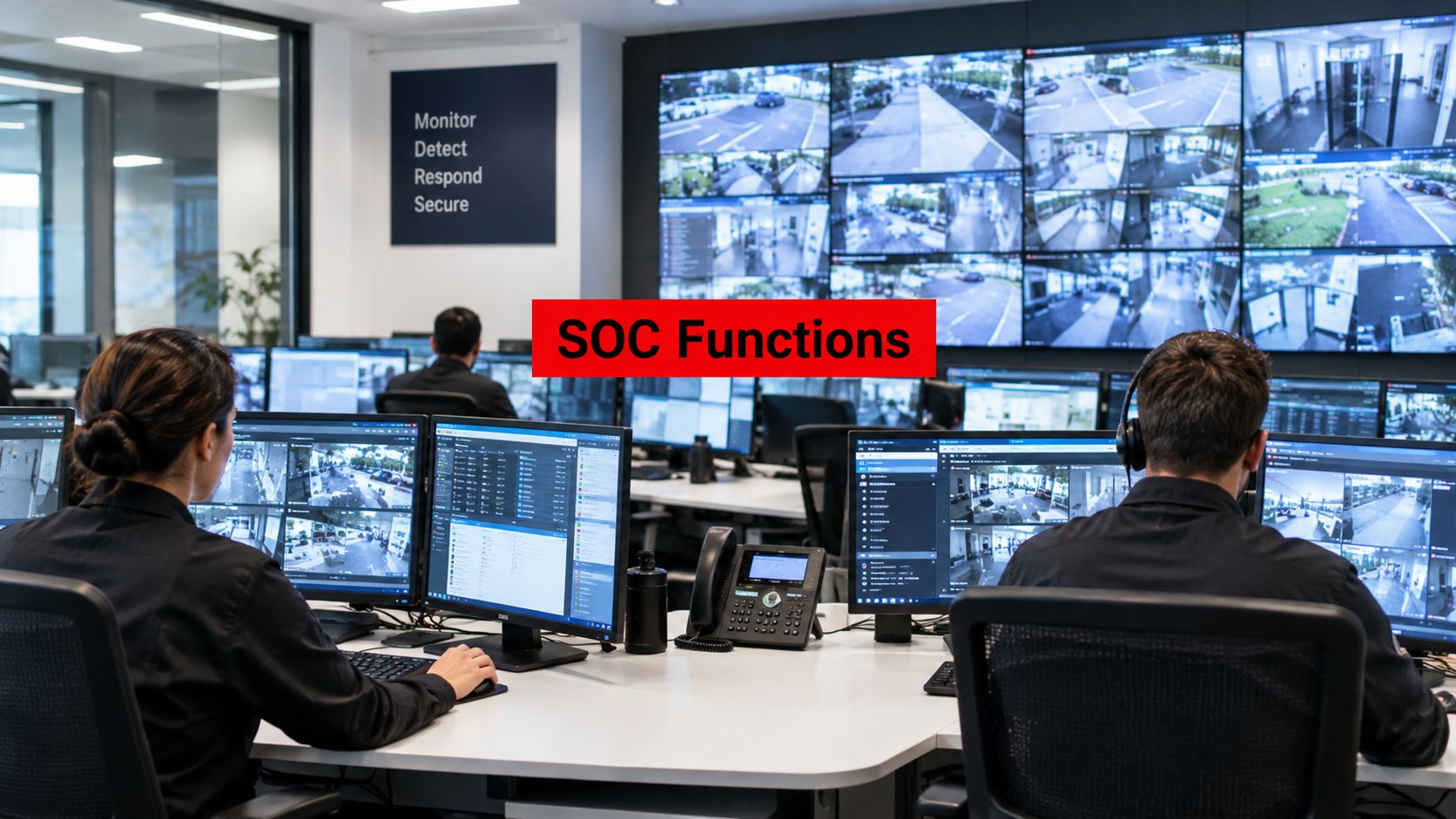
Think of a 24/7 security operations center as the nervous system behind your property security program. Cameras, patrol checkpoints, gate alerts, officer activity, and incident reports all feed into one place. From there, trained personnel decide what needs attention now, what needs verification, and what needs escalation.
A continuously staffed watch model isn't new. The NSA says its National Security Operations Center has operated continuously since February 21, 1973, and personnel have “never left the watch,” which means more than 50 years of uninterrupted 24/7 watch coverage as of 2026 in a mission-critical environment (NSA overview of NSOC's 50 years of 24/7 operations). Property security is obviously a different mission, but the operating lesson is the same. Continuous monitoring works when the process is disciplined.
Here's a visual way to think about it.
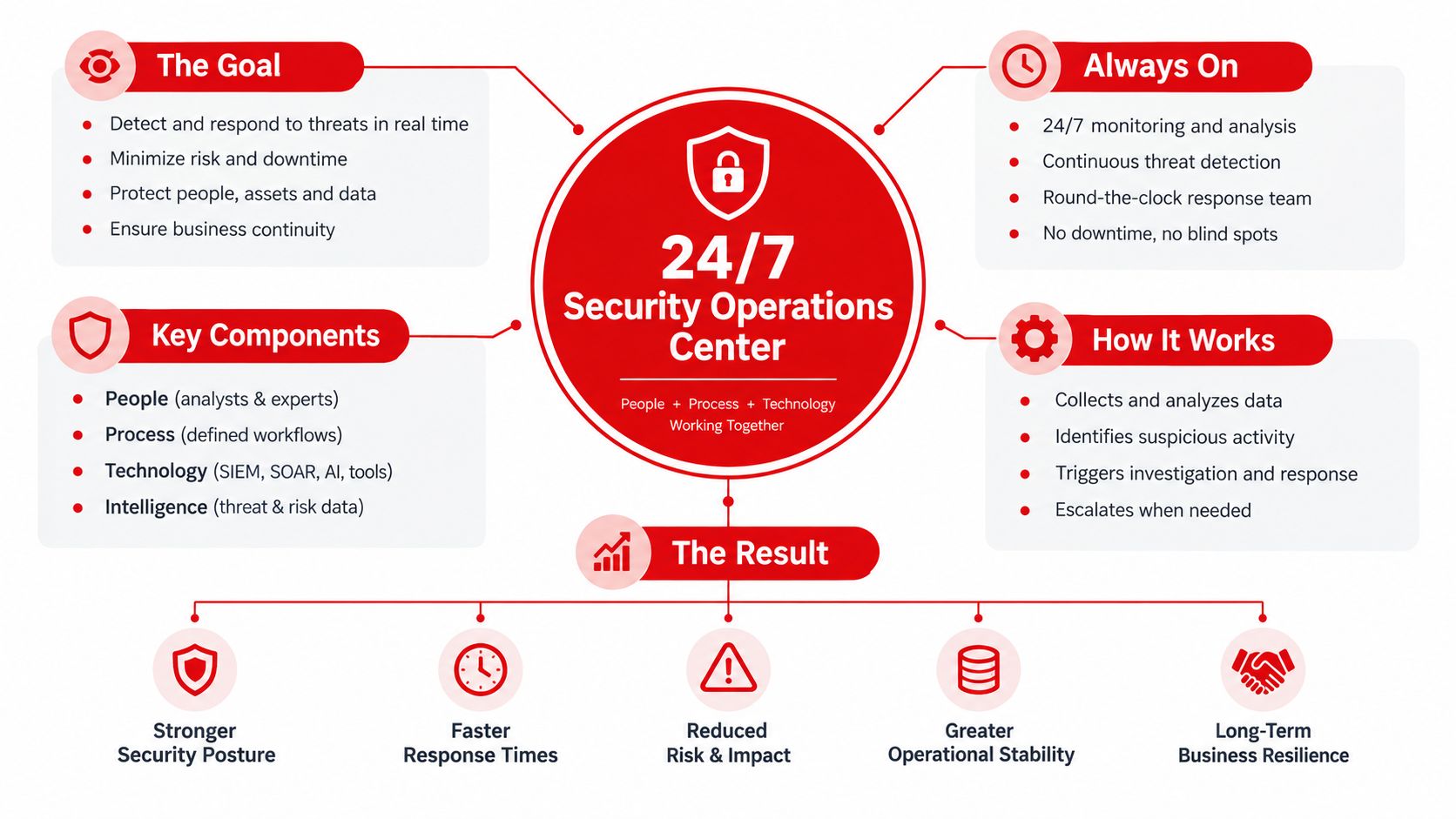
The four functions that matter on a property
A practical SOC for physical security usually performs four jobs.
Real-time monitoring
Someone is actively watching alerts and incoming data instead of relying only on recordings that get reviewed later. That may include cameras, access points, after-hours activity, or missed check-ins.Dispatch coordination
When something needs a physical response, the center directs the right resource. That might be the onsite officer, a mobile patrol unit, a field supervisor, or emergency services.Incident escalation
Not every event belongs in the same lane. A nuisance loitering issue, a forced-entry sign, and a medical event shouldn't all be handled the same way. The SOC applies the site plan and escalation rules.Officer wellness and GPS oversight
A lone officer working a large property needs backup accountability. If check-ins are missed or movement doesn't match expected patrol activity, the center can intervene early.
Why this matters to a property manager
Property managers usually aren't buying a SOC because they want a technology layer. They're buying control. They want fewer blind spots, cleaner communication, and a record that holds up when a tenant, owner, insurer, or attorney asks what happened.
If you want a plain-language breakdown of the operating model, this short primer on what a security operations center is is a useful companion.
A guard gives you presence. A 24/7 security operations center gives that presence structure.
That's the concept. It's not surveillance for its own sake. It's a command function that keeps people, patrols, and information moving in the right order.
Key Benefits of 24/7 SOC Coverage for Property Managers
At the property level, the benefits are practical. Problems get handled faster, field activity is easier to verify, and you have a cleaner record when an owner, tenant, or insurer asks what happened overnight.
Faster handling of incidents with real property risk
A good SOC shortens the time between detection and action. Analysts at UnderDefense found benchmark targets of about 2 minutes for alert triage and under 15 minutes for critical-incident escalation, with automation reducing response times by 60% to 90% in some workflows (security operations benchmark report).
On a property, that speed matters when the issue is physical. A person lingering near a locked amenity space, a vehicle circling a garage level, or a door forced open after hours can all start as small signals. Quick review and escalation help contain the problem before it turns into theft, vandalism, or a resident safety issue.
Better visibility into whether security work actually happened
Property managers should not have to guess whether rounds were completed, whether a call for service was acknowledged, or whether a hazard found at 1:20 AM made it into the report.
With 24/7 SOC coverage, patrol activity, exceptions, and incident notes are logged as the shift unfolds. That creates a working record instead of a next-morning summary. On larger portfolios, that matters because patterns show up sooner. A loading dock with repeat after-hours access issues or a parking area with recurring vehicle break-ins stands out faster when events are reviewed centrally instead of site by site.
Stronger documentation when a decision gets questioned
Security decisions are often judged after the fact. Why was a trespass warning issued? Why was a gate secured early? Why did the officer call law enforcement instead of handling it as a customer-service issue?
The answer needs to be easy to retrieve and easy to defend.
A staffed SOC helps by time-stamping activity, preserving escalation notes, and keeping the incident trail organized while events are still fresh. In practice, that usually leads to better reports and fewer gaps between what the officer saw, what the supervisor knew, and what the property team later communicates to ownership.
Field reality: The report available right away is usually the one that shapes the conversation.
More consistent support for onsite teams and tenants after hours
Overnight coverage is about more than watching feeds. It gives onsite guards, mobile patrol, and after-hours contacts a live point of coordination when the property office is closed.
That support shows up in small but important ways. An officer can get a second set of eyes on suspicious activity. A patrol unit can have an event logged and escalated while still in the field. A property manager can come in the next morning to a documented sequence of events instead of fragmented texts and voicemail.
For tenants, boards, and ownership groups, that consistency builds confidence. They know someone is actively receiving alarms, reviewing camera activity, and tracking incidents through resolution, not just collecting footage for later.
How the SOC Integrates with Onsite Security Services
A 24/7 security operations center doesn't replace onsite security. It makes onsite security more dependable.
That distinction matters because property managers are often sold one side or the other. They hear about the visible value of officers, or they hear about remote monitoring as if technology can do the whole job alone. On real properties, the better approach is layered. You want trained people in the field, and you want a command function behind them.
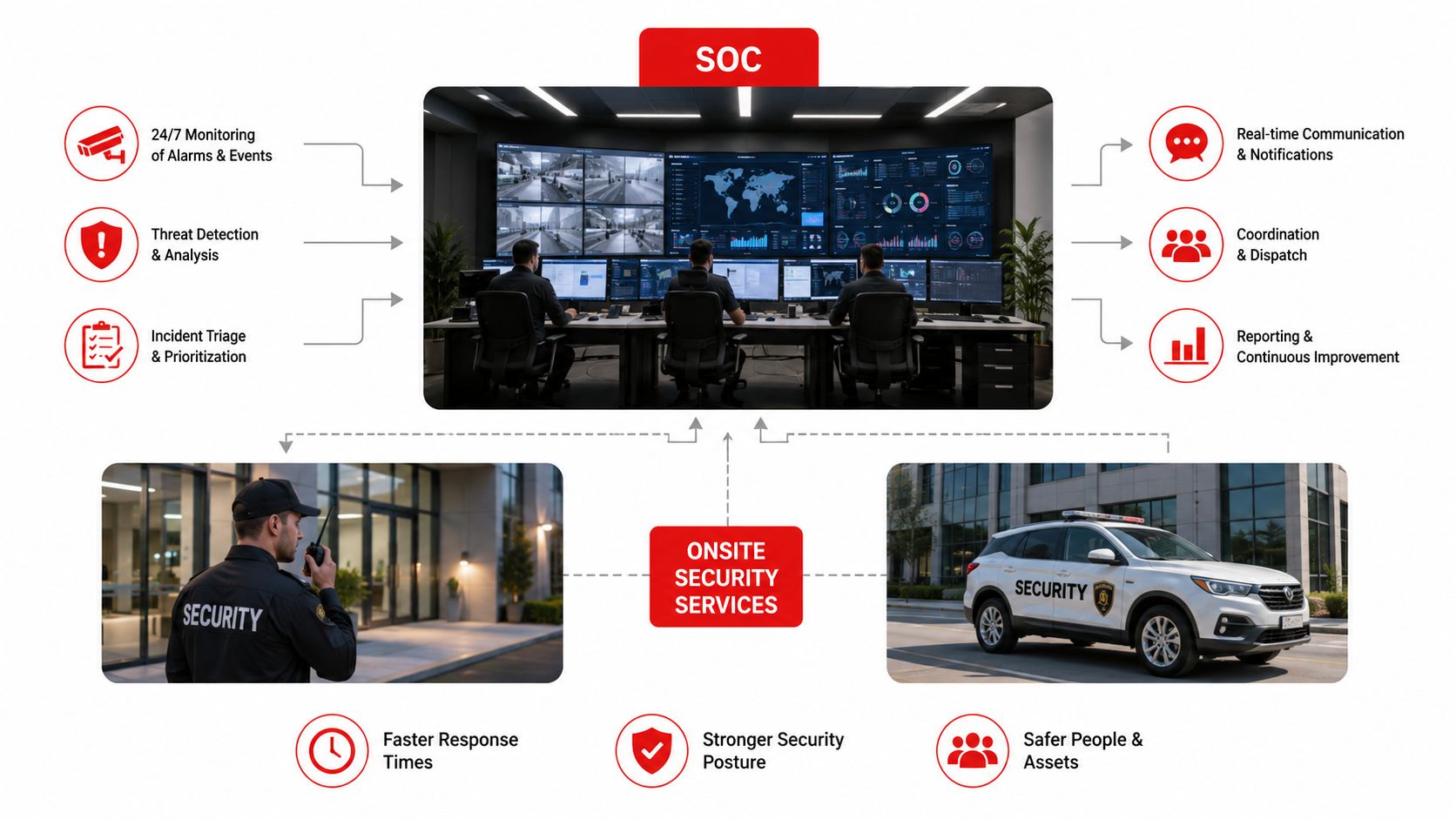
What the data flow looks like on the ground
Guard tour systems are a good example. In physical security operations, guard-tour software commonly uses NFC checkpoint scans with GPS and timestamp capture, and one vendor description notes that each scan can transmit the guard's identity, time, GPS location, and checkpoint data instantly to a client portal (guard tour verification overview).
That matters because a patrol verification isn't just proof that someone touched a checkpoint. It creates a live accountability trail the SOC can review as the shift unfolds.
For example, a field officer completes an exterior round, scans the expected checkpoints, uploads a photo of a damaged gate arm, and adds a note that a delivery entrance didn't latch properly. The operations center sees that sequence in real time, confirms the round was completed, and can flag the gate issue for escalation before it turns into a larger access problem.
Where integration helps most
The strongest results usually come from connecting several layers at once:
- Onsite officers: They provide deterrence, customer contact, and immediate physical response.
- Mobile patrol units: They add backup, coverage depth, and response flexibility across larger footprints.
- Remote surveillance: Analysts can review live footage while the field team is moving.
- Access systems: Gate and door activity adds context that helps separate nuisance events from real incidents.
If you manage gated communities, resources on multifamily gate access control can also help when you're thinking through how resident access events and security response should work together.
What works and what usually doesn't
What works is a shared operating picture. The officer sees what's on the ground. The SOC sees the broader pattern. Property management gets timely communication without needing to chase multiple people for answers.
What doesn't work is stacking tools that don't talk to each other. A camera platform in one place, patrol verification in another, and reporting in a third system often creates delay exactly when speed matters.
For teams that rely on checkpoint accountability, guard tour management is one of the clearest examples of how field activity and SOC oversight can be tied together. Overton Security uses that model as part of its field support approach, with GPS-enabled patrol verification and live reporting feeding into round-the-clock oversight.
KPIs and SLAs to Request from Your SOC Provider
If a provider says they offer 24/7 monitoring, the next question should be, “How do you measure whether it's working?” Property managers don't need jargon here. They need service levels that tie directly to outcomes on the property.
Ask for evidence, not promises
The first trap is confusing coverage with performance. A room can be staffed all night and still produce poor results if alerts sit too long, handoffs are sloppy, or analysts drown in noise.
Alert noise is a real issue in SOC design. One benchmark report cites an industry-average false-alarm rate of 32.5%, rising to 44% at enterprise scale, while mature environments aim for under 10% to 15%, and some tuned deployments target under 5%. The same source notes that tuned environments can improve over the first 60 to 90 days as detection rules and triage logic are refined (false-alarm benchmark discussion).
If a provider can't explain how they reduce false positives, your officers and your managers will end up doing that sorting by hand.
SOC Performance Benchmarks for Property Managers
| Metric | Industry Target | Why It Matters |
|---|---|---|
| Alert-to-triage time | Roughly 2 minutes | Shows how quickly the center acknowledges a live issue before it goes stale |
| Critical incident escalation | Under 15 minutes | Tells you whether serious situations move fast enough to support field response |
| False-positive rate | Mature environments target under 10% to 15% | Lower noise means analysts can focus on the alerts that actually deserve action |
| Rule-tuning period | Improvement often happens in the first 60 to 90 days | Indicates whether the provider actively refines the system after launch |
The SLA questions worth asking
Ask providers to walk you through specifics such as:
- Response commitments: What happens when an alert hits after midnight, and who is contacted first?
- Reporting turnaround: How quickly do you receive incident documentation that's usable by management?
- Handoff discipline: What does the shift-change process look like when an incident is still open?
- Account oversight: Who reviews recurring issues and adjusts post orders when the site pattern changes?
If you want a broader operational framework for measuring field performance, this guide on how to cut costs with OnRoute KPIs is useful because it helps translate service metrics into management decisions.
For buyers, the point isn't to create a spreadsheet for its own sake. It's to separate a provider that merely staffs a console from one that runs a disciplined operation.
Compliance, Privacy, and Cost Considerations
A 24/7 security operations center should make a property feel more controlled, not more intrusive. That starts with clear boundaries around privacy and clean operating rules for how monitoring is used.
Handle privacy like an operating policy, not a footnote
If cameras, access events, guard reports, and patrol logs are feeding into a central command function, clients should know what's being monitored, where records are stored, who can review them, and how incidents are documented. In practical terms, common-area monitoring and officer activity tracking need to fit the property's legal and operational requirements.
For property managers, the useful question isn't “Do we have surveillance?” It's “Do we have a transparent system with a legitimate security purpose and a controlled reporting process?”
A healthy sign is when the provider can show you exactly how reports are generated, how after-hours escalations are documented, and how managers access information without informal side channels.
The cost discussion should include turnover
Hourly rates never tell the whole story. In security, service quality often breaks down because the people on the site keep changing.
A 2026 Berkeley Labor Center report found annual turnover in U.S. security services reached 88.6% in 2024, compared with 66.0% for the private sector overall (Berkeley Labor Center workforce report). Separately, Trackforce's 2025 Physical Security Operations Benchmark Report says more than 40% of firms identified turnover as their biggest challenge (Trackforce benchmark report announcement).
Those numbers explain a lot of what property managers experience on the ground. New officers need site orientation. New supervisors need time to learn the account. Small misses become more common when the team keeps resetting.
A more practical way to evaluate value
When you review proposals, look beyond line-item staffing.
- Officer stability: Ask how the provider supports retention and whether the account sees frequent staffing churn.
- Shift handoffs: Ask how open issues transfer from one watch to the next without losing context.
- Documentation quality: Review actual incident and patrol reports, not sample marketing screenshots.
- Management attention: A low manager-to-client ratio usually matters more than polished sales language.
Night coverage fails quietly first. You see it in weak handoffs, incomplete reports, and unresolved recurring issues before you see it in a major incident.
That's why sustainable operations matter. A 24/7 model only works when the people behind it can maintain consistency at 2 PM, 2 AM, weekends, and holidays.
Frequently Asked Questions About 24/7 Security Operations Centers
Does a 24/7 security operations center replace onsite guards
No. It strengthens them.
An onsite officer handles presence, patrols, tenant interaction, and immediate physical response. The SOC adds coordination, escalation, wellness oversight, and live documentation. In practice, that means the officer isn't working alone from an information standpoint, even if they're physically the only person on site.
How do I know the SOC is actually helping instead of just generating more alerts
Ask how the provider measures triage speed, false positives, escalation quality, and after-hours reporting. That question matters because alert volume by itself doesn't mean much. One industry summary reported average alert loads near 4,484 per day with 83% false positives, while another source cited 2,992 alerts per day with 63% unaddressed, which is exactly why outcome-based metrics matter more than raw volume (industry summary discussing alert fatigue and SOC metrics).
If the answer you get is mostly “we watch everything,” keep asking. A useful SOC should be able to show how it sorts noise from real issues and how it keeps after-hours performance from slipping.
What should I worry about most with a smaller provider
Sustainability.
Recent industry coverage says 24/7 SOCs are reaching a breaking point because alert volume, cloud sprawl, and AI-driven attacks are outpacing human capacity. The same discussion points to burnout, turnover, manual reporting, and retention as major concerns, which helps explain why some teams are technically 24/7 but still fragile in practice (Deepwatch discussion of 24×7 SOC sustainability and burnout).
For a property manager, that translates into simple due diligence. Ask about staffing depth, handoffs, reporting discipline, and what happens on nights, weekends, and holidays when the unexpected hits.
If you're evaluating how to tighten after-hours coverage, improve patrol accountability, or connect remote monitoring with onsite guard services, Overton Security offers California property managers a 24/7 SOC-supported model with GPS-enabled patrol visibility, live reporting, and field escalation support. It's a practical fit for commercial properties, residential communities, retail centers, and construction sites that need more than basic guard coverage.