
You're reviewing overnight incident logs and seeing the same pattern: a vacant suite has been entered repeatedly, the rear access point keeps showing signs of tampering, and the leasing team wants a visible deterrent in place before morning. The natural question is whether an armed security patrol will solve the problem.
Sometimes it's the right answer. Sometimes an unarmed mobile patrol, better lighting, monitored cameras, access control, or a fixed post will reduce the risk more effectively and with less liability. The decision should begin with the property's threat profile, not with the assumption that a firearm automatically creates better security.
What an Armed Security Patrol Actually Is
An armed security patrol is a licensed security officer authorized to carry a firearm while performing protective duties on a defined property or route. Unlike a guard who remains at one entrance, a patrol officer moves through the site according to written post orders and a planned schedule.
The officer may check exterior doors, walk interior common areas, inspect parking structures, observe loading zones, verify that restricted areas remain secure, and respond to alarms or reported disturbances. The work combines visibility, observation, documentation, and incident response. The firearm is one part of that capability. It isn't the officer's entire job.
Where patrol fits into a security plan
Property managers often compare patrol with the wrong alternatives. An armed patrol isn't the same service as event security, which is usually organized around crowd movement and venue rules. It also differs from executive protection, where the officer's primary responsibility follows a specific person. A patrol program protects a property, route, or group of locations through repeated checks and mobile coverage.
A complete protection plan may combine:
- Access control: Managing who enters buildings, gates, restricted rooms, or parking areas.
- CCTV and remote monitoring: Reviewing camera activity and escalating verified concerns.
- Alarm response: Sending an officer to investigate an alarm or suspicious activation.
- Unarmed mobile patrols: Creating visible presence and documenting conditions without adding firearm-related exposure.
- Stationary coverage: Keeping an officer at a gate, lobby, reception point, or other critical location.
The operational question is simple: What must the officer accomplish during the shift? If the priority is discouraging trespass and documenting property conditions, an unarmed patrol may be sufficient. If the site faces a credible risk of armed confrontation and a trained officer may need to respond before law enforcement arrives, armed coverage may deserve consideration.
Practical rule: The weapon should support a documented response plan. It shouldn't substitute for one.
An effective patrol begins with site knowledge. The officer needs to understand access points, vulnerable areas, tenant activity, emergency contacts, lighting conditions, alarm procedures, and the point at which the situation must be transferred to law enforcement. That structure keeps the service professional and prevents the patrol from becoming an undefined drive around the property.
Armed vs Unarmed Patrols and Stationary Guards
The three common models solve different problems. An armed patrol offers the broadest response capability, an unarmed patrol often provides efficient visibility and reporting, and a stationary guard concentrates attention at one location.
| Factor | Armed Patrol | Unarmed Patrol | Stationary Guard |
|---|---|---|---|
| Cost position | Usually the highest of the three because of firearm-related qualification, training, insurance, and operational requirements | Usually lower than armed coverage | Varies by duties, schedule, and required qualifications |
| Liability exposure | Higher, especially around negligent hiring, weapon handling, and use-of-force decisions | Lower firearm-related exposure, though general security liability remains | Depends on post duties, supervision, and response expectations |
| Visibility | Strong deterrent while moving through multiple areas | Visible presence across a route without a firearm | Maximum presence at one post |
| Perimeter coverage | Can check several access points and zones | Can check several access points and zones | Limited outside the assigned location |
| Response capability | Adds a trained armed response option within legal and policy limits | Can observe, report, de-escalate, and request emergency support | Can respond immediately at the post, but may leave other areas uncovered |
| Best fit | Credible risk of serious violence, high-value assets, or a threat that may require armed response | Trespass, vandalism, routine access concerns, and broad deterrence | Gate control, lobby management, visitor screening, or a critical entrance |
A stationary guard can be the right choice when the main weakness is a single entrance or lobby. That officer can verify credentials, greet tenants, control deliveries, and notice activity that a passing vehicle might miss. The tradeoff is coverage. A guard at the front entrance can't simultaneously inspect a rear alley, detached structure, or remote parking area.
An unarmed patrol expands the officer's reach. Scheduled or variable visits can cover multiple buildings, check doors and gates, and produce a record of conditions. For many commercial properties, residential communities, and construction sites, that visibility addresses the primary problem without introducing a firearm into routine disputes. Property managers evaluating this option can review why unarmed security guards are a smart security choice before assuming armed coverage is necessary.
The liability tradeoff
Armed service also changes the buyer's responsibilities. The client must evaluate hiring standards, training records, insurance, weapon qualification, supervision, incident reporting, and post orders. A firearm may provide an option during an extreme threat, but it also increases the consequences of poor judgment, unclear authority, weak documentation, or inadequate oversight.
The right answer is driven by threat profile, asset value, location, operating hours, and recovery cost. “Armed feels safer” isn't a sufficient decision standard. The better question is whether the additional response capability justifies the added cost and liability for this property.
California Licensing and Training Requirements
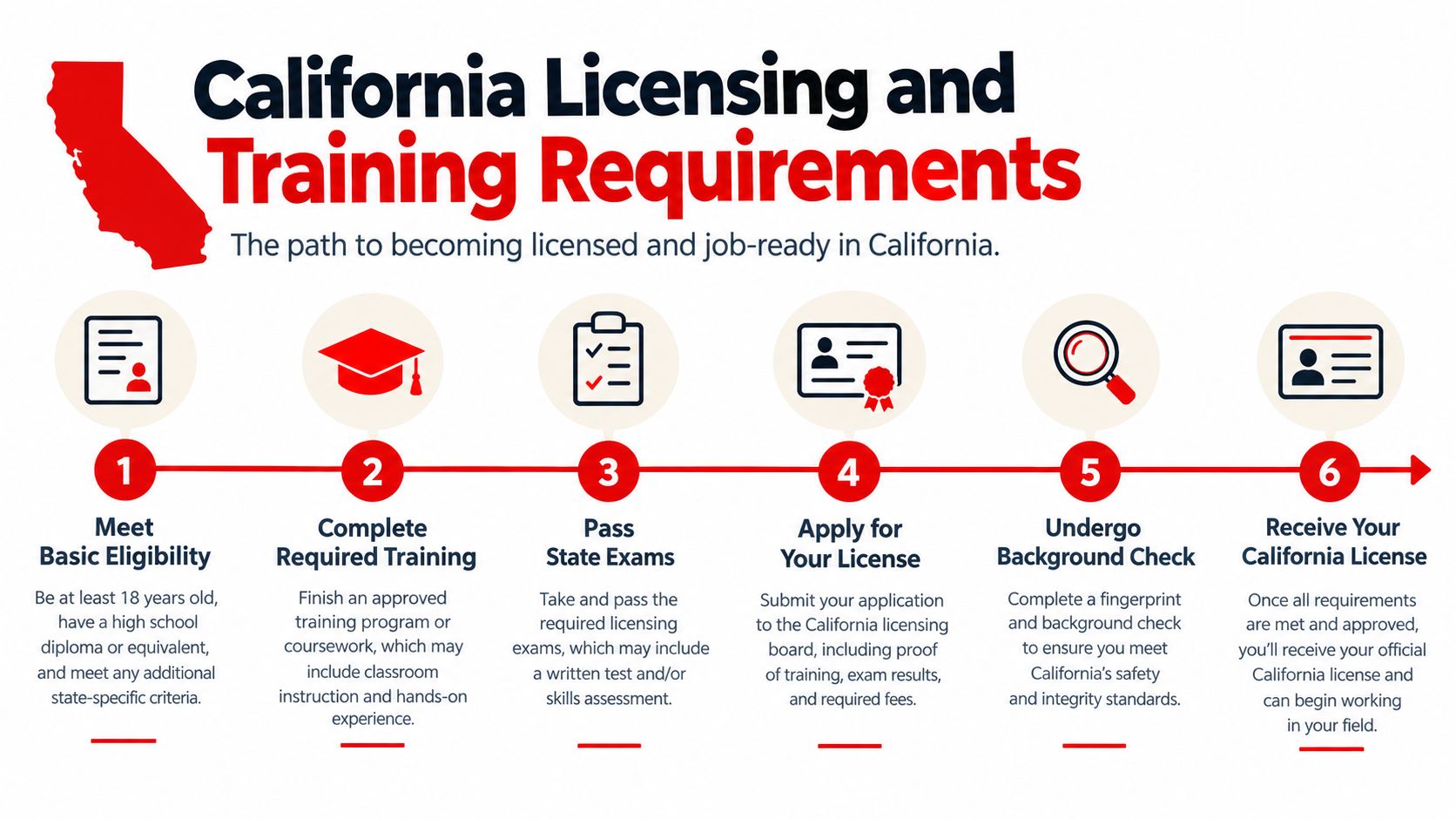
California property managers should ask for more than proof that an officer is carrying lawfully. The California Bureau of Security and Investigative Services, or BSIS, establishes specific training and firearms requirements that help a buyer trace an officer's qualifications.
The basic sequence
A newly licensed or employed guard must complete two mandatory training courses within 30 days of the registration card being issued or the guard starting work, according to California BSIS training requirements. BSIS describes a full basic training sequence totaling 40 hours, including 8 hours of power to arrest training, 8 hours of firearms or baton safety and elective content as applicable, and 32 hours of security officer skills training. Guards also complete 8 hours of annual continuing training under the same guidance.
An armed assignment adds another layer. Before carrying a firearm on duty, the officer needs an exposed firearms permit. The process includes:
- Approved instruction: The officer completes a Bureau-approved firearms training course.
- Written examination: The application materials specify a passing score of 86% or greater.
- Range qualification: The officer qualifies with the caliber of weapon they'll carry while on duty.
- Timing: The range qualification occurs after classroom training and after the written exam, with completion within 30 days of classroom instruction.
The BSIS firearms permit manual explains the permit process, while the initial firearms qualification materials identify the written and range requirements.
What the buyer should verify
BSIS requirements are the floor, not the complete operating standard. A responsible provider should also explain its use-of-force policy, de-escalation expectations, scenario-based judgment training, reporting process, supervisor structure, and method for verifying current permits and qualifications.
Before signing, request documentation showing:
- Guard registration: Confirm the officer is properly registered.
- Firearms permit: Verify that the permit applies to the assignment.
- Training records: Review required coursework and continuing training.
- Qualification status: Confirm that firearms qualification remains current.
- Insurance and supervision: Ask how the provider manages coverage, audits, and incident review.
For a broader overview of the first licensing steps, property managers can review security guard licensing in California. The goal isn't to turn a property manager into a licensing specialist. It's to make sure the person assigned to the site has traceable qualifications and that the company can produce records when asked.
When Armed Patrols Are the Right Fit
A useful decision becomes clearer when you apply it to actual properties. The same patrol model shouldn't automatically be assigned to a retail center, a construction site, and a residential community.
Four common property scenarios
A Class A retail center sits along a busy corridor and has experienced repeat smash-and-grab incidents involving organized groups willing to confront security personnel. An armed vehicle patrol may be appropriate here if the property's risk assessment supports it, particularly during vulnerable operating periods. The patrol should still emphasize observation, communications, safe positioning, and rapid law enforcement notification rather than treating the officer as a substitute for police.
A residential construction site is in an active build phase. Tools, materials, and equipment attract trespass and theft, but the primary concern is property loss rather than a credible armed threat. An unarmed vehicle sweep combined with monitored cameras may handle the exposure without introducing a firearm around workers, residents, and passersby.
A luxury residential community has executive residents, controlled access, and a need to preserve a calm tenant experience. A layered model may fit: uniformed unarmed officers at the gate for access control and resident service, with armed roving patrol at night if the threat assessment supports that added response capability.
A corporate campus houses sensitive intellectual property and high-value research and development assets. Armed coverage may be justified when the consequences of intrusion, theft, or violent disruption are severe enough to support the added liability and operating requirements.
| Property Type | Recommended Posture | Primary Risk Driver |
|---|---|---|
| Class A retail center | Armed vehicle patrol may fit, supported by access control and cameras | Repeat organized theft and confrontation risk |
| Residential construction site | Unarmed vehicle patrol with monitored cameras | Trespass, theft, vandalism, and equipment exposure |
| Luxury residential community | Layered unarmed gate coverage with possible armed night patrol | Resident safety, controlled access, and after-hours threat profile |
| Corporate research campus | Armed or layered coverage after a formal assessment | Sensitive information, valuable assets, and recovery consequences |
The summary is straightforward. Retail and research environments may justify armed patrol when the threat and asset value support it. Construction sites often benefit more from layered detection and unarmed presence. Luxury residential properties usually need a careful balance between protection and a welcoming atmosphere.
“Choose the response you can govern, document, and explain to your tenants, employees, board, and insurer.”
Benefits and Limitations You Should Weigh
Armed patrol has a legitimate operational purpose, but it isn't automatically a superior security program. The strongest case for it appears when a property faces a credible risk of serious violence, when organized offenders may confront guards, or when the cost of losing an asset or interrupting operations is especially high.
What armed coverage can add
An armed officer can create a stronger deterrent against offenders who may not be discouraged by an unarmed presence. The officer also brings a response option that an unarmed guard doesn't have when a serious armed threat develops. That doesn't mean the officer should pursue suspects or act beyond the assignment. It means the property has a trained professional prepared to respond within law, policy, and post orders.
California law also includes a specific home-protection provision under Penal Code 198.5. Property managers should have counsel explain how that provision applies to a particular incident, because a statutory rule about a residence isn't a blanket grant of authority for private security on every commercial or residential property.
The broader research lesson is just as important as the weapon decision. A randomized field experiment involving private security agents in public transit stations recorded 41% more patrol visits and 29% more patrol minutes at treatment stations than at control stations. Over six months, the treatment program totaled 17,632 patrol minutes and 4,249 patrol visits, and the added presence corresponded with a 16% reduction in victim-generated crimes across station complexes and a 49% increase in police-generated detections at target locations. The published experiment shows that patrol intensity can influence both exposure to crime and enforcement activity.
What armed coverage can complicate
The additional capability carries additional responsibility. Firearms training, qualification, insurance, supervision, and incident review can make armed service significantly more expensive than an unarmed alternative. A discharge can also create serious legal, financial, operational, and reputational consequences, even when the officer believed the response was justified.
Visible firearms may increase tension during civil disputes, tenant complaints, access disagreements, or routine enforcement encounters. If the site's everyday incidents are mostly verbal conflicts, trespass, or customer-service issues, an armed presence may escalate the feel of the property without addressing the underlying weakness.
Research on preventive patrol also cautions against treating presence as a magic solution. The landmark 1995 randomized trial on preventive patrol in crime hotspots found a moderate deterrent effect from substantial patrol increases. A later systematic review and meta-analysis reported a 6% overall crime reduction associated with preventive patrol and a 9% decline in randomized experimental evaluations, as summarized in the Sherman and Weisburd research materials. The practical lesson is that concentration, timing, and dosage matter more than placing an officer on the property.
How a Modern Armed Patrol Program Is Run
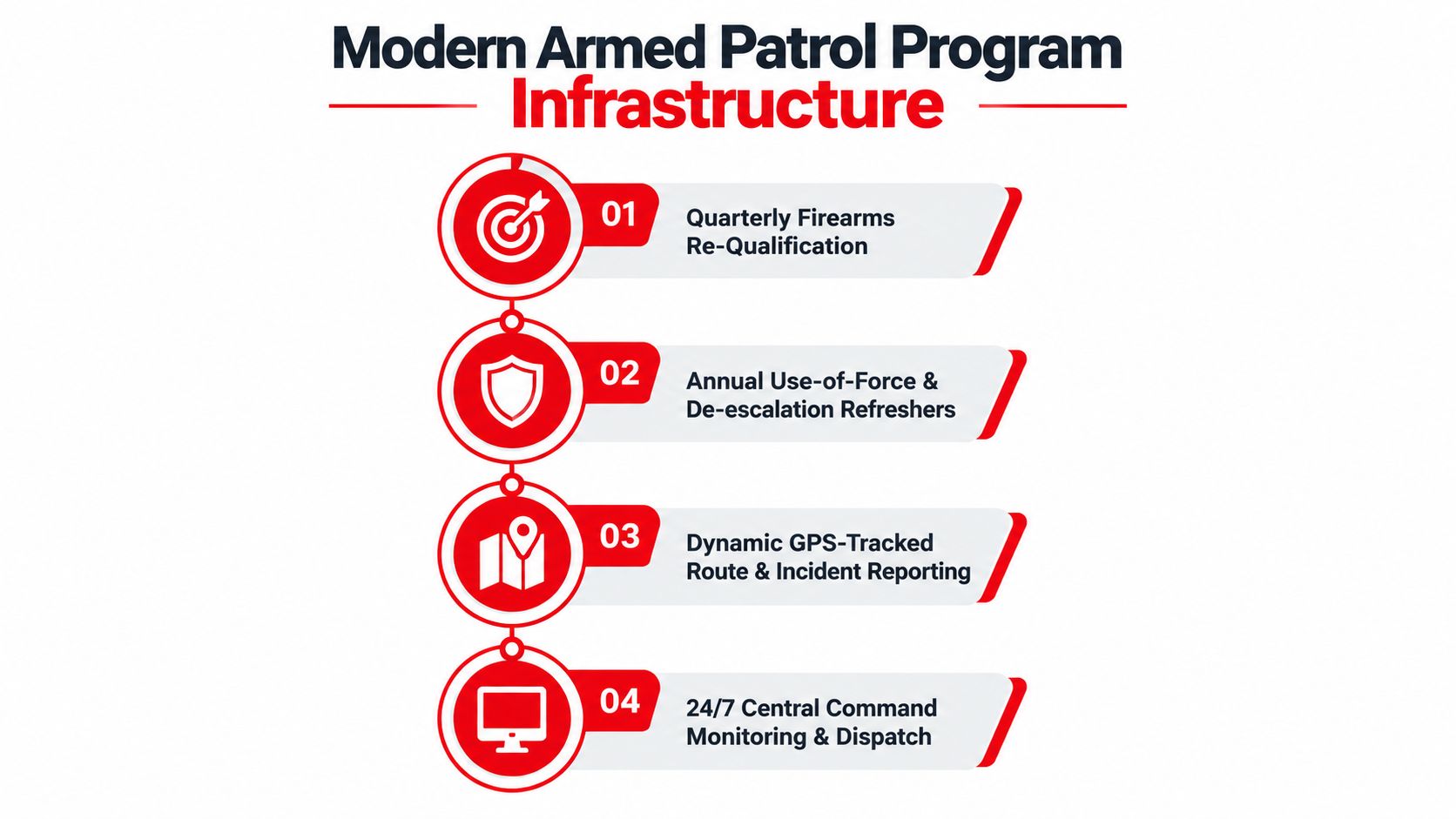
A professional armed patrol program is a managed system. The officer, firearm, vehicle, radio, route, supervisor, reporting platform, and security operations center must work together.
Training and supervision
Federal best-practice guidance for armed contract security officers recommends a minimum of 64 hours of training, with 80% practical application across defensive tactics, handcuffing, non-lethal weapons, firearms, and use-of-force topics. It also recommends semi-annual weapons qualification, with a recommended minimum score of 80% on the course of fire. The federal guidance for armed security officers states that force must be reasonable and necessary, with deadly force limited to situations involving a risk of death or serious bodily injury.
A sound program adds regular firearms re-qualification, use-of-force and de-escalation refreshers, and scenario drills based on the types of incidents the property may face. Field supervisors should conduct ride-alongs, audit tour compliance, review reports, and examine body-worn camera footage when that equipment is part of the assignment.
Technology and command support
GPS-enabled tour management verifies that officers reached required checkpoints. Each scan can establish when a checkpoint was visited, while digital daily activity reports, photographs, and incident records give the client a clearer operating picture.
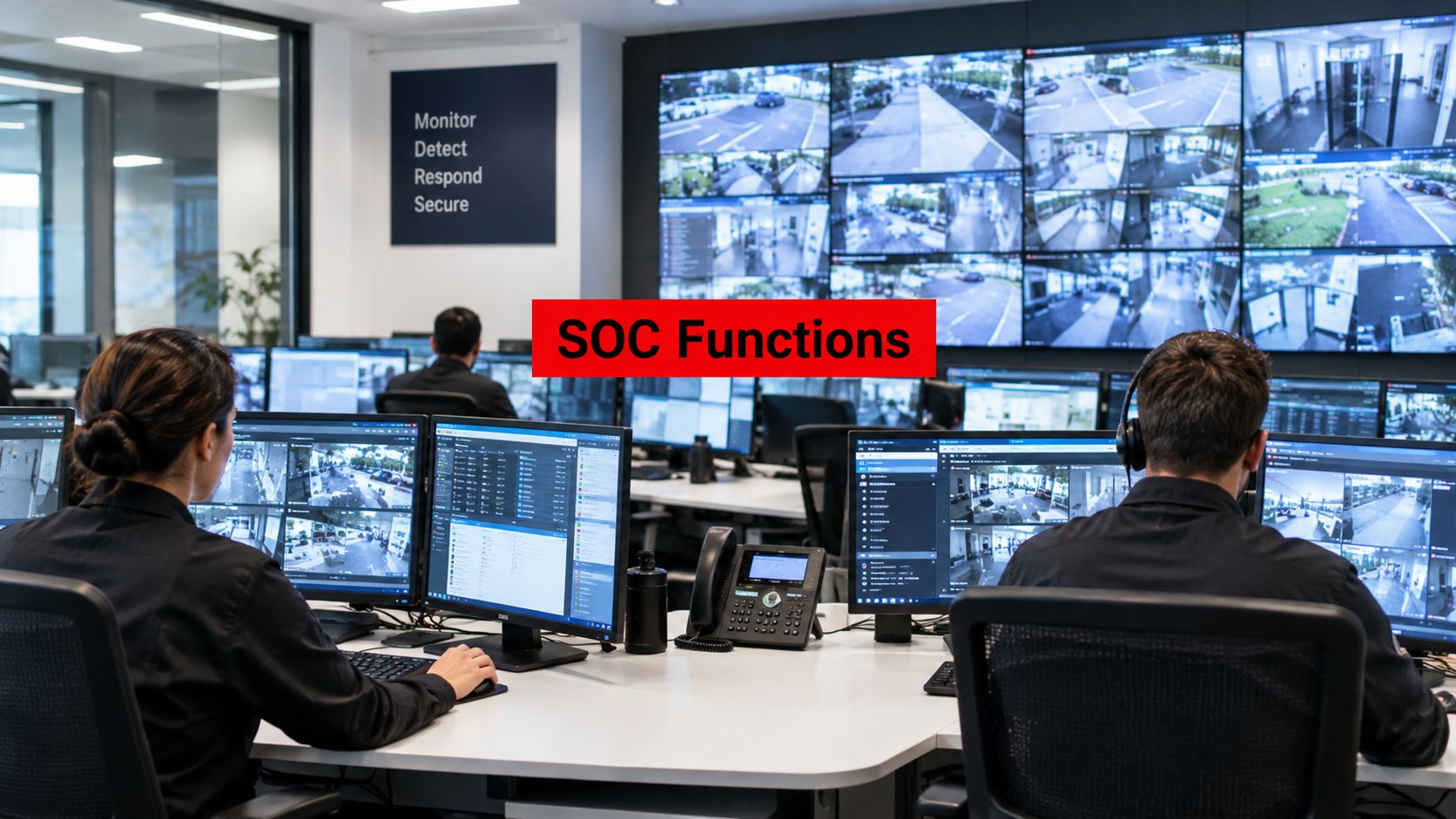
A 24/7 security operations center can monitor alerts, perform wellness checks, dispatch backup, and coordinate with law enforcement. That support matters because an officer shouldn't have to manage a serious event, communicate with the client, preserve evidence, and request assistance without a structured command channel.
Operational test: If the client can't see where patrols occurred, what officers found, and how supervisors reviewed the work, the program has an accountability gap.
Post orders connect everything. They should identify access points, priority zones, checkpoint requirements, emergency contacts, communication channels, escalation thresholds, alarm procedures, and rules of engagement. The firearm remains one tool inside that framework.
For property managers comparing patrol structures, this guide to modern security patrol services provides useful context on how mobile coverage, reporting, and technology can fit together.
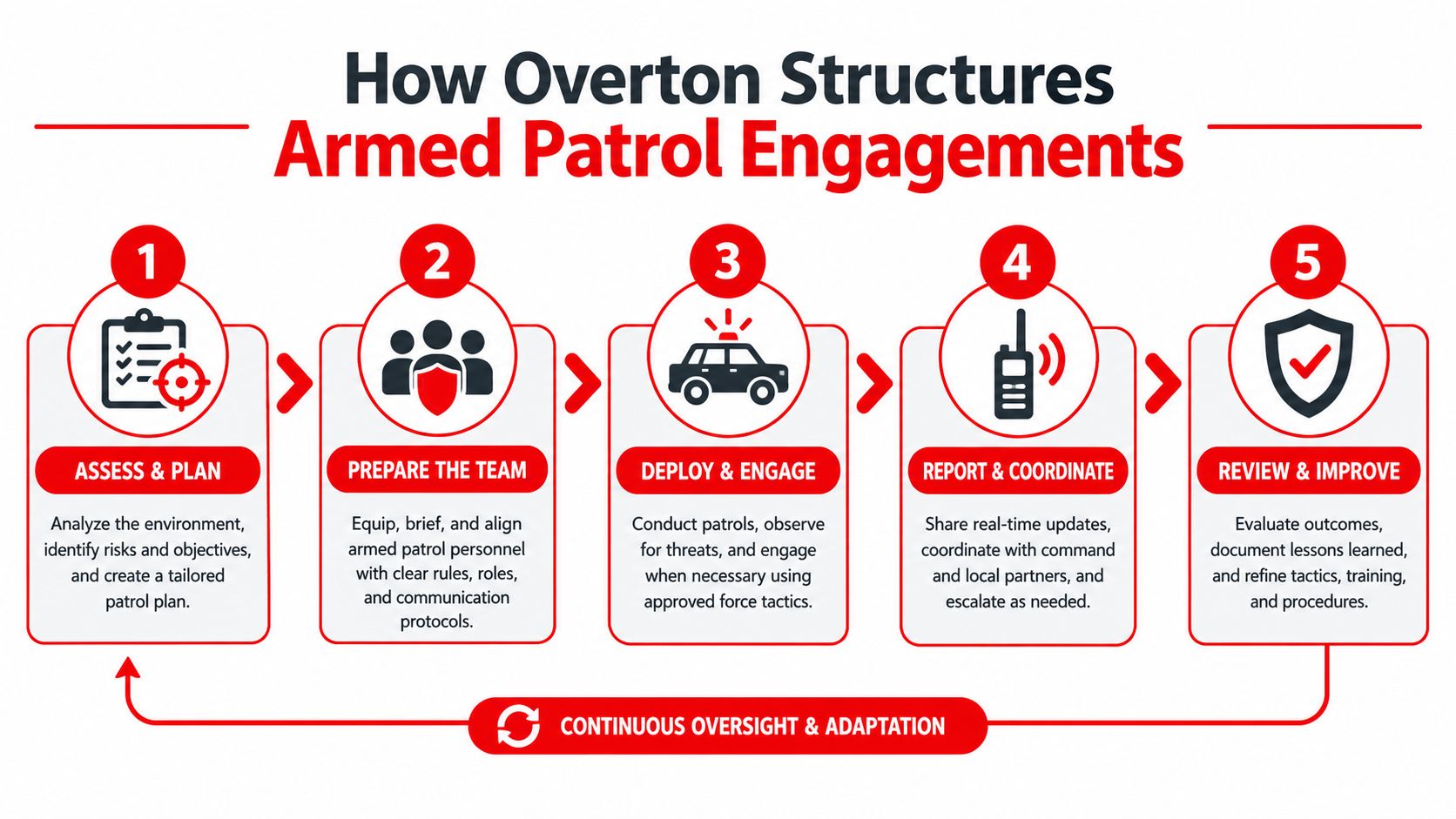
How Overton Structures Armed Patrol Engagements
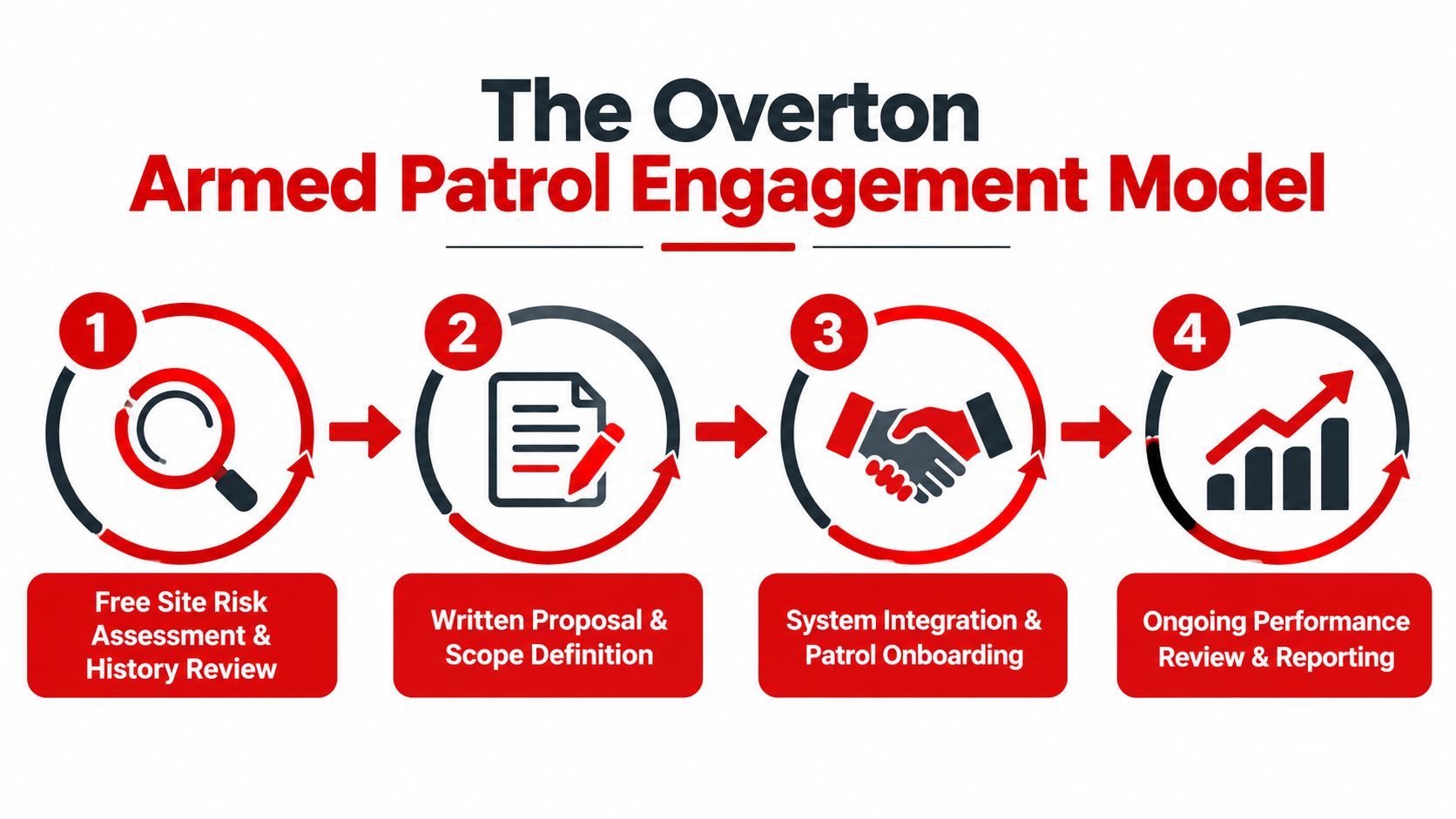
The engagement should begin with the property, not with a preselected number of officers or hours. Overton Security uses a practical sequence that gives the client a chance to evaluate the scope before deployment.
Start with the site
The first step is a free site risk assessment and history review. The assessment considers the property layout, incident history, access points, operating hours, vulnerable areas, tenant activity, existing cameras, alarm procedures, and the likely consequences of a security failure.
The next step is a written proposal. It should define the patrol hours, vehicle or foot route, priority checkpoints, response expectations, communication process, and reporting deliverables. A clear scope helps the property manager compare armed, unarmed, stationary, and layered alternatives on the same operational terms.
Turn the assessment into field instructions
Post orders name the actual checkpoints and escalation contacts. They explain what the officer should inspect, what requires documentation, when to contact a supervisor, when to call emergency services, and how to protect people while maintaining distance and control.
Before the first shift, each officer receives a site-specific handoff document. That material should cover the property map, access procedures, tenant or resident concerns, alarm contacts, restricted areas, emergency routes, and reporting standards. A supervisor ride-along during the first week helps confirm that the written plan matches the physical site.
Review performance after deployment
Deployment is the beginning of measurement, not the end of planning. A 30-day review gives the client and operations team an opportunity to assess route coverage, incident patterns, response coordination, staffing fit, and changes needed in the post orders.
The client's monthly activity report should show patrol times, incidents, observations, and recommendations. Overton's operating model includes GPS-enabled patrols, detailed digital reports, and 24/7 SOC oversight, along with hands-on management and attention to officer support and retention. Those tools are useful only when the provider uses the information to correct gaps, coach officers, and adjust the program.
If you're managing a commercial property, retail center, residential community, construction site, or multi-site portfolio in California, request a site walk-through and ask for a sample post-order template. Overton Security can discuss armed officers, unarmed guards, vehicle patrol, remote monitoring, and a layered plan built around the risks your property faces.