
A late-night alarm comes in at a mixed-use property. The lobby officer reaches the door first. A delivery driver is upset, a resident is filming, and the property manager is getting texts before anyone has a clear picture of what happened.
In that moment, the difference usually isn't the uniform. It's the training behind the response.
Property managers, HOA boards, retail operators, and construction teams rarely ask for training because they enjoy compliance paperwork. They ask for it because they want calmer interactions, better documentation, fewer avoidable mistakes, and officers who can follow post orders without creating a new problem on site. That's what strong private security officer training is supposed to produce.
Why Private Security Officer Training Matters on Your Property
In residential communities, training shows up at the front desk. An officer has to decide whether a guest gets access, how to respond when a resident is frustrated, and when to call a supervisor instead of escalating a routine issue.
In retail, it shows up in the aisle or parking lot. An officer may need to address suspicious behavior, support store staff, and keep the interaction professional in front of customers. At a construction site, the same issue looks different. A gate is unsecured, a subcontractor arrives after hours, or someone enters an area they shouldn't. The officer's job is to act early, document clearly, and protect the site without overstepping legal limits.
Training affects outcomes you actually care about
For busy property teams, a strong training program usually supports four practical goals:
- More consistent judgment: Officers respond in a way that fits the situation, not just their personal instincts.
- Better tenant and visitor experience: People feel helped, not challenged, during normal interactions.
- Cleaner incident records: Reports are usable when management, ownership, or law enforcement needs to review them.
- Lower operational friction: Supervisors spend less time correcting avoidable mistakes after the fact.
Practical rule: If an officer works independently on your property, their training has to support independent decisions, not just badge eligibility.
That's why private security officer training shouldn't be treated as a one-time license checkbox. It's closer to a readiness system. The licensing piece matters, but so do scenario practice, post orders, refresher training, and verification that the officer assigned to your site can perform the assignment.
A quality-focused provider looks at training this way because the property manager's win is simple. You want fewer surprises, more professionalism, and a response that holds up after review. That's been a core part of Overton Security's approach through 26 years of service in California, with an emphasis on consistency, hands-on leadership, and officers who are prepared for the site they're standing on.
What Private Security Officer Training Covers at Its Core
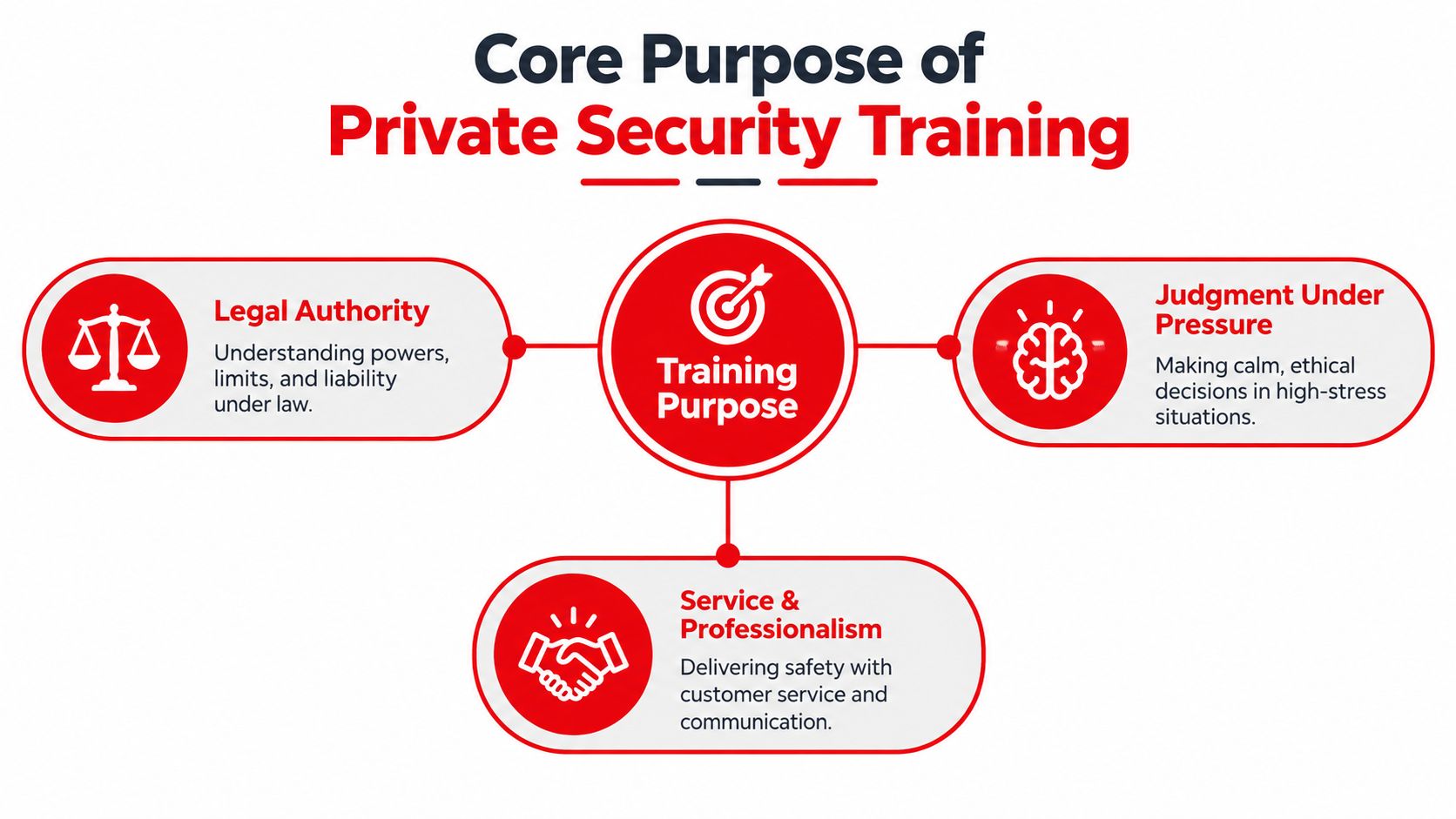
Private security officer training does three jobs at once. It teaches what an officer is legally allowed to do, how to make decisions under pressure, and how to represent the property professionally while doing it.
That combination matters because an officer isn't only there to observe. They're often the first person to answer a question, approach a concern, handle an access issue, or stabilize a situation until management, emergency responders, or law enforcement arrives. If the training covers only licensing basics, the property still carries risk.
The three pillars that matter most
A useful way to think about private security officer training is as a three-part system:
Legal authority
Officers need to understand powers, limits, reporting duties, and liability. Many managers assume “common sense” is enough. It usually isn't.Judgment under pressure
An officer has to assess what's happening, choose a proportional response, and avoid making a tense interaction worse.Service and professionalism
Security is part safety function and part people-facing role. Tone, communication, appearance, and follow-through all affect how tenants, shoppers, residents, and contractors experience the property.
Why California is a useful benchmark
California treats training as an ongoing obligation, not a one-and-done class. That's one reason many operators use the state's framework as a practical benchmark when they manage properties across Los Angeles, San Diego, San Francisco, or other large markets.
Nationally, the picture is much less uniform. A state-by-state review found the median regulatory training requirement for unarmed security is 24 hours nationwide, while armed security typically faces 32 to 40 hours. The same review found 27 states, or about 55%, specify a minimum number of training hours for unarmed guards. It also noted a wide range, from 4 hours to 48 hours of initial training for unarmed guards, with an average of about 20 hours and a median of 16 in the cited review (state training review PDF).
That variation is exactly why multi-site portfolios get confused. One market may expect formal staged training. Another may rely more heavily on employer practices.
A consistent portfolio standard often matters more than the local minimum, especially when your teams move between residential, retail, and office environments.
If your broader safety plan also includes cameras and resident-facing privacy concerns, a practical companion topic is privacy-compliant home security install. It helps frame how physical security decisions and occupant expectations need to work together.
California Licensing and Certification Requirements Explained
A property manager approves overnight coverage for a mixed-use site, then learns the assigned officer has a valid guard card but is still inside the state's early training window. That gap matters. On a residential property, it can affect how a trespass call is handled at 2 a.m. In a retail center, it can change how an officer responds to a shoplifting detention issue. On a construction site, it can shape whether a perimeter problem is documented correctly or turned into an avoidable confrontation.
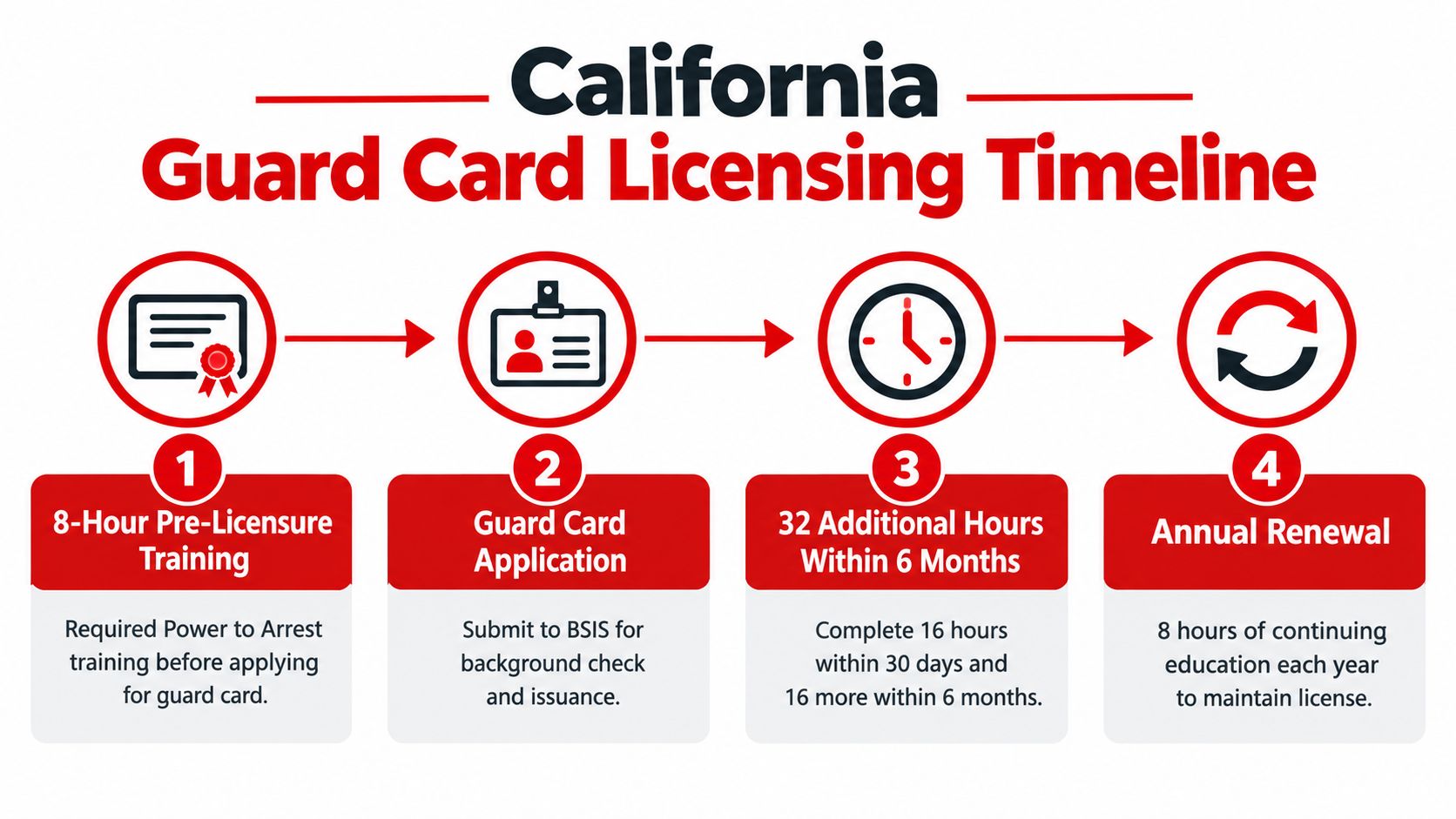
California built its licensing system to reduce that kind of inconsistency. The state uses staged training, not a one-time class, so readiness develops in steps and can be checked in steps. For a registered security guard, BSIS requires 8 hours of pre-licensure training, then 32 additional hours of skills training within the first six months, with 16 of those hours completed within 30 days if they were not already included before registration. Guards also complete 8 hours of continuing training each year, including at least 2 hours on appropriate use of force (California guard training requirements).
What the timeline means in practice
For busy site teams, the easiest way to read this system is as a readiness ladder. A guard card shows the officer has entered the regulated path. It does not automatically show that every assigned skill block is finished.
That distinction matters during scheduling.
If you manage an apartment community, for example, an officer may be cleared for assignment while still completing part of the first-month or first-six-month training sequence. A retail manager may assume the same card covers de-escalation expectations for customer incidents. A construction superintendent may assume it covers site-specific reporting habits. California's staged structure is designed to prevent those assumptions from going unchecked.
Here is the practical timeline managers should verify:
- Before or at registration: The officer completes the required foundation training.
- Within 30 days: Early required courses must be completed if they were not already finished before registration.
- Within 6 months: The remaining state-required skills training is completed.
- Each year after that: Continuing training keeps knowledge current, including use-of-force review.
For a practical breakdown of forms, timing, and guard card documentation, this California security guard licensing guide can help clarify the administrative side.
Why California puts key topics up front
The state places legal authority and force standards at the front of the process for a reason. BSIS requires Power to Arrest training before registration, and the bureau's training materials also identify Appropriate Use of Force as a required early topic in the overall guard training sequence (BSIS Power to Arrest and training materials).
That order works like teaching braking and steering before highway driving. An officer who does not understand authority limits can create risk even if the rest of the shift looks calm. At a residential tower, that may mean mishandling a guest refusal issue. At a storefront, it may mean confusing observation with detention authority. At a construction gate, it may mean confronting instead of documenting and escalating through the right channel.
Well-run providers do more than collect certificates. They verify which stage each officer has completed, connect that status to post orders, and confirm field readiness through a supervisor, SOC review, or a training management system such as GTMS. That is how a staged state requirement turns into consistent on-site performance.
The safer outcome usually comes from the officer who knows the boundary of the role, follows post orders, and reports clearly under pressure.
Proprietary officers follow a related path
California also sets separate training rules for proprietary private security officers. BSIS states that proprietary officers complete 8 hours of pre-license training, made up of 3 hours of Power to Arrest and 5 hours of Appropriate Use of Force, then 16 additional hours within 6 months of approval, along with annual continuing education requirements (PPSO fact sheet).
A related BSIS FAQ for proprietary officers describes 8 hours of pre-license training, 16 additional hours within 6 months of registration approval, and 8 hours of annual continuing education, including at least 2 hours reviewing appropriate use of force topics (PPSO FAQ).
One point often causes confusion for employers. The training clock can tie to the registration issue date or the employment date with a Proprietary Private Security Employer, depending on the officer's situation. The employer fact sheet is a useful cross-check when records do not line up cleanly (PPSE fact sheet).
A manager's compliance check
When you review staffing for residential, retail, office, or construction properties, check four things:
- Training stage: Confirm whether the officer is only pre-license complete, inside the 30-day window, or still finishing the 6-month requirement.
- Course documentation: Ask for records that match the California timeline, not a general statement that training was completed.
- Annual training status: Confirm the yearly refresher schedule is active and documented.
- Assignment fit: Make sure the officer's training stage matches the duties at that specific site.
This is why California's model is useful for property operations. It creates checkpoints. Those checkpoints give providers and clients a way to verify readiness, correct drift early, and build a security program that performs the same way on Monday night as it did during onboarding.
Core Training Modules Every Professional Officer Must Master
Hours tell you whether training happened. Modules tell you whether the training is useful.
A professional officer needs more than a certificate. They need a repeatable skill set they can carry from a residential tower in San Jose to a retail center in Long Beach or a construction site in Sacramento. The strongest private security officer training programs build that skill set in clear blocks and then reinforce it with post orders.
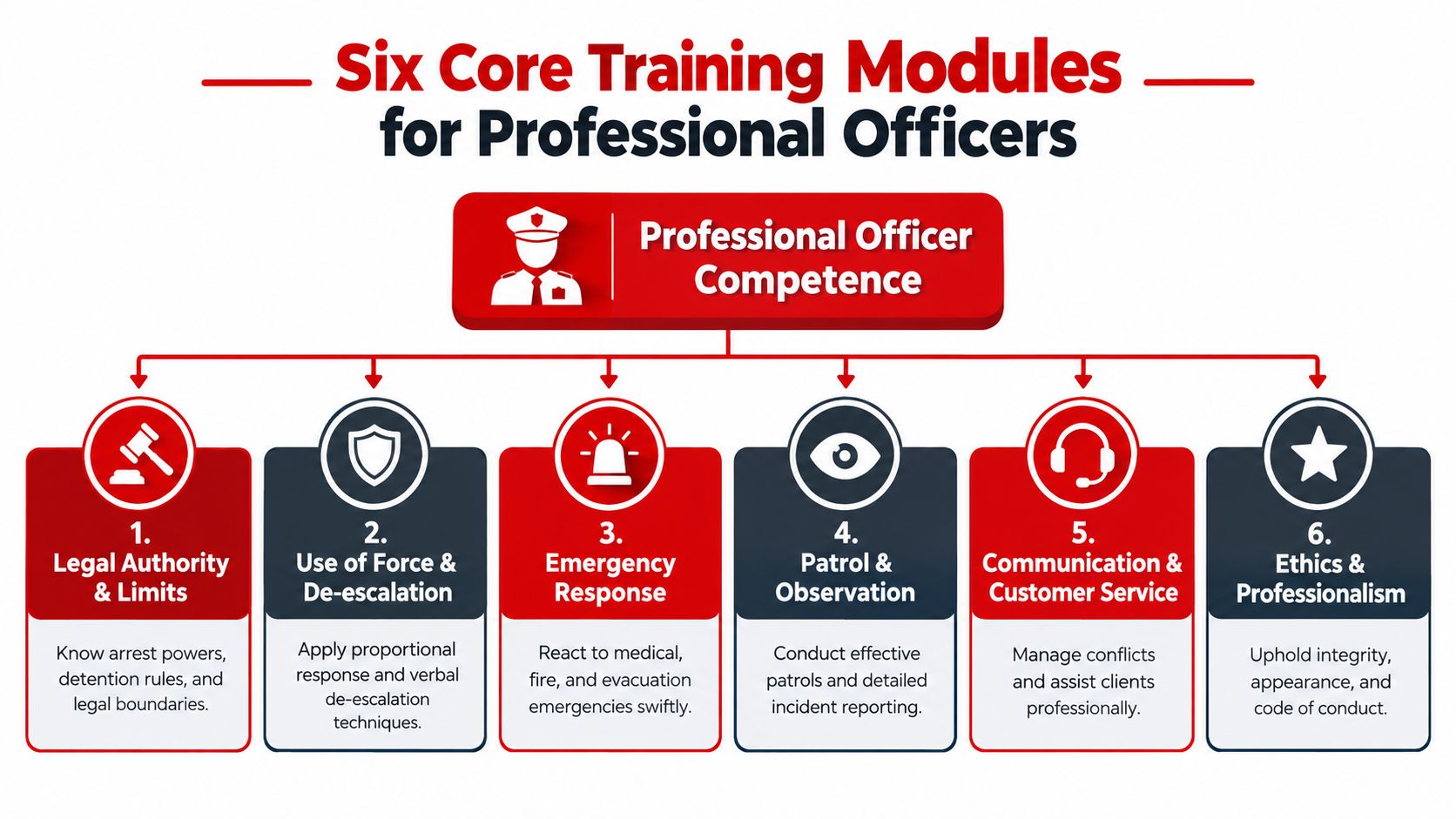
Six modules that shape field performance
Legal authority and limits
This is the foundation for every other skill. Officers need to know what they can do, what they can't do, and when to involve supervisors or law enforcement.
At a residential property, that might mean handling a nonresident who refuses to leave common areas. At a construction site, it may involve documenting trespass activity without turning a perimeter issue into a legal one.
Use of force and de-escalation
A calm verbal response is often the most important tool an officer has. Training here should cover proportional response, body language, tone, and how to create space during a tense interaction.
In retail, this often shows up when an upset customer or suspected shoplifter draws attention from nearby shoppers. The officer's goal is control, not drama.
Emergency response
Officers are frequently the first person on scene for a fire alarm, medical issue, elevator concern, or evacuation. Training should prepare them to stabilize the scene, notify the right people, and follow site procedures without confusion.
CPR and first aid
Not every post requires the same medical role, but practical first-response knowledge matters. A lobby officer in a high-rise may encounter a resident in distress before paramedics arrive. A construction officer may be closest to the first report of an onsite injury.
The skills that keep properties running smoothly
Report writing and observation
If the report is vague, management loses time reconstructing what happened. Good report writing training teaches officers to record facts, sequence, names, locations, and actions taken.
That's especially valuable on mixed-use and retail properties, where a single event may affect tenants, vendors, parking staff, and after-hours cleaning crews.
Communication and customer service
Some of the best security work looks simple from the outside. A visitor gets clear direction. A vendor is checked in correctly. A resident complaint is acknowledged professionally. A contractor is redirected without conflict.
Those moments come from training, not personality alone. This is one reason many teams also use templates for safety training videos when they want a consistent way to reinforce procedures visually across locations.
Strong officers don't just know the rule. They know how to apply it in a way that protects the property and preserves the relationship.
If you're evaluating a provider's curriculum, it helps to compare their content against a role-based skills standard like this security officer skills resource. The main question is simple: does the training prepare the officer for real post decisions, or only for basic compliance?
Why post orders matter so much
Even a well-trained officer still needs site-specific direction. A Class A office lobby, a gated HOA, and an active construction yard don't run on the same decision tree.
That's where customized post orders become part of the training system. They translate general skills into property rules, contact protocols, patrol expectations, escalation paths, and reporting standards. Without that layer, even experienced officers can make the wrong call for the specific site.
Armed Versus Unarmed Training Pathways and How to Choose
Choosing between armed and unarmed coverage shouldn't be driven by image. It should be driven by site conditions, legal requirements, and the type of incidents the officer is likely to face.
For many residential communities, office buildings, shopping centers, and concierge posts, unarmed officers are the right fit. The work often depends more on presence, access control, reporting, de-escalation, and customer-facing professionalism than on weapons-related duties. Other assignments involve a different risk profile and require a more intensive pathway.
Texas offers a clear example of how regulators treat that distinction. For commissioned security officers, the basic course must be department-approved, include general security issues, handgun proficiency, self-defense tactics, and range instruction, and total at least 30 hours. Personal protection officers must complete a separate 15-hour course (Texas private security statutes and rules).
Choosing Between Armed and Unarmed Officer Training
| Pathway | Training Focus and Hours | Best Fit |
|---|---|---|
| Unarmed | Usually centers on observation, reporting, access control, legal limits, communication, and de-escalation. Training requirements vary by jurisdiction. | Residential communities, office lobbies, retail centers, schools, parking facilities, and many construction access posts |
| Armed | Adds higher-risk competency requirements tied to weapons handling, live-fire qualification, legal force standards, and tighter authorization rules. Texas, for example, requires at least 30 hours for commissioned officers, plus a separate 15-hour course for personal protection roles. | Higher-risk assignments, sensitive facilities, select asset protection roles, and posts where the threat profile supports the added responsibility |
A practical decision filter
Use these questions when deciding:
- What does the officer do on site: Access control and patrol usually point in a different direction than high-risk protection duties.
- What's the property environment: A luxury residential tower in San Francisco isn't staffed the same way as a remote industrial yard or certain late-night commercial uses.
- How much public interaction is involved: Heavily customer-facing roles often benefit from a service-first unarmed model.
- Can the provider verify the pathway: Armed posts require more than a title change. They need documented training, authorization, and ongoing qualification.
For a closer look at role requirements and when armed coverage fits, this armed security guard requirements guide is a practical next step.
In most California property settings, the better question isn't “armed or unarmed?” It's “what level of training and supervision does this post need?”
From Scenario Drills to On the Job Readiness and Verification
The biggest gap in security training usually isn't whether a class was assigned. It's whether the officer can perform on the property, under pressure, in the conditions your site presents.
That's why scenario-based training matters. A classroom can explain policy, but a drill shows whether the officer can apply it when a resident is angry, a shoplifting incident is unfolding, or a subcontractor refuses to follow gate procedures. A 2026 industry brief notes that security professionals continue to ask for more conflict management, communication, legal-boundary, and decision-making practice, while a 2026 California policy analysis warns that newer training deadlines can be difficult to enforce without centralized tracking because certificates can be falsified and compliance often depends on recordkeeping audits (industry brief and policy summary).
What readiness looks like on a real site
A good readiness system usually includes three layers:
- Scenario drills: Officers practice common property situations before they face them live.
- Site onboarding: Supervisors walk the officer through post orders, patrol routes, contact lists, restricted areas, and escalation points.
- Verification: Management can confirm that the officer completed the training, understood the assignment, and followed the patrol expectations.
That last point matters more than many clients realize. A paper certificate may show course completion. It doesn't automatically show that the officer checked the north gate, documented the damaged fence line, or called in an access problem at the time it happened.
Why digital verification has become essential
For multi-site operators, training quality is now tied closely to documentation quality. If a provider can't verify activity in the field, the training system has a weak link.
One modern approach is to connect training and field accountability through a digital platform. For example, Overton Security uses a GPS-enabled Guard Tour Management System, NFC checkpoints, digital DARs with photos, and 24/7 SOC oversight for wellness checks and escalation support. Used properly, tools like these don't replace supervision. They make supervision visible.
Training works better when the field record shows what the officer actually did, not just what the file says they learned.
Some property teams build similar oversight into their own internal learning systems as well. If you're evaluating how to track recurring assignments, acknowledgments, and officer progress, this overview of course management on Power Platform is a useful example of how organizations structure training records more centrally.
Hands-on leadership still matters. So does a low manager-to-client ratio. Technology gives those people cleaner information to work with. For a property manager in Los Angeles, Oakland, or Fresno, that means fewer gray areas when a report needs review.
Building a Training Confident Security Program for Your Portfolio
If you manage one site, training affects daily consistency. If you manage several, it affects whether your security program feels organized or constantly reactive.
A training-confident program starts with the basics, but it doesn't stop there. You want California-compliant staged hours where required, scenario practice that reflects the property, documented evaluations, clear post orders, and reporting tools that verify what happened in the field. That combination turns private security officer training into an operating standard instead of a file cabinet exercise.
A short checklist for vetting providers
- Ask about staged compliance: Can they track required training by assignment date and training deadline?
- Ask how officers practice decisions: Do they use scenario work, supervisor ride-alongs, or site-based walkthroughs?
- Review post orders: Are instructions generic, or designed for your residential, retail, or construction environment?
- Check the reporting trail: Can you see patrol completion, incident notes, photos, and time-stamped activity?
- Look at support structure: Who coaches the officer after placement, and how often does management review site performance?
For property managers and facilities teams, the goal isn't more paperwork. It's dependable coverage. A provider with stable officers, hands-on leadership, and transparent systems usually gives you a better chance of getting it. That matters in Los Angeles, San Francisco, San Diego, and every other California market where one weak response can become a tenant issue, a safety issue, or a management issue by morning.
If you're reviewing security coverage for a community, shopping center, office property, or jobsite, start by asking one direct question. How does this company verify that its officers are ready for my site?
Overton Security provides California security services that connect licensing, site-specific training, post orders, and field verification into one practical operating model for residential, retail, commercial, and construction properties. If you'd like to review training expectations, patrol options, or onsite coverage for your property, visit Overton Security and start a conversation with a team that can walk through your site requirements clearly.