
A property manager can often tell when security is failing before anyone files a formal complaint. A tenant reports an unfamiliar vehicle near the loading area. A superintendent finds that copper, tools, or fuel have disappeared from a construction site. Patrol reports arrive late, access logs sit in a separate system, and nobody can say with confidence whether an officer completed the required rounds.
These problems rarely come from one missing camera or one uncovered shift. They usually reflect a disconnected program, where guards, patrols, technology, reporting, and supervision operate as separate pieces. Pro security solutions bring those pieces into one operating model, giving managers a clearer view of what happened, who responded, and which risks still need attention.
Introduction to Pro Security Solutions
Consider a mixed-use property with retail tenants on the ground floor and offices above. After-hours trespassing begins near a rear service entrance. The property manager adds occasional patrols, but the reports vary in detail. One officer records a routine check, another notes a damaged gate, and a third misses the location entirely. Meanwhile, equipment disappears from a nearby improvement project, and tenants start asking why the same access point remains vulnerable.
The manager's challenge isn't merely finding more guards. It's creating dependable coverage, documenting activity, and ensuring that someone reviews the information quickly enough to act. Patchwork services can leave gaps between a camera alert, a patrol visit, an access-control event, and a supervisor's follow-up.
A professional program connects those functions. An officer can deter trespassing, a mobile unit can inspect distant areas, a camera can extend visibility, and a security operations center can receive reports and escalate exceptions. The value comes from the relationship among these controls, not from treating any single one as a complete answer.
Practical rule: If you can't verify what happened during a shift, you don't yet have operational security. You have coverage that may or may not be working.
Asset tracking can also support a broader protection plan, particularly for trailers, mobile equipment, and fleet-related property. For readers managing construction, logistics, or service vehicles, Fleetalyse's fleet security guide offers useful context on trailer tracking devices and fleet security considerations.
This guide focuses on the less visible part of security performance: reliability over time. Staffing consistency, manager oversight, digital guard tours, detailed reports, and clear escalation procedures determine whether a security investment protects the property or merely creates the appearance of protection.
Understanding Pro Security Solutions
Professional security solutions are best understood as a layered protection system. Think of a property as a building with several doors. If one door is left open, the other doors still matter, but the system has a weakness. Security works the same way. Officers, patrols, access controls, surveillance, monitoring, and reporting each address a different point of risk.
An effective program usually combines the following layers:
- On-site security officers: Unarmed or armed officers control access, observe activity, assist occupants, and respond according to post orders.
- Vehicle patrols: Mobile security patrols visit parking areas, perimeter roads, vacant spaces, construction zones, and other locations that fixed personnel may not reach regularly.
- Access control: Credentials, visitor procedures, key management, and door checks help limit unauthorized movement.
- Surveillance and remote monitoring: Cameras and monitoring personnel extend observation beyond the officer's immediate location.
- Documentation and supervision: Digital daily activity reports, checkpoint records, photos, and incident escalation create a record that managers can review.
A guard at a lobby desk may control the main entrance effectively, but that officer can't simultaneously inspect a remote garage or monitor a rear loading dock. A camera can show activity, but it may not deter someone who knows no one is watching. A patrol can find a damaged fence, but without a timestamped report and escalation path, the issue may remain unresolved.
Why integration matters
Integration turns separate services into a workflow. A patrol officer identifies a forced gate, records the location, takes a photo, and submits an incident report. A supervisor reviews the entry, contacts the responsible property representative, and assigns a follow-up inspection. The manager receives a factual record instead of relying on a verbal update.
The physical security equipment market reached $60.1 billion in 2024 and is projected to reach $70 billion by 2026, according to the Security Industry Association's global security market report. The figures reflect a broader change in how organizations treat security. Commercial real estate, retail, healthcare, logistics, construction, and public-sector operators increasingly view protection as part of routine risk management rather than an occasional response to an incident.
A layered program doesn't mean buying every available service. It means assigning each control a clear job and making sure the controls communicate with one another.
Start with the property's operating reality. A residential high-rise may prioritize lobby presence, resident assistance, parking checks, and visitor management. A retail plaza may need visible mobile patrols, loitering deterrence, and after-hours perimeter inspections. A construction site may require material protection, gate control, equipment checks, and documentation during periods when the site is quiet.
The right question isn't, “Do we need guards or technology?” It's, “Which combination gives this property dependable detection, response, documentation, and follow-through?”
Service Types and Use Cases
Security services work best when they match the property's layout, occupancy, operating hours, and exposure. A high-rise lobby, an open-air shopping center, and an active construction site shouldn't receive identical coverage solely because they share a zip code.
On-site officers and concierge security
Unarmed security officers are often appropriate for access control, patrols, customer assistance, tenant support, and incident observation. Armed officers may be considered where the risk assessment, client policy, legal requirements, and local conditions support that model. The decision should follow a documented assessment, not a general assumption that more visible force automatically creates better protection.
Concierge security adds a hospitality function to the security role. In a Class A office building or luxury residential tower, the officer may greet visitors, verify access, assist with deliveries, monitor the lobby, and coordinate emergency response. Professional conduct matters because the officer becomes part of the tenant experience.
Mobile patrols and commercial properties
Vehicle patrol services add mobility and unpredictability. Officers can conduct scheduled or random visits around a retail center, parking structure, vacant property, or multi-building portfolio. GPS-enabled patrol records help confirm where the officer went and when the visit occurred.
For a retail plaza, a patrol route might include exterior doors, loading zones, trash enclosures, parking rows, and areas affected by repeated vandalism. For a property manager overseeing locations in Los Angeles, San Jose, or other California markets, a shared patrol program may provide flexible coverage across several sites, while a dedicated vehicle patrol can focus on one property or a defined group of properties.
Fire watch and temporary coverage
Fire watch becomes necessary when a fire protection system is impaired, offline, or under maintenance. The officer's role is not just to walk around. The post orders should define the areas to inspect, hazards to report, communication procedures, and escalation requirements.
Several fire-watch guidance documents specify patrols every 15 minutes for facilities with sleeping occupants, institutional occupancies, or occupied assembly occupancies. Other affected facilities are typically patrolled every 30 minutes, according to Palm Beach County Fire Rescue's fire-watch guidance. The applicable authority and site conditions should always control the final schedule.
Construction, events, and remote monitoring
Construction sites need a different balance of gate control, material checks, equipment observation, and off-hours patrols. Academic research found that the U.S. construction industry loses about $1 billion annually to direct theft, with an average loss of $5,865 per incident, as documented in this construction site theft research paper. That exposure helps explain why layered controls remain valuable even before a project is fully occupied.
Event security requires temporary staffing, crowd awareness, entry procedures, and coordination with the event organizer. Remote monitoring can extend visibility when a property doesn't need a full-time officer at every location. The strongest programs define exactly when the SOC contacts an officer, a manager, emergency services, or another designated responder.
Technology and Operations Center Workflows
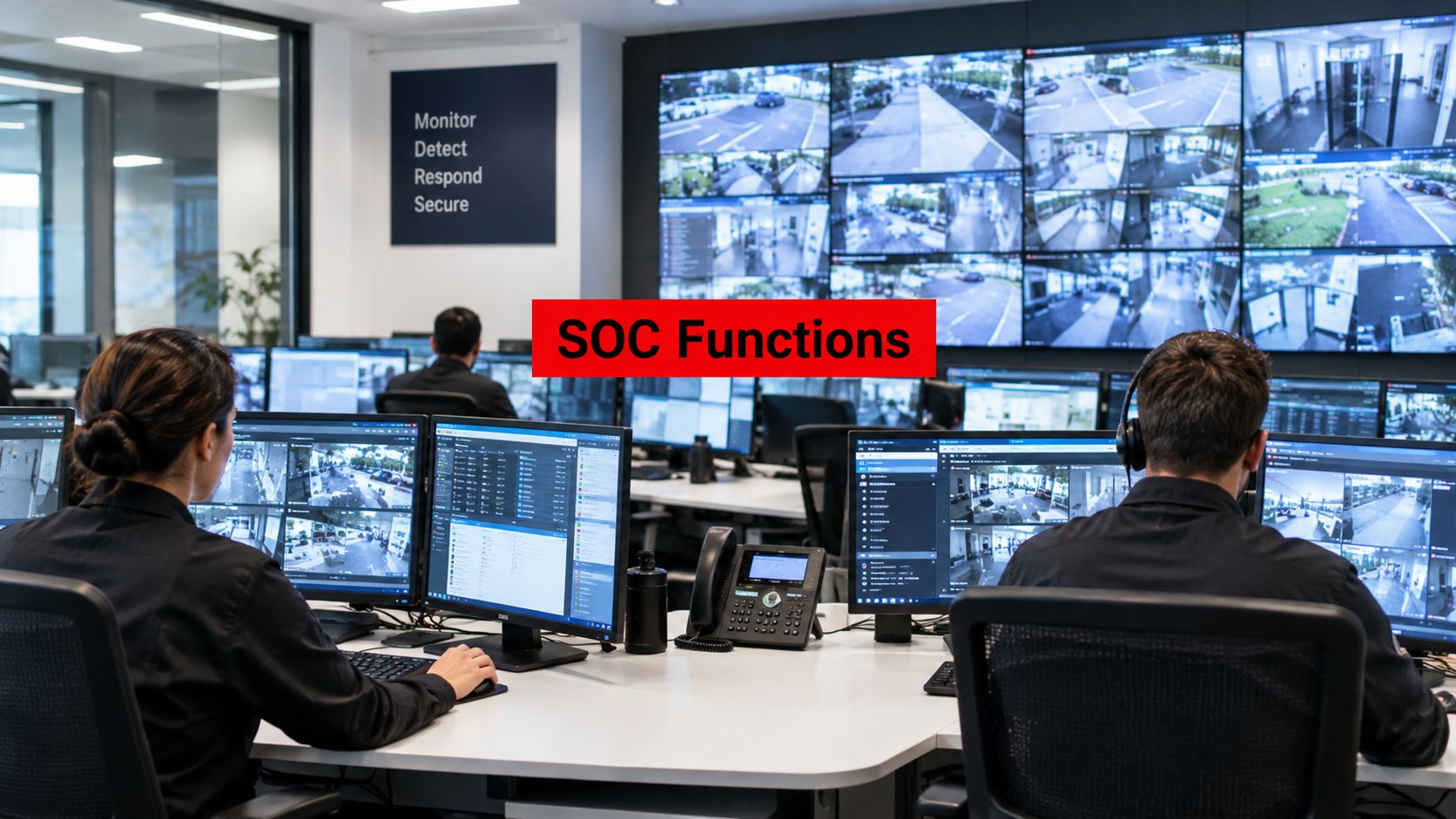
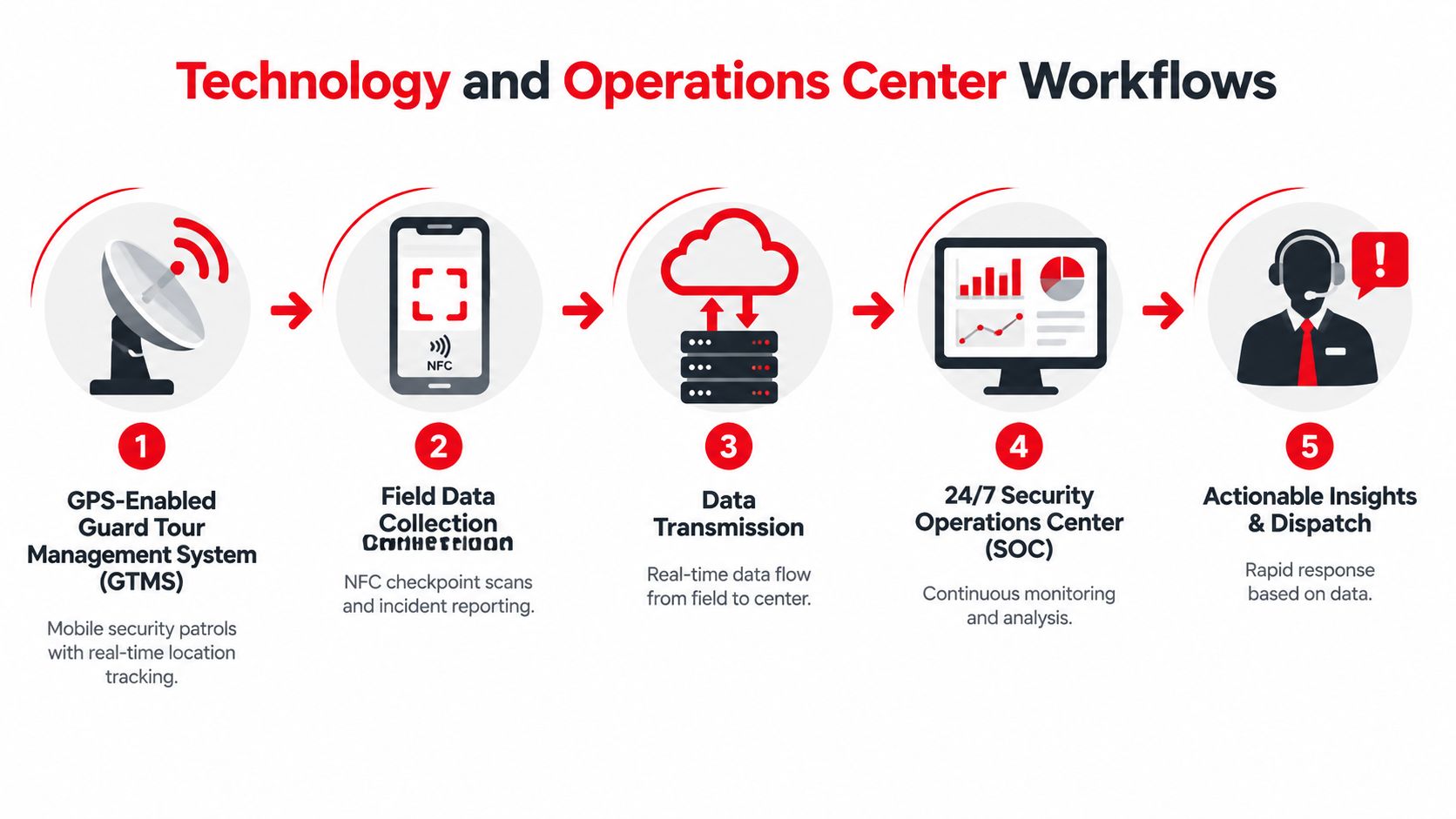
Technology helps only when it supports a clear operating process. A GPS-enabled Guard Tour Management System, or GTMS, should create evidence of activity, while a 24/7 Security Operations Center, or SOC, should review exceptions and coordinate action.
The field-to-center sequence
The workflow begins with the assignment. The officer receives post orders, patrol expectations, checkpoint requirements, and escalation instructions through the operating system or established site procedures. During the shift, the officer scans fixed NFC checkpoints and uses GPS route verification to document movement.
GPS alone can drift indoors or in dense urban environments. Fixed-point NFC checkpoints add a reliable physical confirmation, recording who scanned, where the scan occurred, and when it happened. Guidance on security operations center best practices for guard tours explains why combining these methods can improve proof-of-service and supervisor oversight. Missed scans can trigger alerts within minutes, allowing the SOC or supervisor to investigate rather than discovering the gap after the shift ends.
The officer then submits digital reports. A daily activity report should capture routine patrols, property checks, visitors, open doors, hazards, contacts, notifications, and unresolved matters. An incident report should add the time of occurrence, exact location, factual description, actions taken, outcome, and available photo or video evidence.
What the SOC does with the information
The SOC receives field data and evaluates exceptions. A missed checkpoint may require a wellness check. A photo of a forced gate may require dispatch, client notification, or a review of nearby camera footage. An unresolved hazard may be assigned for follow-up during the next patrol or escalated immediately, depending on the post orders.
Managers benefit when the system provides more than a PDF as a final output. They need a usable record of attendance, patrol completion, incidents, open items, and communication. Overton's security operations center automation describes the type of connected oversight property managers may evaluate when comparing technology-supported security programs.
A dependable workflow looks like this:
- Assign: Establish the officer, location, shift, route, and required actions.
- Verify: Record GPS movement and fixed checkpoint scans.
- Document: Add DAR entries, incident details, and supporting media.
- Review: Have the SOC or supervisor assess missed events and reports.
- Escalate: Notify the correct people and track unresolved items through closure.
The objective isn't to automate judgment. It's to give human decision-makers timely, specific information.
Selection Criteria and Procurement Checklist
A low hourly rate can hide operational costs. If officers change frequently, supervisors have limited visibility, and reports lack useful detail, the property manager may spend more time correcting service failures than managing the property.
Retention deserves particular attention. The UC Berkeley Labor Center reports that security officer turnover reached 89% annually in 2024, far above the private-sector average, making workforce stability a practical procurement concern rather than a human-resources footnote. High turnover can weaken site knowledge, interrupt post coverage, and force repeated retraining.
Questions to ask during procurement
Ask each vendor to explain how it recruits, trains, supports, and retains officers. Request a clear description of the manager-to-client structure, site-visit schedule, call-off process, and replacement protocol. A vendor that can't explain who owns the account when a problem occurs may not provide the continuity your property requires.
Technology should be evaluated through a demonstration, not a brochure. Ask the vendor to show a checkpoint scan, an exception alert, a digital DAR, a photo attachment, a supervisor review, and a client report. You should also understand how the system handles poor connectivity, incorrect scans, device failure, and privacy requirements.
Use this guide to contractor insurance options as additional background when reviewing insurance-related questions for construction and property work. Your broker, counsel, and risk team should confirm the coverage terms that apply to your specific contract.
| Criteria | Description |
|---|---|
| Experience | Review experience with your property type, operating hours, and risk profile. |
| Officer stability | Ask how the vendor supports retention, handles vacancies, and preserves site knowledge. |
| Management access | Confirm the manager-to-client ratio, escalation contacts, and site-visit expectations. |
| Technology integration | Request a live demonstration of GTMS, GPS verification, checkpoint scans, reporting, and alerts. |
| Post orders | Check whether instructions are customized to the property layout and reviewed after operational changes. |
| Reporting quality | Inspect sample DARs and incident reports for timestamps, locations, actions, outcomes, and media. |
| Compliance record | Verify licensing, training, incident procedures, and any required documentation. |
| Insurance alignment | Have qualified advisors review certificates, limits, exclusions, and contractual requirements. |
| Continuity planning | Ask how the vendor covers call-offs, emergencies, technology outages, and supervisor absences. |
For a broader decision framework, review considerations when choosing a security outsourcing partner. Score responses consistently, then validate them through a site walk, references, and a review of actual sample reports.
Choose the vendor whose operating process you can inspect, not merely the vendor whose proposal sounds polished.
Cost Analysis and ROI Considerations
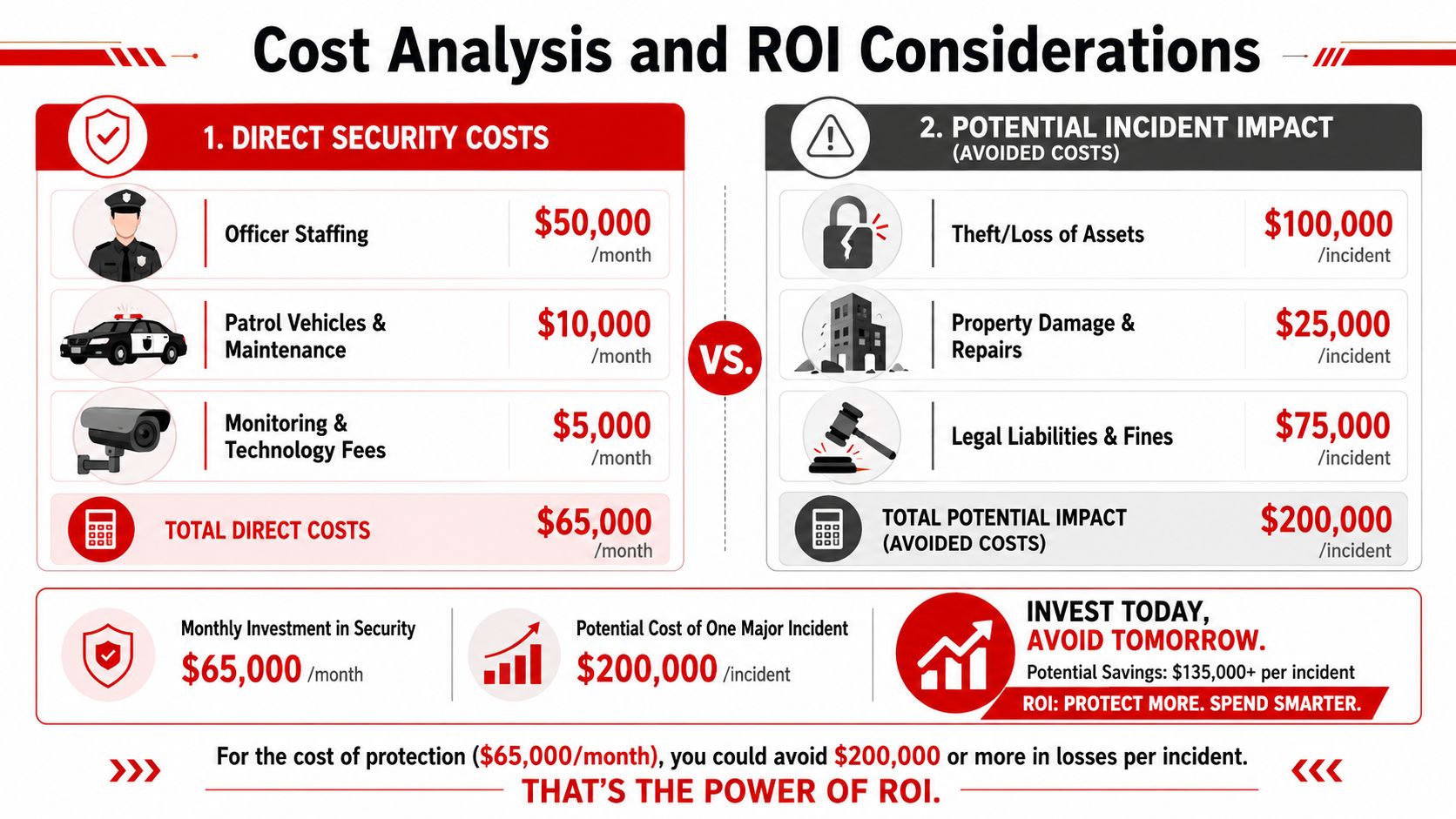
Security ROI begins with a simple distinction: direct cost is what you pay for coverage, while avoided cost is the loss you may prevent or limit. Direct costs can include officer staffing, patrol vehicles, supervision, monitoring, equipment, reporting systems, training, and implementation. Avoided costs can include stolen assets, property damage, business disruption, tenant dissatisfaction, emergency repairs, and liability exposure.
The calculation shouldn't promise that every incident would have been prevented. A more credible approach asks what the program is designed to deter, detect, document, or contain. Compare the cost of that protection with the likely consequences of leaving a known vulnerability unmanaged.
Build an avoided-loss model
Start with the incidents most relevant to your property. A construction manager may examine tools, copper, fuel, equipment, gate damage, and schedule disruption. A retail property manager may examine vandalism, forced doors, theft, parking-lot incidents, and tenant concerns. A residential manager may focus on unauthorized access, package areas, garage activity, resident safety, and emergency coordination.
Construction theft provides a useful reference point. Industry guidance places the average construction-site theft loss at about $6,000 per incident, according to this construction site theft cost analysis. That figure doesn't predict the loss at your property, but it illustrates how one event can consume a meaningful portion of a security budget.
A practical model can include:
- Known exposure: List the assets, entrances, schedules, and locations most vulnerable to loss.
- Incident consequence: Estimate replacement, repair, delay, administrative, and notification costs using your own records.
- Control contribution: Identify whether each service deters, detects, responds, documents, or supports recovery.
- Review period: Compare incidents, near misses, response times, and unresolved issues over an agreed evaluation period.
- Decision threshold: Set the conditions that would justify expanded patrols, additional staffing, or technology changes.
Compare coverage options
Suppose a property has a staffed lobby but repeated issues at a remote parking area. Adding another lobby officer may increase presence where coverage already exists. A mobile patrol, improved lighting, camera monitoring, or a revised checkpoint route may address the actual gap more directly.
The opposite can also be true. Technology may identify a door opening, but an officer still needs to verify conditions, contact occupants, preserve information, or manage the scene. ROI improves when each cost addresses a defined operational weakness instead of adding overlapping tools.
Share the model with ownership, finance, and risk stakeholders. Explain what the program does, what it can't guarantee, how reports will demonstrate activity, and which indicators will guide future adjustments. A measured proposal is easier to defend than a promise of total prevention.
Compliance Risk Management and Post Orders Sample
Reliable security starts with instructions that officers can follow without guessing. Post orders should reflect the property's layout, hazards, occupancy, access points, emergency contacts, reporting expectations, and authority limits.
Begin with a site plan. Mark entrances, exits, fire equipment, restricted areas, elevators, loading zones, utility rooms, parking areas, construction boundaries, and locations requiring special attention. Then define what the officer should do during normal operations, during an exception, and when the officer can't complete a required task.
Essential post order elements
A useful post order should identify:
- Assignment purpose: State the protection objective, such as access control, life safety, patrol, customer assistance, or asset protection.
- Routine duties: List opening checks, visitor procedures, patrol areas, equipment inspections, and communication tasks.
- Checkpoint expectations: Identify required scan points, route requirements, and procedures for a missed or inaccessible checkpoint.
- Escalation steps: State who receives notification for trespassing, forced entry, medical events, fire hazards, violence, or equipment failure.
- Evidence handling: Explain how officers record facts, take photographs when appropriate, preserve relevant information, and avoid speculation.
- Shift handoff: Require unresolved issues, access changes, active work orders, and notifications to pass to the next officer and supervisor.
Property managers can use this guide to writing security post orders when developing or revising site-specific instructions. The document should be reviewed whenever the property changes, a new hazard appears, a tenant moves in or out, or an incident exposes a weakness.
Daily reports and fire watch
A Daily Activity Report, or DAR, is a chronological record of routine security work during a shift. It should include patrols, property checks, visitors, open doors, hazards, contacts, notifications, and unresolved items, not just major incidents. That detail gives managers evidence of ordinary work and helps supervisors identify patterns before they become larger problems.
Incident reports should remain objective. Record when the event occurred, where it happened, what the officer observed, what action the officer took, the outcome, and supporting photo or video evidence when available. Avoid conclusions that the officer can't verify.
Fire watch requires particular discipline. Where applicable guidance calls for patrols every 15 minutes in facilities with sleeping occupants, institutional occupancies, or occupied assembly occupancies, the post order should state the schedule clearly. Other affected facilities are commonly assigned 30-minute patrol intervals under the cited guidance. Officers should know what to inspect, how to communicate an alarm or hazard, and how to document every round.
Documentation standard: Write the report so a person who wasn't present can understand the event, the response, and the remaining risk.
Next Steps for Vendor Engagement and Overton Strengths
A productive vendor engagement begins with a site walk, not a generic price sheet. Invite the provider to review access points, staffing conditions, patrol routes, tenant activity, construction phases, reporting needs, and existing technology. The vendor should then connect those observations to a risk assessment and a customized proposal.
Overton Security Services has operated for 26 years, with a stated focus on quality over quantity, hands-on leadership, a low manager-to-client ratio, and support for officer retention. Its operating model combines onsite security officers, mobile patrols, GPS-enabled guard tours, detailed digital reports, and 24/7 SOC oversight.
For a property manager, the practical evaluation is straightforward. Ask to see the proposed post orders, reporting workflow, escalation contacts, supervisor structure, and onboarding timeline. Confirm how the provider will measure patrol completion, handle call-offs, review incidents, and communicate unresolved issues.
A strong onboarding process should leave you with:
- A documented site risk assessment
- Customized post orders and patrol routes
- Defined checkpoints and reporting requirements
- Named operational and escalation contacts
- A schedule for service reviews and adjustments
Security should become easier to manage, not another disconnected task on an already full property-operations list.
Overton Security offers onsite officers, mobile patrols, fire watch, construction security, remote monitoring, and SOC-supported reporting designed around property-specific risks. Visit Overton Security to discuss a site assessment and build a professional security solution with clear accountability from the first patrol onward.