A property manager can have cameras on every entrance, officers on every shift, and still struggle to answer a basic question after an incident: What happened, when did it happen, and who responded? A missed patrol checkpoint, an incomplete report, or an alert buried in a separate system quickly becomes an owner conversation, a tenant complaint, or an avoidable operational gap.
That's why security management innovations deserve a practical look. The useful advances aren't gadgets purchased for appearances. They're improvements that connect trained people, clear procedures, reliable reporting, and technology that helps a team see and act sooner. For commercial property managers in Los Angeles, residential communities in San Jose, construction sites in Long Beach, and multi-site portfolios across California, the right approach is phased, measurable, and grounded in daily work.
Why Security Management Needs a New Approach Today
At 10:30 p.m., a property manager receives a call about an open service door. The camera feed shows movement, but the video is stored in a separate system. The patrol officer's handwritten log won't be available until morning. A second property in the portfolio has reported a similar issue, but nobody can quickly compare the two events.
That situation isn't unusual because traditional security tools are useless. Guards, cameras, access controls, and patrols still have important roles. The problem is that separate tools often leave people responsible for connecting the evidence manually, usually after an event has already created pressure.
Security operations centers have moved from small, centralized monitoring teams toward more distributed, metrics-driven management hubs. The SANS 2023 SOC Survey found that 84% of SOCs collected and exposed performance metrics, 73% allowed analysts to work remotely, and 49% already used cloud-based services in their SOC architecture. The survey projected cloud-based use would reach 62% within 12 months, showing that operational change includes staffing models, workflow design, and infrastructure, not only detection software.
Reactive coverage leaves managers assembling the story
A camera can record an event without explaining its significance. A guard can complete a patrol without creating an easily auditable record. An access-control platform can show a credential use without connecting it to video, a mobile patrol observation, or a documented response.
This fragmentation creates familiar problems:
- Incomplete accountability: Supervisors may know that a patrol was scheduled but lack reliable proof of each checkpoint visit.
- Slow escalation: An operator may need to check several screens before deciding whether an alert requires dispatch.
- Unclear performance: Owners may ask whether the security program is reducing exposure, but reports may focus only on activity counts.
- Inconsistent response: Officers and site teams may interpret the same condition differently when post orders and escalation paths aren't aligned.
The SANS survey reported that more than 75% of respondents detected incidents before external notification, but only 9% did so through proactive threat hunting. That contrast points to a management opportunity. Security teams are finding incidents, yet many organizations are still developing the processes needed to look ahead rather than wait for a signal.
Innovation means stronger management, not less human judgment
A modern program may combine a 24/7 SOC, cloud-managed video, AI-assisted analytics, NFC checkpoint verification, GPS patrol records, and digital incident reports. Those tools don't remove the need for professional security officers. They give officers and supervisors better information, clearer priorities, and stronger evidence of what occurred.
For property managers, the practical question isn't whether a technology sounds advanced. It's whether it helps the team protect people and property, document work, coordinate across sites, and explain results in business language without overwhelming the operating budget.
What Security Management Innovation Really Means
Security management innovation is the coordinated improvement of people, process, and technology. Each part matters. Technology can identify a possible event, but a trained officer still needs to verify conditions, follow post orders, communicate clearly, and make a sound decision.
An orchestra provides a useful analogy. Cameras, access controls, sensors, patrol systems, and SOC dashboards are different instruments. A conductor, a shared score, and timed coordination turn those instruments into a performance. Without common procedures, each device may work properly while the overall program remains disjointed.
Start with the operating problem
A useful evaluation begins with a site question, not a product category.
- Identify the recurring gap. Is the issue incomplete patrol verification, slow alarm review, unauthorized access, poor after-hours visibility, or inconsistent reporting?
- Define the decision that must improve. A manager may need to decide whether to dispatch an officer, contact building engineering, notify a resident, or escalate to law enforcement.
- Match the tool to the decision. AI video analytics may help filter visual alerts. NFC and GPS systems may verify patrol coverage. A cloud platform may help supervisors compare information across properties.
- Assign responsibility. Someone must own alert review, incident classification, follow-up, and system maintenance.
The distinction between innovation and hype is simple. A feature is useful only when it changes an operational behavior or produces evidence that a responsible person can act on.
Integration creates consistency
Standalone cameras and sensors produce data. Integrated platforms connect that data to a workflow. A unified view can associate a door event with nearby video, a patrol officer's location, and an incident report, giving supervisors more context than any one feed provides.
For a plain-language overview of how technology can support coordinated safety work, property leaders can review innovative technologies improving community safety in security operations. The key principle is that connected systems should make the right action easier, not add another screen for an already busy team.
Practical rule: If a new tool creates more alerts than your staff can review, it isn't innovation yet. It's another workload.
A strong program also includes governance. Managers need rules for who can access video, how long reports are retained, how AI-generated alerts are verified, and what happens when a system is unavailable. Transparency, consistency, and human review matter more than the novelty of a device.
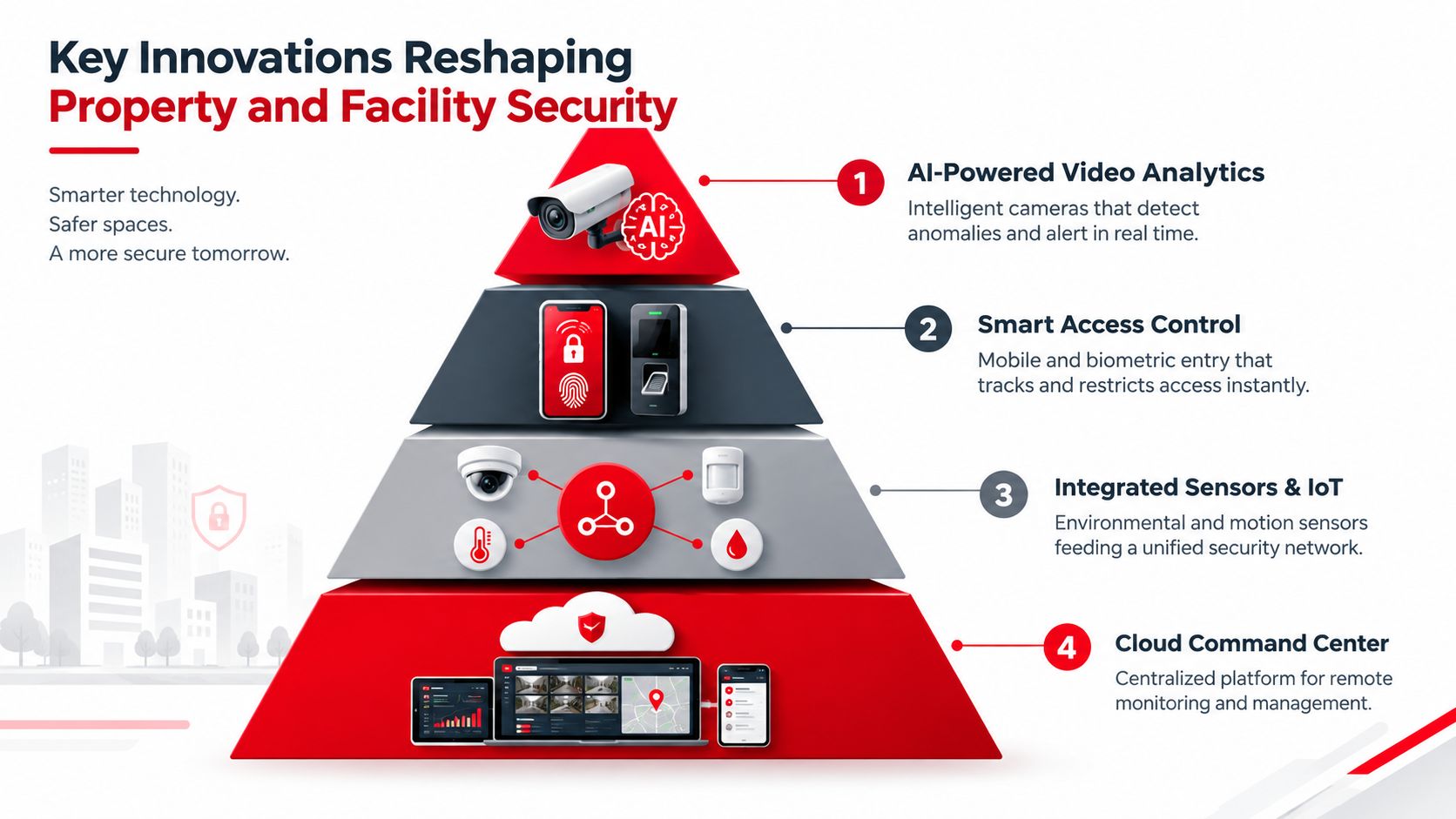
Key Innovations Reshaping Property and Facility Security
The most useful security management innovations fall into several connected groups. Each solves a different operational problem, and none should be evaluated in isolation.
AI-powered video analytics
Traditional motion detection reacts to changes in pixels. AI-powered video analytics can classify objects and filter environmental noise before an alert reaches an operator. That distinction can reduce false alarms by more than 90% in security monitoring workflows, as described by TMA's report on AI video false-alarm reduction.
For a retail center, the system might distinguish a person entering a restricted service area from tree movement or changing light. The operator receives a higher-confidence alert and can check the relevant footage instead of manually reviewing every motion event. The technology supports judgment. It doesn't replace the officer or operator who verifies the situation.
Cloud-managed platforms and SOC coordination
Cloud-managed security brings video, alerts, access events, and reports into a platform that authorized users can review remotely. This matters for a portfolio manager who can't be physically present at a property in Los Angeles while an after-hours event unfolds in San Jose.
The shift is already visible. A 2026 industry report summarized by SourceSecurity.com's cloud physical security coverage said 94% of organizations that weren't yet fully cloud-managed were planning or already making the transition, while 89% agreed that the future of physical security is cloud-based. The same reporting identified hybrid environments as the dominant arrangement, with 70% of organizations in hybrid environments, compared with 22% fully cloud-managed and 8% fully on-premises.
That hybrid reality is important. A manager doesn't need to replace every system at once. The first priority may be connecting the most important feeds to a SOC that can verify alarms and coordinate dispatch.
IoT sensors and integrated access control
Door contacts, water sensors, environmental monitors, and access-control events can provide early context. In a construction site, an unauthorized gate opening may become more meaningful when paired with a nearby camera event and a mobile patrol officer's location. In a residential community, access records can help staff review a garage entry without relying on memory or a paper log.
The value comes from correlation. A sensor alone reports a condition. A connected workflow helps a person determine whether the condition is routine, suspicious, urgent, or already handled.
Drones and robotics for selected sites
Drones and robotics may support inspections in large yards, industrial properties, or construction environments where visibility is difficult. They're most useful when a site has defined routes, clear operating permissions, and a human team ready to review findings.
They shouldn't be treated as universal replacements for officers. Privacy, weather, battery limits, airspace rules, public interaction, and escalation responsibilities all affect whether a deployment makes sense. For many sites, a targeted mobile patrol remains the more practical first step.
Mobile guard technology
A mobile guard-patrol system using NFC or RFID checkpoint verification, GPS logging, and cloud incident reporting can record patrol time, location, guard ID, and incident evidence in real time, according to the mobile patrol verification study. Modern NFC guard-tour systems can also record checkpoint IDs, timestamps, GPS coordinates, photographs, incident details, and missed-patrol alerts, as explained by Trackforce's guide to enterprise guard tour systems.
For an apartment community, that creates a reviewable record of garage, pool, and perimeter checks. For a construction superintendent, it shows whether high-value materials and access points were inspected. For a deeper example of AI in building operations, AI-driven smart building results can help stakeholders think about how analytics fit into broader facility workflows.
How Integrated Operations Create Real Time Visibility
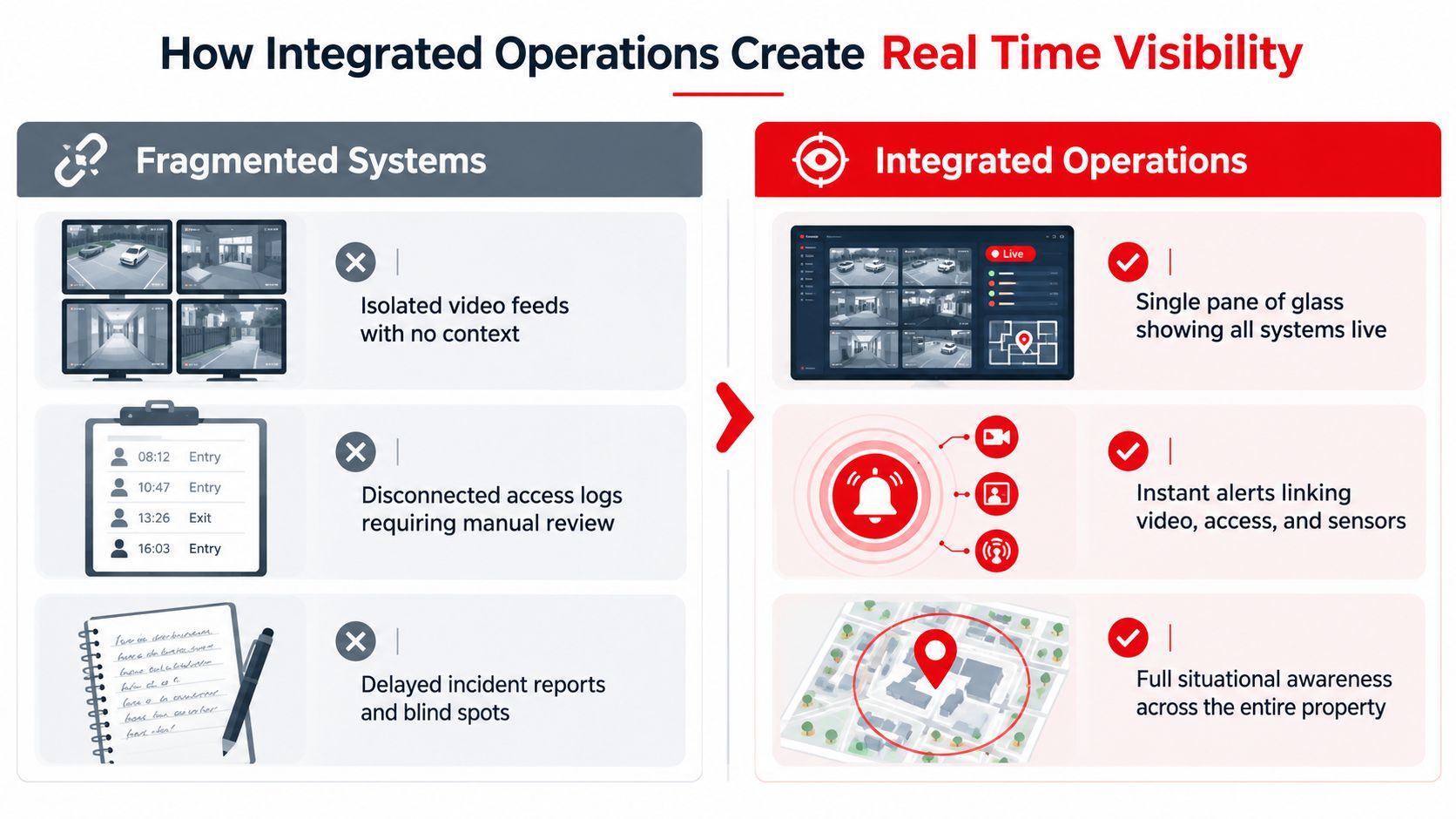
Fragmented security asks the property manager to assemble information. Integrated operations organize information around the event.
In a fragmented model, a camera records video, an access system stores entry data, and an officer writes a report. The manager may need to request each record separately, compare timestamps, and decide whether the accounts align. That process can work for a small incident, but it becomes difficult across multiple buildings, shifts, and vendors.
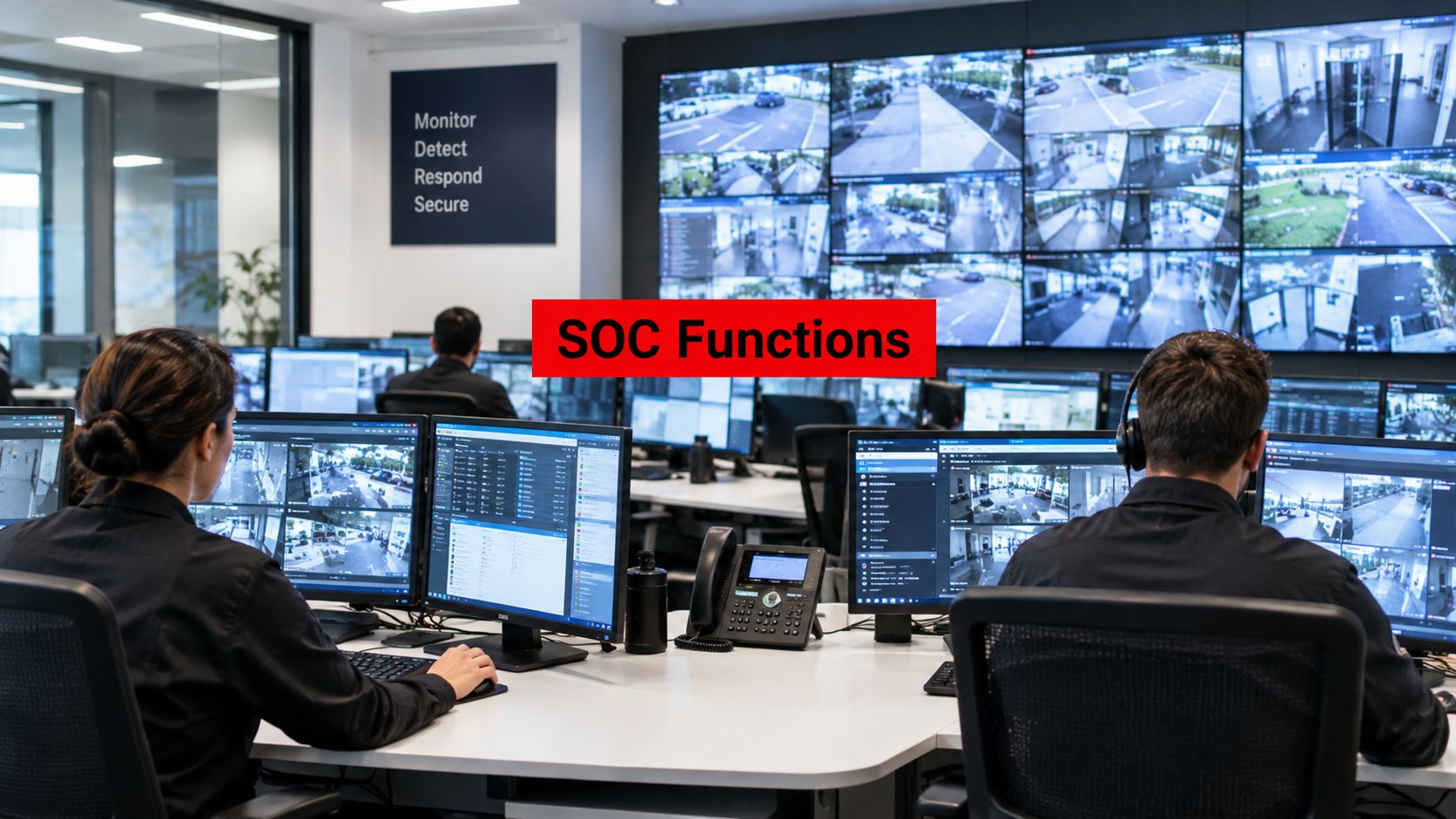
A connected model starts with a shared operational view. SOC personnel can review alerts, confirm relevant video, check officer or patrol location, document the event, and escalate it through an agreed path. A FortiSOC example described in FortiAnalyzer's SOC data sheet includes real-time log and threat data, drill-down views, notifications, reports, customizable dashboards, assignments, timelines, attached artifacts, and playbook execution history.
The daily difference is evidence
Suppose a garage door opens outside normal hours.
| Fragmented approach | Integrated approach |
|---|---|
| Staff checks a camera feed manually | An alert points the operator to the relevant event |
| Access records require a separate review | Access activity is reviewed alongside video |
| Patrol coverage is assumed from a written log | NFC and GPS data show checkpoint and location activity |
| Incident details arrive later | A digital report can include notes and photos in real time |
| Escalation depends on individual judgment | Post orders define who receives the next notification |
The integrated model doesn't guarantee that every event is correctly classified. It does make the decision process more visible and auditable. Supervisors can review what the system detected, what the officer observed, what action followed, and whether the response matched the site plan.
Visibility supports trust across stakeholders
Owners want evidence that contracted services are being delivered. HOAs want clear documentation when residents raise concerns. Tenants want professional communication after an incident. Facilities teams need security information that helps them address doors, lighting, elevators, or other physical conditions.
A 24/7 SOC can support real-time monitoring, dispatching, wellness checks, GPS tracking, and escalation. For property managers evaluating that operating model, security operations center automation offers a relevant reference point.
A good dashboard doesn't merely show more information. It shows the right information to the person responsible for the next decision.
The strongest systems also preserve human context. An operator can classify a false positive, an officer can explain an unusual condition, and a supervisor can identify a recurring pattern that deserves a post-order change. Technology creates the record. People create the response.
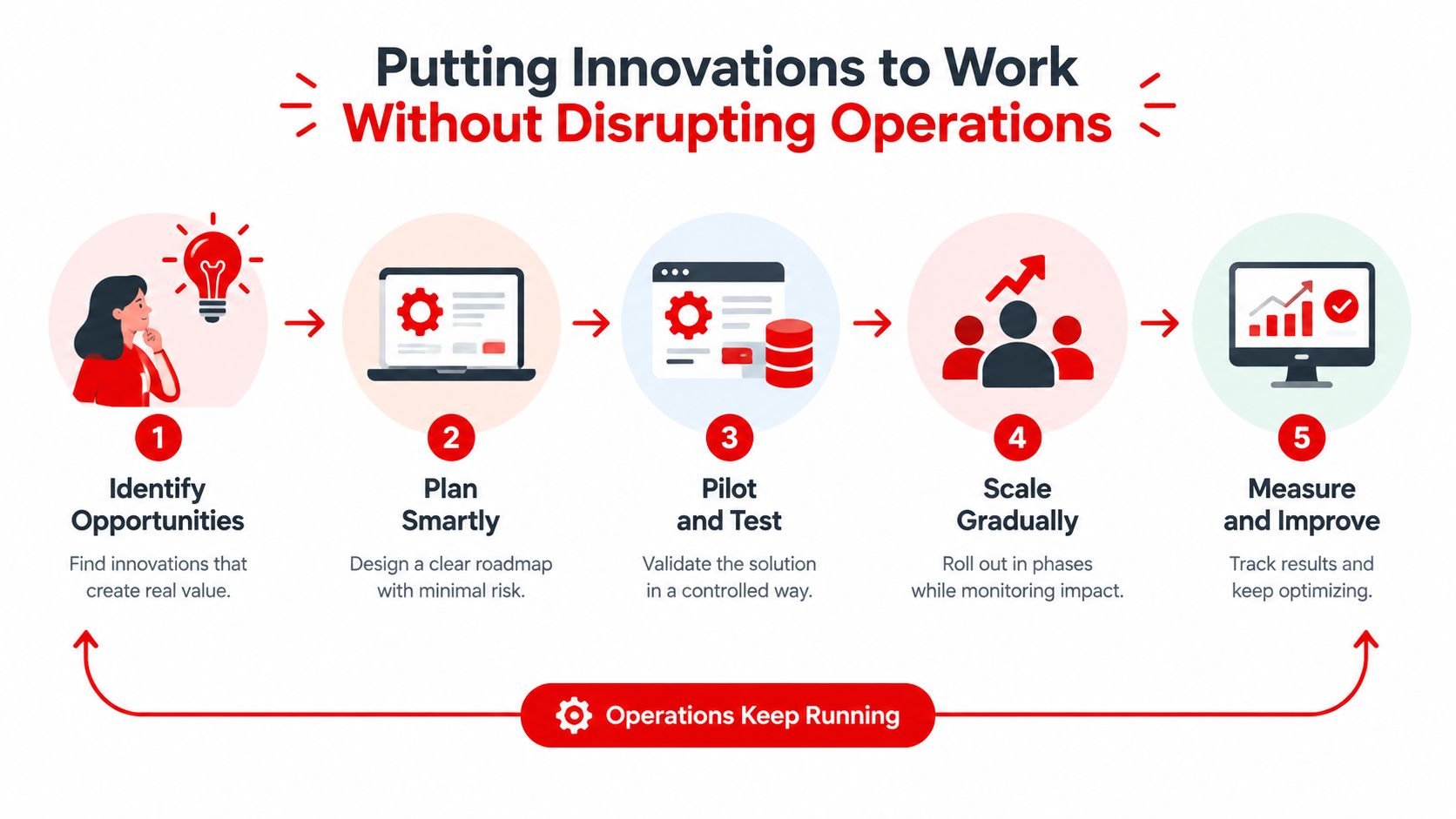
Putting Innovations to Work Without Disrupting Operations
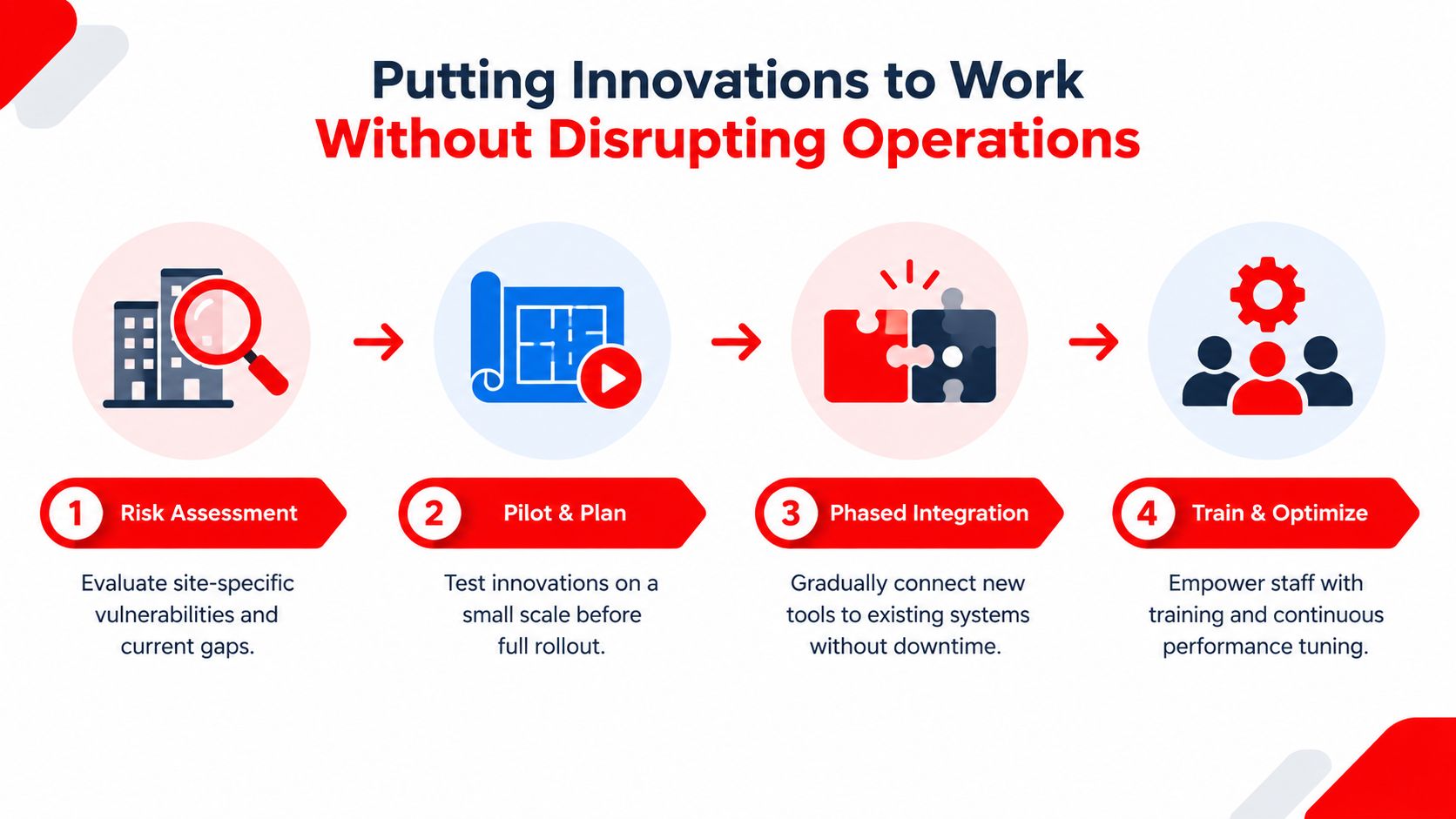
A live property can't pause while a new security platform is installed. Residents still enter garages, retailers still open and close, construction crews still move equipment, and officers still need clear instructions at every shift change. Adoption should therefore follow the rhythm of the site.
Begin with a documented baseline
Walk the property with the people who operate it. Review current patrol routes, access points, camera coverage, incident reports, lighting, alarm handling, and escalation contacts. Write site-specific post orders before introducing new alerts, because a technology system can't compensate for unclear responsibilities.
The baseline should answer practical questions:
- Which events require immediate dispatch?
- Which conditions can wait for a supervisor?
- Who contacts building engineering or ownership?
- What evidence must an officer collect?
- How will the team protect privacy and limit access to sensitive video?
The SANS survey found that 56% of SOCs weren't trying to calculate the monetary value their SOC provides, while 31% had computed a cost-per-record figure from an actual incident. Those findings reinforce a useful discipline: decide how value will be measured before selecting a platform.
Pilot one workflow before expanding
A pilot might focus on a single garage, one construction gate, a retail loading area, or a defined patrol route. Choose a problem that staff already understand, such as missed checkpoint verification or excessive video alerts.
During the pilot, test the full workflow:
- The system creates an alert or task.
- The responsible person receives it.
- The officer or operator verifies the condition.
- The report captures the required evidence.
- The supervisor reviews the outcome.
- The team adjusts the post order or alert rule if needed.
This approach reveals integration and training issues while the scope remains manageable.
Train for decisions, not buttons
Officers need to know what a scan confirms, what a photograph should show, and when a report requires escalation. Supervisors need to know how to review exceptions, correct incomplete records, and coach the team without turning every alert into a disciplinary event.
Workforce readiness deserves the same attention as software. Industry coverage cited by ASIS UK's summary of the Genetec State of Physical Security 2025 said 77% of end users were working closely with IT teams and 37% planned AI implementations in 2025. The same coverage highlighted staffing challenges and targeted training needs.
Protect continuity and retention
Security innovation fails when experienced officers leave because the new process feels confusing, punitive, or disconnected from the actual site. Provide practice time, simple job aids, supervisor availability, and feedback from officers who use the system every shift.
Workforce stability is a concrete operational issue. The Berkeley Labor Center report on the U.S. security guard workforce reported 88.6% annual turnover in U.S. investigation and security services in 2024, compared with 66.0% for the private sector overall. A rollout that supports retention protects the investment in training and site knowledge.
Real World Examples and How to Measure What Matters
Consider a retail center where operators review every motion alert from a parking area. AI video analytics can classify likely objects and filter environmental noise before the alert reaches the monitoring team. The manager should then compare the volume and quality of alerts, dispatch decisions, and documented outcomes, rather than treating the installation itself as success.
A residential community may have a different priority. Management may want proof that officers checked the garage, pool area, and perimeter during overnight rounds. NFC checkpoint scans and GPS records can create time-stamped evidence, while digital reports with photographs give the community manager a clearer record for owners and residents.
A construction site often needs layered coverage. A remote monitoring team can review camera events while mobile patrol officers inspect gates, equipment storage, and material areas. The manager can measure whether the combined workflow produces faster verification, better documentation, and fewer unresolved exceptions.
Choose metrics that connect security to operations
A practical scorecard may include:
- Response time: How long does it take to acknowledge and verify an alert?
- Documentation quality: Do reports include the required location, time, action, and supporting evidence?
- Patrol completion: Are scheduled checkpoints verified, and are missed visits escalated?
- False-alarm workload: How many alerts require manual review, and how many lead to meaningful action?
- Labor allocation: Does automation reduce repetitive review or duplicate reporting?
- Integration performance: Can supervisors retrieve related video, access, patrol, and incident information without separate searches?
- Workforce readiness: Can officers use the workflow accurately across shifts and locations?
Security management innovation becomes easier to defend when the scorecard reflects business concerns. Property owners may care about labor efficiency, incident exposure, tenant experience, and reliable vendor accountability. A security director may focus on escalation quality and evidence. Both perspectives belong in the same review.
ROI requires governance too
The hardest part isn't buying AI or cloud technology. It's proving ROI, integration value, and governance at the same time. Recent industry reporting identified integration as the leading factor influencing security decisions, while ROI has become a common language between security and business teams, and trust and governance remain adoption barriers. A separate outlook reported that only 18% of organizations were fully cloud-based, while 34% expected to be fully cloud-based within five years, indicating that most organizations still operate in a hybrid environment. Those findings appear in Gallagher's security trends report.
That means a responsible business case should include privacy controls, access permissions, training time, maintenance, system compatibility, and a plan for reviewing results. A lower alarm volume isn't enough if the team misses important events. A new dashboard isn't valuable if nobody owns the follow-up.
For a structured approach to selecting and reviewing operational measures, property managers can use security performance indicators.
Choosing the Right Innovations for Your Property Portfolio
The right security management innovations should fit the property's risks, current systems, staffing model, and decision-making structure. A useful procurement screen asks five questions:
- Integration fit: Can the platform connect with the systems your team already uses?
- Governance: Who can view, change, export, and retain data?
- Workforce readiness: What training, supervision, and support will officers need?
- Portfolio scalability: Can the process work across residential, retail, construction, and office sites without becoming generic?
- Measurable value: Which labor, response, reporting, or accountability outcome will the pilot test?
Think of the portfolio as an operating system, not a collection of gadgets. A focused pilot can reveal whether an innovation improves the work before you expand it. Resource planning principles such as optimizing maintenance resource allocation can also help managers think carefully about where limited personnel, attention, and budget will produce the greatest operational value.
Overton Security brings together onsite security officers, vehicle patrol services, GPS-enabled patrol verification, digital reporting, and 24/7 SOC oversight, with customized post orders and hands-on account management. If your California property needs a phased plan that connects professional officers with practical technology, visit Overton Security to discuss your site, portfolio, and next operational priority.