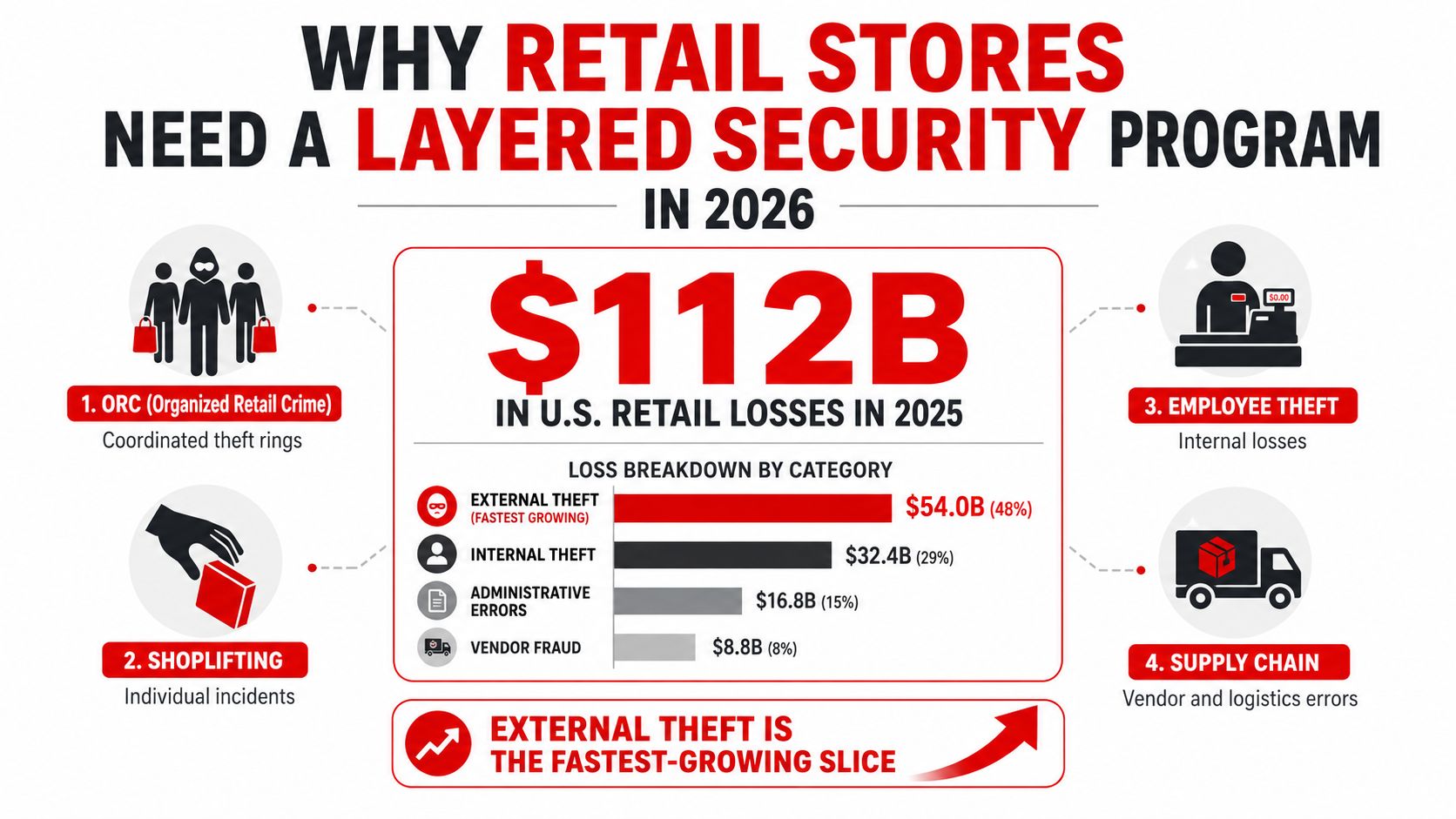
Retail shrink reached 1.6% of sales in fiscal year 2022, up from 1.4% the prior year, representing approximately $112.1 billion in losses, according to the National Retail Federation's 2023 National Retail Security Survey. That number changes the security conversation. Retail security isn't just about placing a guard near the entrance or adding another camera above the register. It's about matching people, technology, merchandise controls, and operating procedures to the way loss occurs.
The pressure is visible outside the United States, too. Australia recorded 595,660 theft victims in 2024, the highest level in 21 years, with theft at retail locations representing 45% of all theft incidents, compared with 32% in 2010, according to the Australian Bureau of Statistics. In the United Kingdom, police recorded 516,971 shop theft offences in the year ending December 2024, a 20% year-over-year increase, according to the UK retail-crime factsheet.
For property managers, loss-prevention leaders, and operators of shopping centers or standalone stores, the useful question isn't whether to buy more security. It's which control belongs at which loss point, and how to measure whether it changes the result.
Why Retail Stores Need a Layered Security Program in 2026
Retail loss can come from organized retail crime, individual shoplifting, employee theft, administrative mistakes, vendor discrepancies, return fraud, or coordinated grab-and-run events. Each pattern creates a different loss point, so the response should match the cause rather than default to the most visible security measure.
The National Retail Federation identified CCTV and video systems, locking cases and cages, exception-based reporting, loss-prevention staffing, and upgraded or integrated CCTV among the leading perceived mitigations for external losses. As the NRF data above showed, shrink reached 1.6% of sales in FY2022, which is why one control cannot carry the load. The survey findings support a portfolio built around defined loss points, measurable responses, and regular review.
Why one control fails
A camera records events. It cannot intervene physically, question a suspect, protect an employee during a confrontation, or confirm what occurred at the receiving dock. EAS tags can alert staff at an exit, yet a determined offender may ignore the alarm or use a poorly covered doorway. A uniformed officer offers visible deterrence and can help de-escalate a situation, but one person cannot cover fitting rooms, the stockroom, parking areas, and self-checkout at the same time.
Technology tends to outperform personnel for continuous coverage, evidence collection, and exception review. Uniformed officers tend to outperform technology when a store needs visible presence, immediate judgment, customer assistance, or a controlled response to developing behavior. The right mix depends on the loss point, operating hours, staffing, and response expectations.
Organized crews may study blind spots, shift changes, inconsistent reporting, and weak escalation practices. That pattern requires deterrence, detection, intervention, documentation, and follow-up to work as one program.
Practical rule: A control earns its place when it addresses a defined loss point and produces a measurable operating response.
A layered program can combine officers during high-risk periods, remote video review, cameras at exits and high-shrink aisles, locking cases for selected products, exception-based reporting, trained managers, and clear incident thresholds. For broader property needs, managers can review security for buildings alongside this store-level plan. For camera coverage specifically, see Perth retail security cameras and how video fits a layered program.
The objective is practical: reduce opportunity, shorten detection time, limit confrontation, improve recovery, and preserve evidence. Controls that do not connect those functions leave gaps, and offenders work in the gaps.
Running a Risk Assessment for a Retail Property
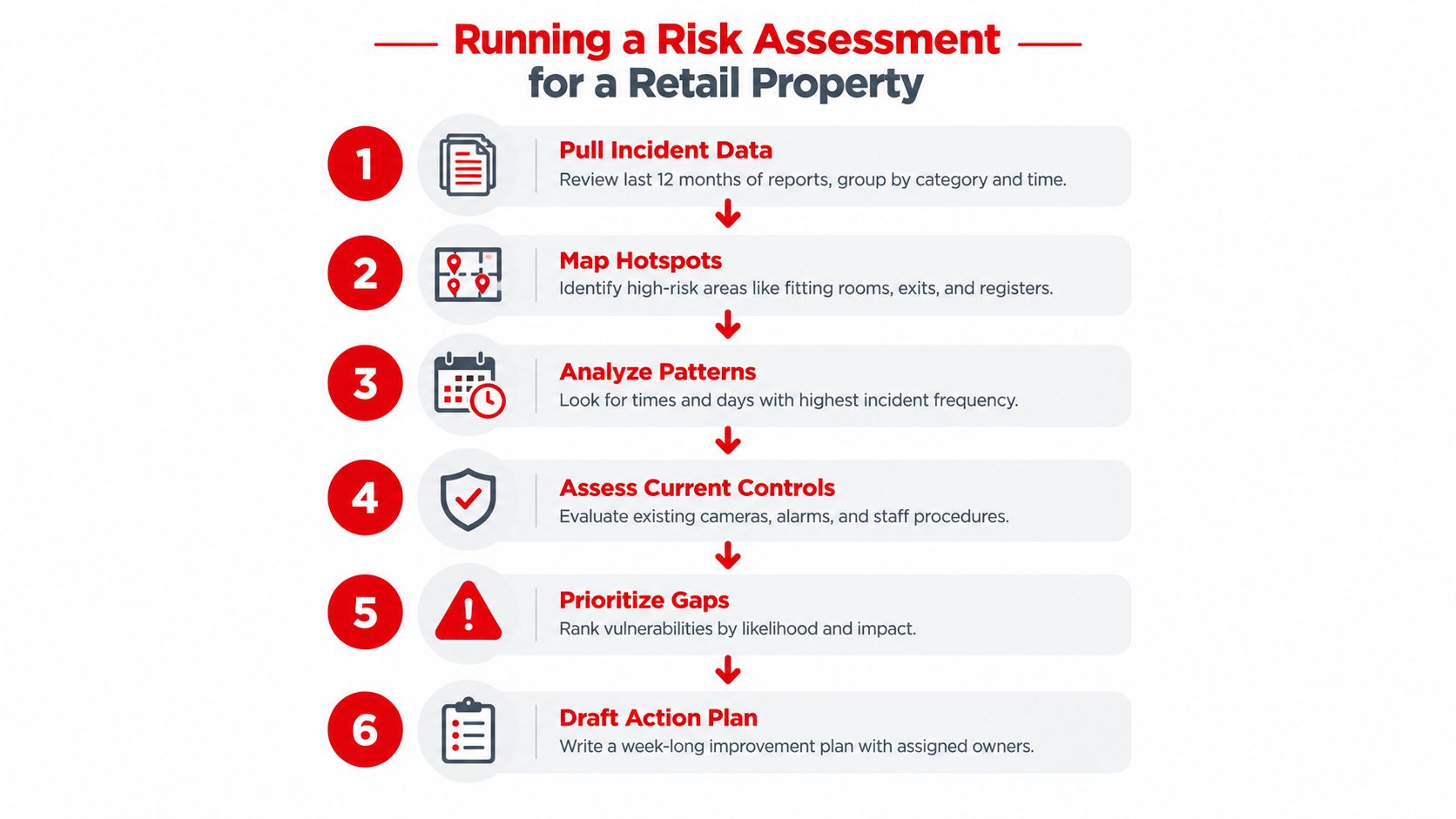
A risk assessment should describe what happens at the actual store, not what a corporate template assumes happens there. A property or operations manager can complete a useful first pass in about a week by combining records, observation, interviews, and realistic response testing.
A six-step field checklist
Pull the last 12 months of incident reports. Group events by category, time of day, day of week, entry point, department, and outcome. Separate confirmed loss from suspicious activity, operational error, employee concerns, and incidents involving threats or violence.
Map the store footprint. Mark entrances, exits, fitting rooms, registers, stockrooms, loading areas, blind corners, sightline obstructions, and high-shrink SKUs. Walk the map while carrying the same basket, cart, or merchandise that a customer would use. A floor plan often looks safer on paper than it feels from an aisle.
Test response under normal conditions. Time private security, management, and police notification processes without relying on an ideal scenario. Note who receives the call, who makes the decision, and where the responding person must travel from.
Audit the existing hardware. Check camera angles, image quality, coverage at entrances and exits, EAS pedestal placement, alarm panel condition, and lighting around the perimeter and parking lot. Ask whether the system produces footage that a supervisor can retrieve quickly.
Interview the store manager and two longest-tenured associates. Ask about near-misses, repeat offenders, suspicious returns, vendor problems, unsafe areas, and events that never became formal reports. Their observations often reveal process weaknesses that incident data misses.
Score and prioritize. Rate each finding by likelihood and impact, then select the top five gaps. Assign an owner, an action, and a review date. A long list without ownership becomes a file, not a security program.
For a more formal framework, managers can use guidance on how to identify threats and score impact while keeping the assessment specific to the location.
Common assessment mistakes
Don't treat incident counts as the only evidence. A store may have few documented events because employees don't feel supported when they report, while another store may report every suspicious interaction and appear riskier on paper.
Also avoid buying hardware before identifying the loss node. Adding cameras to an already visible sales floor won't help if the receiving dock lacks a controlled handoff or if the exit camera can't capture faces and merchandise movement. The assessment should determine whether the first investment belongs in staffing, placement, training, access control, reporting, or technology.
Choosing Between Guards, Patrols, and Technology
Retail operators commonly budget for five control categories: uniformed officers, vehicle patrol and alarm response, CCTV with remote monitoring, EAS, and locked merchandise displays. Each solves a different problem, and each has a blind spot.
Independent retail data shows that 82% of mid-size to large retailers use uniformed security or law-enforcement officers in at least some locations, while stores catch shoplifters only about 2.0% of the time. The same dataset reports use of locking cases, cages, or hooks at 70% of multi-location retailers, EAS or similar tags at 76%, and removal of some products from sales floors at 65%. These figures appear in submitted retail-security testimony, and they point to the limits of staffing alone.
No universal monthly price applies across California. Store size, hours, post requirements, labor conditions, patrol distance, technology ownership, and response expectations all change the cost. Treat the cost column below as a budgeting category, not a quotation.
| Control | Primary Strength | Blind Spot | Typical Monthly Cost | Best Fit |
|---|---|---|---|---|
| Uniformed in-store officer | Visible deterrence, customer assistance, de-escalation, incident response | Can't watch every zone or replace trained management | Site-specific staffing budget | Urban flagships, high-risk periods, enclosed malls |
| Vehicle patrol and alarm response | Perimeter checks, after-hours visibility, response to alarms and access issues | Scheduled visits don't provide continuous interior coverage | Shared or dedicated patrol budget | Strip centers, standalone stores, portfolios |
| CCTV with remote monitoring | Continuous visibility, evidence retrieval, alarm verification, multi-site oversight | Doesn't physically intervene and weak placement limits value | System and monitoring budget | Multiple sites, entrances, exits, parking, high-shrink zones |
| EAS tags and gates | Exit alerts and product-level deterrence | Tags can be removed, ignored, or triggered by process errors | Hardware and tagging budget | Apparel, selected electronics, controlled merchandise |
| Locked cases and secure cabinets | Directly limits access to selected high-value items | Adds friction for customers and can reduce sales convenience | Fixture, labor, and maintenance budget | Electronics, liquor, premium cosmetics |
Where people outperform systems
An officer can greet customers, recognize escalating behavior, separate a dispute from a theft investigation, protect staff during an incident, and coordinate with a manager. At receiving, a trained officer or loss-prevention specialist can also observe vendor access, verify unusual activity, and enforce a handoff procedure.
Technology wins at persistence. Cameras provide coverage during unstaffed periods, remote operators can review multiple locations, and analytics can help identify repeat patterns or verify alarms. Remote oversight works best when the system has clear escalation rules, usable video, and a person responsible for acting on alerts. Retail operators evaluating that model can review remote monitoring technologies alongside their existing camera plan.
Match the blend to the property
A standalone urban flagship usually needs a combination of customer-facing officers, strong exit and high-shrink camera coverage, and secure displays for selected merchandise. A suburban strip center may gain more from mobile patrols, lighting, perimeter checks, alarm response, and coordinated tenant reporting. An enclosed mall often needs shared exterior patrols, tenant-facing officers during peak periods, mall management coordination, and camera coverage at common-area exits and parking connections.
Start with the two or three controls that address the highest-ranked findings. Buying everything at once often creates maintenance, training, and accountability problems.
Writing Post Orders and SOPs Your Officers Will Actually Use
A post order binder should help an officer make the right decision quickly. If the first page is a long narrative about the property, the document has already failed under pressure.
Build the binder around action
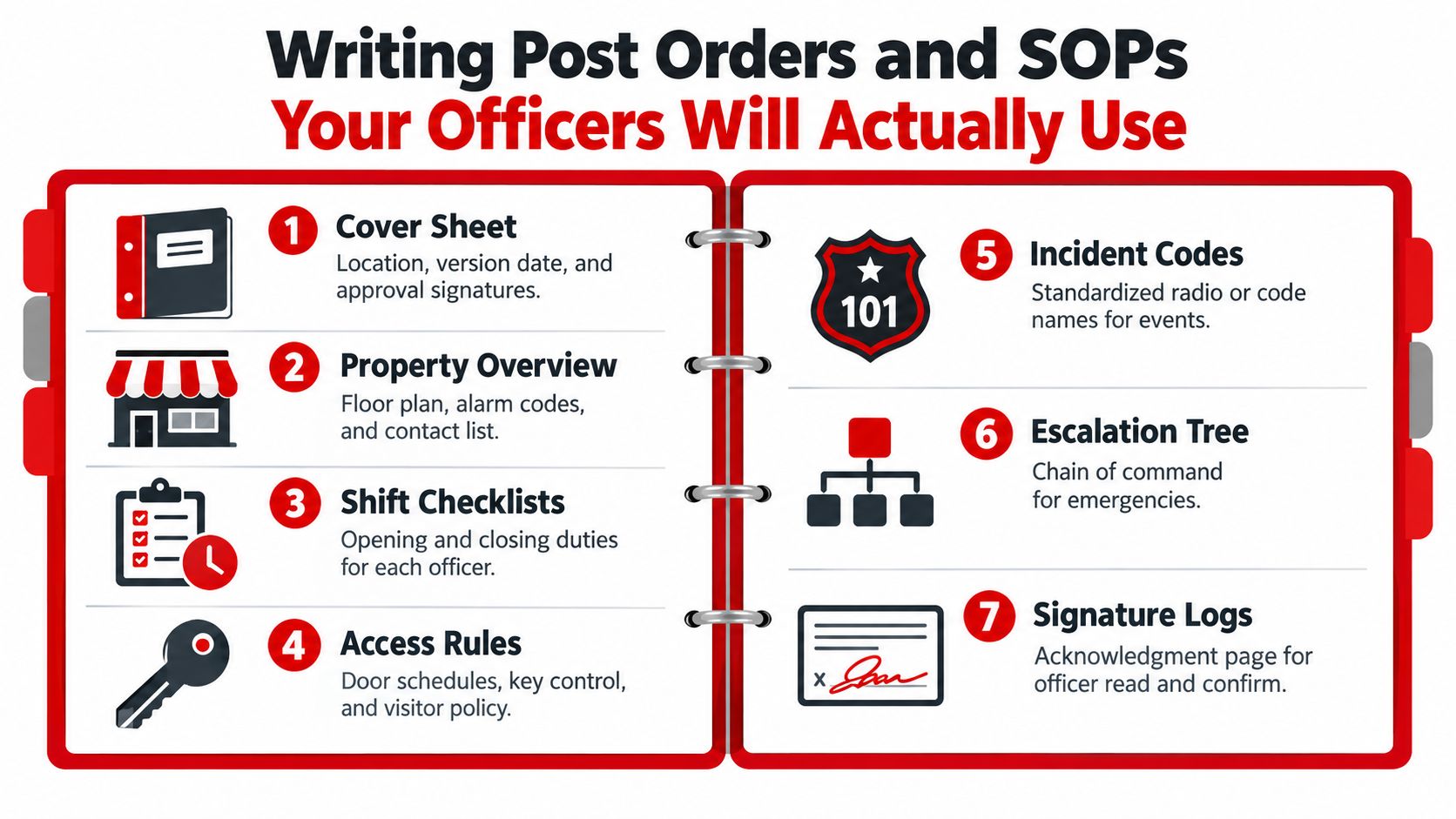
Use a cover sheet with the location, version date, approval signatures, and emergency contacts. Follow it with a property overview containing the floor plan, access points, alarm information, restricted areas, manager contacts, and police or fire procedures.
The working pages should include:
- Shift checklists: Opening, mid-day, closing, and relief duties.
- Access rules: Door schedules, key control, vendor entry, deliveries, and visitor requirements.
- Incident codes: Consistent radio language for suspicious behavior, theft, trespass, medical events, fire, and violence.
- Escalation tree: Who the officer calls, in what order, and which events require emergency services.
- Signature logs: Acknowledgment that officers received, read, and understood the current version.
Use verbs at the start of each instruction. “Check the north exit and confirm the crash bar is secure” gives an officer something to do. “Maintain awareness of access-control conditions” does not.
Write decisions as short branches
A shoplifting procedure might direct the officer to observe, notify the manager, avoid unnecessary confrontation, document the facts, and follow the approved recovery or detention process. A trespass procedure should identify who can issue the direction to leave, what the officer should do if the person refuses, and when police should be contacted.
A medical procedure should tell the officer to call emergency services, protect the area, direct responders to the correct entrance, avoid moving the injured person unless there's an immediate danger, and preserve witness information. Every procedure also needs a clear do-not-engage threshold for weapons, active violence, group confrontations, and threats.
Under pressure, officers follow the clearest available action. Write for the first ten seconds, not for a policy committee.
A practical sweep can be written in three lines:
- Opening: Check exterior doors, loading areas, high-risk displays, alarms, and signs of forced entry before normal customer flow begins.
- Mid-day: Walk assigned zones, verify sightlines, check restricted doors, support staff with observed risks, and document exceptions.
- Closing: Confirm customer egress, inspect restrooms and stock areas under store policy, secure access points, and complete the handover report.
Handover discipline matters. The outgoing officer should state unresolved events, missing keys, equipment issues, restricted persons, manager instructions, and follow-up tasks. Radio traffic should identify the location first, use plain language for urgent events, and avoid broadcasting sensitive personal details.
After any meaningful incident, review the footage, report, and officer decisions. Update the post order, version the change, brief every affected officer, and collect new signatures. A binder that never changes becomes disconnected from the property it's supposed to protect.
Loss Prevention Techniques That Move the Shrink Number
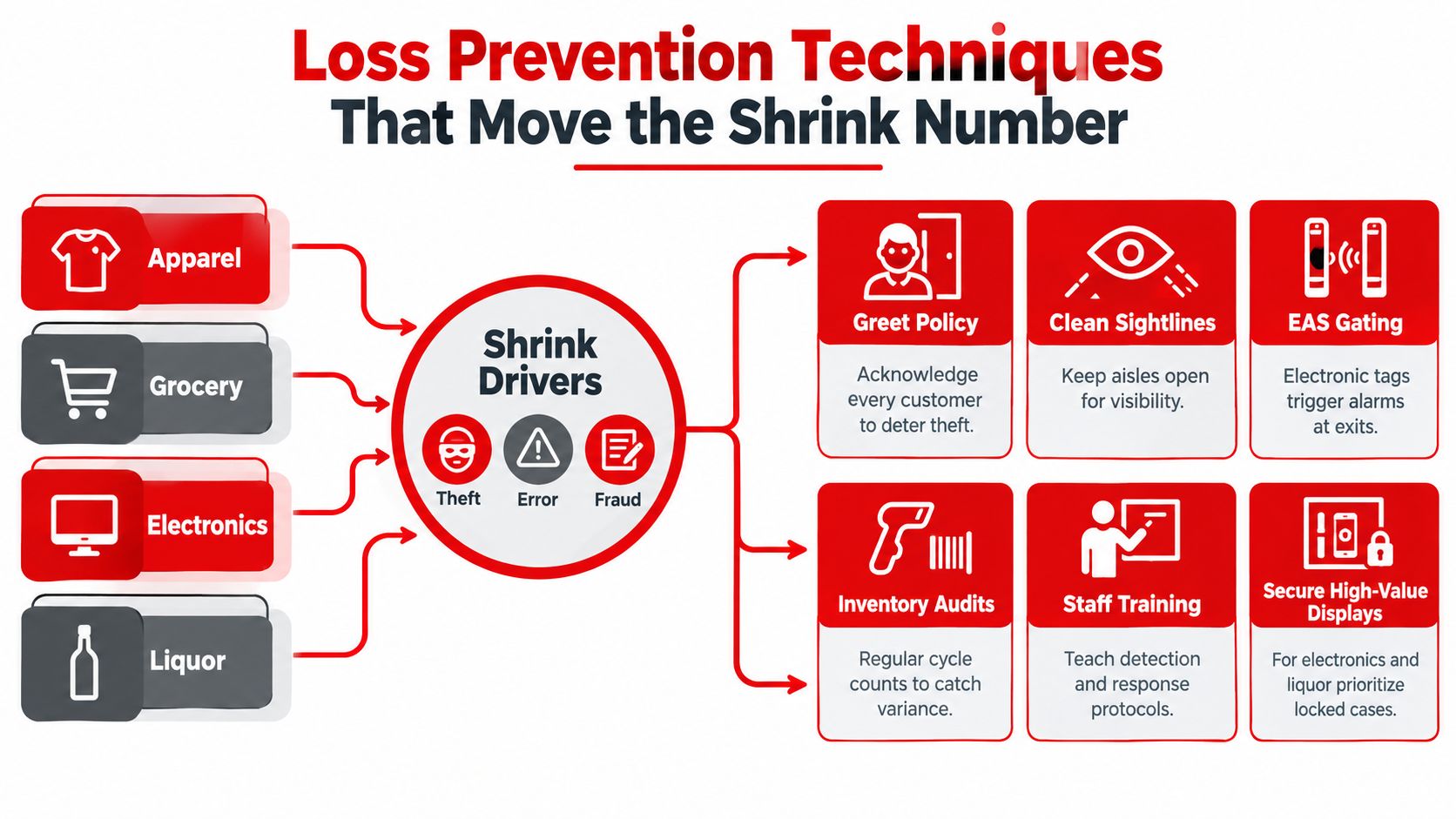
Loss prevention works when the tactic matches the merchandise, transaction, and movement pattern. Apparel, grocery, electronics, and liquor stores don't have the same exposure, so a universal checklist wastes effort.
Start with the product and the process
Apparel stores should examine fitting rooms, concealed merchandise, EAS tag removal, and exits with limited staff visibility. Grocery operators should separate shoplifting from scanning errors, sweethearting, refund problems, and receiving discrepancies. Electronics stores often need controlled displays, serial-number verification, and stronger stockroom access. Liquor stores may need locked cases, clear sightlines, transaction controls, and a plan for aggressive behavior.
Customer-facing measures should include a consistent greeting, open aisles, clean sightlines, properly placed EAS gates, and merchandising that keeps high-risk products visible without making the store difficult to shop. Back-of-house controls should include receiving audits, returns verification, vendor check-in, cycle counts, and review of unusual inventory adjustments.
Use a safe apprehension workflow
Staff should never improvise a confrontation. The approved procedure should define:
- Observe: Confirm the behavior and maintain a safe distance.
- Notify: Contact the manager or officer using the store's incident code.
- Assess: Determine whether the person is leaving, resisting, threatening, or part of a group.
- Choose the response: Follow the site's recovery-only, detention, juvenile, and police-notification rules.
- Document: Record descriptions, merchandise, witnesses, time, location, statements, and video references.
- Hand off: Provide the report and preserved evidence to the appropriate manager or police contact.
The law and company policy control what officers may do. A recovery target never justifies putting employees or customers in danger.
Track repeat behavior responsibly
Use approved BOLO notices, ban lists, and information-sharing channels with neighboring tenants where policy and law allow. Limit access to staff who need it, document the basis for the notice, and avoid turning a vague description into an unsupported accusation.
Retail operators can use retail loss prevention strategies to connect floor behavior, inventory controls, officer reporting, and management review. The useful measure isn't the number of people approached. It's whether the program reduces repeat loss, improves recovery, and keeps employees from taking unsafe action.
Emergency Response and Post-Incident Procedures
Retail response should use clear tiers so officers and managers don't debate urgency during an event. The same behavior can move from low to high risk quickly, so the procedure must define the trigger for escalation.
Set three response tiers
Low-level events include suspicious behavior, minor disturbances, and non-threatening policy violations. The response may involve observation, customer service, manager notification, and documentation.
Medium-level events include refusal to leave, active shoplifting with resistance, threats without immediate serious danger, or escalating disorder. The officer should notify management, create distance, protect staff and customers, and request police support when the facts meet the site threshold.
High-level events include active violence, fire, severe injury, and bomb or chemical threats. Follow the emergency plan, call emergency services, direct evacuation or lockdown as appropriate, and avoid unnecessary exposure.
UK police guidance identifies immediate danger, serious offences in progress, immediate threats of violence, serious property damage in progress, and a detained offender who may pose a risk as situations warranting emergency response. Non-emergency, non-priority incidents use routine reporting channels under the UK Retail Crime Action Plan.
Preserve the scene and the record
After the immediate danger ends:
- Secure the area: Lock the premises after an offender leaves when policy requires it, or preserve a safe perimeter after a serious event.
- Call and coordinate: Contact 911 for emergencies, assign one person to manage police communication, and direct responders to the correct entrance.
- Protect evidence: Preserve CCTV before it overwrites, retain photos, identify relevant access records, and avoid moving objects unnecessarily.
- Separate witnesses: Collect names and contact details, then obtain individual statements rather than a group account.
- Complete the report: Include time, location, people involved, actions taken, injuries, property damage, merchandise, witnesses, and evidence references.
- Notify supervisors: Escalate according to the chain of command and preserve the handoff.
The Retail Council of Canada's retail safety guide also recommends documenting suspect details, assigning responsibility for police and insurance reporting, and using non-emergency reporting channels so incidents enter police statistics.
For claims, preserve a photo timeline, coordinate repair vendors, retain receipts and reports, and identify the person responsible for insurer communication. Hold an after-action review within 72 hours, then update post orders and training while the details remain fresh.
Metrics, Reporting, and a Rollout Checklist for Retail Centers
Security reporting should show whether the program reduces loss and improves response, not just whether officers completed patrols. Patrol counts can confirm activity, but they don't tell a property manager whether the right zone received attention or whether merchandise came back into inventory.
Put useful measures on one page
A property dashboard should track:
- Shrink percentage by category: Separate apparel, electronics, grocery, liquor, and other relevant departments.
- Incident closure time: Measure the time from notification to documented disposition.
- Apprehension-to-recovery rate: Distinguish an intervention that recovered merchandise from an interaction that produced no recovery.
- False-alarm ratio: Review alarm quality and the workload created by avoidable dispatches.
- Officer turnover: Frequent changes can weaken site knowledge, post-order consistency, and customer familiarity.
- Open corrective actions: Show the owner, due date, and status for each unresolved risk.
Review incidents and open actions weekly. Use a monthly meeting to examine shrink by category, recurring locations, response quality, training gaps, and changes in merchandise or store layout. Don't reward teams for generating more incidents. Reward accurate reporting, safe intervention, complete follow-through, and lower loss severity.
Roll out in controlled phases
Begin with a pilot site that has a clearly defined risk profile and a manager willing to participate. Complete the assessment, select the initial controls, train officers and store leaders, approve the post orders, and confirm that camera, alarm, reporting, and escalation workflows connect.
At the first review cycle, examine whether staff followed the procedure and whether the chosen controls addressed the original loss nodes. Continue reviewing at the next two milestone points, then recalibrate quarterly against the original risk assessment. A new product mix, tenant change, construction project, or repeat offender pattern can make an old plan inaccurate.
For California shopping centers and chains, Overton Security provides onsite unarmed and armed officers, vehicle patrols, retail loss-prevention support, GPS-enabled patrol verification, digital reporting, and 24/7 SOC oversight. Its operating model emphasizes a low manager-to-client ratio, hands-on leadership, and officer retention rather than short-term coverage alone.
Overton Security can help retail operators design a California program that combines uniformed officers, mobile patrols, remote monitoring, detailed post orders, and accountable reporting for stores and shopping centers. Visit Overton Security to discuss a site assessment and a security plan built around your actual loss points.