
A late-night alarm sounds at a residential community. The officer checks the area, a property manager receives a short message, and the formal incident report arrives much later than expected. By morning, the manager is asking three practical questions: What happened, how quickly did anyone respond, and what did the contract require?
That uncertainty usually doesn't come from a lack of concern. It comes from vague service level expectations. “Provide professional security,” “maintain a visible presence,” and “respond as needed” sound reasonable, but they don't tell a manager who owns the escalation, what counts as a response, how patrol completion is verified, or when a report must be delivered.
Clear expectations turn security from a presence into an operational service that can be reviewed and improved. They help residential, retail, construction, healthcare, and commercial property teams align coverage with the moments when failures create the most disruption. They also give officers practical direction instead of leaving them to interpret broad promises on their own.
Introduction When Good Security Still Feels Uncertain
A guard may be standing at the entrance exactly as scheduled, yet the property can still feel unprotected if a tenant's concern goes unanswered, a patrol isn't documented, or an incident report leaves out key facts. Visibility matters, but visibility alone isn't a service level. A service level describes the outcome the client should be able to verify.
Consider a retail center after closing. A door alarm activates, the officer investigates, and the issue turns out to be a contractor who didn't secure a service entrance. If the agreement only says “respond to incidents,” the manager may never know whether the response was timely, whether the officer followed the post orders, whether facilities was notified, or whether the same access point needs corrective action.
A stronger agreement defines those details without making the contract unreadable. It can identify priority categories, response acknowledgment, on-site assistance, reporting, escalation, and follow-up ownership. Each item gives the property manager a way to distinguish an isolated event from a recurring service failure.
Practical rule: If a performance promise can't be observed, timestamped, or discussed using shared definitions, it probably needs clearer language.
This guide focuses on the practical side of service level expectations. It explains the difference between an expectation and a formal service level agreement, shows which metrics matter by property type, and outlines how digital patrol records, incident reports, and Security Operations Center oversight support verification.
The examples apply to apartment communities, high-rise buildings, retail centers, construction sites, healthcare facilities, and multi-site portfolios. The objective isn't to demand unrealistic coverage. It's to create expectations that a security team can deliver consistently and a property manager can audit with confidence.
What Service Level Expectations Really Mean
Start with an everyday comparison. A restaurant may promise attentive service, but a written event agreement might specify when guests are greeted, when food is served, and who handles a problem. The first statement expresses a general expectation. The second creates an operational standard that people can follow and evaluate.
Service level expectations work the same way in security. They describe the measurable outcomes behind a broad promise such as “protect the property” or “provide responsive officers.” Those outcomes might include patrol completion, response acknowledgment, time to detect, incident reporting, escalation, availability, and communication with the property team.
From broad promise to measurable outcome
A useful way to define an expectation is to ask four questions:
- What happens: Is the officer acknowledging a call, arriving on site, completing a patrol, documenting an incident, or escalating a concern?
- Who owns it: Does the assigned officer act first, or does a supervisor, dispatcher, facilities contact, or SOC take the next step?
- How is it measured: Will the record use a dispatch timestamp, GPS event, NFC checkpoint scan, report submission time, or manager confirmation?
- What happens next: Does the issue close after the initial response, or does someone verify resolution and communicate the outcome?
These questions prevent a common contract problem. A manager may think “response” means an officer arrives and takes control of the situation. A provider may interpret it as acknowledging a call or beginning an investigation. Both parties can believe they followed the agreement while the property still experiences a service gap.
Expectations, SLAs, OLAs, and contracts
A service level expectation is the desired operational result. A Service Level Agreement, or SLA, is the documented commitment between the client and provider. An Operational Level Agreement, or OLA, can define internal handoffs, such as how quickly a dispatcher or supervisor supports the field officer. An underpinning contract can establish obligations from another supplier whose performance affects the service.
Service management standards helped formalize this language. ISO/IEC 20000-2:2012 frames service level management around agreeing, monitoring, and improving service levels through measurable targets and documented agreements, including availability, response time, resolution time, and throughput, as described in this ISO/IEC 20000 service level management guidance.
The goal isn't to make every expectation stricter. Clarity is more valuable than severity. A realistic standard tied to a timestamp, responsible person, and documented outcome gives both sides a fair basis for managing performance.
Why Clear Expectations Matter for Property Managers Today
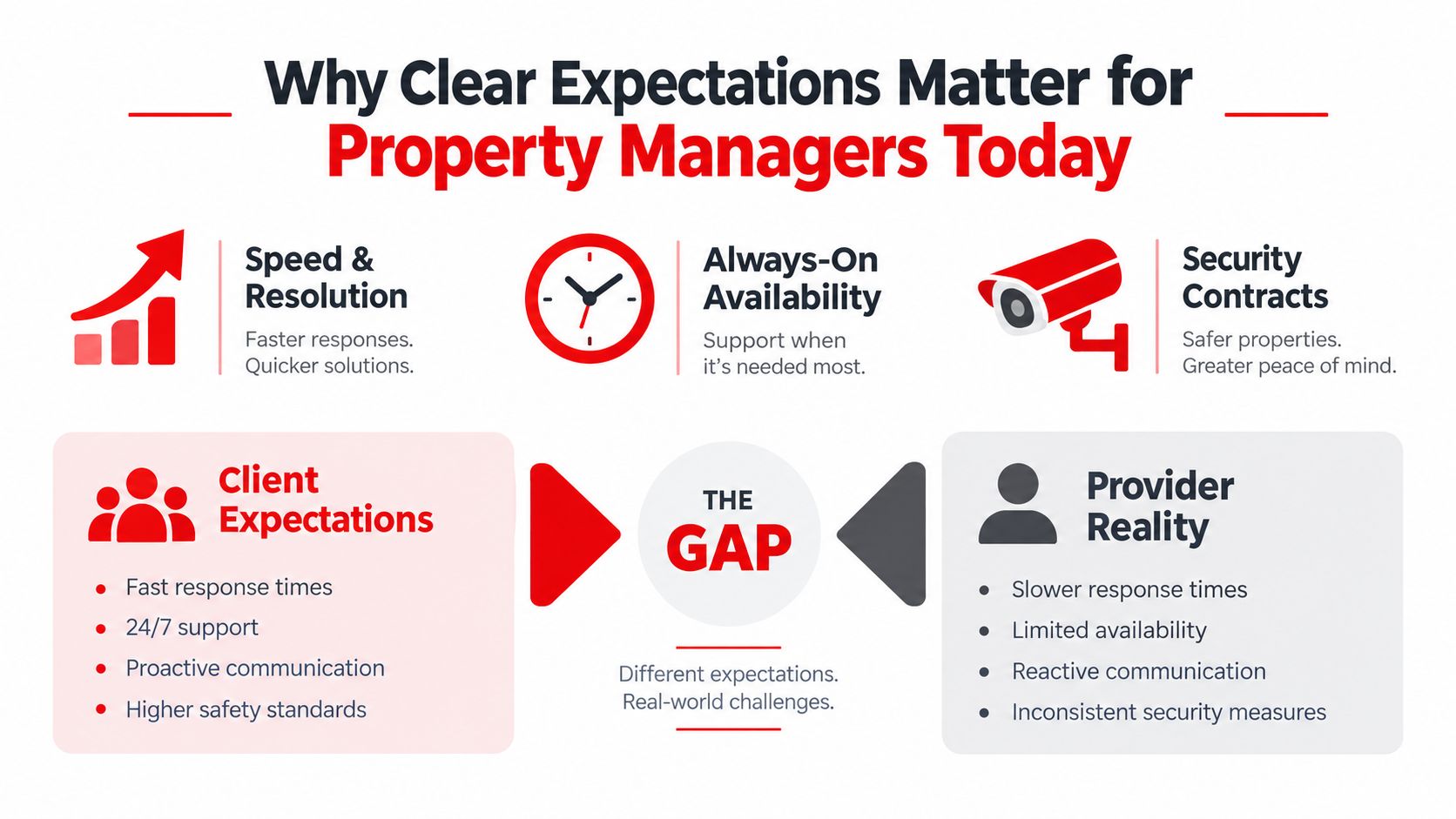
Property teams increasingly manage service in operational terms. Tenants want quick acknowledgment, retail managers need timely intervention, construction teams need reliable site checks, and healthcare facilities need dependable escalation. A visible officer still has value, but clients also judge service by what happens after an issue is reported.
A 2026 customer service roundup reported that 88% of customers expected faster response times than they did one year earlier, while 74% expected customer service to be available 24/7. The same roundup ranked speed of response at 63%, speed of resolution at 57%, and availability at 49% among the qualities customers value most in service interactions, as documented in this customer service statistics roundup.
Those figures don't create a universal security contract. They do show why property managers increasingly ask questions that older agreements often leave unanswered:
- Can someone acknowledge a concern outside normal office hours?
- How quickly does the assigned team begin the response?
- Who stays responsible until the issue is closed?
- How does the manager know a patrol occurred?
- What information appears in the report?
The expectation gap usually appears at failure points
Service-quality gap analysis highlights a recurring problem between what clients expect, what management believes was defined, what internal teams are instructed to do, and what officers deliver. The largest mismatches often involve responsiveness and reliability, rather than visible basics such as uniforms or general appearance, according to the SERVQUAL-style service-quality analysis.
That distinction matters. A property may have a clean lobby, a marked patrol vehicle, and a staffed post, yet still experience weak service if the officer doesn't know how to escalate a repeated trespass concern or if reports arrive without a usable timeline. Better expectations focus on the moments where the operation can fail.
Integrated contracts need more than one score
Security and facilities responsibilities increasingly overlap. A vendor may handle visitor interaction, patrol coverage, incident documentation, access concerns, and coordination with maintenance under one arrangement. That can reduce handoff failures, but it can also blur accountability unless each outcome is written separately.
For example, a mixed-use property might define:
- Patrol completion and checkpoint verification
- Visitor or delivery escalation
- Incident closure and report quality
- Communication latency between security and facilities
- Coverage continuity during breaks, absences, or shift changes
One overall “service quality” score can't explain which part failed. Multi-dimensional expectations make operational responsibility visible, especially when a retail center, residential community, or medical campus relies on coordinated action from several teams.
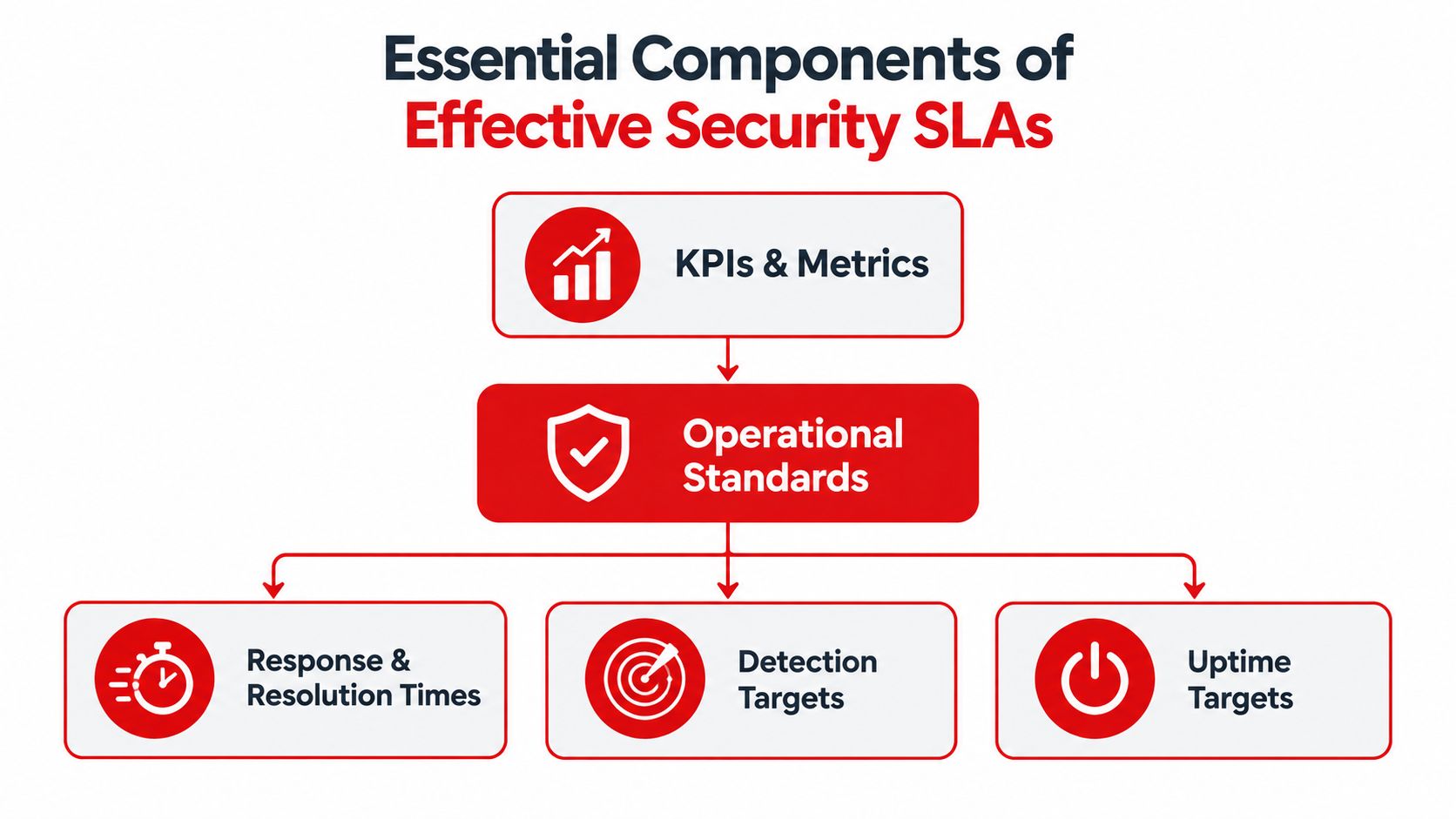
Essential Components of Effective Security SLAs
An effective security SLA connects the contract to daily work. It doesn't merely list desirable behavior. It tells the provider what outcome matters, who acts, when the action begins, how performance is recorded, and what happens if the first response doesn't solve the problem.
Security and facilities SLAs commonly convert broad promises into KPIs such as response time, time to detect, time to respond, resolution time, and uptime. Guidance on security service level agreements and measurable KPIs also emphasizes that targets should be clear and realistic because they become the basis for judging performance and assigning resources.
Start with the event, not the metric
A metric has meaning only when the event starts and ends clearly. “Fast response” is incomplete. A stronger definition might identify the start as the time a call enters the dispatch process, the response as acknowledgment or arrival, and resolution as the point when the officer documents the outcome or transfers ownership to a named contact.
Build the SLA around the property's real operating moments:
- Detection: How does the team learn about an alarm, access issue, welfare concern, or suspicious activity?
- Response: What action must the officer or dispatcher take first?
- Escalation: Which conditions require a supervisor, client contact, emergency service, or facilities partner?
- Resolution: What evidence shows that the immediate issue is controlled or transferred?
- Communication: Who receives the update, through which channel, and with what information?
This sequence prevents a fast acknowledgment from being mistaken for a completed response. It also helps managers decide whether a dedicated officer, shared patrol, concierge post, remote monitoring, or a combination fits the risk.
Reporting is part of the service
A security incident report should answer who, what, when, where, and how. It should use factual chronological order, describe the location and conditions when relevant, record actions taken, and separate observed facts from assumptions. The incident report guidance for security officers explains why reports should also be understandable to readers who don't work in security.
A daily activity report should identify the shift date and times, officer names or badge IDs, event times, specific locations, objective descriptions, actions, outcomes, and supporting photos or video when available. The daily activity report guidance also recommends recording entries in real time or immediately after an event rather than relying on end-of-shift memory.
People and technology must support the promise
A contract can require reliable patrols, but staffing stability and supervision determine whether the promise survives a difficult shift. Training, post orders, supervisor access, wellness checks, and clear relief procedures all belong in the operating model.
Technology adds verification. GPS-enabled patrols, digital reports, NFC checkpoints, and 24/7 SOC oversight can connect the written expectation to an actual record. Overton Security uses these tools alongside customized post orders, a low manager-to-client ratio, and officer support programs. Its service quality assurance approach describes the broader discipline of connecting field activity, supervision, reporting, and client review.
A strong SLA doesn't replace professional judgment. It gives professional judgment a reliable framework.
Sample Metrics and Contract Language by Property Type
The right service level depends on the property's exposure, operating hours, visitor activity, staffing model, and consequences of delay. A residential high-rise may prioritize concierge interaction and life-safety escalation. A construction site may prioritize perimeter checks, equipment protection, and evidence of completed patrols. A healthcare facility may need carefully defined communication and escalation across a complex operating environment.
Security-specific guidance uses concrete examples such as critical incident response within 15 minutes, security monitoring or detection uptime at 99.99%, vulnerability reports within 48 hours, and critical patches within 24 hours. These thresholds appear in security-specific service level guidance. They shouldn't be copied into every contract automatically. They illustrate how a vague promise becomes an assessable target.
| Property Type | Priority KPI | Example Threshold | Contract Language Tip |
|---|---|---|---|
| Residential high-rise | Resident concern acknowledgment and escalation | Define a documented response window for priority calls | State who contacts management, what the officer documents, and how concierge duties differ from security duties |
| Retail center | Incident response, patrol completion, and reporting | Use a defined response target for critical incidents | Separate customer-service interaction, loss-prevention support, patrol activity, and emergency escalation |
| Construction site | Perimeter checks, access control, and incident documentation | Tie each patrol to verified locations and timestamps | Coordinate post orders with the site plan and review risk management for construction firms for broader site-risk considerations |
| Healthcare facility | Escalation, response coordination, and report quality | Define priority levels and named contacts | Document privacy-sensitive reporting practices, handoffs, and communication responsibilities |
| Multi-site portfolio | Coverage continuity and standardized reporting | Use shared definitions across locations | Keep core KPIs consistent while adding site-specific measures for each property |
Dedicated and shared patrols also need different language. A shared patrol program should identify the assigned service area, required visit evidence, dispatch priority, and what happens when multiple properties need assistance at the same time. A dedicated vehicle patrol can use more site-specific requirements, including route priorities, access points, recurring hazards, and property-only escalation rules.
For portfolio managers, a common scorecard improves comparison, but identical thresholds can hide different risks. A distribution center, apartment community, parking garage, and medical office building shouldn't be judged solely by the same patrol measure. Use security performance indicators to organize the scorecard around outcomes that match each property's operating risk.
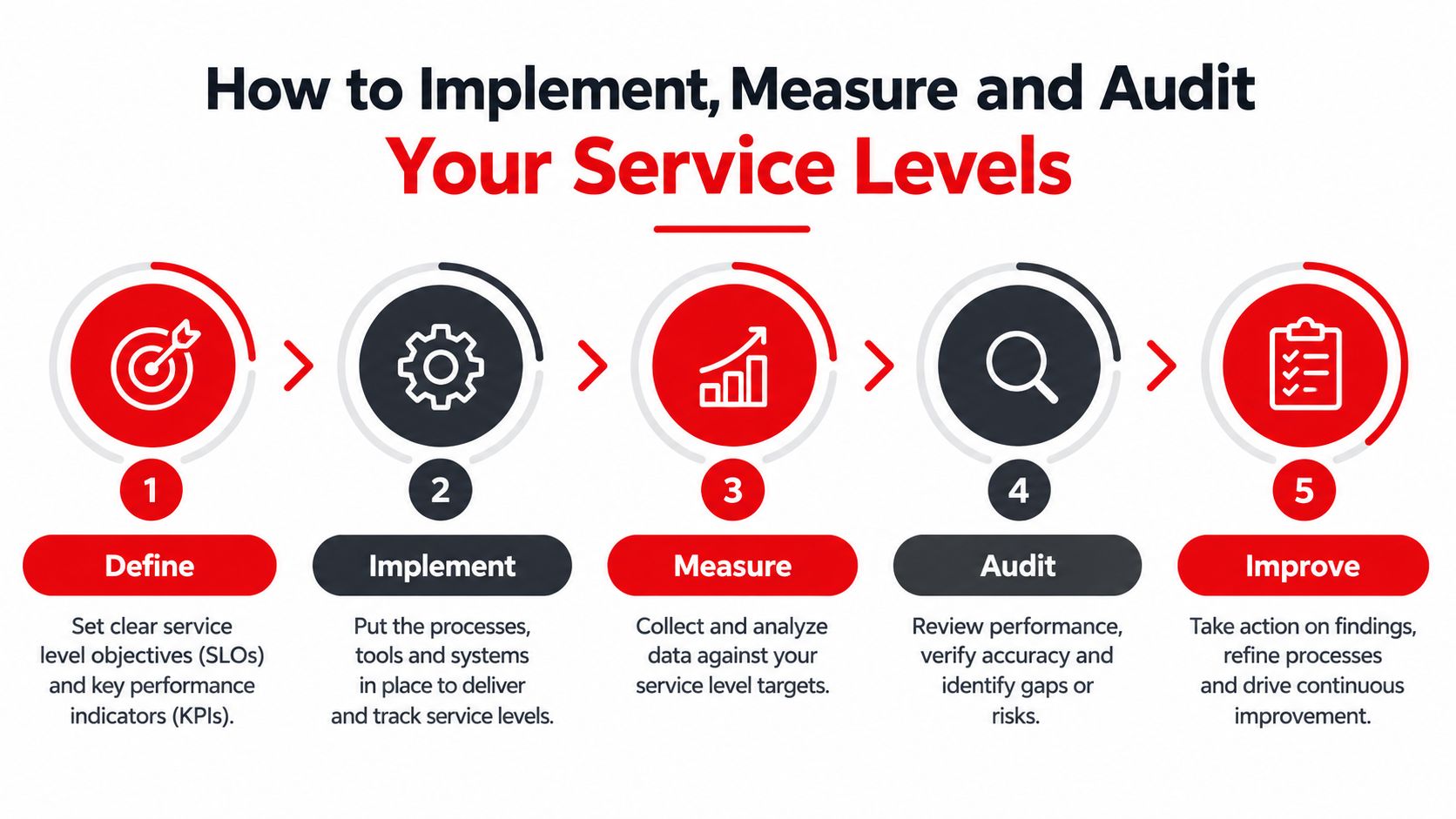
How to Implement Measure and Audit Your Service Levels
Writing a target is only the beginning. Implementation translates the contract into post orders, site maps, training, reporting channels, and a review routine that officers and managers can use during ordinary shifts.
Build the operating instructions
Start with a site walk. Mark entrances, vulnerable access points, loading areas, resident amenities, equipment zones, emergency equipment, employee areas, and locations where an officer must notify facilities or management. Then convert those observations into customized post orders that explain priorities, prohibited assumptions, contact details, and escalation conditions.
A practical implementation sequence looks like this:
- Define the event categories: Separate routine observations, service requests, urgent concerns, and critical incidents.
- Assign ownership: Name the officer, supervisor, dispatcher, SOC, client contact, and facilities contact for each escalation path.
- Configure verification: Place GPS or NFC checkpoints where a patrol must provide meaningful assurance, not create a convenient route.
- Train to the site: Review post orders with officers and use property-specific examples, such as a propped-open garage door or an unauthorized delivery.
- Set the review rhythm: Decide when managers receive daily reports, exception notices, incident updates, and performance summaries.
Digital tools help connect those steps. Guard-tour systems can automatically show checkpoints, timestamps, notes, and photos. NFC verification can timestamp each scan on the server and tie it to the exact checkpoint walked in the correct sequence, as described in this NFC patrol system overview.
Audit records for facts, not impressions
An audit should compare the agreed outcome with the available evidence. Review checkpoint completion, scan timestamps, report submission times, photo evidence, escalation records, and manager observations. A site visit still matters because records can confirm where an officer went, while direct observation can reveal whether the post orders remain practical.
The guard tour management process shows how digital patrol activity and reporting can support this kind of review. The strongest audits look for patterns, such as repeated missed locations, late handoffs, incomplete reports, or recurring issues that officers document without a clear owner.
Good documentation remains factual and chronological. It should tell a non-security reader what occurred, where it occurred, what the officer observed, what action followed, and what outcome was reached. Real-time entry is especially valuable because it reduces dependence on memory after a long shift.
Audit question: Can a new manager understand what happened from the record without calling three people to reconstruct the timeline?
Red Flags Common Gaps and Next Steps for Better Coverage
Stricter contract language doesn't automatically produce better service. A target that no team can meet consistently creates disputes, rushed work, and inaccurate reporting. The strongest agreements are specific about the points where a property is most likely to experience a failure.
Look for these red flags:
- Vague response language: “Promptly” or “as needed” appears without a defined event, owner, or measurement method.
- Unclear escalation: The contract doesn't identify who takes responsibility after the first officer notification.
- Thin reporting: Reports omit location, chronology, actions, outcome, or supporting evidence.
- Invisible patrols: The agreement requires rounds but provides no verifiable checkpoint or timestamp record.
- Unstable staffing: Frequent officer changes make site knowledge and consistent post-order execution difficult.
Retention deserves direct attention. A Berkeley Labor Center report reported 88.6% annual turnover in U.S. security services in 2024, compared with 66.0% for the private-sector average. A 2026 Trackforce benchmark also noted that over 40% of firms cited turnover as their biggest challenge, using the same linked report as its reference.
Review your current agreement by asking whether every major promise has a responsible person, a measurable record, a realistic target, and a defined recovery step. Overton Security brings 26 years of experience, hands-on leadership, supported officers, GPS-enabled patrols, digital reporting, and 24/7 SOC oversight to customized security programs across California, including Los Angeles, San Jose, San Diego, Sacramento, San Francisco, Oakland, Long Beach, and Fresno.
Visit Overton Security to review service level expectations for your property, whether you need unarmed guards, concierge security, vehicle patrols, construction site coverage, or remote monitoring. Ask the team to map your contract promises to post orders, escalation ownership, and verifiable reporting so your security program is measurable in the moments that matter.