A hospital facilities director usually sees the pressure before anyone else does. Morning shift change is underway, a vendor is waiting at receiving, a family is trying to reach a patient floor, pharmacy staff need uninterrupted movement, and security gets a call about a door that was propped open near a restricted corridor. Nothing about that scene is unusual. That's exactly why hospital access control systems matter so much.
In healthcare, access control isn't just a way to lock doors. It shapes how people move, how quickly staff can work, how sensitive areas are protected, and how incidents are handled when the day stops being routine. A weak setup creates workarounds. A well-run one supports care without adding friction.
The most useful way to think about access control is as part of a broader operating model. Credentials, readers, software, video, officers at key posts, and Security Operations Center oversight all need to work together. If one piece is isolated, the system gets slower, less reliable, and harder to trust when something goes wrong.
Securing the Modern Hospital Campus
At most hospitals, the challenge isn't a single front door. It's the constant movement across an entire campus that never really closes. Staff rotate through units. Visitors arrive with different levels of authorization. Vendors need short-term access. Patients move between public and clinical spaces. Security has to protect the pharmacy, labs, behavioral health areas, loading docks, IT rooms, and medication storage without turning the hospital into a bottleneck.
That's why hospital access control systems work best when they're treated as operating infrastructure, not a hardware purchase. A badge reader on one door doesn't solve much if permissions are too broad, visitor access is still handled on paper, and no one can quickly verify whether an alarm is real or a nuisance event. The system has to support care delivery while reducing avoidable risk.
A lot of healthcare leaders are also looking at physical access and digital access together now. If you're reviewing broader healthcare information system security, it's worth viewing physical entry controls and identity controls as part of the same risk picture. The person who can enter a server room, medication area, or records office has influence over more than a door.
What a practical approach looks like
The hospitals that manage access well usually do a few things consistently:
- They define zones clearly. Public, staff-only, clinical, and highly restricted areas are treated differently.
- They match access to actual job function. A nurse, pharmacy tech, contractor, and EVS worker shouldn't carry the same permissions.
- They plan for exceptions. Shift coverage, emergency access, and after-hours vendor support are built into policy instead of handled ad hoc.
Practical rule: If staff regularly need someone to “just let them in,” the access design is probably wrong.
Physical security planning also has to account for people, not just devices. An officer at a reception point can catch behavior a credential system won't. A remote operator can spot patterns across multiple entrances that local staff might miss. That combination is a big part of what makes a healthcare security program resilient in practice. For organizations comparing service models alongside technology, a healthcare-focused security program like health care security services should be evaluated on both system design and day-to-day response capability.
Understanding the Core Components
At a hospital, a door decision has to hold up under pressure. A nurse coming onto a unit at shift change, a pharmacist entering a medication room, and an officer responding to a door-held-open alarm all depend on the same system, but they use it in different ways. Good access control design accounts for both the hardware at the opening and the people responsible for acting on what the system reports.

Credentials and readers
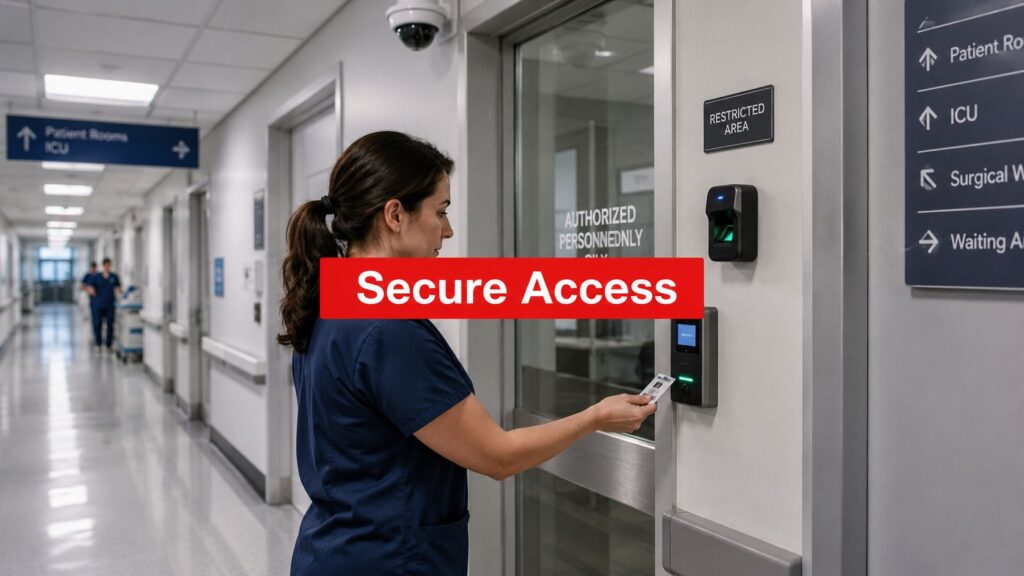
Credentials are what staff, contractors, and approved visitors present to request entry. In a hospital, that usually means badges, keycards, fobs, mobile credentials, PINs, or biometric factors. The right choice depends on traffic volume, infection control considerations, staffing patterns, and how much certainty the opening requires.
Readers are the front line of that decision.
In practice, hospitals usually need a mix rather than one standard device across every opening:
- Badge and card readers fit general staff circulation, support offices, and controlled interior corridors.
- Mobile credentials help with temporary staff, frequent permission changes, and cases where replacing lost cards creates avoidable administrative work.
- Biometric readers make more sense in spaces where confirming identity outweighs throughput concerns.
- PIN-enabled readers add a second factor in locations where a badge alone is not enough.
A common design mistake is forcing the same credential method onto every door. An emergency department staff entrance, a maternity unit, and a server room have different risk profiles and different workflow demands. If the method slows care delivery or creates frequent workarounds, staff will find another way through the door.
Locks, controllers, and door peripherals
Locks secure the opening. Controllers apply the access rules and tell the lock what to do. Door contacts, request-to-exit devices, and forced-door or held-open sensors provide the event detail that security teams need to tell the difference between normal use, a maintenance issue, and a developing incident.
That distinction matters on a busy campus. A held-open alarm at a loading dock may call for an officer check. The same condition at an infant protection area may need an immediate response from both on-site personnel and the security operations center.
The basic sequence is straightforward. The credential identifies the user. The reader captures the request. The controller checks permissions, schedules, and door logic. The lock either releases or stays secure.
Hospitals do not need the most complex hardware package. They need equipment that works consistently during overnight staffing gaps, emergency access events, and routine wear from constant use.
Software is where control resides
The software platform manages users, permissions, alarms, audit trails, and operator workflows. It also determines how well the system supports the people behind it. If a security supervisor, badging administrator, or SOC operator cannot understand what they are seeing quickly, response quality drops.
Strong platforms handle a few functions reliably:
| Component | What it should do well |
|---|---|
| User management | Assign permissions by role, department, location, and schedule |
| Event logging | Record granted, denied, forced, and held-open events in a way operators can review quickly |
| Alerts | Surface abnormal activity fast enough for officers or remote monitors to act |
| Reporting | Produce audit trails that support investigations, compliance reviews, and management decisions |
Ease of administration has direct security impact. If access changes take too long, terminated users remain active longer than they should, temporary permissions stay in place, and departments start asking for broad exceptions. Hospitals evaluating platforms should compare the underlying access control devices and system options against the daily workload of badge office staff, supervisors, and monitoring personnel.
The strongest hospital programs do one more thing well. They make sure the system's signals reach trained people who know how to respond. A denied access attempt after hours at a pharmacy door may be harmless, or it may be the first indicator of a larger problem. Technology records the event. On-site officers and SOC personnel provide the judgment that turns that event into an appropriate response.
Integrating Access Control with Your Security Ecosystem
At 2:13 a.m., a badge is denied at a pharmacy door, then the same person appears on camera near a staff entrance on the other side of the building. If access control, video, alarms, and dispatch all sit in separate systems, the hospital loses time while operators piece the story together. In a busy clinical environment, those minutes matter.
An integrated security setup gives the SOC, onsite officers, and supervisors a shared operating picture. Access events should connect to camera views, intercom activity, intrusion alarms, visitor records, and incident workflows so one event can be checked, classified, and escalated without switching between screens or calling three different teams for context.

Why integration changes response quality
A forced door alarm means very little by itself. An officer or SOC operator needs to know what camera covers the opening, whether a valid credential was used nearby, whether the door was scheduled to be open, and whether anyone already called in a delivery or maintenance request.
That context changes the response. Security can clear a routine exception quickly, or treat it as a developing incident and send the right person to the right place. The benefit is not just speed. It is fewer bad assumptions, fewer unnecessary dispatches, and better coverage for the events that are high risk.
A connected environment usually improves four areas:
- Visual verification so operators can confirm who presented a badge and whether anyone followed through the door without authorization
- Alarm triage so access activity, intrusion signals, and intercom calls are reviewed together
- Investigations because video, door history, and operator actions can be reviewed as one timeline
- Escalation from SOC monitoring to onsite officers with clear, usable details instead of partial information
The human layer matters at every decision point
Hospitals do not get better security just by adding integrations. They get better security when those integrations support trained people with clear post orders and escalation paths.
A denied badge after midnight may point to a harmless mistake, an expired credential, an employee at the wrong door, or a person testing whether anyone is watching. Software can surface the event. Human responders decide whether to call the unit, speak through an intercom, review live video, dispatch an officer, or document and monitor.
The strongest programs treat technology and staffing as one operating model. SOC personnel filter noise and confirm details before waking up a supervisor. Onsite officers handle the physical response, check welfare issues, and manage the human side of the encounter. Security leaders evaluating integrated security system design for hospitals and other complex facilities should judge the setup by one standard: does it help people make faster, better decisions under pressure.
The goal is better judgment with better information.
Meeting Critical Compliance and Life Safety Standards
At 2:00 a.m., a badge works at a pharmacy door for someone who should never have had access after their shift ended. The system recorded it. The real question is why the permission was still active, who reviews that exception, and how quickly security and operations can correct it before it happens again.
That is what compliance looks like in a hospital. It is not just a reader on the wall or a report saved for survey day. It is a working control set that matches policy, staffing reality, and life safety requirements.
A peer-reviewed national survey found that only 23.7% of health systems restricted access to controlled-substance areas by specific work area, which points to a common gap between written policy and day-to-day access design (peer-reviewed survey summary on hospital access control).

Audit trails are only useful if permissions are disciplined
Hospitals need a defensible record of who accessed medication storage, IT rooms, records areas, labs, and other restricted spaces. Logs matter during investigations, audits, diversion reviews, and internal disputes. But a long audit trail does not solve overpermissioning. If broad groups can get through the same door, the report only proves the weakness existed.
The better approach is tighter governance across the full access lifecycle:
- Role-based permissions tied to department and actual job responsibility
- Time-based rules for staff, contractors, vendors, and after-hours exceptions
- Review of exception events such as forced-open doors, held-open alarms, and repeated denials
- Clear ownership for granting, changing, suspending, and revoking access
This is also where the human side of the program shows up. HR may initiate onboarding. IT may feed identity data. Department leaders often request access. Security manages the doors, the alarms, and the response. Without one accountable process owner, privileges drift, exceptions pile up, and no one catches the mismatch until an incident or inspection exposes it.
SOC personnel and on-site officers both have a role here. The SOC can monitor unusual access attempts, confirm whether an event matches a known staffing exception, and escalate cleanly. On-site officers can verify the person at the door, check with the unit, and document what happened in a way compliance staff can readily use later.
Life safety can't be an afterthought
Hospital doors do more than keep people out. They have to support egress, fire response, infant protection, behavioral health protocols, and selective lockdowns without creating confusion for staff or delay for patients.
That means security, facilities, compliance, clinical leadership, and life safety teams need to agree on door behavior before the system goes live. A lockdown rule that looks good on paper can fail badly in practice if nurses cannot move where they need to go, if responders hit conflicting release logic, or if a fire alarm sequence overrides a security plan no one tested.
Field note: The right question is, “How will this door behave during fire alarm, infant abduction response, behavioral health escalation, and emergency egress, and who has validated each scenario?”
In working hospitals, validation should include both the technology response and the people response. SOC operators need clear procedures for alarm receipt, camera verification, mass notification, and escalation. On-site officers need post orders that tell them where to stage, which doors should release, who has override authority, and how to support clinical teams during a fast-moving event.
Compliance and safety need the same design discipline
The strongest programs treat compliance and life safety as one design problem, not two separate checklists.
| Priority | Weak approach | Better approach |
|---|---|---|
| Data and medication protection | Broad access groups and manual exceptions | Specific permissions by role, area, and schedule |
| Emergency response | One generic lockdown rule | Predefined responses by zone and incident type |
| Inspection readiness | Pull logs after a problem | Maintain reviewable records continuously |
Hospitals rarely face trouble because a policy document was missing. Problems start when the operating environment no longer matches the written standard, and no one in security, operations, or compliance catches the drift soon enough.
Operational Best Practices for a Secure Campus
At 2:15 a.m., the access control system matters less as a piece of software and more as an operating discipline. An agency nurse needs entry to a med room she was just assigned to. A contractor badge should still open the plant corridor but nowhere near patient care. The SOC sees a door held open at a staff entrance, and the on-site officer has to decide within seconds whether it is normal shift traffic or the start of a problem. Good hospital access control supports those decisions because the rules are clear, the exceptions are limited, and the people monitoring the system know what normal looks like.
Least privilege is still the foundation. In a hospital, that means giving each person access only to the areas and schedules tied to the work they perform. The value is practical. Fewer unnecessary permissions mean fewer cleanup tasks after staffing changes, fewer badging shortcuts, and a smaller investigation set when something goes wrong.
Build the campus in layers
A workable campus model usually starts with four access layers:
- Public zones such as lobbies, waiting areas, and approved visitor circulation paths
- Operational staff zones such as back offices, supply areas, staff corridors, and nonpublic elevators
- Clinical restricted zones such as treatment areas, nursing support spaces, and certain patient care wings
- High-risk zones such as pharmacies, medication rooms, labs, infant protection areas, and infrastructure rooms
That structure helps technology and personnel do their jobs together. The system applies the rule at the door. The SOC watches for exceptions inside each zone. On-site officers respond with better context because they know whether a person is out of place or moving through an approved route.
Hospitals get into trouble when zoning exists on a diagram but not in daily operations. If a badge group is too broad, officers start seeing alarms they cannot trust. If staff regularly borrow access because provisioning is slow, the audit trail stops reflecting reality.
Treat temporary access as a controlled workflow
Temporary access causes more avoidable risk than many hospitals expect. Agency staff, students, vendors, construction teams, and after-hours specialists all need entry, but they do not need the same approval path, escort rules, or expiration period.
The safer approach is to build temporary access around the actual task and the actual path of travel. A biomedical vendor may need the loading dock, one elevator, a storage room, and a treatment area for a defined window. A contractor working overnight in a mechanical space should not be able to drift into a patient unit because the badge template was easier to assign.
Three operating rules make a real difference:
- Set expiration by default. Temporary credentials should shut off automatically unless someone renews them for a stated reason.
- Assign a sponsor. A department leader, project manager, or facilities contact should confirm the need and own the request.
- Limit movement. Grant the doors required for the job, not the whole building or campus.
This is also where the human layer matters. SOC operators should be able to see whether a temporary credential is active, who approved it, and which route was intended. Officers need post orders that tell them what to check when they encounter a vendor or contractor after hours.
Plan for exceptions before the day gets busy
Hospitals do not stay static for long. Staff float. Clinics run late. Behavioral health patients may require movement restrictions. A family dispute can change visitor access in minutes. The access control plan has to support those operational shifts without forcing security staff to improvise at the worst time.
Strong programs define exception handling in advance. That includes who can approve temporary changes, how those changes are logged, when the SOC must verify by camera, and when an officer should respond in person. In my experience, effective exception handling distinguishes good systems from merely expensive ones. A platform can have every feature on paper and still create risk if the frontline team cannot apply those features cleanly during a crowded shift.
One practical test helps. Pick three common exception scenarios, then walk them from request to resolution. Floating nurse. After-hours vendor. Partial lockdown of a maternity area. If the badge rules, SOC workflow, officer response, and clinical communication all hold together, the campus is usually in good shape. If they do not, the problem is rarely just the software. It is the gap between the system design and the people expected to run it.
Least privilege works best when it is supported by trained personnel, disciplined badge administration, and active monitoring. That combination gives hospitals tighter control without making the campus harder to operate.
Your Procurement and Implementation Checklist
Buying hospital access control systems gets expensive when a facility chooses based on features alone. A cleaner process starts with operational questions. How many credential groups need to exist? How quickly does your organization change permissions? Who owns visitor approval? What happens when HR, facilities, security, and IT disagree about access?
The strongest procurements usually come from hospitals that evaluate software workflow, integration maturity, and support structure just as closely as readers and locks.

Questions worth asking before you buy
Use these questions to pressure-test any vendor or integrator:
Can the system scale by campus and by building?
Expansion shouldn't force a redesign every time a new clinic, wing, or leased medical office comes online.How are permissions created and revoked?
If deactivation depends on manual follow-up, the hospital is carrying unnecessary risk.Can the system support security zones with different rules?
A good platform should handle public access, staff-only circulation, and high-risk areas without clumsy workarounds.What happens during an outage or communications failure?
Doors still need predictable behavior. Staff need a clear fallback process.How are incidents reviewed after the fact?
If event review is difficult, investigations will be slow and inconsistent.
Visitor management deserves its own review
Hospitals often underestimate how much risk sits inside visitor processes. Independent healthcare guidance recommends automated, time-limited credentials linked to electronic locks and elevators so visitors can enter only approved zones for a defined period, replacing paper logs that can't enforce real-time restrictions or support rapid audits (healthcare visitor access control guidance).
That leads to a second set of procurement questions:
- Can visitor credentials expire automatically?
- Can elevators and doors enforce approved destinations?
- Can staff preauthorize a visitor without creating lobby confusion?
- Can the system produce a searchable log without relying on paper records?
Implementation usually succeeds or fails on governance
The hardware install is rarely the hardest part. The harder part is deciding who approves access, who audits it, and how often those decisions are reviewed. Without governance, even good systems turn messy.
A practical rollout checklist should include:
| Decision area | What to confirm |
|---|---|
| Ownership | Which team grants, changes, and revokes access |
| Training | Whether supervisors and officers know exception workflows |
| Testing | Whether lockdown, egress, and door-held scenarios were validated |
| Support | Who responds when a critical access point fails |
Some facilities also choose a service partner that can bridge technology and operations. For example, Overton Security provides onsite officers, remote monitoring, and Security Operations Center support that can complement access control infrastructure where hospitals need active oversight beyond the installed system.
Buy the system your team can operate consistently, not the one that looks most impressive in a demo.
Partnering for Success Integrating Systems and Services
At 2:00 a.m., a badge event at a pharmacy door can mean several different things. It may be a nurse with a valid need, a contractor at the wrong entrance, or the first sign of a larger problem. The reader records the event. Software applies the rule set. A safe outcome still depends on people who can assess intent, verify status, and respond without slowing hospital operations more than necessary.
That gap shows up fastest during abnormal conditions. Gallagher's review of healthcare access control points out that many systems are configured for routine traffic and need stronger planning for lockdowns, emergency exceptions, and coordinated human response during high-stress events (Gallagher on healthcare safety and access control).
Technology should handle identity, permissions, schedules, and alarm generation. Officers and SOC personnel handle judgment.
A restricted movement order in a behavioral health unit is a good example. The system can secure selected doors and preserve approved egress paths, but it cannot calm a confused visitor, redirect family members, or help a charge nurse manage traffic at the unit threshold. In the emergency department, a surge can change entry patterns in minutes. Remote monitoring staff may need to watch several cameras at once, confirm whether a door alarm reflects misuse or clinical urgency, and relay clear instructions to on-site officers before congestion turns into a safety issue.
That is why dependable hospital security is built as an integrated operating model with defined roles, escalation paths, and shared visibility. Hardware and software create control points and event data. Trained personnel turn those signals into action that fits the moment.
For California hospitals and medical campuses, that partnership often matters as much as the system design itself. Overton brings long experience supporting complex properties with on-site officers, SOC oversight, manager support, and accountability tools that help supervisors confirm coverage and response. In practice, that means a hospital is not relying on doors, badges, and alerts alone. It has a service structure that can help convert policy into day-to-day control during routine operations and during the moments that test the program.