
In today's world, managing who comes and goes from your property is more critical than ever. Whether you're a property manager for a Class A office building in Los Angeles, an HOA board member in a San Jose residential community, or a superintendent protecting a valuable construction site in San Diego, a single unsecured entry point can lead to significant losses and liability. Traditional locks and keys are no longer sufficient. Today’s risks require a thoughtful, layered approach that combines smart policy with dependable execution.
This guide moves beyond generic advice to deliver 8 essential access control best practices that form the bedrock of a robust security program. We'll explore how blending strategic frameworks like the Principle of Least Privilege with reliable human oversight creates a truly secure environment. These are actionable strategies you can implement to fortify your property's defenses, protect your assets, and ensure peace of mind.
1. Principle of Least Privilege (PoLP): Granting Access on a Need-to-Know Basis
The Principle of Least Privilege (PoLP) is a foundational concept in both digital and physical security. It dictates that any user or system should have only the bare minimum permissions necessary to perform its specific function. This is a cornerstone of modern access control best practices, shifting the mindset from "who needs access?" to "what is the absolute minimum access this role requires?"
By strictly limiting permissions, you drastically reduce your property's exposure to risk. A lost keycard or a leaked passcode can cause significantly less damage when access is confined to only essential areas. This isn't about fostering distrust; it is a calm, strategic method of risk mitigation.
How PoLP Works in Practice
Implementing this principle forces a clear definition of every role and its corresponding access needs, creating a more organized and defensible security posture.
- For a Janitorial Team: Their access fobs might be programmed to work only between 10 PM and 6 AM, and only grant entry to common areas and specific utility rooms, not individual tenant suites or sensitive data centers.
- For a Temporary Contractor: Instead of a master key, they receive a temporary badge that provides access exclusively to the project area and only for the duration of their contract.
- For an HOA Pool: A resident's keycard is programmed to unlock the pool gate only during designated hours, preventing unauthorized after-hours use and limiting liability.
At Overton Security, a company with 26 years of experience, our professional officers are trained to understand and enforce these granular access rules. Our hands-on leadership ensures that post orders clearly define who is authorized to be where, making our team an intelligent layer of enforcement for your PoLP policies.
2. Multi-Factor Authentication (MFA): Adding Layers to Your Digital Keys
Multi-factor authentication moves beyond the single point of failure of a simple password or keycard. This security method requires a user to provide two or more distinct verification factors to gain access, creating a layered and significantly more robust defense. It operates on the principle of combining something you know (like a password), something you have (like a phone or a key fob), and something you are (like a fingerprint).
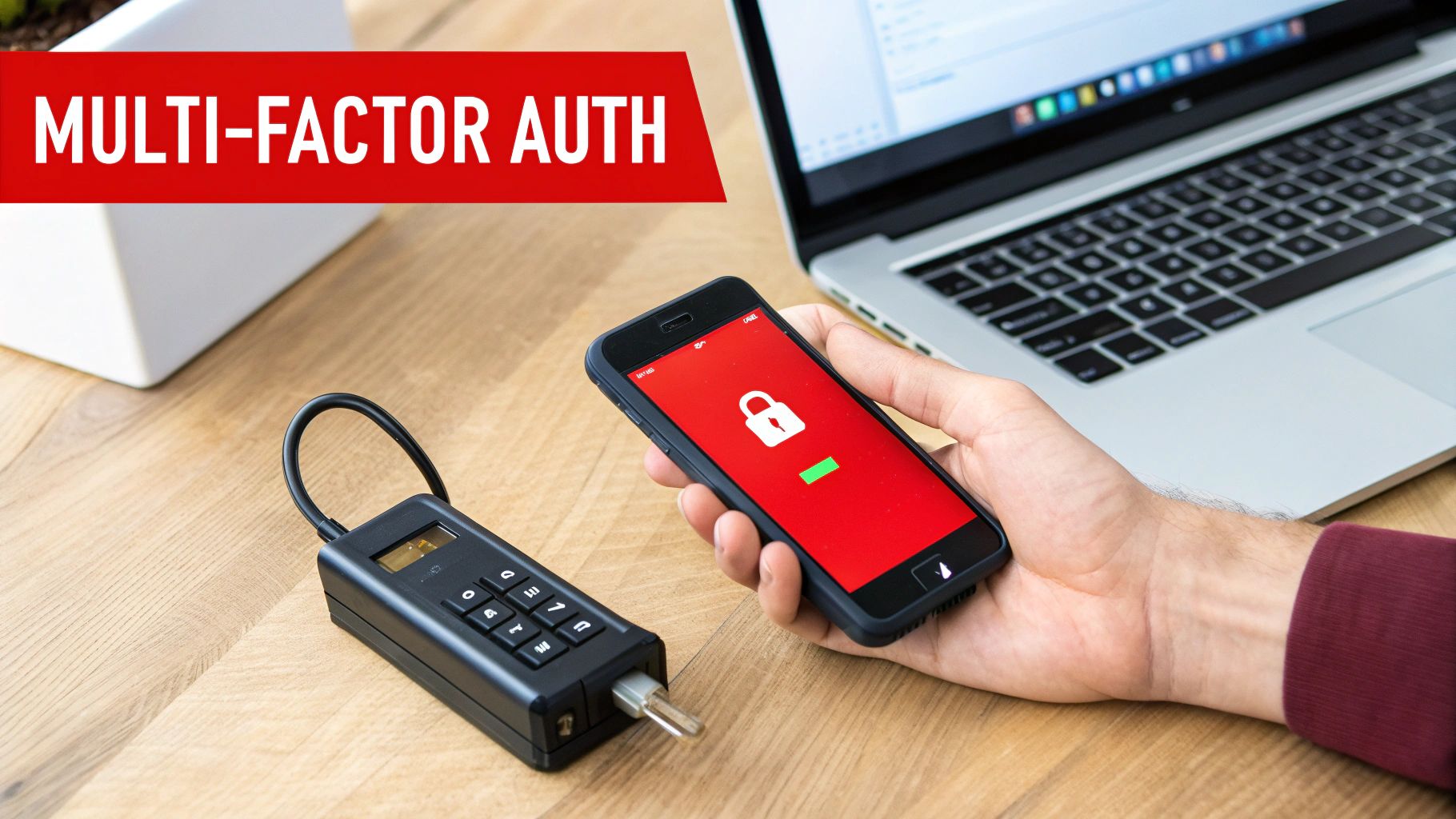
Even if someone steals a password or clones a keycard, they would still be blocked without the second required factor. This makes MFA one of the most effective access control best practices for protecting sensitive data and high-value areas. Its widespread adoption underscores its critical role in modern security.
How MFA Works in Practice
Implementing MFA adds a crucial verification step that confirms a user’s identity before granting access, making unauthorized entry exponentially more difficult.
- For Administrative Portals: A property manager logging into the building’s security system would first enter their password (something they know) and then approve a push notification sent to their company smartphone (something they have).
- For High-Security Areas: Access to a data center might require an employee to swipe their ID badge (something they have) and then scan their fingerprint on a biometric reader (something they are).
- For Resident Amenity Access: A resident booking a community clubhouse online might need their password and a one-time code sent via SMS to their registered phone number, preventing fraudulent reservations.
At Overton Security, we recognize that digital security is just as important as physical security. We blend human expertise with smart technology, ensuring our on-site personnel can assist users and verify identities, making sure technology and human oversight work in tandem to protect your property.
3. Role-Based Access Control (RBAC): Streamlining Permissions at Scale
While the Principle of Least Privilege defines what access is needed, Role-Based Access Control (RBAC) provides an efficient framework for how to manage it. RBAC is a method of restricting access based on a person’s job function or role. Instead of assigning dozens of unique permissions to each individual, you assign permissions to a role, and then assign individuals to that role. This is a critical component of modern access control best practices, especially for larger organizations or multi-site portfolios.
This approach simplifies administration, improves security consistency, and makes your entire access system more scalable. When a new person joins the team or an employee changes jobs, you simply assign them to the new role, and they instantly inherit all the necessary permissions—no more and no less.

How RBAC Works in Practice
Implementing RBAC creates a clear, manageable structure that prevents the chaos of managing individual permissions. It shifts the focus from individual users to their functional responsibilities.
- In a Hospital: A "Nurse" role would have keycard access to patient floors and medication rooms. A "Surgeon" role would have all of that plus access to operating theaters. An "Administrator" role would have office access but not clinical areas, supporting HIPAA compliance.
- In a Corporate Office: You might create a "Marketing Team" role that grants access to the main office and their specific department wing. An "Executive" role would have broader access, including the boardroom and executive suites.
- For a Multi-Site Retail Chain: A "Store Manager" role template can be applied across all locations, granting access to the sales floor, stockroom, and cash office, ensuring consistency from a store in Los Angeles to one in San Diego.
At Overton Security, we know that effective access control is a blend of technology and human oversight. Our security officers are trained to understand your property's RBAC policies. They don't just see a keycard swipe; they recognize who should be in a specific area and are empowered to verify access, ensuring your role-based rules are upheld in the real world.
4. Zero Trust Architecture: Never Trust, Always Verify
Zero Trust Architecture is a security model that fundamentally inverts the traditional "trust but verify" approach. It operates on the decisive principle of 'never trust, always verify.' This framework assumes that threats exist both outside and inside your property's network, eliminating the outdated concept of a trusted internal zone.

This model requires strict identity verification for every person and device trying to access a resource, regardless of their location. Implementing Zero Trust is a crucial step in creating a resilient security ecosystem, making it one of the most effective access control best practices for protecting high-value assets. It hardens your defenses by assuming a breach is always a possibility.
How Zero Trust Works in Practice
Implementing a Zero Trust model involves continuously analyzing and validating access requests against a strict set of policies. It's a strategic approach to security architecture.
- For a Corporate Campus: An employee attempting to access a server room from their office computer would still need to re-authenticate, perhaps using an MFA app on their phone. The system verifies their identity and device before granting access for that specific session.
- For a Medical Facility: A doctor accessing patient records on a hospital-provided tablet must have their credentials and device validated for every access request, preventing unauthorized data access even from a seemingly secure device.
- For a Smart Building System: A facilities director trying to adjust HVAC settings via a remote portal would undergo rigorous verification. The system checks not just their login, but also the security status of the network they are using.
Overton Security understands that technology alone is not enough. Our security officers act as the human element of your Zero Trust policy, trained to physically verify identities and cross-reference permissions defined in our real-time digital reporting systems. This blend of smart technology and human oversight ensures your verification protocols are enforced at every entry point.
5. Regular Access Reviews and Audits
Access permissions are not static; they should evolve with your property’s needs and personnel changes. Regular access reviews and audits are the critical maintenance tasks that keep your system secure over time. This process involves systematically examining user access rights to confirm all permissions are still appropriate and necessary. This is a core tenet of effective access control best practices.
Without this crucial step, "access creep" occurs, where employees and vendors accumulate permissions they no longer need, creating security vulnerabilities. A regular audit is your proactive defense, allowing you to identify and remove outdated credentials and inappropriate permissions before they can be exploited. This systematic verification ensures your access control policy reflects current realities.
How Regular Audits Work in Practice
Implementing a consistent review cycle transforms access control from a "set it and forget it" system into a dynamic security asset.
- For a Commercial High-Rise: A quarterly review, led by the property manager, involves checking the access logs for all employees, tenants, and vendors. They would verify that a former tenant's keycards have been deactivated and that a vendor who completed a project six months ago no longer has access.
- For a Construction Site: The superintendent would regularly review who has 24/7 access to the site and equipment storage, cross-referencing this list with current subcontractor rosters to revoke any unnecessary privileges immediately.
- For an HOA Board: Annually, the board reviews access credentials for amenities like pools and fitness centers, ensuring only current, dues-paying residents have active keycards.
A robust access control system is only as strong as its ongoing management. Overton Security can assist by providing detailed activity reports from our patrols, which serve as valuable, real-world data for your access audits. This helps you validate if your programmed rules are being followed on the ground.
6. Privileged Access Management (PAM): Securing High-Risk Accounts
While PoLP limits what everyday users can access, Privileged Access Management (PAM) provides a higher level of scrutiny for accounts that hold the keys to your most critical systems. PAM is a security strategy designed to control and monitor access for privileged users like system administrators and facilities directors. These accounts, if compromised, represent the greatest risk.
Implementing a PAM strategy is a crucial component of modern access control best practices, particularly as digital and physical systems become more integrated. It addresses the significant threat posed by elevated permissions, ensuring that even your most trusted users operate within a secure, monitored, and accountable framework.
How PAM Works in Practice
A robust PAM system inventories all privileged accounts and enforces strict policies, creating an audit trail for every high-stakes action.
- For an IT Administrator: Instead of using a single, powerful password, the administrator would "check out" credentials from a secure vault for a specific task. Their session is recorded, and the password is automatically changed once the task is complete.
- For a Third-Party HVAC Vendor: To access a building's management system, the vendor is granted temporary, "just-in-time" access that is limited only to the systems they need to service and automatically expires after their scheduled maintenance window.
- For Emergency "Break-Glass" Scenarios: If a system fails and an administrator needs immediate, overriding access, a break-glass procedure grants the necessary permissions but also triggers instant alerts to multiple stakeholders, ensuring the event is documented.
At Overton Security, we understand that access control extends beyond physical doors. Our consultation services help you identify both physical and digital vulnerabilities, ensuring your policies for privileged access are aligned with your on-site security protocols for a truly unified defense.
7. Attribute-Based Access Control (ABAC): Dynamic, Context-Aware Permissions
Attribute-Based Access Control (ABAC) represents an evolution from rigid, role-based systems to a more flexible and intelligent authorization model. It makes access decisions not just based on who a person is, but on a combination of their attributes, the resource's attributes, and the environmental context. This is one of the most powerful access control best practices for complex and dynamic environments.
ABAC evaluates policies in real-time by asking questions like: Is this employee on the data science team? Are they accessing the file during business hours? Are they connecting from a company-managed device? If all conditions are met, access is granted, creating a fine-grained and highly secure framework.
How ABAC Works in Practice
Implementing ABAC allows you to build sophisticated, context-aware rules that adapt to changing conditions without needing to constantly re-assign roles.
- For a Healthcare System: A doctor's access to patient records could be granted only if the doctor is currently on-shift (user attribute), the patient has provided consent (object attribute), and the access request originates from within the hospital's secure network (environment attribute).
- For a Government Facility: An analyst can access a classified document only if they hold a "Top Secret" clearance (user attribute) and the current threat level for the facility is below "High" (environment attribute).
- For a Tech Company: A developer can push code to a production server only from a corporate laptop (environment attribute), between 9 AM and 5 PM on a weekday (environment attribute), and after a peer-review ticket has been approved (action attribute).
Overton Security recognizes that modern security risks are not static. Our 24/7 Security Operations Center (SOC) and on-site officers can be integrated into your ABAC logic, acting as the human verification point for policy exceptions or high-stakes access events, ensuring your dynamic rules are enforced with real-world judgment.
8. Single Sign-On (SSO) with Centralized Identity Management
Managing countless passwords for different systems is a source of user frustration and a significant security risk. Single Sign-On (SSO) is an authentication scheme that allows a user to log in with a single ID and password to gain access to multiple, independent software systems. When paired with a centralized identity management platform, it streamlines user access and strengthens security.
This approach is a crucial element of modern access control best practices. Instead of securing dozens of separate entry points, you secure one primary gateway. This simplifies user experience, reduces password fatigue, and provides a single point for enforcing robust security policies and monitoring access across your entire digital ecosystem.
How SSO Works in Practice
Implementing SSO centralizes authentication, giving administrators a unified dashboard to manage permissions and instantly revoke access when an employee or vendor relationship ends.
- For a Commercial Property Management Firm: A property manager can use one set of credentials to access their email, the building management system, the tenant portal, and accounting software without logging into each one separately.
- For a Corporate Campus: Employees can use their company login to seamlessly access everything from their HR platform and project management tools to shared network drives.
- For a Retail Chain: A district manager can use a single login to access inventory systems, sales dashboards, and employee scheduling software for all stores under their purview, greatly improving efficiency and security.
At Overton Security, we recognize that digital access control is just as important as physical security. A well-implemented SSO strategy reduces the risk of weak passwords, which are common vectors for unauthorized access that can ultimately compromise physical site security. We help clients align their digital and physical security protocols for a truly comprehensive defense.
Access Control Best Practices Comparison
| Item | Implementation Complexity | Resource Requirements | Expected Outcomes | Ideal Use Cases | Key Advantages |
|---|---|---|---|---|---|
| Principle of Least Privilege (PoLP) | Moderate to High; requires role analysis and ongoing reviews | Time and effort for access audits and management tools | Reduced attack surface and insider risk | Organizations needing strict permission control | Minimizes damage from breaches; compliance improvement |
| Multi-Factor Authentication (MFA) | Moderate; infrastructure and user training needed | Additional hardware/software and user support | Stronger authentication, reduced unauthorized access | High-security environments requiring user verification | Protects against password attacks; audit trails |
| Role-Based Access Control (RBAC) | Moderate; role design and maintenance required | Role management tools and administrative effort | Scalable and consistent access management | Enterprises with clear organizational roles | Simplifies management; reduces overhead |
| Zero Trust Architecture | High; requires broad technical and cultural changes | Significant investment in identity, monitoring, and segmentation | Comprehensive security and breach reduction | Cloud environments, remote work, modern IT | Strong security coverage; improved visibility |
| Regular Access Reviews and Audits | Moderate; ongoing scheduling and coordination required | Staffing for reviews, automated tools recommended | Identification and removal of excessive access | Compliance-driven organizations | Maintains least privilege; compliance support |
| Privileged Access Management (PAM) | High; complex integration and admin training | Specialized PAM solutions and training | Secured privileged accounts, audit readiness | Organizations managing critical admin access | Prevents privileged account misuse; detailed auditing |
| Attribute-Based Access Control (ABAC) | High; complex policy and attribute design | Policy management tools and computing resources | Fine-grained, context-aware authorization | Environments requiring dynamic and granular control | Extremely flexible; supports complex rules |
| Single Sign-On (SSO) with Centralized Identity Management | Moderate; integration with diverse apps needed | Identity management platforms and IT resources | Improved user experience and centralized control | Enterprises with multiple apps and users | Reduces login friction; centralized policy enforcement |
Partnering for a Secure Future: From Policy to Practice
Navigating modern security requires moving beyond simple locks into a more dynamic and intelligent framework. Throughout this guide, we've explored the pillars of a robust security posture, from the foundational Principle of Least Privilege (PoLP) to the advanced architecture of a Zero Trust model. These represent a strategic shift in how we protect our most valuable assets. Mastering these concepts is the first step toward creating a truly secure environment for your tenants, employees, and visitors.
The core takeaway is that effective access control is never a "set it and forget it" task. It's a living system that demands consistent attention and oversight. The best practices we’ve detailed, such as implementing Multi-Factor Authentication (MFA) and conducting regular access reviews, are the active ingredients that keep your security policies effective. Structuring permissions with Role-Based (RBAC) or Attribute-Based (ABAC) systems ensures that access is both logical and defensible.
From Strategy to Execution: Your Actionable Next Steps
Implementing these access control best practices can feel like a significant undertaking, but progress starts with a clear, strategic plan.
- Conduct a Comprehensive Audit: Begin by evaluating your current system. Where are the gaps? Who has access to what, and is it still necessary? This initial audit provides the roadmap for all future improvements.
- Prioritize Your Risks: You don't have to implement everything at once. Identify the most critical areas of your property or the most sensitive data. Start by applying stronger controls, like PAM for your IT administrators or MFA for external-facing systems.
- Develop a Clear Policy: Formalize your access control rules into a written policy. This document becomes the authoritative guide for your team, ensuring consistency and providing a clear framework for enforcement.
- Engage a Security Partner: A sophisticated access control system is only as strong as its enforcement. Technology can grant or deny access, but it takes professional, trained personnel to manage exceptions, respond to incidents, and provide the crucial human element of observation and deterrence.
Ultimately, a strong access control strategy is about creating layers of defense that work in concert. It's the thoughtful integration of technology like Single Sign-On (SSO) with the diligent oversight of a professional security team. This blend of smart systems and skilled personnel transforms a theoretical security plan into a tangible, reliable shield for your property, protecting its value and fostering a genuine sense of safety.
Ready to turn these best practices into a reality for your property? The experts at Overton Security specialize in creating and implementing customized access control plans that blend advanced technology with reliable, professional on-site enforcement. As a partner known for experience and quality service, we are here to help. Contact us today to schedule a comprehensive security assessment and build a partnership that protects your future.