
A terminal manager usually doesn't start rethinking security during a calm morning meeting. It happens after the call nobody wants. A breached container. A trailer where the seal doesn't match the log. A gate entry that looked routine at the time and becomes suspicious only after inventory goes missing.
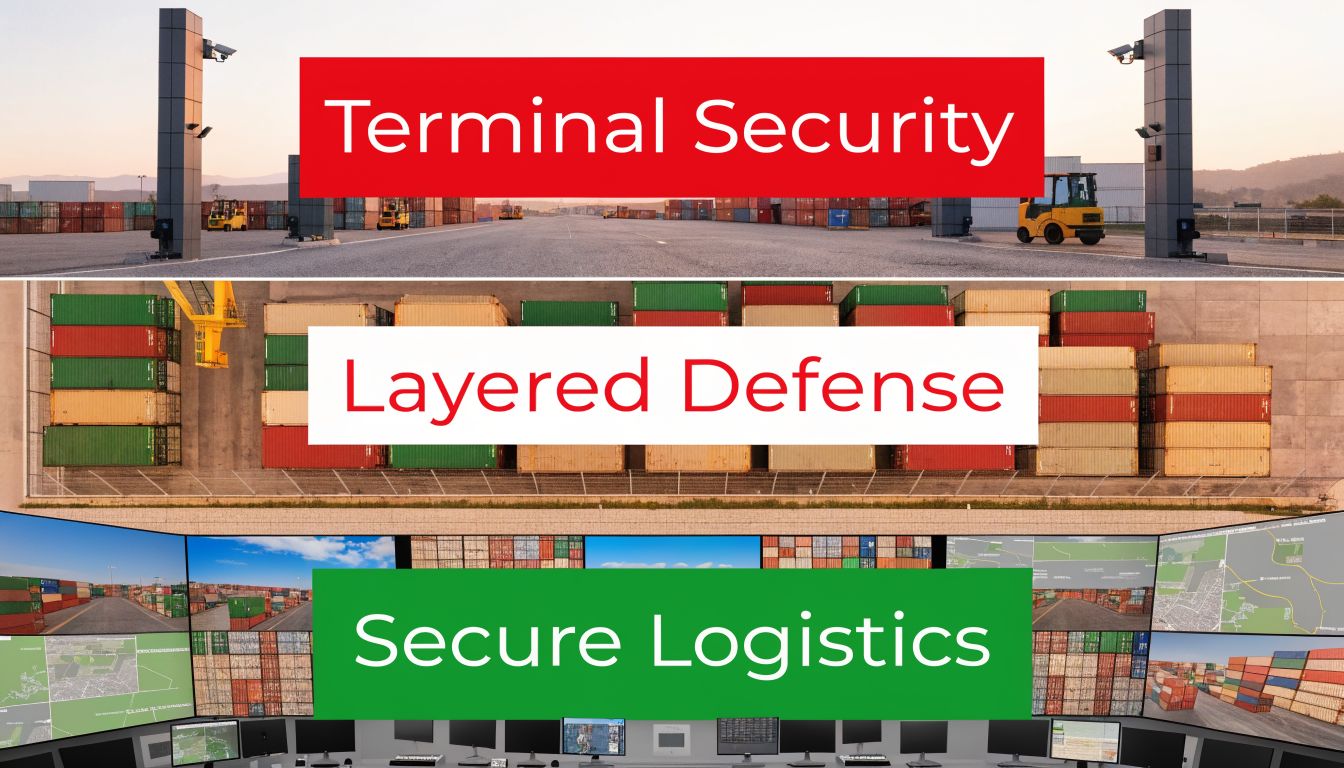
That's why effective terminal security solutions have to do more than put a uniform at the entrance and cameras on the poles. High-traffic terminals in Long Beach, Oakland, San Diego, and inland logistics yards across California operate like living systems. Trucks queue up, vendors come and go, cargo changes hands fast, and small gaps in process turn into expensive incidents.
The strongest security programs are built for operations, not just optics. They protect cargo, people, schedules, and documentation at the same time. They also stay flexible enough to work across maritime sites, warehouse campuses, distribution centers, and mixed industrial properties where the risk profile changes by shift, tenant, or season.
Protecting Your Assets Beyond the Fence Line
A broken lock on a container doesn't always mean the failure started at the container. In many terminal incidents, the problem began earlier. Someone tailgated through a gate. A vendor was waved in without proper verification. A dark stretch of perimeter gave cover to a cut fence. A patrol route looked active on paper but missed the blind side of the yard.

That's the mistake many sites make. They focus on the point of loss instead of the chain of exposure that allowed it. Good terminal security solutions start outside the immediate problem area and work inward, from the perimeter and approach roads to the yard, the dock, the staging area, the access office, and the handoff process.
Where terminal losses usually begin
For high-value terminals, the weak point is often one of these:
- Perimeter drift where fencing, lighting, or camera coverage hasn't kept up with changing yard use
- Gate fatigue when officers or staff process vehicles quickly but stop verifying details carefully
- Poor after-hours visibility in overflow parking, container rows, and equipment laydown zones
- Disconnected reporting where operations, maintenance, and security each hold part of the picture
A practical resource for reviewing common container vulnerabilities is this Quickfit guide to container site security. It's useful because it focuses on real physical weak points rather than generic advice.
A modern terminal needs more than a gate guard
The best programs combine visible officer presence, site-specific patrol patterns, access control discipline, and remote verification tools. In some environments, that also means adding flexible coverage such as mobile surveillance units for large outdoor properties where permanent infrastructure isn't practical or where temporary cargo surges create new blind spots.
Practical rule: If your security plan only activates after an incident, you don't have a terminal security program. You have a response program.
A resilient terminal security plan should reassure operations, not slow them down. That's the balance experienced teams work toward every day. Overton Security has done that for 26 years across California properties where access control, reporting discipline, and field accountability matter as much as raw headcount.
Assessing Your Terminal's Unique Security Risks
A terminal handling sealed containers, a warehouse with cross-dock traffic, and an inland freight yard can all look similar from the street. Inside, they operate very differently. That's why one-size-fits-all terminal security solutions usually underperform. The site's layout, hours, cargo profile, tenant mix, and vehicle flow all shape the actual risk.
Start with a disciplined site review. Not a generic checklist. A working assessment that follows how people, vehicles, freight, and information move.
Check the physical environment first
Walk the site the way an intruder, thief, or unauthorized driver would. Don't start from the security office. Start from the outer edge.
Look at these points closely:
- Fence lines and edges for gaps, climb points, stacked materials near the perimeter, and places where sightlines disappear
- Gate operations for tailgating exposure, visitor processing, credential checks, and how exceptions are handled under pressure
- Lighting coverage in truck queuing lanes, equipment yards, rear loading areas, and employee parking
- Camera usefulness not just camera presence. Can someone identify a driver, plate, seal issue, or handoff event from recorded footage?
A terminal that looks secure in daylight can feel completely different during shift change, heavy rain, or overnight loading. Review it during those conditions too.
Then map the operational pressure points
Most terminal losses don't happen because nobody cared. They happen because the operation got busy and controls became informal. That's where a security director needs to be blunt.
Ask these questions:
- Where does freight pause? Staging points, hold areas, and delayed outbound lanes create opportunity.
- Who can approve access exceptions? If too many people can override process, accountability disappears.
- How are vendors managed? Contractors, maintenance crews, and temporary drivers often move through the site with less scrutiny than they should.
- What does normal vehicle flow look like? If no one has documented “normal,” suspicious movement blends in.
The best site assessment usually reveals process drift before it reveals criminal sophistication.
This is also where many logistics operators benefit from reviewing controls used in adjacent environments such as warehouse security services for active distribution sites. Warehouses and terminals share a lot of the same operational friction points, especially around loading activity, access exceptions, and after-hours yard movement.
Digital risk now affects physical security
Terminal managers can't treat cyber and physical security as separate worlds anymore. A 2022 survey of U.S. port and terminal executives revealed ransomware as the top cybersecurity threat, cited by 45% of respondents in the Jones Walker maritime cybersecurity survey. For a terminal, that matters even if your main concern is cargo theft.
If gate systems, access logs, scheduling tools, or terminal management software are disrupted, the physical site gets harder to control. Officers lose visibility. Dispatch decisions slow down. Manual workarounds appear, and those workarounds are usually weaker.
A useful risk review should include both sides of the operation:
| Risk area | What to examine |
|---|---|
| Access control | Badge use, visitor process, override authority, lost credential response |
| Cargo movement | Staging delays, seal verification, handoff documentation, escort rules |
| Vehicle management | Queue control, route discipline, unauthorized parking, trailer drop areas |
| System resilience | What happens if logs, schedules, or access platforms go offline |
A strong assessment doesn't need drama. It needs honesty. If the site depends on one guard, one gate, one manager, or one software platform to keep order, the site is more fragile than it looks.
Implementing The Layered Security Model
Terminals become easier to protect when you stop searching for a single fix. There isn't one. The durable approach is layered security, where personnel, technology, and policy support each other so one failure doesn't expose the whole site.

Personnel who can do more than observe
A terminal officer's value isn't just visibility. It's judgment. The right officer notices when a driver's reason for entry doesn't fit the manifest, when a subcontractor is working outside the approved area, or when a routine outbound movement doesn't match the normal tempo of the yard.
That only happens when staffing is stable, training is site-specific, and supervision is active. In maritime-adjacent environments, staffing also gets more complicated. Advanced terminals deploy a multi-layered technology stack including x-ray, metal detection, and facial recognition, but the system's strength often depends on federally credentialed (TWIC) officers. The 6-12 month clearance cycle for these officers creates a significant staffing bottleneck according to Terminal Security Solutions' technology overview.
That bottleneck matters even beyond strictly maritime facilities. Any site that needs specialized clearances, licensing, or high-trust access should plan staffing early. Last-minute hiring rarely works in high-compliance environments.
Technology that supports the field
Good terminal security solutions use technology to confirm, document, and escalate. They don't use it to replace field discipline.
The most useful tools usually include:
- Access control systems that record who entered, when, and under whose authority
- Cameras positioned for evidence rather than just coverage, especially at gates, choke points, and cargo handoff areas
- GPS-enabled patrol accountability so supervisors and clients can verify patrol completion in real time
- Digital incident reporting with photos, timestamps, and immediate escalation paths
- 24/7 monitoring support for after-hours oversight and faster response coordination
For facilities that want these functions connected rather than managed in separate silos, an integrated security system for commercial properties gives operations teams a cleaner picture of what's happening on site.
A useful outside perspective on the cyber side is this resource on cybersecurity for UK businesses. Even though it isn't terminal-specific, the principles apply well to sites where physical security now depends on digital tools staying available and properly managed.
Field note: Cameras catch what happened. Reporting systems show whether anyone acted on it in time.
Policy that removes guesswork
Policy is the layer many sites neglect because it feels less visible than fencing or cameras. In practice, it often determines whether the other layers work.
A terminal should have clear written direction for routine and exceptional situations. That includes:
- Post orders that match the actual site, not a generic template
- Visitor and vendor rules that define approval, escort, and restricted-area access
- Incident response protocols for theft, trespass, disputes, medical events, and system outages
- Evidence handling procedures so reports, footage, photos, and witness notes are preserved properly
When policy is weak, officers improvise. Sometimes they improvise well. Sometimes they don't. Either way, the site becomes inconsistent, and inconsistency is exactly what organized theft groups look for.
A layered model works because each component checks the others. Personnel notice issues. Technology confirms them. Policy tells everyone what to do next.
How To Choose the Right Security Partner
Most terminal managers don't struggle to find vendors. They struggle to filter them. Many firms can promise coverage. Fewer can explain how they'll manage a busy terminal when staffing gets tight, an access dispute happens at the gate, and the client needs documentation before the shift ends.

The first mistake buyers make is overvaluing specialization by itself. Niche experience can help, but only if it comes with operational depth. As noted in the RocketReach company profile on Terminal Security Solutions, while niche firms may focus on specific port types like cruise terminals in Miami or Galveston, a security partner with broad expertise securing varied commercial assets offers greater flexibility and a more holistic understanding of threats common to logistics, cargo, and industrial facilities.
Questions that reveal real capability
When you evaluate a provider, ask questions that force specifics:
- How do you staff hard-to-fill posts? You're looking for a real recruiting and backup process, not a general promise.
- How are officers supervised after hours? A terminal doesn't stop needing management when office staff go home.
- What does the client receive after an incident? Ask to see a sample report format.
- How often are post orders reviewed? Good site instructions evolve with operations.
Compare systems, not just rates
A lower hourly rate can cost more if the vendor burns through officers, misses patrol verification, or leaves your team chasing basic documentation. The better comparison is operational value.
| What to compare | Weak answer | Strong answer |
|---|---|---|
| Reporting | Paper logs or delayed summaries | Time-stamped digital reports with photos |
| Supervision | Occasional check-ins | Structured oversight with clear escalation |
| Technology | Standalone cameras and radios | Connected reporting, tracking, and monitoring |
| Experience | One niche only | Multi-site commercial and industrial exposure |
If your site is adding or upgrading access control, gates, or related hardware, it can also help to review practical guidance on installing facility security systems. The hardware decision affects how well the guarding program will function day to day.
The vendor you want is the one who makes your operation easier to manage, not the one who gives the shortest proposal.
Price matters. It always will. But for terminals, reliability, retention, supervision, and documentation are usually what determine whether the contract solves problems or just hides them for a while.
Calculating the ROI of Your Security Investment
Security budgets are often reviewed as overhead. That's understandable, but it's incomplete. In a terminal environment, security affects loss prevention, operational continuity, claims exposure, and client confidence. A better question isn't “What does security cost?” It's “What does weak security force the operation to absorb?”
Start with the costs you can see
Direct losses are the easiest to recognize. Missing freight, vandalized equipment, unauthorized yard access, and damage from uncontrolled vehicle movement all create immediate expense. So do investigations that pull supervisors away from operations.
Then look at the hidden costs:
- Dispatch disruption when a gate issue backs up trucks
- Administrative time spent reconstructing events from incomplete logs
- Tenant or customer friction when site controls feel inconsistent
- Insurance and claims exposure when incident documentation is weak
Those costs rarely appear on one line item, but operations teams feel them every week.
Stability has financial value
One of the clearest ROI factors is officer continuity. With security industry turnover averaging 35% annually, choosing a partner focused on officer retention provides a better long-term ROI by ensuring stability, reducing training churn, and delivering consistent service quality, especially as regional U.S. port traffic grows according to Terminal Security Solutions' main site.
That's an important budgeting point. A site with frequent staffing changes keeps paying for retraining, relearning, and preventable mistakes. A stable team learns traffic patterns, recognizes regular vendors, understands restricted areas, and writes better reports because they know what matters on that property.
Use a simple ROI lens
A practical way to evaluate terminal security solutions is to review four categories:
- Loss reduction through stronger access control, patrol coverage, and evidence capture
- Operational efficiency from smoother gate handling and fewer avoidable disruptions
- Liability reduction through documented procedures and faster response
- Reputation protection because secure terminals are easier for customers and partners to trust
Security ROI often shows up as fewer interruptions, fewer arguments about what happened, and fewer surprises at the end of the month.
This is why experienced operators stop treating security as a commodity purchase. The right program doesn't just stand post. It protects schedule integrity, documentation quality, and management time.
Your Implementation Roadmap with Overton Security
A strong terminal program usually comes together in phases. That matters because terminals don't operate in a vacuum. Cargo still moves, tenants still expect access, and yard patterns still change while the security plan is being built.
Phase one starts with the site, not the staffing roster
The first step is a full site assessment tied to operations. That means reviewing access points, perimeter conditions, traffic flow, after-hours activity, reporting expectations, and response priorities. The goal is to build a plan around your terminal's actual pressure points, not a standard template.
Phase two matches people to the post
Once the risk profile is clear, officer selection and site-specific training come next. That includes post orders, escalation protocols, access procedures, communication standards, and documentation requirements. At a terminal, details matter. An officer who understands the difference between a routine delay and an abnormal movement becomes much more effective.
Phase three connects the technology
Modern terminals need more than physical presence. As noted on Terminal Security Solutions' cruise page, modern threats require modern solutions. Unlike security providers focused solely on physical access, an integrated approach that includes a 24/7 SOC and GPS-enabled tour management can address the 25% increase in reported cyber incidents and protect against both digital and physical vulnerabilities.
That's where field execution and visibility come together. GPS patrol tracking, digital activity reports, photo documentation, remote monitoring, and structured escalation give terminal managers a usable record of what's happening.
Phase four keeps the program from drifting
The last phase is ongoing management. Site visits, post updates, performance reviews, incident trend analysis, and active supervision keep the plan aligned with the operation. Without that layer, even a well-designed program starts slipping as traffic patterns, tenants, and staffing realities change.
For California terminals, yards, and logistics properties, that hands-on management is usually what separates a functioning plan from a paper plan. Overton Security applies this model with customized post orders, GPS-enabled reporting, and 24/7 SOC support so clients can see activity in real time and hold the program accountable day one.
If you're reviewing terminal security solutions for a cargo yard, distribution hub, mixed-use logistics site, or high-traffic facility in California, contact Overton Security for a complimentary terminal security assessment. A practical review can identify the gaps that matter most, prioritize the right layers of protection, and help you build a plan that supports operations as well as safety.