Is your security setup a collection of disconnected gadgets? An integrated security system is a significant leap beyond juggling separate cameras, alarms, and access readers that can't communicate. Instead, an integrated security system weaves every component into one smart, responsive network.
This shifts your property’s protection from a collection of isolated tools into a single, cohesive strategy that delivers peace of mind for property managers, HOA boards, and business owners.
From Disconnected Parts to a Unified Defense
Managing separate security systems is like trying to conduct an orchestra where every musician has a different sheet of music. The result is chaos, noise, and dangerous blind spots. For a property manager or facilities director, this common frustration leads to slow response times and missed threats.
An integrated approach is the conductor, ensuring every part—every camera, sensor, and officer—is perfectly in sync.
When your security components are siloed, you’re left trying to solve a puzzle with half the pieces missing. An alarm might go off, but without connected camera footage, you have no way to visually verify what triggered it. This forces a slow and often unnecessary dispatch. Or perhaps an access reader flags an unauthorized entry attempt, but it can’t automatically notify a mobile patrol officer who is just around the corner.
The core purpose of an integrated system is to close these gaps. It creates a single shield for your property by making sure the technology and the people watching it work as one team. You move from a reactive, fragmented system to a proactive, intelligent defense.
This is the foundation of modern security, solving the exact headaches that property managers in busy markets like Los Angeles or San Jose deal with every day. The goal is to stop juggling a dozen different platforms and vendors.
An integrated security system delivers a smarter way to protect your property by providing:
- Centralized Control: Manage everything—from your cameras to door locks—from one simple interface. No more bouncing between apps.
- Automated, Intelligent Responses: Imagine a door is forced open after hours. The system can instantly lock down other entry points, point nearby cameras at the location, and send an immediate alert to our 24/7 Security Operations Center (SOC).
- Total Situational Awareness: By pulling in data from multiple sources, you get the full picture of what’s happening on your property, in real time.
- Clearer Accountability: With every action logged and connected, it’s far easier to track events, review incident reports, and generate the documentation needed for compliance or insurance.
Ultimately, this approach provides genuine reassurance. You know your security isn’t just a collection of standalone gadgets, but a responsive ecosystem designed to protect your assets.
The Pillars of a Modern Security Ecosystem
A truly effective integrated security system is more than a collection of gadgets. It’s a complete ecosystem where technology and trained professionals work together seamlessly. Each piece—or pillar—has its own job, but the real power comes when they all communicate. When property managers understand these pillars, it becomes clear why a piecemeal approach falls short.
This infographic illustrates the difference between having separate, chaotic systems and one single, integrated platform that provides harmony and control.

As you can see, integration turns security from a source of confusion into a source of clear, actionable information. Let's break down the core components that make this possible.
Human Expertise and Onsite Presence
Technology is a powerful tool, but it can’t replace the judgment and physical presence of a trained security officer. Whether stationed onsite or conducting mobile patrols, these professionals are the active responders in your system. They provide a visible deterrent, handle situations that require a human touch, and act on the intel the technology gathers.
At Overton Security, we consider our officers the most important pillar of any security plan. With over 26 years of experience, we know that supporting our team leads to better outcomes for our clients. Our officers aren't just watching a screen; they’re equipped with real-time data from the entire system, giving them a complete picture of what’s happening so they can respond effectively.
Intelligent Access Control Systems
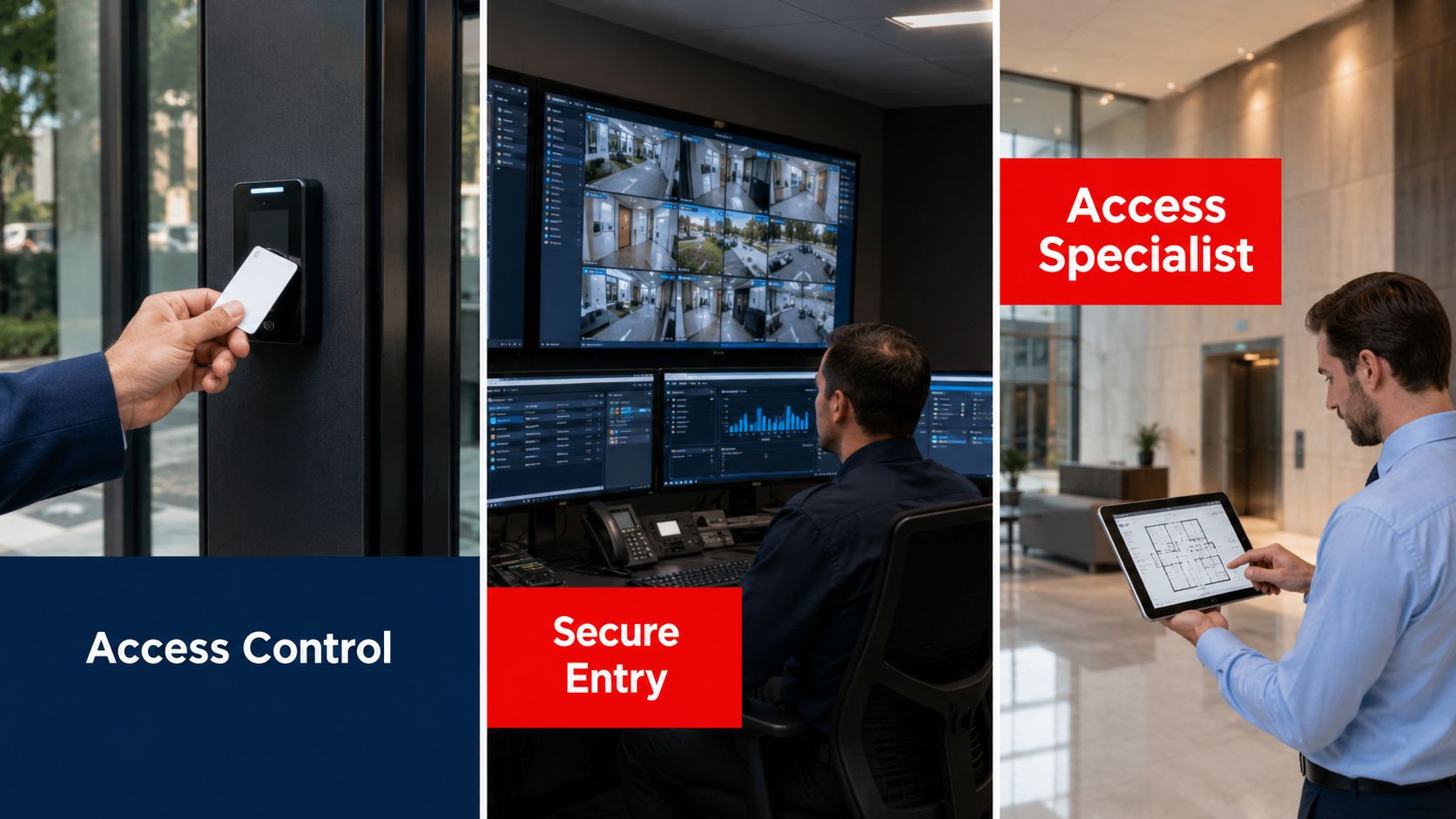
Think of modern access control as the digital gatekeeper for your property. It’s what dictates who can go where, and when. Unlike old-fashioned locks and keys, these systems use key cards, fobs, or even mobile apps to grant or deny entry. When integrated with your other systems, they become exponentially more powerful.
An integrated access control system can:
- Trigger an Alert: If a terminated employee tries to use their old key card, the system can instantly flag the attempt and notify security and management.
- Log Every Event: It creates a perfect digital record of every door that opens and closes, which is invaluable for investigations or compliance audits.
- Initiate a Lockdown: In an emergency, you can secure the entire property or specific zones with a single command, helping to contain a threat immediately.
If you want to go deeper on this topic, check out our guide on modern access control solutions. It's a foundational piece for any serious security strategy.
Advanced Video Surveillance and Alarms
Cameras are your eyes on the property, and alarms are your first line of defense. In an integrated system, they stop being passive tools and become active participants. When an alarm sensor—like a door contact or glass-break detector—is tripped, the system does more than just make noise.
It can instantly point the nearest camera to the exact location of the alert. This provides immediate visual confirmation, cuts down on false alarms, and gives first responders critical information before they even arrive.
This level of integration is becoming the new standard. The global electronic security market has already hit $35.4 billion, driven by platforms that bring all this data together for faster, smarter responses. In fact, 42% of modern buildings now use integrated systems to manage their properties more efficiently.
The Central Command Hub
Finally, the brain of the whole operation is the 24/7 Security Operations Center (SOC). This is where trained professionals monitor all the data streaming in from your access control, cameras, and alarms.
The SOC is the central nervous system that ensures every single alert is seen, evaluated, and acted upon correctly. It’s what transforms your security from being reactive to truly proactive.
The Hidden Risks of Disconnected Security
Trying to secure a property with a patchwork of disconnected systems is a constant challenge. It’s a common problem: your access control, alarms, and cameras all operate in their own silos. This creates dangerous blind spots and communication gaps that leave your property vulnerable.
For property managers and HOA boards, this disjointed approach is a constant source of frustration, leading to slow responses, missed threats, and operational inefficiency.

These aren't just "what-if" scenarios; they play out every day on properties with an outdated security posture. Think about it: a perimeter alarm goes off at your San Jose construction site at 2 a.m. Your alarm system sends an alert, but it can’t talk to your cameras. You have no idea if it’s a thief stealing copper wire or just a raccoon. The result is a slow, potentially costly response based on a guess.
Where Communication Breakdowns Occur
Here’s another all-too-common situation. Your access control system logs that a server room door in your office building was propped open. If that system is a lone wolf, the information just sits there in a digital logbook, unseen. It can’t automatically notify a mobile patrol guard who is just minutes away or tell a nearby camera to start recording what’s happening.
These are the very real, hidden risks of disconnected security:
- Delayed Response Times: When your systems don't communicate, a person has to manually connect the dots. This wastes precious seconds—or even minutes—during a real incident.
- Lack of Context: An alarm tells you that something happened, but it doesn't tell you what or why. This leads to a high rate of false alarms and drains your security resources.
- Operational Inefficiency: Your team ends up wasting valuable time toggling between different platforms, trying to piece together a story instead of focusing on proactive security.
This fragmentation creates what we call security debt. Each disconnected system you add piles on another layer of complexity and another potential point of failure. An integrated security system is designed to pay down that debt by unifying your technology and human oversight.
This challenge isn't unique to physical security. The complexities of managing separate systems in the digital world, as detailed in this guide to Multi Cloud Security, mirror the exact same problems we see on physical properties. It all comes down to the critical need for a unified approach.
Siloed Security vs. Integrated Security: A Direct Comparison
When you see them side-by-side, the operational difference between a disconnected setup and an integrated one is like night and day. A properly designed integrated security system acts as a force multiplier, turning isolated bits of data into intelligence you can actually act on.
This table shows the stark contrast between managing separate systems and the streamlined effectiveness of a single, unified platform.
| Security Challenge | Siloed System Response (The Problem) | Integrated System Response (The Solution) |
|---|---|---|
| After-Hours Breach | An alarm sounds. The monitoring station calls a contact list, but there's no visual verification. A guard is dispatched blindly. | An alarm trips, which automatically activates the nearest camera. The SOC operator verifies a real threat and dispatches patrol with precise location details. |
| Door Propped Open | The access control system logs the event, but no one is alerted. The vulnerability remains until someone physically discovers it. | The system detects the door is ajar past the time limit and sends an instant alert to the property manager and the mobile patrol officer's device. |
| Incident Investigation | Management must manually pull reports from the alarm panel, access logs, and then scrub through hours of separate video footage to build a timeline. | All events are linked on one platform. A single click on the access event pulls up the associated video and any other sensor data from that exact moment. |
As the table makes clear, an integrated system doesn't just collect data—it connects it. This allows your team to move from a reactive guessing game to a proactive, informed security strategy.
Measuring the True Value of Security Integration
It’s one thing to understand the technical side of an integrated security system, but what really matters to property managers, owners, and HOAs is its actual value. What’s the real return? Beyond just better protection, a unified system can fundamentally change how you handle safety and day-to-day operations.
The core question we always hear is: "How will this make my job easier and my property safer?"
The answer comes down to making a critical shift from reactive damage control to proactive threat prevention. An integrated system doesn't just record what happened; it actively works to prevent incidents before they occur. It’s the difference between reviewing footage of a break-in after your property has been hit and getting an instant alert that lets a remote officer intervene before a trespasser even gets through the door.
Greater Operational Efficiency
One of the first things our clients notice is a significant jump in operational efficiency. When all your security tools are talking to each other, your team stops wasting countless hours trying to piece together information from a half-dozen different platforms.
No more manually matching up alarm logs with video timestamps to figure out what happened. The system connects the dots for you, simplifying everything.
An integrated system answers "what if" scenarios before they become costly problems. For example, a single, intelligent alert can validate an event, dispatch a patrol, and create a digital incident report automatically, streamlining the entire response and documentation process for insurance claims.
This efficiency pays off directly by lowering your long-term costs. When technology can instantly verify an alarm, you can reduce expensive guard dispatches for false alarms. In some cases, smart remote monitoring can even reduce the need for multiple static guards, letting you focus your security budget where it has the most impact.
Proactive Mitigation and Simplified Compliance
An integrated security system gives you the power to be proactive, not reactive. For a construction superintendent in Los Angeles, this means getting an alert the second a truck enters a restricted area after hours—not showing up the next morning to find a pallet of copper wiring gone. For a commercial property manager, it means the system can spot a propped-open door and automatically notify a mobile patrol officer to investigate.
The global market for integrated security systems has exploded, now valued at $28.7 billion, as more businesses recognize these benefits. North America is leading the way, accounting for over 41% of the market, and most security integrators are now using AI-powered video analytics for real-time threat detection. These systems don't just make properties safer; they cut operational costs by an estimated 20-30% by putting everything under one central control.
This proactive approach also makes compliance a breeze. Automated digital reports for everything from guard tours to incident responses create a perfect, easy-to-access audit trail. This makes satisfying regulatory requirements and providing clear documentation for insurance claims far simpler.
Of course, to ensure every alert is handled correctly, you need a well-managed Security Operations Center. You can learn more about how a SOC maximizes your system's value by reading our guide on Security Operations Center best practices.
How to Plan Your Security System Integration
Moving to a fully integrated security system is a significant upgrade for any property, but it doesn't have to be overwhelming. The key is a solid plan, built alongside a trusted security partner. For busy property managers and facilities directors, having a clear roadmap turns what seems like a massive project into a series of manageable steps.

The entire point is to build a system that solves your unique problems—not to shoehorn a generic package onto your site. This takes a hands-on approach that starts with clear goals and expert guidance.
Step 1: Conduct a Thorough On-Site Risk Assessment
Before we talk about technology, a security expert needs to walk your property with you. This is much more than just spotting a broken fence or a poorly lit corner. It’s about understanding the unique rhythm of your property—how people move through it, where your high-risk zones are, and what existing infrastructure we can leverage.
This initial walkthrough is the bedrock of your entire security strategy. It helps us pinpoint the specific threats you face, whether that's late-night trespassing at a San Francisco retail center or equipment theft from a Los Angeles construction site.
Step 2: Define Your Specific Security Objectives
Once you have a clear picture of your risks, it’s time to define what a "win" actually looks like. Your goals must be specific and measurable. Aiming for "better security" is too vague; we need to focus on concrete results.
Your objectives might look something like this:
- Deter vandalism in common areas and parking structures.
- Control after-hours access to sensitive areas like server rooms or inventory storage.
- Create a verifiable record of every entry and exit for compliance reporting.
- Reduce false alarm dispatches by 90% through video verification.
Having clear objectives ensures that every piece of your integrated system has a specific job to do. This is how you avoid wasting money on technology you don't need and ensure the final system directly tackles your biggest challenges.
Step 3: Select the Right Partner and Technology
This is a critical step. There’s a world of difference between a vendor who just sells boxes and a partner who delivers a complete solution. A true security partner, like Overton Security, brings 26 years of experience to the table, blending smart technology with highly trained personnel. We’ll help you choose hardware that works together seamlessly, managed from one intuitive platform.
Bringing this vision to life requires a professional security system installation service. Proper installation is crucial for ensuring all your cameras, sensors, and access points are correctly wired, configured, and tested from day one.
Step 4: Phase Your Implementation to Align with Budgets
You don't have to overhaul everything at once. A strategic partner will help you map out a phased implementation that works with your budget and immediate priorities. For example, you might start by integrating your existing cameras with a new access control system this quarter. Then, you could add remote video monitoring services in the next.
Phasing the project makes the investment much more manageable without losing sight of your long-term security goals. For a deeper dive, our guide on remote video monitoring offers great insights into how that piece fits into the puzzle.
Your Questions About Integrated Security Answered
Making a significant change to your property's security is a major decision, and it’s natural to have questions. For property managers, business owners, and HOA boards, the idea of an integrated security system can feel like a huge leap. We understand.
Let's walk through some of the most common concerns we hear. Our goal is to provide the clear answers you need to feel confident about protecting your property, whether it's a retail center in San Diego or a high-rise in San Francisco.
Can I Integrate My Existing Security Cameras and Hardware?
This is one of the first questions we're usually asked, and the answer is often yes. A good partner won't force you to rip and replace everything you already own.
The first step is a full technology audit. Many modern platforms are designed to work with a wide variety of cameras, sensors, and access control hardware. A security partner like Overton Security will take a close look at your current equipment to see what can be seamlessly folded into the new system. This approach respects your initial investment and helps keep upgrade costs manageable.
Is an Integrated System Too Complex for My Staff?
Actually, it's just the opposite. While the technology running in the background is powerful, the entire point of an integrated system is to make your team's job simpler.
Think about it: instead of fumbling with different logins and programs, your staff gets one simple dashboard to manage everything. They can check alerts, pull up camera feeds, and run reports all from a single screen.
The purpose of integration is to reduce complexity, not add to it. A unified platform empowers your staff by giving them clear, actionable information in one place, which means faster, more confident responses.
Of course, proper training is key. A good partner will ensure your team feels comfortable from day one, turning what seems complicated into a powerful tool they can use to keep your property safe.
How Much Does an Integrated Security System Cost?
The price tag for an integrated system will always depend on your property’s size, layout, and specific objectives. However, looking only at the upfront cost misses the bigger picture. It's important to consider the total cost of ownership.
A disconnected, patchwork security setup is full of hidden expenses that drain your budget over time.
These hidden costs often include:
- Wasted staff hours trying to piece together what happened after an incident.
- The high price of false alarm dispatches from unreliable systems.
- The financial and reputational fallout from a security breach that could have been prevented.
An integrated security system pays for itself by boosting efficiency, reducing redundant costs, and preventing expensive problems before they start. It's not just another line item on your budget; it’s a strategic investment in the long-term health and safety of your property.
Ready to get answers tailored to your specific property? The team at Overton Security has over 26 years of experience designing and managing integrated security solutions for properties just like yours. Let's schedule a no-obligation consultation to discuss your security goals.