
For property managers, HOA board members, and facilities directors, security is more than just a camera on a wall; it’s the assurance of safety, the protection of assets, and the preservation of peace of mind. But what happens behind the scenes to make that a reality? A high-functioning Security Operations Center (SOC) is the nerve center of any modern security program, transforming passive monitoring into an active, intelligent defense system that safeguards your community or commercial space.
Without a solid operational framework, however, a SOC can quickly become a costly, reactive expense rather than a proactive asset. An effective security partnership depends on a foundation of transparency, accountability, and proven procedures. Simply having a command center is not enough; it must operate with precision and purpose, guided by clear protocols and managed by experienced professionals.
This guide moves beyond generic advice to provide a blueprint for excellence. We will outline 10 essential security operations center best practices that form the foundation of an effective and reliable security strategy. From real-time monitoring and dispatch to integrated technology and continuous officer training, these actionable points detail what you should expect from a security partner. Whether you manage properties in Los Angeles, a residential community in San Jose, or a retail portfolio across California, these principles will help you evaluate and implement a security program that delivers tangible results and genuine security.
1. 24/7 Security Operations Center (SOC) with Real-Time Monitoring & Dispatch
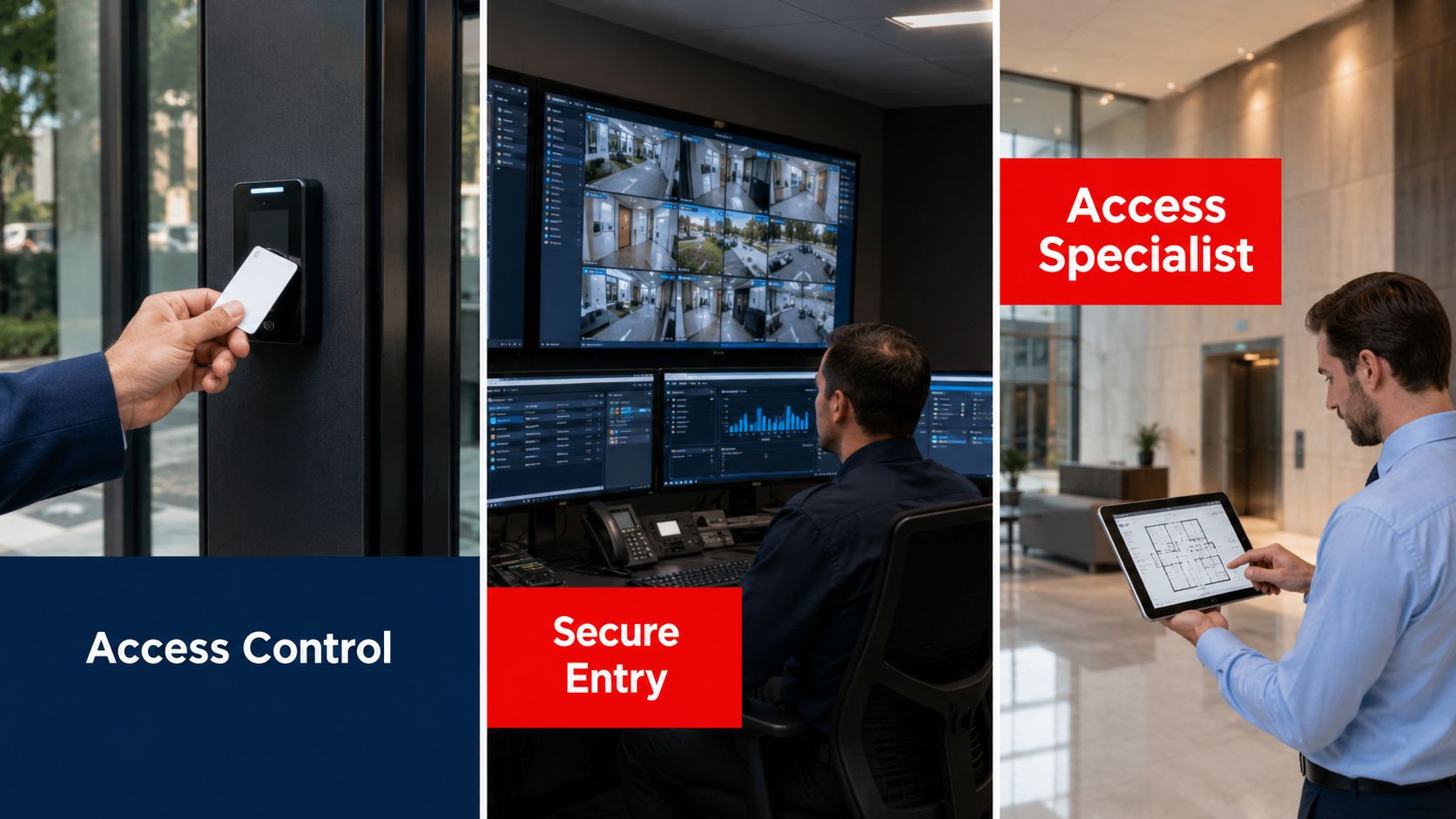
A modern security strategy is incomplete without a centralized command hub operating around the clock. A 24/7 Security Operations Center (SOC) acts as the nerve center for all security activities, providing constant oversight, real-time coordination, and immediate support for field personnel. This is a fundamental component of effective security operations center best practices, transforming security from a reactive function into a proactive, intelligence-led operation.
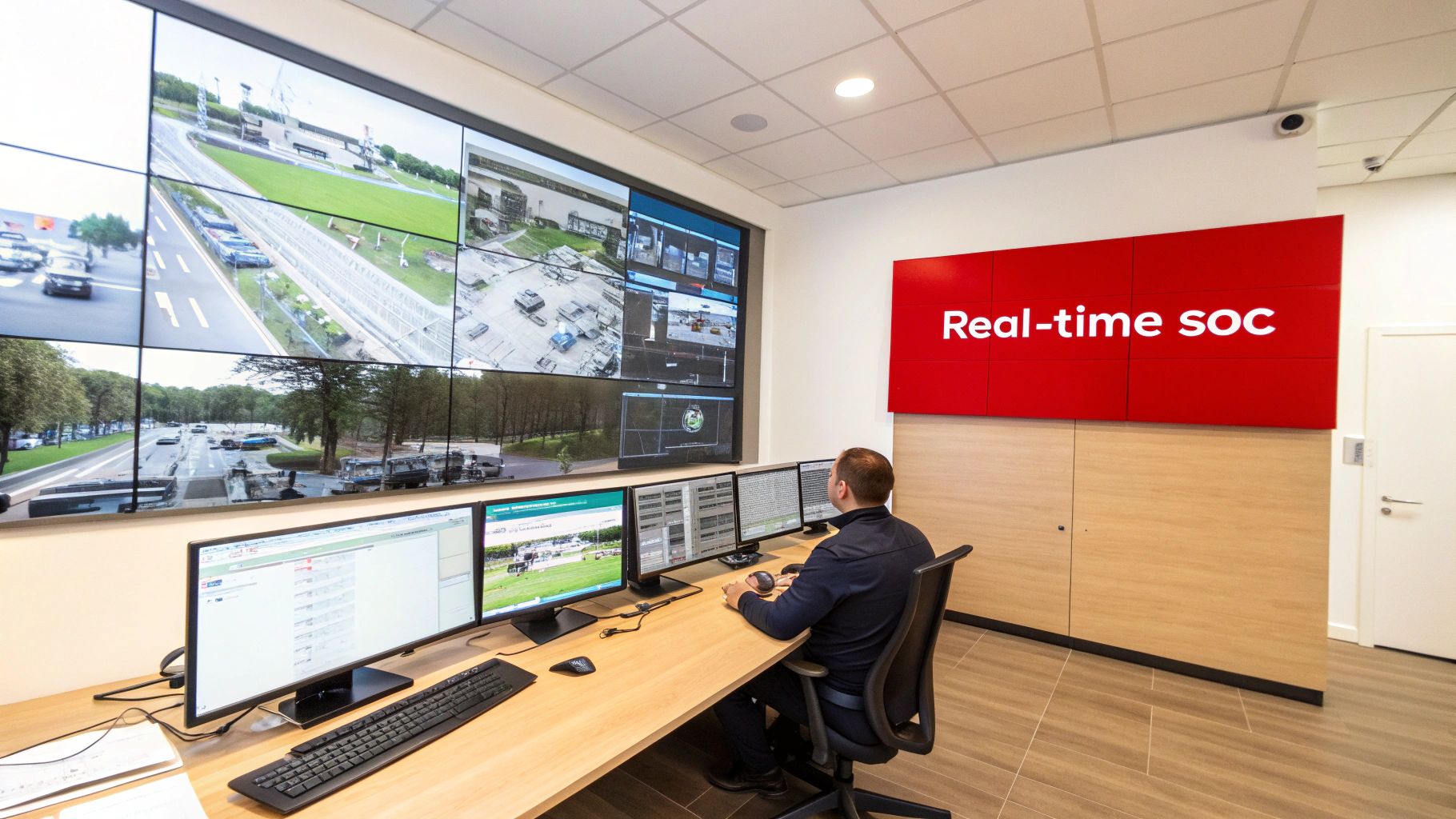
For property managers overseeing multiple locations, construction sites, or high-value assets, an active SOC ensures threats are detected and addressed instantly. Instead of waiting for a patrol officer to discover an issue or relying on a client notification after the fact, the SOC’s real-time monitoring capabilities enable instant threat identification and response coordination. You can learn more about the structure and function of a modern Security Operations Center to better understand its critical role.
Why This Is a Core Best Practice
A dedicated SOC provides accountability and a single source of truth during any incident. For example, a major retail chain can use its SOC to monitor for loss prevention events across dozens of stores simultaneously, dispatching local assets as needed. Likewise, a multi-building healthcare campus relies on its SOC to coordinate emergency responses, ensuring personnel are directed to the precise location of a duress alarm or access control breach without delay.
Actionable Implementation Tips
- Establish Clear Escalation Protocols: Define specific procedures and required response times for different alert levels (e.g., trespassing vs. active threat).
- Invest in Redundancy: Ensure your SOC has backup power, internet, and communication systems to maintain operational continuity during outages.
- Document Everything: Implement a rigorous system for logging all activities, alerts, and responses. This data is invaluable for post-incident reviews, identifying security trends, and demonstrating compliance.
- Maintain Direct Communication: Create seamless communication channels between SOC operators and on-site officer supervisors to ensure clear, rapid information flow during critical events.
2. Guard Tour Management System (GTMS) with Digital Documentation & GPS Verification
Moving beyond traditional paper logs, a Guard Tour Management System (GTMS) introduces verifiable accountability into every patrol. This mobile-first platform uses NFC tags or GPS checkpoints to ensure officers physically visit designated locations, creating an immutable digital record of their rounds. For property and facility managers, this technology replaces trust with data-driven proof, a cornerstone of modern security operations center best practices.

This system provides a real-time, verifiable audit trail of all patrol activities. Officers use their devices to scan checkpoints, complete digital Daily Activity Reports (DARs), upload photos of incidents, and log observations directly from the field. This constant stream of verified data flows directly to the SOC and to clients, providing unprecedented transparency and confirming that contractual obligations are being met consistently.
Why This Is a Core Best Practice
A GTMS transforms security from a subjective service into a data-verified operation. For instance, a residential HOA can use GTMS reports to confirm that all common areas, like the pool and fitness center, were secured on schedule each night. Similarly, a construction site manager can verify that high-value equipment storage areas were inspected at specific intervals, providing documented proof of diligence for insurance purposes. The system eliminates any doubt about whether a patrol was completed, providing a clear record of presence and attention to detail.
Actionable Implementation Tips
- Strategic Checkpoint Placement: Install NFC tags or define GPS geofences at critical areas such as entry/exit points, high-risk zones, and isolated corners of the property.
- Set Realistic Patrol Expectations: Configure patrol routes with a manageable number of checkpoints. Too many can be burdensome and lead to rushed inspections, while too few may not provide adequate coverage.
- Emphasize Accountability, Not Punishment: Train officers to view the GTMS as a professional tool that validates their work and protects them from false claims, rather than a punitive tracking device.
- Integrate Data with Performance Reviews: Use GTMS data on patrol completion rates and timeliness in regular performance discussions to reinforce standards and recognize consistent performers.
- Conduct Weekly Report Reviews: Schedule brief meetings with your security account manager to review GTMS analytics, identify patrol gaps or trends, and make proactive adjustments to security posture.
3. Predictive Analytics & Threat Assessment for Risk-Based Patrol Optimization
Transitioning from a reactive to a proactive security posture requires more than just responding to alerts; it means anticipating them. Predictive analytics uses historical incident data, environmental factors, and temporal patterns to forecast when and where security events are most likely to occur. This data-driven approach allows for the dynamic allocation of patrol resources, representing one of the most advanced security operations center best practices for optimizing both safety and efficiency.
Instead of spreading patrols evenly across all hours and locations, this model identifies high-risk windows and focuses guard presence accordingly. For property managers, this means maximizing deterrence during peak vulnerability periods while improving cost efficiency. Decisions are based on objective data rather than assumptions, allowing for a more intelligent and effective security strategy that directly addresses identified risks.
Why This Is a Core Best Practice
Predictive analytics transforms security patrols from a routine task into a strategic, intelligence-led operation. For instance, a residential community can analyze break-in patterns to predict vulnerable times, like weekday afternoons or holiday weekends, and adjust patrol schedules to provide a stronger visible presence. Similarly, a construction site can use historical data on equipment theft to forecast higher risks during long weekends, ensuring patrols are concentrated when the site is most exposed. This proactive allocation of resources is proven to deter opportunistic crime more effectively.
Actionable Implementation Tips
- Gather Sufficient Data: Ensure you have at least 12 to 24 months of detailed incident data before relying heavily on predictive models for accurate forecasting.
- Combine Data with Expertise: Use predictive insights to inform decisions, but always combine them with the on-the-ground judgment of experienced security managers. Data identifies patterns, while humans understand context.
- Review and Refine Models: Quarterly reviews of prediction accuracy versus actual outcomes are crucial. Use these findings to continuously refine algorithms and improve future forecasts.
- Educate Stakeholders: Use predictive insights to educate clients and HOA boards about specific risk patterns, providing a clear, data-backed justification for security investments and operational adjustments.
4. Low Manager-to-Client Ratio Model for Hands-On Account Management
While technology is the backbone of a modern SOC, the human element of account management is what transforms a vendor relationship into a true security partnership. A low manager-to-client ratio model ensures that each client receives dedicated, hands-on attention from an account manager who is deeply familiar with their property’s unique security landscape. This approach, a cornerstone of effective security operations center best practices, prioritizes quality of service over sheer volume of accounts.
Instead of assigning 30 to 50 properties to a single manager, this model limits the portfolio to a more manageable 10 to 15 clients. This allows account managers to conduct frequent site visits, build strong relationships with property managers, and proactively address potential issues before they escalate. This structure ensures that client communication is never lost in a queue and that your primary contact is an expert on your operational needs, not just a name in a CRM.
Why This Is a Core Best Practice
A dedicated account manager with a small portfolio serves as a powerful advocate and a single point of accountability for the client. For a property manager overseeing a luxury high-rise, this means having a partner who understands their specific tenant demographics, access control challenges, and emergency protocols. For a logistics manager at a distribution center, it means their account manager is familiar with their peak hours, common security threats, and the layout of their yard. This focused approach, championed by service-oriented firms like Overton Security, ensures that strategies are tailored and responsive.
Actionable Implementation Tips
- Establish Clear Responsibilities: Define the account manager's role, including mandatory site visit frequency (e.g., monthly for standard accounts, bi-weekly for high-risk properties).
- Develop Client-Specific Plans: Create detailed account plans that outline property-specific goals, known challenges, key personnel, and success metrics.
- Invest in Training: Equip account managers with training in customer relationship management, conflict resolution, and the specific security challenges of the industries they serve.
- Use Feedback for Improvement: Implement a system for account managers to channel client feedback directly to SOC leadership and field supervisors to drive continuous service improvements.
5. Continuous Officer Training, Certification, and Professional Development Programs
A security officer is far more than just a uniform; they are the on-site extension of the SOC’s intelligence and a critical component of any effective security strategy. Investing in their ongoing education, role-specific certifications, and clear career pathways ensures they possess current skills, institutional knowledge, and motivation. This commitment to professional development transforms officers from passive observers into proactive problem-solvers, making it one of the most vital security operations center best practices.
For property managers, the difference between a well-trained officer and a minimally trained one is significant. A properly trained officer can de-escalate a tense situation at a retail center, correctly document an incident at a construction site for liability purposes, or provide life-saving assistance during a medical emergency at a residential high-rise. They become force multipliers, capable of handling complex situations independently and providing value that far exceeds their hourly rate.
Why This Is a Core Best Practice
High-quality, continuous training directly impacts officer retention, performance, and client satisfaction. Companies that prioritize professional development, such as offering competitive pay and defined career paths, experience lower turnover rates. This consistency ensures that officers develop deep familiarity with a property’s specific security protocols, tenants, and potential vulnerabilities, creating a more stable and effective security posture.
For example, a healthcare campus requires officers with specialized training in patient interaction, emergency response codes, and HIPAA compliance. Similarly, an officer at a high-end condominium needs advanced customer service and concierge skills. Continuous training ensures personnel are not just present but are truly prepared for the unique demands of their assigned environment.
Actionable Implementation Tips
- Establish a Diverse Training Calendar: Create a schedule that mixes in-person, online, and practical on-the-job training to cover topics like de-escalation, technology use, and emergency procedures without disrupting field operations.
- Tie Training to Advancement: Link the completion of certifications and training modules to performance evaluations, pay increases, and promotional opportunities.
- Update Content Regularly: Ensure training materials reflect emerging security threats, new technologies implemented by the SOC, and evolving client needs.
- Create Mentorship Programs: Pair experienced, high-performing officers with newer staff to transfer institutional knowledge and reinforce best practices in a real-world setting.
6. Integrated Technology Stack with Clear SOC-to-Field Communication Protocols
A siloed approach to security technology is no longer viable. A modern, effective SOC relies on a unified ecosystem where CCTV, access control, alarms, and mobile field devices communicate seamlessly. An integrated technology stack ensures that information flows efficiently between the security operations center and personnel on the ground, a core component of security operations center best practices that drastically reduces response times and eliminates critical communication gaps.
Instead of managing disparate systems that create blind spots, an integrated platform provides a single pane of glass for monitoring, dispatch, and incident management. For property managers, this means a more coordinated security response, simplified vendor relationships, and a holistic view of portfolio-wide security posture. This approach transforms individual tools into a cohesive, force-multiplying security solution.
Why This Is a Core Best Practice
An integrated stack provides complete situational awareness and accountability. When an access control system registers a forced door entry, for example, it can automatically trigger the nearest CCTV camera to begin recording and simultaneously send an alert with live video to the SOC and the closest officer's mobile device. This level of automation and information sharing is impossible with non-integrated systems.
This is especially critical for large-scale operations. A healthcare campus can integrate its emergency call systems directly with its SOC platform, ensuring security is dispatched to the exact location of a duress alarm instantly. Likewise, a national retail chain can unify its loss prevention platforms, allowing the SOC to correlate point-of-sale data with video surveillance to identify and respond to theft in real-time.
Actionable Implementation Tips
- Map All Systems and Data Flows: Before integrating, create a detailed diagram of your current technologies, how they connect (or don't), and where data originates and terminates.
- Prioritize Open Standards: Whenever possible, use technologies that support open APIs and industry standards (like ONVIF for cameras) to simplify integration and avoid vendor lock-in.
- Establish Clear Communication Protocols: Document specific communication procedures. For instance, define what information must be included in a dispatch alert from the SOC to a field officer’s mobile device.
- Train on the System as a Whole: Ensure staff are trained on the integrated platform as a single, cohesive tool, not just a collection of separate applications. This fosters a deeper understanding of workflows and capabilities.
7. Incident Response Playbooks with Pre-Defined Escalation Procedures and Decision Trees
Effective security operations hinge on consistency and predictability, especially during a crisis. Incident response playbooks provide documented, step-by-step procedures for handling specific security events. This critical element of security operations center best practices removes guesswork, ensuring that every officer and SOC operator responds to threats in a coordinated, informed, and professional manner that minimizes liability and protects assets.
Rather than relying on individuals to make high-stakes decisions under pressure, playbooks offer a clear roadmap. At the heart of this strategy is a well-defined incident management procedure, which forms the basis for pre-defined escalation procedures and decision trees. This ensures that responses to events like break-ins, medical emergencies, or active threats are uniform and effective across all properties.
Why This Is a Core Best Practice
Playbooks create a standardized, professional response that property managers and clients can depend on. For instance, a retail center can use a specific playbook for handling suspected theft, which includes de-escalation techniques and precise instructions for when to contact law enforcement, protecting both staff and the business. Similarly, a healthcare facility can deploy a violence de-escalation playbook, guiding staff on how to manage agitated individuals without escalating the situation, thereby ensuring patient and employee safety. The result is a predictable, compliant, and defensible security posture. You can explore a deeper dive into creating a comprehensive strategy with a look at security incident response planning.
Actionable Implementation Tips
- Develop Scenario-Specific Playbooks: Create distinct playbooks for different incident types (e.g., trespassing, fire watch, medical emergency) and for different property types (e.g., retail, healthcare, residential).
- Conduct Tabletop Exercises: Regularly test playbooks with your SOC and field teams through simulated scenarios to identify gaps and refine procedures.
- Involve Key Stakeholders: Collaborate with facility management, local emergency services, and legal counsel during playbook development to ensure they are comprehensive and compliant.
- Make Playbooks Easily Accessible: Ensure playbooks are available in both digital and printed formats for quick reference by all security personnel, both in the SOC and in the field.
- Schedule Regular Reviews: Update all playbooks annually or immediately following a significant incident to incorporate lessons learned and adapt to new threats.
8. Customized Post Orders and Site-Specific Security Plans Based on Risk Assessment
Generic, one-size-fits-all security instructions are ineffective and create vulnerabilities. A cornerstone of security operations center best practices is the development of detailed, property-specific post orders and security plans that are based on a formal risk assessment. These documents transform security from a simple presence into a targeted, intelligence-driven function tailored to the unique operational needs and threats of each location.
This approach ensures that every action taken by on-site personnel is purposeful and directly addresses identified risks. For property managers, this means security efforts are aligned with specific business objectives, whether that's loss prevention in a retail center, patient safety in a healthcare facility, or asset protection on a construction site. By defining clear responsibilities and procedures, customized plans empower officers and provide SOC operators with a precise playbook for incident management.
Why This Is a Core Best Practice
Tailored security plans provide clarity and eliminate guesswork during critical incidents. For example, a high-rise residential community’s post orders will detail specific access control protocols for guests versus vendors, outline patrol routes for common areas like pools and parking garages, and establish procedures for responding to noise complaints. A distribution center’s plan, in contrast, will focus on gate access for trucks, seal verification procedures, and perimeter patrols to prevent cargo theft.
This level of detail ensures that security actions are consistent, effective, and auditable. For effective site-specific security plans and robust risk assessments, security operations centers often rely on detailed property data; utilizing property data lookup tools can provide essential information for these critical tasks. You can explore how detailed directives are structured by learning more about crafting effective security guard post orders.
Actionable Implementation Tips
- Conduct On-Site Risk Assessments: Collaborate with facility management and security stakeholders to walk the property, identifying critical assets, vulnerabilities, and historical incident locations.
- Document Everything Visually: Supplement written post orders with simple maps and diagrams showing patrol routes, camera locations, critical access points, and emergency equipment shut-offs.
- Establish Clear Escalation Trees: Define who to contact and under what circumstances for different incident types, including specific contact information for property management, maintenance, and local emergency services.
- Review and Revise Regularly: Treat post orders as living documents. Review them quarterly or after any significant incident to incorporate lessons learned and adapt to operational changes.
9. Multi-Channel Communication and Escalation Protocols (Redundancy and Fail-Safes)
An effective security operation is built on reliable communication. When primary channels like radios are overwhelmed or cell networks become congested during an emergency, a single point of failure can disrupt the entire response. Establishing multiple, independent communication channels with clear escalation protocols is a critical best practice that ensures vital information always reaches its intended recipients, no matter the circumstances.
This approach moves beyond relying on a single method and builds a resilient communication web. For property managers overseeing large campuses with known cellular dead zones or facilities in areas prone to natural disasters, this redundancy is not optional; it is essential for maintaining command and control. SOC-to-field communication should never depend on a single, fragile link.
Why This Is a Core Best practice
A multi-channel strategy provides the necessary fail-safes to guarantee operational continuity. For instance, a healthcare facility can use its SOC to dispatch emergency codes via overhead paging systems, mobile app push notifications, and SMS alerts simultaneously. This layered approach ensures that even if one system fails or a recipient misses a notification, the message still gets through on another channel, which is crucial for life-safety events.
Similarly, a portfolio manager overseeing multiple retail properties can receive automated alerts via email, text, and a dedicated client portal. If they don't acknowledge the initial alert within a set timeframe, the system can automatically escalate the notification to a secondary contact, ensuring awareness and timely decision-making.
Actionable Implementation Tips
- Define Channel-Specific Protocols: Clearly document when to use each channel. For example, use two-way radios for immediate, on-site coordination, and use email for detailed post-incident reporting and documentation.
- Establish Automated Escalation Paths: Configure SOC software to automatically try secondary and tertiary contacts if a primary recipient does not acknowledge a critical alert within a predefined window.
- Test Backup Systems Regularly: Conduct monthly or quarterly tests of all communication systems, including satellite phones or backup radios, to verify they are functional and ready for deployment.
- Maintain Redundant Infrastructure: Ensure backup systems operate on separate infrastructure where possible, such as using different cellular carriers for primary and secondary mobile devices.
- Train Staff on All Procedures: Conduct drills focused specifically on communication failures, training SOC operators and field personnel on how to seamlessly switch to backup channels and follow escalation procedures.
10. Performance Measurement and KPIs with Regular Reporting and Continuous Improvement
Effective security is not an abstract feeling of safety; it is a measurable, data-driven operation. Implementing a robust system for performance measurement transforms security from a perceived cost center into a transparent, accountable service that demonstrates clear value. This is a critical component of security operations center best practices, as it provides the evidence needed to justify investments, guide strategic decisions, and foster continuous improvement.
For property managers and facilities directors, this means moving beyond the "no news is good news" mindset. Instead of operating in a black box, a metrics-driven SOC provides regular, tangible proof of the security program's effectiveness. It answers key questions like: "How quickly are we responding to alerts?" and "Are our patrols covering all critical checkpoints as required?"
Why This Is a Core Best Practice
Data-driven reporting builds trust and accountability between the security provider and the client. A retail portfolio manager, for example, can receive a quarterly incident trend report from the SOC that identifies a rise in after-hours trespassing at specific locations. This data allows for proactive adjustments, such as increasing patrol frequency or optimizing camera placements, before a minor issue becomes a major loss.
Likewise, an HOA board can use patrol completion reports to verify that their community is receiving the exact level of service they are paying for. This level of transparency provides peace of mind and reinforces the value of the security partnership.
Actionable Implementation Tips
- Start with Core Metrics: Begin by tracking 5-7 key performance indicators (KPIs) that align directly with client goals, such as incident response time, patrol completion rates, and alert-to-dispatch time.
- Establish a Reporting Cadence: Provide regular, consistent reports. Monthly internal reviews and quarterly client-facing reports create a reliable rhythm for communication and analysis.
- Provide Context, Not Just Numbers: Never present raw data alone. Explain what the metrics mean, identify trends, and outline the corrective actions being taken to address any negative patterns.
- Use Data for Continuous Improvement: Analyze performance metrics to identify operational weaknesses or training gaps. Use this information to conduct root cause analysis and implement targeted improvements, turning insights into action.
10-Point Comparison of SOC Best Practices
| Item | Implementation complexity | Resource requirements | Expected outcomes | Ideal use cases | Key advantages |
|---|---|---|---|---|---|
| 24/7 Security Operations Center (SOC) with Real-Time Monitoring & Dispatch | High — continuous staffing, tech integration, redundancy | SOC software, video feeds, trained 24/7 staff, reliable power/internet | Instant detection and dispatch, centralized oversight, audit trails | Multi-site portfolios, high-risk assets, retail, healthcare, construction | Immediate response, officer accountability, scalable monitoring |
| Guard Tour Management System (GTMS) with Digital Documentation & GPS Verification | Medium — mobile deployment, checkpoint setup, integrations | Mobile devices, NFC/checkpoint hardware, cellular/data, training | Verifiable patrols, real-time incident logs, immutable audit trail | Patrol-dependent sites: parking, retail, residential, construction | Irrefutable patrol proof, reduced paperwork, evidence collection |
| Predictive Analytics & Threat Assessment for Risk-Based Patrol Optimization | High — data modeling, continuous tuning, system integration | Historical incident data, analytics tools, data scientists, validation | Optimized patrol allocation, proactive threat identification, cost efficiency | Data-rich portfolios, retail peaks, event-driven sites, large campuses | Data-driven resource allocation, early threat detection, cost savings |
| Low Manager-to-Client Ratio Model for Hands-On Account Management | Low–Medium — organizational redesign, hiring and scheduling | More account managers, travel/time, CRM and reporting tools | Personalized service, faster issue resolution, stronger client relationships | Complex facilities, clients requiring white-glove service, high-touch accounts | Strong relationships, tailored solutions, proactive oversight |
| Continuous Officer Training, Certification, and Professional Development Programs | Medium — curriculum design, scheduling, assessment | Training staff, classrooms/online modules, certification costs, time | Higher competency, fewer errors, improved retention and customer service | High-risk sites, specialized roles (healthcare, construction), client-facing posts | Better performance, lower liability, increased officer retention |
| Integrated Technology Stack with Clear SOC-to-Field Communication Protocols | High — API integrations, unified platforms, process standardization | IT resources, vendor coordination, integration middleware, maintenance | Seamless information flow, reduced silos, faster coordinated responses | Enterprises with diverse systems, multi-property operations, complex sites | Unified visibility, improved analytics, simplified operations |
| Incident Response Playbooks with Pre-Defined Escalation Procedures and Decision Trees | Medium — content development, testing, legal review | SMEs, drills/test exercises, documentation, stakeholder input | Consistent, coordinated responses, faster triage, documented actions | Healthcare, schools, large campuses, critical-incident environments | Predictable responses, faster decision-making, liability protection |
| Customized Post Orders and Site-Specific Security Plans Based on Risk Assessment | Medium–High — on-site risk assessments and bespoke documentation | Risk assessors, time onsite, stakeholder coordination, documentation updates | Targeted security measures, clearer officer expectations, efficient patrols | Sites with unique risks: retail, hospitals, construction, gated communities | Tailored security, alignment with operations, measurable objectives |
| Multi-Channel Communication and Escalation Protocols (Redundancy and Fail-Safes) | Medium — protocol design, redundancy planning, testing | Multiple comms systems (radio, cellular, SMS, email), backups, training | Reliable notifications, reduced communication failures, documented escalation | Areas with unreliable networks, emergency-prone sites, large portfolios | Communication reliability, redundancy, ensured escalation |
| Performance Measurement and KPIs with Regular Reporting and Continuous Improvement | Medium — KPI definition, dashboarding, governance | Data integrations (GTMS/SOC), analytics tools, reporting cadence, analysts | Transparency, identified improvement areas, evidence-based decisions | Clients requiring ROI transparency, contract management, large portfolios | Accountability, data-driven decisions, continuous improvement |
Your Partner in Proactive, Accountable Security
Navigating the landscape of modern security is no longer about simply placing a guard on-site. It's about building an intelligent, interconnected ecosystem where people, processes, and technology work in seamless concert. The ten security operations center best practices detailed in this article represent the critical pillars of such a system. From establishing a 24/7 SOC with real-time monitoring to implementing rigorous incident response playbooks and leveraging GPS-verified guard tour management, each practice contributes to a larger goal: transforming your security from a reactive expense into a proactive, value-driving asset.
This is the fundamental shift from a passive security posture to an active one. Instead of waiting for an incident to occur and then reviewing footage, a modern SOC-driven approach anticipates, deters, and responds in real-time. It’s about creating a transparent, accountable framework that provides not just protection, but peace of mind. The integration of technology with well-defined human workflows ensures that every patrol is documented, every alert is triaged, and every response is executed according to a pre-approved plan. This disciplined approach eliminates ambiguity and replaces it with clarity, consistency, and control.
Key Takeaways for Property and Facilities Managers
As you evaluate your current security program, consider these essential takeaways that underscore the value of a mature security operations center:
- Visibility is Non-Negotiable: You should never have to wonder what your security team is doing. Best practices like digital reporting, GPS tracking, and a centralized SOC provide undeniable proof of service and a clear, auditable record of all security activities.
- Process Overcomes Panic: In a crisis, established protocols are your greatest asset. Incident response playbooks and pre-defined escalation procedures ensure that your security partner responds swiftly, correctly, and consistently, minimizing risk and liability.
- Data Drives Decisions: A modern security program generates valuable data. By analyzing patrol patterns, incident reports, and system alerts, you can move beyond static security plans to a dynamic model that allocates resources where they are needed most, optimizing both safety and budget.
- Integration is the Ultimate Force Multiplier: The true power of a SOC lies in its ability to connect disparate elements. When your on-site officers, remote monitoring systems, and management team are all linked through a central hub, your security posture becomes exponentially stronger and more resilient.
Your Actionable Next Steps
Implementing these security operations center best practices is not an overnight task; it is a strategic commitment to excellence. Begin by assessing your current program against the standards outlined here. Ask your provider tough questions about their SOC capabilities, their officer training programs, and their reporting transparency. If their answers are vague or their systems seem disconnected, it may be time to seek a partner whose operational philosophy is built on a foundation of accountability and proactive management.
Ultimately, adopting these practices elevates your property's safety, enhances tenant and resident satisfaction, and protects your assets with an unparalleled level of diligence. It is the definitive step toward building a security program that is not only effective today but also prepared for the challenges of tomorrow.
At Overton Security, our 26-year legacy is built on the very principles discussed here, blending hands-on leadership with a state-of-the-art 24/7 Security Operations Center. We deliver the accountability and real-time oversight that property managers need to feel confident and in control. If you're ready to see how a truly integrated security program can protect your property and enhance its value, connect with our team for a comprehensive security assessment at Overton Security.