
When a security incident occurs—an unauthorized person on a construction site, a series of break-ins in a parking garage—the first few moments can feel chaotic. That initial uncertainty can quickly escalate without a clear course of action. This is where a security incident response plan becomes your most valuable asset, turning potential chaos into a calm, coordinated, and effective response.
A well-crafted plan is more than just a document; it's an actionable roadmap. It outlines precisely how your organization will prepare for, detect, contain, and recover from a security breach. It empowers your team to act decisively, minimizing damage and protecting what matters most to your tenants, residents, and stakeholders.
Why a Response Plan Is a Critical Business Asset
Without a plan, every decision is made under pressure, leading to reactive and often ineffective choices. A solid security incident response plan is specifically designed to prevent that scenario.
For property managers and HOA boards, the benefits are tangible: operational continuity, tenant safety, and the preservation of your reputation. The plan establishes specific roles, communication channels, and immediate actions, so every stakeholder knows exactly what to do when an incident occurs.
Moving From Reactive to Proactive
Let's consider a real-world situation. An alarm is triggered late at night at a retail plaza you manage in Los Angeles. Without a plan, you receive a panicked phone call and must scramble to figure out who to contact, how to verify the threat, and what instructions to provide.
Now, imagine the same scenario with a response plan. The alarm immediately triggers a pre-defined protocol. An Overton Security officer from our mobile patrol service is dispatched, guided by site-specific post orders. Simultaneously, alerts are sent to a designated contact list, and every action is logged in our real-time digital system. This structured response contains the situation quickly and provides you with clear, actionable information from the start.
With 26 years of experience, we've seen it time and again: the difference between a minor issue and a full-blown crisis is almost always the quality of the response plan. A well-rehearsed plan is the single greatest tool for maintaining control.
The Financial and Reputational Stakes
The value of preparation is supported by data. A surprising number of organizations are still unprepared—only 55% of companies worldwide have a fully documented incident response (IR) plan. This means nearly half are navigating threats without a guide.
The financial incentive for planning is significant. Companies that regularly test their IR plans save an average of $1.49 million per breach incident. That is a substantial saving achieved simply by being prepared.
For a great overview of building a solid strategy, this guide on Building a Robust Incident Response Plan is an excellent resource. A thoughtful plan doesn’t just mitigate risk; it demonstrates a professional commitment to safety that tenants, board members, and stakeholders will notice.
At Overton Security, this proactive approach is central to our service. We blend the expertise of our professional officers with smart technology, all supported by our 24/7 Global Security Operations Center.
Key Incident Response Plan Components
To help you visualize what a comprehensive plan includes, we've broken down the essential pillars. These are the core elements that transform a simple document into a powerful operational tool.
| Component | Objective |
|---|---|
| Preparation | Develop and refine protocols, train the team, and ensure all necessary resources are in place before an incident occurs. |
| Identification & Detection | Define what constitutes an incident and establish monitoring systems (e.g., alarms, cameras) to detect threats early. |
| Containment | Isolate the affected systems or areas to prevent the incident from spreading and causing further damage. |
| Eradication | Neutralize the threat and completely remove its presence from the environment. |
| Recovery | Restore all systems and operations to their normal state, ensuring they are secure and fully functional. |
| Post-Incident Analysis | Review the entire response process to identify lessons learned, document findings, and improve the plan for the future. |
Each of these components is crucial. A well-rounded plan addresses every stage of an incident, from the first alert to the final report, ensuring no vulnerability is overlooked.
Assembling Your Incident Response Team
An effective security incident response is a coordinated team effort. While a uniformed security officer is often the first to arrive on the scene, a successful outcome depends on a well-defined team that can manage every aspect of a crisis, from operational details to stakeholder communication.
Consider this analogy: when a major pipe bursts in a commercial high-rise, you don’t just call a plumber. You need the maintenance crew for cleanup, the property manager to alert tenants, and perhaps an engineer to assess structural integrity. A security incident requires the same multi-skilled approach.
Building Your Core Response Unit
Your incident response team should be a cross-functional group where everyone has a clearly assigned role. Simply listing names in a binder is not enough; each person must understand their duties and have the authority to execute them. This clarity prevents hesitation when every second is critical.
For a property manager, this team extends beyond your immediate staff. You should consider including:
- Maintenance Supervisor: This individual knows the building's infrastructure—access points, utility shut-offs, and alarm systems. They are vital for containing physical threats or securing a scene.
- Tenant or Resident Liaison: This person serves as your communications hub. Their role is to provide clear, calm, and accurate information to residents or tenants, manage inquiries, and prevent rumors.
- IT or Systems Specialist: If your property relies on integrated access control, surveillance cameras, or other smart technologies, having an IT expert on call is essential for preserving digital evidence or restoring systems.
An HOA team might look slightly different, often including board members and community managers empowered to make decisions for residents. The key is to select people based on their function, not just their job title.
Establishing a Clear Chain of Command
One of the fastest ways a response can falter is through confusion over who is in charge. Your plan must specify who leads the response, who they report to, and who has the final authority on major decisions. This structure enables decisive action and prevents conflicting orders.
A well-defined team structure is the backbone of an effective response. It transforms a group of individuals into a cohesive unit capable of navigating high-stress situations with confidence.
Key roles should be assigned long before an incident occurs. These are not just titles; they are functional responsibilities that activate the moment a crisis begins.
Core Responsibilities to Assign
- Incident Commander: This is your ultimate decision-maker. They coordinate the entire response, approve major actions, and serve as the central contact for leadership. On a construction site, this might be the superintendent; in a residential tower, it is likely the general manager.
- Communications Lead: This person manages all internal and external messaging. They draft notifications for tenants, prepare statements for the media if necessary, and coordinate with public information officers from law enforcement.
- Operations Lead: This role focuses on the tactical, on-the-ground response. They direct security personnel, work with maintenance to secure the physical site, and ensure containment procedures are followed precisely.
- Liaison Officer: This individual is the main point of contact for external agencies like the fire department, police, or EMS. They ensure seamless communication and coordination between your team and first responders.
The Overton Security Partnership Model
This is where our approach makes a difference. At Overton Security, we are known for our low manager-to-client ratio. This is a fundamental part of our service model, ensuring your dedicated Overton manager has the bandwidth to become a true, integrated member of your incident response team.
Our managers do more than supervise officers from a distance. They work alongside you to build and refine your plan, participate in tabletop exercises, and serve as your expert security advisor during a real event. They become a seamless extension of your team, bringing 26 years of institutional knowledge and practical experience to your side when you need it most.
How to Classify Security Incidents
A blaring alarm at 3 a.m. requires a different response than someone loitering near a loading dock. Not every security event is a full-blown crisis, and treating them as such can exhaust resources and create unnecessary panic. A solid classification system provides a logical framework for sorting events by severity, guiding your team on how to react appropriately.
This system brings order to chaotic situations. For property managers, construction superintendents, and HOA boards, it means you can handle minor issues efficiently while reserving an "all-hands-on-deck" response for true emergencies. It makes the unpredictable more predictable.
Building a Practical Classification Framework
The goal is a simple, tiered system that anyone—from a new security officer to a senior manager—can understand instantly. A straightforward three-level model works effectively for most physical properties, whether it's a retail center in San Jose or a sprawling residential community in Los Angeles.
This approach categorizes an incident based on its immediate impact on people, property, and business operations.
- Level 1: Minor Incidents. These are low-impact events that do not pose an immediate threat and require routine handling. An onsite officer or mobile patrol can document the issue without needing to alert the property manager in the middle of the night.
- Level 2: Significant Incidents. These events involve property damage, create potential safety risks, or disrupt operations. They require a more urgent, coordinated response, including direct notification to management and other key personnel.
- Level 3: Critical Incidents. These are worst-case scenarios, such as active threats to life, major property damage, or events that completely shut down operations. A Level 3 incident triggers your full emergency protocol, starting with an immediate call to law enforcement and senior leadership.
Real-World Scenarios and Escalation Paths
Let's see how this framework applies in the real world. The classification is not just a label; it initiates a pre-planned response.
| Incident Level | Example Scenario | Immediate Response Protocol |
|---|---|---|
| Level 1 | A resident reports a non-functioning gate or an unfamiliar vehicle parked in a visitor spot overnight. | A security officer investigates, documents the issue in a digital report with photos, and, if needed, tags the vehicle with a warning notice. Management receives the update in the next daily report. |
| Level 2 | A patrol officer discovers fresh graffiti on a building or finds a broken window in a common area. | The officer immediately secures the area to prevent entry, takes photos for evidence, and notifies the designated property manager with a direct call or priority alert. The incident is logged in real-time. |
| Level 3 | A silent alarm trips in a retail store after hours, and live camera footage shows a forced entry in progress. | The 24/7 SOC operator immediately dispatches law enforcement, begins calling the primary and secondary emergency contacts, and directs any responding Overton patrol to a safe staging area to assist police. |
This tiered approach helps everyone remain calm and ensures the response is always appropriate—no overreacting to minor issues and no delays when a critical threat demands immediate, high-level attention.
Aligning Classification with Modern Threats
A clear classification system is more important today than ever. Threats are becoming more complex, and attackers often aim for maximum disruption. In fact, recent data shows that around 86% of cybersecurity incidents involved deliberate tactics designed to disrupt business, from causing downtime to damaging a company's reputation.
While that statistic originates from the digital world, the lesson is universal for physical security: understanding an incident's potential impact is critical. You can explore this trend and other key findings in the latest Palo Alto Networks Unit 42 research.
At Overton Security, our technology is designed to support this process. Our GPS-enabled reporting system allows officers to categorize incidents in real-time from their mobile devices. This gives you instant, structured data so you can activate the right response with confidence, knowing your decision is backed by a clear and consistent framework.
Developing Actionable Response Protocols
Once your team is assembled and you can classify threats, it's time to build the roadmap they will follow. This is where your security incident response planning transforms from a document on a shelf into a real-world tool. Actionable response protocols are clear, step-by-step instructions that guide your team through an incident, ensuring everyone acts with confidence and consistency.
A truly effective plan doesn't just react; it anticipates. It's built on effective threat and vulnerability management strategies that help you foresee potential issues. This proactive mindset is what separates a generic checklist from a plan that works under pressure.
The security industry generally follows a six-phase model for incident response. However, what those phases look like for a construction site in Fresno is completely different from a luxury condo tower in San Francisco. The real work is translating these industry standards into practical, on-the-ground actions for your specific property.
The Six Phases of Incident Response in Practice
A structured response framework is critical. It prevents crucial steps from being missed when stress is high and brings order to a potentially chaotic situation. Each phase logically builds on the last, creating a clear path from the initial alert to the final resolution.
Here's how we break it down:
- Preparation: This is the work you do before an incident. It involves developing this plan, training your people, and ensuring essentials like emergency contact lists and access keys are up-to-date.
- Identification: This begins the moment an event is detected—an alarm, a tenant call, or an officer's observation. The goal is to verify if it’s a genuine security incident.
- Containment: As soon as an incident is confirmed, the priority is to isolate the affected area and prevent the situation from escalating.
- Eradication: This phase focuses on removing the threat completely, whether it's apprehending a trespasser or repairing a broken fence.
- Recovery: The objective is to return the property to normal, safe operations as quickly as possible, ensuring the threat is fully resolved.
- Lessons Learned: After every incident, a review should be conducted. What went right? What could be improved? This feedback loop strengthens your plan over time.
This infographic illustrates the classification system that initiates the entire process.
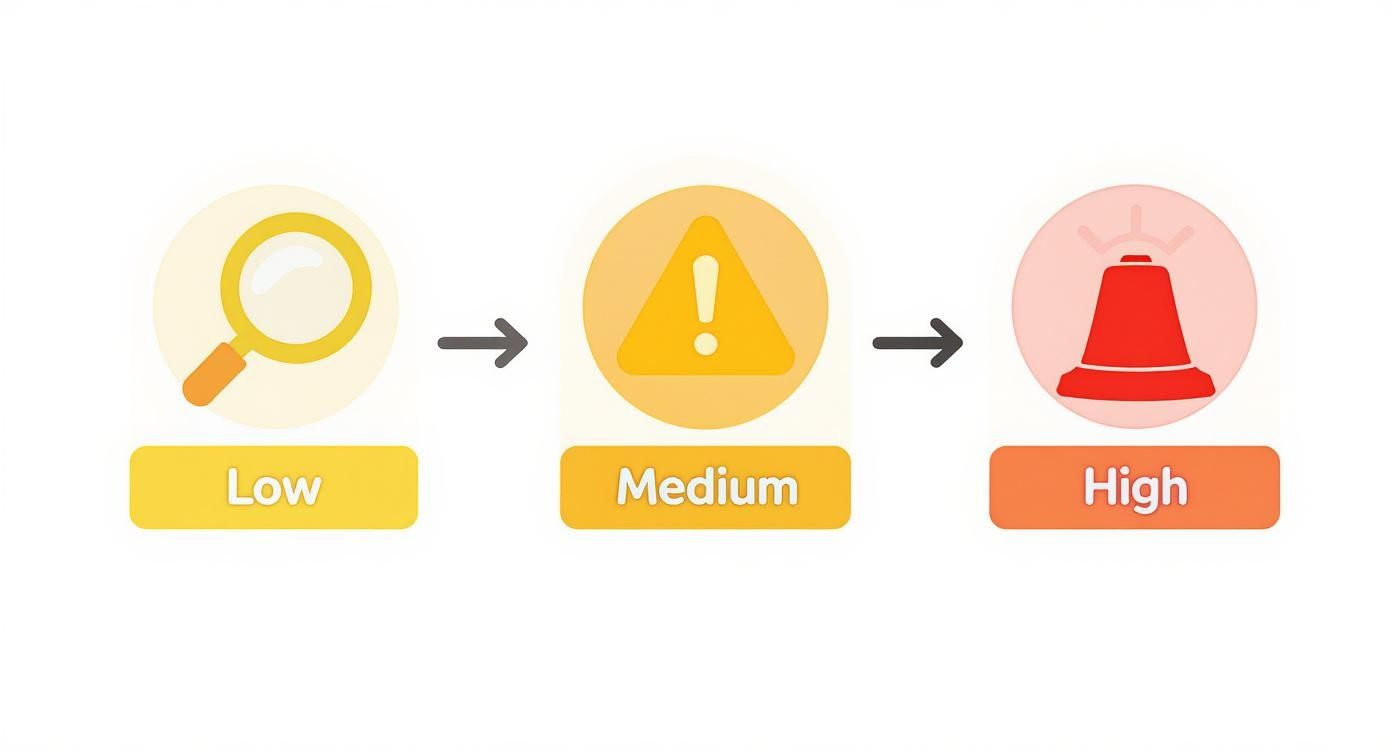
A tiered system like this helps the team on the ground immediately understand the severity and trigger the right protocol without hesitation.
Translating Protocols Across Different Properties
A plan is only as good as its specifics. Generic protocols often fail because they don't account for the unique challenges of different properties. What does "Containment" or "Recovery" actually mean at your site?
A plan isn't actionable until it speaks the language of your property. "Containment" on a construction site is about locking down the perimeter and accounting for all heavy equipment. For a retail center, it's about managing public access and protecting inventory.
To make this clear, here’s a look at how these phases translate into concrete actions across different environments.
Response Phase Actions for Different Property Types
This table demonstrates how critical phases of an incident response plan are adapted to fit the specific needs and vulnerabilities of residential, commercial, and construction properties.
| Response Phase | Residential Community Action | Commercial Property Action | Construction Site Action |
|---|---|---|---|
| Containment | Disable access fobs for the affected area and station a guard at the entry point to manually verify residents. | Isolate the floor or wing where the incident occurred, restricting elevator access and redirecting foot traffic. | Lock all site access gates, secure high-value material containers, and conduct a full inventory of heavy equipment. |
| Recovery | Repair the damaged gate, issue new access credentials to all residents, and send out a community-wide communication update. | Bring in a specialized team to repair damages, restore alarm systems to full function, and brief tenants on restored operations. | Replace stolen materials, repair any damage to fencing or equipment, and implement enhanced overnight patrol schedules. |
This level of detail is exactly what your team needs to act decisively. Property managers can build these actions directly into their security guard post orders, ensuring every officer on site knows the playbook.
Overton's Role in Executing Your Protocols
A dedicated security partner plays a crucial role here. Overton Security’s services are designed to integrate directly into your response plan and execute each phase flawlessly. Our GPS-enabled patrols provide rapid identification, with officers documenting incidents in real-time.
Our 24/7 Security Operations Center (SOC) acts as the command center for coordinating containment and eradication, ensuring a professional and seamless response. We partner with you to transform your documented protocols into a living, breathing strategy that actively protects your property, people, and reputation.
Bringing Your Plan to Life Through Training
A well-crafted security incident response plan is only effective if it's put into practice. In our 26 years of experience, we've seen organizations invest in a plan only to neglect the most critical step: training.
Your plan is a living strategy that requires practice and refinement to work under pressure. Training builds the muscle memory needed for a calm, coordinated, and effective response.
From Paper Plans to Practical Drills
Testing your security incident response plan doesn't have to be disruptive. Simple, low-impact exercises can build confidence and expose weaknesses in a controlled environment.
One of the most effective methods is the tabletop exercise. This involves gathering your incident response team to walk through a simulated scenario. For example, a property manager might propose:
"It’s 10 PM on a Tuesday. Our mobile patrol officer reports signs of forced entry at a vacant retail unit. What is our first move? Who makes the first call? What are the next three steps, in order?"
This simple exercise can immediately uncover confusion about roles, communication chains, and approval processes—long before a real crisis occurs.
The Importance of Consistent Training
Training should extend beyond your core response team. Everyone, from the front-desk concierge to the maintenance staff, has a role in your property's security and needs to understand what is expected of them.
Consistent training should include:
- Role-Specific Drills: Provide training that applies directly to each person's job. A maintenance technician needs different instructions than a security officer.
- Communication Practice: Regularly test your call lists and communication apps to ensure contact information is current.
- Cross-Training: Prepare for absences by having backups for critical roles.
Well-trained people are the foundation of any solid security program. Our approach to comprehensive security guard training is built on practical skills and situational awareness.
The payoff for a well-prepared team is clear. As risks have grown, the severity of claims for prepared firms has dropped by over 50%, largely due to increased security investments that improve detection and response. This data proves that training is not just an operational task—it's a smart financial decision. You can read more about how preparedness changes outcomes in this Allianz Commercial cyber risk trends report.
At Overton Security, we partner with our clients to run drills, lead tabletop exercises, and provide ongoing training. We help turn your static document into a dynamic, effective strategy, ensuring your team is always ready to respond with confidence.
Your Questions Answered
When developing a security incident response plan, many questions arise. With over 26 years of experience, we've heard them all from property managers, HOA boards, and business owners. Here are straightforward answers to the most common questions.
How often should we update our incident response plan?
Your plan should be a living document. We advise our clients to conduct a full review at least once a year.
However, you should also revisit the plan whenever a significant change occurs. Did your commercial building in Los Angeles complete a major renovation? Did your San Jose residential community install a new access control system? An update is needed. Most importantly, after any real incident, a post-mortem review is essential to strengthen your plan with real-world experience.
What is the biggest mistake people make in planning?
The most common mistake is creating a detailed plan that is never tested. A plan may look perfect on paper but can fall apart during a real event. If your team has not practiced their roles, you will discover gaps in communication and resources when it's too late.
A plan is only as strong as your team's ability to execute it under pressure. An untested plan can create a false sense of security, which is more dangerous than having no plan at all.
This is why drills and tabletop exercises are so critical. They build the muscle memory your team needs to act decisively.
Where do we start if our budget is limited?
A limited budget requires a smart, focused approach. If you are starting from scratch, concentrate on these three priorities:
- Identify Key Risks: Determine what you need to protect most and which threats are most likely. Is it equipment theft from a construction site? Or unauthorized access to a residential parking garage? Focus your efforts there.
- Create a Communication Tree: Develop a clear chart showing who to call, and in what order, during an incident. This simple tool reduces confusion in a crisis.
- Write Basic Protocols: You don't need a 100-page document. Start by writing clear, step-by-step instructions for the two or three most likely incidents your property could face.
Even a simple, documented plan is far better than having no plan at all. It provides your team with a foundation for a calm, structured response.
How does a security service integrate with our team?
A true security partner should feel like a natural extension of your management team. To ensure seamless integration, they should be involved from the beginning.
At Overton Security, we become part of our clients' teams by:
- Collaborating during the planning process to lend our expertise.
- Training our security officers on your site’s unique protocols and post orders.
- Using technology like digital reports and GPS-tracked patrols to provide your team with real-time, actionable information.
When an incident occurs, our 24/7 Security Operations Center (SOC) acts as your command hub, while our dedicated managers provide expert guidance on the ground. It’s about creating a single, coordinated team that responds calmly and professionally every time.
A well-practiced security incident response plan is one of the most powerful tools for protecting your property, tenants, and employees. If you’re ready to build a plan that provides real peace of mind, the team at Overton Security is here to help. With 26 years of hands-on experience, we have the expertise to ensure you’re prepared for anything.
Learn more about our professional security solutions at overtonsecurity.com