
Have you ever reviewed a late-night incident report that was frustratingly vague? Or watched a security guard look confused when a routine after-hours delivery arrives? These common frustrations often trace back to a single root cause: weak or generic security guard post orders.
Think of post orders as more than just a checklist. They are the operational DNA for your property’s security—the single source of truth that transforms a reactive security presence into a predictable, reliable, and professional service.
The Foundation of Consistent and Reliable Security
What truly separates an officer who is just physically present from one who is genuinely effective? The answer almost always lies in the quality of their instructions and training. Security guard post orders are the official, site-specific documents that detail every duty, protocol, and emergency procedure for an officer at your location. They are the playbook that ensures every officer, regardless of their shift, acts with consistency and purpose.
Without clear post orders, security becomes a guessing game. Officers are forced to rely on memory or improvisation, which inevitably leads to inconsistencies, missed tasks, and increased liability for property managers and business owners.
A well-crafted post order transforms security from an unpredictable variable into a structured, accountable service. It’s the bridge between your expectations and the officer’s on-the-ground performance.
Why Every Site Needs Unique Post Orders
One of the most significant pitfalls in the security industry is the use of “one-size-fits-all” templates for every property. This approach simply doesn’t work. The security needs of a busy retail center in Los Angeles are worlds apart from those of a quiet residential HOA in San Jose or a high-value construction site in Fresno. Generic instructions fail to account for the unique risks, access points, and operational realities of your specific site.
Truly effective security guard post orders are meticulously customized. They should be:
- Site-Specific: Detailing everything from the location of fire risers and emergency shut-offs to the names of approved vendors and after-hours contacts.
- Clear and Actionable: Using simple, direct language to describe precise tasks. For example, “Patrol the west perimeter fence hourly” is far more effective than the vague “Monitor the property.”
- Comprehensive: Covering routine duties, emergency responses, and communication protocols, leaving no room for confusion about what to do in any given situation.
The Role of Training and Updates
Creating a detailed document is only half the job. The best post orders are ineffective if officers are not properly trained on them. This is where a committed security partner demonstrates their value. Every officer assigned to your property must be thoroughly trained on your specific post orders before their first shift. You can learn more about how comprehensive security guard training directly impacts on-site performance and reliability.
Furthermore, your property is not static, and neither should its security plan be. Post orders must be treated as living documents, updated regularly to reflect changes in tenants, new construction, or different operational hours. After an incident, the post orders should be reviewed and revised to prevent a recurrence. This continuous cycle of documentation, training, and refinement is the hallmark of a professional security program.
The Anatomy of Effective Post Orders
Think of your security guard post orders as the master playbook for your property. A simple list of “dos and don’ts” is not enough. An effective set of post orders is a detailed, site-specific guide that directs an officer’s every action. Like a building’s blueprint, every detail must be precise for the final structure to be safe and sound. Vague instructions are the weak points in your security; clear, detailed protocols build a truly resilient defense.
This detailed framework is essential for maintaining consistent performance across every shift and every officer. With approximately 1.2 million security guards working in the United States in 2023, clear documentation is the only reliable way to ensure quality service on such a large scale. Considering that contract security comprises about 70% of the market, it highlights how critical it is for property managers to have a rock-solid system for communicating their exact needs to their security partners. You can see more data on the security guard industry’s scale and importance on Jobera.com.
At Overton Security, we approach post orders with this philosophy. They must be a practical, living tool, not a document left to gather dust in a binder. The best post orders are built on four critical pillars, each covering a key piece of the on-site puzzle.
Site-Specific Details and General Orders
This is the foundation of the entire document. It provides an officer with immediate context and the essential information they need about the property, going far beyond a simple street address.
- Property Overview: A concise summary of the site—is it a “Class A commercial office tower,” a “gated residential HOA community,” or an “active construction site”? This section also outlines the primary security goals.
- Key Contacts: A complete, up-to-date list of who to call for both emergencies and non-emergencies. This includes property management, maintenance supervisors, and local law enforcement non-emergency lines.
- Critical Infrastructure Locations: Clear maps and descriptions showing an officer where to find fire alarm panels, water shut-off valves, electrical rooms, and other key building systems. This information is invaluable during an emergency.
Getting this foundational knowledge right means any officer, even one new to your site, has the core information needed to perform effectively from the moment their shift begins.
Officer Duties and Responsibilities
Here, we move from general information to specific, actionable tasks. This section is about eliminating guesswork by clearly defining the routine responsibilities an officer will handle during their shift. The goal is to create a predictable and repeatable standard of service.
For example, instead of a vague instruction like “patrol the property,” effective post orders get specific: “Conduct foot patrols every hour on the half-hour, following the designated route on Map A. Scan the NFC checkpoint at the pool gate and the main lobby entrance on each patrol.” This level of detail creates accountability, which we verify through our GPS-enabled guard tour system.
This image drives home how specific patrol duties are a central part of maintaining security.
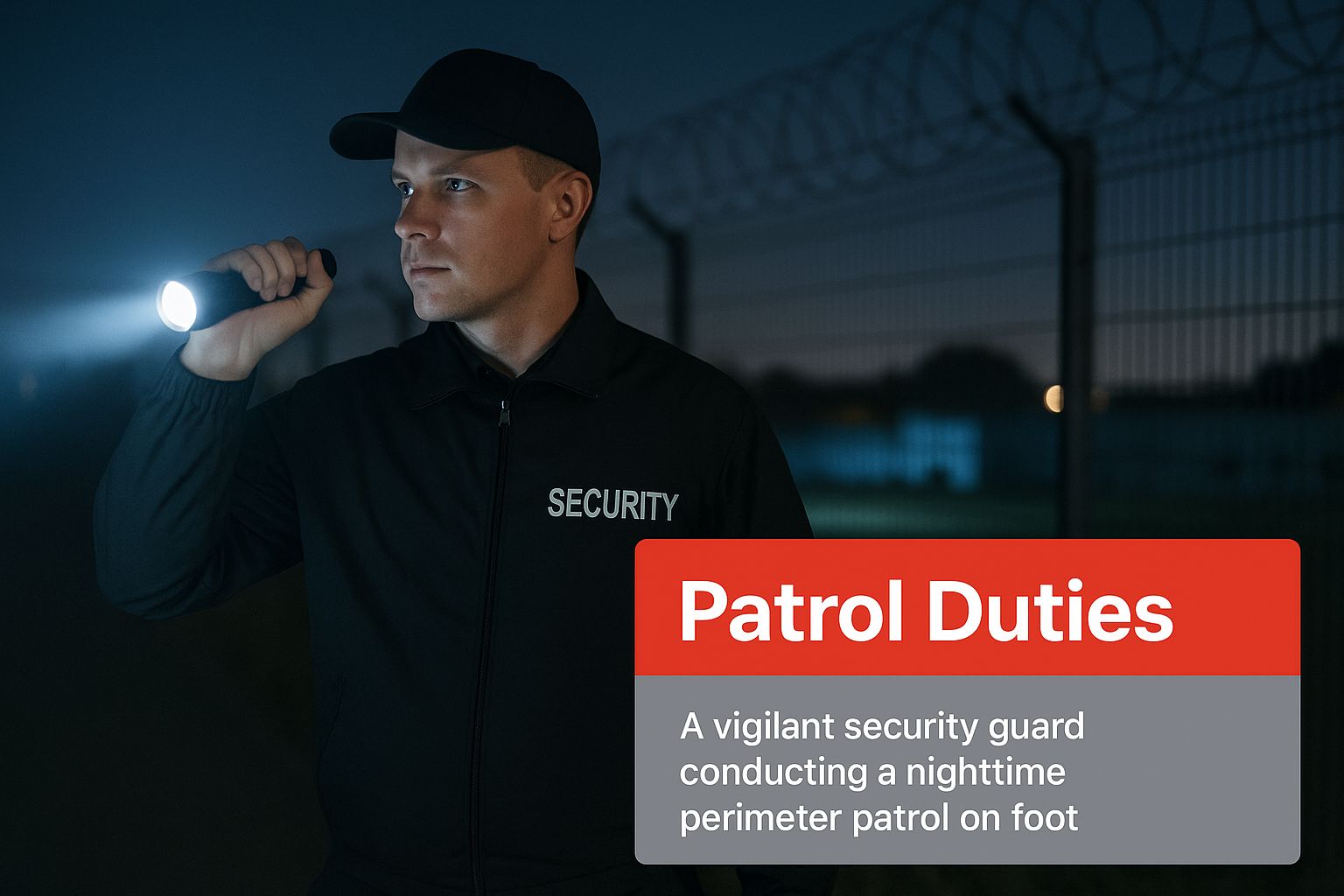
It’s a clear visual reminder that an officer’s vigilance during patrols is a cornerstone of a successful security plan, and it all starts with clear instructions in the post orders.
Emergency Response Procedures
While routine duties keep things running smoothly, how an officer reacts during a crisis truly defines a professional security program. This is where you lay out clear, step-by-step instructions for different emergency scenarios, ensuring a calm, organized response instead of panic.
An emergency is not the time for an officer to guess what to do. Clear, pre-defined protocols for fire, medical events, or security threats are non-negotiable for protecting people and property.
Every protocol needs to be tailored to your specific property. For instance:
- Fire Emergency: Clear instructions on pulling alarms, notifying the fire department, communicating with the on-site command post, and assisting with an orderly evacuation.
- Medical Emergency: The exact steps for calling 911, providing dispatchers with the correct information, guiding paramedics to the person in need, and documenting everything.
- Unauthorized Access: Protocols for how to challenge trespassers, how to de-escalate the situation, and when to contact law enforcement if the person refuses to comply.
Communication and Reporting Protocols
The final piece of the puzzle is communication. Everything an officer sees and does is valuable only if it’s documented and reported correctly. This section outlines the “how, what, and when” of all reporting.
It should specify the exact tools to be used, like our digital reporting software for Daily Activity Reports (DARs) and detailed incident reports, including the requirement for photos when needed. It also defines the chain of command, making it crystal clear when an officer should notify their field supervisor versus the 24/7 SOC or the property manager directly. This ensures the right information gets to the right people quickly, giving clients the transparency and peace of mind they deserve.
To bring all this together, it’s helpful to see these components in a structured format. Think of this as your checklist for building robust and reliable post orders.
Core Components of Effective Post Orders
| Component Category | Specific Details to Include | Why It’s Critical |
|---|---|---|
| General Site Information | Property address, key contacts (management, maintenance), maps of critical infrastructure (fire panels, water shut-offs), and primary security objectives. | Provides immediate context and essential operational knowledge for any officer, ensuring they can function effectively from day one. |
| Routine Duties | Specific patrol routes and frequencies, lock-up/unlock schedules, access control procedures, and required checkpoints (NFC/QR scans). | Eliminates ambiguity, creates accountability, and establishes a consistent, verifiable standard of service across all shifts. |
| Emergency Procedures | Step-by-step instructions for fire, medical, active threat, and natural disaster scenarios. Includes evacuation routes and muster points. | Ensures a calm, organized, and effective response during high-stress events, minimizing harm to people and property. |
| Reporting & Communication | Guidelines for Daily Activity Reports (DARs), incident reporting format, required photos/videos, and chain of command for notifications. | Guarantees that crucial information is documented accurately and communicated to the right people in a timely manner, providing transparency. |
By ensuring each of these core components is thoroughly addressed, you move from a simple checklist to a comprehensive operational guide that empowers your security team and protects your property.
Why Generic Post Orders Put Your Property at Risk

In the world of property security, a “one-size-fits-all” approach is a recipe for failure. Relying on generic, boilerplate security guard post orders is like a doctor writing the same prescription for every patient, regardless of their symptoms. It completely ignores the unique risks, layout, and operational flow of your specific property, leaving you exposed to preventable threats.
When a security provider hands you a pre-written document without walking the site with you or discussing your needs, they’re just checking a box. This approach prioritizes their convenience over your safety—a significant red flag. It signals that they view security as a commodity, not a specialized service, a mindset that runs counter to Overton Security’s 26-year history of focusing on quality over quantity.
To fully appreciate the risk, let’s compare two very different properties and see how their security needs diverge.
The Urban High-Rise vs. The Suburban HOA
First, picture a sleek, 40-story Class A office tower in bustling downtown Los Angeles. The security challenges are vertical, technical, and fast-paced. Now, contrast that with a sprawling, 300-home HOA community in a quiet San Jose suburb. Here, the needs are horizontal, community-focused, and built on relationships.
A generic set of post orders would fail both properties, but in completely different ways.
Scenario 1: The High-Rise Office Tower
The primary goals here are controlling access, ensuring tenant safety, and protecting critical infrastructure. A generic document might simply say, “Monitor lobby and check visitor IDs.” This isn’t just insufficient; it’s dangerously inadequate.
Proper post orders for this building would have detailed protocols for:
- Vendor and Contractor Access: Clear instructions on verifying work orders, issuing temporary badges, and escorting workers to sensitive areas like data centers or mechanical rooms.
- After-Hours Tenant Access: A step-by-step process for verifying employees working late against an approved access list from their company.
- Delivery and Mailroom Security: Procedures for screening packages, managing courier flow at the loading dock, and securing the mailroom to prevent theft.
- Elevator Control and Response: What to do if an elevator gets stuck, including coordinating with maintenance and emergency services while keeping trapped tenants calm.
A generic template misses every one of these crucial details. It doesn’t tell an officer how to differentiate between a tenant’s food delivery and a suspicious individual attempting to access the building’s core.
Generic post orders create a false sense of security. They give the appearance of a plan without providing the site-specific instructions needed to execute it, leaving both officers and clients vulnerable when a real issue arises.
Scenario 2: The Sprawling HOA Community
For this property, security is less about high-tech systems and more about upholding community rules and preserving quality of life. The generic order to “patrol the property” is nearly useless when you’re talking about hundreds of acres with various amenities.
Customized post orders for this HOA would need to cover real-world issues:
- Amenity Access and Rules: How to handle opening and closing the pool, checking resident IDs, and politely addressing non-residents trying to use the facilities.
- Parking Enforcement: Detailed steps for dealing with unauthorized vehicles in resident or guest parking, including when to issue warnings versus calling a tow service.
- Resident Complaint Response: A guide for responding to noise complaints or neighborly disputes, with a focus on de-escalation and careful documentation.
- Patrol Route Nuances: A planned route that specifically covers known trouble spots, like a poorly lit park or a back gate often left open, all verified by our GPS-enabled reporting system.
Generic orders don’t prepare an officer for the day-to-day reality of managing a residential community. They fail to provide guidance on handling a parking dispute or enforcing pool rules—often the most common “security” events at an HOA.
The Overton Difference: The Power of Bespoke Orders
This sharp contrast gets to the heart of what we believe: effective security starts with hands-on engagement. Our leadership team personally invests the time to walk every property, whether it’s a new construction site in Fresno or a busy retail center in San Diego. We sit down with property managers to truly understand their pain points and operational goals.
This deep dive allows us to create security guard post orders that are genuinely bespoke. They become a real-world operational playbook, not just a piece of paper for an insurance file. We translate your property’s unique DNA into clear, actionable instructions, ensuring our officers are prepared for the specific challenges they will face on your site. This commitment to detail is what separates a true security partner from a simple guard vendor.
Turning Post Orders Into Living Documents

One of the biggest mistakes a property manager can make is treating security guard post orders as a static checklist to be filed away and forgotten. We’ve seen it happen. The most effective security plans are not set in stone; they must be dynamic, responsive, and constantly adapting to the real world. At Overton Security, we treat post orders as living documents that require consistent attention to remain effective.
Your property’s needs are always changing. A new high-value tenant moves in, construction begins on an adjacent lot, or a minor incident reveals a previously unknown vulnerability. A security program that doesn’t adapt to these changes is already falling behind. This is why we don’t just write post orders and walk away—we actively manage them as a central part of our service.
A Proactive System of Review and Refinement
Relying on outdated instructions isn’t just inefficient; it’s a significant liability. That’s why our entire process is built on a foundation of proactive, scheduled reviews. We don’t wait for a problem to force our hand.
Our commitment to keeping your post orders sharp and relevant includes:
- Scheduled Quarterly Reviews: Every three months, our managers meet with you to review the post orders. This is our dedicated time to discuss operational changes, address new concerns, and ensure the instructions are still a perfect fit for your property.
- Immediate Post-Incident Updates: After any significant security incident, our first step—once the situation is resolved—is to update the post orders. We analyze what happened, why it happened, and integrate new protocols to prevent it from happening again.
- Adjustments for Operational Changes: When you change gate access codes, welcome a new anchor tenant, or alter your property’s hours, we update the documentation immediately. The instructions must reflect the reality on the ground, not what was true last year.
This disciplined approach ensures your security strategy never becomes outdated. It’s a core part of the hands-on leadership our clients have come to expect over our 26 years of service.
Closing the Loop Between Documentation and Execution
What good is an updated document if the officers on-site don’t know about the changes? This is a critical failure point for many security providers, creating a dangerous gap between strategy and execution. An instruction that only exists on a manager’s computer doesn’t protect your property.
To solve this, we blend human oversight with smart technology. When a post order is updated, we do more than just send an email.
We use our digital reporting and management system to push the updated documents directly to the officers assigned to your site. Before they can begin their shift, they must digitally acknowledge that they have read and understood the new protocols.
This process creates a clear, documented audit trail, giving you complete peace of mind. You can be confident that the officer on duty tonight is working from the most current instructions, not a version from six months ago. The sheer scale of the private security industry shows why systems like these are so important. The global security guard market was valued at around $220 billion in 2023 and continues to grow. This rapid expansion makes clear, well-communicated security guard post orders indispensable for maintaining quality and accountability. You can discover more insights about the growing security guard market at DataIntelo.com.
This closed-loop system of review, update, and confirmation is fundamental to providing security you can rely on. It’s one of the many details that separates a dedicated security partner from a simple vendor. If you’re looking for a partner who takes this level of detail seriously, check out our guide on how to hire the right security guards for your property.
Your Top Questions About Security Guard Post Orders
As a property manager, facilities director, or HOA board member, you know that the effectiveness of your security program lies in the details. The cornerstone of strong on-site performance? Your security guard post orders. They are essential, yet they often raise many questions. Here are straightforward answers to the most common ones we hear.
How Often Should Post Orders Be Updated?
Think of your post orders as a living document, not something to be written once and filed away. They must adapt as your property does. We recommend a formal review at least quarterly to ensure they align with your current day-to-day operations.
However, certain situations require an immediate update:
- Following any significant security incident or emergency.
- Anytime you change the property’s layout, access points, or key infrastructure.
- When a new major tenant moves in or your operating hours shift.
- After an officer on-site identifies a gap or suggests a more efficient protocol.
Keeping instructions current isn’t just good practice—it’s how you ensure your security team is always working with the right playbook. This hands-on, proactive management is a core part of our service at Overton Security.
What Is the Difference Between Post Orders and a Security Plan?
This is an excellent question, and the distinction is vital. The easiest way to think about it is like building a house: the security plan is the architect’s overall blueprint, while the post orders are the detailed, step-by-step instructions for the construction crew on-site.
A security plan is your high-level strategy—the “what” and the “why.” It identifies your property’s risks, sets overarching security goals, and outlines the big-picture approach to mitigation.
Security guard post orders are the tactical guide for the officer—the “how, when, and where.” These are the on-the-ground instructions that detail every routine task and provide clear steps for responding to any emergency.
Who Is Responsible for Creating Post Orders?
Crafting effective post orders should always be a partnership. A quality security provider will take the lead, but your involvement as the client is essential. If a company simply provides a generic document without seeking your input, they are not genuinely invested in protecting your unique property.
Our process at Overton Security is built on collaboration:
- We start with a thorough site walk, with your team by our side.
- We sit down for a real conversation to understand your specific goals and pain points.
- We draft a completely custom set of post orders based on our shared understanding.
- Finally, we review the draft with you to fine-tune it, ensuring every instruction aligns perfectly with your expectations.
No one knows your property better than you do. A true security partner doesn’t just recognize this—they build their entire service strategy around your expertise.
Can Technology Replace Written Post Orders?
No, technology enhances post orders but does not replace them. Tools like GPS-enabled guard tour systems and digital reporting software are fantastic for accountability—we use them at every site to provide proof that the duties outlined in the post orders are being performed.
However, in a high-stress emergency or a complex access control situation, the officer needs a single, reliable source of truth to guide their actions. Written security guard post orders serve as that definitive guide. They ensure every response is clear, consistent, and correct when it matters most, blending human expertise with smart technology for a more reliable outcome.
For over 26 years, Overton Security has built its reputation on creating customized security programs founded on clear communication and active management. If your current post orders feel generic or outdated, it may be time for a fresh perspective. Contact us to see how our client-focused process can bring a new level of clarity, consistency, and reliability to your property’s security.