A lot of property managers find out too late that “security on site” and “security being done well” are not the same thing.
The warning sign is usually small. A nightly report says “all clear,” but a side gate was left unsecured, a vendor entered through the wrong door, residents complained about loitering in the garage, or tools disappeared from a construction laydown area. The guard may have been present the whole time. The problem is that presence alone doesn’t tell you whether the right duties were performed, whether they were done consistently, or whether anyone can verify them afterward.
That’s why understanding security guards duties matters so much. If you manage a commercial building in Los Angeles, a residential community in San Diego, or a construction site in Fresno, you’re not just hiring a person in a uniform. You’re putting a process in place to protect people, property, and day-to-day operations without creating unnecessary friction for tenants, staff, residents, or vendors.
What Do Security Guards Actually Do All Day
A property manager gets a morning report that says only one thing: “No issues.” On paper, that sounds fine. In practice, it leaves every important question unanswered. Were all doors checked. Did anyone challenge unknown persons in the loading dock. Was the patrol route completed. Did the officer notice the broken latch on the rear gate before it turned into a trespassing problem.
That gap is where many security programs fail. The work of a professional officer isn’t passive. It’s a sequence of observations, decisions, interventions, and documentation that should line up with the actual risks on your site.

What a serious shift usually includes
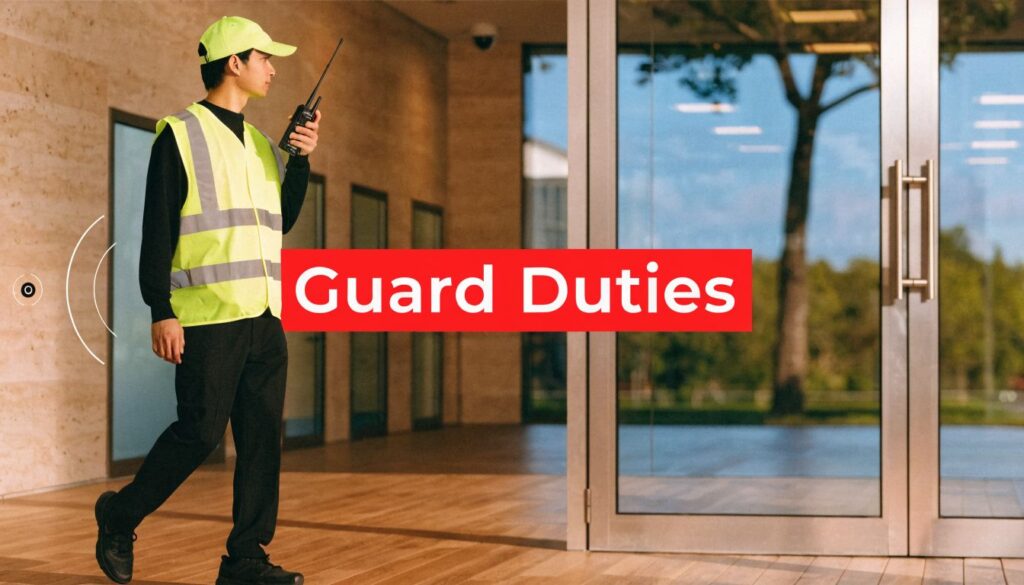
A good officer’s day is built around routine, but not mindless routine. The shift often includes:
- Patrolling the property: Checking entrances, perimeter areas, parking structures, common areas, and points that tend to attract trespassing or misuse.
- Watching who comes and goes: Managing visitors, vendors, contractors, deliveries, and after-hours access.
- Responding to incidents: Handling disturbances, suspicious activity, fire alarms, lockouts, or safety hazards until management or emergency responders take over.
- Documenting what happened: Writing reports that describe conditions, actions taken, and follow-up needs clearly enough that a manager can act on them.
Security that can’t be described, documented, and verified usually turns into guesswork.
This isn’t a niche function. The U.S. security services industry employs 1,272,400 security guards, and the industry is valued at $49.1 billion in 2026, with 73.69% of guards working in investigation and security services, primarily for contract firms, according to security guard industry data from Building Security.
Why property managers need more than a warm body
From the client side, the main question isn’t whether a guard was on duty. It’s whether the officer’s duties matched the site.
A lobby officer in San Francisco shouldn’t work like a vehicle patrol officer covering a spread-out industrial property in Oakland. A residential officer in Long Beach needs a different approach than a daytime concierge-style officer in a Class A office tower in San Jose. The strongest programs define duties clearly, verify performance, and adjust those duties as the property changes.
The Three Pillars of Core Security Guard Responsibilities
Most security work can be reduced to three responsibilities: observe, deter, and report. That sounds simple, but each part takes judgment, consistency, and site-specific direction.
When these three pillars are done well, they prevent small issues from becoming operational problems. When they’re done poorly, management ends up reacting to preventable incidents instead of controlling risk.
Observe
Observation is more than walking the property. Officers are there to protect personnel, property, and assets through proactive vigilance and systematic patrols, and that means noticing what doesn’t fit.
An officer observing well pays attention to patterns. A delivery door that is usually closed but is standing open. A vehicle parked in the wrong place three nights in a row. A person testing whether a side entrance is monitored. A tenant complaint that suggests a recurring issue rather than a one-time annoyance.
Practical observation usually includes:
- Physical patrols: Interior and exterior checks, stairwells, garages, loading docks, roof access points, and common areas.
- System monitoring: Watching cameras, alarms, intercoms, and access activity for irregular behavior.
- Condition checks: Spotting lighting failures, broken locks, blocked exits, water leaks, or hazards that aren’t crimes but still matter.
Deter
A trained officer often prevents incidents by being visible, alert, and appropriately engaged. That deterrent value is one of the most misunderstood parts of security work.
An officer who greets entrants, keeps moving through the property, and addresses minor violations early changes the tone of a site. People notice quickly whether a property is managed or neglected. Trespassers, shoplifters, and problem visitors notice too.
Practical rule: A visible officer who interacts professionally usually deters more trouble than an officer who stays seated and only reacts after a complaint.
Deterrence works best when officers know which behaviors require immediate contact and which are better handled through observation and escalation. Overreacting creates friction. Underreacting creates patterns that become harder to control later.
Report
Reporting is where professional security separates itself from vague coverage. According to Garda’s overview of security officer duties and responsibilities, a critical function involves controlling access points, and when incidents occur, officers maintain accurate incident reports documenting observations, security breaches, and details for investigative purposes.
Good reporting does three jobs at once:
| Reporting job | Why it matters to management |
|---|---|
| Documents incidents | Creates a usable record for follow-up, insurance, liability, and tenant communication |
| Tracks patterns | Helps identify repeat offenders, recurring access problems, and weak points on the property |
| Shows performance | Confirms whether officers completed the duties you’re paying for |
A weak report says “patrolled property, all secure.”
A useful report says the officer checked the south stairwell, found a door failing to latch, notified the proper contact, increased checks in that area, and documented photos for maintenance and management review.
Exploring Different Types of Security Guard Roles
Not every property needs the same kind of officer. A lot of frustration starts when the selected role doesn’t match the assignment.
If you put a concierge-style officer on a rough after-hours industrial property, you’ve likely chosen the wrong fit. If you assign a highly assertive enforcement-minded officer to a luxury residential lobby, resident experience can suffer even if that officer means well.

Unarmed onsite guards
This is the role most commercial and residential managers think of first. Unarmed officers are often the right fit when the property needs visible deterrence, access control, patrols, policy enforcement, and incident documentation without a high-threat posture.
They work well for:
- Office buildings: Lobby desk coverage, visitor management, loading dock control, and after-hours rounds
- Retail centers: Common area patrols, parking lot presence, merchant support, and loitering deterrence
- Apartment and HOA communities: Amenity checks, garage patrols, access monitoring, and resident issue response
The key skill here is balance. These officers need to be approachable enough for tenants and residents, but firm enough to address violations early.
Armed officers
Armed coverage belongs in settings where the risk profile justifies it. That can involve sensitive assets, prior serious incidents, or environments where the consequences of a security failure are much higher.
The role requires stronger judgment, tighter policy compliance, and a clear understanding of legal boundaries. On many properties, armed service is not the better option. It’s the more appropriate option when the threat picture supports it.
A useful decision filter is whether the site requires higher-level readiness, or if it instead needs stronger procedures, better supervision, and more disciplined unarmed coverage.
Concierge security
Concierge security is common in Class A buildings, high-rise residential properties, and mixed-use environments where service matters as much as enforcement.
These officers do more front-facing work:
- Greeting and screening visitors
- Coordinating guest access
- Managing deliveries and contractor check-ins
- Supporting tenant and resident experience while protecting the property
This role often fails when companies staff it like a static desk post. A true concierge officer still performs security duties. The difference is that the officer delivers them with stronger communication, presentation, and front-of-house discipline.
The best concierge officers don’t look like reception staff with a badge. They look like security professionals who understand hospitality.
Mobile vehicle patrols
Vehicle patrol is a strong option when one officer doesn’t need to remain fixed at a single post all shift. It works well for apartment portfolios, industrial parks, office campuses, retail lots, and parking structures spread over a larger area.
Typical duties include lock and entryway status checks, perimeter inspections, suspicious vehicle observations, amenity closures, and response to alarms or resident calls. The value is flexibility. The limitation is obvious too. A patrol officer can’t be everywhere at once.
That’s why vehicle patrol works best when the client understands the assignment clearly. It’s a mobile deterrence and inspection service, not a substitute for full-time lobby or gate coverage.
Specialized and temporary roles
Some assignments are narrower and more procedural.
Examples include:
- Fire watch: Frequent rounds and life-safety observation when systems are offline
- Event security: Entry screening, crowd management, restricted area control, and incident coordination
- Site-specific guards: Officers trained around one property’s recurring needs, such as school dismissal traffic, medical office access, or overnight construction laydown protection
The right role starts with the property’s operating reality, not with a generic package.
How Modern Technology Elevates Security Responsibilities
Technology has changed security guards duties in a practical way. It hasn’t made officers less important. It has made weak performance easier to spot and strong performance easier to verify.
That matters to property managers because trust alone isn’t a system. If an officer says a patrol was completed, there should be a way to confirm where the officer went, when the patrol happened, and what was found.

GTMS turns patrols into proof
A GPS-enabled Guard Tour Management System changes the old model of handwritten logs and vague summaries. Officers scan checkpoints, submit digital Daily Activity Reports, add photos, and build a time-stamped record of what happened on site.
For a property manager, that means better visibility into questions like:
- Were vulnerable areas checked
- Did the officer complete the full route
- Was a gate, stairwell, or garage inspected
- How quickly was an issue documented and escalated
A system like this doesn’t make an officer better by itself. What it does is enforce consistency and give supervisors a clear record to review.
SOC oversight changes field accountability
A 24/7 Security Operations Center adds a second layer of discipline. The officer in the field isn’t operating alone. Dispatch, wellness checks, escalation support, and real-time coordination help management close the gap between “something happened” and “the right people know about it.”
This matters most on multi-building sites, after-hours assignments, and mobile patrol programs. It also matters when an incident starts small and changes quickly. An officer may be the first set of eyes on the problem, but the response is stronger when someone else is tracking the event, documenting updates, and coordinating next steps.
One example of that approach is an integrated security system for commercial properties, where onsite staffing, patrol verification, and remote oversight work together instead of operating as separate pieces.
AI supervision is now part of the job
The officer’s role has also shifted because more firms are using automated alerts and predictive tools. Recent data from 2025 shows 68% of security firms now use AI for predictive analytics and automated alerts, reducing manual monitoring by 40%, while AI false positives can increase incident response time by 15-20% without trained human oversight, according to this review of the evolving role of guards and AI supervision.
That creates a real trade-off.
AI can help surface activity faster, but an officer still has to verify whether the alert reflects a genuine problem, an environmental trigger, or normal site activity. If the guard treats every alert as equal, response quality drops. If the guard ignores the system, the technology becomes expensive background noise.
A good officer now does more than watch the property. The officer also watches the system that watches the property.
The practical standard is simple. Technology should give officers better information, not replace judgment.
Customizing Security Duties for Your Property Type
A strong security plan starts with one question: what exactly needs to be controlled on this property, and during which hours?
That answer changes by property type. A downtown office tower has traffic flow and visitor management issues. A residential community has recurring lifestyle issues, parking disputes, and amenity misuse. A construction site has open access points, changing crews, and materials that can disappear quickly if nobody is paying attention.

Commercial and retail properties
Commercial security usually succeeds or fails at the front door, in the loading area, and in the parking environment.
In office buildings, officers often manage visitor flow, verify credentials, monitor deliveries, and enforce after-hours access procedures. In retail centers, the assignment shifts toward common-area patrols, merchant support, suspicious activity observation, and customer-facing professionalism. The officer has to protect the site without making normal visitors feel policed.
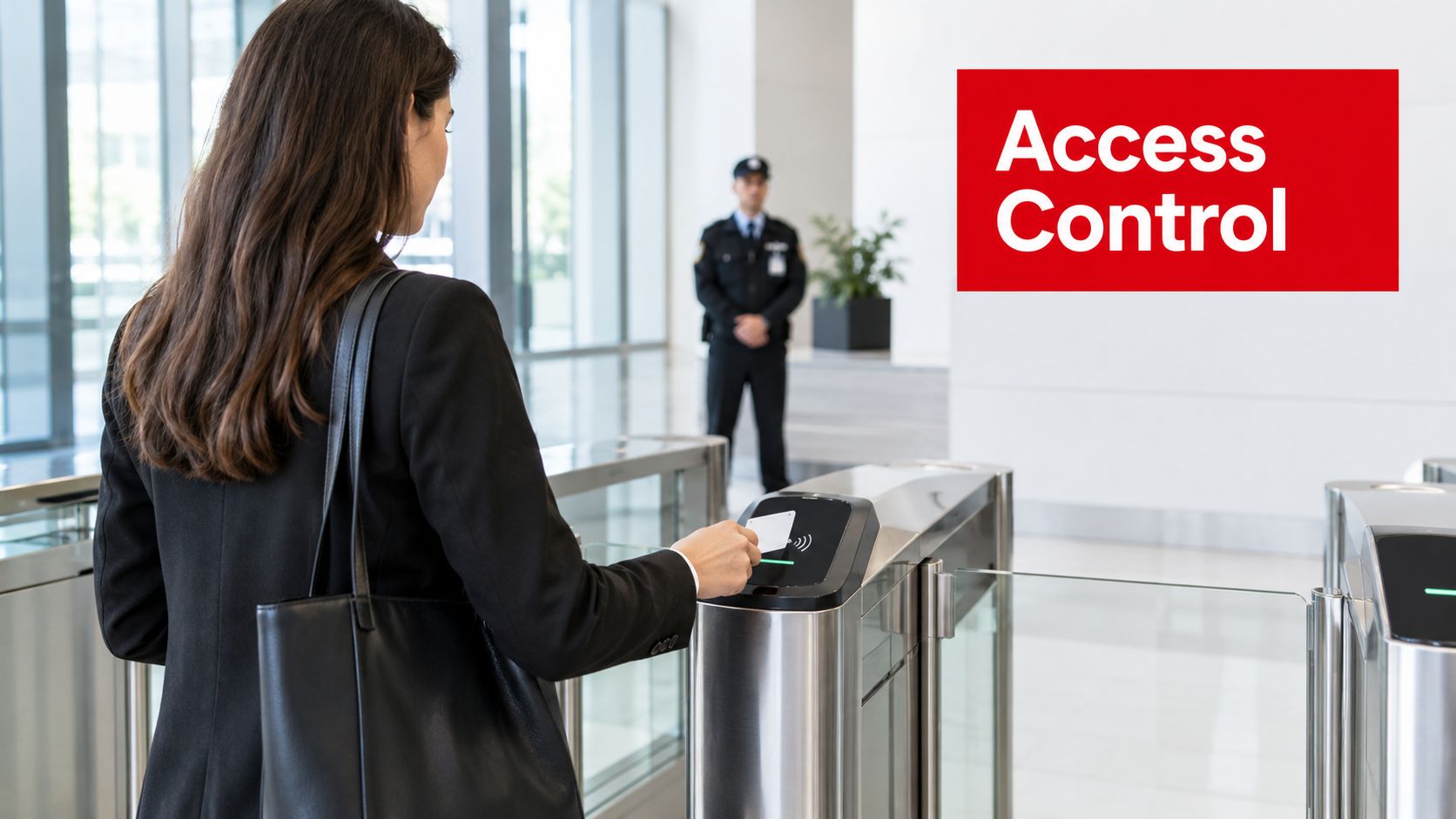
Access control is central here. According to BOS Security’s discussion of access control responsibilities, security guards execute multi-layered access control protocols, from visual ID checks to biometric scans, which can reduce unauthorized access incidents by up to 40% in high-security facilities, and unverified entries account for 25% of corporate espionage cases.
For a Los Angeles office property, that may mean a lobby officer verifies visitors, confirms suites before granting access, and controls freight elevator use after business hours. For a San Jose retail center, it may mean officers focus more on perimeter visibility, known trouble spots, and merchant communication.
Useful commercial duties often include:
- Lobby and reception security: Screening guests, confirming appointments, and handling contractor sign-in procedures
- Loading dock control: Checking who is authorized to receive or remove goods
- Parking area patrols: Watching for trespassing, vehicle break-ins, and unsafe conditions
- Tenant support: Responding to access issues, disturbances, or policy violations professionally
Residential and HOA communities
Residential security is more nuanced than many people expect. Residents want safety, but they also want normal living conditions. That means officers need patience, consistency, and clear direction from management.
In a San Diego HOA or a high-rise in Long Beach, common duties include garage patrols, amenity closing checks, guest access management, pool and clubhouse rule enforcement, and response to noise or nuisance complaints. Officers also become extra eyes for property conditions. They may be the first to spot a broken pedestrian gate, a dark stairwell, or a pattern of unauthorized parking that frustrates residents.
Property managers handling these communities also have broader obligations around maintenance, habitability, and site oversight. For a useful outside reference, this guide for California property owners helps frame the wider operational responsibilities that often overlap with security observations.
Residential officers tend to do well when duties are specific and realistic:
- Guest and vendor control: Who may enter, during which hours, and through which point
- Amenity oversight: Pools, gyms, lounges, and package rooms need regular checks
- Parking enforcement support: Identifying recurring violations and documenting them correctly
- Resident contact: Helping resolve issues calmly without turning every complaint into a confrontation
Residents judge security by two things. Whether the property feels controlled, and whether officers handle people with respect.
Construction sites
Construction security is less about customer service and more about controlling vulnerability. The site changes constantly. Fencing moves, trades rotate, materials arrive and sit exposed, and the busiest risk period may be after everyone has gone home.
On a Fresno project, for example, duties may include checking perimeter integrity, confirming that only authorized personnel are entering, inspecting laydown areas, logging vehicle activity, and watching for tampering around trailers, fuel storage, and equipment. If the officer doesn’t understand the site rhythm, it’s easy to miss what stands out.
Construction-specific duties usually focus on:
- After-hours patrols: Watching entry points, staging zones, tool containers, and temporary offices
- Access restrictions: Preventing unauthorized entry by former workers, opportunistic thieves, or curious passersby
- Material protection: Paying attention to high-theft items and any unusual movement near them
- Early issue reporting: Notifying supervisors about fence damage, unsecured storage, missing chains, or signs of attempted entry
What doesn’t work on construction projects is generic patrol language. “Checked property” means very little. “Inspected the east fence line, trailer row, generator area, and rebar staging zone” gives management something useful.
The Importance of Detailed Security Post Orders
If duties describe the job, post orders describe exactly how the job is done on one specific property.
This is one of the first documents I look at when evaluating whether a security program is likely to succeed. Vague post orders usually produce vague performance. Clear post orders create consistency across officers, shifts, and supervisors.
What good post orders include
A professional set of post orders should tell an officer what to do, when to do it, how to escalate problems, and what matters most at that site.
That usually includes:
- Site priorities: The property’s main concerns, sensitive areas, and expected officer presence
- Patrol instructions: Routes, checkpoints, timing expectations, and doors or gates that require special attention
- Access procedures: How to handle visitors, vendors, contractors, residents, deliveries, and after-hours requests
- Incident response steps: What to do for trespassing, disturbances, alarms, lockouts, suspicious persons, medical calls, or fire-related issues
- Communication chain: Who gets called first, what gets reported immediately, and what belongs in the end-of-shift report
A useful reference point is a detailed look at security guard post orders and how they guide site performance. The underlying principle is simple. Officers perform better when the expectations are written clearly and trained consistently.
The difference between generic and site-specific
A one-page instruction sheet often sounds acceptable until something goes wrong.
Generic post orders tend to say things like “patrol property,” “observe suspicious activity,” or “contact management if needed.” That language leaves too much open to interpretation. One officer may think an hourly patrol is enough. Another may spend most of the shift at the desk. Both may believe they followed instructions.
Site-specific post orders remove that ambiguity. They tell the officer which stairwells are recurring problem areas, which tenant has approved after-hours vendors, which gate must be physically checked rather than viewed on camera, and what kind of reporting management expects.
The best post orders read less like a brochure and more like an operating manual.
Why managers should ask to review them
Many clients focus first on staffing and price. Those matter, but they don’t tell you how the assignment will run.
Ask practical questions:
| Question to ask | What you’re really learning |
|---|---|
| Who writes the post orders | Whether leadership understands site-specific risk |
| How often are they updated | Whether the program adapts as property issues change |
| How are officers trained on them | Whether instructions live on paper or in practice |
| Are reports tied back to post orders | Whether accountability exists beyond attendance |
Detailed post orders reduce confusion, protect the client, and give supervisors a fair standard to enforce. They also help officers succeed, because the assignment no longer depends on guesswork or habit.
Understanding Legal Limits and Training Requirements
Security officers work in a regulated environment, and that’s a good thing for property owners. It creates clearer expectations around training, conduct, and the limits of authority.
One of the biggest misconceptions in private security is that a uniformed officer has broad law enforcement powers. That isn’t how reputable private security should be understood or managed. The role is to protect the property within lawful boundaries, follow site procedures, observe, document, intervene when appropriate, and escalate to law enforcement when the situation requires it.
Why legal limits matter to the client
For a property manager, legal limits are not abstract. They affect liability, tenant relations, and the quality of incident handling on your site.
An officer who doesn’t understand those boundaries can create risk by escalating unnecessarily, mishandling contact with the public, or using poor judgment in a tense situation. An officer who is properly trained is more likely to slow the situation down, follow procedure, preserve evidence, and make clean handoffs to police or emergency responders when needed.
That’s one reason California licensing and training standards matter. A practical overview of California security guard licensing requirements helps clarify the role of Guard Card requirements, compliance, and baseline preparation for officers working in the state.
What good training looks like in practice
Training shouldn’t stop with a license. The strongest programs continue training around report writing, de-escalation, access control, emergency response, and site-specific duties.
From a client perspective, these are the training areas that usually matter most:
- Legal and policy compliance: Officers need to know what they may do, what they shouldn’t do, and when to escalate
- Communication and de-escalation: A large share of onsite incidents depend on calm, controlled conversation
- Emergency handling: Fire alarms, disturbances, medical events, and evacuation support require practiced response
- Documentation quality: Reports need to be factual, complete, and usable after the fact
Why professionalism reduces liability
The safest security program isn’t the one with the toughest language. It’s the one with trained officers, clear supervision, and disciplined procedures.
That’s especially important in California, where clients often manage properties with high public interaction, frequent vendor access, and a mix of safety, customer service, and liability concerns. When officers understand their role and stay within it, the property is better protected and management has fewer unpleasant surprises.
From Presence to Performance A Modern Approach to Security
Security guards duties haven’t become simpler. They’ve become more defined.
Today, an effective officer does more than stand post. The job combines observation, deterrence, reporting, access control, site-specific procedures, and the ability to work with verification tools rather than rely on memory or assumption. The best programs also recognize that a residential tower, a retail center, and a construction site don’t need the same style of coverage.
That shift is important for property managers. You’re not only buying coverage hours. You’re choosing whether your property will have a documented, customized, accountable security program or a loosely managed presence that leaves too much to chance.
A modern approach usually comes down to a few basics: clear duties, strong post orders, field accountability, trained officers, and hands-on supervision. Over time, those basics protect more than the site itself. They protect tenant confidence, resident experience, operational continuity, and management’s ability to make informed decisions.
If you’re reviewing your current security program or planning coverage for a new property, Overton Security can help you evaluate what duties make sense for your site, how those duties should be documented, and what level of accountability you should expect from a professional security partner.