
Pursuing a security guard license in California involves meeting key state requirements, including specific training, a thorough background check, and a formal application. This entire process is overseen by the Bureau of Security and Investigative Services (BSIS). It begins with a foundational 8-hour training course, followed by your application and a Live Scan fingerprinting check.
Understanding California's Security Licensing Framework

Before diving into the application, it’s helpful to understand why California’s regulations are so comprehensive. This isn’t just bureaucratic red tape; it's about building a foundation of trust and professionalism for the entire security industry. These standards ensure every licensed security officer meets a consistent, statewide benchmark for integrity and essential skills.
The Role of the Bureau of Security and Investigative Services (BSIS)
The Bureau of Security and Investigative Services (BSIS) is the state agency responsible for licensing and regulating California's private security industry. As the official gatekeeper, the BSIS sets the standards, processes applications, and enforces the rules to protect the public. Their oversight guarantees that individuals hired to protect lives and property are properly trained and vetted.
For property managers and business owners, this provides a critical layer of assurance. When you partner with a security firm that employs officers with a valid Guard Card, you have confirmation that they have:
- Passed a criminal history background check through both the DOJ and FBI.
- Completed mandatory foundational training on their duties and limitations.
- Met the minimum age and eligibility requirements mandated by state law.
This system is designed to screen out unsuitable candidates and establish a baseline of quality that clients can depend on.
Core Eligibility Requirements for Applicants
While the full process involves several steps, the initial requirements are quite clear. Before an applicant can even register for training, they must meet these non-negotiable criteria.
To qualify for a California Guard Card, you must be at least 18 years old and consent to a comprehensive criminal history review. This is more than a simple records search; it requires submitting fingerprints via Live Scan to both the California Department of Justice (DOJ) and the Federal Bureau of Investigation (FBI). This deep-dive background check is one of the most critical steps in the process.
California has one of the nation's oldest and most established security guard licensing systems. The framework began in 1915 when the state first required licenses for private investigators. By 1973, the system evolved to mandate registration for uniformed patrol employees, creating the robust structure we have today.
This strict vetting is precisely why a company like Overton Security, with over 26 years of experience, makes hiring fully licensed professionals a cornerstone of our operations. It ensures that every officer we assign to a client's property—whether it’s a gated community in Los Angeles or a construction site in San Jose—has already been cleared by the state. It's the first step in building a team known for reliability and consistency, steering clear of the "burn and churn" hiring common in the industry. To see what this means on the ground, you can learn more about what security guards can and can't do in our detailed guide. This commitment to compliance is how we protect our clients and maintain the professional standards that define a quality security partner.
Navigating the Guard Card Application Process
Obtaining your unarmed security guard registration—known throughout the industry as the "Guard Card"—is a clear, structured journey. Rather than viewing it as a series of hurdles, consider it a roadmap into a professional field where you are trusted to protect people and assets. Each step serves a purpose, ensuring you have the right training and a verified background to perform your duties effectively.
Let's walk through the entire process, from your first training class to receiving your license.
Kicking Things Off with 'Power to Arrest' Training
Before you can submit an application, you must complete the mandatory 8-hour "Power to Arrest" training course. This is the foundation of everything you'll do as a security officer in California. It’s an essential introduction to your responsibilities and legal limitations.
This initial training is divided into two critical four-hour blocks:
- Power to Arrest: This section teaches the specific legal authority a security officer has to perform a citizen's arrest. You'll cover essentials like probable cause, lawful detention, and when to involve law enforcement. It’s all about understanding the difference between what you can do and what you must do.
- Weapons of Mass Destruction (WMD) & Terrorism Awareness: This segment provides crucial awareness training. It’s designed to help you identify and report potential threats, understand emergency procedures, and act as a reliable first observer.
It is critical to take this course from a BSIS-certified training facility. Only certificates from approved providers will be accepted. You can easily find a list of licensed schools in your area, from Los Angeles to Sacramento, by searching the official BSIS website.
The BreEZe Online Application Portal
Once you have your 8-hour training certificate, it's time to file your application with the BSIS. The most efficient way to do this is through California's online portal, BreEZe. This system allows you to manage everything in one place: submitting the application, paying fees, and tracking your status.
The BreEZe portal is user-friendly, but simple errors can cause significant delays. One of the most common mistakes is a name mismatch. The name on your application must perfectly match the name on your government-issued ID and the one you use for fingerprinting. Even a small discrepancy, like a missing middle initial, can flag your application for a manual review, adding weeks to the process.
Pro Tip: Before logging into BreEZe, gather all your documents. Have your training certificate, a valid photo ID, and your payment method ready. Take a moment to double-check every field for accuracy before you hit submit. A few extra minutes here can save you a lot of time later.
Demystifying the Live Scan Fingerprinting Process
After submitting your application, your next step is to visit a Live Scan location for fingerprinting. This is a non-negotiable requirement for licensure in California. Your fingerprints are sent digitally to both the California Department of Justice (DOJ) and the FBI for a complete criminal history check.
You will need to bring a completed "Request for Live Scan Service" form. This form contains specific codes that direct your results to the BSIS. You'll also need a photo ID and payment for the rolling fee, which covers the service itself plus the DOJ and FBI processing fees. The scan is quick, usually taking just 10-15 minutes. To ensure you have everything you need, it's helpful to know what to expect. For those in the Bay Area, you can learn more about what to expect from Live Scan in Fremont to avoid any surprises.
Once this is complete, the various agencies begin their review.
California Guard Card Application Checklist
To help you keep everything organized, here is a quick checklist that breaks down the entire process for first-time applicants.
| Step | Requirement | Key Action | Estimated Timeline |
|---|---|---|---|
| Initial Training | 8-Hour "Power to Arrest" Course | Complete the course and obtain your certificate from a BSIS-approved school. | 1 Day |
| Application | Submit Guard Card Application via BreEZe | Create an account, fill out the form accurately, and pay the state fee. | 1-2 Days |
| Fingerprinting | Complete Live Scan Background Check | Take your completed form and ID to a Live Scan site for fingerprinting. | 1 Day |
| Processing | BSIS, DOJ, & FBI Review | This is the waiting period while agencies process your application and background check. | 2-6 Weeks (on average) |
| Approval | Receive Your Guard Card | Your license will appear on the BSIS site, and the physical card will be mailed. | 1-2 Weeks (after approval) |
Understanding the Timeline from Start to Finish
So, how long does the process really take? While every case is unique, most applicants can expect to have their license within 30 to 60 days from the day they complete all the necessary steps.
A key benefit of the online system is the ability to check your application status anytime on the BreEZe portal. It provides real-time updates as your file moves through the system, so you’re not left in the dark. This transparency helps you stay informed and plan your entry into the security industry.
Meeting Your Training and Education Requirements
Earning your Guard Card is a significant achievement, but it’s just the starting point. The BSIS has a comprehensive training schedule designed to ensure every officer’s skills remain sharp and relevant. This commitment to ongoing learning is what distinguishes a professional security officer from someone simply wearing a uniform.
Think of the initial 8-hour "Power to Arrest" course as a learner's permit. It gets you started, but true skill is built with experience and further education. The subsequent 40 hours of required training are your advanced lessons—they prepare you for the real-world situations you will encounter on duty.
The entire training pathway follows a clear, logical progression.
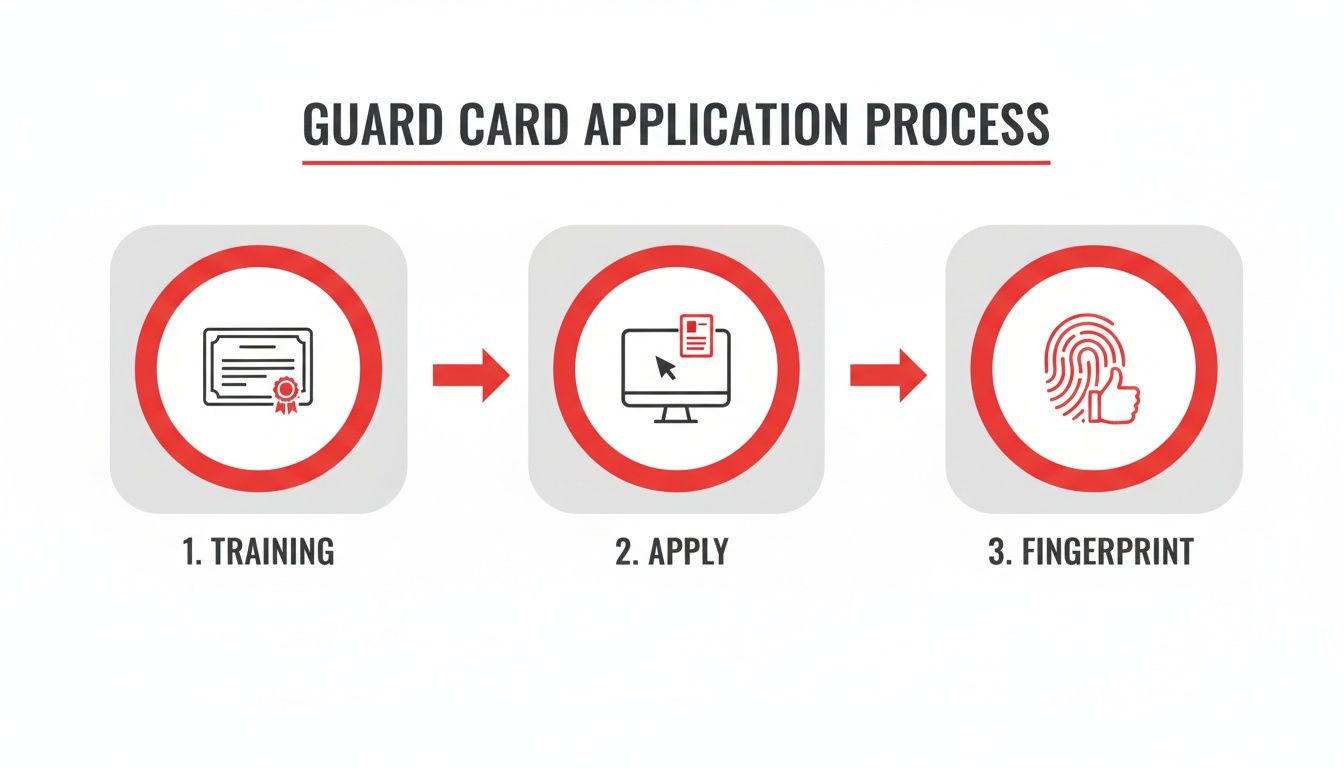
As this illustrates, training is the essential first step before you can apply for your license and complete your fingerprinting.
Breaking Down the 40-Hour Training Requirement
The state provides a reasonable timeline to complete all 40 hours of security guard training—you have the first six months of your employment to finish it. The curriculum is structured to build your knowledge logically, starting with the basics and advancing to more specialized skills as you gain experience.
The timeline is divided into three manageable phases:
- Phase 1: Your First 8 Hours (Pre-License): This is the mandatory "Power to Arrest" and Weapons of Mass Destruction course. You must finish this before submitting your Guard Card application.
- Phase 2: The Next 16 Hours (Within 30 Days): Once you are hired, the clock starts. You have 30 days to complete the next 16 hours of training.
- Phase 3: The Final 16 Hours (Within 6 Months): The last block of 16 hours must be completed within your first six months as a working security officer.
This phased approach helps prevent new officers from feeling overwhelmed and allows you to apply classroom knowledge directly to your daily duties, whether at a construction site, a retail center, or a residential community.
Key Topics Covered in Your Continuing Education
Those additional 32 hours are where true professional development occurs. You'll move beyond basic arrest procedures and into the soft skills and sharp observational abilities that define a top-tier security officer.
You’ll be diving into critical subjects, including:
- Public Relations (Community & Customer): This is vital. Learning to interact professionally and de-escalate situations is a core competency.
- Observation & Documentation: This is about becoming an effective witness. You'll learn how to spot unusual activity, recall key details, and write clear, concise incident reports that stand up to scrutiny.
- Communication & Its Significance: This covers everything from verbal de-escalation techniques to proper emergency radio use.
- Liability & Legal Aspects: You must understand the legal boundaries of your role. This training helps protect you, your employer, and your client from potential mistakes.
At Overton Security, we recognize this training is invaluable. We are committed to supporting our officers through these requirements, which is a major reason for our high retention rate. To see how we structure these learning paths, you can learn more about our comprehensive security officer training programs.
You might think a system this detailed would be slow, but the BSIS is remarkably efficient. In 2022-2023, the agency achieved a 100% success rate on its application processing time goals while handling over 46,000 applications. That efficiency demonstrates the state's dedication to maintaining a well-regulated security industry.
The Annual 8-Hour Refresher Course
Your training doesn't stop after the first six months. To keep your Guard Card active, California requires you to complete an 8-hour continuing education course every year. Think of it as a vital professional tune-up. It keeps your knowledge sharp and ensures you’re up-to-date on any changes in state laws or industry best practices.
This annual course typically revisits core topics and may introduce new material relevant to today's security challenges. It is your responsibility to complete this training and retain the certificate of completion. The BSIS can request it at any time, especially when you renew your license every two years. Forgetting this simple step is one of the most common—and entirely avoidable—reasons officers let their licenses lapse.
Pursuing Advanced Security Permits and Endorsements
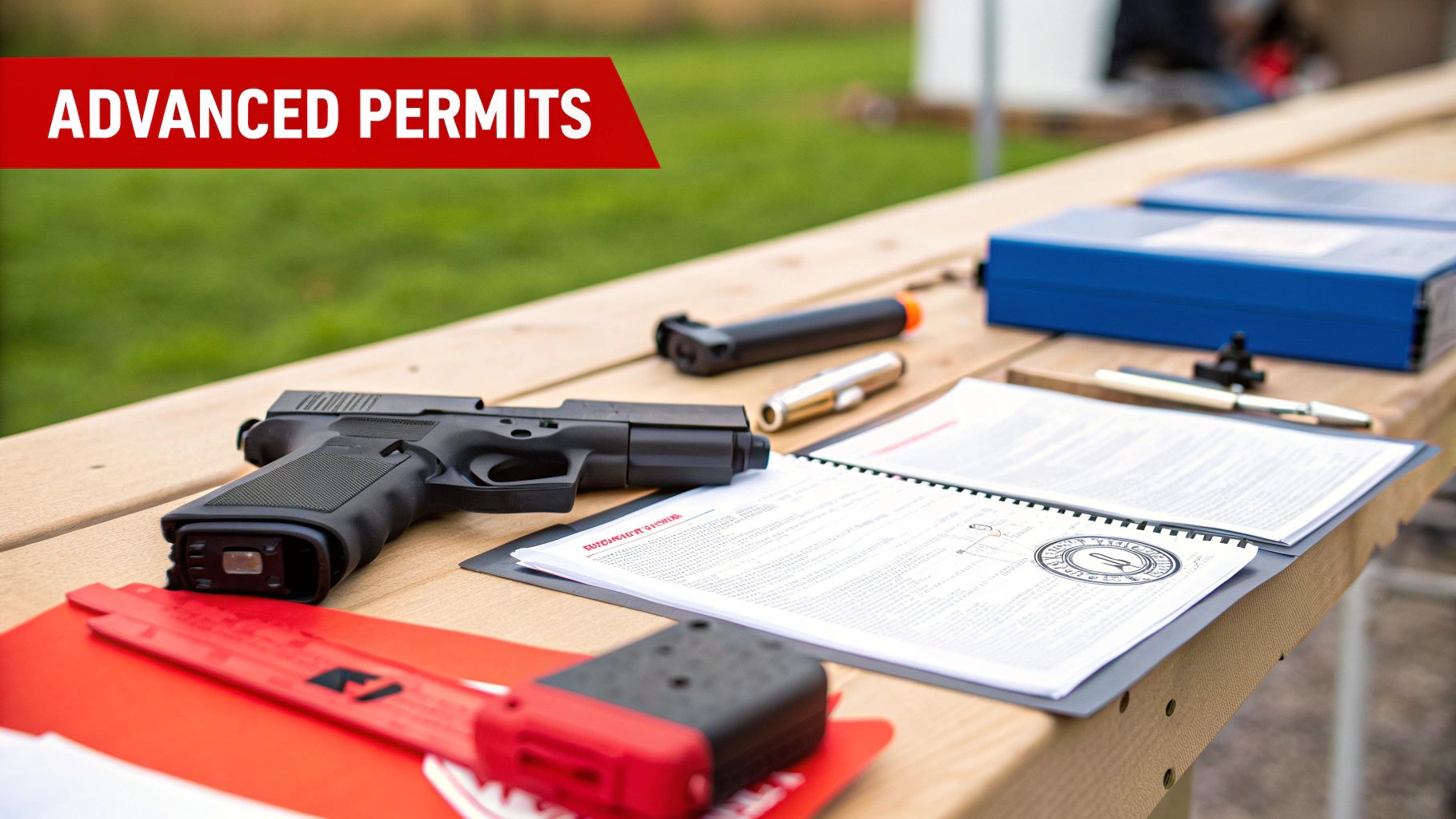
While the Guard Card is the foundation for every unarmed officer in California, some roles require a higher level of qualification. For officers seeking career advancement and for clients who need an elevated level of protection, the BSIS offers several advanced permits. These endorsements allow licensed guards to carry firearms, batons, and chemical agents while on duty.
Obtaining these permits is a significant step beyond the initial Guard Card process. It involves more intensive training, separate applications, and a deeper understanding of use-of-force policies. This is a path for dedicated professionals ready to handle the immense responsibility that comes with these tools.
The BSIS Exposed Firearm Permit
The most significant advanced qualification is the Exposed Firearm Permit. This authorizes a security officer to openly carry a firearm on duty, and it’s critical to understand that this is not an extension of the Guard Card. It's a completely separate license with its own stringent set of requirements.
To be eligible, an officer must already hold a valid Guard Card. From there, the process includes a new application, additional fees, and another thorough background check focused specifically on firearm eligibility.
The core of this qualification is the training, which is substantially more demanding than the initial 40-hour unarmed course. Applicants must complete a 14-hour firearms course from a BSIS-certified instructor, which covers:
- Classroom Instruction: A deep dive into the moral and legal aspects of firearm use, de-escalation tactics, and critical situational awareness.
- Hands-on Training: A focus on firearm safety, proper handling, and marksmanship under pressure.
- Range Qualification: A non-negotiable live-fire shooting test to demonstrate proficiency.
This permit also requires ongoing diligence. To maintain it, officers must complete two range qualifications every six months and a refresher course before each two-year renewal.
The decision to place an armed officer on a property should never be taken lightly. It requires a careful risk assessment and absolute confidence in the officer's training, temperament, and judgment. This is why leading security firms invest heavily in vetting and supporting their armed personnel.
Obtaining a Baton Permit and Other Endorsements
Beyond firearms, officers can also obtain permits for other less-lethal tools, providing more options for de-escalation and control.
The Baton Permit is another common advanced qualification. It requires an 8-hour training course focused on the proper and lawful use of a baton for self-defense or to safely restrain an individual. A significant portion of this training addresses using the minimum force necessary and understanding the serious legal consequences of its misuse.
Similarly, officers can become certified to carry tear gas or other chemical agents after completing the required training. These endorsements equip officers with additional tools to manage difficult situations without escalating to higher levels of force.
Comparing California Security Permits
For a clearer picture, let’s compare these primary permits. This table breaks down what each permit is for, the training involved, and how often it needs to be renewed, giving you a quick snapshot of the commitment required for each level of security service.
| Permit Type | Primary Purpose | Minimum Training Requirement | Renewal Cycle |
|---|---|---|---|
| Guard Card | Unarmed security duties | 40 Hours (Initial) + 8 Hours (Annual) | Every 2 Years |
| Exposed Firearm | To carry a firearm on duty | 14 Hours (Initial) + Biannual Range Qualifications | Every 2 Years |
| Baton Permit | To carry a baton on duty | 8 Hours (One-Time) | Does Not Expire |
Each permit represents a different tier of responsibility and skill, ensuring that officers are appropriately qualified for the specific demands of their assignments.
The Overton Security Approach to Advanced Roles
At Overton Security, we understand that advanced permits are not just about adding tools to a duty belt—they represent a higher level of trust and capability. For over 26 years, our philosophy has been to identify, support, and continuously train the officers best suited for these specialized roles.
We ensure that any officer assigned to an armed post not only meets but exceeds BSIS standards. This commitment involves ongoing tactical training, regular use-of-force refreshers, and consistent leadership support.
This dedication to quality over quantity is central to our mission. It ensures that when a client in Los Angeles or a property manager in San Jose needs an armed officer, they are getting a professional who is thoroughly vetted, exceptionally trained, and fully prepared for the responsibilities of the role.
Staying Licensed and Dodging Common Pitfalls
Obtaining your Guard Card is a major step, but it's not the final one. Think of it less like a diploma to be framed and more like a driver's license—it requires regular attention to remain valid and keep you in good standing with the BSIS.
Staying compliant is straightforward, but it's easy for a few key details to slip through the cracks. Overlooking them can put your career at risk. For property managers and business owners, knowing their security team is diligent about compliance provides essential peace of mind.
The Two-Year Renewal Cycle
Your California security guard registration is valid for two years and expires the day after your birthday. You will handle the renewal through the BreEZe online system, the same portal where you began your initial application. The key is completing your required continuing education before submitting your renewal application and paying the fee.
This is a firm requirement. The BSIS mandates 8 hours of continuing education for each year of your license cycle, meaning you must complete 16 hours in total for every two-year renewal. Be sure to retain those certificates of completion, as the BSIS can request them during an audit.
Pro tip: Don't wait until the last minute. The BSIS recommends submitting your renewal at least 60-90 days before it expires. This buffer can save you from the stress of a lapsed license due to processing delays.
Critical Deadlines to Keep on Your Radar
Beyond the two-year renewal, a few other time-sensitive rules can catch even experienced officers off guard. Ignoring these can lead to fines or prevent you from renewing your license.
Keep these dates in mind:
- Change of Address: If you move, you are legally required to notify the BSIS within 30 days. This is crucial because all official mail, including renewal reminders, is sent to the address on file.
- Lost or Stolen Guard Card: If your physical Guard Card is lost or stolen, you must request a replacement within 30 days. You cannot legally work a post without your card on your person, so prompt action is necessary.
What Happens If Your License Expires?
Working as a security guard with an expired license is a serious violation in California, creating significant liability for both you and your employer. It can result in hefty fines, disciplinary action from the BSIS, and immediate removal from your post.
Once your license expires, you are legally prohibited from working until it's renewed. The BSIS offers a grace period—typically up to three years—where you can renew an expired license by paying additional delinquency fees. However, if you let it go past that point, you must start from scratch. You'll have to retake the initial 8-hour course, undergo a new background check, and re-apply all over again. It’s a completely avoidable setback.
Common Questions About California Security Licensing
If you’re just starting, navigating the world of security guard licensing in California can feel a little overwhelming. We frequently receive questions from aspiring officers and from property managers who need to understand the process.
Having the right information upfront is the best way to build a solid career or a dependable security program. Let's clarify a few of the most common questions we hear.
How Long Does It Really Take to Get a Guard Card?
This is undoubtedly the most frequent question we receive. While there isn't one definitive timeline, you can realistically expect the entire process—from completing your initial 8-hour training to having your license approved—to take between 30 and 60 days.
A few key factors can influence this timeline:
- Application Accuracy: Small errors on your BreEZe application, such as a name not matching your ID, can cause significant delays. Double-check everything.
- Live Scan Processing: Your background check is processed by both the California DOJ and the FBI. Most results are returned within a week, but a more complex history can take longer to review.
- BSIS Workload: The Bureau of Security and Investigative Services handles thousands of applications. While they are efficient, volume can impact processing times.
The good news is that you can track your application’s progress in real-time through the BreEZe portal, which gives you a clear window into its status.
What Kind of Criminal History Can Prevent Me from Getting a License?
The BSIS reviews each applicant's criminal history on a case-by-case basis. There are few automatic disqualifiers. Instead, the Bureau evaluates whether a crime is "substantially related" to the duties and responsibilities of a security officer.
A common misconception is that any past conviction results in an automatic denial. The BSIS actually considers the nature of the crime, how long ago it occurred, and any evidence of rehabilitation. Complete honesty on your application is the most important thing you can do.
That said, certain convictions are highly likely to lead to a denial. These typically include serious felonies, violent crimes, theft, fraud, or any offense that suggests a lack of integrity or could pose a risk to public safety. If you have a concern about your record, it is always best to be upfront.
Can I Work While My Application Is Pending?
Yes, under specific conditions. California law allows you to begin working as a security officer once you have submitted your application, completed your Live Scan fingerprinting, and received a temporary registration from the BSIS.
You can typically confirm this temporary status through the BreEZe system. This allows you to work for up to 120 days while your full background check is completed. It is absolutely critical that both you and your employer verify this temporary registration is active before your first shift. This system helps new officers start working without a lengthy, unpaid waiting period.
Navigating these regulations is key to building a professional security team. At Overton Security, we ensure every officer not only meets but exceeds state requirements, giving our clients total peace of mind. For a security partner that prioritizes compliance and quality, contact us to see how our 26 years of experience can protect your property. Learn more at https://www.overtonsecurity.com.