Friday at 5 p.m., the lobby is filling up, a wedding party is arriving early, two housekeepers are still turning rooms, and the front desk just flagged a reservation dispute. That's the moment most hotel managers feel the weight of safety in hotels. Guests expect a warm welcome. Ownership expects smooth operations. Your team needs a plan that holds up when the property gets busy, messy, and unpredictable.
The mistake is treating security like a separate function that lives at the side door with a radio and a clipboard. In practice, guests experience safety through the whole stay. They notice who's in the lobby, how access is managed, whether staff seem confident, and whether problems get handled discreetly and professionally. Good security protects people, but it also protects the feeling of the property.
A strong hotel safety program works the same way a strong guest service program works. It relies on standards, training, consistency, and follow-through. When those pieces line up, security stops looking like a cost center and starts acting like one of the most valuable amenities on site.
Setting the Stage for Modern Hotel Safety
A hotel manager rarely gets to solve one problem at a time. You're balancing arrival flow, guest satisfaction, staffing gaps, vendor access, late-night noise complaints, and the brand standard your ownership group expects. In that environment, security can't be limited to an overnight guard or a camera screen behind the desk. It has to support the entire guest experience.

What guests actually notice
Most guests won't inspect your camera coverage or ask about your post orders. They'll judge the property by signals. Is the lobby calm? Are entrances controlled without feeling hostile? Does someone visibly own the space?
That matters because 77% of hotel guests report feeling safer when visible security personnel are present on the premises, and 68% say safety is their top priority when selecting a hotel, according to hotel security statistics on guest perception and decision-making.
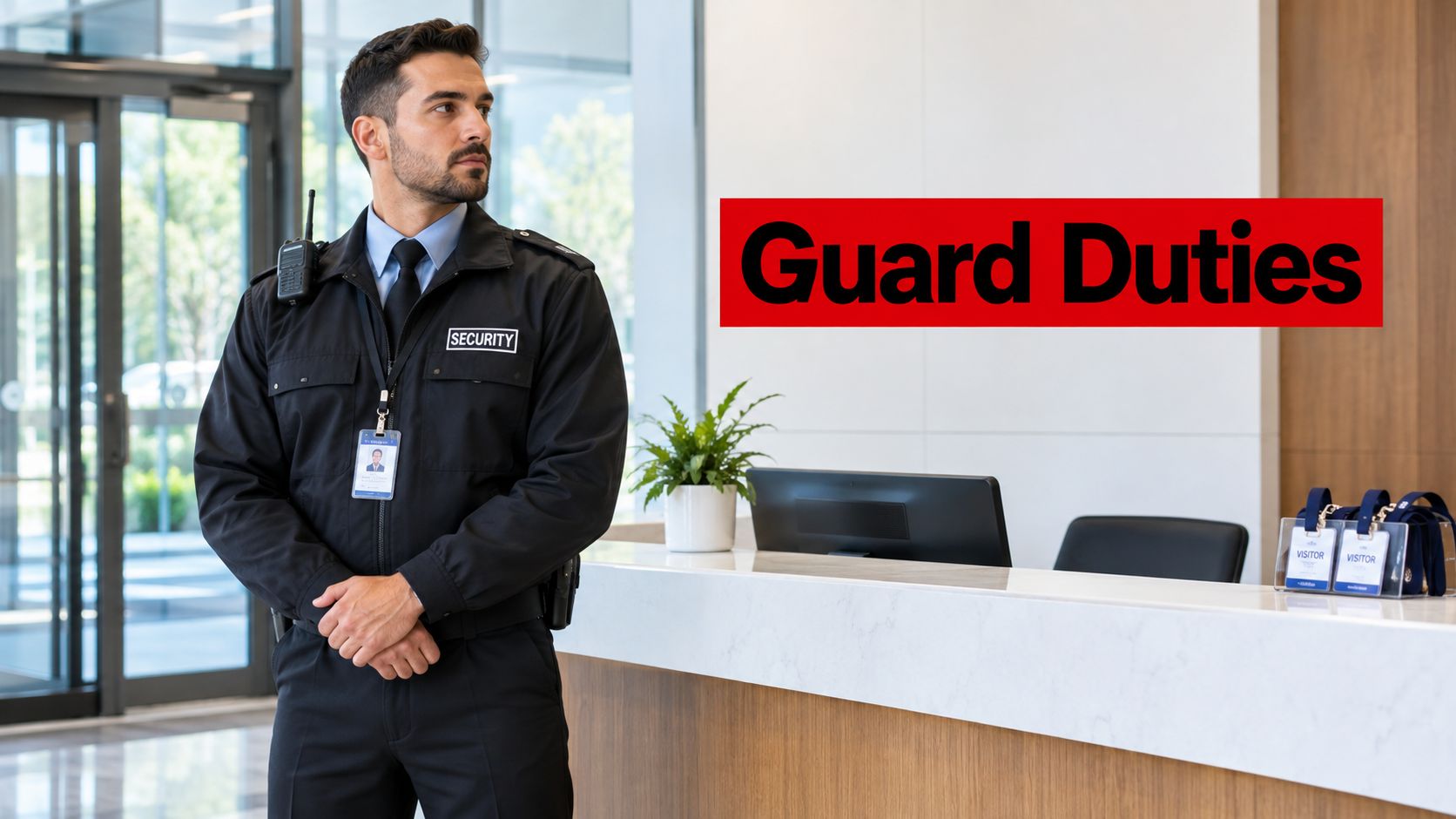
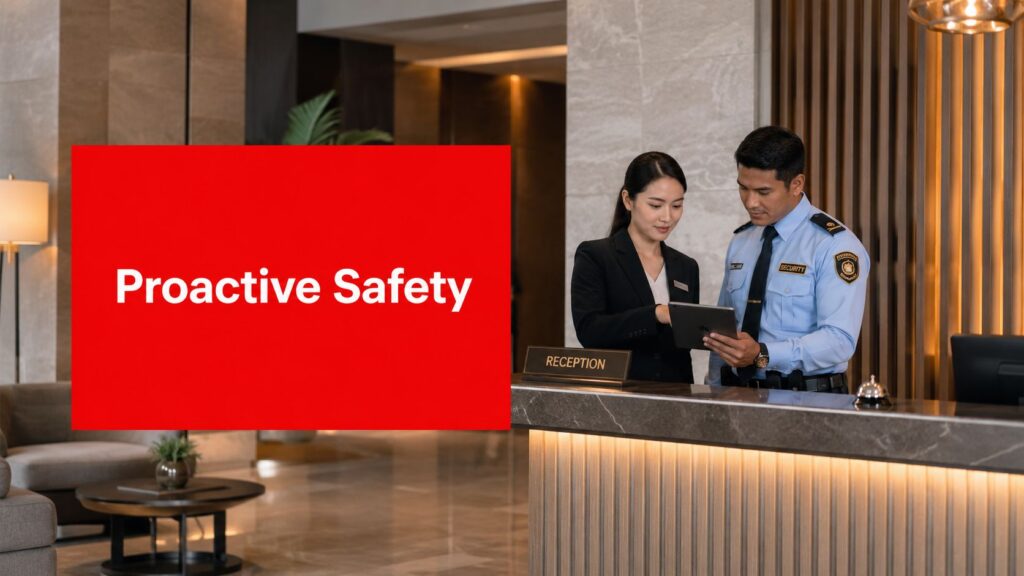
Those numbers line up with what operators see every day. Guests don't want theater. They want quiet competence. A professional officer near the entrance, a front desk team that verifies access without friction, and a manager who can respond decisively all reinforce the same message: this property is under control.
Operational reality: The most effective hotel security presence doesn't compete with hospitality. It supports it.
Why managers should treat security like an amenity
A spa, valet team, or upgraded breakfast offering can improve a stay. So can a property that feels orderly and well-managed from check-in to checkout. Safety shapes reviews, repeat bookings, and staff confidence. When a guest feels protected, they're more likely to relax. When staff feel supported, they perform better under pressure.
That's why better operators fold security into routine management, not just incident response. If you're refining staffing models, communication flows, and check-in procedures, it helps to review a broader guide for hotel operations managers alongside your site-specific safety plan. Operations and security affect each other constantly.
The brand impact no one can ignore
A lobby disturbance, unauthorized visitor, or poor response to a guest complaint doesn't stay operational for long. It becomes a reputation issue. In hospitality, the line between safety and service is thin. Guests remember whether your team created order without creating stress.
That's the frame worth keeping. Security isn't just there for the worst day. At a well-run property, it helps create the kind of stay people describe as smooth, professional, and worth returning for.
Identifying Your Hotel's Unique Threats and Vulnerabilities
Every hotel has a different risk profile. A select-service property off the freeway faces one pattern of issues. A luxury hotel in San Francisco with event traffic, vendor access, and underground parking faces another. A resort in San Diego has a different mix again. Generic advice won't help much unless it reflects how your property operates.
A useful threat assessment starts by dividing risk into categories. That keeps managers from focusing only on dramatic scenarios while missing routine failures that create just as much exposure.

Four risk categories that matter
| Category | What it includes | Common management blind spot |
|---|---|---|
| Physical | Entrances, side doors, loading docks, parking, stairwells, guest floors | Assuming the lobby is the only control point |
| Operational | Key control, vendor access, lost-and-found, incident handling, room change procedures | Inconsistent shift-to-shift execution |
| Personnel | Staff conflict, reporting failures, internal theft, poor escalation | Training once and assuming it sticks |
| Digital | Reservation systems, payment handling, Wi-Fi, access permissions | Treating cyber risk as an IT-only issue |
The point isn't to make every issue sound severe. It's to identify where a lapse could happen because the process is weak, not because anyone had bad intentions.
Hidden risks are often the most expensive
Managers often focus on visible crime risks and overlook liability tied to equipment or process failures. In-room safes are a good example. They're marketed as a reassurance feature, but they can create false confidence if no one verifies they work properly.
Research shows that 30-40% of in-room safes in major markets are either malfunctioning or have bypass codes easily accessible to staff, according to this review of hotel safety and security dimensions.
That tells you something important. A safety feature isn't the same as a functioning control. Presence alone doesn't reduce risk.
Guests trust what the room appears to offer. Managers have to verify what the room actually delivers.
Questions worth asking on a live property walk
When I assess a hotel, I don't start with the camera count. I start with movement and habits. Who can enter without challenge, who can reach guest floors, who has keys or credentials, and where staff are improvising because the written process doesn't match reality.
Use a walk with questions like these:
- Public-to-private transition: Can a non-guest move from lobby to elevator to guest corridor without a meaningful checkpoint?
- Back-of-house exposure: Do vendors, temp staff, and contractors follow the same sign-in and escort rules every time?
- Room-level controls: Are safes, door alarms, and secondary locking hardware function-checked between stays?
- Data handling: Does staff know what to do when a payment issue, chargeback concern, or suspicious booking pattern appears?
The strongest assessments aren't dramatic. They're honest. If you can identify where your property relies on assumption instead of verification, you're already improving safety in hotels at the level that matters most.
Building a Layered Security Program
A hotel doesn't become secure because it bought better hardware or hired one capable officer. It becomes secure when physical controls, technology, procedures, and people reinforce each other. If one layer slips, another needs to catch the problem early enough for the team to respond.
That layered approach is the difference between reacting to incidents and controlling them.

Start with the physical layer
Physical security should make the right behavior easy and the wrong behavior difficult. That includes commercial-grade doors, impact-resistant glass where appropriate, secondary locking mechanisms, anti-tampering devices, controlled access points, and lighting that supports visibility instead of creating glare and shadows.
For hotels, physical layout matters as much as hardware. Front desks need clear sightlines. Side entrances need oversight. Landscaping can't create blind corners near paths, stair exits, or parking access. If you're reviewing layout and line-of-sight issues, these crime prevention through environmental design principles are a practical reference for turning design choices into security advantages.
Use technology to close gaps, not create noise
Technology should answer specific operational questions. Who entered? What happened? How fast can staff verify it? Can a supervisor review it remotely? If your systems don't help your team make decisions quickly, they're just adding complexity.
Industry benchmarks for a multi-layered defense call for high-resolution CCTV with blind-spot elimination, electronic access control, and trained security personnel to minimize threats within 15 minutes of detection, based on hotel security best practices for layered defense.
A sound hotel technology stack usually includes:
- Video coverage that supports investigation: Hallways, elevators, entrances, and parking areas need usable footage, not decorative camera placement.
- Electronic access control: Staff-only areas, utility rooms, back entrances, and restricted guest amenities should be controlled and auditable.
- Reliable reporting tools: Incident logs, patrol notes, and maintenance-security crossover issues should be documented in real time.
- Protected camera infrastructure: If your property relies on IP-based video, this guide for securing IP camera streams is worth reviewing with your integrator or IT lead.
Field test: If a manager can't pull video, verify access activity, and understand the incident timeline quickly, the technology stack isn't doing its job.
The personnel layer decides whether the rest works
Even excellent systems fail when no one owns them. Officers, supervisors, front desk leads, and managers each have to know what they're watching for and how they escalate. In hotel settings, the best security personnel are steady, guest-aware, and procedural. They know how to be visible without becoming disruptive.
That means role clarity matters. A lobby officer isn't just there for presence. That person may be handling guest verification, coordinating with valet, identifying loitering, managing a disturbance until management arrives, and preserving details for follow-up. A mobile patrol officer covering a larger property needs a route plan, reporting standard, and escalation threshold that match the site.
Build overlap on purpose
The strongest hotel security programs don't rely on perfection. They build backup into the system.
Consider how the layers reinforce each other:
- A controlled side door reduces unauthorized entry.
- Camera coverage confirms whether staff propped it open or a visitor tailgated in.
- An officer or trained employee responds based on a clear procedure.
- A documented report gives management a record for retraining, maintenance correction, or liability defense.
That's what makes safety in hotels durable. Not a single tool. A chain of controls that works when the property is busy, tired, and under pressure.
The Critical Role of Staff Training and SOPs
Most hotel incidents aren't prevented by a dramatic intervention. They're prevented because a front desk agent notices something off, a housekeeper reports a concern quickly, or a maintenance tech understands which area is restricted and who needs to be notified. That's why every employee is part of the security posture whether the org chart says so or not.
Security officers are essential, but they can't see every hallway, floor, service corridor, guest interaction, and back-of-house handoff at once. Your staff fills those gaps.
Training should change behavior on shift
The best hotel training isn't generic awareness. It gives each role a clear threshold for action. Front desk staff need a script for guest verification and reservation disputes. Housekeeping needs a simple process for suspicious rooms, unsecured doors, and personal safety concerns. Maintenance needs access rules and a reporting path for broken locks, damaged doors, and failing life-safety devices.
A solid SOP program usually covers:
- Observation standards: What staff should notice, document, and escalate without guessing motives or profiling guests.
- Communication rules: Who gets called first, what details matter, and when radio traffic should move to management or emergency response.
- De-escalation basics: How to slow down conflict, create space, and avoid language that inflames a guest complaint.
- Evidence preservation: What not to touch, what to write down, and how to protect a clean incident timeline.
If your written procedures are vague, staff will improvise. Improvisation is where inconsistency, liability, and avoidable confrontation show up. For managers tightening site instructions, a practical reference on how to write security post orders can help turn broad expectations into useful field guidance.
Protecting staff is part of protecting the hotel
Staff members work in isolated conditions more often than guests realize. Housekeepers enter occupied and recently vacated rooms. Restroom attendants and overnight employees may spend long periods without direct support nearby. If they don't feel safe, reporting drops and turnover rises.
Anaheim's Hotel Worker Protection Law addresses that directly. Lodging employers are required to provide personal security devices to employees, such as housekeepers, who work alone in guestrooms or restrooms to ensure their personal safety, as outlined by Anaheim's hotel worker protection requirements.
That law reflects a larger truth. Panic devices, communication tools, and clear check-in procedures aren't extras. They tell staff that management takes their safety seriously.
Staff report faster and more accurately when they know the property has their back.
What doesn't work
Annual training that gets checked off and forgotten doesn't hold up. Neither does a binder of SOPs no one can find at 11 p.m. during a disturbance. Managers need short refreshers, role-based practice, and supervisors who reinforce the standard on shift.
The strongest training cultures are visible. Team members know who to call. They know what to write. They know the difference between a service issue, a safety issue, and an emergency. That clarity is a force multiplier on any hotel property.
Developing Your Emergency Response and Evacuation Plan
When prevention fails, the plan has to take over. In a hotel, that means staff need to act in a way that protects life first, supports first responders, and keeps communication clear for guests who may have no idea what's happening outside their room door.
An emergency plan isn't useful because it's detailed on paper. It's useful because people can execute it under stress.

Build the plan around decisions, not binders
Start with scenarios that fit your property. Fire, medical emergencies, elevator entrapment, power loss, flooding, disruptive guests, and external threats all affect hotels differently depending on layout and occupancy. A high-rise in Los Angeles needs different evacuation and assembly logic than a low-rise roadside property in Fresno.
A practical framework looks like this:
- Define command roles. Decide who leads on each shift, who contacts emergency services, who manages guest communication, and who secures critical areas.
- Map primary and backup routes. Evacuation routes should reflect real obstructions, ADA needs, and how guests realistically move through the building.
- Set communication methods. Front desk scripts, radio channels, internal call trees, and guest notification methods need to be simple enough to use during confusion.
- Assign property recovery tasks. After the immediate event, someone still needs to handle perimeter control, reentry decisions, documentation, and coordination with responders.
Drills should be calm and repeatable
Hotels can't shut down operations every time they practice. But they also can't afford plans that no one has tested. The answer is disciplined, low-drama drilling. Tabletop exercises for managers. Small team walkthroughs for floor staff. Focused refreshers for overnight teams that often inherit the most difficult scenarios with the fewest people on duty.
A professional security partner can help pressure-test these plans, especially around chain of command, perimeter security, and coordination with local responders. For properties reviewing that side of preparedness, this resource on emergency response security is a useful starting point.
In a real emergency, staff don't rise to the occasion. They fall back on what they've practiced.
Documentation matters before the audit and after the incident
Emergency planning also has a compliance side. Hotels increasingly need to show that plans were tested, updated, and communicated. If you're reviewing continuity and testing discipline across departments, guidance on preparing for regulatory DR audits can help frame how often plans should be reviewed and what evidence operators should retain.
A good emergency plan protects guests in the moment. A documented, practiced one also protects the business afterward.
Navigating Compliance and Reducing Liability
Hotel managers often separate compliance from security, but on a real property they're connected. The same habits that prevent incidents also help defend the hotel when a claim, inspection, or dispute follows. Clear procedures, documented follow-through, and accurate reporting do more than keep operations tidy. They show that the property acted responsibly.
Compliance lives in the details
California hotels face specific obligations that can look small until they're ignored. One example is chemical exposure warnings. In California, hotels must provide a specific warning, including a designated symbol and bold text, for exposures to listed chemicals to comply with regulations under Cal. Code Regs. Tit. 27, § 25607.33, as reflected in the California chemical warning requirement for hotels and similar properties.
That kind of requirement matters for two reasons. First, it creates a direct compliance obligation. Second, it shows how liability often turns on whether management had a system for identifying, posting, maintaining, and documenting conditions that affect guest or employee safety.
Good records are operational protection
If a guest alleges inadequate response, an employee reports a safety concern, or an insurer asks how the property manages known risks, vague assurances won't help. Managers need records that show what happened, who responded, what was observed, and whether the issue was corrected.
Useful documentation usually includes:
- Daily activity records: What officers or managers checked, observed, and addressed
- Incident reports: Clean timelines, involved parties, witness details, and follow-up actions
- Maintenance crossover logs: Broken locks, failed lighting, damaged doors, or alarm issues tied to work orders
- Training records: What staff were taught, when refreshers occurred, and who attended
Liability drops when standards are consistent
Premises liability usually grows in the gap between what a property says it does and what it can prove it did. That's why security investment is often best understood as risk management. Not because every measure stops every incident, but because a disciplined program reduces preventable failures and gives the hotel a defensible record when something goes wrong.
For managers, that's the business case. Better safety in hotels protects people first. It also protects insurability, reputation, and the long-term financial health of the property.
Conclusion Partnering for Lasting Peace of Mind
Hotel safety works best when it becomes part of the operating culture. Not a side project. Not a reaction after an incident. A daily standard that shapes how the lobby is managed, how access is controlled, how staff report concerns, and how leadership responds when conditions change.
The strongest programs are layered. They combine physical protections, reliable technology, trained employees, and realistic emergency planning. They also respect the hospitality environment. Guests should feel cared for, not processed. Staff should feel supported, not left to improvise.
That's why the right security partner matters. You need more than coverage. You need consistency, good judgment on site, clean reporting, and leadership that stays involved after the contract is signed. In California markets like Los Angeles, San Diego, San Francisco, San Jose, Sacramento, Oakland, Long Beach, and Fresno, that often means balancing open public-facing spaces with real operational pressure behind the scenes.
A capable security partner should help you assess vulnerabilities, tighten procedures without harming service, support officer accountability with real-time systems, and give managers visibility into what's happening on the property. The difference shows up in the details. Better retained officers. Better site knowledge. Better follow-through. Better communication when issues arise.
That kind of partnership is what creates lasting peace of mind. Not because risk disappears, but because your property is prepared to manage it professionally.
If you're reviewing safety in hotels at your property and want a practical outside perspective, Overton Security offers experienced support across California. With 26 years of service, hands-on leadership, GPS-enabled patrol accountability, digital reporting, and 24/7 SOC oversight, the team helps hotel operators build security programs that protect guests, staff, operations, and brand reputation. Reach out for a complimentary, no-obligation security assessment for your hotel in Los Angeles, San Diego, San Francisco, or anywhere in California.