A lot of warehouse security problems don't start with a smashed door or a dramatic alarm. They start with a smaller question that no one can answer quickly.
A pallet count is off after a shift change. A side door was found propped open, but no one knows for how long. A truck that shouldn't have been in the yard made it to the loading area before anyone challenged the driver. By the time a facilities director or warehouse manager starts piecing it together, operations are already disrupted and everyone is burning time.
That's where warehouse access control stops being a technical term and becomes a management tool. It answers four practical questions: who entered, what area they reached, when they were there, and whether they should've had access at all. If those answers are clear, problems get contained faster. If they aren't, even a well-run warehouse can lose control of inventory, liability, and workflow.
After 26 years in security across California properties, one pattern stays consistent. The facilities that perform best don't rely on one device or one officer. They build a system that fits the site, the staff, the traffic flow, and the business reality of the operation.
Securing Your Warehouse Starts with Access Control
Most managers don't start shopping for access control because they love security hardware. They start because something isn't adding up.
One common version is inventory shrinkage with no clean explanation. Another is after-hours movement in the yard that nobody can verify. In busy warehouse environments, those gaps usually trace back to the same root issue. Too many people can get into too many places with too little accountability.
Access control is really about operational clarity
At its best, warehouse access control is simple. It creates a clear structure for entry at the property line, the gate, the dock, the building, and the sensitive zones inside.
That structure matters even more overnight. Statistics indicate that 60% of warehouse break-ins occur during the night shift window between 10 PM and 6 AM, and employee theft incidents are concentrated during shift changes and lunch breaks, which makes time-based access rules and reliable event logs especially important according to warehouse security best practices from Omnilert.
A physical key can open a door, but it can't tell you who used it, whether access happened outside policy, or how movement lined up with a discrepancy. Digital credentials and biometric readers can.
Practical rule: If your system can't reconstruct movement after an incident, it isn't giving you control. It's only giving you a lock.
The question isn't whether to control access
The question is how to control access without slowing down shipping, receiving, staffing, and visitor management. That's the balance warehouse leaders have to get right.
A strong program usually starts with a few basics:
- Define the site boundary: Know where public access ends and controlled access begins.
- Separate traffic types: Employees, drivers, vendors, and visitors shouldn't all move through the same process.
- Tie access to job function: People need the access required for work, not blanket access because it's convenient.
- Keep records you can use: Time-stamped digital events make investigation and supervision much easier.
Done properly, securing a warehouse is manageable. It doesn't require turning the site into a fortress. It requires a disciplined system that fits the way the property runs.
Why Access Control Is a Financial and Operational Imperative
At 5:45 a.m., the dock is filling up, inbound drivers are checking in, the first shift is badging through, and a supervisor is already dealing with a shortage from the night before. In that hour, access control is not a security accessory. It is part of how the warehouse keeps freight moving, limits disputes, and prevents a small problem from becoming an expensive one.
I have seen facilities spend heavily on cameras and fencing, then lose time and money because the actual entry rules were loose, inconsistent, or impossible to audit. The issue is rarely one broken door. It is a weak operating system around who can enter, where they can go, when they can move, and how that decision gets recorded. That is why a well-planned electronic access control system for commercial facilities belongs in the same budget discussion as shrink, labor efficiency, claims, and uptime.
Losses spread beyond stolen product
The obvious cost is missing inventory. The less obvious cost is the chain reaction that follows. A discrepancy triggers a supervisor review, then a recount, then a customer service issue, then pressure on shipping and receiving teams who still have to hit the day's numbers.
Weak access control also creates avoidable exposure in places warehouse teams feel every week:
- Unauthorized presence in restricted areas: This raises safety risk, increases liability, and makes incident reviews harder.
- Unclear vehicle access: Poor gate control slows yard flow and creates openings for tailgating, improper pickups, and driver confusion.
- Manager time pulled into investigations: Supervisors end up reconstructing movements from memory instead of reliable event records.
- Weak claim support: If access records are incomplete, it is harder to show who entered, when they entered, and whether policy was followed.
That is the financial side many operators underestimate. The cost is not limited to what leaves the building. It shows up in labor hours, strained accountability between departments, delayed decisions, and weaker documentation when something goes wrong.
Bad access design disrupts operations
A warehouse can be secure and still run poorly. I have seen sites tighten entry controls in ways that backed up trucks, frustrated employees, and pushed staff into workarounds. Those workarounds become the next security problem.
Good access control has to fit the pace of the property. Gate procedures, employee credentials, visitor handling, and vendor entry rules should support throughput during shift changes, receiving peaks, and contractor activity. If the process is too slow, people bypass it. If it is too loose, the site absorbs the cost later.
Managers overseeing mobile crews, satellite yards, or service teams often benefit from a broader guide for optimizing field operations. The connection is practical. Access control works better when dispatch, arrivals, workforce movement, and site authorization are managed as one operating picture rather than separate administrative tasks.
Strong warehouse access control protects margin and keeps the site moving.
In California, complexity raises the stakes
California warehouses often deal with large contractor populations, multi-tenant industrial properties, strict labor practices, heavy delivery traffic, and operations that run across multiple shifts. Those conditions make simple, ad hoc access rules break down fast.
That is why the job is bigger than buying readers or assigning badges. Facility managers need a system that ties physical barriers, electronic permissions, and human oversight into one structure people can manage. The goal is clear authority at each entry point, clean records when questions come up, and access rules that match the way the facility really works.
When that structure is in place, incidents stay smaller, investigations move faster, and daily operations run with fewer interruptions. That represents the return on access control.
The Core Components of a Layered Access Control System
A warehouse is easier to secure when you stop thinking in terms of one front door and start thinking in layers. Each layer should force a decision, record an event, or slow down unauthorized movement long enough for someone to intervene.
That's the model that works in large logistics sites, urban infill warehouses, and multi-building industrial properties alike.

Start at the perimeter
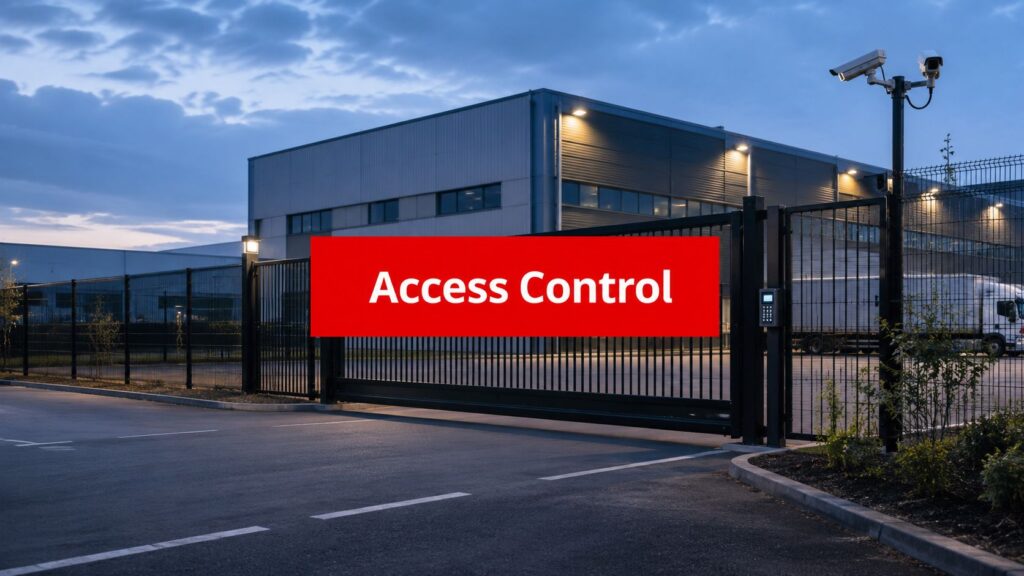
Perimeter security sets the tone for the whole property. Fencing, gates, lighting, and visible boundary definition do more than discourage trespassing. They create a controlled starting point.
A common mistake is treating the fence as the system. It isn't. It's the outer layer. Locked gates and barriers work far better when they're tied into electronic decision points that control who can enter and when.
That integration matters in measurable ways. Modern warehouse access control systems using RFID and biometric authentication have reduced unauthorized entry incidents by up to 78% in major logistics hubs, while the effectiveness of physical barriers like locked gates increases by 65% when integrated with electronic access points, according to Resolute Dog Security's analysis of warehouse access control.
Control the yard before the building
Many warehouse issues happen before anyone touches a warehouse door. Vehicle staging, trailer movement, contractor arrivals, and driver check-ins all create opportunities for confusion.
A practical yard layer often includes:
- Gate logic: Approved entry windows, driver verification, and lane discipline.
- Vehicle screening: Clear procedures for employees, vendors, and scheduled deliveries.
- Dock assignment discipline: Drivers should know where they're supposed to go before they circulate the property.
- After-hours management: The yard shouldn't become an unmonitored holding area once office staff leaves.
For teams comparing hardware and workflow options, this overview on choosing access control technologies is a useful reference because it helps frame the trade-offs between convenience, control, and system complexity.
Secure building entry points
Once a person reaches the structure, each entry point needs a clear purpose. Main employee doors, office entrances, dock doors, side doors, and maintenance access shouldn't all operate under the same rules.
Electronic systems earn their value. Card readers, PIN entry, mobile credentials, and biometrics let management assign access by role, time window, and location. That creates a cleaner operating environment than physical keys, especially in facilities with turnover, multiple shifts, or third-party workers.
If you're evaluating system design options, a practical starting point is to review how an electronic access control system should align with the building layout and the way staff move through the property.
A warehouse doesn't need every door to be high security. It needs every door to have a defined rule.
Divide the interior into meaningful zones
One of the most expensive mistakes in warehouse access control is over-permissioning. If everyone can enter receiving, returns, inventory control, server rooms, cage storage, and supervisor offices, then the building may be locked, but the operation still isn't controlled.
Interior zoning usually works best when it reflects actual responsibility:
| Zone | Typical access approach | Why it matters |
|---|---|---|
| Receiving and shipping | Shift and role-based permissions | Limits casual movement around active freight |
| High-value storage | Restricted credentials or biometrics | Reduces internal theft opportunity |
| IT or records rooms | Limited named users only | Protects operational and business data |
| Hazmat or regulated areas | Strict authorization and logging | Supports safety and compliance expectations |
Support the system with alarms and video
Access control works best when it isn't alone. Video verifies movement. Alarms alert staff when a door is forced, held open, or accessed outside policy.
That baseline still matters. Warehouses without alarm systems are 4.5 times more likely to be burglarized than those with an operational alarm system, according to Carolina Handling's warehouse security overview.
The lesson is straightforward. Hardware should work together. Barriers delay. Credentials decide. Cameras verify. Alarms escalate. That's how layers become a system instead of a collection of parts.
How to Conduct a Practical Warehouse Risk Assessment
Before replacing hardware or issuing new credentials, get clear on where the site is vulnerable. A warehouse risk assessment doesn't need to start with a consultant walking the property with a clipboard. A manager can learn a lot by mapping movement, pressure points, and exceptions.
The key is to assess the warehouse the way an intruder, an opportunistic employee, or an impatient driver would experience it.
Walk the site in layers
Start outside. Follow the path from the public street to the fence line, then to the gate, then to the dock and building doors. Look for routes that allow someone to bypass normal supervision.
Include the less obvious points too. Roof hatches, caged exterior ladders, maintenance doors, trailer yard cut-throughs, and areas hidden from regular line of sight often get missed because they aren't part of daily operational attention.
A practical assessment usually covers:
- Property boundary: Where can someone enter the grounds without being challenged?
- Vehicle movement: Where do trucks queue, idle, turn around, or wait for direction?
- Pedestrian movement: Which doors do employees really use, not just the ones listed in policy?
- Interior exposure: Which areas hold high-value, sensitive, or easily resold inventory?
- Exception handling: How are visitors, temps, contractors, and after-hours arrivals managed?
Study traffic patterns, not just doors
A weak point isn't always a broken lock. Often it's a predictable moment when normal controls loosen.
Shift changes, lunch periods, late carrier arrivals, and end-of-day dock congestion all create decision fatigue. People prop doors for convenience, wave vehicles through, or assume someone else checked credentials. Those are the moments to design around.
Gate operations are worth special attention because they affect both security and efficiency. Benchmark data shows that implementing ANPR for vehicle access at warehouse gates reduces gate dwell time by 42 seconds per entry and increases throughput by 28% compared to manual key-fob systems, according to Nortech Control's warehouse access control benchmark data.
That doesn't mean every site needs ANPR. It means your assessment should ask whether the gate process is creating friction, inconsistency, or blind spots.
Prioritize by consequence
Not every vulnerability belongs at the top of the budget. Rank findings by business impact.
Use a simple decision model:
- High consequence: Areas tied to theft, injury, business interruption, or sensitive records
- High frequency: Problems that happen routinely, even if each one seems minor
- Low visibility: Places where unauthorized activity could continue without quick detection
- Hard to investigate: Gaps that leave you without reliable records after an incident
If a problem can happen often, cause real loss, and leave no usable record, move it to the top of the list.
For facilities that want a more structured review before selecting equipment or services, a professional security risk assessment can help turn those observations into a site plan with clear priorities.
Integrating Technology with Professional Security Services
Even a well-designed access system can stall out if no one owns the response. A reader can reject a credential. A camera can flag motion. A dashboard can issue an alert. None of that matters if the alert sits unverified or the exception gets handled inconsistently.
The strongest warehouse access control programs combine technology with people who know what to do when the system raises its hand.

Technology should narrow the problem
Electronic access control, CCTV, alarms, visitor management, and gate automation are good at one thing. They reduce ambiguity.
They can identify the door involved, the credential used, the time of the event, and sometimes the related video. That's valuable, but it still needs a human layer to confirm whether the event was legitimate, accidental, or suspicious.
This is especially true for insider threats. Many warehouse access control strategies overlook the gap of insider threat detection, and ASIS International confirms that modern AI can now integrate into access systems to flag anomalous credential usage, but those alerts still require informed interpretation by people who understand site operations, according to ASIS International's article on modern warehouse security.
Onsite officers give the system judgment
A professional officer stationed at the right post can do what hardware can't.
They can verify a driver's reason for entry, catch tailgating at a staff door, question a contractor who's headed to the wrong area, or resolve a credential issue without turning the front gate into a traffic jam. In a warehouse, that judgment matters because the site changes by the hour.
Good officer integration usually includes:
- Visitor and vendor control: Confirming identity, destination, and escort requirements
- Door and dock awareness: Noticing held-open doors, unusual movement, or procedural drift
- Credential exception handling: Managing denied access without making ad hoc decisions
- Incident documentation: Recording facts while the event is still fresh
If you're building a post with this role in mind, the operational model behind an access control officer is useful because it focuses on active entry management rather than passive presence.
Hardware records the event. Trained people determine whether it's routine, mistaken, or a precursor to loss.
Mobile patrols and remote oversight close the gap
Not every warehouse needs full-time officers at every point. Many sites get better results by combining fixed access controls with mobile patrols and remote monitoring.
Mobile patrols are effective for checking perimeter integrity, locked gates, trailer yards, side doors, and dark corners of a property after hours. They also help verify that the access plan is being followed when supervisors and office staff are gone.
Remote monitoring adds another layer. A SOC can watch for alarm activity, review triggered events, escalate to on-site personnel, and preserve a cleaner chain of documentation. In practical terms, that turns a passive system into an active operating loop.
Integration works when accountability is clear
Technology and staffing only blend well when responsibilities are assigned in advance. Someone should know who resets alarms, who handles denied credentials, who responds to after-hours gate exceptions, and who reviews the event trail after an incident.
Without that discipline, even expensive systems drift back toward workarounds. Doors stay propped. Exceptions become routine. Temporary credentials never get cleaned up.
A warehouse runs best when the system supports the operation, and the people supporting the system are trained to use it consistently.
Your Warehouse Access Control Implementation Checklist
At 6:45 a.m., the first shift is lining up at the employee entrance, a contract cleaning crew is still inside, and three trucks are already waiting at the gate. If access control is not mapped to actual warehouse activity, that first hour exposes every weakness in the plan. Good implementation protects the building and keeps freight, labor, and carriers moving.
That matters even more in California's logistics environment, where shared industrial sites, temp labor, outside carriers, and local vendor turnover are common. A workable system has to connect physical barriers, electronic controls, and daily site procedures in a way a facility manager can effectively run.

Build the permissions map before you buy hardware
Start with movement, not equipment.
Map who needs access, where they need it, and during which hours. Break that out by employees, supervisors, temporary labor, sanitation crews, maintenance vendors, drivers, and visitors. Then assign approval authority for each group and define how access is removed when a shift changes, a contract ends, or an employee leaves.
A usable checklist at this stage includes:
- Zone assignments: Yard, office, dock, inventory areas, cages, server rooms, and maintenance spaces
- Time rules: Standard shifts, overtime, after-hours exceptions, weekend access, and holiday schedules
- Escalation contacts: Who gets called when access is denied or a door is forced
- Credential ownership: Who issues badges, fobs, mobile credentials, or biometric enrollment
This is also the right point to set up a process for user permissions auditing. If nobody reviews access rights after launch, permissions drift fast in a warehouse with rotating labor and outside service providers.
Match the hardware to the site, not the catalog
Site conditions should drive the hardware decision. A high-throughput distribution building in Los Angeles has different traffic patterns, labor flow, and yard pressure than a smaller facility in San Jose or Fresno.
Use the method that fits the opening and the risk. Card readers may be enough for office doors. Biometrics may be justified at a controlled inventory cage. Gate operators, intercoms, and camera verification may solve a yard entry problem better than adding another person with a clipboard.
Older buildings need special attention. Many California warehouses were not built with modern electronic access in mind, so a phased retrofit is often the smarter path. In practice, that can mean securing exterior doors and key interior zones first, then replacing older locksets as lease terms, capital budgets, or operations windows allow.
Write the policy before launch day
Hardware without written rules creates confusion on day one.
Put the procedures in writing before credentials are active. Keep them short enough for supervisors to use during a shift and clear enough that security staff, HR, operations, and receiving interpret them the same way.
Cover these areas:
- Employee access: Issuance, use, lost credentials, and termination handling
- Visitors and vendors: Check-in, escorting, temporary credentials, and restricted zones
- Truck and yard entry: Carrier verification, after-hours deliveries, and rejected arrivals
- Exception response: Forced doors, held-open alarms, denied entry, and emergency override
The policy should also settle the practical questions that cause daily friction. Who can approve a last-minute vendor badge. How long a temporary credential stays active. Whether a driver can enter the office area without an escort. Those details prevent workarounds.
Train by role, not in one general session
One generic training meeting rarely holds up in a warehouse.
Forklift operators, office staff, shift leads, receiving clerks, and guard personnel use the system differently, so train them differently. Employees need basic badge use and rules on tailgating and door propping. Supervisors need exception approval steps. Receiving teams need a process for unscheduled carriers. Security personnel need reporting standards that produce a usable event record.
I have seen solid installations struggle for one simple reason. The team was shown how to present a credential, but nobody was taught how to handle the exceptions that happen every shift.
The first week after launch shows whether the hardware was configured correctly. The first month shows whether the site procedures were.
Test in real conditions
Commissioning should happen during live operating periods, not only during a quiet afternoon walkthrough. Test the morning start, shift change, lunch turnover, late deliveries, and after-hours entry.
Look for operational failure points as well as technical ones:
| Test area | What to verify | Common issue |
|---|---|---|
| Employee entry | Credentials work by shift and role | Shared badges or door holding |
| Vendor access | Temporary permissions expire correctly | Vendors keep broad access too long |
| Gate flow | Vehicles enter without avoidable delay | Queues form because exception handling is unclear |
| Alarm response | Alerts reach the right person fast | Notifications go out, but nobody owns response |
Phasing the rollout usually produces better results. Start with the highest-risk doors, gates, and restricted zones. Correct the weak points, tighten the procedures, and then extend the system across the rest of the property. That approach is easier to manage and usually causes fewer disruptions to shipping and receiving.
Maintaining and Measuring Your System for Long-Term Success
Six months after a warehouse upgrades its access control, the weak points usually are not the readers or the gates. They are stale permissions, ignored alerts, doors that no longer close cleanly, and supervisors who have started making exceptions outside the process. Long-term performance comes from routine discipline, not from the installation itself.
A warehouse access control program needs an owner, a review schedule, and a clear standard for what gets fixed first. Without that structure, small issues turn into operating habits. A contractor badge stays active. A dock door starts alarming twice a shift, so staff stop taking the alarm seriously. A camera loses its view of a gate lane, and no one notices until an incident has to be reconstructed.

Review permissions and event history regularly
Permission reviews should follow the way the warehouse runs. Tie them to shift changes, supervisor changes, seasonal labor cycles, new carrier relationships, and contractor turnover. In California facilities, that matters even more because labor models, temporary staffing, and third-party logistics arrangements can change quickly.
Named users, role groups, visitor credentials, shared gate codes, and dormant accounts all need review on a set cadence. Teams that want a structured way to think about that process can use resources focused on user permissions auditing to help frame how rights reviews should work across connected systems and workflows.
At the site level, watch for patterns that point to control drift:
- Repeated denied access: often signals a mismatch between policy and actual job duties, or an employee testing the boundary
- After-hours entry by approved users: may be legitimate, but it should match a known business reason
- Doors held open or forced: usually a workflow problem first, then a hardware problem
- Active credentials with no recent use: a cleanup issue that should be closed before it becomes an exposure
Reviewing event history only helps if someone is expected to act on it. I usually advise facility managers to assign one person to run the report and one person to clear the exceptions. If both tasks sit with the same overloaded supervisor, the review often slips.
Maintain the equipment and update the plan
Access control hardware fails gradually. Readers become intermittent. Strike plates shift. Gate operators slow down. Intercom audio gets ignored because it is poor enough that staff cannot make out the driver. The system may still look online in the dashboard while performance at the door is getting worse.
Set maintenance intervals for locks, readers, sensors, cameras, gate hardware, backup power, and software updates. Test them during live operating periods, not only during a planned service window. A door that works at 2 p.m. may still fail during the 5 a.m. inbound rush when pressure on the process is highest.
Replacement planning also matters. Older platforms can remain serviceable for years, but support gaps, parts availability, cybersecurity exposure, and integration limits usually show up before total failure. Budgeting for staged upgrades is easier than waiting for a forced replacement after a controller dies or a software version can no longer be supported.
The written plan needs the same attention. California operators should review access policies with HR and legal when monitoring practices, visitor procedures, contractor access, or record retention rules change. The goal is an integrated system that protects the site, gives supervisors clear rules, and avoids confusion about how access decisions are made and documented.
Measure whether the system is doing its job
Measure control, response, and operational impact.
A reliable program produces fewer unresolved exceptions, faster investigations, cleaner credential lists, and more consistent handling at gates and restricted areas. It should also reduce the number of workarounds staff use to keep freight moving. If people are propping doors, sharing badges, or calling supervisors for routine access decisions, the process still needs work even if the hardware is functioning.
Good metrics are simple enough to review every month. Track forced-door events, held-open alarms, average time to resolve an access issue, inactive credentials removed, temporary badges not returned, and repeat incidents at the same opening. Then compare those numbers against shipping delays, staffing changes, and known busy periods. That gives facility leadership a usable picture of whether the access control program is supporting operations or creating friction.
A well-managed warehouse does not treat access control as a collection of devices. It runs physical barriers, electronic controls, and guard procedures as one system, with regular review to keep all three aligned.