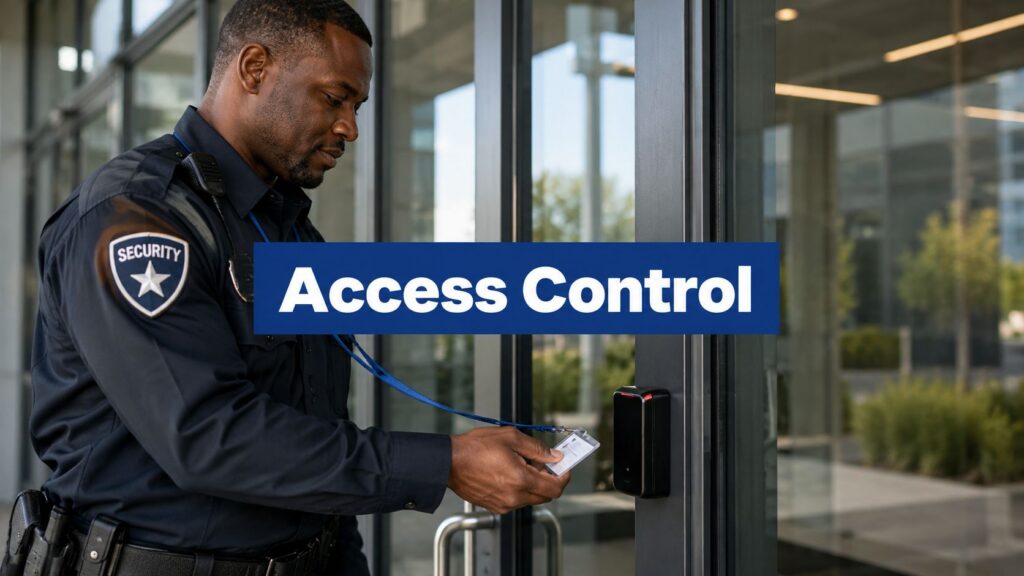
A busy lobby looks fine right up until it doesn't. Deliveries are stacking up, a vendor says he's “with engineering,” a resident waves in a guest before the desk can verify them, and your receptionist is trying to answer the phone while watching the door.
That's the moment property managers realize the front entry isn't a furniture piece. It's a control point. If no one owns that control point with training, authority, and judgment, small exceptions start becoming the daily operating model.
Why Your Front Desk Is More Than Just a Welcome Mat
At a commercial tower, the weak spot is often the most polished part of the building. The lobby is clean, the doors work, the camera is live, and the staff is friendly. But the question is simple. Who is actively controlling access when the pace picks up?
In residential communities, the same issue shows up at the gatehouse. A driver says they're expected. A food delivery arrives during a resident rush. A contractor claims they were “already approved yesterday.” Without a defined access process, staff start making judgment calls they were never trained to make.
The entry point sets the tone for the whole property
An unmanaged front desk creates two problems at once. First, unauthorized people can get farther into the property than they should. Second, legitimate residents, tenants, and guests feel friction because nobody is running a clear process.
That's why the role at the front matters more now than it used to. The global access control market was valued at USD 18.01 billion in 2024 and is projected to reach USD 34.59 billion by 2032, growing at a CAGR of 8.50% from 2025 to 2032, with approximately 16,000 annual openings for related security roles according to access control market projections.
For property teams reviewing broader 2026 business security insights, the common thread is clear. Entry management is no longer a passive function.
A front desk without access control discipline is a customer service station carrying security risk.
Hospitality and control have to work together
Many buildings try to solve the issue by expecting concierge staff to “also keep an eye on things.” Sometimes that works for light traffic. It usually breaks down when the site has resident turnover, executive visitors, vendors, after-hours deliveries, or multiple tenant expectations.
That's where a dedicated access function changes the outcome. In high-touch environments, the right model often looks closer to concierge security support in Sacramento than to a traditional receptionist post. The person at the front needs to welcome people well, but also verify, document, deny entry when necessary, and stay consistent under pressure.
What Is an Access Control Officer
An Access Control Officer is the person responsible for deciding who gets in, who doesn't, and under what conditions. That sounds simple until you look at the number of exceptions a real property handles in a normal day.
At a practical level, think of this role as the private-property version of airport screening. A TSA agent isn't there just to smile, point, and keep the line moving. The job is to verify, compare, question, document, and stop entry when something doesn't match the rules. An access control officer performs that same function for a building, community, campus, or controlled site.
According to this description of the access control security guard role, an access control officer acts as the primary gatekeeper for entry points, strictly regulating access by verifying credentials, IDs, and badges to prevent unauthorized entry, while simultaneously managing physical and electronic access control systems.

How the role differs from a receptionist or patrol guard
A receptionist usually serves the building. A patrol guard usually serves the property perimeter and common areas. An access control officer serves the threshold.
That distinction matters because threshold failures are different from patrol failures. If someone gets waved in without verification, the problem starts before a patrol route can help. If a badge exception gets ignored, the breach happens at the point of decision.
Key differences include:
- Credential focus: The officer checks IDs, visitor status, badges, and approvals instead of relying on assumptions.
- System responsibility: The role often includes active use of door systems, visitor logs, gate controls, and surveillance tied to the entry area.
- Denial authority: The officer must be prepared to say no, hold a person at the point of entry, or escalate according to site rules.
- Audit value: Good access work creates usable records for management review, incident follow-up, and pattern tracking.
Why specialization matters
General coverage doesn't automatically produce disciplined access control. A capable officer at a desk still needs clear post orders, authority, and training specific to visitor flow and credential handling.
If you want a plain-language breakdown of the systems behind the role, this guide on what access control means in security operations is useful. It helps separate the hardware from the officer's actual job, which is applying those rules correctly in live situations.
Practical rule: If the person at the entry point can't confidently verify, document, and deny access, you don't have true access control. You have attendance.
A Day in the Life Key Responsibilities
A strong access control post runs on repeatable tasks, not improvisation. The officer's day should be structured around clear post orders that match the property's risk profile, traffic flow, and tenant expectations.
In Los Angeles, that may mean managing a busy office lobby with executive arrivals and vendor screening. In San Francisco, it may mean balancing resident access, food delivery traffic, and garage entry issues in a mixed-use tower. The duties are similar, but the details should be site-specific.
Core duties at the entry point
Most daily responsibilities fall into a few categories:
- Visitor verification: Checking identification, confirming appointments, contacting the host when required, issuing badges or temporary credentials, and recording entry details accurately.
- Delivery control: Verifying courier purpose, directing them to approved receiving areas, logging exceptions, and preventing free movement beyond authorized zones.
- Credential management: Monitoring badges, cards, or gate codes, identifying access discrepancies, and following procedure when a person's permissions don't match their request.
- Immediate-area monitoring: Watching lobby cameras, entrance lines, and surrounding approaches for tailgating, loitering, and unusual behavior near the control point.
- Rule enforcement: Applying site-specific instructions for parking, package handoff, contractor access, after-hours entry, and resident or tenant guest protocols.
- Incident documentation: Completing daily activity reports, noting denied entries, recording unusual interactions, and preserving a clean timeline for management.
What good post orders look like
Property managers often underestimate how much quality depends on written post orders. Vague instructions produce uneven enforcement. Clear instructions create consistency across shifts.
Useful post orders answer practical questions such as:
| Situation | What the officer should know |
|---|---|
| After-hours tenant entry | Which credentials are accepted, who can authorize exceptions, and what gets logged |
| Vendor arrival | Which vendors are preapproved, where they check in, and whether escorts are required |
| Resident guest access | What verification method applies, how to handle missing approvals, and when to deny entry |
| Emergency response | Which doors lock down, who gets notified, and how access priorities change |
The work that prevents bigger problems
The most valuable part of the job often looks minor in the moment. An officer notices that a delivery driver is trying the wrong elevator bank. A contractor name doesn't match the approved work order. A former vendor badge still appears active. None of that feels dramatic, but that's where control either holds or erodes.
The best officers also keep a usable written record. A daily activity report shouldn't read like filler text. It should tell management what happened, what was checked, what was denied, what was escalated, and whether patterns are starting to develop.
Good access control isn't just about stopping the wrong person. It's also about proving that the right process was followed.
What doesn't work
Some common failures are easy to spot:
- Shared responsibility with no owner: Everyone assumes someone else verified the person.
- Informal exceptions: Staff start letting known faces bypass process.
- Weak logs: Management only finds out there was an issue after a complaint.
- Unclear escalation: The officer senses a problem but doesn't know whether to call building management, engineering, or law enforcement.
When those gaps exist, the desk becomes reactive. A proper access control officer keeps it disciplined.
How the Role Adapts to Your Property Type
An access control officer doesn't work from a generic script. The job changes with the property, the people using it, and the culture management wants at the front.

In a Class A office building
In a San Diego office tower, the officer may start the morning with tenant employee traffic, then shift into visitor registration, executive guest handling, and vendor coordination before lunch. The pressure isn't only security. It's pace.
The officer has to move people through efficiently without becoming casual. If a person says they're “just meeting someone upstairs,” that still requires verification. If a delivery is marked urgent, that still doesn't give access to restricted floors.
For a gated HOA community
At a Sacramento community, the role feels more personal. Residents expect recognition, smooth entry, and respectful treatment of their guests. But familiar environments can create sloppy habits if the officer isn't trained to stay consistent.
The officer becomes the first point of contact for residents, vendors, and guests. That means checking guest approvals, watching for piggyback entry through gates, handling rule enforcement calmly, and maintaining a professional tone even when a resident wants an exception.
On a construction site
In San Jose, access control often shifts from polish to perimeter discipline. The officer may be tracking contractor arrivals, verifying who's authorized to enter specific work zones, logging equipment movement, and documenting after-hours access requests.
Construction sites create constant variation. Crews change. Subcontractors rotate. Deliveries arrive early or late. The officer's value comes from keeping a controlled record of who entered, why they entered, and whether that access matched the day's work plan.
The hospitality problem property managers know well
One of the hardest parts of this role is balancing firmness with service. That isn't a soft issue. It's an operating issue.
According to 2025 operational reporting on access control staffing, 57% of property manager complaints about access control relate to aggressive enforcement that alienates tenants, while 33% relate to a lack of vigilance. That's why dual-role training matters, especially in luxury residential, mixed-use, and executive office settings.
The right officer doesn't choose between service and security. They deliver both in the same interaction.
A good access control officer knows how to slow down a questionable entry without embarrassing a resident's guest. They know how to deny access without turning the lobby into a confrontation. They know when a person is confused, when they're impatient, and when they're testing the process.
That's the human layer software can't provide on its own.
Training Certifications and Key Performance Indicators
A badge system can confirm that a credential is active. It cannot judge whether the person using it is nervous, distracted, evasive, or deliberately trying to rush the desk past a rule. That judgment comes from training, repetition, and clear post standards.
Property managers should treat training as risk control, not a hiring formality. State licensing is the baseline. The officer also needs site instruction that covers your approved access levels, exception procedures, escalation chain, incident reporting, and the practical use of your electronic access control system. On stronger posts, officers also train on de-escalation, report writing, radio use, and how to verify identity without creating unnecessary friction at the entrance.
The qualifications that matter on day one
An access control officer should arrive ready to enforce policy with consistency and judgment. The basics are straightforward:
- Licensing and background clearance: The officer meets state requirements and passes screening that fits the property.
- Post-specific instruction: The officer knows your tenant rules, visitor procedures, restricted areas, and emergency contacts before taking the desk or gate.
- Communication discipline: The officer can delay or deny entry clearly, calmly, and without turning a routine check into an argument.
- System fluency: The officer can work with credentials, digital logs, cameras, intercoms, radios, and reporting tools without losing track of the person standing in front of them.
- Observation under pressure: The officer notices small inconsistencies, mismatched stories, unusual urgency, and behavior that does not fit the setting.
That last point is the difference between a staffed access point and a monitored doorway. A trained officer does not just process entries. The officer compares the credential, the request, the timing, and the behavior, then decides whether the situation fits normal operations.
KPIs that show whether the post is actually working
Good access control leaves evidence. If management cannot review decisions after a complaint, a denied entry, or a policy exception, the post is running on assumptions.
Useful key performance indicators include:
- Visitor log accuracy: Names, times, destinations, host details, and badge returns are recorded consistently.
- Exception documentation: Denied entries, temporary approvals, escort requirements, and after-hours requests are documented with enough detail to audit later.
- Post order compliance: The officer follows the written process for guests, vendors, deliveries, and restricted access.
- Escalation quality: The officer knows when to call management, engineering, or emergency response instead of improvising.
- Report quality: Daily activity reports include observations, actions taken, and unresolved issues. They do not read like copied filler.
- Shift handoff quality: Open issues, pending approvals, watch items, and system problems carry over cleanly to the next officer.
- Occupant feedback: Complaints and compliments show whether the officer is applying policy consistently and treating people professionally.
For larger or smarter facilities, managers may also be tracking operational design issues tied to building systems and efficient navigation for smart venues. That has value, but it does not replace post-level performance review. Access control still succeeds or fails at the decision point.
What weak performance usually looks like
Weak performance is rarely dramatic. It usually shows up as incomplete logs, casual exceptions, vague reports, and an officer who treats every irregularity as harmless because the person sounded confident.
I see this often. The technology is in place, the lobby looks orderly, and management assumes the post is fine until a tenant complaint or missing audit trail exposes the gaps.
A stronger officer creates a record you can trust and makes sound decisions in the gray areas. That is the actual standard. The officer should not only know the rule. The officer should know when a situation falls just outside the rule and needs a closer look.
Manager check: If you cannot reconstruct who was admitted, who was denied, and why, you do not have controlled access. You have a staffed entrance.
Blending Human Expertise with Smart Technology
At 8:07 a.m., the reader flashes green, the door releases, and everything looks normal. A trained access control officer still pauses. The credential is valid, but the person using it is scanning the lobby instead of heading to the elevator, avoiding eye contact, and waiting for someone else to hold a second door. That call belongs to a person, not a system.
Technology is good at confirming signals. Access control officers are good at judging context, pressure, and intent in real time. Properties that rely on both usually catch the problems that slip past software alone.
For facilities teams investing in connected building features and efficient navigation for smart venues, that distinction matters. A smarter building can move information faster, but it still needs a trained officer at the point of access to decide whether a routine event is routine.

What a strong human-tech workflow looks like
On a well-run site, the officer uses building systems to speed up clean decisions and slow down questionable ones.
- Electronic credentials: Badge readers and gate controls confirm baseline authorization before the officer makes any exception call.
- Digital reporting: Incidents, denied entries, escorts, and unusual requests are logged as they happen, which gives management a usable record instead of patched-together notes.
- Camera support: Video helps confirm tailgating, loitering, repeated approach attempts, and movement patterns around restricted doors.
- Escalation channels: Radios, monitoring support, and management contacts let the officer verify details quickly when a story does not line up.
In practice, the officer becomes the filter between system output and real-world action. A panel can show that a card was accepted. It cannot tell whether the cardholder is agitated, whether a visitor is coaching an answer, or whether a contractor is using old familiarity to test your staff.
That gap is where breaches start.
The strongest setups combine trained personnel with reliable electronic access control system support. The hardware handles credential checks, door states, and audit trails. The officer handles the parts that still require judgment, such as challenge, verification, refusal, and escalation when something feels off.
I have seen good officers stop incidents that would never have triggered an automatic alert. The badge was real. The name matched. The behavior did not. That is the value of the role. Technology records the event. The officer decides whether the event should continue.
The Smart Choice Hiring an Officer or Partnering with a Firm
At some point, most property managers ask the same question. Should we hire one access control officer directly, or should we partner with a security firm that staffs and manages the function?
The answer depends on how much risk, supervision, and administrative load your team wants to carry internally. Salary is only part of the calculation.
According to current Access Control Officer salary data, the average annual pay for an Access Control Officer is $51,962 in 2026, with hourly rates often reaching over $28.37 in competitive markets. For many properties, the actual issue isn't just wage level. It's everything attached to it, including scheduling, benefits, training, coverage for call-offs, and quality control.
In-House vs. Outsourced Access Control Officer
| Factor | In-House Employee | Outsourced Partner (Overton Security) |
|---|---|---|
| Base staffing cost | Direct wage responsibility tied to market conditions | Service cost bundled around coverage model |
| Benefits and overtime | Managed by the property or ownership group | Typically handled by the security firm |
| Recruiting and screening | Internal team must source, vet, and replace staff | Firm provides vetted officer pipeline |
| Training burden | Property must build and maintain training process | Firm can deliver role-specific security training and post instruction |
| Call-offs and turnover | Manager has to solve same-day coverage gaps | Replacement coverage is part of operational staffing |
| Supervision | Building team must coach, document, and correct performance | Field supervision and account oversight sit with the provider |
| Reporting systems | Property may need separate tools and workflows | May include digital reports, GPS tracking, and centralized oversight |
| Liability and compliance | More direct internal management responsibility | Shared through the provider's operating structure and insurance model |
What property managers usually underestimate
The hidden cost of in-house staffing is management time. Someone has to own schedule gaps, training refreshers, performance correction, report review, and emergency backup. If that person is your property manager or facilities lead, security management starts pulling attention from the rest of the asset.
The other issue is consistency. One strong employee can stabilize a front desk. One resignation can undo the whole system.
For sites that need structured reporting, hands-on oversight, and integrated field support, one option is Overton Security, a California provider with 26 years in operation, a low manager-to-client ratio, GPS-enabled reporting, and 24/7 SOC oversight. That model can fit properties that want an access post treated as an actively managed security function rather than a single staffed seat.
The practical decision standard
If your building has low traffic and minimal access complexity, an internal hire may be workable if you're prepared to supervise the role closely.
If your property deals with resident expectations, executive visitors, vendor flow, after-hours access, multiple entry types, or portfolio-wide consistency, a specialized firm usually gives management a cleaner operational result with fewer staffing headaches.
The best test is straightforward. Ask who will own the post when the assigned person is absent, when the logs slip, when a tenant complains, or when a questionable entry happens at the busiest part of the day. If the answer is “we'll figure it out,” the model isn't stable.
If your team is reviewing lobby, gatehouse, or building entry coverage, Overton Security can help you assess whether an access control officer, concierge-style post, or broader site security plan fits your property's actual traffic, risk profile, and service expectations.