A trespassing complaint lands in your inbox before breakfast. By lunch, a construction superintendent is asking about overnight coverage, and a resident at a Class A high-rise wants to know why nobody was visible near the garage. You search “hire security guard near me”, but the first page gives you a list of companies, not a reliable way to separate accountable operations from a uniformed body on a post.
The right hire starts before the first officer arrives. You need a defined post, a lawful and properly trained guard, a quote that explains its cost, and a management system that proves the work is being done. After 26 years in security operations, my recommendation is simple: buy accountability, not just coverage.
The Moment Every Property Manager Faces the Same Question
A retail center manager usually doesn't begin looking for security because procurement scheduled a routine review. The search starts after a person is caught sleeping in a stairwell, merchandise disappears during a busy shift, or tenants complain that the parking area feels unmanaged. At a construction site, the trigger may be missing copper, damaged fencing, or tools gone after one quiet night. At a residential tower, it may be repeated unauthorized entry through a garage door.
A fire-system outage creates a different kind of pressure. The facility needs a documented fire watch, not a generic overnight patrol. When automatic fire protection is impaired, fire-code guidance commonly calls for patrols at least every 30 minutes until the system is restored, as described in California BSIS fire-watch guidance.
Why local searches suddenly spike
Most urgent searches fall into three categories:
- Incident response: Something happened, and ownership needs visible deterrence, documentation, and a response plan.
- Coverage gaps: An officer called off, a previous vendor failed to fill a shift, or a new property opened without a complete staffing plan.
- Contract renewal: The incumbent submits a higher quote, service has declined, or the property manager realizes the vendor has been selling hours without meaningful supervision.
The phrase “just send a guard” hides several decisions. Is the post fixed or mobile? Does the officer control access, patrol a garage, greet residents, watch a fire impairment, or support a loss-prevention team? What happens when the officer is late, leaves the post, or faces an incident beyond the assignment?
Operational rule: If the duty can't be written clearly, it can't be supervised fairly.
A structured process protects your budget and your reputation. Define the post, determine the deployment model, verify California compliance, compare complete quotes, inspect the site with the vendor, and set measurable checkpoints after launch. By the time you finish this guide, you'll know which questions expose a weak provider, which pricing variables matter, and how to evaluate a security partner before a coverage failure forces the decision.
Choosing the Right Type of Guard for Your Site
The cheapest guard type is rarely the correct starting point. Start with the property's exposure, the officer's duties, and the experience your tenants, customers, employees, or residents expect.
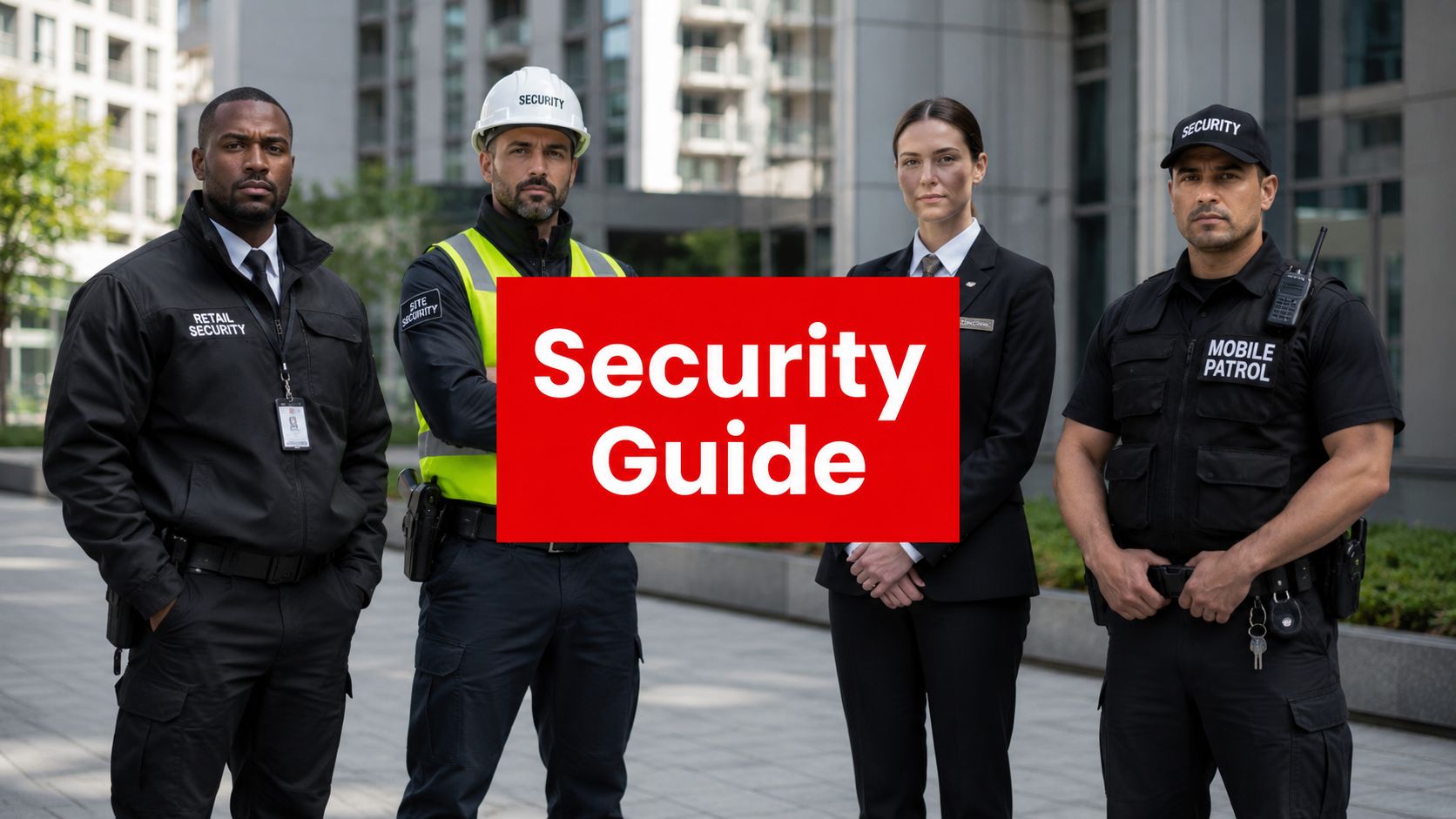
An unarmed officer fits many residential lobbies, retail entrances, construction sites, and routine access-control posts. The assignment may include visitor screening, patrols, incident reporting, and customer-facing assistance. Armed coverage belongs in a different conversation, usually involving documented heightened risk, cash handling, cannabis operations, jewelry, high-value assets, or executive protection. The additional authority and risk require stronger screening, training, insurance, and supervision.
Vehicle patrol works well when a property needs visible deterrence without a dedicated stationary post. HOAs, parking lots, and multi-property portfolios can benefit from scheduled or randomized checks of gates, lighting, access points, and building exteriors. A concierge officer serves a different purpose. At a Class A office building or high-rise residential property, the officer must combine hospitality, access control, resident interaction, and emergency judgment.
| Guard Type | Typical Sites | Best Fit | Watch Out For |
|---|---|---|---|
| Unarmed officer | Residential, retail, construction, offices | Access control, patrols, deterrence, reporting | Treating a customer-facing post as generic labor |
| Armed officer | Cash-handling, cannabis, jewelry, high-risk sites | Documented elevated risk and specialized protection | Selecting armed coverage without a defined threat assessment |
| Vehicle patrol | HOAs, parking areas, multi-site portfolios | Broad visibility across several locations | Assuming drive-by presence replaces response planning |
| Concierge security | High-rise residential and Class A offices | Hospitality combined with controlled access | Hiring for appearance without evaluating judgment and communication |
| Remote monitoring with guard support | Properties with cameras, multiple access points, or broad coverage needs | Extending oversight and escalating verified events | Buying cameras without a human response path |
Match the post to the experience
A stationary officer can deter activity at a front entrance, but a remote monitoring and patrol blend may cover more ground when your risk is distributed across a large site. Conversely, a camera can't greet a resident, manage a delivery, or resolve an access issue in real time. The strongest program often combines technology with the right human presence instead of forcing one tool to do every job.
For a plain-language overview of officer roles, review Overton's security officer types. For campus and property teams reconsidering outdated emergency technology, why blue lights fail students offers useful context on why a visible device alone isn't a complete safety strategy.
Before you request a quote, write down the post's location, hours, duties, threat history, access points, reporting needs, and tenant expectations. Then ask whether the proposed officer needs an active California guard card and whether the vendor can document the qualifications that match that assignment.
California Licensing and Insurance You Must Verify
California compliance is a hiring filter, not paperwork to review after deployment. A security guard must be at least 18 years old, pass DOJ and FBI criminal-history background checks, and complete BSIS Power to Arrest training to qualify for registration. BSIS also requires 8 hours of continuing training every year, so a vendor must manage compliance after hiring, not just during onboarding. These requirements are summarized by California BSIS guard regulations.

Know what the vendor should already manage
The initial California guard registration is valid for 2 years. The California labor-market licensing entry lists a $50 application fee, separate fingerprint-processing fees of $32 for DOJ and $17 for FBI, and a $450 renewal fee. Those figures come from the California labor-market licensing information.
BSIS also says newly licensed or newly employed guards must complete two mandatory courses within 30 days of the registration card being issued or employment beginning. That short window matters when a vendor promises immediate coverage for a property that needs a fully onboarded officer.
Ask the licensing coordinator:
- Guard status: Can you provide active BSIS registration details for each proposed officer?
- Training records: How do you track Power to Arrest, continuing education, and the required onboarding courses?
- Firm authorization: Is the contracting company properly authorized to provide private patrol services?
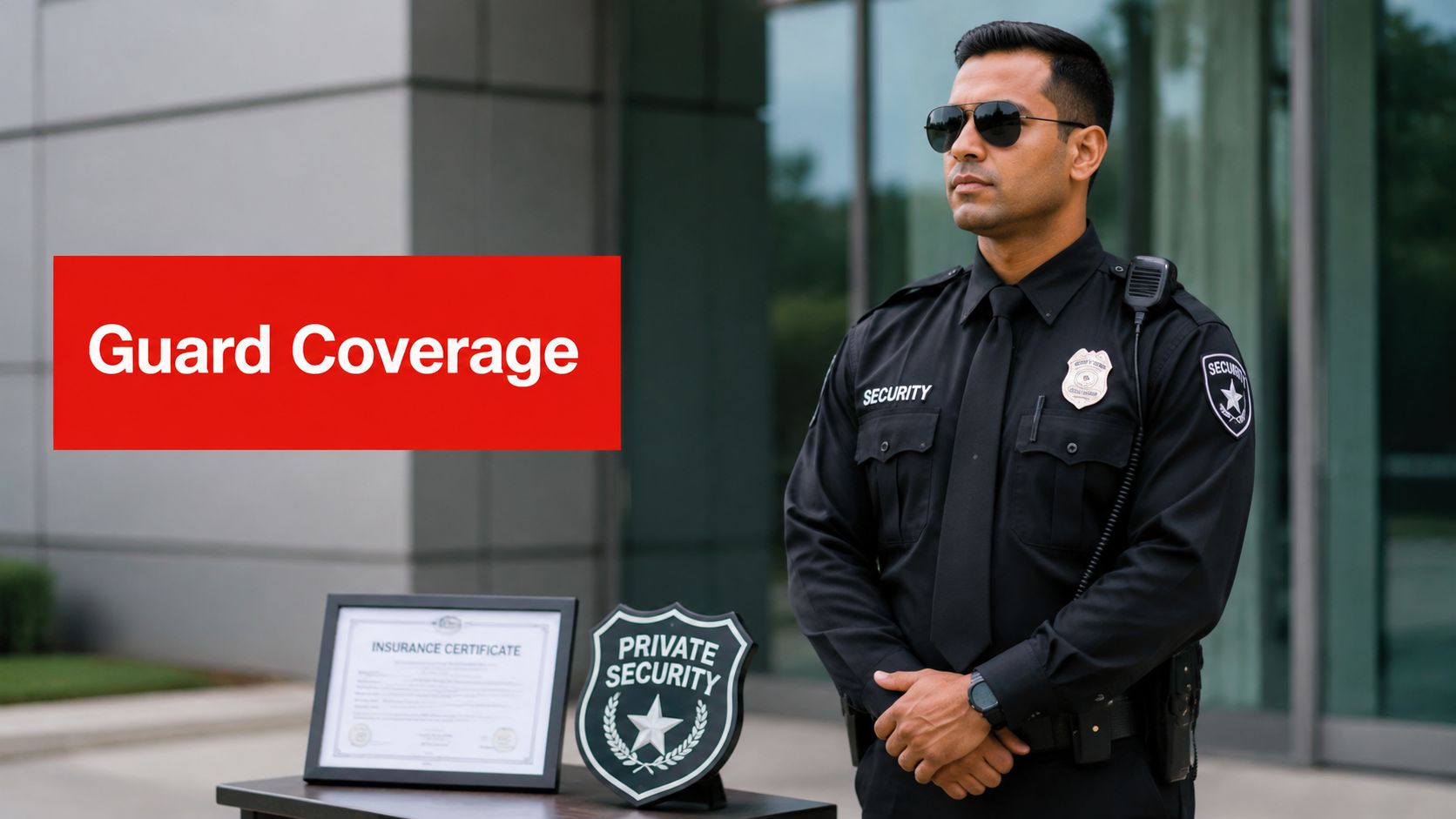
- Insurance evidence: Will you provide a current certificate of insurance and name the property as an additional insured where required?
- Patrol vehicles: Does the policy include commercial auto coverage for mobile patrol operations?
- Employee liability: Do you carry workers' compensation for every officer assigned to the property?
Red flags that end the conversation
Keep shopping if the salesperson avoids providing licensing information, cannot explain who verifies guard cards, presents a certificate that doesn't match the contracting entity, or says training is the officer's personal responsibility. A broker may locate a person quickly, but the property owner needs a company that controls supervision, replacement staffing, insurance, reporting, and compliance.
You can use Overton's California security guard licensing resource as a reference point while building your verification questions. Underlicensed staffing can create direct liability exposure and complicate incident coverage. A low quote isn't a bargain if the provider can't prove that the person on your property is legally qualified and properly insured.
Pricing Benchmarks and What Actually Drives the Quote
Published pricing ranges are useful for budgeting, but they aren't a quote. Current industry guidance places unarmed guards around $20 to $40 per hour, armed guards around $35 to $100 or more per hour, patrol visits around $40 to $150 or more, and 24/7 onsite security at a custom-quote level. Those benchmarks appear in this 2026 security guard pricing guide.

A Los Angeles quote won't necessarily resemble a Fresno quote. Local wage conditions, benefits, training time, insurance, commute distance, scheduling difficulty, holiday coverage, vehicle costs, uniforms, equipment, supervisor visits, and absence backfill all affect the delivered price. The scope drives the number more than the label on the officer's shirt.
The cost of unstable staffing
Industry turnover estimates place annual security-guard turnover between 77% and 89%, according to security-industry career information from Securitas. One independent industry review places direct replacement costs near $2,000 per guard in some operations, as detailed in security guard industry benchmarks.
That makes the lowest hourly rate a poor selection criterion. A vendor that repeatedly backfills, sends unfamiliar officers, misses reports, or leaves posts uncovered transfers administrative work and risk to your team. Ask for a price that includes the management needed to keep the assignment stable.
Require an itemized proposal
Your written proposal should show:
- Coverage assumptions: Exact posts, hours, days, minimum shift requirements, and relief arrangements.
- Labor inclusions: Regular rates, overtime treatment, holiday or emergency premiums, and training time.
- Management scope: Site visits, supervisor coverage, scheduling, dispatch, and escalation.
- Technology: GPS tours, digital reports, photographs, monitoring, radios, and equipment.
- Replacement plan: The response to a no-show and the process for maintaining continuity.
- Contract terms: Rate changes, pass-through charges, cancellation rights, and service remedies.
The useful question isn't “How much does a guard cost?” Ask, “What does this quote include, and what guarantees protect my property?”
Vetting Vendors and Asking the Right Interview Questions
A polished salesperson can win a meeting without understanding your site. Make the vendor earn the proposal by walking the property with the person who will manage the account.
Start with a detailed request for proposal. Mark every access point, blind corner, garage entrance, loading zone, tenant path, lighting concern, and restricted area. Require vendors to respond to the same post duties so you can compare service rather than marketing language.

Watch how the account manager sees the site
During the site walk, don't lead the entire inspection. Let the vendor identify access vulnerabilities, sight-line problems, lighting gaps, tenant-flow conflicts, and areas where a fixed post would fail. Compare the proposed post orders with what your property needs, including patrol cadence, access rules, incident escalation, and report delivery.
Use a scorecard instead of choosing the smoothest presenter. Rate each provider on compliance, site understanding, staffing depth, reporting, supervision, price transparency, and contract flexibility.
Ask these questions directly:
- Officer-to-manager ratio: How many accounts does the proposed manager carry, and how often will they visit?
- Officer tenure: How long do officers typically remain on comparable accounts?
- Recent fill performance: What was your fill rate during the last quarter, and how do you calculate it?
- Training: What does the curriculum cover beyond minimum licensing requirements?
- Emergency escalation: Who gets called first when an officer reports a serious incident?
- Overnight failure: What happens when an officer doesn't show up at 2 a.m.?
- Retention checkpoints: What happens during the officer's 30/60/90-day onboarding period?
- Reporting: Can we review a redacted daily activity report and incident report?
A provider that can't answer these questions will struggle when the property needs judgment rather than a uniform. For broader interviewing discipline, reduce hiring risk with best practices before conducting reference calls.
Reference calls should focus on consequences. Did the vendor communicate during incidents? Did the same officers remain assigned? Were reports useful, timely, and accurate? Did management solve recurring problems, or apologize after each failure? A service-quality framework such as Overton's service quality assurance approach can help you define the standards before selecting a provider.
Technology, Reporting, and Site-Specific Considerations in California
A guard is more accountable when the operation supports the person on post. GPS-enabled guard tour management systems, NFC checkpoint scans, digital daily activity reports, photographs, and incident documentation create a record of what happened, where it happened, and when it happened. A 24/7 security operations center can add welfare checks, GPS oversight, dispatch support, and escalation when an officer misses a checkpoint or reports a developing problem.
That changes your morning review. Instead of asking whether someone drove through the property, you can examine timestamped tour activity, photographs, open incidents, and officer notes. If a tenant disputes a patrol or an owner asks why an access point was missed, the team can review evidence rather than rely on memory.
Match the program to the California property
Los Angeles properties often need a deliberate combination of visible deterrence, access control, parking oversight, and mobile coverage because dense activity can shift quickly between entrances, sidewalks, garages, and transit-connected areas. San Francisco sites may need stronger attention to building access, delivery traffic, public-facing lobbies, and trespass issues near transit corridors.
San Diego assignments can call for a blend of concierge presence, residential patrol, and seasonal operational awareness, while Sacramento properties may require disciplined access control and reporting around government, healthcare, and commercial facilities. San Jose and Oakland portfolios often benefit from technology-supported oversight across separate buildings, while Long Beach sites may need coordinated coverage for retail, parking, residential, or port-adjacent operations. Fresno properties may gain more from patrol routes and targeted after-hours checks than from a permanent lobby post.
HOA boards should also decide how visible patrols should be. A marked vehicle may reassure residents and deter activity, but the route, timing, and reporting expectations still need to be written into the post orders.
Fire watch requires mechanical precision
Fire watch is not a generic security shift. When automatic fire protection is impaired, patrols commonly must occur at least every 30 minutes and continue until the system is restored, according to the BSIS licensing and fire-watch guidance. The officer needs clear instructions for documenting rounds, identifying hazards, notifying responsible parties, and escalating an emergency.
Choose the model by site profile. Use dedicated officers for continuous access control, concierge interaction, or active fire watch. Use vehicle patrol for distributed properties and lower-intensity deterrence. Add remote monitoring when cameras can extend coverage, but keep a human escalation path for verified events and urgent decisions.
Your Hiring Checklist and Next Steps
A guard can arrive on time, wear the uniform, and still leave your property exposed if the assignment was never defined. Give vendors the same operating brief, then judge whether they improve the plan while keeping accountability clear.

Prepare the vendor meeting
Use this sequence:
- Define the post: Document the location, hours, duties, access rules, patrol route, incident expectations, and known threats.
- Verify compliance: Confirm active BSIS credentials, required training, insurance, workers' compensation, commercial auto coverage, and additional-insured requirements.
- Collect comparable quotes: Require itemized pricing for labor, supervision, equipment, technology, emergency coverage, and replacement staffing. Hourly rates mean little without these cost drivers.
- Complete the site walk: Observe how each vendor studies the property, identifies weak points, and tests your assumptions.
- Score the interview: Record answers about manager workload, officer stability, fill performance, training, escalation, and reporting.
- Review the contract: Do not sign until the proposal, post orders, insurance documents, and performance terms match.
Review the terms people overlook
Read the provisions covering pass-through costs, rate-escalation caps, termination for convenience, post-order amendments, insurance endorsements, and service levels. A service credit has little value unless the contract defines the failure, measurement method, notice process, and remedy.
Set 30/60/90-day checkpoints after launch. Review attendance, report completion, incident handling, post-order accuracy, officer conduct, client communication, and staffing continuity. These reviews show whether the officer team and account manager can sustain the service, rather than just fill the post at launch.
A real partner can explain what happens before, during, and after a missed shift.
Overton Security brings more than 26 years of California security experience to assignments across Los Angeles, San Francisco, San Diego, Sacramento, San Jose, Oakland, Long Beach, and Fresno. Its operating model includes a low manager-to-client ratio, hands-on leadership, officer retention, GPS-enabled patrols, digital reports, and 24/7 SOC oversight.
If you're evaluating an onsite guard, vehicle patrol, concierge, fire watch, or blended monitoring program, contact Overton Security for a site assessment and written scope based on your property's risks. Walk the site with the operations team, and request the post orders, compliance documents, reporting process, and service commitments before signing.