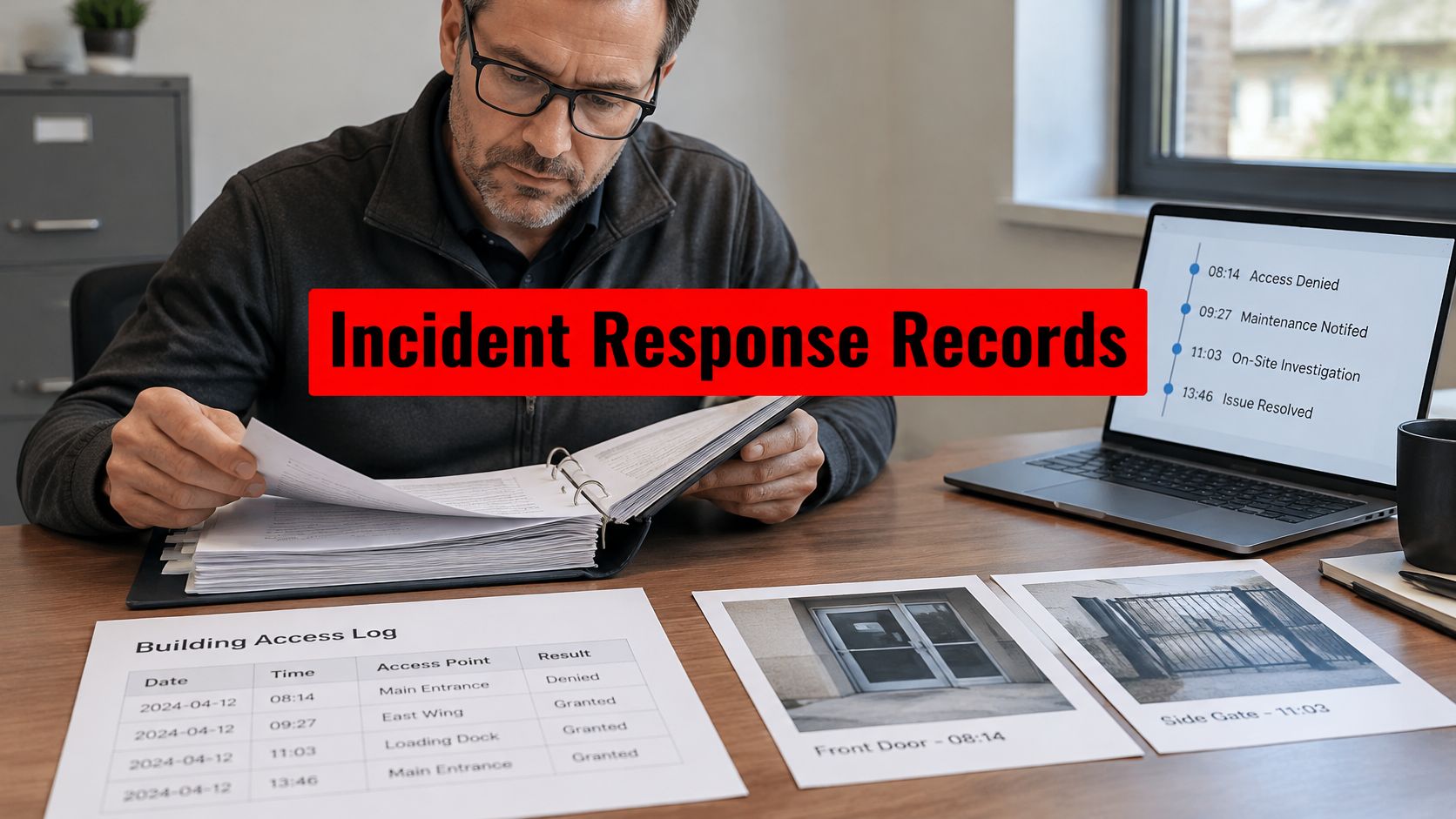
Say your Sacramento retail center discovers a vehicle break-in in the loading lot. Two weeks later, the insurer asks for a minute-by-minute timeline, but the officer's report, dispatch notes, and camera clips don't line up. You know your team responded. You can't yet show exactly what they knew or did at each moment.
Good incident response documentation closes that gap without turning officers into full-time administrators. A usable system combines a complete timeline, named owners, preserved evidence, and dated revisions so a manager can assemble an insurer or auditor response within a day.
What a Complete Incident Record Must Contain
A polished narrative isn't enough. Your file needs to connect observations, decisions, actions, communications, and outcomes so someone outside the property can reconstruct the response.
The NIST incident-handling guide calls for documenting each step taken while analyzing and validating an incident, including responder actions, involved-party contacts, gathered evidence, reports, and success measures. Although written for cybersecurity, that structure works well for physical-security incidents, alarms, access-control events, and patrol findings.
Build the file around review questions
Use these sections in your digital reporting platform or controlled case folder. Keep the labels consistent across properties so a portfolio manager doesn't need to learn a different filing system at every building.
Core sections of an incident record
| Section | What it must capture | Why reviewers ask for it |
|---|---|---|
| Incident identifier | Unique case number, detection time and time zone, reporting source | Proves the timeline starts when it says it does |
| Location and assets | Exact site, zone, entrance or asset affected | Shows the scope of the event and prevents mix-ups between buildings |
| Participants and witnesses | Names, roles, contact details, and whether each person is a participant or a witness | Lets an insurer or attorney contact the right people |
| Action log | Each response step with timestamp, responder, and reason | Shows whether the response followed procedure at every point |
| Evidence index | Every photo, log, clip, or statement, with its storage location | Connects each claim in the report to proof |
| Notifications and escalations | Who was told, when, and by whom | Demonstrates whether the escalation chain worked |
| Outcome and corrective action | Damage or injuries, police involvement, follow-up tasks with named owners | Shows the event led to a fix, not just a note |
| Review and sign-off | Reviewer, review date, and draft or final status | Establishes which version governs |
An identifier should follow the case everywhere, including exported video, maintenance requests, and correspondence. Record detection separately from the estimated occurrence time. If a tenant reports damage discovered after opening, don't substitute the discovery time for the unknown time of the break-in.
Make the record easy to interpret
State the time zone, identify the author, and label each version draft or final. Record unknown facts as unknown, with an owner assigned to investigate them. Empty fields leave reviewers guessing whether someone forgot the question.
Success measures should be practical: whether the affected entrance was secured, required contacts acknowledged notification, and assigned repairs were verified. A closed report with an unresolved gate fault isn't the same as a completed corrective action.
For additional context on documenting evidence transfers, the guide to chain of custody with Texas Autopsy Services offers a specialist perspective. Apply the relevant documentation principles alongside your property's procedures.
Could someone who wasn't there reconstruct who knew what, what they did, and when?
Roles and Responsibilities for Every Incident
Weak records often have plenty of contributors and no owner. An officer writes a narrative, dispatch saves a call, and maintenance emails a photograph, but nobody checks whether those pieces agree.
Assign responsibilities by name, not just department. A shared inbox can receive material, but it can't accept accountability or approve a release.
Assign ownership and working windows
The following are recommended internal service targets, not statutory deadlines. Set them in your post orders, confirm staffing can support them, and give responders a way to report a missed target without concealing it.
- Initial responder: within minutes, before leaving the scene. Record first-hand observations, immediate protective actions, and unresolved hazards. If safety duties interrupt reporting, tell dispatch what remains undocumented.
- Shift supervisor: within 1 hour. Review the first draft for missing locations, unclear language, unsupported conclusions, and evidence that needs preservation.
- Incident owner: within 24 hours. Hold the master record, reconcile conflicting accounts, assign follow-up work, and sign off the report when it's ready. Ownership doesn't mean forcing an incomplete investigation into final status.
- Dispatch or SOC operator: continuous, 24 hours a day. Maintain time-stamped communications and acknowledgments. Record unsuccessful contact attempts as well as completed calls.
- Contractor contact: within 24 hours. Supply the contractor's own logs, service records, or relevant access information. Don't rewrite their account into an officer's first-person narrative.
- Liaison: as each request arrives. Coordinate legal, insurer, and police requests, verify authority to release information, and log exactly what was supplied.
At a smaller property, someone may fill several roles. Keep the responsibilities distinct even when the names repeat, and use a separate reviewer for consequential decisions whenever staffing permits.
Keep working notes identifiable
Preserve original notes in a clearly labeled working-materials folder. The finalized report should identify its supporting documents without absorbing every informal comment as an established fact.
When accounts conflict, the incident owner should identify the disagreement and the evidence used to resolve it. Don't ask contributors to make their accounts match merely for a cleaner narrative.
Practical rule: Every assigned role needs a named backup with working access to the same systems.
Review the contact roster every quarter as an internal maintenance habit. Check after-hours numbers, contractor coverage, and delegated signing authority, not just whether a person still works for the organization.
How to Build an Escalation Workflow
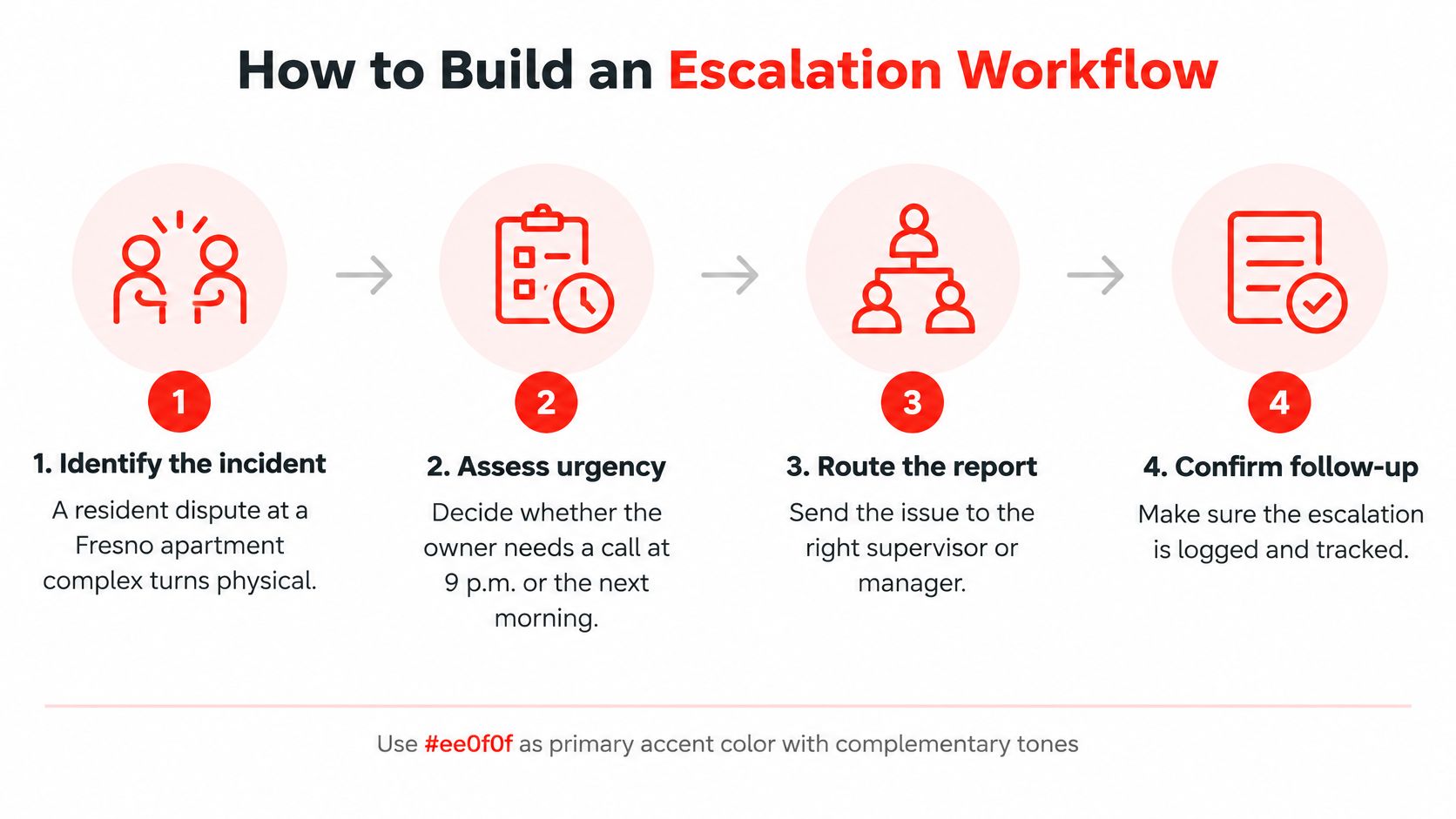
Say a resident dispute at a Fresno apartment complex turns physical at 9 p.m. The officer needs a clear answer about whether to call the owner immediately or leave a report for morning. That decision shouldn't depend on who happens to answer the radio.
Use a compact severity matrix approved by property leadership. These are proposed operational targets, not a substitute for emergency response, insurance conditions, or legal notification requirements.
Escalation levels, notification and target times
| Level | Example events | Notify | Target time |
|---|---|---|---|
| Level 1, minor | Lost keycard, graffiti, door left unlocked | Shift supervisor | By end of shift |
| Level 2, moderate | Trespasser removed, minor vehicle damage, resident dispute | Property manager | Within 1 hour |
| Level 3, serious | Physical altercation, injury needing treatment, fire alarm activation | Owner or executive, insurer | Within 30 minutes, then hourly updates |
| Level 4, critical | Firearm discharge, worker death, worker hospitalized | Executive, police, regulators | Immediately, then written report by legal deadline |
Treat examples as starting classifications. A lost credential that provides access to a restricted area may warrant a higher response than an ordinary replacement request.
Follow the same routing procedure
- Classify the event against the table. Use observable facts and the highest applicable severity. Don't delay protective action while debating a label.
- Notify the named contact for that level. Use the approved channel and backup contact if the primary person is unavailable.
- Confirm the call was received and log the time. Sending a message isn't proof that anyone accepted responsibility.
- Reassess every hour and update the action log. For this proposed workflow, record changed conditions, unanswered questions, and the reason for raising or lowering severity.
- Hand ownership off in writing at every shift change. Include current status, outstanding notifications, preserved evidence, and the next required action.
- Close the escalation only when the owner signs it off. Record what remains open under maintenance, claims, or another responsible team.
The visual below summarizes the routing logic officers and supervisors should recognize.
Separate urgent action from administrative notification
A fire alarm requires the appropriate life-safety response immediately, regardless of the manager-notification target. Similarly, the critical category flags possible reporting obligations; it doesn't mean every listed regulator receives every incident.
Give the liaison responsibility for identifying applicable recipients and deadlines. Never wait for executive approval to request emergency assistance when people need it.
Build the approved routing rules into your incident response process and site post orders. Officers, mobile patrols, dispatch, and property staff should use the same contact names and escalation language.
Handling Evidence So It Holds Up Later
An officer records that the area was checked. The report doesn't identify the area, the time, the officer's route, or what they observed. A reviewer can't tell whether that means the loading entrance, the entire lot, or a glance through a window.
Replace broad conclusions with verifiable actions. The CISA incident-response playbooks recommend preserving information for incident verification and documenting evidence acquisition details, including what was collected, how, when, and by whom.
Build an evidence-linked case file
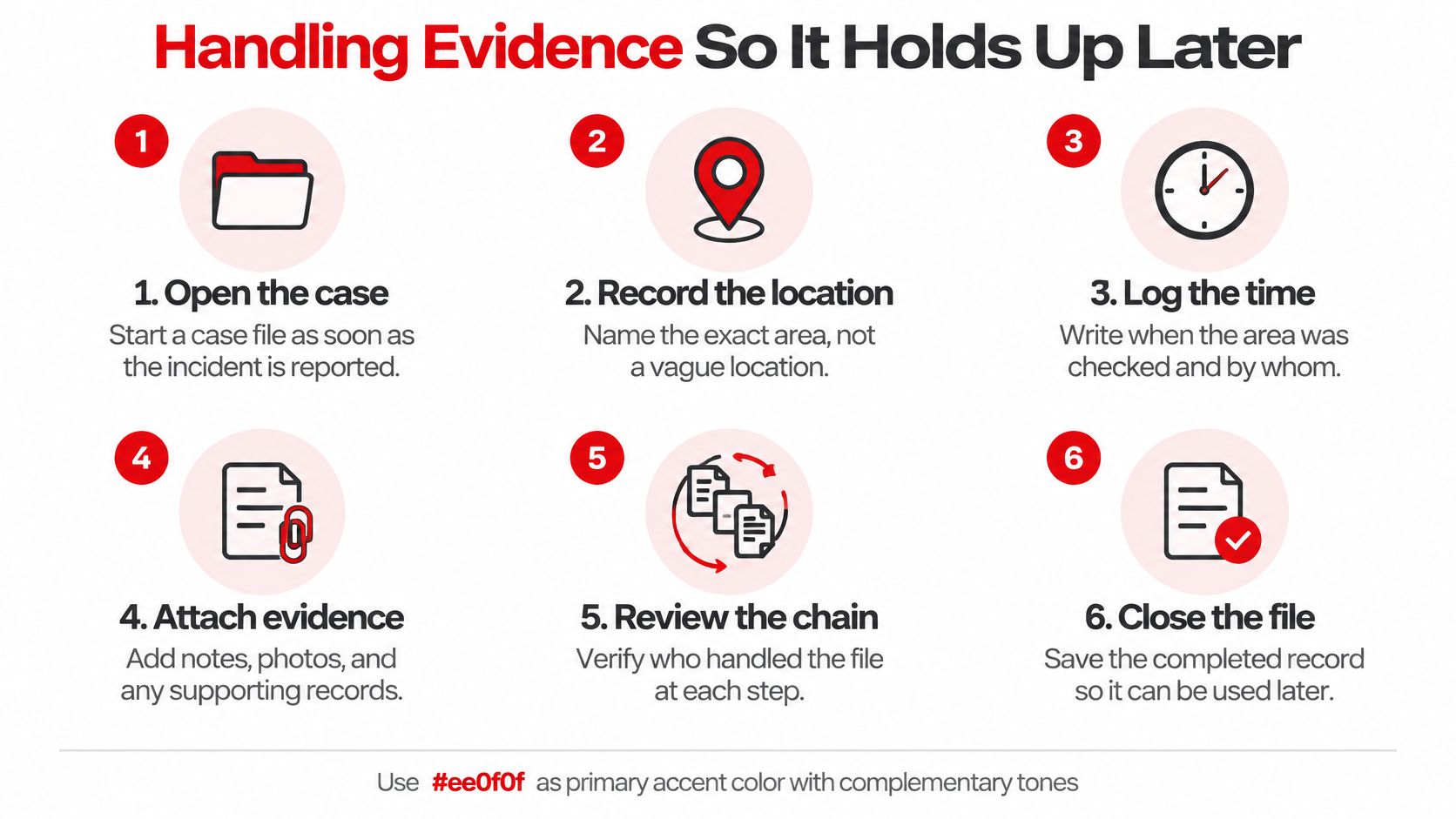
- Open the case and freeze the initial facts. Preserve the original report as received, including uncertainty and reporting source.
- Record observable conditions without speculation. Describe broken glass, an unsecured latch, or a visible injury rather than guessing motive or responsibility.
- Log each response action. Include the exact timestamp, actor, authorization, rationale, and outcome.
- Link evidence to each material statement. Reference the relevant photograph, clip, access event, or signed account.
- Record escalations, handoffs, and containment decisions. Include who approved restrictions or changes to site operations.
- Close only after checking completeness. Resolve missing fields and broken evidence references, or explicitly document outstanding limitations.
Use this visual as a reminder at the reporting workstation.
Evidence sources and custody fields
| Evidence | Collection method | Custody fields to log |
|---|---|---|
| CCTV clip | Export the original file format and note the file size | Camera ID, time range, time zone, exporter |
| Photographs | Shoot wide then close, with device time enabled | Device, photographer, time taken, location |
| Access-control export | Pull the raw event log for the affected zone | Reader ID, export time, person who pulled it |
| Patrol GPS and checkpoint scans | Save the time-stamped tour record without editing | Patrol route, officer ID, checkpoint times |
| Radio or dispatch log | Save call and dispatch timestamps from the system | Operator, call start time, call end time |
| Written statements | Obtain signed statements on the day of the event when practicable | Witness name, contact, time signed |
Preserve originals and explain limitations
For every item, add an evidence identifier, storage location, collection method, acquisition time, and collector. Track later transfers with the sender, recipient, purpose, and time.
Keep native CCTV exports and any player needed to view them. Annotate a working copy rather than drawing over the original photograph, and document known camera-clock differences instead of adjusting timestamps.
When an incident also involves employee conduct, HR evidence procedures from Paradigm International provide useful context for coordinating security and personnel records. Restrict sensitive statements to authorized reviewers rather than distributing the entire file broadly.
Avoid these common failures:
- Edited originals: Preserve the source file and identify derived copies.
- Missing time zones: Record the system's displayed zone and known clock issues.
- Unsupported summaries: Connect significant conclusions to identifiable evidence.
For insurance claim investigations, an organized evidence index is more useful than an attachment folder full of unexplained files.
Writing Post-Incident Reports on Time
California's reporting deadline can surprise property teams: under Business and Professions Code section 7583.2(f), a private patrol operator must report an on-duty firearm discharge or physical altercation involving a member of the public to BSIS within seven business days when the employee acts within the course and scope of employment; the BSIS reporting guidance also requires a guard or patrolperson involved in an on-duty firearm discharge to report to BSIS and the local police or sheriff within seven days.
Those are different reporting duties and different deadline wording. A call requesting police assistance isn't a substitute for the required written submission. Outside California, have the liaison verify the applicable state rules.
Capture the underlying facts immediately, then track preparation, approval, submission, and receipt separately. The manager should be able to see who owns each filing and whether confirmation is still outstanding.
Use a report form that supports review
The following entries are hypothetical examples, not facts about an actual incident. Replace them with verified information and preserve uncertainty where the occurrence time or responsible person remains unknown.
Sample post-incident report fields
| Field | What to enter | Example entry |
|---|---|---|
| Case number | Same identifier used in the action log | SAC-LOT-A |
| Incident type and level | Category and severity from the escalation table | Vehicle break-in, Level 2 |
| Date, time and time zone | Detection time and occurrence time if different | July 8, 2026, 06:40 PDT detected; occurrence time unknown |
| Participants and witnesses | Names, roles, contact details, and status | Officer J. Ruiz (responder), tenant (witness); contacts in restricted directory |
| Injuries or damage | Observable consequences with photo references | Passenger-side window shattered; photograph GLASS-A; no injury reported |
| Police involvement | Agency, report number, responding officer | Sacramento Police, report number on file; responding officer recorded in agency-contact field |
| Actions taken | Summary with timestamps linked to the action log | 06:42 PDT, Ruiz restricted access around glass; action entry SECURE-A |
| Corrective actions | Fixes with named owners and due dates | Gate sensor replaced, owner Jamie, due in 10 days; completion evidence attached |
Separate participants from witnesses, and distinguish reported injuries from your own observations. The BSIS incident report form requests injuries or property damage, participant identities, suspect and witness information, and whether police investigated.
A careful review takes concentration, not just a completed signature box.

Sign off without delaying required notices
The supervisor checks factual clarity; the incident owner approves the controlled version. The liaison confirms recipients, submission method, and acknowledgment, then attaches the filing confirmation.
A pending investigation is a reason to identify unknown facts, not a reason to let a reporting deadline pass.
OSHA duties require their own review. Many employers with 10 or more employees must maintain qualifying injury and illness records, while severe-event reporting obligations must be checked separately from routine recordkeeping exemptions under OSHA's recordkeeping guidance:
- Employee death: Notify OSHA within eight hours of a work-related employee death.
- Specified severe injuries: Notify within 24 hours of a work-related inpatient hospitalization, amputation, or loss of an eye.
- Annual posting: Covered employers post Form 300A from February 1 through April 30.
- Record retention: Covered employers retain the required logs, summaries, incident reports, and applicable privacy case list for five years.
Retention Periods and Legal Holds
Saving a report isn't the same as retaining a usable case. A narrative may survive while the related video is overwritten, the contractor closes its portal, or a departing manager's mailbox is deleted.
Set a written retention schedule by record type. There's no universal period for every security artifact, and storage capacity alone shouldn't determine how long you keep something.
Give each record a retention rule
- Incident records and action logs: Keep them for the applicable lease, insurance-policy, contract, and legal requirements. Record the controlling requirement and disposal authority.
- Post-incident reports and external filings: Retain the submitted version with its approval, attachments, and delivery confirmation.
- OSHA records: Apply the five-year retention requirement to Forms 300, 300A, and 301, including the applicable privacy case list.
- Video clips and access exports: Preserve relevant exports before automatic overwriting, then manage them under the case's approved retention rule.
For a useful comparison with another operational setting, trucking recordkeeping with My Safety Manager illustrates the importance of organizing records by category. Don't adopt another industry's retention periods without checking your own obligations.
Stop deletion when a hold applies
When a claim, lawsuit, or insurer request arrives, preserve related material and consult counsel about the hold's scope. Don't wait for a formal complaint if litigation is reasonably anticipated.
Tag the case, suspend relevant automatic deletion, and notify each custodian, including vendors holding footage or communications. Have the responsible person acknowledge the preservation instruction.
Make corrections through dated additions rather than overwriting retained originals. Release a hold only with documented authorization, then apply the approved schedule instead of deleting material informally.
Keeping the Record Current and Proving It Works
A binder on a shelf doesn't prove your team can document an incident. If the contact list is obsolete, the loading entrance has moved, or officers can't access the reporting system, the paperwork won't reflect current operations.
The NIST incident-response recommendations support documented procedures, periodic testing, and after-action reporting. For a facilities team, that means checking whether people can use the system in practice, not merely confirming that a policy exists.
Turn maintenance into assigned work
Build these habits into the property's operating calendar:
- Name the master-record owner: Give that person authority to resolve missing information and request supporting records.
- Use dated revisions: Preserve the history of changed procedures and approvals.
- Separate working and approved material: Make the governing version unmistakable to officers and managers.
- Review changed conditions: As a recommended trigger, revisit post orders after three repeat incidents or any site change.
Adopt a tabletop exercise twice a year and an after-action review within 30 days of a Level 3 or Level 4 event as internal targets. Use security incident response training to practice access failures, unavailable contacts, conflicting timestamps, and shift handoffs rather than rehearsing only ideal conditions.
Run a retrieval test
Set a 30-minute internal test: select a past case and ask a manager who wasn't involved to reconstruct its timeline using only the file. Record every missing attachment, unexplained decision, and inaccessible folder.
Confirm the case identifier and time zone are present, backups can perform their assigned roles, escalation contacts match the roster, and the master owner signed the latest review. Then assign each discovered gap to a person with a completion date.
For a manager handling three properties through a shared inbox, a calendar entry and a capable backup are often more useful than a larger binder.
Overton Security, a 26-year-old company, is one option for supporting this system through time-stamped digital activity reports, GPS checkpoint scans with photos, and 24/7 SOC oversight. Its low manager-to-client ratio, hands-on leadership, and support for retaining professional officers pair human familiarity with real-time accountability tools.
That quality-over-quantity approach puts experience, consistency, and service ahead of expanding coverage. Request a review of your templates and post orders to identify where responsibilities or evidence references need attention.
Overton Security offers site-specific post orders, professional officers, mobile patrols, and digital reporting that help property teams maintain usable incident records. Visit Overton Security to discuss a review of your documentation templates, escalation contacts, and reporting workflow.