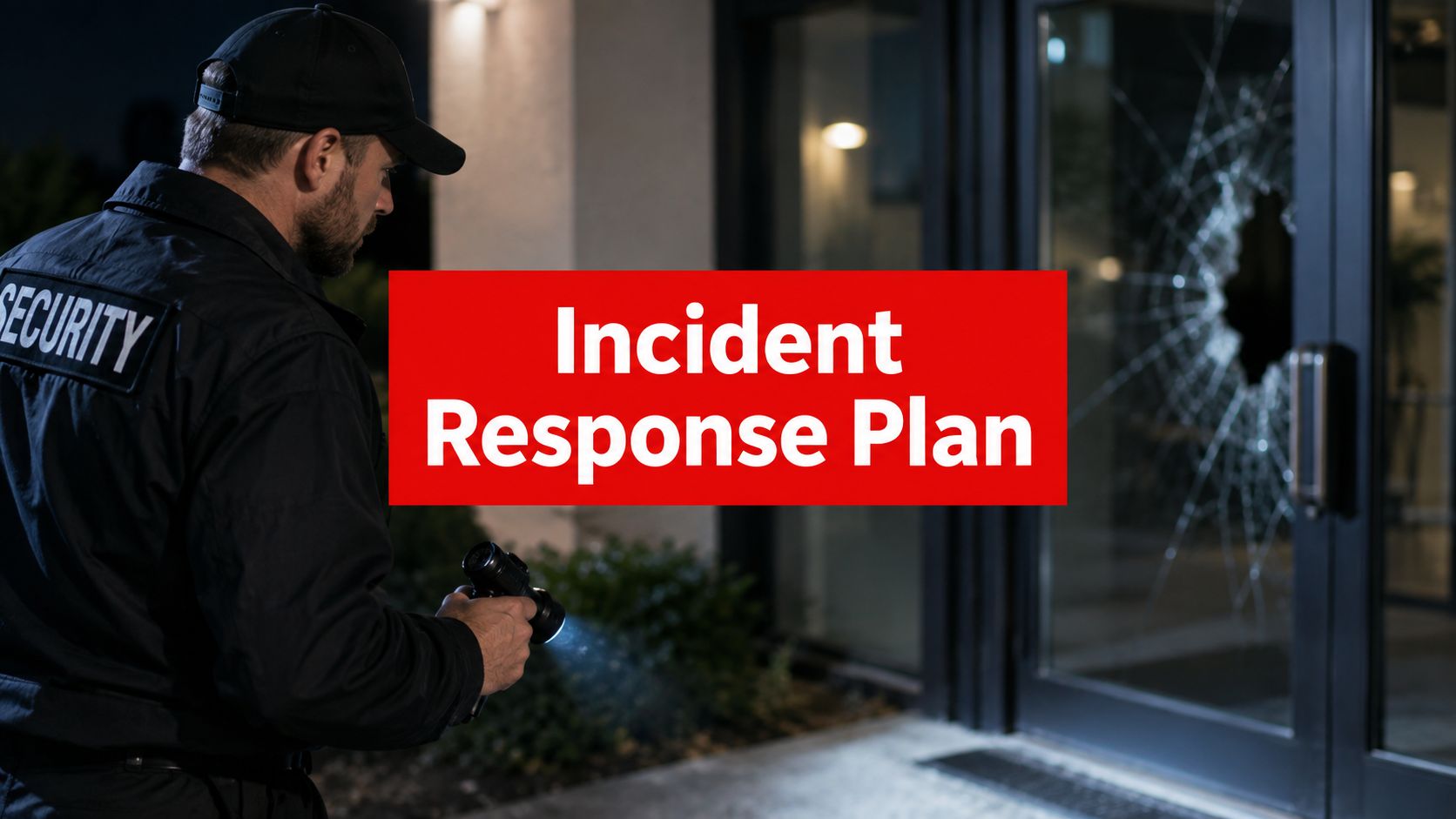
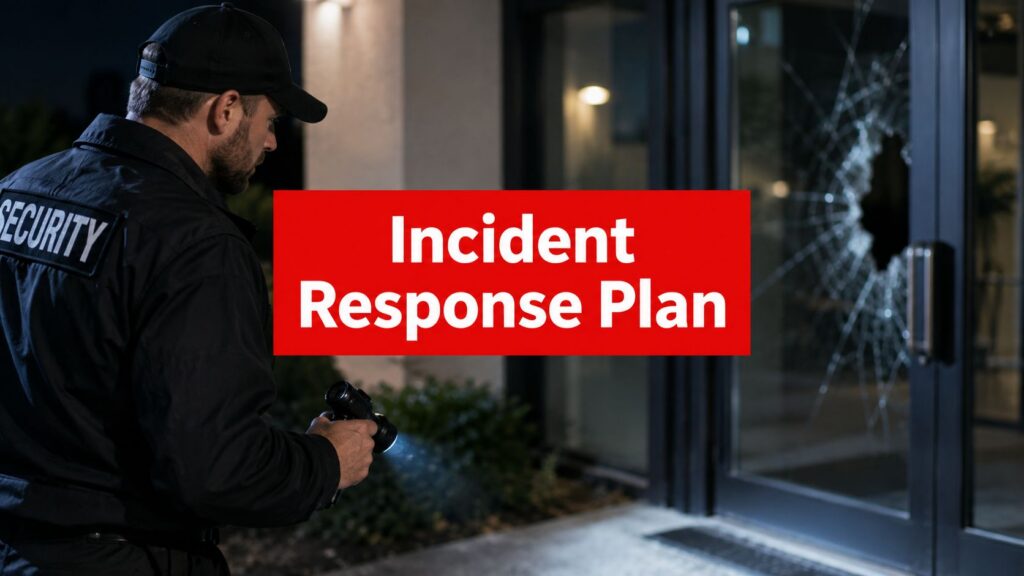
At 2 a.m., a patrol officer finds a shattered glass door at a retail center. The alarm is silent, the parking lot is empty, and the officer can't tell whether the person who caused the damage is still inside. Entering alone could create a safety risk and disturb evidence. Waiting too long could leave a tenant, employee, or neighboring property exposed.
That same uncertainty appears in other settings. A concierge officer may notice an agitated visitor refusing to leave a residential lobby. A loss-prevention officer may stop a repeat shoplifter while a crowd gathers. A construction patrol may find that equipment is missing from a locked area after hours. In each case, the first few decisions affect safety, evidence, communications, and client confidence.
A documented incident response process gives the officer something better than personal guesswork. It defines who gets called, what the officer may do, when law enforcement is contacted, how the scene is preserved, and how the event is recorded. The process should support sound judgment, not replace it.
The structure below adapts established incident response principles for physical properties. NIST describes a repeatable lifecycle built around preparation, detection and analysis, containment, eradication and recovery, and post-incident activity, while Microsoft's guidance emphasizes preparation, detection and analysis, containment, eradication, recovery, and post-incident learning in a model used by security teams (NIST's incident response lifecycle, Microsoft's incident response guidance). On a property, the first responder may be an unarmed officer with a radio, flashlight, body-worn camera, and site post orders. The operating principles still apply.
When Something Goes Wrong on Your Property
The officer at the broken door should stop outside the threshold, move to a position that provides cover without creating a blind spot, and radio the shift supervisor. The first report should be plain and useful: location, visible damage, whether anyone appears injured, whether doors or gates are open, and whether the officer sees signs of an active threat.
The supervisor now has to make several decisions quickly. The officer may be directed to keep people away from the entrance, check nearby areas from a safe position, preserve camera footage, and wait for police. If the officer enters without authorization or training, they could encounter an intruder, contaminate evidence, or become the subject of a preventable safety incident. If the officer drives away, the property remains unsecured and the client may learn about the damage from someone else.
The same sequence changes slightly at a retail center. A loss-prevention officer who detains a suspected shoplifter must manage safety, witness separation, store policy, and law enforcement contact. At a construction site, the patrol officer should document the condition of gates, locks, tool containers, and vehicle tracks without moving items that may help establish what happened.
Practical rule: The first officer's job is to make the scene safer, preserve useful information, and start the right escalation. It isn't to solve every part of the incident alone.
Every action creates a record. A radio call establishes the initial time. A GPS-enabled patrol check can help confirm the officer's location. Photographs, access-control records, camera clips, and witness names may later support an insurance claim, police report, tenant notice, or repair decision.
Physical incidents can also overlap with building emergencies. A property manager handling water intrusion, for example, may benefit from reviewing these basement flood safety steps so officers and facilities staff understand when to keep people clear, protect access routes, and escalate a hazard rather than treating it as a routine maintenance issue.
Trust is often won or lost before the full facts are known. A calm officer who follows a visible process reassures occupants and gives the property manager dependable information. A team that improvises may produce conflicting accounts, miss a notification, or make an otherwise manageable event harder to explain.
The Core Phases of an Incident Response Process
A property-based process starts long before an officer receives a radio call. Preparation includes written post orders, site maps, emergency contacts, equipment checks, officer training, access rules, and clear instructions for vacant units, loading docks, parking structures, retail floors, and active construction zones. The plan should tell an officer what to observe, what to avoid, and who has authority to direct the next action.
Identification begins when someone recognizes that an event may have occurred. A patrol officer may see forced entry, a monitoring operator may receive a camera alert, or a front-desk employee may report a disturbance. The responder should establish basic facts, classify the seriousness, and distinguish an active threat from a discovered condition. A propped door and an armed person may involve the same entrance, but they require entirely different responses.
Containment means reducing immediate exposure while preserving safety and information. That may involve keeping occupants away from a damaged door, securing a construction gate, directing visitors around a wet floor, separating involved parties, or maintaining a safe perimeter until first responders arrive. Containment isn't an invitation for an unarmed officer to pursue a suspect or enter a dangerous space.
Investigation depends on what the first responder preserves
Investigation at a property usually starts with disciplined observation. Officers should avoid touching damaged locks, discarded items, tools, or possible evidence unless a life-safety need requires it. They should record who was present, what each person observed, and whether video, access logs, alarm records, or vehicle information may exist.
The response then moves into notification. The shift supervisor may notify the account manager, property manager, facilities lead, or client representative according to the classification. Serious events may require emergency services, corporate leadership, legal counsel, or communications support. The person making the notification should state what is known, what remains unconfirmed, what actions are underway, and when the next update will occur.
Recovery closes the operational gap
Recovery is more than replacing a lock or sweeping broken glass. It includes restoring safe access, coordinating repairs, reopening an area, supporting affected occupants, and confirming that temporary controls remain in place. A vacant unit may need a board-up and a revised patrol instruction. A retail center may need a safe customer route. A construction site may need a new lock, inventory check, and adjusted patrol pattern.
The lifecycle is repeatable, but the actions must fit the property. A high-rise, shopping center, medical office, and construction yard need different containment boundaries, contacts, and recovery decisions.
Defining Roles and Decision Authority
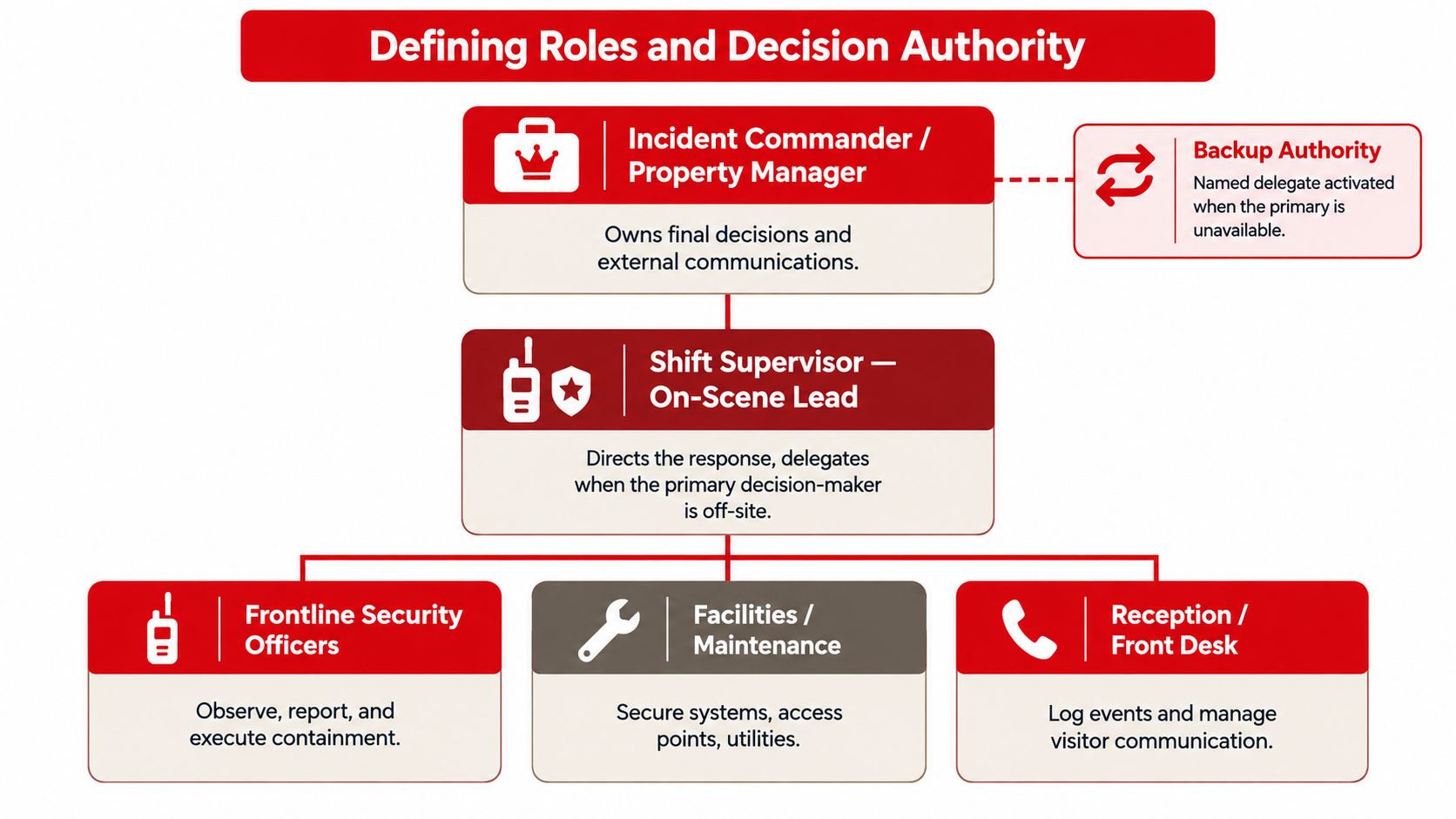
A response becomes unreliable when everyone assumes someone else is in charge. The playbook should name the on-scene lead, the person who backs that lead up, the person who owns client communication, and the executive who handles decisions involving unusual liability, public attention, or significant operational disruption.
At the property, the senior officer or shift supervisor usually directs the immediate response. They assign perimeter control, witness support, access management, and report preparation. A field supervisor provides additional personnel, checks that post orders are followed, and takes command if the first lead is overwhelmed or unavailable.
The account or operations manager owns the service relationship and client update. That role doesn't mean the manager should direct tactical actions from a phone. It means the manager makes sure the property manager receives an accurate status, the contract requirements are met, and follow-up resources are assigned.
Authority changes with the property
In a residential high-rise, the lead concierge security officer may separate residents from a lobby disturbance while the property manager is paged. The shift supervisor decides whether officers remain at the entrance, move residents to another access point, or request additional support. The property manager decides how the building communicates with residents once immediate safety is addressed.
At a retail site, the in-house security lead may coordinate with store management and the contracted guarding supervisor. Store management can address store operations, while the security supervisor directs officer positioning, evidence handling, and escalation. Neither role should assume authority to make a law-enforcement determination beyond the site's written policy and applicable law.
On a construction site, the safety officer and project superintendent may share authority. The safety officer should lead when an injury, fall hazard, fire, or unsafe work area is involved. The superintendent may lead access, equipment, and contractor coordination when the issue is theft, trespass, or a damaged perimeter.
The written playbook should specify who can:
- Call emergency services: Officers should know when immediate danger, injury, fire, or a weapon requires a direct emergency call.
- Authorize emergency repairs: The property or facilities authority should identify who can approve board-up, locksmith, utility isolation, or temporary barriers.
- Speak externally: A named property or executive representative should handle media, public statements, and sensitive client communications.
- Activate a delegate: The backup authority should be listed by name or role, with reliable contact details and an after-hours path.
Delegation must be written into the process. A property manager who can't be reached shouldn't force officers to invent authority during a fire, violent incident, or major access failure.
Escalation Paths and Trigger Points
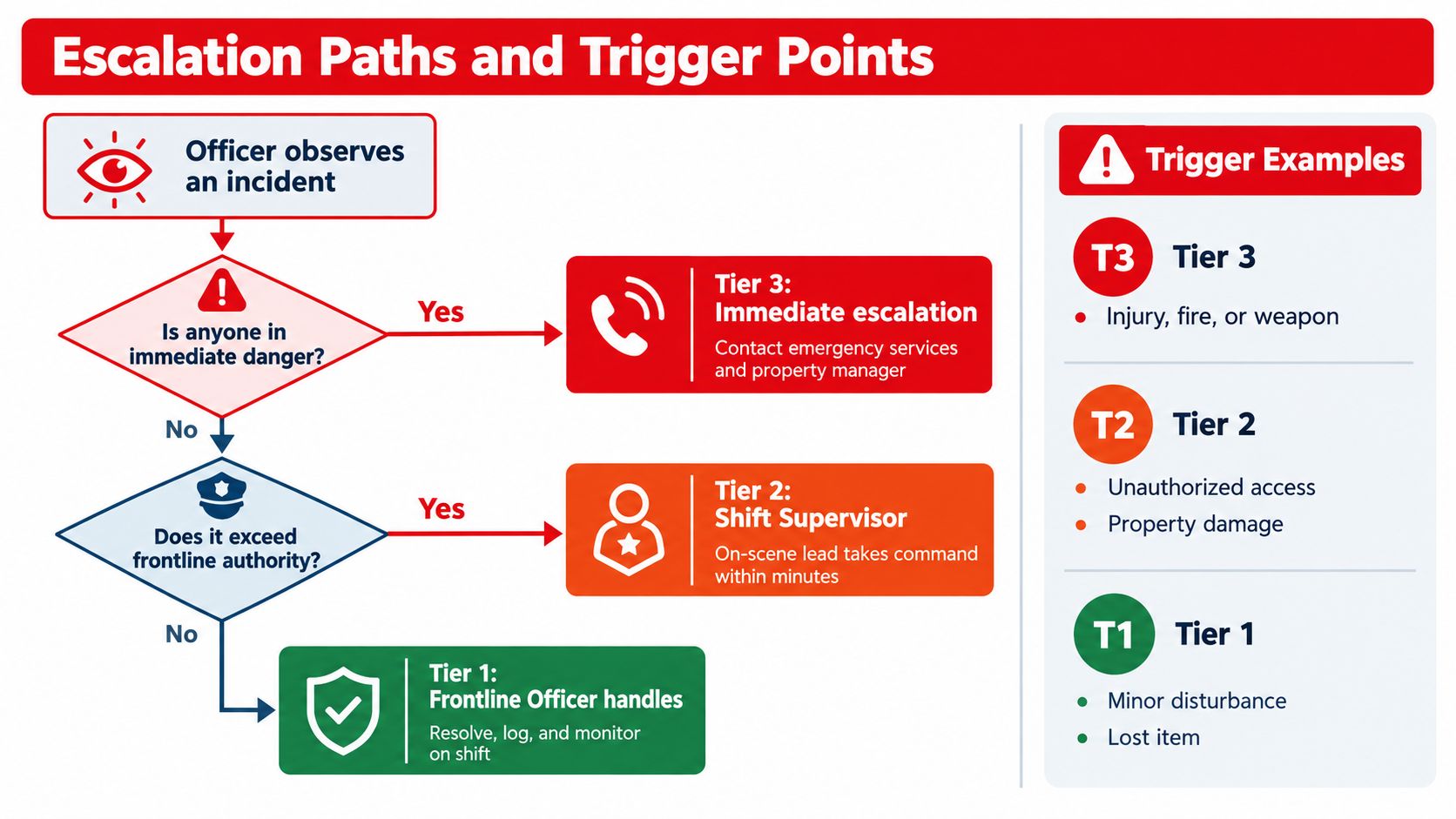
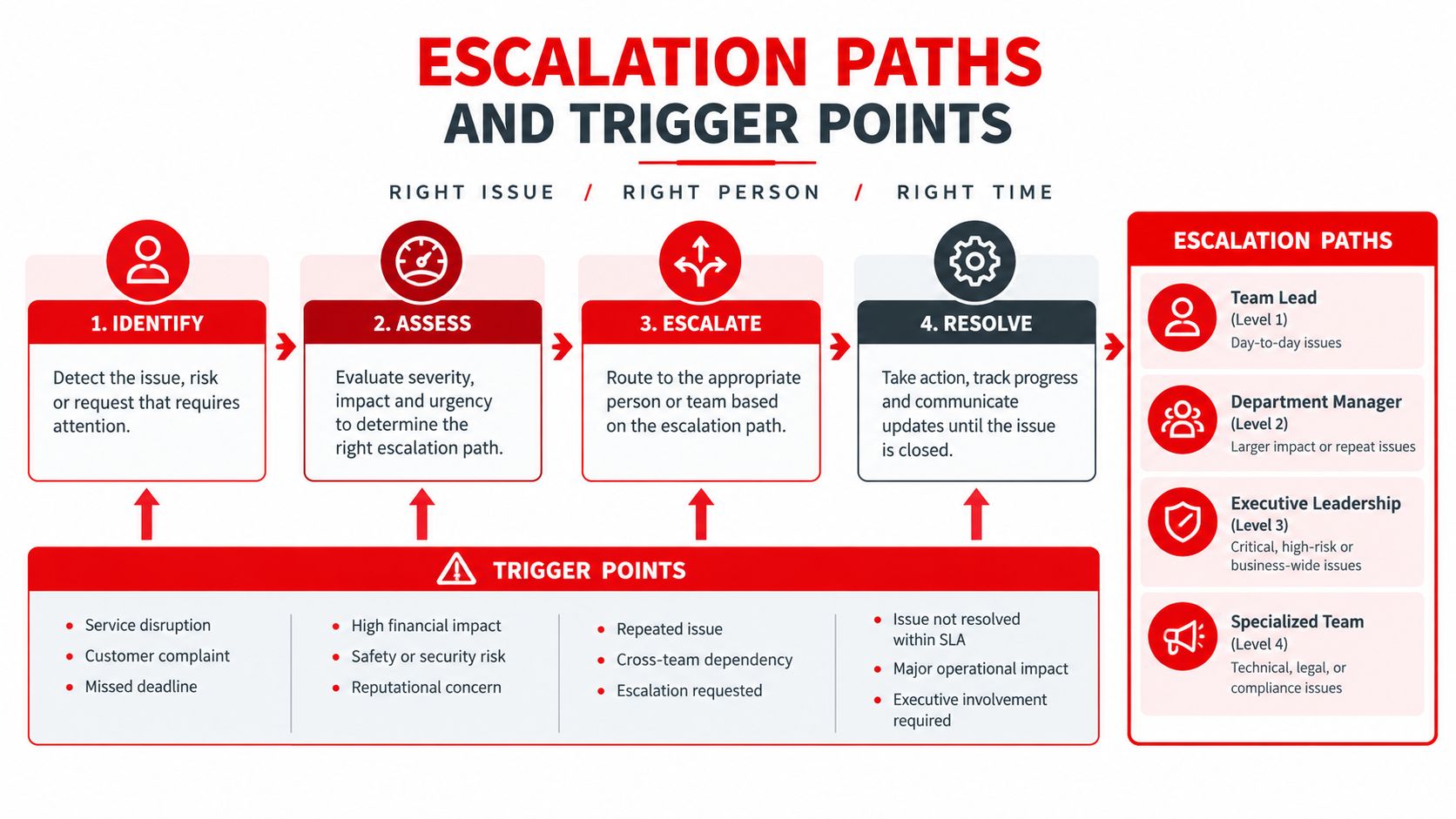
Escalation should be based on observable conditions, not on how anxious the situation feels. A useful property model has three levels.
Tier 1 covers issues a trained frontline officer can resolve within post orders. Examples include a lost item, a minor disturbance, a routine access question, or a low-level condition that presents no immediate danger. The officer handles the matter, records the action, and continues monitoring.
Tier 2 applies when the event exceeds frontline authority but doesn't present an immediate threat to life. Unauthorized access, significant property damage, repeated disorder, suspected theft, or a conflict involving a tenant should reach the shift supervisor promptly. The supervisor takes command, verifies the classification, and decides whether the property manager, facilities team, or law enforcement must be involved.
Tier 3 is for immediate danger. A weapon, active threat, serious injury, fire, or urgent medical emergency requires emergency services and internal escalation at the same time. Officers should give their location, describe the hazard, follow dispatcher instructions, and avoid actions that increase exposure.
The trigger must determine the response
A documented chart should answer four practical questions:
- Who is in danger? Injury, fire, weapons, or an active threat generally require a direct emergency call.
- What is happening now? A secured scene with no immediate danger may allow supervisor-led containment while facts are gathered.
- Who has been affected? Incidents involving minors, vulnerable residents, tenants, visitors, executives, or high-profile guests may require additional notification even when the physical risk is limited.
- What must stay open? A residential entrance, retail floor, medical office, or construction access route may need evacuation, lockdown, shelter in place, or a controlled alternate route.
No dollar threshold is universally suitable for every property. Instead, the client should define what level of damage requires management approval, emergency repair, insurance notification, or law-enforcement involvement. The same broken window may be a routine maintenance issue at one site and a sign of a larger intrusion at another.
Time matters, but safety comes first
A response plan should set expectations for immediate radio notification, prompt supervisor review, and regular leadership updates. Operational benchmark guidance recommends a median time to identify a critical incident under 10 minutes, with no critical incident taking more than 20 minutes to identify, while small to mid-size organizations may use a target under 15 minutes (CrowdStrike's incident response steps). Those benchmarks can inform a property program, but they must never encourage an officer to rush into danger.
Communications During and After an Incident
A property incident produces three communication streams at once. Officers and supervisors use radio traffic to manage the scene. Supervisors and leadership exchange operational updates. The client, occupants, emergency responders, legal advisers, and sometimes media receive information through controlled channels.
Radio traffic should use plain language, a calm tone, and only the detail responders need to act. The officer should identify the location, condition, immediate risk, and requested support. The open channel isn't the place for personal information, speculation, accusations, medical details beyond what responders need, or unverified statements about a suspect.
The client update should be short enough to use under pressure:
Break-in: “At 2:04 a.m., the patrol officer found damage at the east retail entrance. No person is visible, the area is being held clear, and the supervisor has requested police response. Video preservation and a written report are underway.”
Medical event: “A medical incident was reported in the lobby. Officers are keeping the area clear and assisting with access for responders. The property manager has been notified, and further details will follow when confirmed.”
Civil disturbance: “A disturbance is active near the west storefronts. Officers are separating uninvolved occupants, the supervisor is on scene, and the property manager is receiving updates. No injuries have been confirmed.”
Occupant notifications should explain what people need to do, not narrate every investigative detail. “Use the south entrance until further notice” is useful. “A tenant may have caused the damage” is unnecessary and potentially harmful. Media inquiries should go to the designated spokesperson, even if a reporter approaches an officer at the perimeter.
Communication Channels by Audience and Timing
| Audience | Channel | Timing | Approved By |
|---|---|---|---|
| Responding officers | Radio or approved response channel | Immediately, as conditions change | On-scene lead |
| Shift supervisor and field supervisor | Radio, phone, or incident platform | At discovery and after major developments | On-scene lead |
| Property manager and client representative | Phone, secure message, or incident platform | Promptly after classification, then at agreed updates | Account or operations manager |
| Tenants, residents, or visitors | Property notice, approved text, email, or front-desk message | When action is required or access changes | Property manager |
| Emergency responders | Emergency call and in-person briefing | Immediately when the trigger is met | Officer or supervisor |
| Media and legal representatives | Designated spokesperson or counsel | Only after authorized review | Executive or client authority |
For properties that need structured alerts, contact routing, and escalation support, the Overton emergency communications system can be evaluated alongside the client's existing phone, radio, and reporting procedures.
After the event, the written notice should separate confirmed observations from assumptions. The supervisor reviews the report for completeness, the property or account manager checks client-facing language, and authorized leadership approves any sensitive external communication.
Documentation and Post-Incident Review
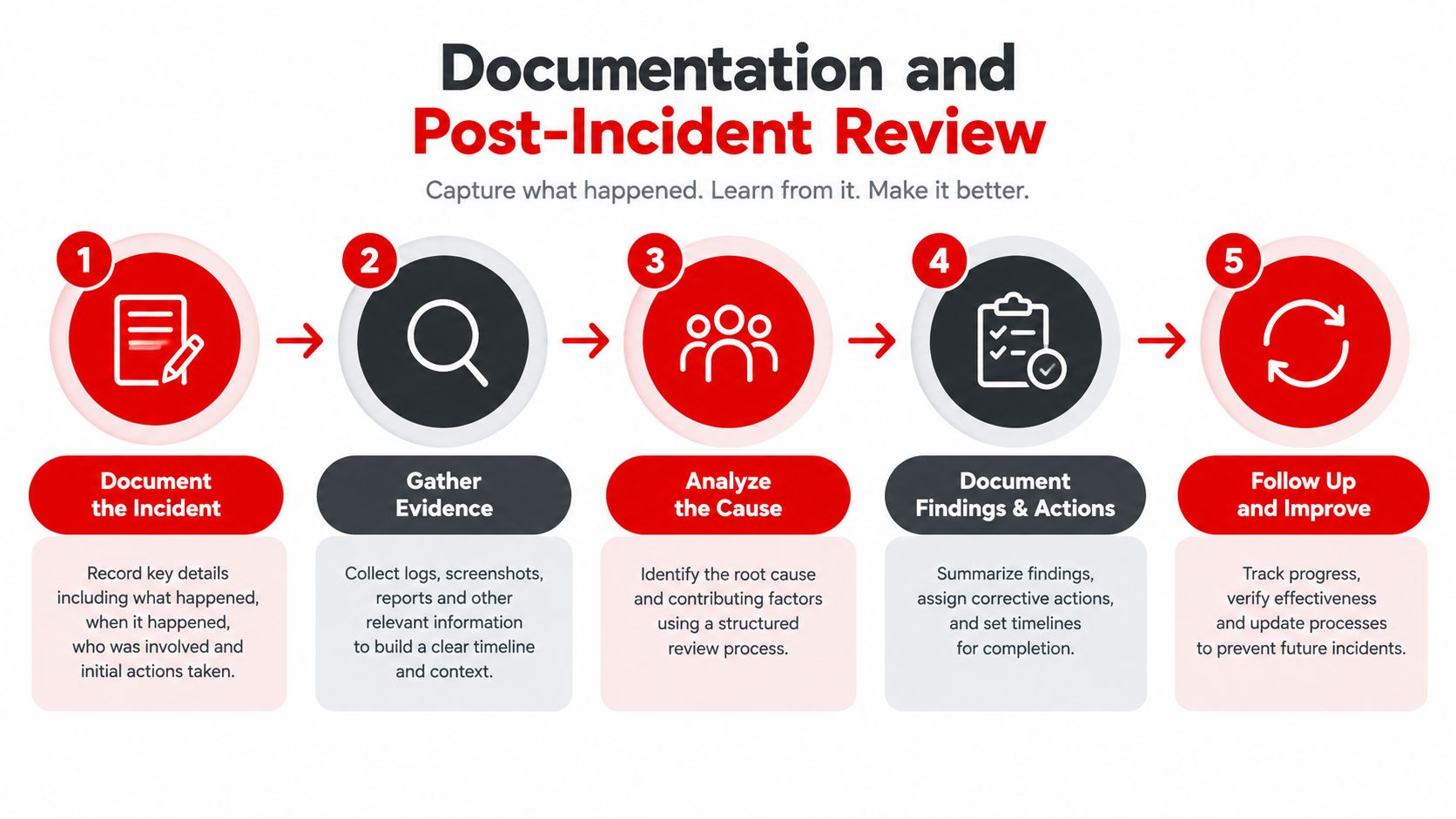
A report should allow a person who wasn't there to reconstruct the event without guessing. Record the time the condition was discovered, the exact location, personnel present, witnesses, observable facts, actions taken, notifications made, evidence preserved, and the status of the property when the response ended.
Property-specific details matter. Include damaged doors, locks, gates, windows, cameras, vehicles, access points, equipment, and utilities when relevant. Record any use-of-force event, injury, medical response, arrest, property damage, or law-enforcement interaction according to company policy and applicable requirements.
The report is the beginning of the review
Schedule the review within 48 to 72 hours when practical, while accounts remain clear and before temporary fixes disappear from view. The responding officer, shift supervisor, site manager, and an appropriate client representative should attend. Facilities, loss prevention, safety, or human resources participants may join when the event touches their responsibilities.
The review should ask:
- What happened: Build a timeline from the first observation through recovery.
- What worked: Identify effective patrol positioning, communication, access control, or emergency coordination.
- What failed: Look for unclear authority, missing contacts, equipment gaps, delayed notifications, or conflicting instructions.
- What changes: Assign a specific owner to each update, from revised post orders to a new training scenario.
Use a blameless approach without removing accountability. The purpose isn't to protect poor performance. It's to distinguish an individual mistake from a process that made the mistake likely, then correct the process and address conduct or training issues fairly.
Close the loop with assigned work
A review has value only when someone tracks its outcomes. Log each action, assign an owner, set a due date, and verify that the updated post order, contact list, radio script, or training material reaches the officers who work the site.
Documentation also supports recovery work, insurance communication, and contractor coordination. Managers handling repairs should keep the response report aligned with the documentation requirements for restoration, especially when water, fire, structural damage, or remediation services become part of the response.
A consistent security incident reporting process gives the team a common record format. Over time, reports reveal recurring blind spots such as poor lighting, unreliable locks, unclear visitor procedures, or patrol routes that don't cover the areas where incidents begin.
Formal programs benefit from measuring their response maturity. SANS reported that 76% of organizations detected incidents within 24 hours of compromise in its 2023 survey, while 54% remediated incidents within 24 hours of containment; the survey also found 43% experienced returning threat actors using the same or similar tactics, techniques, and procedures (SANS 2023 Incident Response Survey). Physical security teams can apply the lesson without copying the figures: detection, containment, and learning must be treated as connected responsibilities.
Putting Your Incident Response Process into Practice
A security manager can move from an undocumented plan to a usable process without producing a massive manual. Start with a one-page classification chart. Put the property's most likely events on one side, such as forced entry, medical emergency, fire, suspicious person, missing equipment, tenant conflict, and access failure. Put the required first action, escalation tier, emergency contact, and reporting requirement beside each event.
Next, map the people already working on the account to defined roles. Name the frontline officer, shift supervisor, field supervisor, account manager, property manager, facilities lead, and backup authority. Confirm that every after-hours contact works, that someone can approve emergency repairs, and that officers know who may speak for the property.
Test the process on a real property scenario
Run a tabletop exercise using a situation the team could encounter. A useful scenario might involve a construction site after hours, an open gate, a missing generator, a camera outage, and a project superintendent who can't be reached. Ask the group to identify the first radio call, the safe perimeter, the evidence to preserve, the police notification decision, the client update, and the recovery owner.
Then validate the process in the field. Check that officers can find the post orders, use the radio script, complete a digital report, reach the supervisor, and identify the nearest safe access point for emergency responders. Confirm local law-enforcement contacts and site directions, but don't assume a contact list is current just because it's printed.
Post orders, wallet cards, radio language, and digital reporting fields should use the same classifications. If one document says “secure the area” and another implies “enter and investigate,” the officer still faces uncertainty at the worst possible time.
For teams that need structured instruction, Overton's security incident response training can fit into a broader program of customized post orders, officer training, patrol oversight, digital reporting, and 24/7 Security Operations Center support. Overton Security has operated for 26 years, serves property types including residential communities, retail centers, construction sites, offices, healthcare facilities, and industrial properties, and uses GPS-enabled patrol documentation and real-time reporting as part of its service infrastructure.
A strong process is maintained, not filed away. Review it after incidents, test it during quiet periods, support the officers expected to use it, and update it when the property, staffing, access controls, or risk profile changes.
Overton Security can help property teams build, test, and refine site-specific incident response processes for residential, retail, commercial, construction, and multi-site properties. Visit Overton Security to discuss customized post orders, trained security officers, mobile patrols, digital reporting, and response support aligned with your property's needs.