
A security service level agreement should replace vague promises with measurable targets, such as a 15-minute response to a suspected breach, one-hour containment for an active threat, and defined deadlines for routine work. Without those commitments, “prompt response” gives a property owner little to enforce when an incident occurs.
At 2 AM, a disturbance begins near a commercial entrance. The guard arrives hours later, the patrol log is incomplete, and the contract says only that the provider will deliver “professional service.” You're left trying to determine whether the failure was a staffing issue, a dispatch problem, unclear instructions, or a commitment nobody could measure.
That situation is common across commercial buildings, residential communities, retail centers, construction sites, and multi-site portfolios. A well-written SLA turns expectations into evidence. It states what the provider must do, when the clock starts, how performance is documented, who owns escalation, and what happens when the standard is missed.
Why Most Security Contracts Fail to Protect Your Property
A generic security contract may identify the number of officers, service hours, patrol locations, and billing terms. It often doesn't answer the operational questions that matter most during an incident: How quickly must someone acknowledge the alert? When must a supervisor be notified? What evidence proves the patrol occurred? What remedy applies if the provider misses the target?
Consider a mixed-use property in Los Angeles. A late-night disturbance is reported, but the assigned officer is dealing with another call. The contract requires “timely incident response” without defining priority, backup procedures, or escalation. The provider can describe the event as an isolated delay, while the property manager sees an unacceptable exposure and has no shared standard to apply.
The weakness of familiar contract language
Phrases such as fast response, adequate coverage, and regular patrols sound reasonable until someone has to verify them. “Fast” might mean minutes to one manager and an hour to another. “Regular” could mean a documented route or an informal drive through the lot.
A security service level agreement prevents that ambiguity by defining:
- The trigger: What starts the service clock, such as an alarm, guard observation, tenant call, or dispatch request.
- The severity: How the provider classifies a life-safety concern, active intrusion, suspicious activity, property damage, or routine service issue.
- The owner: Which officer, supervisor, dispatcher, or account manager is responsible.
- The evidence: GPS records, checkpoint scans, time-stamped reports, photographs, call records, or camera footage.
- The consequence: Corrective action, escalation, service credit, retraining, or contract review.
The academic history of security SLAs reinforces the value of turning security expectations into quantifiable agreements. The practical lesson for a property manager is simple: if a commitment can't be measured and independently verified, it isn't a dependable control.
What Is a Security Service Level Agreement
A security service level agreement is a formal contract between a security provider and its customer that defines the security service being delivered and the performance level expected. Modern SLA frameworks measure concrete targets such as response time, resolution time, uptime, and compliance metrics, rather than relying on broad assurances.
For a property manager, the SLA should function as an operating document, not a marketing attachment. It needs to connect the property's risks with service obligations that officers, supervisors, dispatchers, and managers can follow.
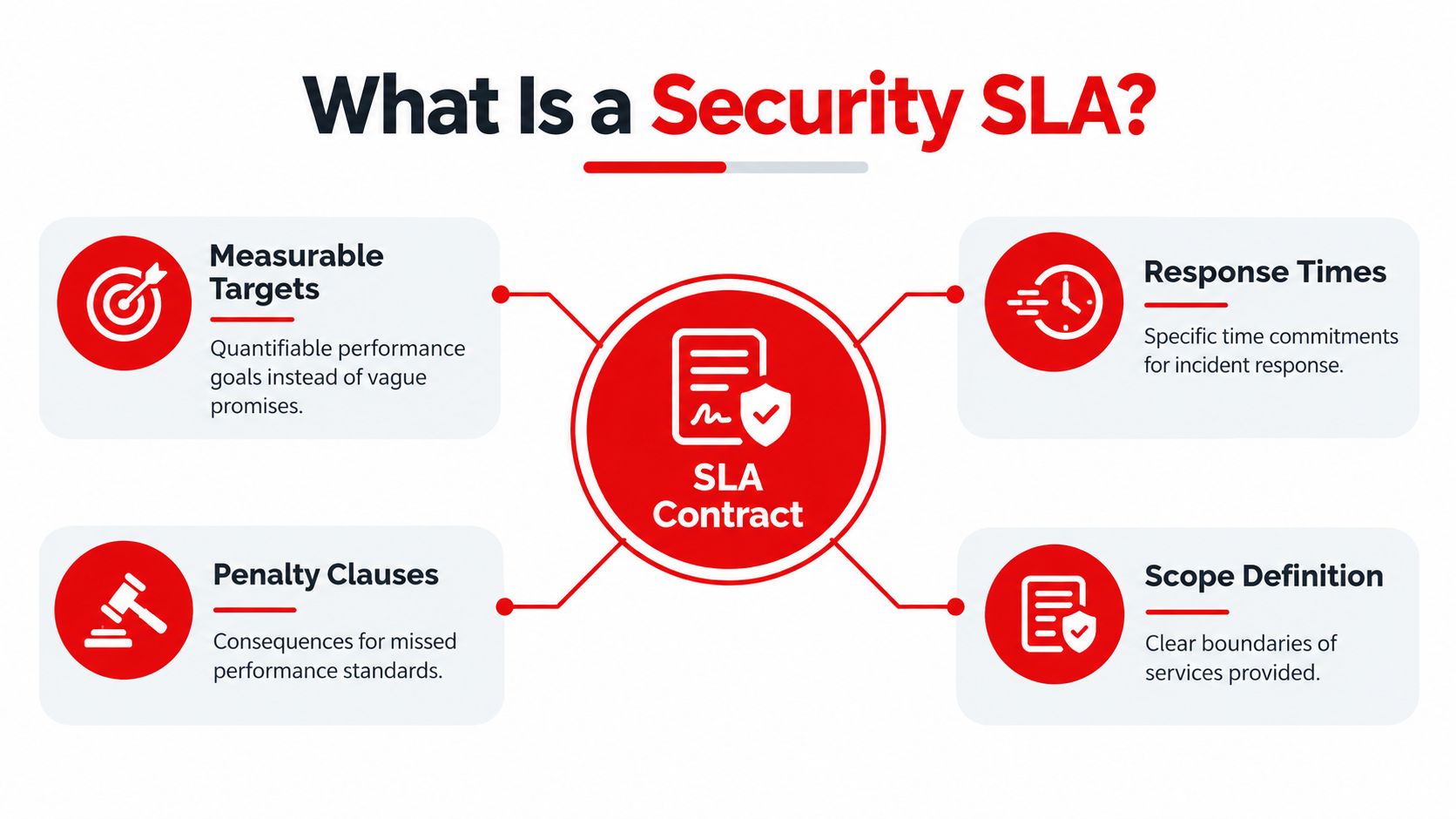
Four building blocks of an enforceable SLA
Scope definition identifies what the provider will deliver. That might include unarmed guards, access control, vehicle patrols, remote camera monitoring, fire watch, incident reporting, supervisor inspections, or emergency dispatch. It should also identify exclusions, customer responsibilities, service hours, locations, and coverage assumptions.
Measurable targets convert service quality into observable results. Examples include the time to acknowledge a dispatch, the deadline for submitting an incident report, completion of required checkpoint scans, or the availability of a remote monitoring function.
Response and resolution terms distinguish between starting work and completing the required action. Guidance from the National Cyber Security Centre on managed service providers describes response time as the period between logging an issue and beginning an investigation. It also identifies under one hour as standard for urgent issues and suggests two to three business days as a starting point for routine medium-priority resolutions.
Remedies and governance explain what follows a miss. A remedy might require a corrective action plan, supervisor review, retraining, replacement coverage, a service credit, or escalation to senior leadership. The SLA should also set a reporting cadence and a process for reviewing targets when the property, threat profile, or operating hours change.
For a venue or event environment, this venue security SLA guide offers useful context on defining responsibilities and service expectations. The same discipline applies to a residential tower, retail plaza, medical office campus, or construction site.
From Vague Promises to Measurable Commitments
The difference between weak and strong language becomes obvious when the clauses sit side by side.
| Vague wording | Measurable commitment |
|---|---|
| “Respond promptly to incidents.” | “Acknowledge a suspected breach within 15 minutes and begin escalation according to the incident matrix.” |
| “Provide regular patrols.” | “Complete the assigned route, scan designated checkpoints, and submit a time-stamped report for each scheduled patrol.” |
| “Maintain adequate coverage.” | “Notify the client and dispatch a qualified replacement when an assigned post becomes vacant.” |
| “Handle emergencies quickly.” | “Escalate an active threat within the defined severity window and document each handoff.” |
The measurable examples above reflect security-focused thresholds described by AWS guidance on service level agreements, including 15 minutes for suspected breaches, one hour for active threat containment, 72 hours for critical patch deployment, and 14 days for standard patch deployment. Physical security buyers won't copy every technology metric directly, but the principle transfers well: match the deadline to the risk.
Use severity instead of one universal clock
A broken gate light, a suspected trespasser, and an assault in progress shouldn't receive the same service target. A single response promise usually creates one of two problems. It can be too slow for a high-risk event, or so strict for every issue that the provider stops treating the metric as operationally realistic.
A practical matrix might separate:
- Critical incidents: Immediate dispatch, defined escalation, supervisor involvement, and documented status updates.
- High-priority incidents: Prompt acknowledgment, triage, site response, and report delivery within the agreed window.
- Routine issues: Corrective work, follow-up, and resolution within a business-day schedule suited to the property.
The service quality assurance program should support this structure with consistent inspections, review procedures, and evidence. The strongest contract isn't the one with the most aggressive promise. It's the one that the provider can deliver consistently and the property manager can verify without argument.
Essential Clauses Every Security SLA Must Include
A security SLA protects the property owner only when its clauses connect responsibility, measurement, evidence, and consequence. Listing patrol hours without defining what counts as a completed patrol doesn't create accountability. Neither does naming a response target without explaining when the clock starts.
Scope and ownership
Start by mapping the service to the property. Identify entrances, garages, amenity areas, loading zones, construction boundaries, camera views, fire-watch routes, and any tenant-facing responsibilities. State whether officers provide access control, concierge duties, incident response, patrols, parking enforcement, loss prevention, or observation only.
Assign ownership for each step. The agreement should identify who receives an alarm, who dispatches a mobile unit, who contacts law enforcement or emergency services when appropriate, who informs the property manager, and who completes the final report.
Performance and reporting
The core KPI schedule should include measurable targets for:
- Acknowledgment: When the provider confirms receipt of an alert or call.
- Response: When an officer or mobile unit begins the required action.
- Containment or stabilization: When the immediate risk is controlled or transferred.
- Resolution: When the agreed service action is complete.
- Documentation: When the Daily Activity Report or incident report reaches the client.
- Coverage: Whether scheduled posts, patrols, and monitoring functions were performed.
A security SLA metrics review identifies response time, availability, and compliance adherence as common ways to evaluate security delivery. For physical properties, those categories can become guard check-ins, patrol verification, report completion, system availability, and compliance with post orders.
Escalation, remedies, and review
The escalation clause should name the sequence, not merely say that issues will be escalated. Define the supervisor's role, the account manager's role, senior management notification, client notification, and the conditions that require a formal corrective action plan.
Remedies should be proportionate and usable. They may include replacement staffing, additional supervision, retraining, a documented root-cause review, service credits, or contract review after repeated misses. A remedy that requires the property manager to discover the failure, prove it, and request relief is weaker than a process that generates the report automatically.
| Clause type | Purpose | Key elements |
|---|---|---|
| Scope and responsibilities | Prevents gaps and disputed duties | Sites, posts, tasks, exclusions, owners |
| KPIs and service objectives | Defines successful performance | Response, resolution, patrol, reporting, availability |
| Evidence and reporting | Makes results auditable | Timestamps, GPS, scans, photos, reports |
| Escalation | Speeds action when risk rises | Severity, contacts, handoffs, notification |
| Remedies | Creates consequences for misses | Correction, retraining, credit, review |
| Governance | Keeps the SLA useful | Meeting cadence, change control, renewal review |
Measurable Metrics for Different Property Types
A single SLA template rarely fits a residential community, retail center, warehouse, hospital campus, and construction site equally well. The metric should reflect the service being purchased and the harm the property is trying to prevent.
Onsite officers
For a staffed post, measure more than attendance. Track post arrival, required check-ins, access-control activity, incident acknowledgment, supervisor inspections, and report submission. If the officer must inspect a garage or monitor a loading entrance, the post orders should identify the route, trigger, evidence, and escalation path.
A strong metric might require an officer to document a discovered gate failure with a time-stamped observation, photograph, notification record, and follow-up status. That produces a useful operational record instead of a vague statement that the officer was “present.”
Mobile patrols
Vehicle patrol programs need route and dispatch metrics. Define scheduled or random visit requirements, checkpoint completion, arrival documentation, access-point inspections, photographic evidence, and the process for handling a missed or interrupted visit.
For a construction site in San Jose or Fresno, the SLA might distinguish between a routine perimeter check and a dispatch for suspected theft. The contract should identify whether the patrol is shared across properties or dedicated to the client's portfolio, then make the expected coverage and response obligations explicit.

Remote monitoring and fire watch
Remote monitoring agreements should measure alert receipt, human review, classification, dispatch, escalation, and report delivery. “Cameras are online” isn't the same as “a trained operator identified and escalated a relevant event.” The policy-as-code approach to cloud governance is a useful conceptual parallel because it emphasizes explicit, testable rules instead of informal interpretation.
Fire watch requires a different control set. Define patrol routes, required observation points, documentation, notification procedures, and compliance responsibilities while a fire-protection system is unavailable or under maintenance.
Across all service types, specify:
- Trigger: What starts the clock.
- Severity: How the event is prioritized.
- Service hours: Whether the target applies continuously or during stated hours.
- Owner: Who must act.
- Pause conditions: What legitimately stops or suspends the clock.
- Evidence: What proves completion.
- Consequence: What happens after a miss.
Property managers can use security performance indicators to organize these measures around outcomes rather than coverage alone.
Implementing SLAs with Technology and Transparency
A contract becomes useful when the operating system behind it captures what happened. Paper logs and retrospective explanations create too much room for disagreement, especially when a manager oversees properties in Los Angeles, Oakland, San Diego, and Sacramento.
GPS-enabled guard tour management can connect a patrol requirement to location, checkpoint, time, and officer identity. NFC scans, digital Daily Activity Reports, photographs, and incident notes give the client a record that can be reviewed after an event and compared with the SLA.
Build a visible chain of accountability
The workflow should follow the incident from trigger to closeout:
- Detection: A guard, resident, tenant, camera operator, or dispatcher identifies the event.
- Assignment: The responsible officer or mobile unit receives the task.
- Action: The officer performs the required response, patrol, inspection, or escalation.
- Verification: The system records time, location, photos, notes, and relevant communications.
- Review: A supervisor or account manager checks the event against post orders and SLA targets.
- Reporting: The property manager receives a clear status and any corrective action.
That chain helps separate a genuine operational exception from a missed obligation. It also shows whether the problem came from staffing, dispatch, equipment, unclear post orders, or a failure to follow procedure.
A guard tour management system supports this type of evidence-based oversight when it records checkpoint activity, digital reports, photographs, and time-stamped events. Overton Security is one example of a provider combining GPS-enabled patrol documentation, digital reporting, and 24/7 SOC oversight with human supervision.
Technology doesn't replace judgment. An officer still has to recognize a developing problem, communicate calmly with tenants, protect life safety, and make sound decisions. The system makes that work visible, while experienced supervisors use the record to coach officers and correct process gaps.
Best Practices for Negotiating and Enforcing Security SLAs
Start negotiations with the property's actual risks, not a template copied from another account. A luxury high-rise may prioritize access control, resident safety, and concierge conduct. A retail plaza may focus on parking activity, trespass response, and incident escalation. A construction site may place greater weight on perimeter checks, equipment protection, and after-hours dispatch.
Ask the provider to demonstrate each metric before you accept it. You should be able to see how the system records the trigger, who receives the alert, how the timer is calculated, what evidence is retained, and how the monthly report identifies misses.
Practical rule: If the provider can't show you how a target is measured, don't treat that target as enforceable.
Negotiate for proof, not impressive promises
A strict response target can look attractive but still fail if the property lacks reliable dispatch coverage, clear access instructions, or qualified backup. A moderate target with a dependable audit trail may protect the owner better than an aggressive promise that officers routinely miss.
Review performance on a regular schedule and ask focused questions:
- Which targets were missed, and why?
- Did the provider notify the property within the required window?
- Was the incident report complete and delivered on time?
- Did the supervisor document corrective action?
- Are repeated misses tied to staffing, training, equipment, or scope?
- Does the current SLA still match the property's risk and operating pattern?
The broader managed security solutions guidance from Networking2000 also reflects the value of matching monitoring, response, and reporting arrangements to the organization's needs rather than buying generic coverage.

Overton's model fits this accountability approach through hands-on leadership, a low manager-to-client ratio, supported officers, customized post orders, GPS-enabled guard tours, digital reports, vehicle patrols, and 24/7 SOC support. The point isn't to micromanage every officer. It's to create a clear operating standard, support the people responsible for delivering it, and give the property manager reliable evidence of performance.
A security service level agreement should protect the relationship as well as the property. Clear duties, realistic thresholds, timely reporting, and fair remedies give both sides a shared definition of success.
If your property or portfolio needs measurable patrols, onsite security officers, remote monitoring, fire watch, or incident escalation, Overton Security can help build a documented service program around your site risks. Contact the team to review your current contract, identify vague commitments, and develop security SLA terms your managers can clearly verify and enforce.