
A patrol log can look flawless and still miss the one thing your tenants care about, a visible, responsive security presence that behaves the same way on Tuesday night as it did during the walkthrough. That's the hard part of service quality assurance in security, because property teams are often handed clean dashboards, tidy daily reports, and on-time check-ins while the lived experience on site tells a different story. When incidents keep happening, complaints keep surfacing, and no one can clearly explain why, the problem usually isn't the report. It's the gap between proof of work and real accountability.
When Perfect Reports Hide Real Security Gaps
A property manager reviews the week's patrol reports and sees nothing alarming. Every checkpoint was scanned, every DAR was submitted, and the timestamps line up neatly with the schedule. Then a tenant reports a repeated access-control issue, or a rear lot keeps drawing after-hours activity, and the question becomes unavoidable, what exactly did those reports prove?
That's where security QA either earns its keep or becomes theater. A clean log says the officer completed tasks, but it doesn't automatically tell you whether the officer noticed the right things, challenged the right behavior, or escalated the right issue at the right moment. In security, the work happens in unpredictable conditions, and the client's experience depends on judgment, presence, and follow-through, not just documentation.
Why dashboard confidence can be misleading
Digital records are useful because they create traceability. But traceability isn't the same as assurance. A GPS ping can confirm location, yet it can't confirm whether the officer walked the dock, checked the door hardware, or understood a tenant complaint that needed a manager's attention.
Practical rule: if the report reads like everything was fine, but residents, tenants, or site staff keep raising the same issue, the QA process is too shallow.
That's why the strongest programs compare what was reported with what was observed on site. They look for patterns across patrol activity, incident follow-up, and client feedback, then correct the underlying behavior instead of just collecting more paperwork. For teams that also manage broader operational risk, even a small business website security audit can be a useful reminder that documentation only matters when it connects to real control.
The same principle shows up in commercial and residential security. If an officer's nightly routine looks compliant on paper but the loading dock is still vulnerable, the issue is not visibility, it's verification.
What Service Quality Assurance Means for Security Operations
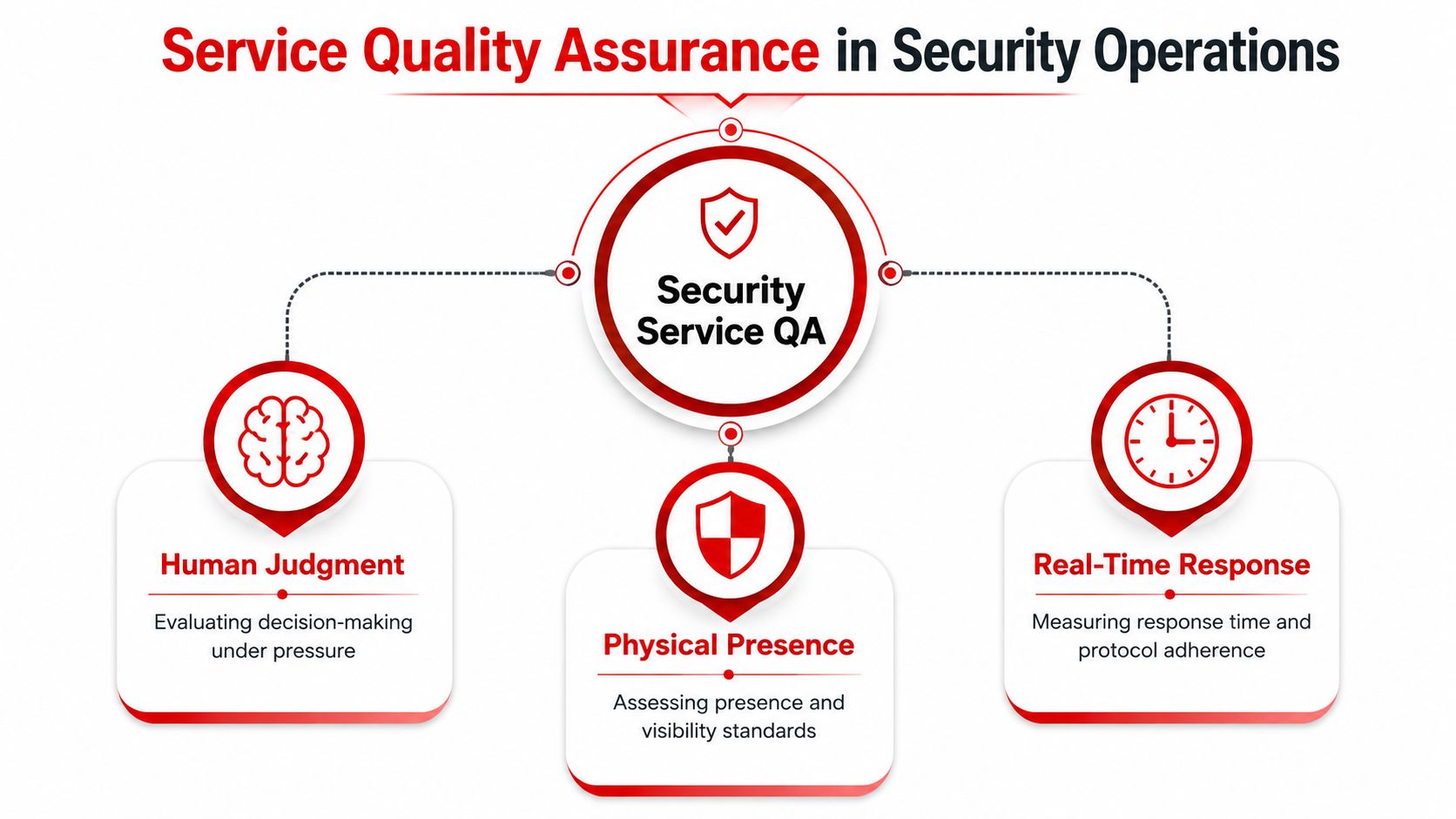
In security, service quality assurance means documenting, checking, and improving the work that officers do in the field so it matches the site's actual requirements. The “product” isn't a file, it's a person making decisions under pressure, maintaining presence, and following post orders when no one is standing over them. That's why QA in this space has to cover judgment, consistency, and response, not just appearance.
Concrete quality assurance is defined by the American Concrete Institute as the actions an organization takes to provide and document assurance that what is being done and what is being provided comply with the contract documents and standards of good practice for the work. That definition fits security better than many generic QA slogans because it treats QA as a documented compliance process, not a casual inspection step. The same logic applies when a guard is assigned access control, patrol routes, visitor handling, incident escalation, or customer service at a front desk.
What security QA should cover
A usable security QA program checks whether officers are doing the following well:
- Following post orders consistently. Site-specific instructions matter because a Class A office tower, a retail center, and a construction site don't fail in the same way.
- Making sound field decisions. An officer may need to de-escalate, verify identity, call for support, or document an incident, sometimes in rapid succession.
- Maintaining visible presence. Presence is part of the service, not background decoration.
- Closing the loop on incidents. A report that never leads to follow-up is only half a control.
This is also where service QA differs from pure manufacturing logic. You can't inspect every possible outcome in advance because people, weather, tenants, vendors, and after-hours activity all change the conditions. That's why the best programs combine standards with field observation, then train officers against the actual situations they face.
For a practical performance lens, it helps to review metrics that are already tied to site execution, such as the ones outlined in security performance indicators. Used correctly, those indicators keep QA grounded in what clients can verify instead of what software can merely record.
Frameworks and Metrics That Actually Drive Accountability
Good security QA starts with a clear agreement about what the site expects and what the team will measure. The most useful tools are SLAs, KPIs, and post orders that are written for the property, not copied from a generic template. If those three things don't line up, the program usually measures activity instead of performance.
A single number can be misleading. A patrol completion target, for example, may look strong even if officers rush through the route, skip conversation with site staff, or miss recurring trouble spots. That's why the strongest QA programs use cross-metric correlation, because one metric alone can hide the underlying problem.
Customer-service guidance recommends combining QA scores with CSAT, resolution time, escalation data, FCR, AHT, and compliance rate, and the same logic works in security operations. Low first-contact resolution in a service environment often points to a knowledge gap or broken process, while AHT can be deceptive because speed doesn't guarantee quality. In security terms, a fast response that isn't documented properly, escalated correctly, or verified at the scene isn't a win.
Security QA Metrics by Property Type
| Property Type | Primary KPIs | SLA Target Example |
|---|---|---|
| Residential communities | Patrol completion, incident documentation quality, resident complaint follow-up | Timely patrol coverage with documented response to resident concerns |
| Commercial properties | Access control accuracy, visitor handling, issue escalation | Consistent lobby or gate procedures with manager notification when required |
| Construction sites | After-hours perimeter checks, trespass detection, incident escalation | Regular perimeter verification and immediate reporting of unauthorized access |
For teams that need a strong data hygiene mindset, a 2026 ID verification guide can be a useful parallel reference, because clean operational records only matter when the underlying process is disciplined. In security, the same principle applies to log quality, incident narratives, and handoffs between officers and supervisors.
What not to over-measure
Don't turn QA into a race to hit one target. If patrol timing is the only thing supervisors review, officers will optimize for the timestamp instead of the outcome. If report count becomes the goal, the team may document more and observe less.
Good QA asks: did the officer do the right thing, at the right time, for the right reason?
That's why SLAs should describe service outcomes in plain language, then KPIs should check whether the team is delivering them. Property managers get better accountability when the numbers reflect site realities, not just easy-to-count activity.
Technology and Operational Controls That Close the Gap
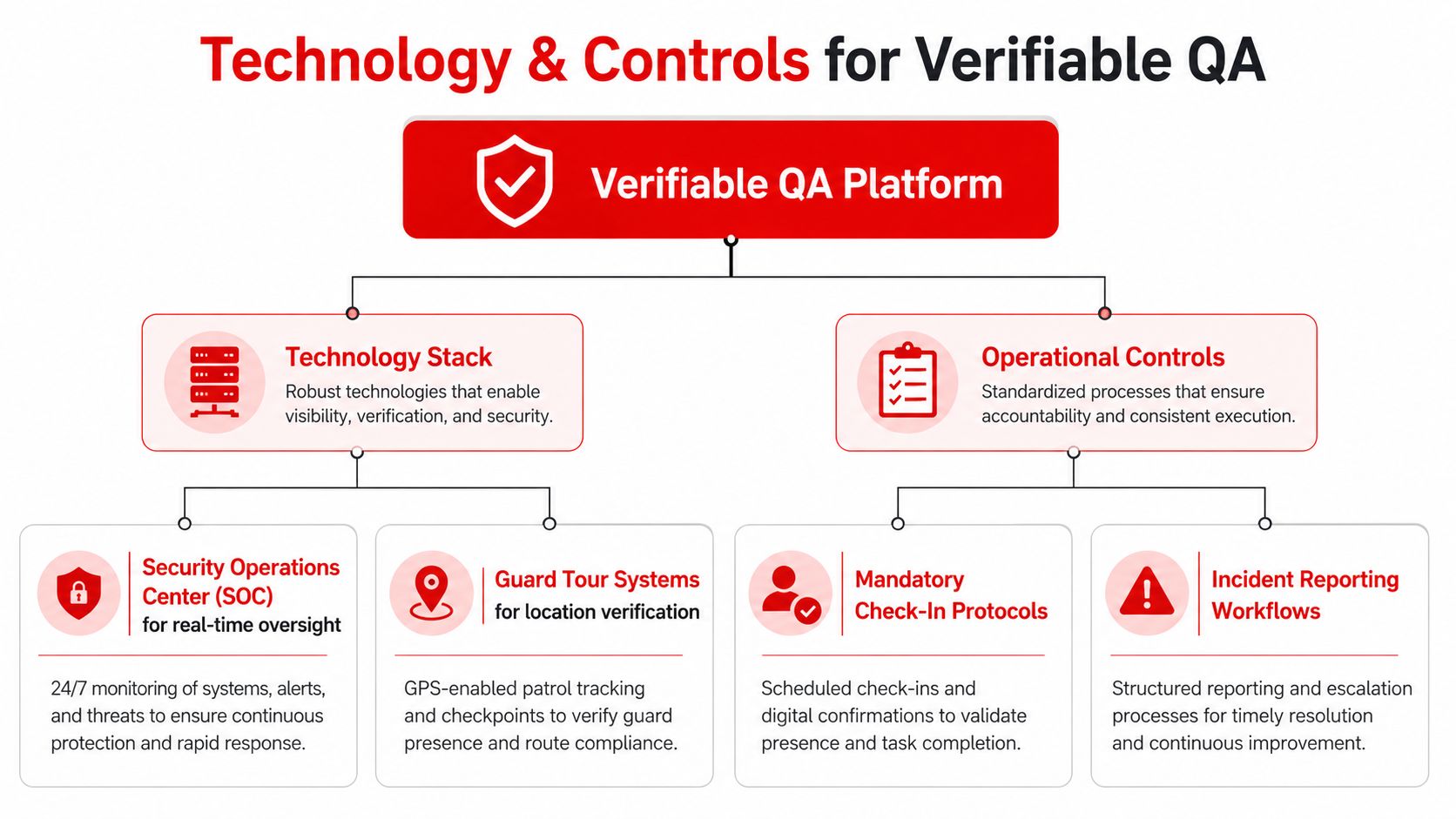
Technology helps most when it makes verification easier, not when it replaces judgment. A Security Operations Center, GPS-enabled guard tours, digital DARs, and photo uploads can all strengthen visibility, but they work best when paired with actual field checks. That balance matters because dashboards can make weak service look organized.
The benchmark from GOV.UK's service standard is useful here, even outside public-sector environments. QA testing should be overseen by the service team, performed regularly, and run as close to live conditions as possible, because that catches environment-specific failures before they affect users. The same standard also ties reliability to operational design, uptime, monitored changes, and a proportional response plan, which is a direct reminder that visibility and recovery have to be built into the system.
Technology and controls side by side
A strong security stack usually includes both of these layers:
- Technology stack. A SOC can review alarms, support officers, and escalate issues in real time. Guard tour systems verify checkpoints, while digital DARs make it easier to attach photos, timestamps, and incident notes.
- Operational controls. Mandatory check-in protocols, unannounced site visits, and physical patrol audits confirm whether the digital evidence matches what's happening on the ground.
Over-documentation becomes a real risk here. A site can produce clean GPS logs, polished reports, and even good-looking dashboards while still missing the patrol habits that matter most to tenants and clients. The fix is simple in principle, harder in practice. Supervisors need to validate what the system says against what they observe in person.
If you're evaluating tools, a security analytics platform should be judged on whether it helps supervisors detect gaps, not just on how much data it displays. That's especially important in California portfolios where officers may cover multiple buildings, because the technology has to support accountability across sites without turning the process into checkbox work.
The best control set is boring in the right way. It creates repeatable visibility, then confirms that the visible record matches real service.
Building Your Security QA Implementation Roadmap
A QA program gets stronger when it's built in phases instead of bolted on after a problem. Start with the site's actual risk profile, because an office lobby, a gated HOA, and a construction yard don't need the same review focus. Then write the post orders around those risks, train the officers against those expectations, and measure the first month as a baseline rather than a verdict.
The first 30 days
Use the opening phase to define what success looks like on the property. That means checking access points, reviewing prior incidents, confirming manager expectations, and identifying what clients will notice first if service slips. If the property has recurring complaints, treat those as QA inputs, not anecdotes.
From there, align post orders with day and night realities. An officer should know what to do when a resident challenges a visitor, a contractor arrives early, a dock door is propped open, or a delivery driver needs direction. Training only works when the instructions reflect the actual site.
The first quarter and beyond
By the end of the first quarter, supervisors should have enough data to see patterns in patrol consistency, incident writeups, and follow-up quality. That's the point where quarterly business reviews become useful, because the conversation can move from “Are the reports complete?” to “What keeps repeating, and why?”
Practical rule: review post orders whenever the site changes, not just on a calendar date.
Use the review cycle to adjust SLAs when tenant mix, construction activity, access rules, or operating hours change. QA shouldn't be a one-time setup, because portfolio needs rarely stay still.
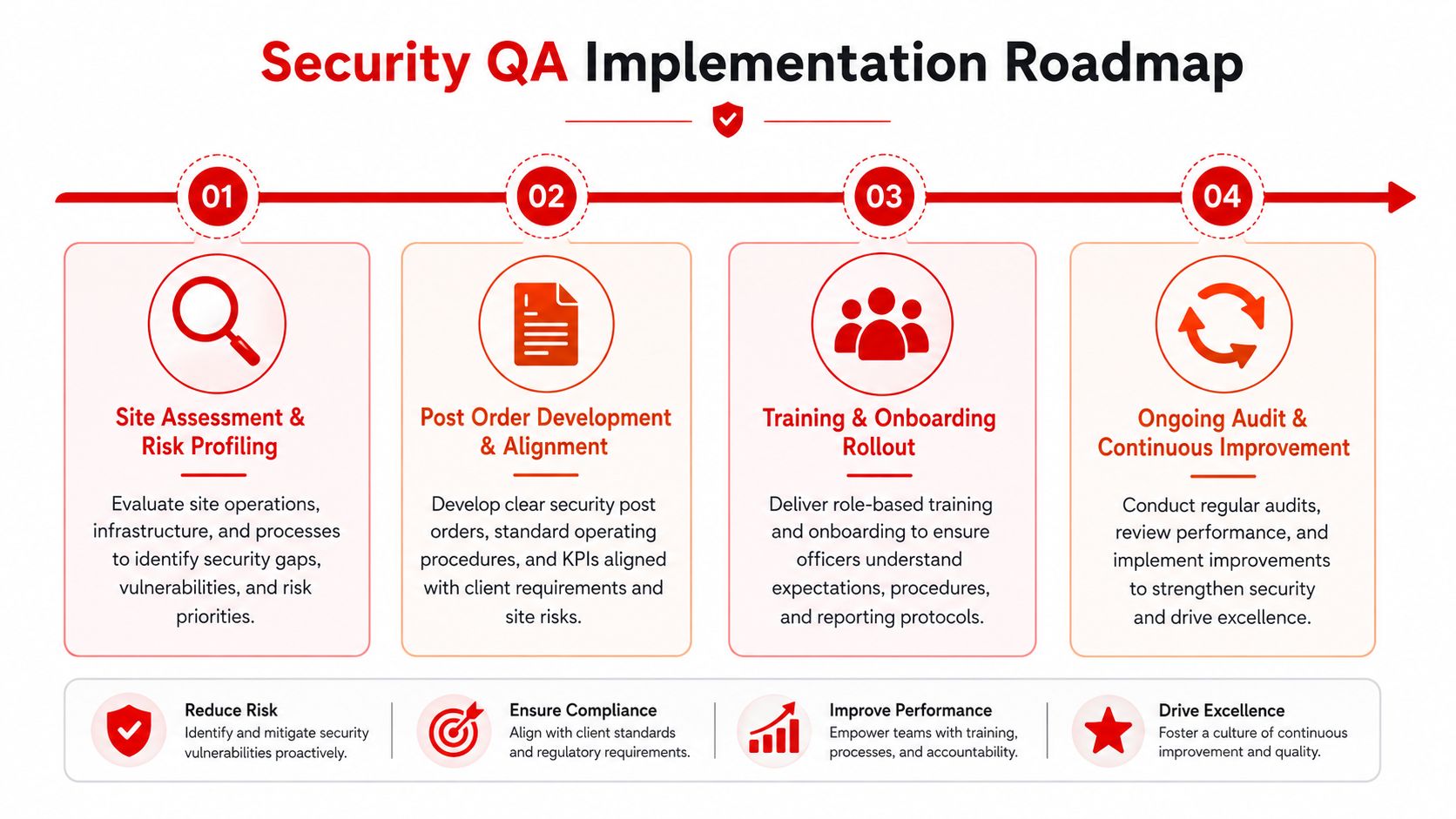
For property teams that want a more organized rollout, a security patrol checklist template can help standardize what supervisors inspect during audits without freezing the process in place. The point isn't to create more paperwork, it's to make sure the same issues get reviewed every time, so changes in performance are easy to spot.
A mature QA program keeps improving because it keeps learning from field conditions, incident data, and client feedback. That loop is what turns security from coverage into control.
Sample Checklists and Post Order Essentials
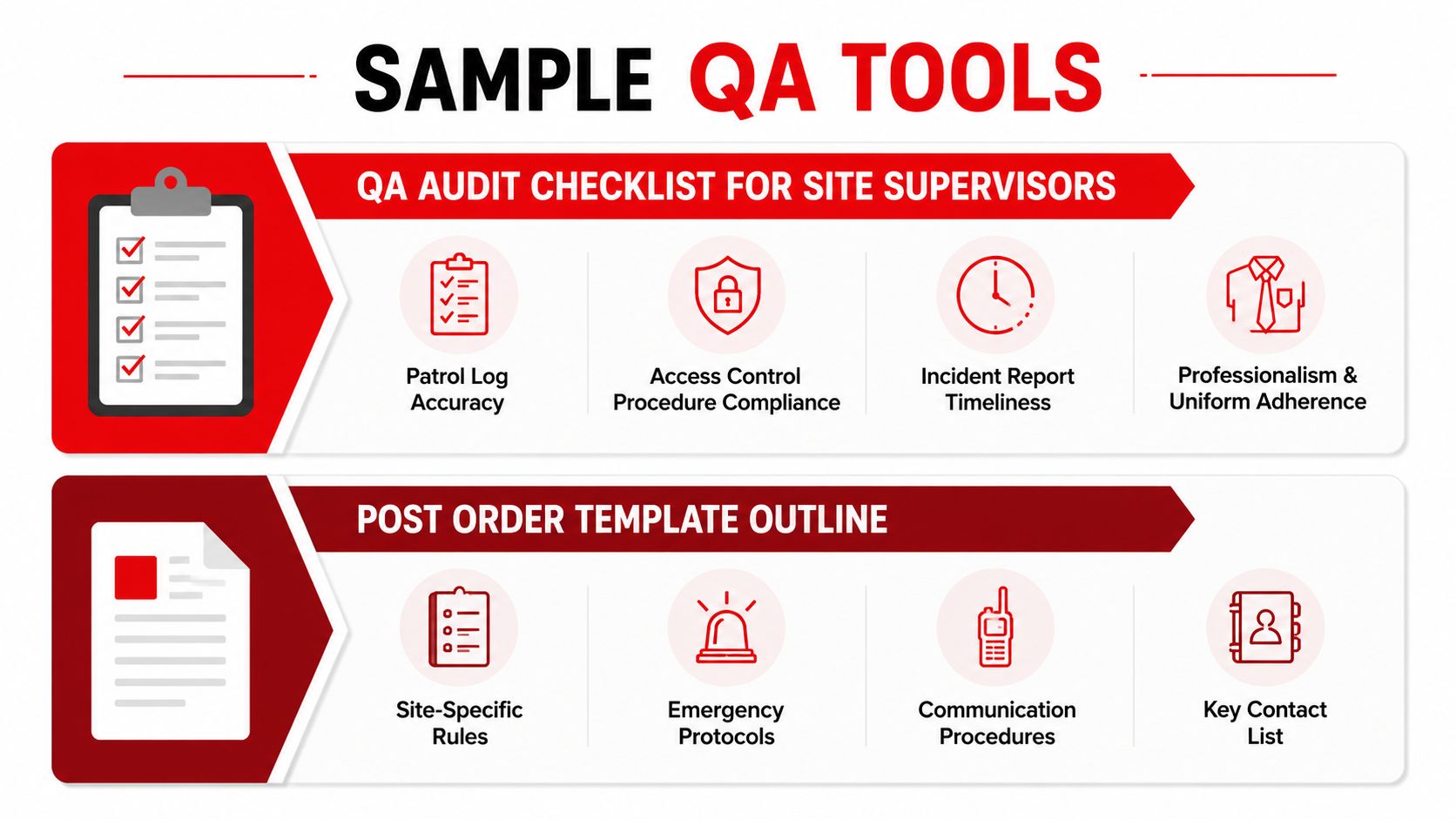
A site can look controlled on paper and still drift in the field. Checklists and post orders are where that gap shows up, because they reveal whether supervisors are checking real conditions or only confirming that forms were filled out. In service quality assurance, that distinction matters.
Good checklists do two jobs at once. They keep supervisors consistent, and they show officers what good looks like in a way that holds up under pressure. If a checklist only exists to satisfy management, officers treat it like extra paperwork. If it helps the team run the site better, it becomes part of the operation.
The most useful audit sheets are short, site-specific, and tied to real outcomes. A site supervisor should be able to confirm whether patrol logs match the route, access control is being followed, reports are filed on time, and officers are presenting professionally. That does not replace observation. It supports it, and it gives QA a way to catch the difference between digital proof of work and actual service quality.
What a usable post order needs
A post order should cover four essentials:
- Site-specific rules. List the doors, gates, restricted areas, and hours that matter for that property.
- Emergency protocols. Spell out what happens for medical issues, trespassing, alarms, fire watch conditions, or suspicious activity.
- Communication procedures. State who gets called, in what order, and by what method.
- Key contacts. Include the client-side contacts officers need, not just a generic directory.
In property types like residential, retail, office, and construction, the order should also reflect the behaviors clients care about most. That means resident service at a high-rise, loitering deterrence at a shopping center, contractor control at a jobsite, and access monitoring in a mixed-use building. The document needs to match the site, not a template copied from somewhere else.
A monthly scorecard works best when it ties KPIs to what the client wants, not to a generic average. If the site cares about fast incident escalation, the scorecard should show it. If the site values resident communication, that belongs on the page too. The point is to make the review reflect what the property manager needs to see, not what looks tidy in a dashboard.
A practical checklist template can help standardize what supervisors inspect during audits without freezing the process in place, and a security patrol checklist template gives property teams a starting point that can be adapted to the site. The value is in consistency. The same issues get reviewed every time, so changes in performance are easier to spot.
A mature QA program keeps improving because it keeps learning from field conditions, incident data, and client feedback. The checklist is one of the clearest places to see that discipline in action.
Why Quality-Focused Security Partnerships Win Long Term
Low-bid coverage looks appealing until service starts to drift. If a provider is built on churn, overloaded managers, and thin supervision, QA usually gets reduced to spot checks and damage control. Property teams get better long-term results from partners who invest in officer retention, hands-on leadership, and transparent reporting.
High-quality security is hard to sustain without stable people. Officers learn site nuance over time, and supervisors who know the portfolio can catch small failures before they turn into recurring issues. A low manager-to-client ratio matters for the same reason. It gives the account team time to visit sites, calibrate expectations, and spot patterns that pure paperwork misses.
In security operations, QA maturity is a core part of the service. A provider that can document, verify, and improve field performance is better positioned to support residential communities, retail centers, construction sites, office buildings, and multi-site portfolios without pretending every property needs the same playbook. If you are comparing partners, ask how they handle audits, how often they validate what the dashboard says, and what they do when reports and reality do not match.
That accountability model applies well beyond physical security. For teams that need the same control mindset in other risk areas, compliance-led cyber protection offers a useful parallel. Oversight has to be built into the service itself, because clean reports mean little if nobody is checking whether the work on site holds up. Security should operate the same way on the ground.
If your current program depends more on polished reports than verified performance, the gaps are probably already there. Overton Security builds accountability around customized post orders, real-time reporting, active supervision, and field verification that matches what is happening on site. Visit Overton Security to review your current security QA approach and start a conversation about what real accountability looks like for your property.