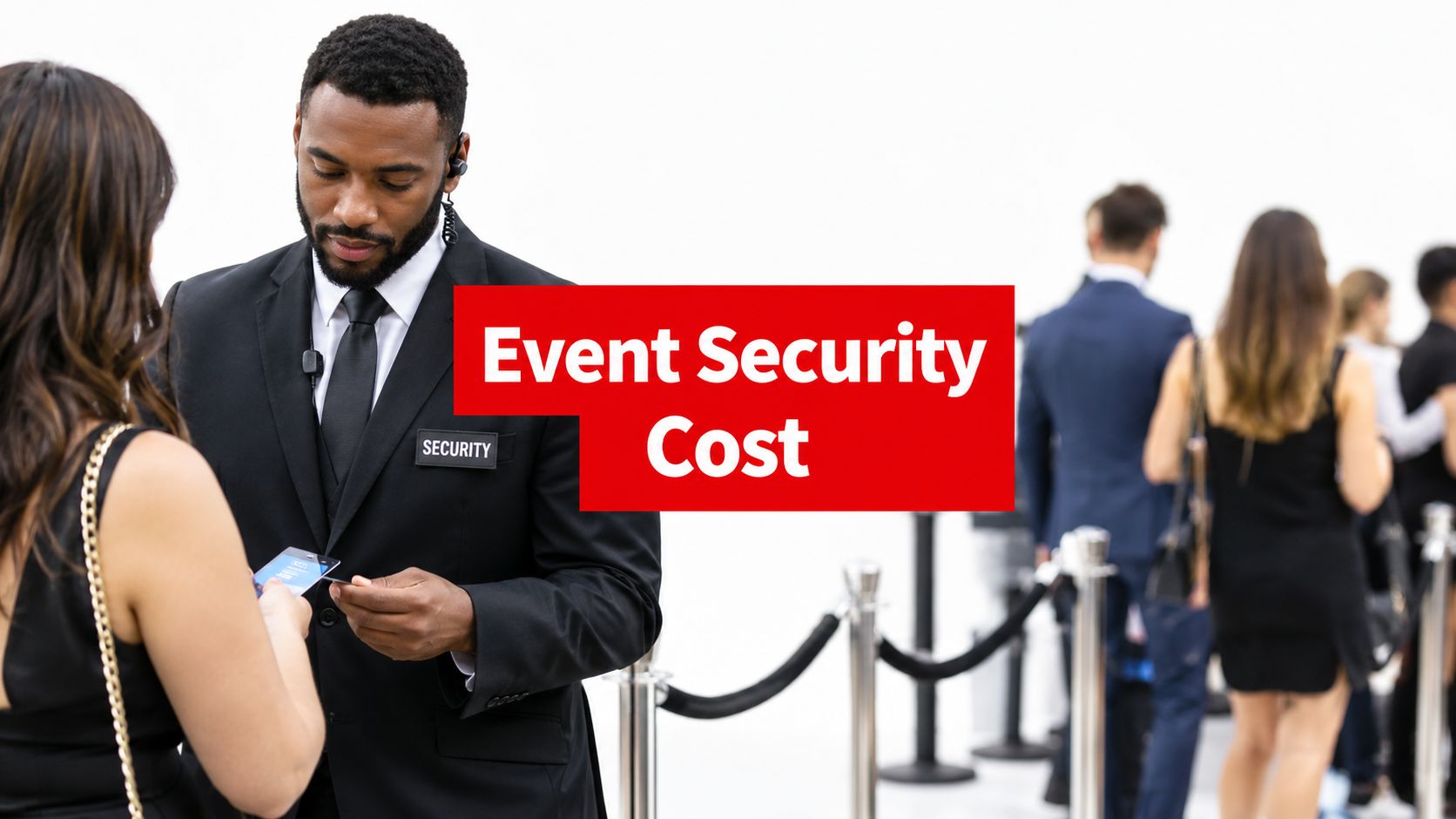
In California in 2026, most event security costs roughly $30 to $90 per guard per hour, depending on whether coverage is unarmed or armed and how much risk the assignment carries. A four-hour minimum per guard is common, so even a short event starts with a meaningful base cost.
A planner in Santa Monica can learn that the hard way while staring at three quotes for the same 200-guest reception. One vendor lists a low hourly rate, another includes a supervisor and radios, and the third prices the assignment as a flat package. The numbers look inconsistent until you examine the staffing plan, minimum hours, and add-ons behind each proposal.
The practical question isn't, “What does one guard cost?” It's how many officers you need, for how long, in what roles, under what conditions, and with what support. That staffing math determines the event security cost.
What Event Security Actually Costs in 2026
A California planner can receive a low hourly quote and still face a much larger invoice. The difference usually comes from paid hours, post coverage, supervision, and operating conditions, not from the headline rate alone.
For 2026 planning, unarmed event coverage commonly falls around $40 to $60 per guard per hour, with lower-risk private events sometimes quoted near $28 to $42. Alcohol service, nightlife, and larger crowds can push unarmed pricing toward $32 to $50 or more per hour. Armed coverage commonly reaches $55 to $90 per hour, while broader event assignments may fall within $30 to $65 per guard per hour. Review the California event-security pricing guide and California-specific event security cost guidance when testing a vendor's range against your plan.
The minimum shift often changes the math fastest. Many providers apply a four-hour minimum per guard, and some pricing guidance describes a four- to five-hour minimum as common. Two hours of visible coverage can therefore produce four paid hours for every assigned officer, before travel, equipment, or supervision is added. That charge covers recruiting, briefing, dispatching, uniforming, and accounting for the officer, even when guest-facing coverage is brief.
Use these broad planning bands:
- Small private parties: Often about $500 to $1,500 total, depending on officer count and venue.
- Mid-sized corporate events: Commonly about $2,000 to $6,000, particularly with entry control, VIP movement, alcohol, and supervision.
- Large festivals: Frequently $15,000 and up, because public access, crowd density, multiple posts, and long operating windows require larger teams.
Treat those figures as planning ranges, not bids. A 300-guest gala with one controlled entrance has a different staffing plan from an outdoor festival with several access points. Industry guidance places typical staffing around one guard per 50 to 100 attendees. Small private events may use one or two guards, while major festivals can require 200 to 500 or more staff. The event security services pricing overview shows how post count and operating scope expand the budget.
Practical rule: Multiply guard count by paid hours, then add supervision and operating requirements. Do not build the budget from the hourly rate alone.
The Five Biggest Drivers Behind Every Quote
Five variables explain most differences between California event security quotes. If a vendor can't show how each one affects the proposal, the quote isn't transparent enough to approve.
Guard type
An unarmed security officer is usually the baseline for guest-list verification, access control, patrol, and incident reporting. Armed officers cost more because the assignment carries additional licensing, training, insurance, and liability considerations. A supervisor or lead officer adds another layer because that person coordinates posts, handles escalation, and keeps the team aligned instead of standing as a routine fixed post. National guidance places unarmed officers around $25 to $40 per hour, with high-cost metros commonly reaching $30 to $60, while armed coverage often runs $40 to $75 or more nationally. These ranges are outlined in this event security pricing guide.
Hours and shift rules
Every paid hour applies to every assigned officer. A four-hour minimum can make a short reception more expensive than a planner expects, and a long shift can create overtime or relief requirements. California labor conditions, late-night scheduling, and the need to keep officers alert all affect the provider's staffing model. Ask whether load-in, guest arrival, event close, and load-out are included in the quoted window.
Staffing ratio
Guest count provides the starting point, but it doesn't determine the final headcount by itself. A contained indoor event with one entrance may need less coverage than an outdoor event with parking, multiple gates, alcohol, and unrestricted public access. Industry guidance commonly places low-risk staffing near one guard per 75 to 100 attendees, with ratios tightening toward one per 50 or fewer when alcohol, cash handling, or crowd density increases. The event-security staffing mechanics guide describes how risk changes that ratio.
Location
Los Angeles, San Francisco, San Diego, San Jose, Oakland, and other major California markets carry different labor, travel, insurance, and operating conditions. Venue access, parking, permit requirements, and the distance from an agency's operating base can all affect the quote. A venue in a dense downtown area may create more logistical work than a similar event at a controlled private property.
Special risks
Alcohol service, VIP attendance, cash handling, recognizable talent, late-night operations, and crowd compression require more than adding bodies. They may call for officers with different experience, armed coverage in specific zones, a supervisor, or a dedicated entry and barricade plan. The assignment becomes a coordinated operating system, not a row of guards.
| Driver | Typical effect on quote | Example lever |
|---|---|---|
| Guard type | Changes the hourly base | Unarmed coverage versus armed or supervisor-level coverage |
| Paid hours | Multiplies every staffed post | Event window, load-in, load-out, and minimum shift |
| Staffing ratio | Determines headcount | Guest count adjusted for entrances, alcohol, and density |
| Location | Adds labor and logistics pressure | Metro market, travel distance, permits, and venue access |
| Special risk | Raises skill and oversight requirements | VIPs, cash, alcohol, talent, or late-night operations |
For a deeper look at how providers convert labor and operating expenses into a client bill rate, review how security guard services get to a bill rate. That calculation is why a client rate can't be compared directly with an officer's wage.
How Pricing Models Shape the Final Number
The same staffing plan can look very different depending on how the provider presents the price. Choose the model that matches how settled your event scope really is.
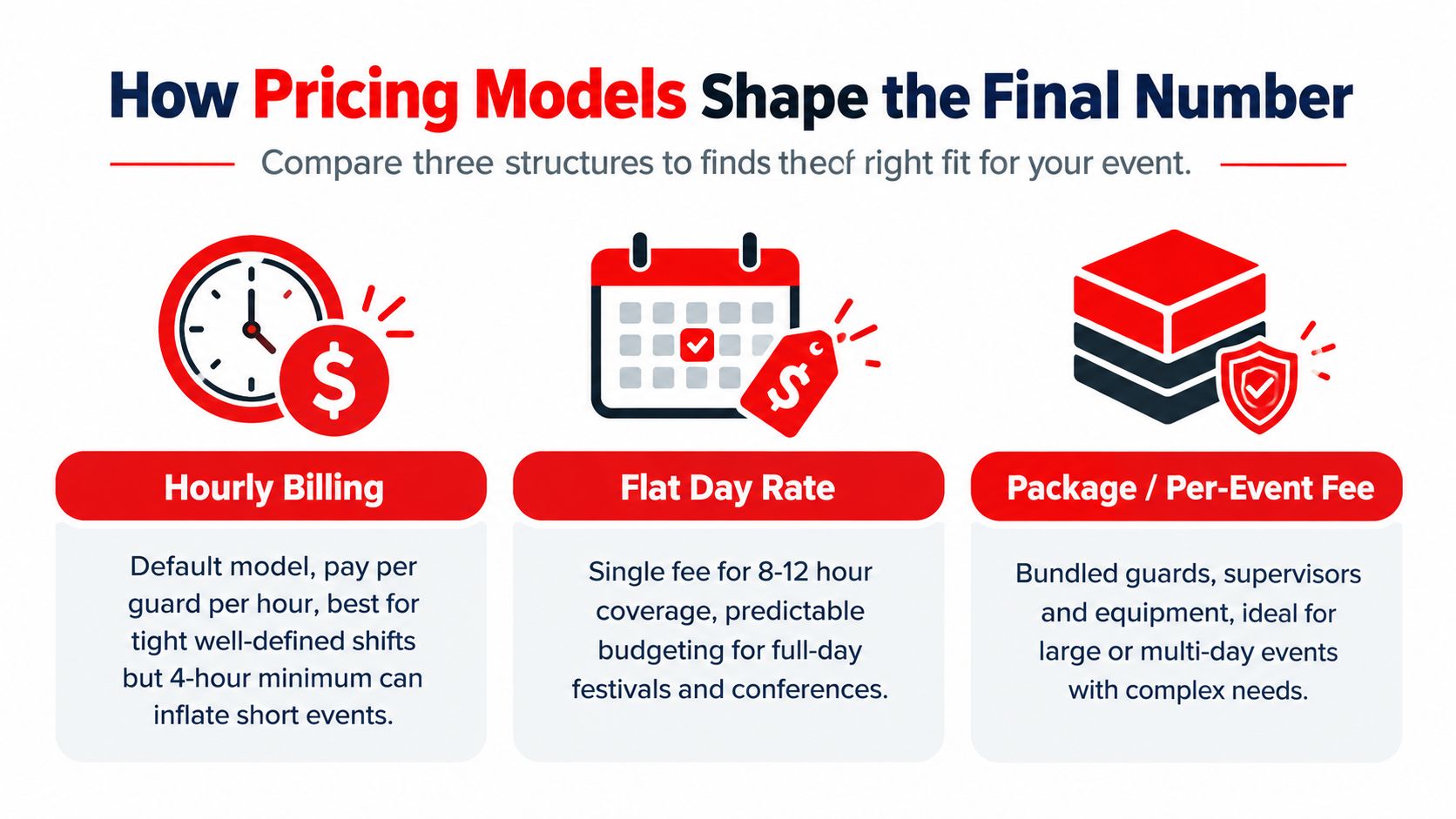
Hourly billing is the default for temporary coverage. You pay by officer and hour, which works well when posts and shift windows are tightly defined. It can favor the planner when the event may end early, but the minimum-hours clause can work against you when the visible program is short. Confirm whether the provider bills the same rate for setup and teardown.
Flat-fee pricing bundles the agreed guard count, coverage window, and supervision into one number. It favors a planner who has locked the venue layout, schedule, and post plan early because the budget becomes easier to forecast. It favors the provider when the scope is vague, so don't accept a flat fee without a written staffing schedule and defined responsibilities.
Bundled or per-event packages combine guards with services such as entry screening, vehicle patrol, radios, or a command vehicle. This structure can be useful for festivals, multi-day programs, or venues with several operational needs. It trades some flexibility for a cleaner invoice and may prevent several separate minimum charges.
| Model | Best fit | Planner's main question |
|---|---|---|
| Hourly | Tight, defined shifts | What happens if the event ends early? |
| Flat fee | Predictable, locked scope | Exactly how many officers and hours are included? |
| Bundled package | Several services or complex events | Which equipment, supervision, and posts are included? |
Ask for the staffing assumptions behind every model. A lower-looking package may omit supervision, equipment, or the coverage needed during load-in and guest departure.
Building Your Own Event Security Budget
Start with the venue, not the vendor's price sheet. Write down the guest count, entrances, parking areas, alcohol zones, VIP routes, stage or presentation areas, and the time officers must arrive and leave.
Step one, establish a baseline
For a low-risk indoor event, begin with roughly one unarmed guard per 75 to 100 attendees, then check whether the venue layout changes that starting point. A 200-guest event may begin with two officers, but separate entrances, a parking structure, a cash point, or an alcohol-heavy program can justify additional coverage.
Step two, adjust for risk
Add coverage where officers must perform distinct functions. One officer can't simultaneously screen the main entrance, monitor a remote parking area, watch a backstage corridor, and respond to an incident elsewhere. Alcohol, outdoor space, VIP movement, crowd density, and public access should appear in the written plan, not remain informal assumptions.
Step three, multiply headcount by paid hours
Use the full minimum shift, not only the time guests are present. A simple example is 200 guests at a one-per-100 ratio, requiring two guards, for four hours at $45 per hour, producing $360 in base guard labor. The $45 hourly figure and the resulting $360 example are planning arithmetic, not a universal market quote. A supervisor add-on, radios, vehicle coverage, travel, or other requirements would raise the final amount.
Use this line-item template before comparing bids:
- Guards: Number of unarmed and armed officers, hourly rates, and paid hours.
- Supervisor: Whether a lead or field supervisor is included.
- Equipment: Radios, screening equipment, lighting, or other rented tools.
- Vehicle: Patrol or command vehicle requirements, if applicable.
- Schedule: Arrival, guest coverage, close, and load-out times.
- Contingency: A clearly identified reserve for scope changes, not an unexplained padding line.
For event-specific staffing support, review security guards for events and give the provider the venue map and schedule rather than requesting a generic hourly number.
Real Budgets for Three Common Event Types
A California planner can quote security for 75 guests and still spend far more on a larger event with a simpler headcount calculation. The difference comes from paid hours, post coverage, supervision, access points, and the number of operational zones officers must cover.
A private birthday at a rented venue may use two unarmed guards for the four-hour minimum, putting labor near $400 in this planning example. Their posts can cover entry, guest assistance, and a visible venue presence. With one controlled entrance and no unusual risk, the minimum shift drives the spend more than additional deployment.
A 300-guest corporate gala with valet service and VIP attendance requires a different staffing design. Mixed unarmed and armed coverage, a supervisor, guest-flow monitoring, and discreet arrival and departure protection can place the budget around $2,800 to $3,800. Guest count sets only the starting point. Specialized posts and oversight create much of the increase.
A 2,000-attendee outdoor music festival can use a working ratio of one guard per 75 attendees, creating a baseline of about 27 guards before the site plan adds dedicated entry, barricade, backstage, parking, or command posts. With a 10-hour day, mixed armed and unarmed coverage, and a command vehicle, this scenario reaches $18,000 to $28,000. Long paid hours, multiple zones, equipment, and coordination drive the total.
These are planning scenarios, not universal rates. A permit, venue contract, alcohol program, or public-access plan can change the staffing design before a provider sends a final quote.
| Event type | Guests | Guards / hours | Total range |
|---|---|---|---|
| Private birthday | 75 | Two unarmed guards, four-hour minimum | Near $400 |
| Corporate gala | 300 | Mixed armed and unarmed coverage, supervisor, event window | $2,800 to $3,800 |
| Outdoor music festival | 2,000 | About 27 baseline guards, 10-hour day, mixed coverage and command vehicle | $18,000 to $28,000 |
A California pricing guide gives a separate reference point: a 300-guest corporate gala with a bar using six officers for eight hours at about $2,500, while a 1,000-attendee festival may need 10 to 13 officers plus dedicated entry and barricade posts. The examples in the event security services cost guide support the practical conclusion. Venue layout and risk profile can outweigh a simple attendance-based calculation. Build the budget from posts, hours, equipment, and supervision, then compare the total rather than the headline hourly rate.
Hidden Multipliers That Push Quotes Higher
A low hourly rate can still produce a high invoice. The difference comes from staffing math: supervision, timing, equipment, travel, and venue requirements turn a basic post into a larger deployment.
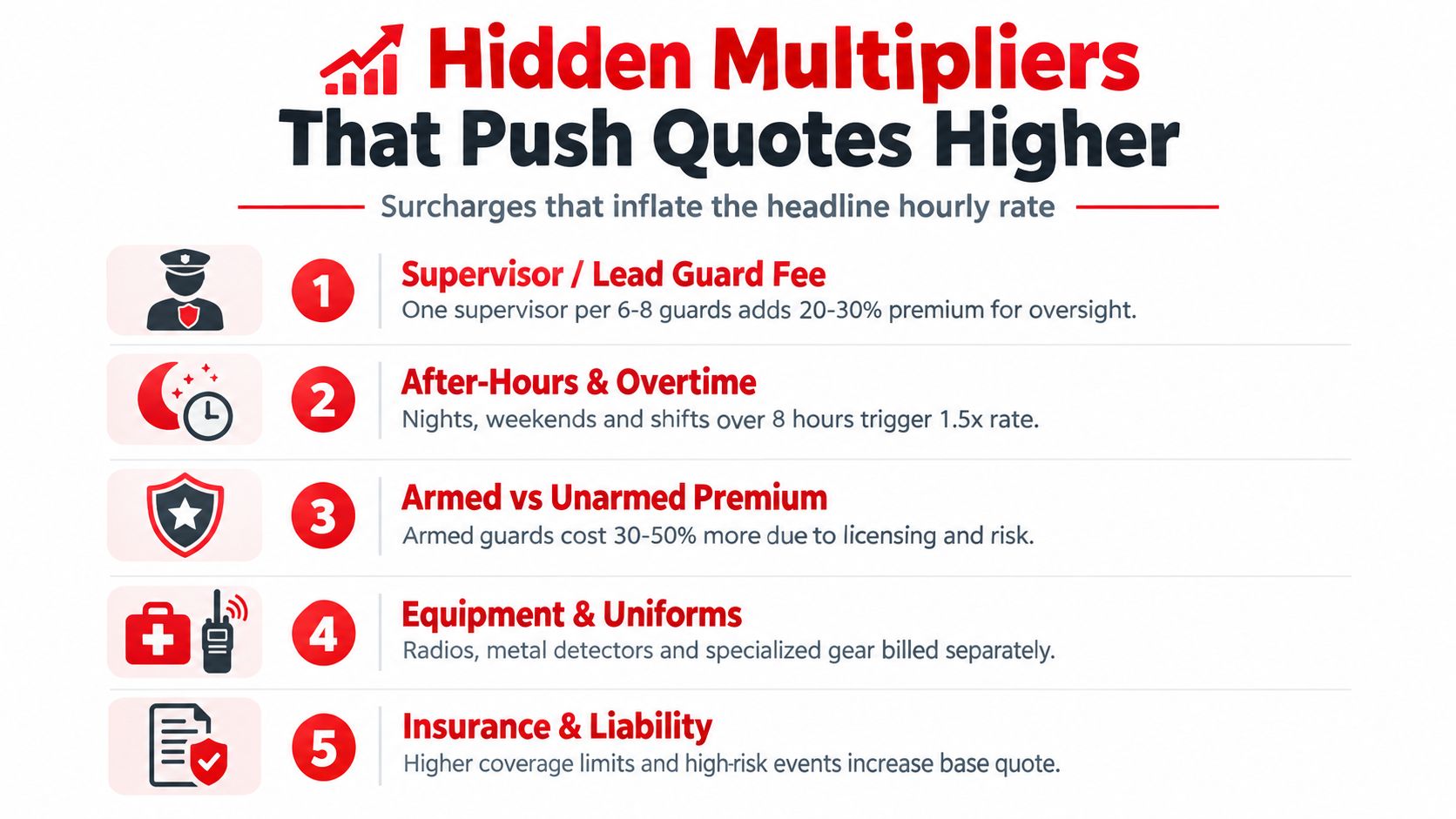
Supervision: A larger team needs a lead to check posts, manage breaks, coordinate with event operations, and handle escalation. Providers may bill that role separately or include it in a package. Ask where the supervisor appears in the quote, how many hours are billed, and what authority the role carries.
Timing: Holiday and late-night assignments can carry an uplift of 15 to 25 percent. Last-minute bookings can add a 20 to 30 percent buffer because qualified staffing is harder to schedule and dispatch pressure rises. Treat those adjustments as quote drivers, not unexplained padding, and ask the provider to identify each one.
Presentation and equipment: A black-tie venue may require upgraded uniforms. Entry screening may require metal detectors, tables, lighting, or additional officers. Radios might be rented or included, so the proposal should state which. Vehicle patrols and command vehicles add separate operating costs.
Travel and venue logistics: A venue outside the provider's normal service area can create travel-time, fuel, or vehicle charges. Union venues may also require parking, credentials, or controlled access procedures that extend the staffing window. Review these requirements before comparing bids.
Scope changes: Adding an entrance, extending load-out, changing the schedule, or introducing a VIP route can trigger a change order. Set the approval process in writing before event day. Otherwise, the operations team may be negotiating while guests, vendors, and staff are already on site.
Read the invoice as an operating plan. Every extra line should answer one question: what work, equipment, risk, or responsibility does this charge cover?
Planners often compare security with other event infrastructure and overlook ownership costs. For a useful comparison of network equipment and guest access, examine the true cost of Cisco Meraki guest Wi-Fi rather than its advertised entry price. Apply the same discipline to security. Compare posts, paid hours, supervision, equipment, travel, and change-order terms.
Use this event risk checklist to identify alcohol service, access control, crowd movement, and other conditions early. Early disclosure gives the provider enough time to price the actual deployment instead of adding emergency coverage on event day.
Smart Ways to Keep Event Security Cost Under Control
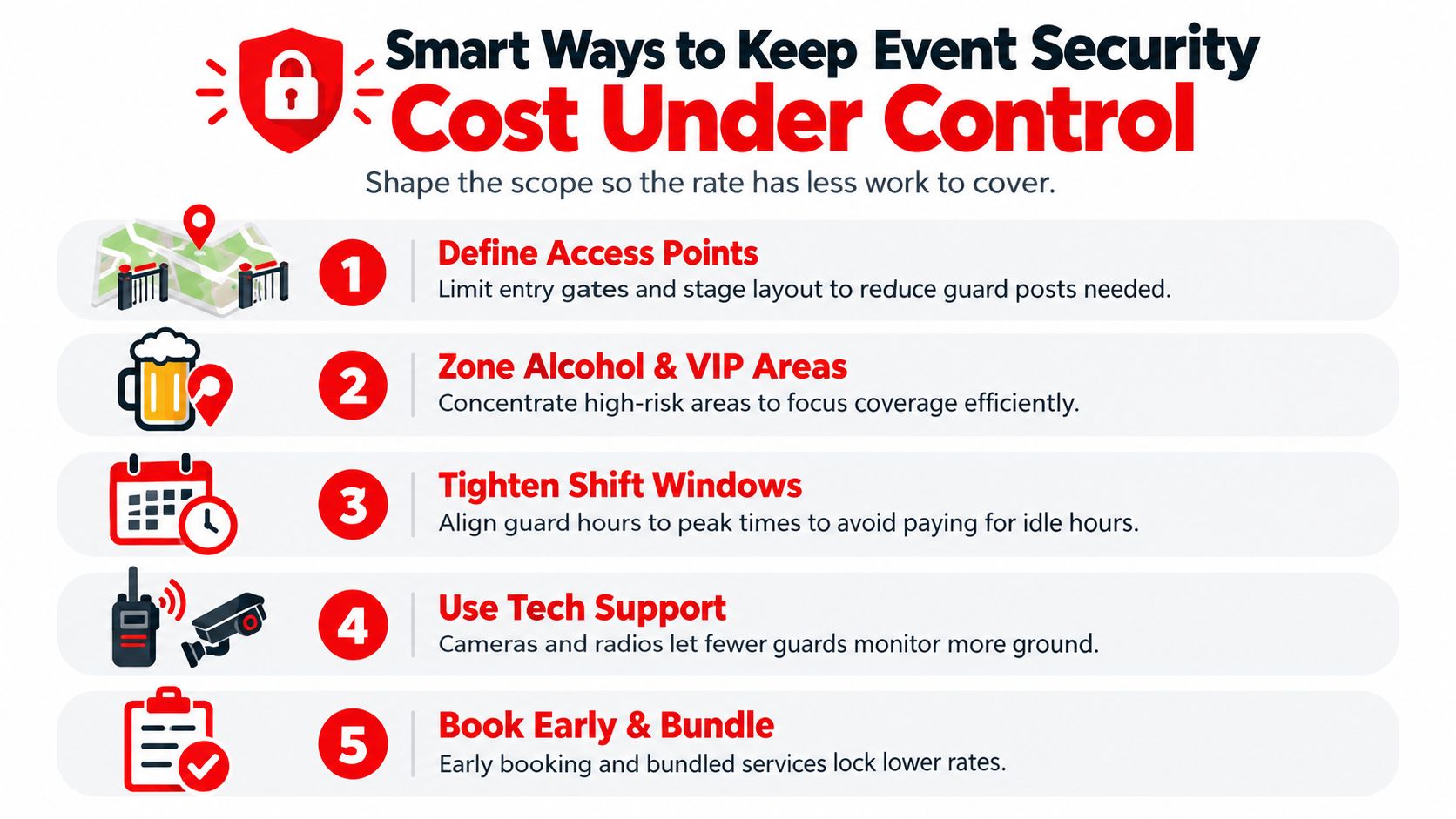
A low hourly rate will not save money if the plan requires too many posts, long idle periods, or last-minute changes. Control the total by designing the deployment around actual risks, clear movement paths, and a staffing window that matches the event.
Map the assignment before requesting bids. Mark access points, stage routes, alcohol zones, VIP paths, parking areas, and load-out locations. A usable site plan lets the provider combine duties where it is safe to do so and prevents vague scope from turning into padded coverage.
Set coverage around activity, not convenience. Schedule officer arrival for load-in, guest arrival, peak activity, and departure. Weeknights and Sunday evenings may avoid weekend premiums, but cutting coverage during the highest-risk period creates the wrong savings. Build the schedule around when guests, vendors, cash, alcohol, and vehicles move.
Group risk without weakening posts. Place alcohol service, cash handling, and VIP movement in defined zones. A supervisor with a practical patrol radius can cover changing conditions more efficiently than permanent posts everywhere, especially at a large venue. Keep entrances and crowd areas staffed when their function requires continuous control.
Book early and combine compatible work. Confirm the scope early so the provider can build a qualified roster and arrange radios, screening equipment, vehicles, or other requirements. Combining setup, event coverage, and teardown into one continuous shift may avoid separate minimums. A package can also reduce duplicate charges when guards, radios, entry screening, and vehicle patrol would otherwise be priced separately.
Decide presentation and reporting requirements before approval. Specify formal uniforms or plainclothes assignments, GPS patrol verification, digital reports, and radio needs in the bid request. Technology improves accountability and coordination. It does not replace officers needed for physical access control or crowd management.
Request a revised deployment when the venue map or schedule changes. Do not accept a lower quote that removes supervision, leaves a required post uncovered, or assumes duties no officer can perform safely. The strongest savings come from eliminating wasted coverage while preserving the positions that protect guests, staff, property, and operations. A provider that understands the venue can make that adjustment without turning the event into a staffing gamble.
Choosing the Right Security Partner and Next Steps
A sound proposal shows its work. Ask each vendor for the unarmed and armed hourly rates, the number of officers, the supervisor line item, the minimum-hours clause, and every fee for radios, uniforms, vehicles, travel, holidays, and special equipment.
Compare at least three California-licensed providers using the same event brief. Then verify:
- BSIS registration: Confirm that assigned guards hold current California registrations.
- Insurance: Request general liability limits and identify any venue-specific certificate requirements.
- Relevant references: Look for comparable private events, corporate functions, festivals, or public gatherings.
- Roster accountability: Ask when the final roster is confirmed and how substitutions are handled.
- Operational reporting: Confirm whether supervisors provide incident reports, activity records, GPS verification, and escalation support.
A quote that sits 20 percent below the field deserves questions, not automatic approval. It may reflect thinner coverage, subcontracted officers, omitted supervision, or change orders that appear once the event is underway. Low price only helps when the scope is equivalent.
Once you select a provider, document the post plan, schedule, responsibilities, escalation contacts, uniforms, equipment, and cancellation terms. Confirm the roster a week before the event and request a 48-hour pre-event walkthrough so the team can resolve access, parking, radio, and staging issues before guests arrive.
Overton Security Services has more than 26 years of California operating experience and provides event and temporary security alongside onsite officers, vehicle patrols, GPS-enabled guard tour management, digital daily activity reports, and 24/7 SOC oversight. Its operating model emphasizes hands-on leadership, a low manager-to-client ratio, and officer support and retention, which are practical factors when you need consistent staffing and clear accountability.
Your next step should be a custom quote built from the guest count, venue map, risk profile, schedule, and required posts. That is the only reliable way to turn a broad event security cost range into a defensible event budget.
For a transparent event security plan, visit Overton Security with your venue details, guest count, schedule, and coverage needs. The team can help scope unarmed or armed officers, supervision, patrol support, reporting, and technology so you receive a quote based on the work your event requires.