
When you receive a proposal from a security guard company, the hourly bill rate might seem straightforward. However, that single number is the result of careful calculation, covering far more than just the security officer's paycheck.
Think of it like an iceberg. The officer’s wage is the visible tip, but beneath the surface lies a much larger structure of essential costs—from insurance and training to the very margin a quality provider needs to operate sustainably and deliver a reliable service.
The Anatomy of a Security Guard Bill Rate
Understanding what goes into that final number is key for anyone responsible for hiring security, whether you're a property manager, an HOA board member, or a business owner. It helps you look past the sticker price to evaluate the real value and dependability of a potential security partner.
A surprisingly low rate isn’t a great deal; it’s a warning sign. It often means corners are being cut somewhere important, such as officer pay (leading to high turnover), supervision, or critical insurance coverage.
The final bill rate is a blend of several key components:
- Direct Labor Costs: This includes the guard's base hourly wage plus the industry term known as the "labor burden." This isn't optional—it covers mandatory costs like payroll taxes, workers' compensation, and unemployment insurance.
- Operational Overhead: These are the non-negotiable costs of running a professional operation. This includes general liability insurance, comprehensive training programs, uniforms, and state-mandated licensing fees.
- Technology and Support: A modern security operation relies on more than just a person in a uniform. It requires support systems like GPS tracking for accountability, digital reporting software for clear communication, and access to a 24/7 dispatch center.
- Profit Margin: A healthy, sustainable margin isn't about greed. It’s what allows a company to reinvest in better training, offer competitive pay to retain professional officers, and maintain the high service standards you expect.
This infographic provides a visual breakdown of how these costs typically stack up.
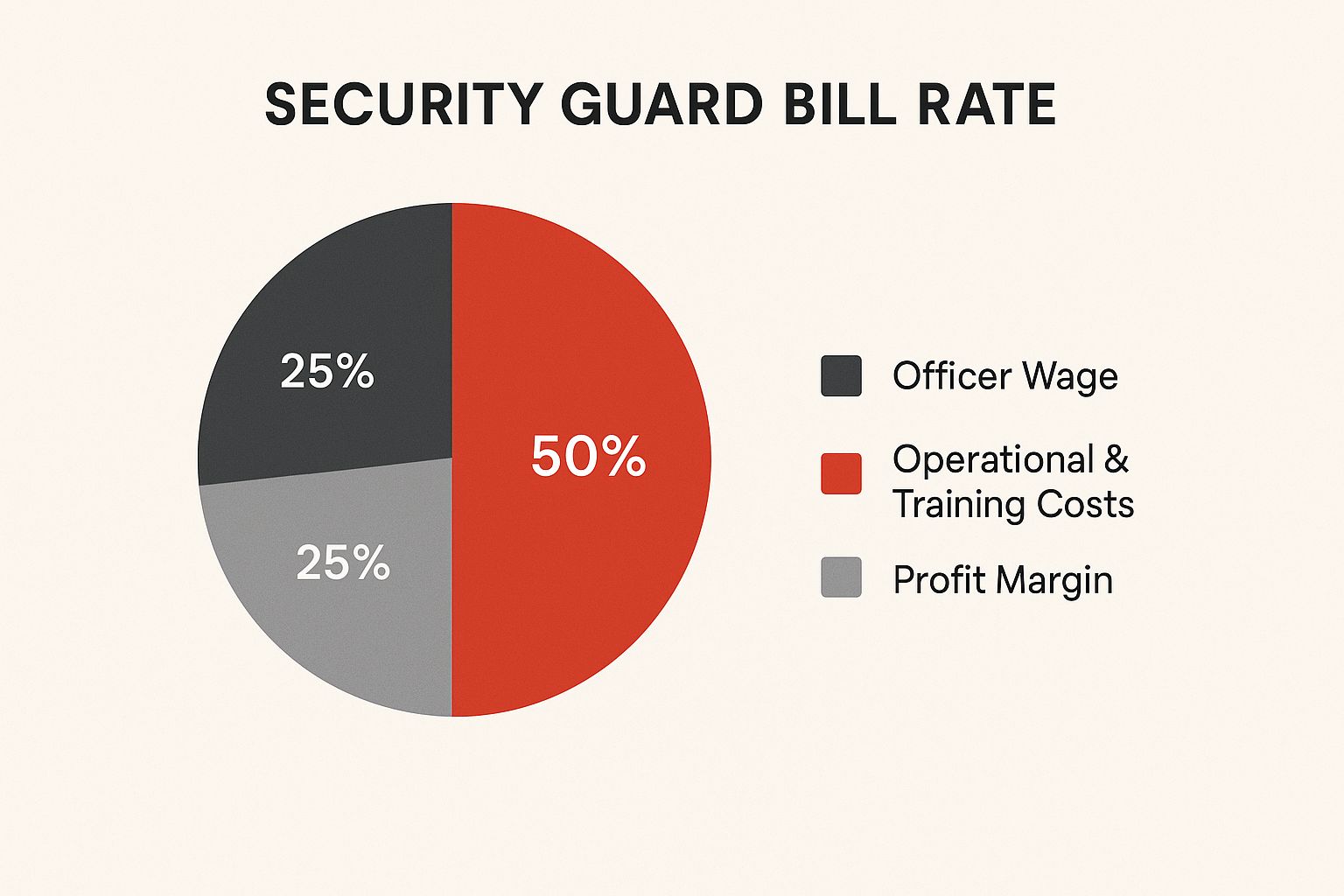
As you can see, the officer's actual wage is just one piece of the puzzle—often a smaller piece than many assume. It takes significant investment to place a reliable, well-equipped, and properly supported professional on your property.
To get some broader context on how service-based businesses approach pricing, you can explore how other services structure their fees, although the specific components for security are quite unique.
Quick Look at Bill Rate Components
Here’s a simple table to summarize the core cost categories that form a typical security guard bill rate.
| Component Category | What It Covers | Typical % of Bill Rate |
|---|---|---|
| Direct Labor Costs | Officer's base wage, payroll taxes, workers' comp, unemployment. | 65-75% |
| Operational Overhead | General liability insurance, training, uniforms, licensing, supervision. | 10-15% |
| Technology & Support | Dispatch services, reporting software, communication equipment. | 3-5% |
| Profit Margin | Funds for reinvestment, company growth, and maintaining service quality. | 10-15% |
This breakdown makes it clear that a high-quality security service is a significant investment in people, infrastructure, and risk management—all of which are reflected in that final hourly rate.
Breaking Down Officer Wages and Labor Burden
When you examine a security provider's bill rate, the largest portion is always the direct cost of the security officer. It’s the foundation of the entire price, and it all starts with the officer's base hourly wage.
This wage isn't just a number pulled from thin air. It’s carefully calculated based on local market conditions, the officer's experience, and the unique demands of your property. For instance, the pay for an officer at a quiet residential community will be different from one managing a high-traffic retail center in Los Angeles. The base pay must be competitive enough to attract and retain reliable, professional people—a core principle of our approach at Overton Security.
The Hidden Costs of Labor Burden
The officer’s wage is only the beginning. Layered on top is the labor burden—a set of mandatory, non-negotiable costs tied directly to employing an individual. Think of it as the "cost of doing business" that a security company must cover for every hour an officer is on duty.
A good rule of thumb in our industry is that the true cost of an officer is 1.3 to 1.4 times their base wage. This multiplier accounts for all the mandatory expenses a responsible provider must cover.
This burden includes several critical components that protect everyone involved—the officer, the security company, and you as the client.
- Payroll Taxes: This covers legally required contributions like FICA (Social Security and Medicare).
- Workers' Compensation Insurance: This is crucial. It protects officers if they are injured on your property, which in turn shields your business from liability. Rates for security work are notably high due to the inherent risks.
- Unemployment Insurance: These are state and federal taxes paid by the employer to fund unemployment benefits.
These costs are not optional. Any company that presents a quote ignoring these is likely cutting corners, which can expose you to serious legal and financial risk.
From Wage to Total Labor Cost: An Example
Let's walk through how a simple base wage quickly grows into a much larger number for the security provider. Imagine an officer's wage is set at a competitive $20.00 per hour. Once the labor burden is factored in, the company's direct cost is considerably higher.
This table breaks it down:
| Cost Item | Example Rate / Percentage | Cost Per Hour |
|---|---|---|
| Officer's Base Wage | – | $20.00 |
| Payroll Taxes (FICA) | 7.65% | $1.53 |
| Workers' Compensation | 18% (Example Rate) | $3.60 |
| Unemployment Insurance (SUI/FUI) | 3% (Example Rate) | $0.60 |
| Total Direct Labor Cost | – | $25.73 |
As you can see, a $20 per hour officer actually costs the security company over $25 per hour. And that’s before a single cent is allocated for uniforms, training, supervision, or company profit. Understanding this basic math is the first step to grasping how security guard services arrive at their final bill rate.
If you're interested in learning more about what our officers do on-site, you can explore the value our professional unarmed security guard services bring to properties across California.
Understanding Essential Operational Overhead
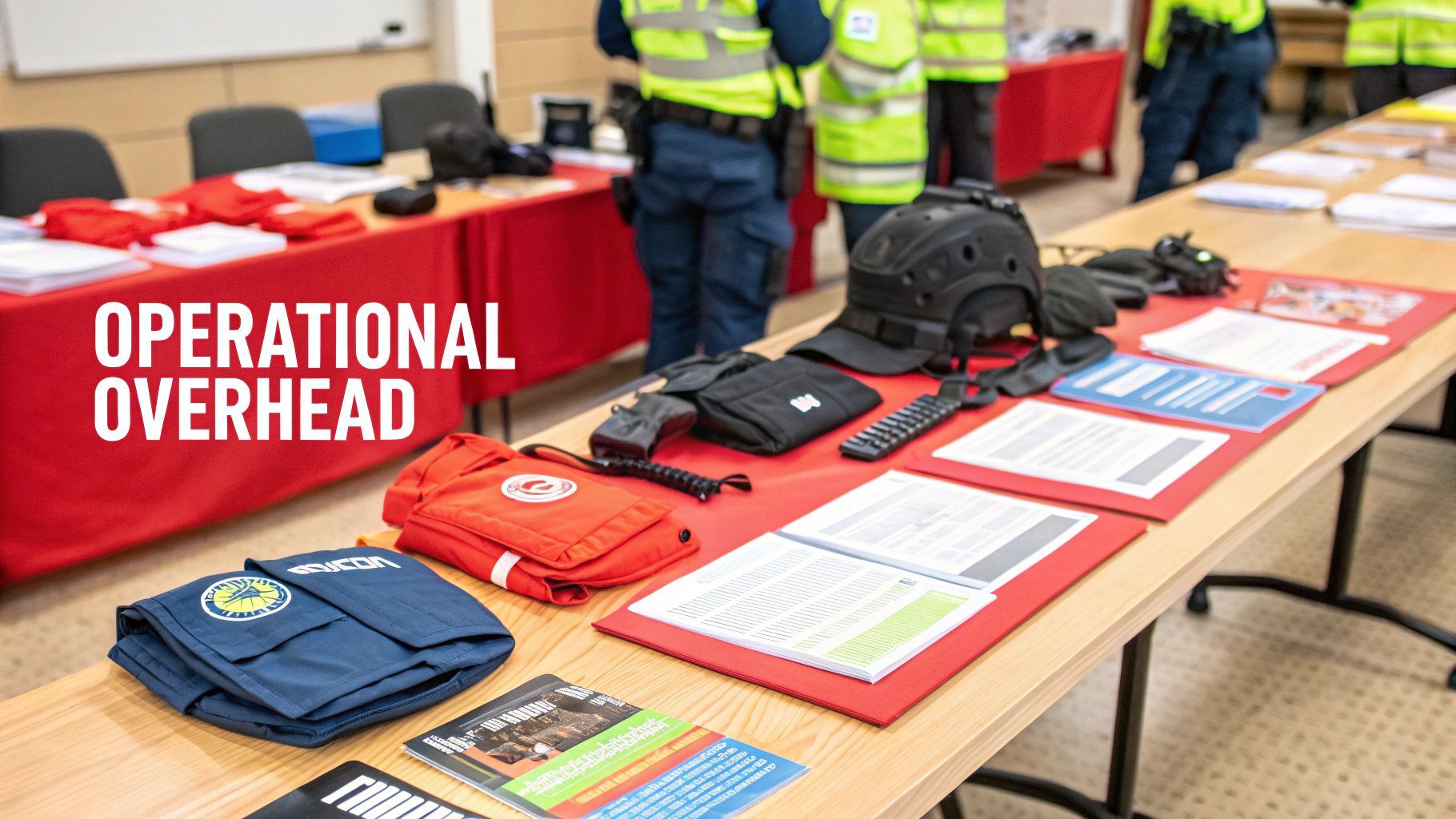
We've covered the direct costs of having an officer on-site. But what about everything else that makes the service work? That’s where operational overhead comes in.
This is the behind-the-scenes infrastructure a professional security firm builds to ensure you receive consistent, high-quality protection. These are the non-negotiable expenses that separate a true security partner from a basic staffing agency.
When you see a suspiciously low bill rate, this is almost always where corners are cut. It’s a risky decision that often leads to unreliable guards, constant turnover, and significant liability landing on your shoulders. Once you see what these costs cover, you'll understand how a bill rate reflects a company's commitment to quality.
Insurance and Licensing Requirements
First up is comprehensive insurance. This isn't just a line item; it's the critical shield protecting your property and your business. Any reputable firm will carry multiple layers of coverage, with General Liability insurance being one of the most important.
This policy protects you from financial responsibility if there are damages or claims stemming from the security provider's actions. On top of that, mandatory state and local licensing fees ensure the company and its officers are legally compliant and fully authorized to operate.
Training and Development Costs
What makes a security officer effective isn't just the uniform—it’s the training. A serious security company invests heavily in preparing its team for any situation.
A quality training program should always include:
- Initial Site Training: The officer learns the specifics of your property—your post orders, emergency plans, and unique vulnerabilities.
- Ongoing Education: Learning is continuous. Regular training on de-escalation, professional report writing, and emergency response is crucial.
- Specialized Certifications: Posts requiring fire watch or front desk concierge duties demand additional, specialized training.
This investment is the difference between having a capable, confident professional and just a warm body filling a shift.
At Overton Security, we see training as the foundation of reliable service. An officer who is well-prepared and confident is better equipped to protect your property and represent your brand professionally.
Supervision and Management Structure
One of the most overlooked—and most critical—overhead costs is active supervision. An officer left without support lacks accountability. A quality provider builds a robust management structure to provide oversight and quality control.
This includes salaries for field supervisors who conduct regular site visits and account managers who serve as your direct point of contact. This is an area where Overton Security's commitment shines. We intentionally maintain a low manager-to-client ratio, meaning our leaders are hands-on, responsive, and present in the field.
This investment in real leadership translates directly to greater accountability and better service at your property. When you add in the costs for professional uniforms and equipment, this entire structure forms the backbone of a dependable security program—and it’s all factored into the bill rate.
Investing in Technology and Support Systems

When you hire a security provider, you're not just getting a guard in a uniform—or at least, you shouldn't be. Modern, effective security is a partnership between a trained officer and the technology that empowers them.
These support systems—the software, hardware, and command center—are what make an officer accountable, responsive, and truly effective. They represent a significant investment for any professional provider, and that investment is absolutely reflected in the final bill rate. While it adds to the cost, the peace of mind it delivers is invaluable.
The Power of Real-Time Accountability
The days of scribbled paper logs and wondering if patrols actually happened are long gone. Top-tier security firms arm their officers with tools that provide undeniable proof of service, creating a transparent, auditable record of every action taken on your property.
This technology stack is fundamental to quality service and usually includes:
- GPS-Enabled Patrol Tracking: We can see exactly where an officer is in real-time and verify that patrol routes are completed on schedule, eliminating guesswork.
- Digital Reporting Platforms: Officers use tablets or phones to file daily activity reports (DARs), incident reports, and maintenance logs. They can include a photo of a broken lock or suspicious vehicle right in the report, which is delivered to your inbox with a timestamp.
This level of transparency is standard practice at Overton Security. It’s a core part of our operations and a key differentiator that separates professional firms from the rest.
Investing in technology isn’t about replacing people; it’s about empowering them. The right tools make a good officer more effective, accountable, and better prepared to protect your assets.
The 24/7 Security Operations Center
The single most critical support system behind any field officer is the Security Operations Center (SOC). Think of it as the nerve center for the entire operation—a constant lifeline for officers and a direct point of contact for you. A true SOC runs 24/7, providing constant oversight and dispatch support.
The SOC team monitors alarms, fields emergency calls, and performs regular check-ins to ensure officer safety. If an incident occurs on your property, the SOC coordinates the entire response, from dispatching backup to contacting emergency services. This infrastructure guarantees a rapid, professional response when you need it most.
To get a deeper look at how this critical hub works, check out our guide to a Global Security Operations Center.
Ultimately, these investments in technology and support are essential to reliable, modern security services. While they contribute to the bill rate, their value is realized every day through verified performance and a truly secure property.
Nailing Down the Profit Margin and Market Factors
After accounting for direct labor, operational overhead, and technology costs, the final piece is the profit margin, which must be balanced against local market realities. A healthy profit margin isn't just about revenue; it's the fuel that allows a quality security company to grow and reinvest in the things that actually protect your property.
That margin separates a genuine security partner from a simple staffing agency. A sustainable profit allows us to pay higher wages that attract and retain top-tier officers, fund better training programs, and invest in effective technology. This approach is the opposite of the "burn and churn" model common with low-bid providers, which almost always leads to high turnover and inconsistent service.
Factoring in the Real World: The Market and Your Site
The final bill rate is also shaped by external factors—the realities of the local market and the specific risks at your property.
For example, security service rates can vary significantly depending on location and the level of protection required. In the U.S., you might see unarmed guards billed anywhere from $27 to $50 per hour, while armed guards can range from $40 to over $100 per hour. This spread is often driven by location; a high-demand market like Los Angeles will naturally command higher rates than a quieter area. For a deeper dive into these pricing trends, Kentley Insights is a great resource.
Beyond local competition, the unique risk profile of your site plays a huge role. Several key factors can influence the final rate:
- Property Type: A quiet HOA community has a different risk level than a busy retail center or a construction site filled with valuable equipment.
- Hours of Coverage: Overnight shifts or 24/7 coverage often require a rate adjustment to attract quality officers for less desirable hours.
- Required Officer Skills: A post requiring advanced skills—like de-escalation expertise or front-desk concierge duties—will naturally command a higher rate.
A fair bill rate is a sign of a healthy, sustainable partnership. It signals that the provider has the resources to pay its officers well, invest in their training, and maintain the operational infrastructure needed to protect your assets effectively.
Understanding these final components helps you see the bill rate for what it is: a direct reflection of a company's commitment to its people and its clients. It’s the best indicator that your security partner can deliver reliable, professional service for the long haul.
Why the Lowest Bid Can Be the Most Expensive Risk
After breaking down wages, overhead, technology, and profit margins, one thing becomes clear: a quality security provider has real, non-negotiable costs. This is why the temptation to choose the lowest bidder is often a trap that leads to greater headaches and expenses down the road.
A bid that seems too good to be true almost always is. It’s a mathematical certainty that something critical has been cut to achieve that number—officer pay, essential training, active supervision, or proper insurance. That initial "savings" quickly appears in other ways, like high officer turnover, inconsistent service, and a spike in liability for your property.
The True Cost of Inadequate Security
An underfunded security program doesn't just fail to protect your assets; it actively creates new, expensive problems.
- High Turnover: Rock-bottom wages create a revolving door of officers. This means you constantly deal with new people learning your site's specific needs.
- Lack of Accountability: Without investment in supervision and technology, there’s no real way to verify that the job is being done, leading to missed patrols and neglected duties.
- Increased Liability: An improperly insured or poorly trained guard exposes your organization to massive financial and legal risks if an incident occurs.
The global security services market is growing rapidly. Residential security revenues alone are projected to hit $47.6 billion by 2028, a surge driven by new technology and rising security needs. As the industry advances, the gap between professional providers and low-cost operators widens. You can find more details on these global security service trends.
Here at Overton Security, our 26 years of experience have taught us one simple truth: real security comes from investing in people. Our commitment to supporting professional officers is the foundation of the reliable service that protects your assets and your reputation.
Choosing a security partner is about managing risk, not just filling a shift. A fair bill rate supports a stable, well-trained team that delivers consistent value. When you need a reliable security guard in Los Angeles or anywhere else in California, it pays to look beyond just the hourly rate to the total peace of mind a true security partner provides.
Still Have Questions About Security Billing?
You're not alone. When property managers and business owners decipher a security proposal, a few key questions often come up. Let's tackle some of the most common ones.
Are Armed Guards Always More Expensive?
Yes, for several good reasons. The bill rate for an armed officer is higher because they require a different level of training, certifications, and licensing.
Additionally, the insurance liability increases significantly. The provider's workers' compensation and general liability premiums are substantially higher for an armed position. Finally, the role itself carries greater risk, which demands a higher wage to attract a professional qualified for that responsibility.
Can I Negotiate The Bill Rate?
While there can be some flexibility, be cautious of any provider willing to slash their rates dramatically. A reputable security company has fixed costs like insurance, payroll taxes, and training baked into their price.
If a company offers a significant price cut, that money must come from somewhere—almost always from the officer's pay or by skimping on supervision. Both will directly impact the quality of service you receive. A more productive conversation is to discuss the scope of services to see if adjustments can better fit your budget.
A very low "bill-to-pay" ratio is a massive red flag. This number compares the final bill rate to the officer's actual wage. If it's too low, it's a strong signal the provider is cutting corners on proper insurance, training, or supervision.
Ultimately, understanding how a security provider calculates their bill rate helps you find a partner who is truly committed to quality and reliability, not just the lowest price.
For a security plan built on 26 years of experience and a firm commitment to transparent, high-quality service, you can trust Overton Security. Contact us today to receive a transparent, no-obligation proposal for your property.