It's a busy Saturday, tenants are calling about different problems, and you're expected to keep the whole property feeling calm and orderly. That's the actual job behind shopping center security guards. They're not just a uniform at one door. They're one layer of a plan that has to cover shoppers, stores, parking areas, delivery routes, and the hours after most tenants close.
Why Shopping Center Security Guards Matter
A delivery driver props open a loading dock door and walks away. Across the property, a parking structure that felt busy at noon feels empty after dark. Near the food court, voices rise, a small crowd gathers, and nearby store staff look toward the common area for help. None of these moments belongs to a single tenant, but all of them affect how safe the entire center feels.
That's why shopping center security guards do more than watch an entrance. Their core work is to protect people, merchandise, money, and equipment. In practice, that can mean noticing the unsecured door, checking the quiet parking level, calming a disturbance, helping a lost visitor, and telling property management what happened in a clear report.
A Large and Established Occupation
Guarding isn't an informal add-on to retail operations. The Bureau of Labor Statistics reported approximately 1,202,940 security guards nationwide in May 2023, with a mean annual wage of $40,440 and a mean hourly wage of $19.44. Investigation and security services employed 735,430 guards, while general-merchandise retailers directly employed 44,640 guards at an average annual wage of $35,200.
Those numbers matter when you're reviewing a bid. They show there's an established labor market behind the uniform, so staffing quality, supervision, and retention deserve the same scrutiny you'd give any other professional service. A very low price should prompt practical questions about who will show up, how they'll be trained, and who supervises them.
Practical rule: Judge coverage by whether officers, technology, lighting, and tenant communication work together, not by headcount alone.
The physical property supports that work. Trimmed landscaping, working lights, and clear sightlines make patrols more useful and help visitors see where they're going. For a broader view of upkeep tasks that affect visibility and access, the Prestonwood Commercial Landscape Services maintenance guide is a helpful companion to a security walk-through.
When the layers line up, the win isn't dramatic. It's fewer surprises, faster answers for tenants, and a property that feels orderly without making shoppers feel watched or unwelcome.
What Guards Protect Across a Retail Center
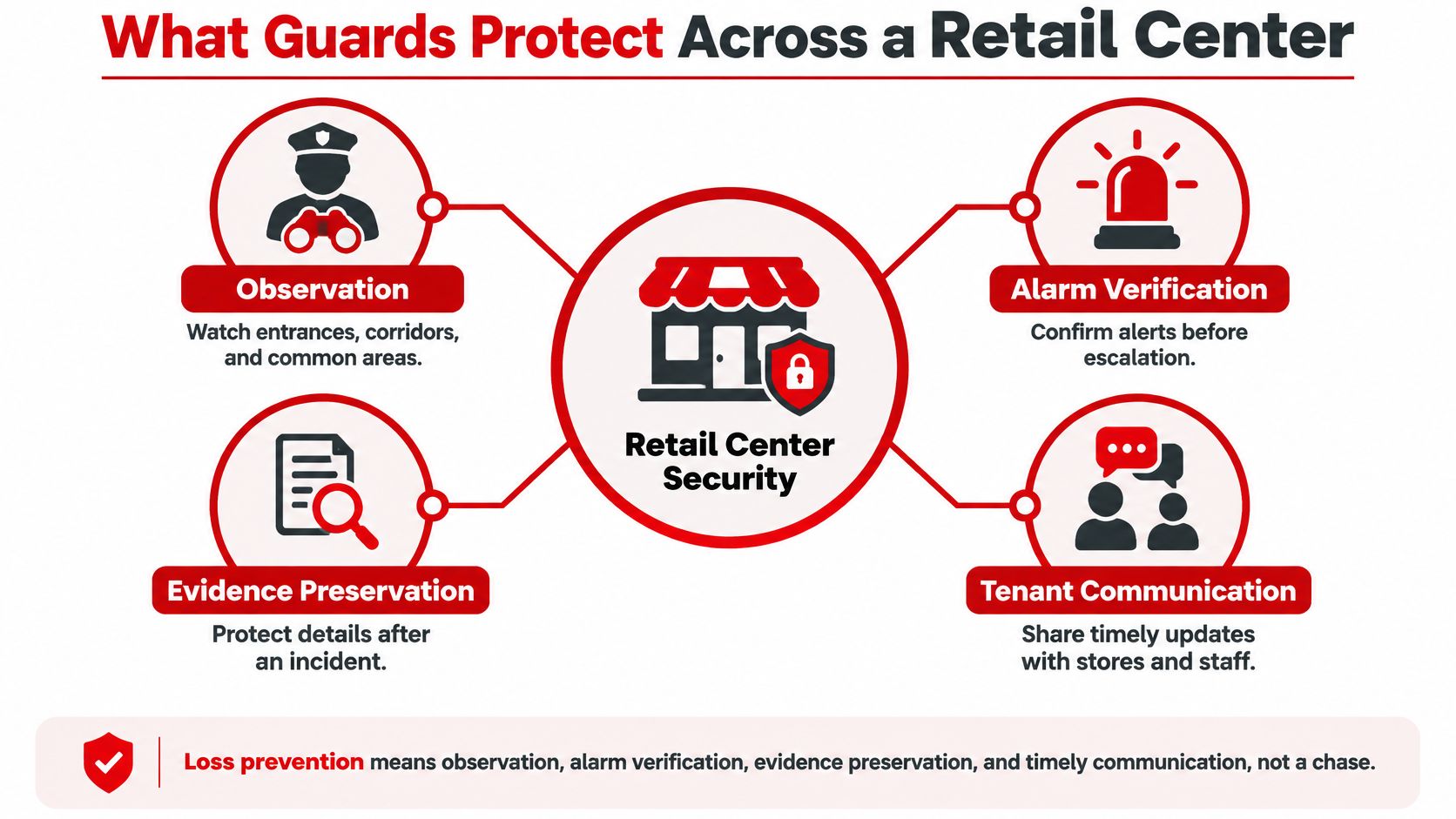
Think of a busy corridor watched from several angles. A store employee notices someone acting strangely near a display, a camera covers the entrance, an alarm tag signals at the door, and an officer nearby verifies what's happening. No single person sees everything, but the overlapping sightlines make concealment harder and response faster. That's how loss prevention should work in a shared retail setting.
Loss prevention usually means observation, alarm verification, evidence preservation, and timely communication with tenants. It doesn't mean a chase through the common area. An officer who confirms an alarm, keeps a safe view of the people involved, protects bystanders, and passes clear details to the store and police is providing a more useful service than one who turns a theft into a public confrontation.
People, Tenants, and Restricted Areas
Customer safety is part of the same post. Officers help separated families reconnect, notice a person who may need medical help, discourage loitering that blocks entrances, and keep attention on areas where crowds gather. Their approachability matters, because shoppers and employees are more likely to report a concern to someone who looks calm and easy to approach.
- Access control: Check employee doors, loading zones, service corridors, and after-hours entries so restricted areas don't become shortcuts.
- Tenant support: Notify affected store managers consistently when one incident involves several businesses.
- Alarm response: Verify the signal, observe the area, preserve relevant details, and escalate through the agreed contact path.
Technology strengthens these duties when someone is assigned to act on it. A survey of 389 store and shopping-mall managers in Istanbul found that managers most frequently selected video cameras and electronic alarm tags for shoplifting prevention. The lesson isn't that cameras replace officers. It's that cameras, tags, alarms, tenant staff, and guards should operate as a layered detection-and-deterrence system.
Your post orders should turn that idea into instructions. Name the observation priorities, the point at which an officer calls a supervisor or police, and exactly who receives each report. A closer look at day-to-day retail security duties can help you compare those written duties with what your tenants need.
Designing Patrols Across People Places and Time
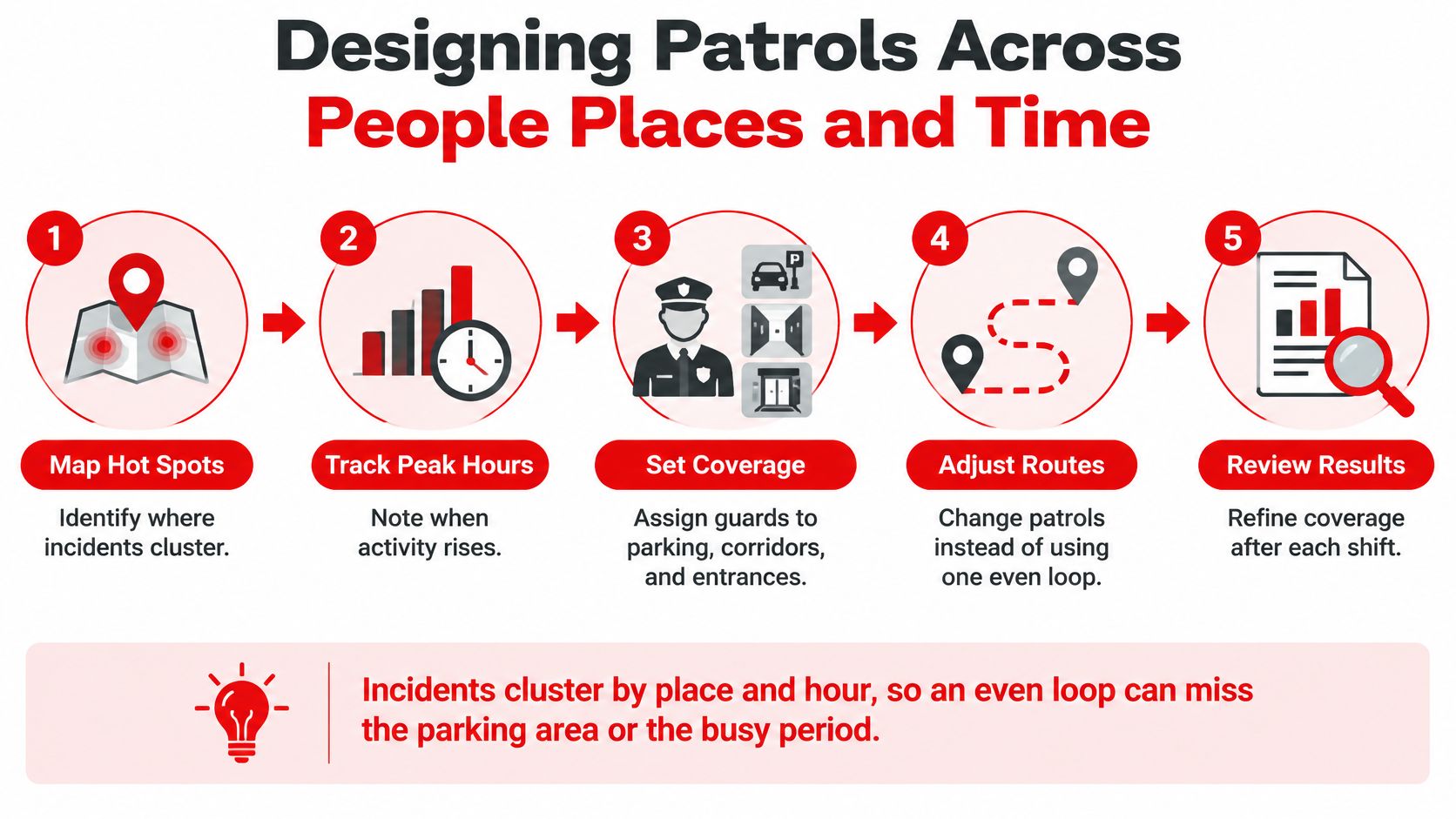
An even loop sounds fair, but it can waste attention. If incidents repeatedly occur near one parking entrance in the evening, giving that entrance the same brief pass as a quiet service corridor at midday doesn't match the risk. Coverage should follow people, places, and time, not just a neat route on a map.
Start by mapping the whole property. Mark stores, common areas, parking lots and structures, loading zones, service corridors, employee routes, and nearby pedestrian paths. Then note when each area is busy, when employees arrive or leave, when deliveries occur, and which doors remain active after closing.
Matching the Patrol to the Pattern
Once you can see the patterns, assign different types of checks for different purposes. Opening and closing checks can be predictable because doors, gates, and alarms need attention at known times. General patrol visits work better when they're less predictable, while checkpoint scans prove that specific locations were visited.
- Map hotspots: Use tenant complaints, incident reports, and maintenance notes to find recurring locations.
- Track peak periods: Separate retail rushes, employee shift changes, delivery windows, and after-close hours.
- Set handoffs: Decide how camera observations, tenant calls, and officer findings reach the next person on duty.
- Review and adjust: Move patrol time when reports show the problem has moved.
The need for this wider view is clear in recent retail findings. Among surveyed retailers, 54% reported increased repeat-offender theft, 48% reported increased cargo or supply-chain theft, and 67% recorded encounters with transnational organized theft groups. A post focused only on storefronts can miss the parking and logistics activity connected to those problems.
A stationed officer gives continuous presence at a busy entrance or common area. A shared vehicle patrol can check several properties during quieter hours, while a dedicated vehicle patrol stays focused on your center or a related group of properties. Whichever mix you choose, GPS-verified tours and time-stamped reports give you proof that the patrol occurred and a record you can use to improve it.
The better question is not only how many guards you need. It's where they should be, at what times, and with what instructions.
Training Standards and When Guards Disengage
A tougher response isn't always a safer response. If a suspected thief becomes threatening near a crowded entrance, a physical struggle can endanger shoppers, employees, and the officer. In that moment, creating distance, moving bystanders away, observing identifying details, and calling police may protect people better than trying to recover merchandise.
That's why disengagement should be written into post orders before an incident happens. Officers shouldn't have to guess whether management expects them to intervene, follow, block an exit, or step back. Clear limits support customer service, reduce escalation, and make the officer's actions easier to explain afterward.
California Training as a Screening Standard
In California, training begins before registration. Before receiving a Security Guard Registration, an applicant must complete a 3-hour Power to Arrest course and a 5-hour Appropriate Use of Force course, including the required examination. After registration, the guard must complete 32 hours of security-officer-skills training within six months, including 16 hours within the first 30 days, plus 8 hours every year with at least 2 hours reviewing appropriate use of force, as set out in the same California guidance.
For a property manager, that's a concrete screening tool. Confirm that assigned officers hold valid registration and that their required training is current. You can compare a provider's process with an overview of training for unarmed security guards, then ask how site-specific instruction is added for your center.
A Simple Decision Guide for Tense Encounters
- Observe first: Note behavior, location, direction of travel, companions, and vehicle details from a safe position.
- Use calm communication: Give clear, brief directions and avoid crowding or touching the person.
- Protect bystanders: Create space and guide shoppers or employees away from the immediate area.
- Escalate early: Contact a supervisor or police when threats, weapons, aggression, or crowd risk appear.
- Document promptly: Record facts, witness names, notifications, and any physical contact while details are fresh.
Officer support matters here. Fatigue, thin refresher training, and hard-to-reach supervisors make poor decisions more likely. Regular training, teamwork, wellness checks, and calm incident reviews help officers use proportional response instead of reacting under strain.
Emergency Plans for Malls and Open-Air Centers
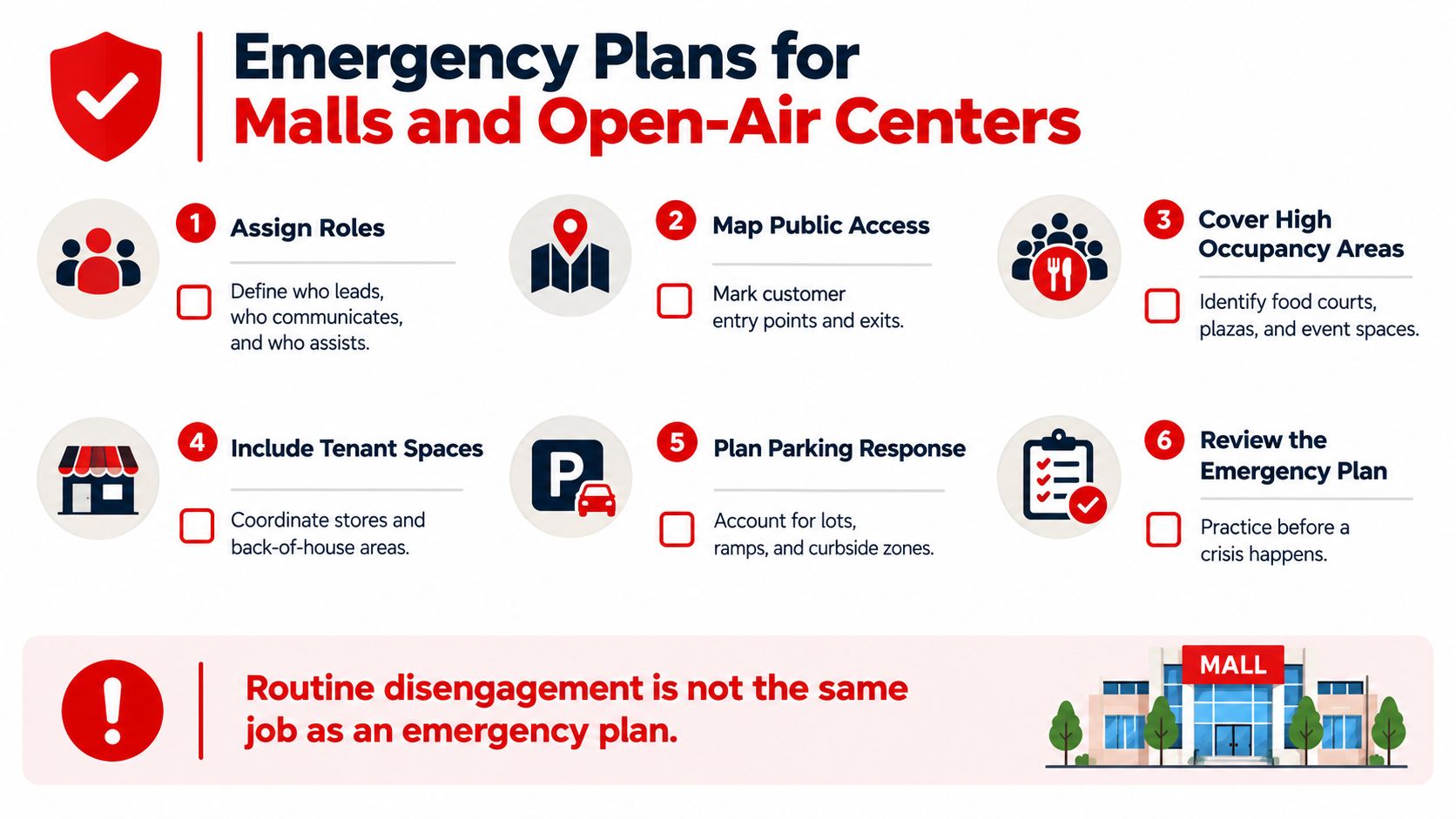
Routine disengagement and emergency response are different jobs. Disengagement helps an officer handle a tense encounter without making it worse. An emergency plan assigns responsibilities across the whole property before anyone has to improvise. Both matter, but one doesn't replace the other.
A shopping center plan has to account for public access and high occupancy at the same time. Food courts, anchor stores, small tenant spaces, parking areas, loading docks, and back corridors may all need different instructions. A guard can't guide movement or relay useful facts if nobody has decided who gives instructions, which exits to use, or how tenants will be notified.
Decisions to Make Before an Incident
CISA active-assailant guidance calls for identifying when to evacuate, who may initiate evacuation in coordination with law enforcement, when lockdown or shelter-in-place is required, and how to secure doors, gates, entrances, and exits. During a lockdown, people should use a lockable room, lock or barricade doors, cover windows where possible, turn off lights, silence phones, remain quiet, and stay away from doors, according to that guidance.
Translate those decisions into site assignments:
- Common areas: Who directs visitors, checks restrooms or corridors if it's safe, and keeps exit routes clear?
- Tenant spaces: Who contacts each store, and how do employees confirm they've received the message?
- Parking and docks: Who manages vehicle movement, secures gates, and meets police or fire crews?
- Communications: Who provides updates to management, tenants, and responders, and through which backup method?
Plans should also cover medical emergencies and orderly evacuations, because those are part of ordinary operations. Officers may need to guide an ambulance to the right entrance, keep a path open, help account for employees, or explain where visitors should gather. Those tasks require the same advance clarity as a rare, severe event.
Communication deserves its own rehearsal. Contact trees fail when numbers change and nobody tests them. The principles in crisis communication planning for Jenks businesses offer useful context for deciding who speaks, who receives updates, and how messages stay consistent. For the security role itself, review how emergency response security support can fit into a plan you've already assigned and practiced.
A plan that only tells a guard to respond isn't finished. It should say where to go, whom to notify, which doors to secure, and what information to relay.
How to Choose Shopping Center Security Coverage
The right coverage model depends on where your risk sits during a normal week. A busy enclosed mall may need a visible officer in common areas throughout operating hours. An open-air plaza with quiet weekdays may get more value from a focused evening post plus vehicle patrols. A center with an upscale entrance or office component may need an officer who combines hospitality with access control.
Don't start with a guard count. Start with the tasks you need covered, the hours when they matter, and the proof you'll receive afterward.
Shopping Center Coverage Options
| Coverage model | Best fit | What the manager can verify | Main limit |
|---|---|---|---|
| Onsite unarmed officer | Busy entrances, common areas, tenant support | Post orders, checkpoint scans, daily reports | One officer can't cover every zone at once |
| Onsite armed officer | Sites where a documented risk review supports it | Registration, training, supervision, incident reviews | Adds cost and policy considerations |
| Concierge-style officer | Lobbies and customer-facing entrances | Visitor handling, access logs, tenant feedback | Less suited to large parking or dock coverage |
| Shared vehicle patrol | Smaller centers and after-hours checks | GPS tour records, photos, time-stamped reports | Present for visits rather than continuously |
| Dedicated vehicle patrol | Large lots, perimeters, related properties | Route records, response notes, checkpoint history | Vehicle still can't replace interior foot patrol everywhere |
Technology should support the model you choose. Cameras are most useful when their views match patrol routes and someone can respond to what they show. If you're comparing camera layouts for entrances, lots, and shared spaces, this overview of security cameras for retail and campuses can help frame questions about placement and monitoring.
When reviewing a proposal, ask for site-specific post orders, proof of valid registration and current training, supervisor availability, and samples of client-visible reporting. Ask how call-offs are covered and how incidents are reviewed with you. A provider should walk the property before quoting a plan, because tenant mix, closing hours, parking layout, and back-of-house access change the answer.
As one California option, Overton Security reports 26 years in business and offers onsite guards, shared or dedicated vehicle patrols, retail loss-prevention coverage, NFC checkpoint scans, digital daily activity reports, and a 24/7 security operations center. Its model includes a low manager-to-client ratio and programs shaped to each property rather than a single template. Whether you choose that model or another provider, those are useful features to compare because they show how work will be supervised and verified.
What Property Managers Should Do Next
Walk your property once as a shopper, once as an employee, and once as a delivery driver. You'll notice different things each time. A shopper sees dark parking rows and confusing exits. An employee sees the back door used after closing. A driver sees the dock, gate, and service corridor that may not appear on a standard patrol route.
Bring a short list and write down what you find. Note the time of day, because a concern at noon may disappear at night while a different one appears.
Your Site Review Checklist
- Entrances and exits: Which doors stay busy, which remain unsecured, and where do crowds collect?
- Parking areas: Where are lighting gaps, camera blind spots, loitering areas, and employee walking routes?
- Loading and service zones: Who uses them, when are gates open, and how are deliveries verified?
- Tenant back corridors: Which stores share access, and who should receive incident updates?
- After-hours access: Which doors, alarms, cleaning crews, and vendors need a clear check-in process?
- Current documentation: Do reports show times, locations, observations, notifications, and follow-up actions?
Next, check the people side of the plan. Confirm valid registration, current training, written post orders, a disengagement rule, and a specific emergency assignment for every post. If any of those pieces is missing, adding hours may not solve the underlying problem.
Then decide what gap you're filling. You may need a stationed officer during peak periods, added vehicle patrols after closing, better tenant notification, or stronger documentation of work that's already being done. Those are different purchases, and separating them helps you spend on the risk you've verified.
Starting point: Fix the unclear instruction before you add another shift. A well-placed officer with clear authority and reporting duties is easier to manage than extra coverage with no shared plan.
Bring your walk-through notes to a provider conversation. Ask the provider to explain, in plain language, where officers will go, what they'll do at each checkpoint, when they'll step back, and how you'll see the results. The best next step isn't a generic request for more guards. It's a coverage plan built from your center's entrances, tenants, parking patterns, delivery activity, and hours.
If your walk-through shows gaps in patrol coverage, tenant communication, or after-hours checks, Overton Security can help you build a customized plan using onsite officers or mobile patrols supported by digital reports and 24/7 operations center oversight. Visit Overton Security to start a site-specific review for your shopping center.