Thirty minutes before doors open, the radios are live, posts are confirmed, and someone is checking the perimeter one last time. If you're planning a corporate reception, festival, private function, or community event, you may be picturing a uniformed guard at the entrance. That's only one part of the job.
A capable event security guard works within a coordinated plan: managing access, observing crowd movement, reporting concerns, and helping guests understand where to go. The first planning question shouldn't be only how many guards to hire. It should be where coverage matters, what each officer is responsible for, and how the team will respond when conditions change.
What an Event Security Guard Really Does on Event Day
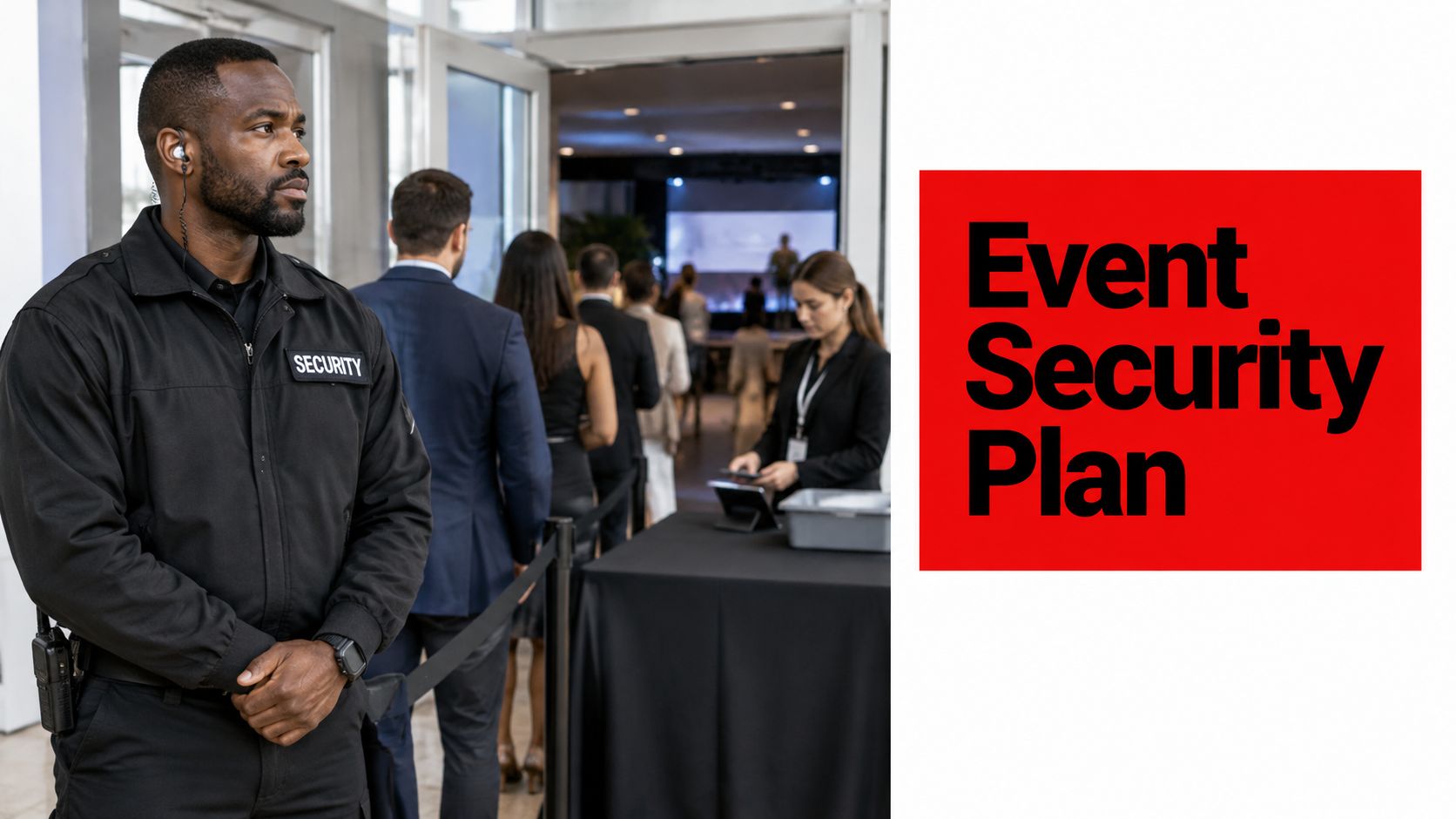
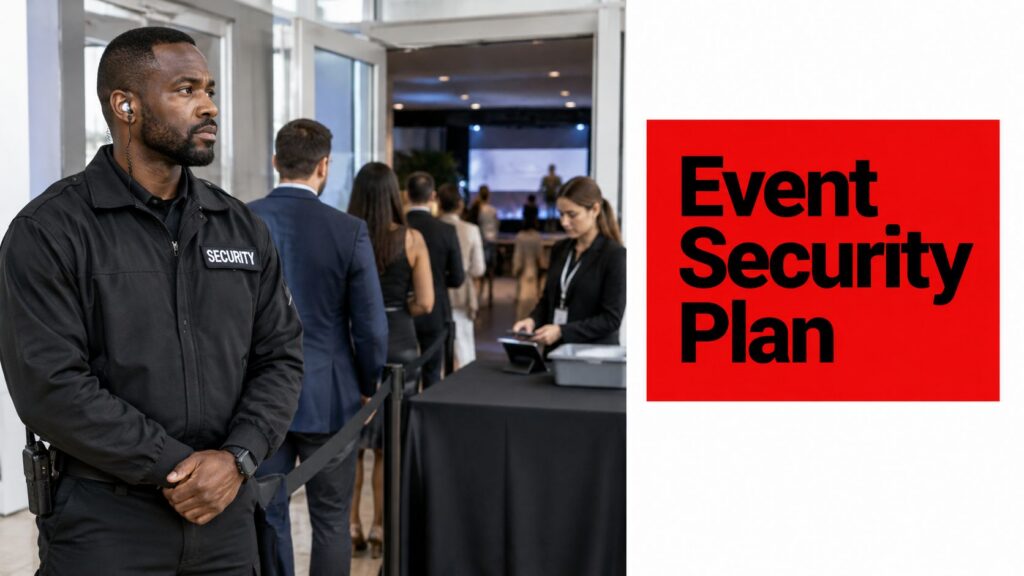
As doors open, the line grows, radios crackle, and guests begin moving between the entrance, registration, and the main event space. The guard at the gate checks tickets or credentials, but other officers may be watching a service entrance, monitoring a queue, patrolling a perimeter, or keeping an exit clear. A supervisor needs to understand how those posts fit together, not just how many people are in uniform.
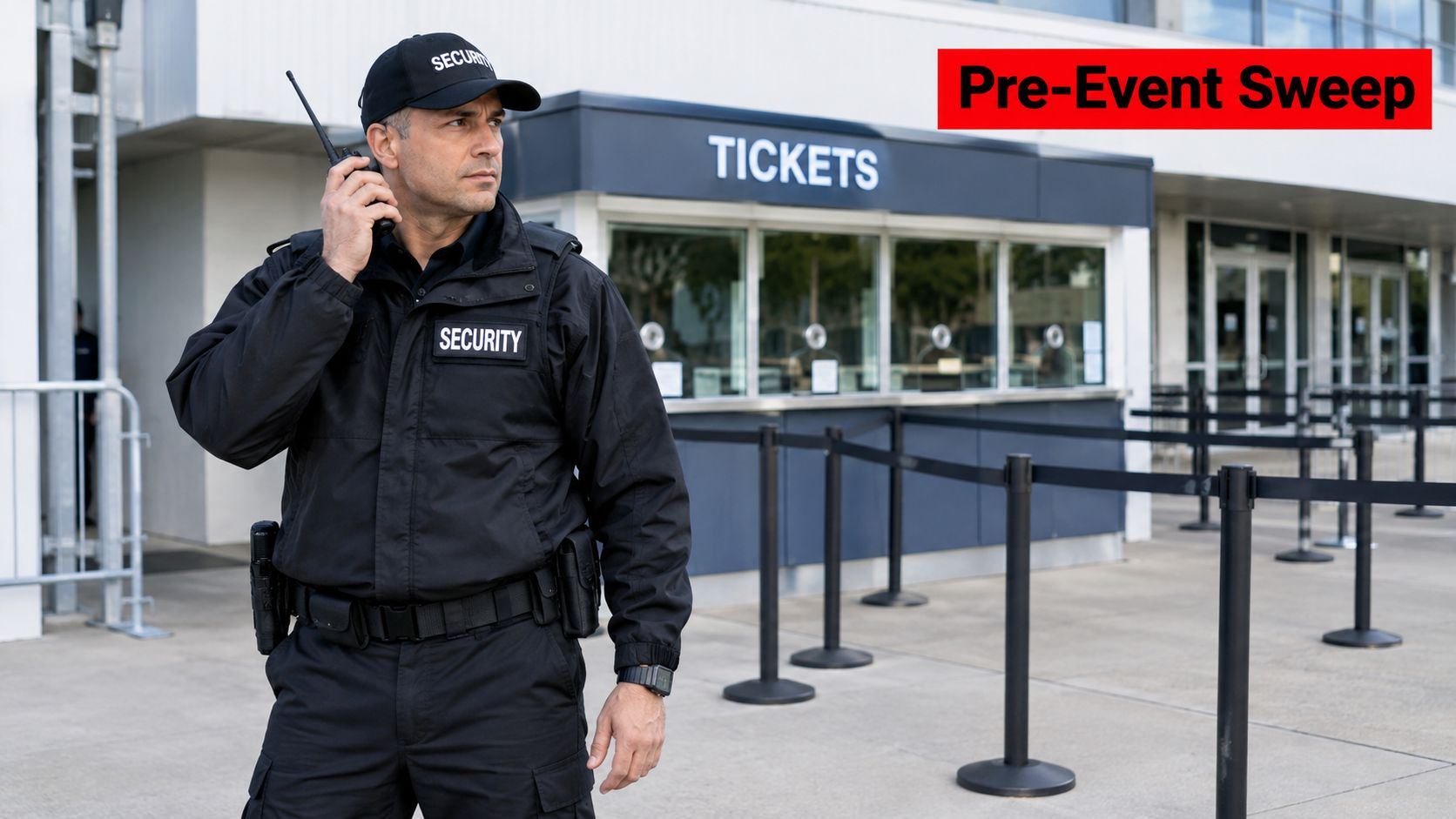
The work starts before guests arrive. Guards need a site-specific briefing, a clear post assignment, a way to contact a supervisor, and a shared understanding of entrances, exits, restricted areas, and emergency procedures. A California event might have one officer checking credentials at a hotel ballroom and another watching a vehicle-pedestrian crossing outside. Both need to know what to report and who acts on that information.
When the event is underway, security combines risk management with customer service. An officer may redirect a guest who's entered through the wrong gate, notice a queue spilling into an accessible route, or call a supervisor when a crowd begins to compress near a stage. Calm directions and early communication can keep a small issue from becoming a larger disruption.
The job continues through the final departure
Event security doesn't end when the program does. Officers may help keep exits unobstructed, guide guests toward a pickup area, watch parking routes, and report any incidents before leaving their posts. The shift should have a clear handoff, so an officer doesn't leave a coverage gap while another person assumes the post is still staffed.
The broader protective-services labor market reflects the scope of this work. The U.S. Bureau of Labor Statistics recorded approximately 1.27 million security guards and gambling surveillance officers in 2024, including about 185,510 in California and 77,910 in the Los Angeles metropolitan area; the source describes guards' work across functions such as access control, patrols, crowd observation, and emergency response (workforce profile citing BLS data).
That labor pool does not mean every event needs a large deployment. It means event security is a professional function, not just a person standing beside a door. The right question is what each post needs to accomplish, and how officers, supervisors, venue staff, and public-safety responders will coordinate.
Core Responsibilities Every Event Security Guard Owns
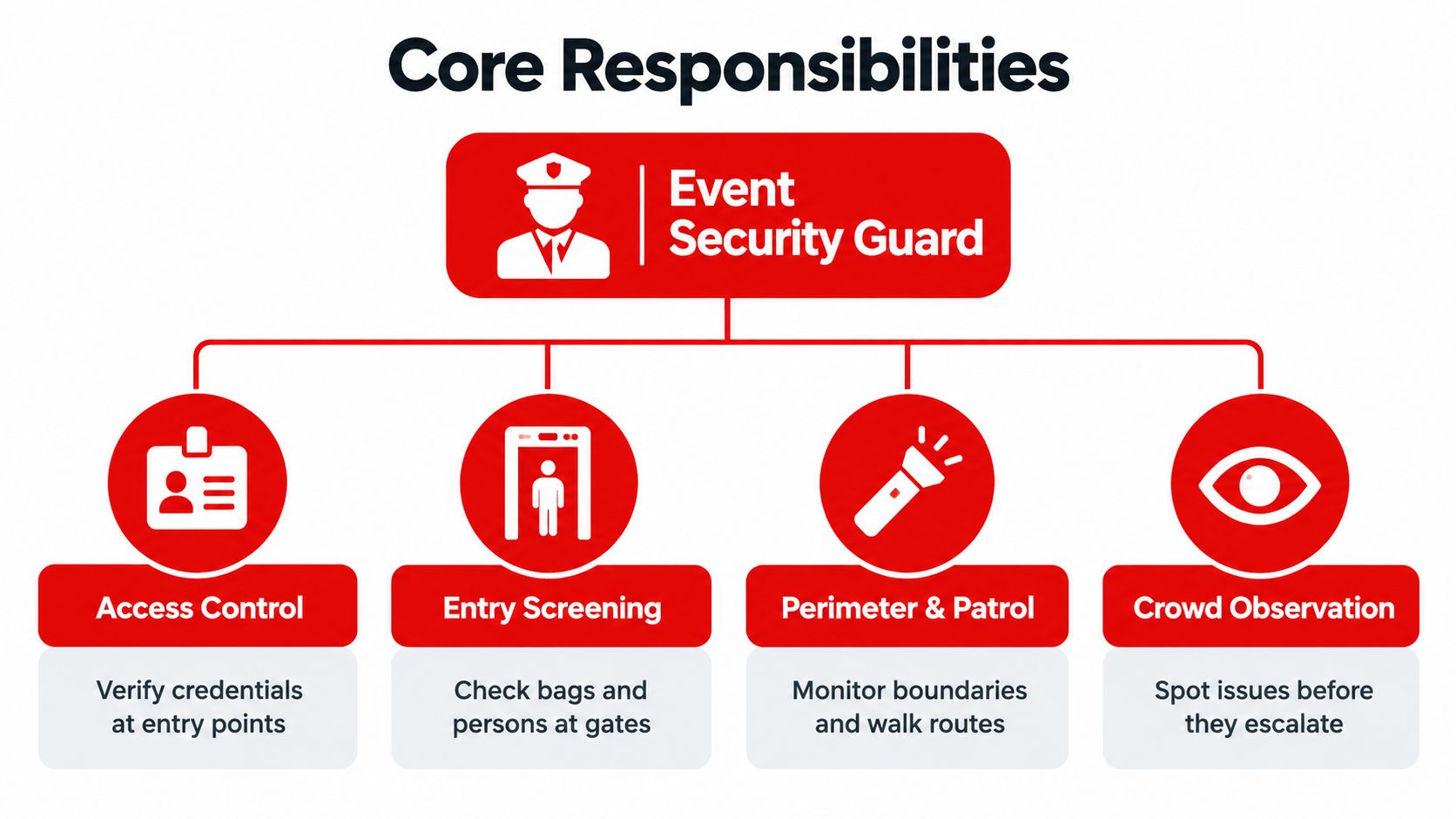
An event guard's responsibilities connect. Screening is less useful if another entrance is left uncontrolled; observation matters only if officers can report what they see; and response becomes inconsistent when nobody knows who can make a decision. Before hiring, ask a provider to explain how its officers will work as a team, rather than handing you a list of generic duties.
Start with access, then keep watching
Access control means managing who enters and where they're allowed to go. A guard may verify tickets, credentials, or permission to enter a restricted area. Those checks need to match the event's posted rules and be applied consistently across entry points.
Entry screening can involve a visual inspection, bag check, or other procedure selected for the event. Officers need clear instructions about what to check, how to handle a prohibited item, and when to call a supervisor. A rushed or inconsistent process can frustrate guests while still leaving gaps.
Perimeter and patrol work covers the spaces that aren't obvious at the main gate: service doors, loading areas, parking approaches, and boundaries around outdoor events. Officers check their assigned areas and report access concerns or other conditions that need attention.
Crowd observation is active work, not watching people pass. Guards monitor queues and movement, look for blocked routes or developing disputes, and communicate what they see using the event's agreed radio procedure. A 2024 empirical study of crowd dynamics and event safety examined attendee perceptions across a 512-person sample in the United Kingdom, highlighting the value of understanding safety from the audience's perspective (study of crowd dynamics and event safety).
Respond calmly, record clearly
When an incident occurs, the guard's job is to follow the plan, alert the right person, and support an orderly response. Officers should know when to request medical help or contact law enforcement, and where responders should meet event staff. They should also document relevant observations according to the provider's reporting process.
The customer-facing side deserves equal attention. Guests ask for directions, need help finding an accessible route, or may be upset about an entry decision. An officer who listens, communicates plainly, and avoids escalating a disagreement supports both the event experience and the security plan.
Ask before you sign: Who supervises the officers, how do they report incidents, and what happens if a guard has to leave a fixed post?
A provider should be able to answer those questions in practical terms. The duties connect, but they don't replace one another: a visible presence can't make up for unclear post orders, and a written procedure won't help if officers haven't been briefed on it.
How to Plan Guard Staffing Beyond a Headcount
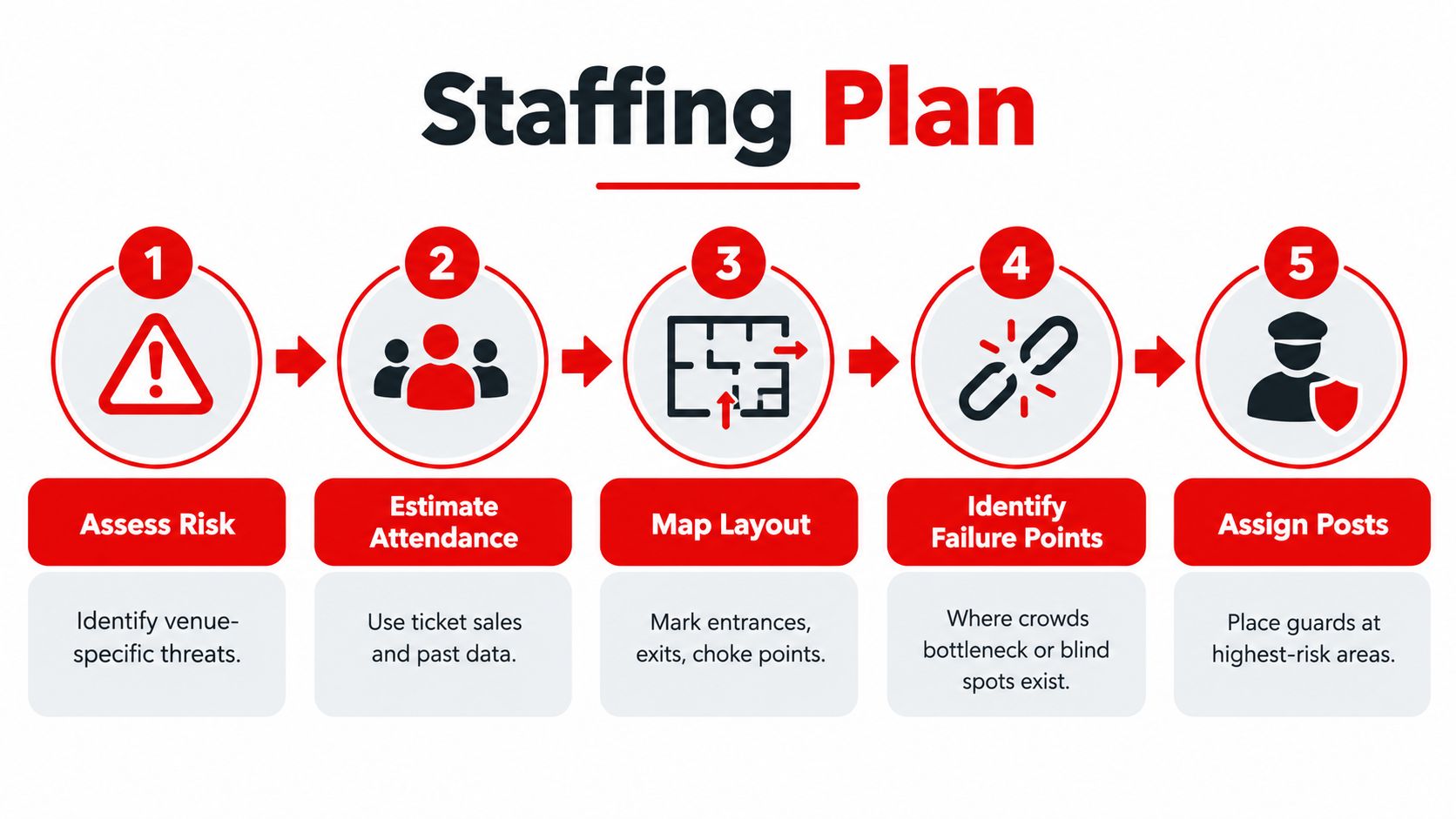
A staffing number without a venue plan is a guess. Attendance matters, but so do the number of entrances, the event layout, restricted areas, expected crowd movement, and periods when people arrive or leave together. Build the plan around specific posts and operating conditions, then check whether the proposed team can cover them.
Use ratios as a starting point, not an answer
U.S. fire-safety guidance provides a planning benchmark of one trained crowd manager or crowd-manager supervisor, with additional trained personnel at a ratio of one per 250 occupants when the occupant load exceeds 250. It also emphasizes establishing a safe capacity and maintaining a continuous count; local codes can be different or stricter, so check the requirements that apply to your venue (crowd-manager guidance).
That benchmark concerns crowd managers. It isn't a universal formula for how many event security guards you need. A guard responsible for screening, a patrol route, a restricted entrance, or an emergency assignment has a different post to cover. Use the benchmark as one reference point, then plan for the actual duties and layout.
Map posts to the conditions on the ground
Walk the site and mark where officers need to be at each phase: setup, guest arrival, peak attendance, program transitions, and departure. Focus on entry lanes, narrow corridors, stairs, stage areas, exits, vehicle-pedestrian crossings, and any door that connects public space to a restricted area. A post in an open space may look reassuring, but it won't help much if a gate or corridor is where movement is slowing.
Ask the provider for a deployment map and written post orders. These should identify each post's location, responsibilities, reporting line, and relief or handoff procedure. A useful planning package also includes radio protocol, supervisor coverage, contingency staffing, and an Event Action Plan that coordinates security with venue operations and responders.
If cost affects the staffing decision, compare the proposed scope and assumptions, not only the total price. The event security cost planning guide can help structure that discussion, but your deployment still needs to reflect your venue and event.
Recommendation: Require a venue walkthrough before you approve the final roster. A supervised team placed at predictable failure points is often more useful than officers spread evenly across areas that don't need the same level of attention.
Crowd Management Strategies That Actually Reduce Risk
Crowds move through routes, queues, doors, stairs, and gathering areas. Security planning should follow those movements. Position guards where people converge, where circulation narrows, and where an exit or route could become obstructed, instead of spreading officers uniformly just to make coverage look balanced.
Public-health review identifies a combined approach to crowd-flow management: one-way pedestrian flows, physical barriers, capacity or density limits, trained personnel at bottlenecks, real-time surveillance, drills, and clear audio or visual communication (review of crowd-flow measures). For event operators, the point isn't to add every measure automatically. It's to choose controls that fit the site and give guards specific actions to take.
Assign people to the pinch points
On a venue map, identify entrances, turnstiles, narrow corridors, stairs, front-of-stage areas, and emergency egress points. Place guards where they can see the flow and communicate with a supervisor or control point. Keep routes open and make it clear who can adjust a post when conditions change.
Give officers observable signs to report. Queue spillover, a blocked exit, counterflow, or a loss of room for people to move sideways is more useful information than a vague radio call that a crowd “feels busy.” Agree on location names or codes and make sure everyone uses them consistently.
Shift coverage as the event changes. A post that is essential during arrival may be less important once lines have cleared. A supervisor can move a floating officer toward a bottleneck, while retaining coverage for fixed responsibilities such as restricted access or an emergency exit. Those changes should follow the plan, not happen through informal guesswork.
Treat communication as part of crowd control
Clear signs and announcements help guests understand where to go. When people can't tell whether a route is open or where a queue starts, they may stop, turn around, or push into another stream of movement. Guards should be ready to direct guests and report when the planned route no longer works.
One gap in many plans is the distance between a risk assessment and a real post assignment. A plan may identify crowding as a concern without stating which officer watches a specific gate, what conditions trigger escalation, or who can change the layout. A recent athletics-security survey found common use of broad controls such as barriers, signage, public-address announcements, and staff direction, while staggered entry was reported by 13% of respondents; that finding points to the importance of translating a plan into event-specific movement decisions (athletics security survey).
For additional planning considerations, review the risks at events with the venue team. Then ask your provider for a deployment map that shows where each guard stands, what they monitor, and how coverage changes across event phases.
Entry Screening Approaches by Event Type
The screening method should fit the event's access rules, layout, guest expectations, and assessed risks. A private reception with a controlled invitation list doesn't need the same process as a public event with several gates. Decide what officers will check, explain the process to guests, and design the queue so screening doesn't block an exit or accessible route.
| Event Type | Recommended Screening | Guard Focus | Key Trade-Off |
|---|---|---|---|
| Corporate function | Ticket or invitation validation, visual check, credentialed access for restricted spaces | Confirming guest eligibility and keeping staff-only areas controlled | A discreet process supports hospitality, but unclear credentials can create access gaps |
| Private party | Guest-list check and visual inspection based on the event's policy | Courteous access management and attention to uninvited entry | A low-friction welcome can suit the event, but officers still need a clear escalation procedure |
| Concert | Ticket validation, bag check, and additional screening where the risk assessment supports it | Consistent checks, queue movement, and restricted-area access | More thorough screening can take longer and needs enough space and staffing |
| Festival | Ticket validation and screening at each public gate, with perimeter observation | Applying the same entry rules across gates and monitoring boundary access | Multiple gates improve distribution but make consistency and perimeter coverage harder |
| Sporting event | Ticket or credential validation with screening aligned to venue policy | Entry flow, restricted sections, and coordination with venue operations | High-throughput entry can conflict with detailed checks if the process is poorly designed |
| High-profile public gathering | Credential control and screening selected through a site-specific risk assessment | Separating access zones and coordinating escalation with event command | Stronger controls can add friction and require more planning for queues and communication |
These are planning options, not a substitute for a venue's requirements or a site-specific assessment. Visual inspection is relatively direct but depends on clear instructions and attentive officers. Bag checks add a physical screening step, which can slow entry if bag rules aren't communicated in advance. Wand or magnetometer screening may suit some events, but equipment, operator training, and queue space need to be considered before choosing it.
Credential checks and ticket-scan validation solve different problems. A ticket can confirm a guest's entry entitlement, while a credential can define access to a backstage, staff, or VIP area. Don't assume one proves the other. Tell guards what each credential permits and what to do when a guest has the wrong pass or no pass.
Whatever approach you choose, make the process usable on the ground. Post instructions where officers can refer to them, use signage to set guest expectations, shape queues away from exits and busy traffic routes, and designate a secondary screening area for cases that need a slower conversation.
The trade-off is practical: faster screening can reduce waiting, while additional checks may require more staffing and space. Choose the least complicated process that supports the event's access rules and security plan, and apply it consistently at every entry point.
Emergency Response Planning That Goes Beyond a Phone Call
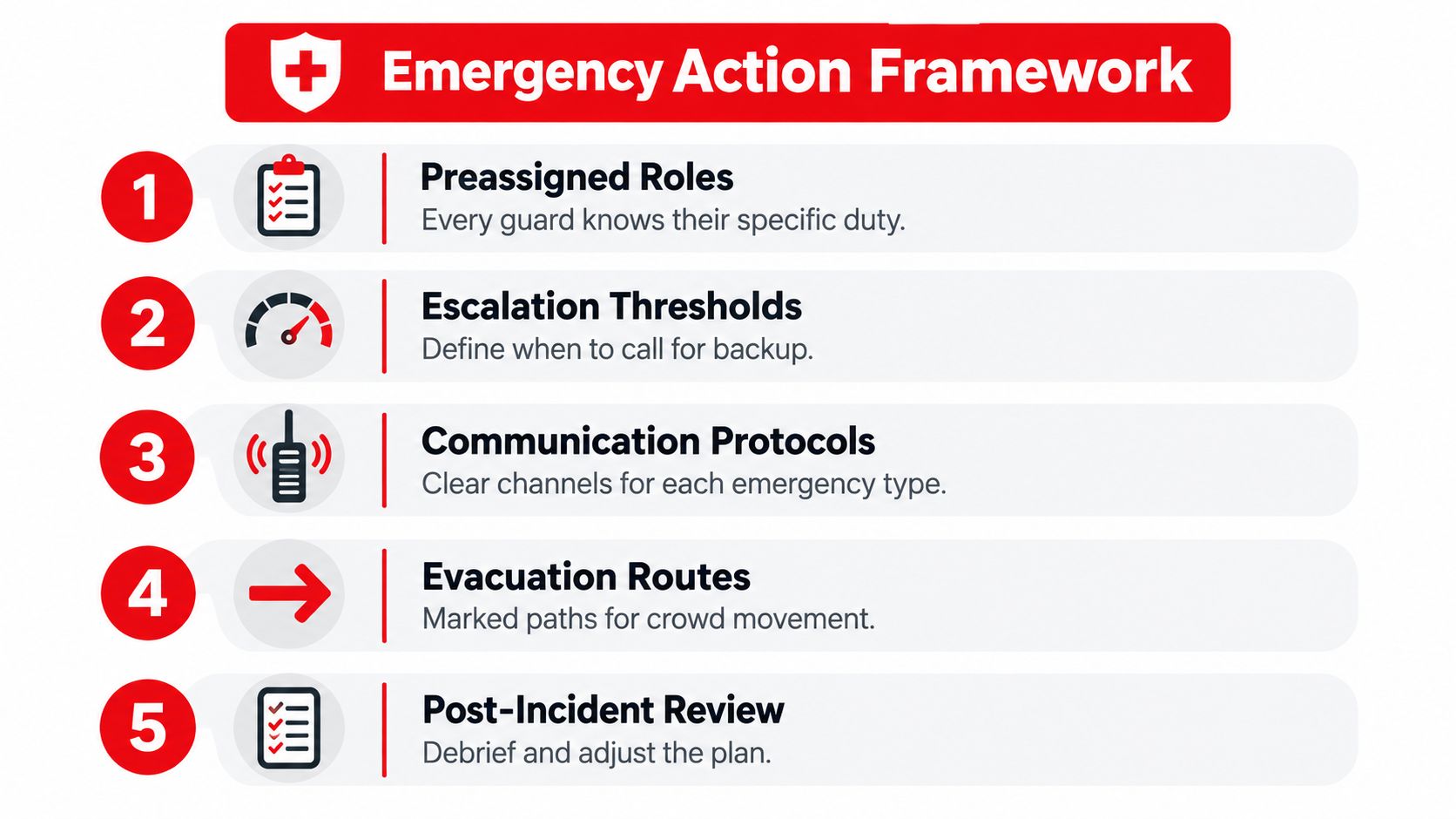
“Call someone if there's a problem” is not an emergency plan. Guards need preassigned roles, escalation thresholds, a radio protocol, and a clear point of contact. The plan should be written, briefed, and tested so officers aren't trying to work out who is in charge while guests need direction.
FEMA recommends that event contingency planning bring together a cross-functional team representing the organizations involved in emergency response. Its guidance also calls for a universal map or grid-reference system covering the event footprint, so event personnel and public-safety responders can identify locations consistently (FEMA contingency-planning guidance).
Write down the response, then rehearse it
FEMA's special-events planning materials identify access, ingress and egress, evacuation, weather, emergency medical services, security, traffic, crowd management, fire protection, communications, temporary structures, and a unified command post as subjects for coordination. They also recommend an Event Action Plan or Incident Action Plan and tabletop and field exercises before major events (FEMA special-events planning materials).
UK government guidance recommends risk assessments and tabletop exercises across the event lifecycle, including scenarios involving medical emergencies, missing persons, natural disasters, equipment failure, and communications loss. A site-specific briefing should cover entrances, exits, restricted zones, emergency equipment, casualty routes, communications channels, and the identity of the incident commander (government guidance for event security buyers).
Weather planning needs its own assigned responsibilities. Identify who monitors official information, the threshold for sheltering or pausing activities, backup communication methods, and the route guards should use to direct guests. The event-planning weather guide covers weather watchers, sheltering strategy, redundant communication, and drills.
A useful emergency framework gives every guard a defined role, tells them how to escalate, and names who coordinates with fire, medical, or law-enforcement responders. Before the event, test those arrangements in a tabletop exercise and confirm that the map, radio procedure, and decision authority are understood. For planning support, review emergency response security alongside the venue's procedures.
Building a Temporary Security Plan You Can Hand to a Partner
A temporary security plan should be something your provider can use, not a document that sits unread in an event folder. Walk the site, assess the risks, write the post orders, mark guard positions on a deployment map, brief the team, and document what happened afterward.
The plan should also account for how the provider supervises and supports officers. Overton Security provides event and temporary security services in California, with hands-on leadership, a low manager-to-client ratio, GPS-enabled guard tour management, digital activity reports, and oversight through a 24/7 Security Operations Center. Those systems can help connect written assignments with field reporting and supervisor follow-up.
Bring your security partner in early. Share the venue map and event schedule, then build the posts and procedures together instead of asking a team to improvise from a headcount just before doors open.
Overton Security provides event and temporary security coverage for corporate functions, private events, and public gatherings, with planning and field oversight built around the needs of each site. If you're organizing an event in California, share your venue layout and event details with Overton Security to discuss a practical deployment plan.