A facilities director can have a full security post at the emergency department entrance and still find the team unprepared when a patient's visitor becomes agitated overnight. The issue may not be a shortage of guards. It may be unclear roles, weak communication with clinical staff, or a deployment plan that puts officers in the wrong places.
That's the central question for security guards for hospitals: not how many officers to schedule, but how to deploy, train, and evaluate them so they reduce harm without disrupting patient care. The answer starts with treating security as part of the hospital's safety system, not a conventional guarding contract.
Why Hospital Security Is a Different Discipline
At 2 a.m., an emergency department is busy, a visitor is becoming louder, and a nurse is trying to keep care moving while other patients watch. The officer's task isn't just to remove a disruptive person. They need to assess what's happening, communicate with clinical staff, protect people nearby, and choose a response that doesn't escalate the situation unnecessarily.
Hospitals create a distinct operating environment. Emergency departments, behavioral-health units, pharmacies, laboratories, parking areas, and public entrances all have different access needs and risks. The facility stays open around the clock, and patients may be frightened, confused, intoxicated, or in crisis. A security plan designed for an office lobby or retail property won't automatically work on a medical campus.
The American Hospital Association, citing Bureau of Labor Statistics data, reported that U.S. hospitals employed 49,280 security guards in 2023. These personnel may support access control, patrols, visitor management, emergency response, incident reporting, and protection of patients, staff, and property. The figure describes hospital employees, not all security staff across clinics, nursing homes, and other healthcare settings. The AHA's report on violence affecting U.S. hospitals provides context for the scale and operational importance of this work.
Security presence alone doesn't establish whether a program is effective. The true test is whether officers understand the clinical environment, know when to involve nurses, and can respond consistently without turning every disturbance into an enforcement event. For a closer look at how connectivity and hospital operations intersect, Purple's Hospital Angeles WiFi case study offers useful context about the connected hospital environment.
Hospital administrators considering healthcare security services should start with that operating reality: officers are part of a wider safety system, alongside clinical teams, facilities staff, emergency procedures, and law enforcement.
What a Hospital Security Officer Actually Does
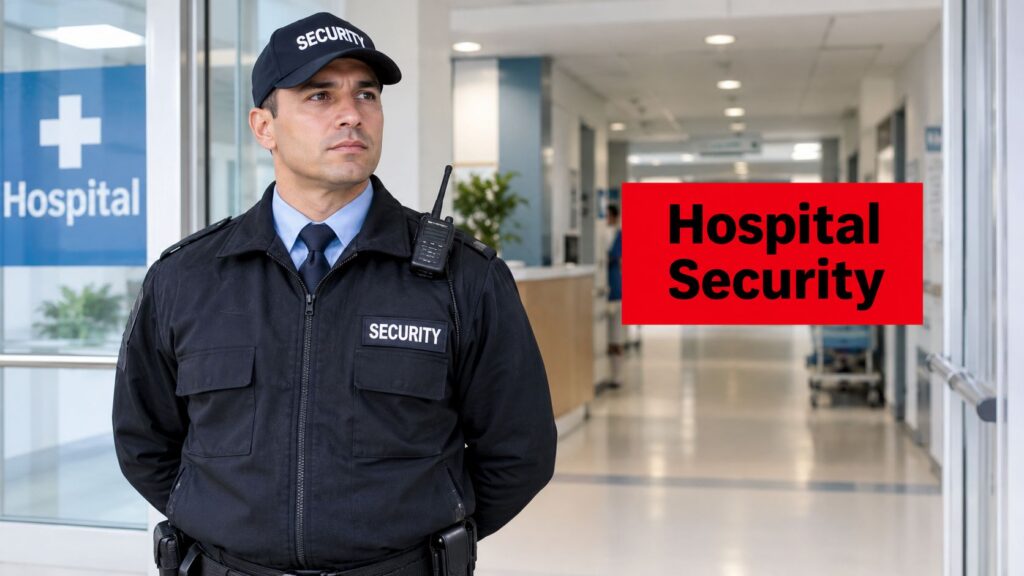
A hospital security officer's responsibilities extend well beyond standing at an entrance. The role combines prevention, communication, observation, and response, all while respecting that clinical staff lead patient care.
At entrances and restricted units, officers manage access procedures, screen visitors according to facility policy, and help staff maintain appropriate boundaries. That requires judgment. A visitor who needs directions, a distressed family member, and someone attempting unauthorized entry may all approach the same desk, but they don't call for the same response.
Across the campus, officers patrol clinical floors, parking structures, and other designated areas. They look for safety concerns, respond to calls, and stay familiar with the layout so they can reach an incident and guide others through the facility. Patrols should reflect the site's actual needs rather than follow a generic route copied from another property.
When behavior escalates, officers should use communication and de-escalation skills and bring in clinical staff promptly. In behavioral-health situations, security may provide support during a crisis or assist with a restraint, but only within the hospital's procedures and under clinical direction. Security officers don't diagnose, decide treatment, or replace a nurse's clinical judgment.
Operational rule: The officer manages the security risk. The clinical team leads patient care. A protocol should make that division clear before a call comes in.
Officers also document incidents and coordinate with nursing, environmental services, and law enforcement when needed. A useful report records what was observed, what actions were taken, who was notified, and what happened next. That record gives supervisors and hospital leaders something concrete to review, rather than relying on recollections after a difficult shift.
Choosing the Right Staffing Model for Your Facility
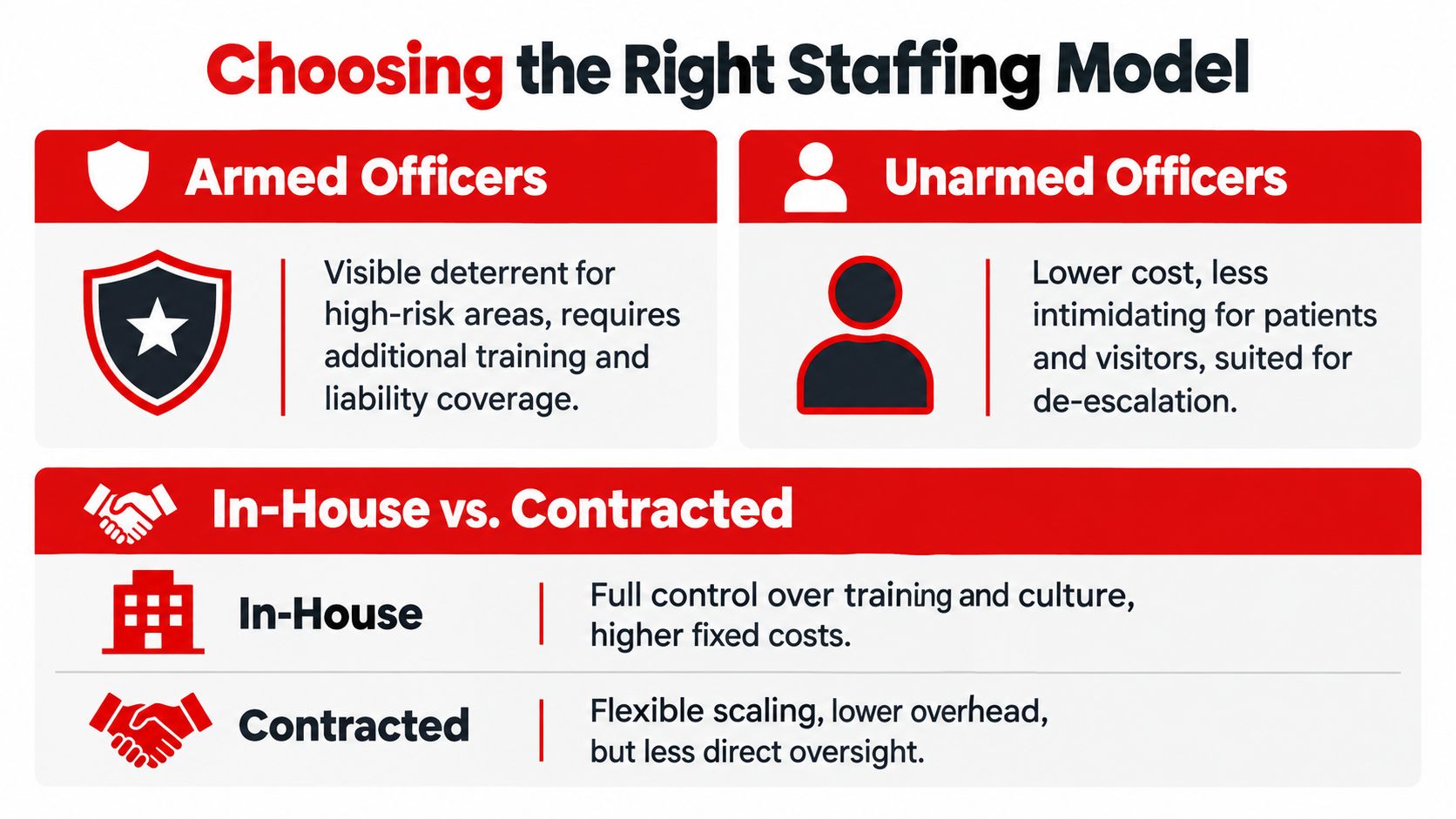
There's no single staffing model that fits every hospital. A small facility with limited public access doesn't have the same coverage needs as a large medical center with busy emergency and behavioral-health services. Set the model by weighing facility layout, emergency-department volume, patient population, incident history, and the posts that must remain covered.
A peer-reviewed study of 52 New Jersey hospitals, based on interviews with 35 safety and security professionals, found that 75% managed security through an in-house team, while 10% reported contracting security to a private agency. Reported staffing ranged from 4 to 200 officers per hospital, and 56% had at least 50 officers. The study also found that 96% had a violence-prevention committee, while 56% reported using data to assess violent incidents and security responses. These findings describe participating New Jersey hospitals, not a universal rule for every facility. The study's findings on hospital security organization and staffing underline why buyers should evaluate both coverage and program oversight.
| Decision | When it may fit | What to examine |
|---|---|---|
| Armed or unarmed officers | Consider the facility's assessed risks and applicable policies, not the desire for a visible deterrent alone. | Training, escalation rules, patient and visitor experience, and the hospital's review of the risks involved. |
| In-house or contracted team | An in-house department offers direct control; a contractor may offer flexibility in arranging coverage. | Who supervises officers, how training aligns with hospital procedures, and how performance is reviewed. |
| Dedicated posts or roving patrols | Fixed posts support continuous coverage at critical locations; patrols provide presence across a broader area. | Which posts cannot be left unattended and where mobile coverage adds value. |
| Full-time or flex staffing | Core staffing provides continuity; per-diem or flex coverage can help address changing schedules and needs. | Whether coverage remains dependable across shifts and whether staff know local procedures. |
Don't choose by headcount alone. The same study found that staffing levels varied considerably, and that having a violence-prevention committee didn't always mean the hospital used incident data to assess performance. Ask bidders to explain how their proposed posts and shifts match your documented risks, and how they'll adjust coverage when patterns change.
Training and Certifications That Actually Matter
A general guard credential doesn't prove that an officer can work effectively in a hospital. Buyers should ask for a training plan tied to the situations officers will face, and a way to verify that people can apply the training under pressure.
At minimum, the program should address:
- De-escalation and communication: Officers should practice calm, clear communication and learn how to avoid actions that unnecessarily intensify a confrontation.
- Behavioral-health awareness: Training should help officers recognize when clinical staff need to lead and how to support a response without confusing security duties with care.
- Trauma-informed interaction: Officers need to account for how distress, fear, or past experiences can shape a person's response.
- Dementia and substance intoxication: Include scenarios that teach officers to seek clinical input and avoid treating confusion or impairment as simple noncompliance.
- Restraint and legal limits: Officers should understand hospital rules, least-restrictive interventions, when clinical direction is required, and when they must not act.
- Clinical handoffs and Code Black participation: Staff should know who communicates what, how officers are called, and what role security plays during the facility's high-risk response.
The World Health Organization reports that between 8% and 38% of health workers experience physical violence at some point in their careers, while many more face threats or verbal aggression. WHO's overview of violence against health workers makes clear why hospitals need training that addresses both prevention and response, not just access control.
Training needs refreshing, but a calendar alone isn't proof of competence. Use scenario-based practice, supervisor observation, and documented assessments to check whether an officer can communicate, request assistance, and follow the hospital's escalation procedure. Set the refresh schedule according to the facility's policies, training requirements, and lessons from incidents. Review private security officer training as one resource when comparing how providers describe preparation and instruction.
How Technology Strengthens the Officer in the Field
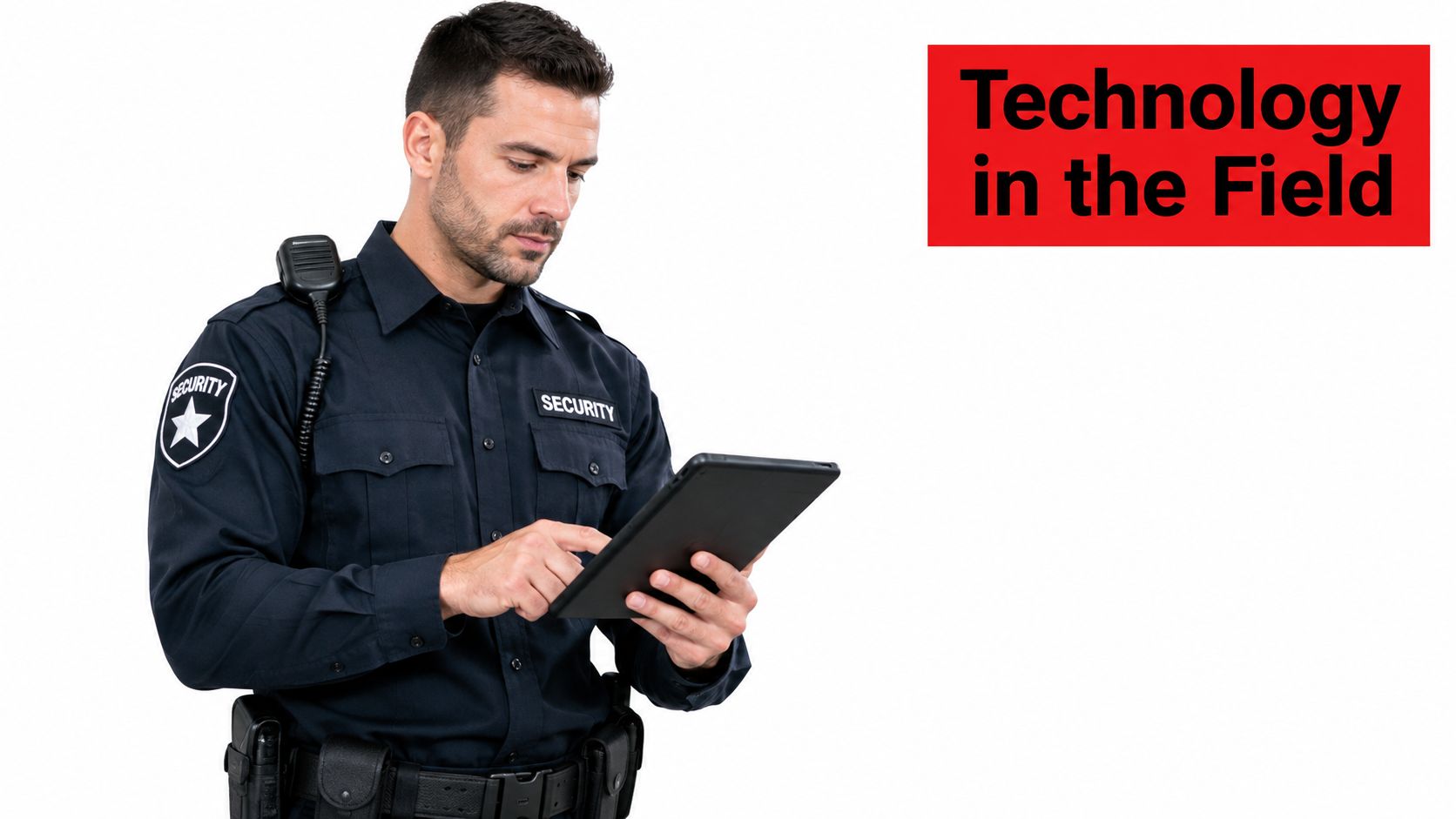
Technology should give officers and supervisors better visibility, not pretend to make judgment calls for them. Cameras, guard tour tools, digital reports, and a staffed operations center can help confirm what happened, identify missed checkpoints, and get support to an officer. They're useful when each tool has a defined job and someone reviews its output.
CCTV gives security and authorized hospital personnel a way to assess an unfolding situation, support dispatch, and preserve relevant footage for review. Video analytics can flag activity for human assessment, but an alert isn't a verdict. Officers still need to verify what's happening and follow the hospital's procedures.
GPS-enabled guard tour management can document patrol checkpoints and show supervisors whether officers completed assigned rounds. Digital daily activity reports and incident reports can include timestamps, photographs, notifications, and follow-up details. A 24/7 security operations center (SOC) can monitor activity, dispatch support, conduct officer wellness checks, and escalate calls when the situation warrants it.
Tools should serve an operational purpose. A checkpoint record can help a supervisor identify a missed patrol. A timestamped report can help reconstruct the order of events. A video review can clarify whether a response followed the post orders. None of those tools, on their own, establishes that the response was appropriate or that patient care was protected.
Hospitals also need a clear connection between security communications and clinical workflows. For background on call systems and how they fit into a care environment, Wisenet Security Ltd.’s guide to call nurse systems is a useful point of reference. For physical entry procedures, hospital access control systems should be planned around the hospital's restricted areas and visitor processes. Overton Security uses GPS-enabled patrols, digital reports, and SOC oversight as operational tools, alongside human supervision and site-specific procedures.
Building a Defensible Incident Response Protocol
A protocol works when officers, nurses, supervisors, and law enforcement understand their roles before an incident. Don't leave authority, communication, or handoffs to interpretation during a crisis. Put the expectations in post orders and review them with the people who will use them.
Start with a facility-specific plan:
- Clarify roles before an event. Identify who calls security, who leads patient care, who communicates with visitors, and when a supervisor or law enforcement should be contacted.
- Set escalation and communication rules. Define how staff request help, what information dispatch needs, and how updates reach the clinical team during a Code Black or another high-risk event.
- Specify intervention limits. Explain when officers may assist with restraint, who directs that action, and how the hospital's least-restrictive-intervention standards apply.
- Plan handoffs and documentation. Set out how officers transfer relevant information to clinical staff, emergency services, or law enforcement, and what details must be recorded.
A separate study of one urban U.S. Level I trauma center documented 300 violent incidents involving security officers over seven months and 19 reported officer injuries over one year. Across the institution's 11-year comparison, officers had an injury rate 13 times that of nursing staff. Incidents concentrated at night, and officer injuries occurred most often in psychiatric departments. These findings from one institution shouldn't be applied as a forecast for every hospital, but they reinforce why post orders and coverage plans need to reflect local patterns. The study of security-officer violence and injuries also supports clarifying roles with clinical teams before an incident occurs.
Customize procedures to the hospital's layout and risk profile. Preserve relevant records, follow applicable privacy and evidence-handling rules, and document notifications and follow-up. A protocol copied from another site may use different names for units, routes, alarms, and decision-makers. Test yours with the actual people expected to respond.
KPIs That Reveal Whether the Program Is Working
A guard's presence isn't a performance measure. Facilities directors need a scorecard that connects deployment and officer behavior to safety, patient experience, and operational follow-through. Track patterns over time, then use them to decide whether coverage, procedures, or training needs to change.
Useful indicators include:
- Response time: Measure the time between a call and officer arrival, and review whether delays cluster by shift or location.
- Restraint use: Track restraint events and review the circumstances, clinical involvement, and whether less restrictive options were considered.
- Repeat-incident locations: Identify recurring locations and times, then examine whether post placement or unit procedures need adjustment.
- Injury rates: Review injuries to officers and staff, along with the circumstances and response actions.
- Staff perceptions and patient complaints: Ask whether people feel safer and whether security interactions are creating avoidable friction.
- De-escalation outcomes: Record whether officers resolved situations without restraint or further escalation, using consistent definitions.
- Reporting completeness: Check whether reports capture the event, actions taken, notifications, injuries, and follow-up.
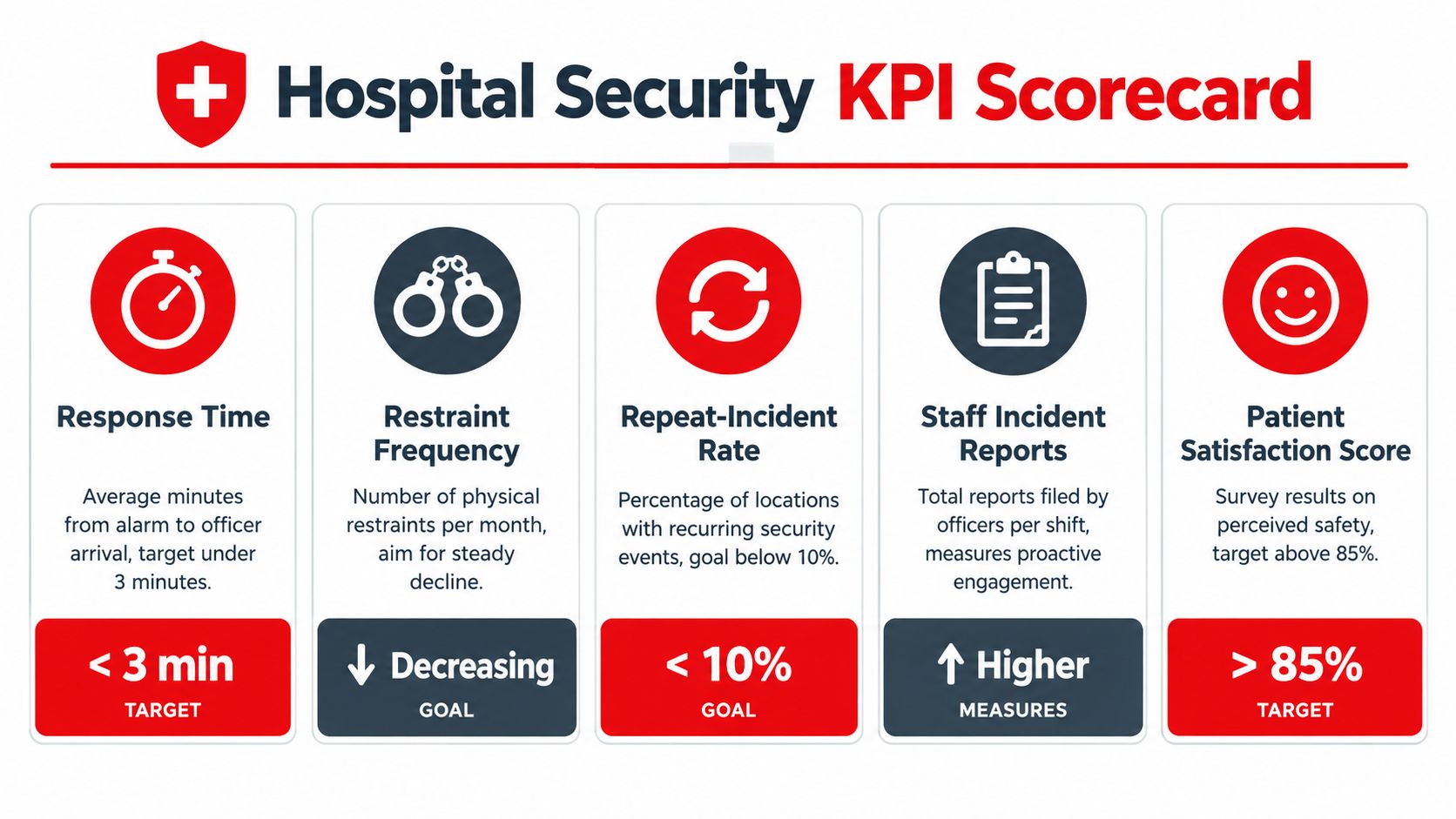
The figures are useful only when the hospital acts on them. If recurring calls gather around one unit, review post orders, staffing at relevant times, and staff access to assistance. If injury reviews point to a particular response gap, use that finding to shape coaching and scenario practice. If reports are incomplete, fix the process before treating the data as a dependable basis for decisions.
OSHA identifies five building blocks for an effective healthcare workplace-violence prevention program: management commitment and employee participation, worksite analysis, hazard prevention and control, safety and health training, and recordkeeping with program evaluation. OSHA's workplace-violence prevention guidance provides a practical framework for connecting security reporting to wider workplace-safety reviews. Use the scorecard as a management tool, not a set of targets detached from patient care.
Selecting a Hospital Security Partner You Can Trust
Use your request for proposal and contract review to test how a provider will work inside the hospital, not just what posts it can fill. Ask for clear answers about staffing, supervision, training, incident reporting, and how the provider will coordinate with clinical leadership.
A practical vendor review should cover these points:
- Training: Ask how officers learn de-escalation, behavioral-health awareness, restraint limits, clinical handoffs, and site procedures. Request a description of how competence is assessed and refreshed.
- Supervision: Find out how often managers visit the site, who handles escalations, and how the provider keeps account oversight responsive.
- Retention and support: Ask how the provider supports officers and maintains continuity. A revolving roster makes it harder for staff to build familiarity with the hospital's layout and procedures.
- Customization: Require post orders designed for your campus, units, entrances, and documented incident patterns.
- Technology and reporting: Review sample reports and ask how patrol records, incidents, photographs, and escalations reach hospital decision-makers.
- Compliance coordination: Confirm how the provider will align officer duties and training with California Title 8, Section 3342, and the hospital's workplace-violence prevention plan. California requires healthcare employers to maintain an effective plan in every unit, service, and operation. Training must address reasonably expected risks, recognizing potential violence, seeking assistance, alerts and alarms, escape or shelter locations, the role of private security, and reporting violent incidents to law enforcement. California's Title 8, Section 3342 requirements set out the relevant obligations. OSHA's program elements offer a complementary framework for evaluating prevention and review practices.
- Relevant references: Speak with comparable facilities about communication, staffing continuity, and how the provider responded when plans had to change.
Don't reward a proposal for promising a large headcount if it can't explain where officers will be placed, who supports them, or how leaders will judge results. A provider should be able to discuss the trade-offs clearly and show how its service will fit the hospital's clinical and operational requirements. For readers comparing broader security services across locations, Nutmeg Technologies' overview of managed IT security options in Portland is an example of how to examine security offerings in a different operational context.
Overton Security is a California-based provider with more than 26 years of experience, a low manager-to-client ratio, hands-on leadership, and an emphasis on supporting and retaining professional officers. Its programs combine human oversight with tools such as GPS-enabled patrols, detailed digital reports, and 24/7 SOC oversight. Evaluate those capabilities against your hospital's needs, just as you should with any prospective partner.
Overton Security can help California healthcare facilities plan onsite coverage, patrols, access control, and accountable reporting around their campus and operating needs. Bring your current post orders and priorities to a conversation with Overton Security, and discuss a hospital security program built to support staff and patients without disrupting care.