A property manager can check a guard's registration, confirm the uniform is ready, and still feel uncertain when the first overnight shift begins. The officer may be assigned to a parking garage in Los Angeles, a residential lobby in San Jose, or a construction entrance in Long Beach, yet the key question is the same: can this person make sound decisions at this specific site?
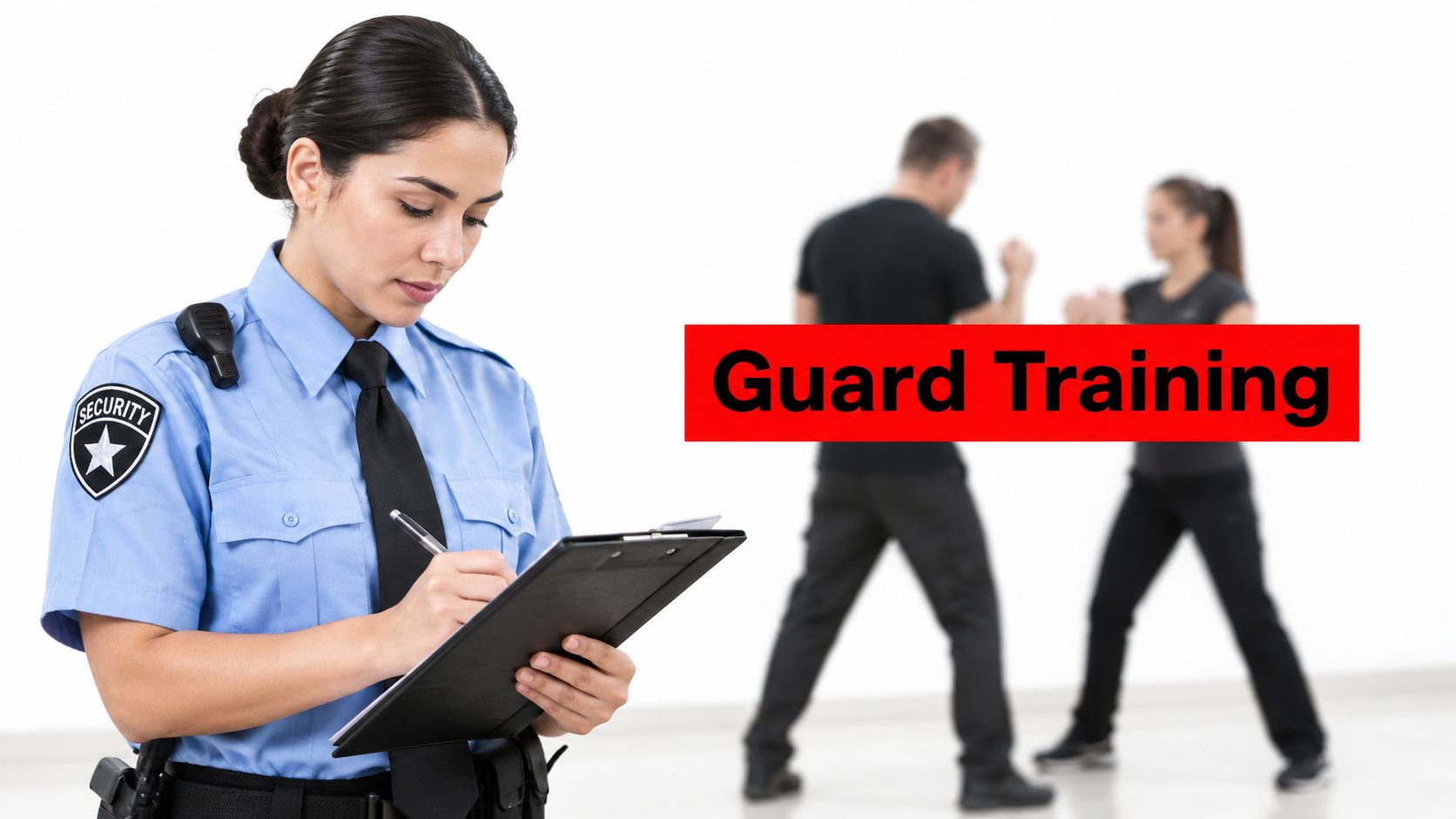
That question reaches beyond a guard card. Effective unarmed security guard training combines legal instruction with observation, communication, de-escalation, emergency response, documentation, supervision, and repeated practice in realistic conditions.
Why a Guard Card Is Only the Starting Line
At 11 p.m., a property manager stands in a parking garage and watches a newly assigned officer settle into a checkpoint booth. The manager already checked the registration. The paperwork is in order, but the officer hasn't yet demonstrated whether they know which doors require inspection, how to handle a resident who refuses access instructions, or when to call for help instead of trying to resolve a conflict alone.
That uncertainty is reasonable. A state-issued registration confirms that an officer has met a legal training requirement. It doesn't prove that the officer understands a particular property's access points, emergency contacts, patrol routes, reporting standards, or tenant expectations.
California offers one of the clearest regulatory benchmarks for unarmed officers. The state establishes a minimum 40-hour initial training framework, followed by 8 hours of continuing training every year, including at least 2 hours reviewing appropriate-use-of-force topics. The framework creates a measurable floor, not a complete definition of readiness. California BSIS explains the guard registration and training requirements.
What the license cannot answer
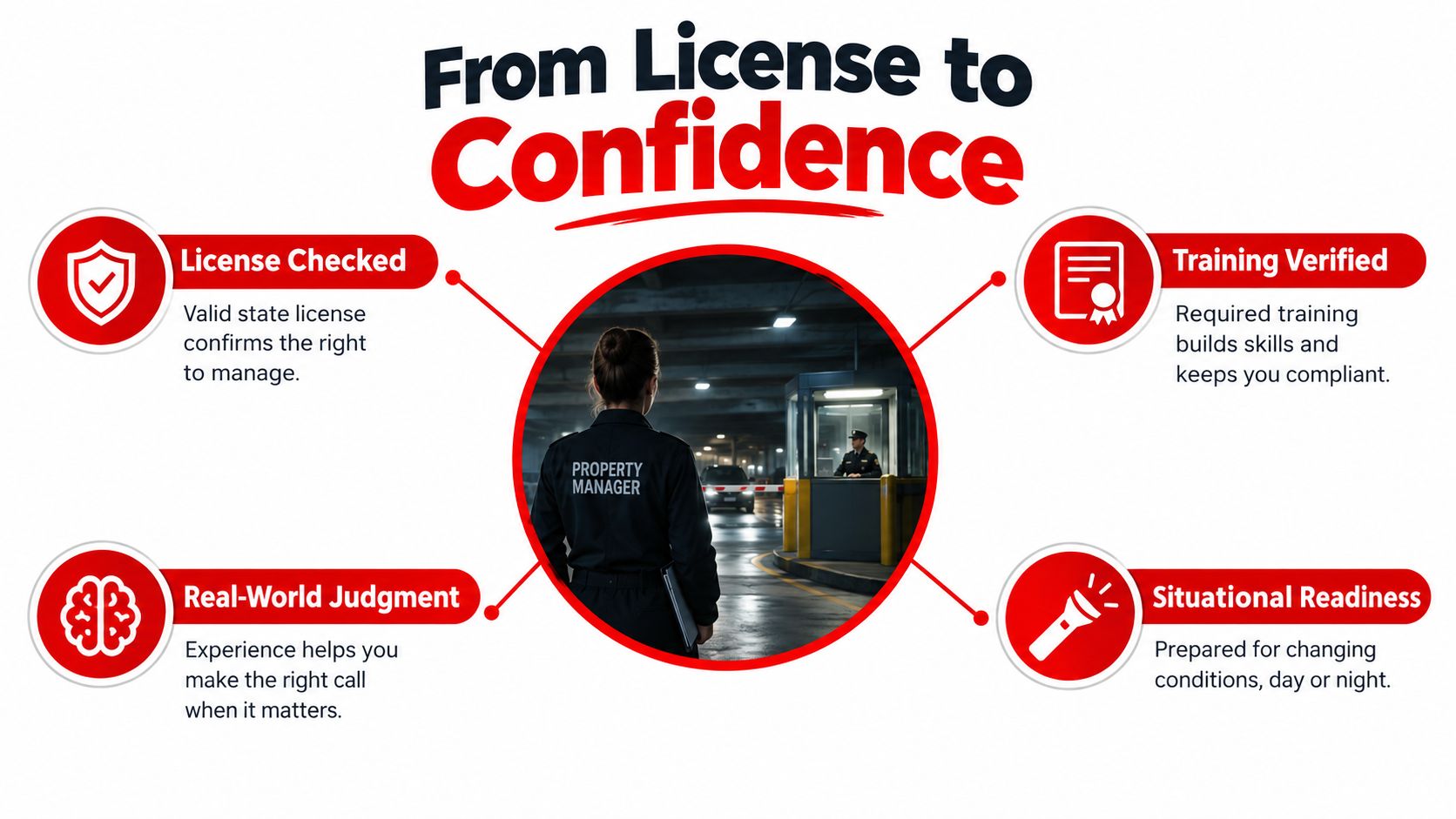
A license doesn't tell a property manager whether an officer can:
- Apply post orders: Follow the actual access-control, patrol, visitor, and key-control procedures for the property.
- Communicate under pressure: Give clear lawful directions without escalating a resident, customer, patient, employee, or trespasser.
- Recognize changing risk: Notice a blocked exit, suspicious vehicle, medical emergency, aggressive behavior, or unsafe condition before it becomes a larger problem.
- Document usable facts: Produce a time-ordered report with names, observations, actions, notifications, and supporting photographs when appropriate.
- Work with the operating team: Coordinate with building engineers, facilities staff, remote-monitoring personnel, emergency responders, and site leadership.
The difference matters across residential, retail, healthcare, commercial, and construction properties. A residential high-rise needs hospitality and conflict-management judgment. A healthcare campus needs calm communication around vulnerable people and medical distress. A construction site needs disciplined perimeter checks, equipment awareness, and clear escalation procedures.
Property managers should ask a security partner for more than a copy of a registration. Request the officer's completed training record, site orientation checklist, post orders, supervised-training documentation, drill evaluations, and refresher schedule. California guard licensing information can help managers understand the regulatory starting point, but the hiring decision should also examine how the provider turns that baseline into daily performance.
Practical rule: A guard card proves eligibility to work. A documented site qualification shows whether the officer has been prepared for your property.
Training quality also depends on what happens after the classroom. Scenario realism, direct supervision, officer stability, and incident review usually reveal more about operational readiness than a proposal that advertises a large training-hour figure.
California's Required Curriculum Step by Step
California's training model is staged. That matters because a property manager shouldn't treat registration as the final checkpoint in onboarding.
Start with legal authority
The initial curriculum begins with a 3-hour Power to Arrest course. It addresses legal considerations, arrest techniques, liability, and employer requirements. The subject is important for unarmed officers because their authority isn't the same as police authority. They need to understand the limits of intervention, the importance of lawful communication, and when to disengage or contact law enforcement.
The next required course is 5 hours of Appropriate Use of Force. It includes a written examination, and the guard must score 100 percent to successfully complete it. California BSIS training requirements describe the Power to Arrest and Appropriate Use of Force courses.
Complete the remaining initial instruction
Together, those courses account for 8 hours before registration. After registration or employment, newly registered or employed guards must complete 32 additional hours of security-officer-skills training within the first 6 months, creating the minimum 40-hour initial framework.
The schedule is deliberately spread out. Some instruction must occur within 30 days of registration or employment, while the remaining courses must be completed during the first six months. This prevents employers from treating the initial classroom requirement as a one-time event that ends before the officer has encountered the realities of a post.
The security-officer-skills portion should connect legal principles to practical duties such as:
- Observation and patrol: Recognizing unusual activity, checking defined areas, and maintaining attention without becoming fixed on one location.
- Communication and public relations: Interacting professionally with residents, customers, employees, visitors, and emergency responders.
- Report writing: Recording facts, times, actions, notifications, and evidence in a form supervisors and clients can use.
- Emergency response: Following site procedures for fire, medical events, hazardous conditions, alarms, and evacuation support.
- Assignment procedures: Learning the property layout, access rules, radio channels, contact list, and escalation path.
For a provider, the timing affects scheduling and supervision. A new officer may be legally eligible for an assignment while still completing the broader skills curriculum. The employer must therefore track what has been completed, what remains due, and which duties the officer has been qualified to perform.
A property manager evaluating a proposal should ask for the training dates, course names, instructor or provider information, examination records where applicable, and a plan for completing the remaining skills instruction. Private security officer training resources can help clarify what should sit beyond the initial registration requirement.
Core Skill Domains Every Unarmed Officer Builds On
A licensed officer becomes useful at a site by repeatedly applying a small set of practical skills. The U.S. Bureau of Labor Statistics reports that a high school diploma was required for 87.4% of security guards, which reinforces the role of structured employer training in developing judgment, communication, and documentation after hiring. BLS Occupational Requirements Survey data for security guards.
Observation without tunnel vision
Observation isn't staring at a camera feed or walking the same route mechanically. An officer learns to establish a normal pattern, notice changes, and verify conditions without abandoning the rest of the property.
At a Class A lobby, that might mean noticing an unfamiliar person following a resident through a controlled entrance while still maintaining awareness of the reception area. At a distribution yard, it could mean identifying an open gate, a damaged lock, or activity near a trailer row and reporting it before making an unsafe approach.
Communication within legal limits
An effective officer gives instructions that are clear, calm, and supportable. The officer should know what the property rules require, what the officer can lawfully direct, and when the matter belongs with a supervisor, site representative, or law enforcement.
A retail officer may need to address a customer dispute without turning a service complaint into a confrontation. A residential officer may need to explain visitor procedures to a frustrated guest. In both cases, tone, distance, listening, and precise language matter as much as authority.
Documentation that survives review
A report should let someone who wasn't present reconstruct what happened. It should separate direct observation from statements made by others, identify notification times, describe actions in sequence, and preserve relevant photographs or video references.
That standard matters after a slip, a property-damage complaint, a workplace conflict, or an access-control failure. Vague phrases such as “everything was handled” don't give a client, claims adjuster, investigator, or supervisor enough to evaluate the event.
Emergency response and customer service
Unarmed officers often serve as the first organized presence during a fire alarm, water leak, medical event, elevator problem, or suspicious condition. They don't replace firefighters, paramedics, building engineers, or police. Their value comes from recognizing the issue, protecting people from avoidable exposure, communicating accurate information, and following the site plan.
Overton's security officer skills training reflects this broader view of the role. The officer at a healthcare campus, office building, residential high-rise, or construction entrance must combine attentiveness with service, restraint, and reliable reporting.
A professional unarmed officer doesn't try to win every interaction. The officer creates time, information, distance, and access to the right help.
From License to Site-Ready Qualification
A license answers a legal eligibility question. Site-ready qualification answers an operational question. Property managers need both.
Federal occupational guidance notes that many states recommend approximately 8 hours of pre-assignment training, 8 to 16 hours of on-the-job training, and 8 hours of annual training, while also emphasizing that actual training varies by employer, assignment, and jurisdiction. BLS guidance on security guard training.
That employer-provided layer is where officers learn the details that make a post function. They learn which doors are restricted, where patrol checkpoints sit, which alarms require immediate escalation, who receives a report, how to manage keys, and how to coordinate with a remote-monitoring team.
| Stage | What is Covered | Delivered By | Documentation to Request |
|---|---|---|---|
| License and required coursework | Legal authority, limits, appropriate use of force, and foundational guard responsibilities | Approved training provider and regulatory process | Registration status, course completion records, and examination documentation where applicable |
| Pre-assignment preparation | Property risks, post orders, equipment, communication procedures, and basic emergency actions | Security employer and site leadership | Training matrix, orientation checklist, and signed post-order acknowledgment |
| On-the-job qualification | Access control, patrol routes, reporting workflow, escalation contacts, and assignment-specific judgment | Supervisor, field trainer, or qualified site lead | Supervised shift record, drill evaluation, and qualification sign-off |
| Continuing development | Refresher topics, incident trends, recurring errors, and changes to site procedures | Security employer, trainer, and client operations team | Annual training record, refresher calendar, and updated competency evaluation |
Post orders are working documents
A useful post order doesn't merely state “patrol the property.” It identifies the areas to check, the conditions to report, the people to contact, and the response expected for common events. It should be updated when the property layout, tenant mix, access system, construction phase, or emergency plan changes.
A training matrix should then map each officer to the required modules and qualification dates. For a multi-site portfolio, the matrix should distinguish general training from site-specific orientation. An officer qualified at a residential property isn't automatically qualified for a healthcare campus or construction yard.
The headline number of classroom hours can be useful for compliance, but it shouldn't be the only selection criterion. A provider with realistic drills, active supervision, reliable records, and stable staffing may produce stronger performance than a provider that advertises more hours without showing how officers were evaluated.
Teaching De-Escalation as a Practiced Discipline
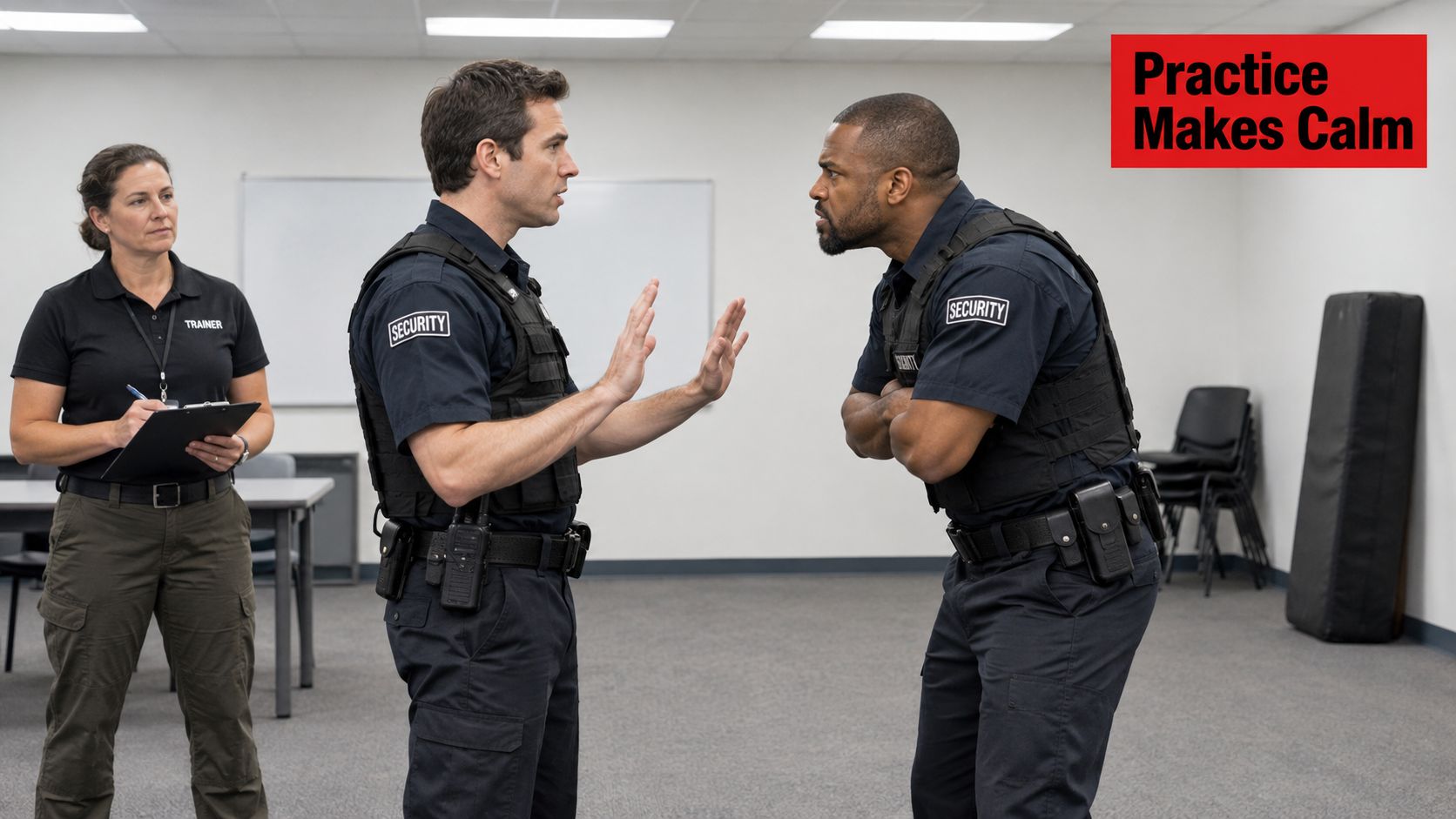
Many programs list de-escalation as a topic. Fewer show how officers perform when a resident is shouting in a lobby, a retail customer refuses to leave, a person appears to be experiencing a mental-health crisis, or a domestic dispute spills into a common area.
A 2025 workplace-violence-prevention survey reported that 69% of organizations did not provide frequent de-escalation training, while only 40% trained security personnel and patient-facing staff in the context described by the report. The 2025 workplace-violence-prevention report illustrates why a topic listed in a course catalog isn't the same as a practiced capability.
Build scenarios around the actual post
A useful drill gives the officer a recognizable situation and a defined objective. The trainer can then evaluate whether the officer:
- Assesses the threat: Identifies behavior, environmental hazards, vulnerable people, exits, barriers, and available support.
- Uses professional language: States the relevant rule or request without insults, threats, unnecessary argument, or promises the officer can't keep.
- Maintains safe positioning: Keeps distance, avoids being trapped, preserves an exit route, and uses barriers where available.
- Calls for support: Uses the radio correctly, provides location and conditions, and activates backup or emergency notification at the defined trigger.
- Documents the sequence: Records what was observed, what was said, when help was requested, who responded, and what happened afterward.
A scenario involving a mental-health crisis or medical distress also requires risk assessment and safety planning, not just conversational technique. The linked guidance from ProMed Certifications on risk assessment and safety planning provides useful context for organizations building crisis-response procedures.
Know what happens when words aren't enough
De-escalation can fail. When it does, an unarmed officer should not improvise police powers or pursue a physical solution to appear decisive. The response should emphasize distance, barriers, protection of vulnerable people, timely dispatch or emergency notification, clear radio updates, and preservation of evidence.
Property managers should ask a provider how often these drills occur, what the pass criteria are, who evaluates the officer, and how incident reviews feed retraining. They should also ask what support follows a difficult event. An officer may need a supervisor review, a documented debrief, schedule adjustment, or additional practice rather than a simple reminder to “stay calm.”
Evaluation standard: Don't ask whether an officer has heard of de-escalation. Ask the officer to demonstrate the first safe action, the backup trigger, the radio message, and the report that follows.
Refresher Training Built Around Real Risk Patterns
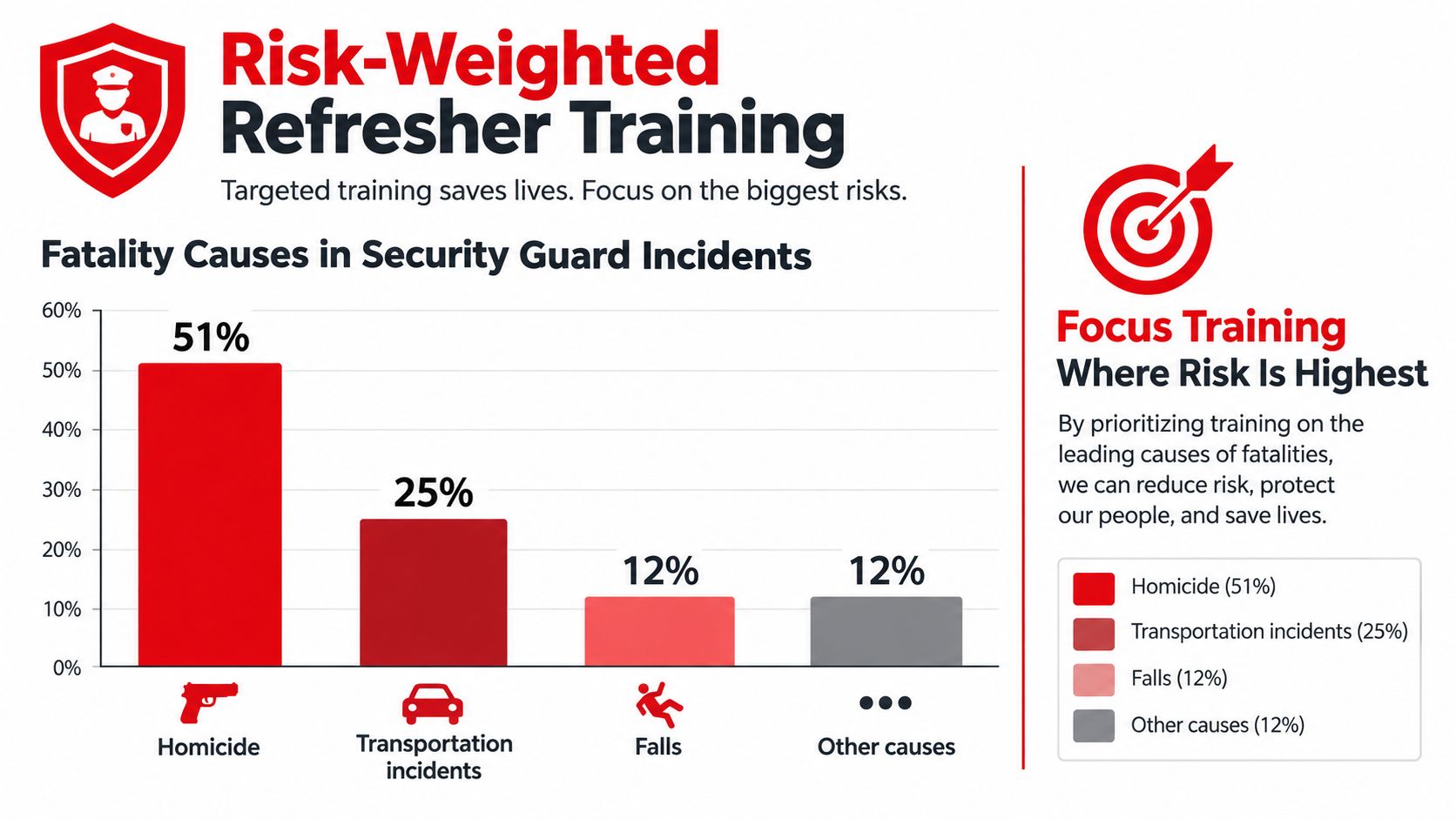
Annual training shouldn't distribute time evenly across every subject. It should reflect how officers are exposed to harm and where recurring operational failures appear.
BLS data reported a 9.4-per-100,000 fatality rate for security guards in 2007, with homicide accounting for 51% of guard fatalities. The same analysis found that falls were the leading event among injuries requiring days away from work, at 27.5 per 10,000 full-time workers. BLS data on security guard injuries, illnesses, and fatalities.
Prioritize night-shift readiness
The same BLS analysis reported that roughly 40% of nonfatal assaults with recorded incident times occurred between 8:00 p.m. and 4:00 a.m., while approximately two-thirds of fatal assaults with recorded times occurred during that period. Those findings support practical night-shift drills rather than generic reminders.
Refresher scenarios should include:
- Low-light patrol: Using lighting, maintaining visibility, and avoiding blind approaches.
- Safe positioning: Keeping an escape route, using cover or barriers, and maintaining a defensible distance.
- Radio discipline: Transmitting location, behavior, and requested support clearly under pressure.
- Welfare checks: Following a defined rule for contact, observation, escalation, and emergency notification.
- Fatigue controls: Recognizing reduced alertness and reporting conditions that could compromise safe performance.
- Slip and trip inspections: Identifying wet floors, uneven surfaces, poor lighting, debris, and blocked walkways.
Measure performance, not attendance
A signed attendance sheet doesn't show whether an officer can apply the training. A scenario evaluation should ask whether the officer identifies the hazard, summons help, maintains distance, issues lawful verbal directions, disengages when appropriate, and completes an accurate time-stamped report.
Supervisors should review incidents for recurring failure points. If officers repeatedly miss a gate check, delay a radio call, write incomplete reports, or approach hazards unsafely, those patterns should shape the next drill. The objective isn't to create more paperwork. It's to make the next shift safer and more consistent.
A Property Manager's Onboarding Checklist for 2026
Before signing with a security partner, request a practical record of how officers become qualified. A property manager should be able to review:
- Training matrix: Initial instruction, role-specific modules, scenario drills, evaluations, and renewal dates.
- Post orders: Current access, patrol, emergency, reporting, and escalation procedures.
- Risk-weighted refreshers: Training focused on the property's actual exposures, not attendance alone.
- Incident review: A process that turns recurring errors into coaching and retraining.
- Site orientation: Proof that healthcare, construction, residential, retail, and commercial officers learned the environment where they'll work.
- Portfolio controls: Separate qualification records for each location, especially across multiple states with different legal requirements.
- Technology coordination: Clear procedures for working with GPS-enabled patrols, digital reports, cameras, and remote-monitoring teams.
For a healthcare post, ask whether the officer has practiced communication around medical distress and vulnerable people. For construction, verify orientation to changing site boundaries, equipment areas, and after-hours access. For a multi-site portfolio, ask who owns the training matrix and how managers see updates.
Overton Security brings 26 years of California experience to this work through site-specific instruction, supervised onboarding, digital reporting, GPS-enabled patrol oversight, and 24/7 SOC support. Its low manager-to-client ratio and focus on officer retention are designed to support consistent service instead of repeatedly placing unfamiliar personnel at the post.
If your property needs unarmed officers who are trained for its actual risks, Overton Security can help build a program around post orders, scenario drills, supervision, and measurable reporting. Visit Overton Security to start a conversation about coverage for your residential, commercial, healthcare, retail, construction, or multi-site property.