A weekday morning lobby can turn from routine to complicated in moments. A resident needs help, a courier arrives, an unannounced visitor asks to go upstairs, and a package cart is left beside the entrance. The person at the desk has to welcome people while making sound decisions about who may enter and what needs attention.
That's the work of a concierge security guard. The role combines hospitality with protective responsibilities, and the quality of the program depends on more than a polished uniform. It depends on training, clear instructions, calm judgment, and reliable records.
A Typical Moment at a Concierge Security Post
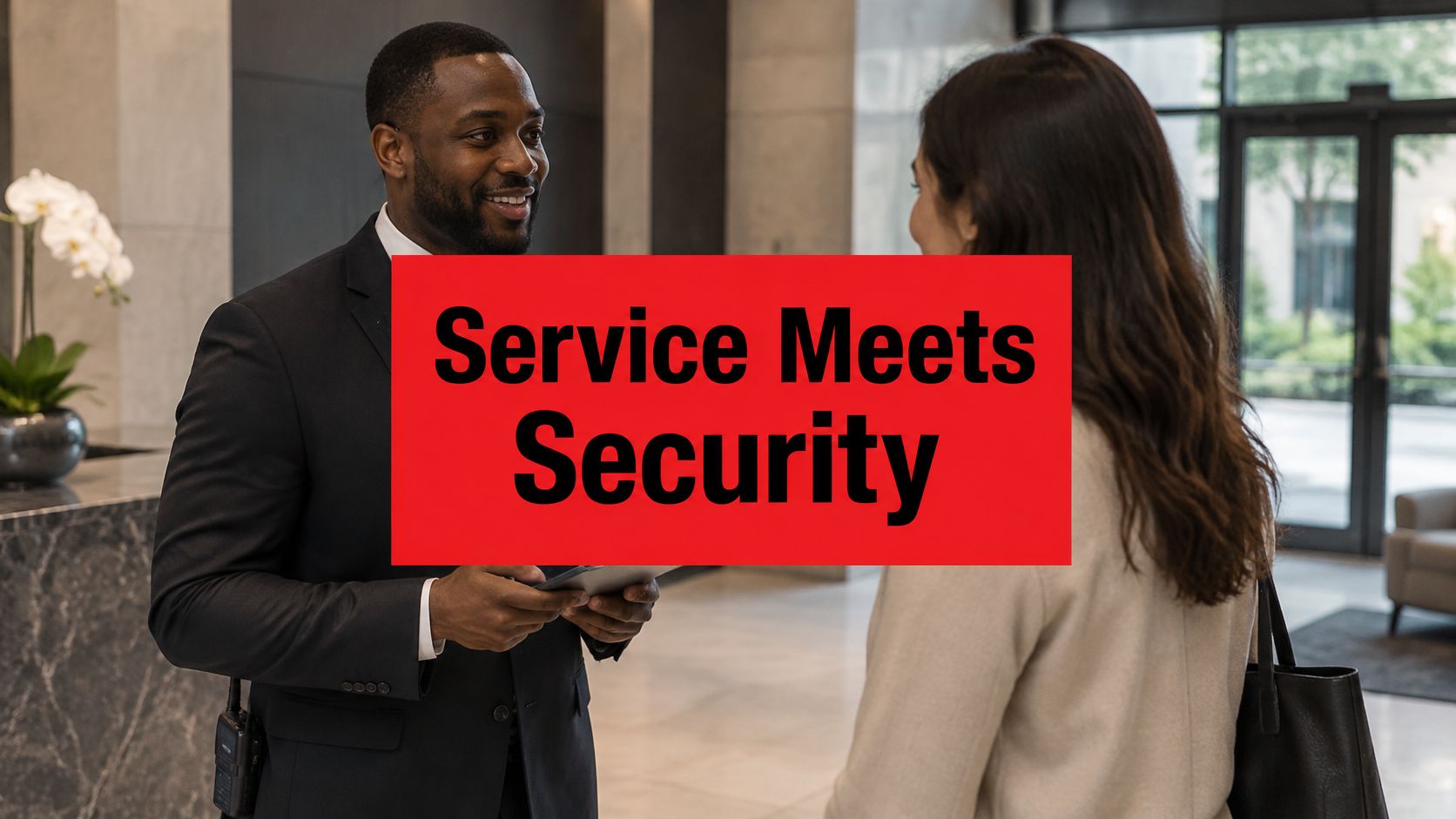
At a residential high-rise, the morning shift begins with familiar activity. A resident stops to ask about a delivery. The guard acknowledges them, checks the package area, and answers without losing sight of the lobby entrance. A courier arrives next, so the officer confirms where the delivery should go and follows the building's procedures for recording it.
Then an unscheduled visitor approaches. They say they're expected and name a resident, but the resident hasn't approved the visit. The guard stays courteous, explains that entry needs to be confirmed, and contacts the resident using the approved process. The visitor may be disappointed, but the officer doesn't let urgency or a confident manner substitute for authorization.
At the same time, a cart near the mailroom is partly blocking a path. The guard notes it, checks whether someone is still using it, and makes sure it's moved or reported to building staff. None of these tasks is especially dramatic. Taken together, they require attention, discretion, and consistent follow-through.
The desk is a decision point
A receptionist's primary responsibility is usually to support visitors and handle front-desk tasks. A security officer may focus on access, patrol, observation, and response. A concierge security officer combines those functions. They're expected to make the lobby feel approachable while applying the building's rules fairly.
That balance matters. A guard who refuses to help may make residents and visitors feel ignored. A guard who prioritizes convenience over verification may allow an unauthorized person into private areas. Strong service means offering a clear explanation and a respectful next step, even when the answer is no.
At the front desk, a friendly greeting and a firm access decision belong in the same interaction.
The property manager's goal isn't to make every check-in effortless. It's to make ordinary interactions welcoming and access decisions dependable. When the guard has clear post orders and knows whom to contact, residents get a more consistent experience and the building gets a more accountable first point of contact.
Defining the Concierge Security Guard Role
A concierge security guard is a security professional who provides protective services while supporting the day-to-day experience of residents, tenants, visitors, and guests. The officer often works at a lobby, residential entrance, hotel desk, or corporate front desk, where a single conversation can involve hospitality, access control, and safety.
Think of the officer as the human control layer of the building's physical access system. A card reader can confirm that a credential is valid, but it can't independently assess an unfamiliar visitor who says they've been invited, notice a tense exchange, or explain a building procedure in a calm and respectful way. The officer connects the property's rules to what is happening in person.
The role also differs from that of a regular front-desk attendant. A receptionist can provide directions or call a tenant, but a registered security professional has training and responsibilities tied to protective services. That distinction is important when someone refuses screening, attempts to enter a restricted area, or asks the officer to take action beyond the officer's authority.
California's requirements make the distinction concrete
In California, security guards register through the Bureau of Security and Investigative Services, or BSIS. Applicants must be at least 18, complete a criminal-history check through the California Department of Justice and the FBI, and complete Power to Arrest training before registration is issued. New guards must then complete 32 hours of security-officer skills training within their first six months, followed by 8 hours of continuing training every year, as outlined by California BSIS security guard training requirements.
A BSIS staff report recorded 351,170 security-guard licensees and 3,077 licensed Private Patrol Operators through February 25, 2026, placing the role within an established regulated industry in California (BSIS staff report). These requirements offer property managers practical questions to ask a provider: How does the company confirm registration? How does it ensure officers receive required training? How does it prepare them for the actual decisions they'll face at the property?
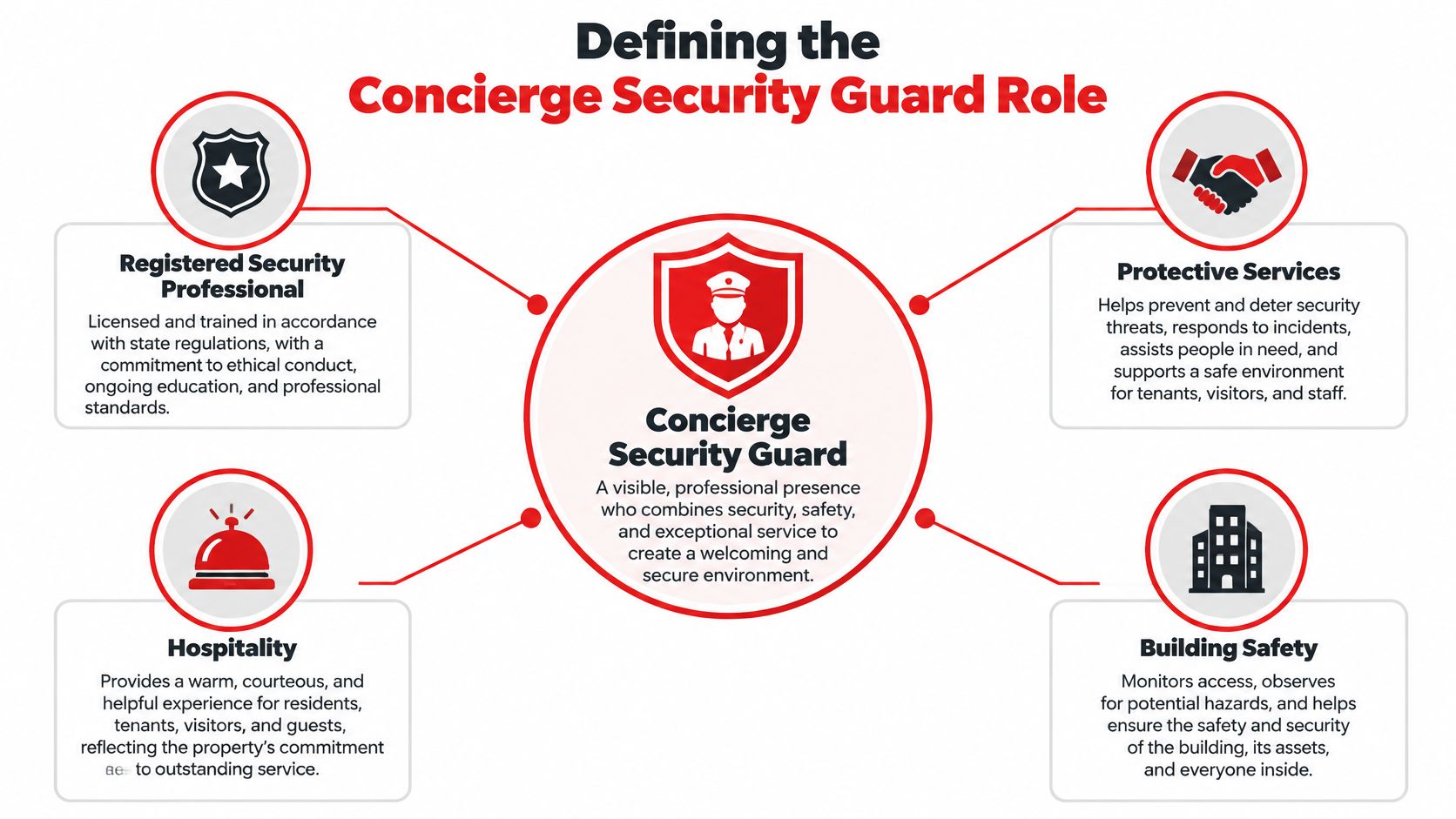
The role works best when service expectations and security authority are both clear. The officer can greet, assist, verify, observe, and report. They aren't a substitute for law enforcement, and residents or managers shouldn't expect them to exercise police powers. Well-written post orders help officers understand what they should do, when to escalate, and when to call for help.
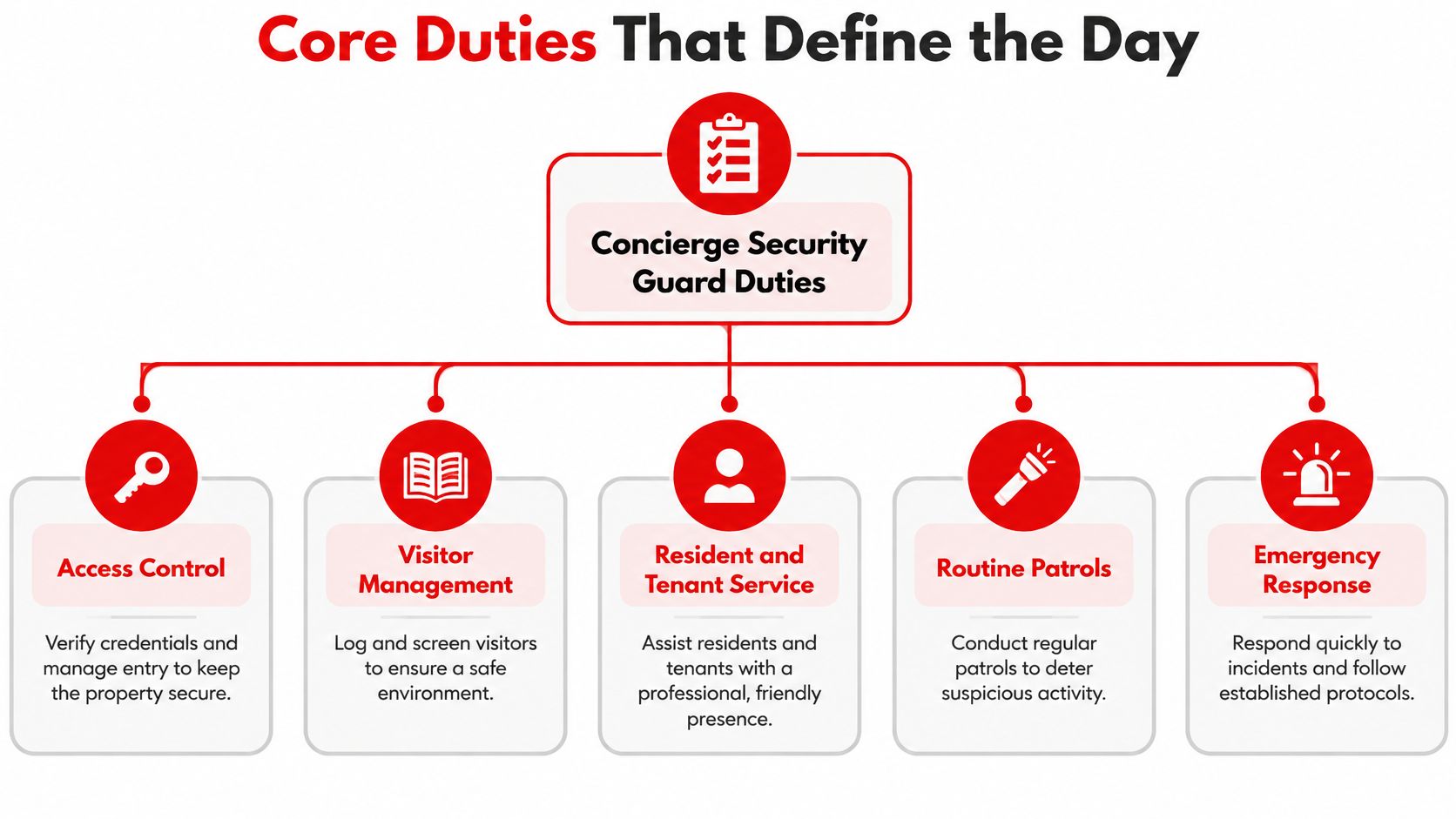
Core Duties That Define the Day
The work at a concierge post isn't a set of unrelated chores. One interaction may begin with a greeting, continue with identity and authorization checks, and end with a visitor record or a note for the next shift. These duties support both a welcoming property and a controlled one.
Five responsibilities, connected in practice
-
Access control: The officer checks whether a person is authorized before allowing them into a controlled area. For example, a contractor may need approval from a building contact before receiving a temporary badge.
-
Visitor management: The guard records the visit according to the property's procedures. That could include confirming the host and recording when the visitor arrives and leaves.
-
Resident and tenant service: The officer gives directions, helps a resident contact building staff, or follows the established process when someone is locked out. Service doesn't mean bypassing identity or access rules.
-
Routine patrols and observations: Depending on the post, the officer may check shared spaces, notice a door that has been propped open, or report an unfamiliar item near the mailroom. Patrol instructions should reflect the building's layout and needs.
-
Incident response and documentation: If a noise complaint becomes a dispute, the guard follows response procedures, calls a supervisor when required, and records what was observed and what action was taken.
Consider a vendor arriving to work on a tenant's floor. The guard greets the vendor, checks the authorization source listed in the post orders, confirms the destination, issues a temporary credential if approved, and records the visit. If the tenant can't be reached, the guard follows the escalation procedure rather than guessing. Later, if there's a question about who entered, a complete record helps the property review what happened.
Good service is part of the job, not an alternative to security. The officer can explain a denial politely, help a visitor reach the right contact, and still uphold the building's rules. Property teams looking to strengthen that balance can review practical approaches to security customer service.
Access Control and Visitor Management at the Lobby
A lobby is more than a place to welcome people. It's a point where the property decides who can move farther inside. NIST guidance describes physical access controls as measures that limit unauthorized entry and includes managing and monitoring access, keeping logs, and handling visitors. In practice, the concierge officer serves as the human part of that system.
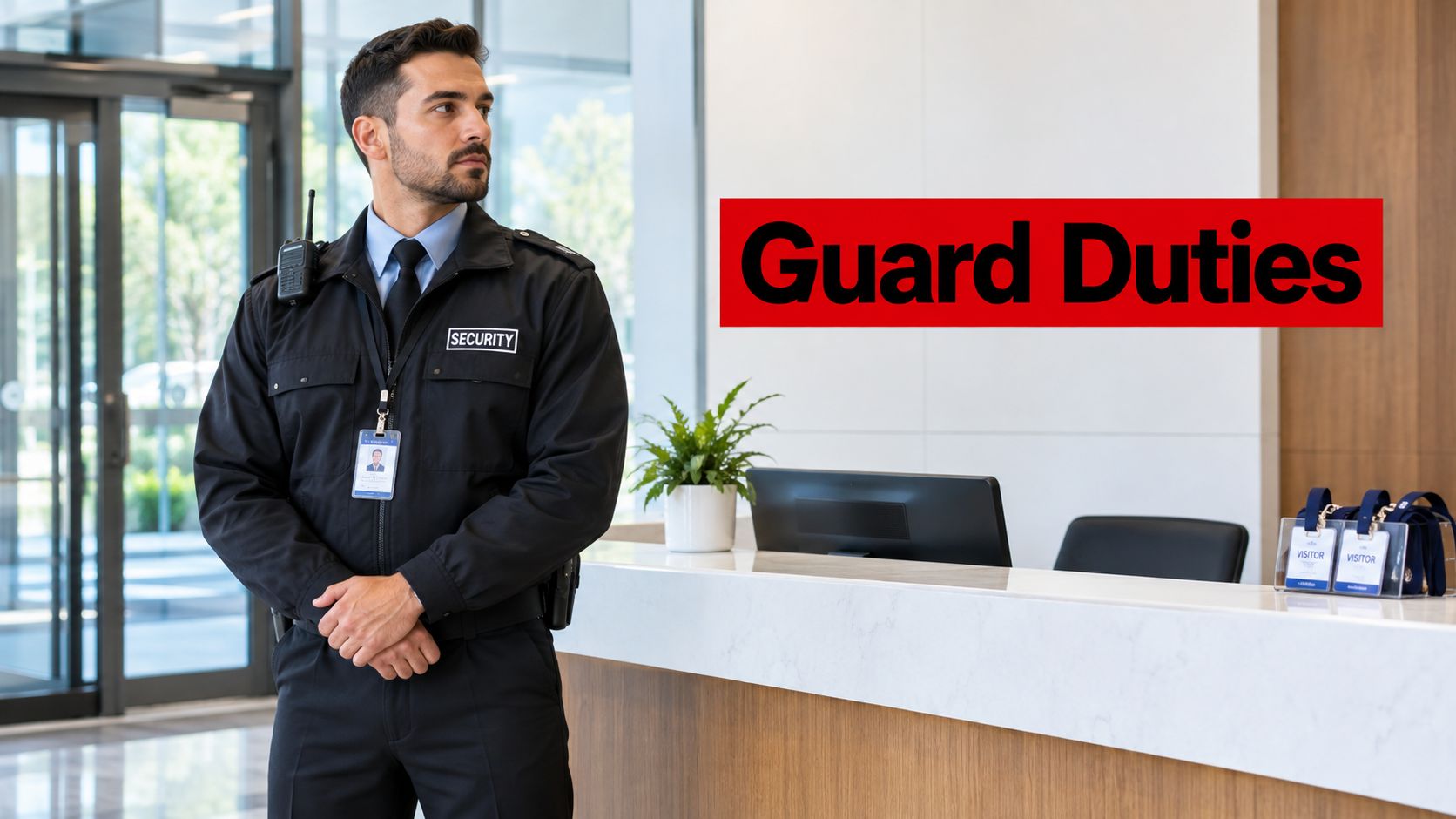
A dependable visitor process follows the property's approved rules, not the officer's memory of who seems familiar. When a visitor arrives, the officer confirms identity and authorization, checks the host or destination, and issues a temporary credential when approved. If the information doesn't match or approval is unavailable, the officer pauses entry and escalates the exception.
NIST guidance also recommends monitoring visitors in sensitive areas and maintaining records with details such as identity, organization, purpose, entry time, and departure time (NIST guidance on physical access control). The purpose isn't paperwork for its own sake. A clear record helps the property answer basic questions later, including who entered, why they were there, and when they left.
Put the decision rules in the post orders
Property managers can reduce inconsistent decisions by spelling out:
- Approved entry points: Which doors may visitors use, and which entrances are for tenants or staff?
- Authorization sources: Should the officer call a host, check an approved visitor system, or contact a designated building representative?
- Temporary credentials: How should badges be displayed, tracked, and returned?
- Escort zones: Where must visitors remain with an escort?
- Exception escalation: Who should be contacted when a host doesn't respond or a visitor disputes the rule?
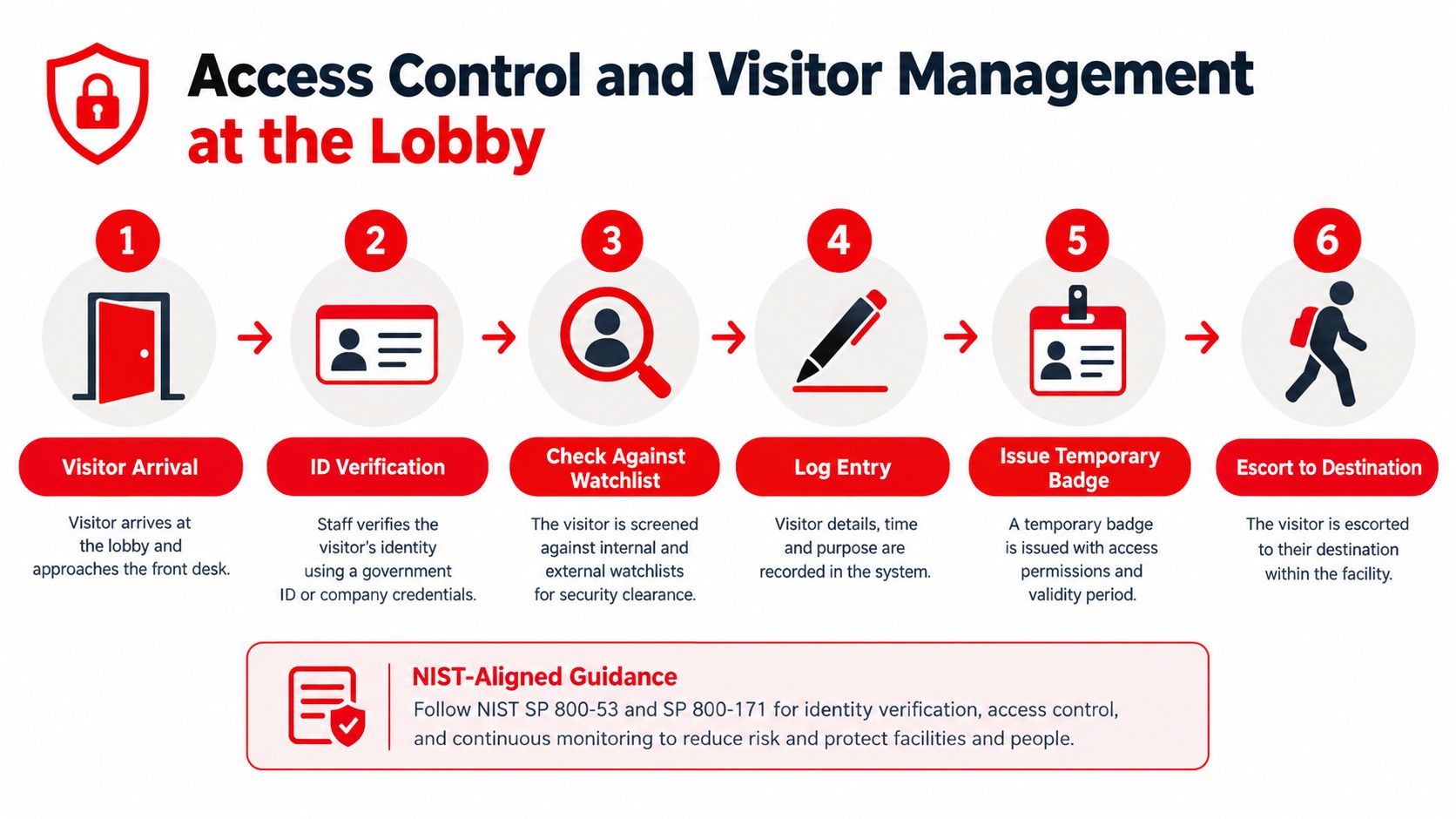
Physical access is also an auditable process. NIST describes ways to enforce authorization, such as guards, locks, keys, and card readers, and identifies visitor logs and video surveillance as examples of monitoring. Its assessment guidance explains that access records may be written, automated through badges or smart cards, or a combination, with retention governed by the organization's policy (NIST physical access assessment guidance).
The same thinking applies to communities with controlled vehicle entrances. Property teams reviewing gated community access control can consider how entry rules, visitor authorization, and records connect with the lobby's procedures. For the officer, the measure of success isn't a quick check-in. It's a complete, reviewable account of entry and exit that follows the property's rules. Managers developing those rules can also use a written access control procedure as a practical reference point.
De-Escalation as a Core Operating Skill
A courier insists the delivery is urgent and the resident isn't answering. The officer holds the entry rule, and the courier's voice starts to climb. At a concierge post, this is the moment the job shifts from service to control: the officer has seconds to read whether frustration will stay verbal or become something else.
De-escalation is a trained skill with identifiable behaviors. Speak evenly. Use clear, respectful language. State boundaries out loud. Keep a safe distance and an available exit route. Call for support before the situation peaks rather than after. Then describe observable facts in the report, what was said and what was done, instead of labels like "aggressive" or "unstable."
The risk behind this training is documented. Security guards rank among the occupations with the highest rates of nonfatal workplace violence, a pattern summarized in guidance on conflict de-escalation for frontline teams. At a concierge desk, the officer is usually the first person that risk reaches, so the response has to be rehearsed rather than improvised.
Define the point where the response changes
Officers need post orders that work like decision rules instead of general advice. The orders can name the behavior that triggers a supervisor call, fix the radio wording for requesting help, and mark where a service dispute ends and an immediate threat begins. Just as important, they should say when to stop resolving a disagreement at the desk and move to emergency procedures or request law enforcement.
OSHA's workplace-violence guidance identifies training on recognizing hostile behavior, diffusing volatile situations, following security procedures, and reporting incidents, and it applies to managers, supervisors, employees, and contractors involved in the prevention program (OSHA workplace-violence guidance). For a property team, the practical lesson is coverage. The concierge officer shouldn't be the only person in the building who knows how to respond. Front-desk staff, engineers on call, and supervisors need the same shared picture of how to report and escalate a concern.
Practical rule: A respectful tone can still hold a firm boundary. Explain the rule, offer the approved next step, and request support the moment the situation reaches the escalation threshold.
A prepared program rehearses specific cases: the visitor who refuses screening, the person who won't leave private property, the resident who asks the guard to make an arrest. That last request tests judgment, because a security officer's authority differs from police authority. Post orders should walk the officer through the decision ladder: de-escalate, deny access, document, notify a supervisor, call law enforcement, or act to protect someone from immediate harm.
How the Role Looks in Different Properties
The same professional standard can look different from one building to another. A residential high-rise and a Class A office tower both need a welcoming, controlled entrance, but their busiest interactions aren't identical.
At a residential high-rise
The morning may bring residents heading to work, deliveries arriving, and a move-in crew needing directions. The officer helps residents and visitors, follows procedures for packages and contractors, and keeps an eye on access points. Later, a guest arrives after hours and says they're visiting a resident. The guard verifies the visit through the approved process rather than allowing entry based on a name alone.
For the property manager or HOA board, success means residents get courteous assistance while access rules remain consistent. The officer should know how to contact the appropriate building representative, what the delivery policy requires, and what to do when a resident is unavailable.
At a Class A office tower
During business hours, the officer may handle a steady flow of visitors, vendors, and tenant guests. After hours, the focus can shift to authorized cleaning crews and other approved building users. If the officer notices an emergency exit door propped open, they follow the site procedure, notify the right contact, and document the condition.
In both settings, the officer needs to know the property, not just the desk. That includes how to communicate with building staff, where access restrictions apply, and how to report an issue. A medical event calls for a different response than an unapproved visitor, and clear post orders help officers make that distinction without losing composure.
The mix of hospitality and protective work is especially relevant to residential towers, commercial properties, healthcare facilities, and mixed-use buildings. The day's details differ, but managers benefit from the same basics: professional judgment, clear communication, reliable escalation, and records that let the property understand what happened.
How to Evaluate a Concierge Security Program
A sharp uniform and a friendly greeting make a good first impression, but they do not tell you how an officer will handle a denied visitor, a dispute over a delivery, or a missing access record. Treat the proposal review as a scenario test: you are checking whether the program prepares officers for the specific decisions your lobby will demand of them.
As noted earlier, de-escalation is a core operating skill for this role. In evaluation, go past the label and ask the provider to show the procedure: how officers are trained to recognize a situation heating up, when they are expected to call a supervisor, and how the incident gets written up afterward.
Questions to take into a proposal review
- Training depth and recency: What training does the officer receive for access control, communication, emergency response, and de-escalation? How does the provider confirm required credentials and continuing education?
- Post-order specificity: Do the written instructions name your authorization sources, restricted areas, escalation contacts, and reporting expectations, or are they generic to any building?
- Supervision and accountability: Who checks service quality, communicates with building leadership, and follows up when a report raises a concern? Ask how often a supervisor visits the post.
- Technology that supports judgment: Do digital reports, patrol checkpoints, photographs, or time-stamped activity records help managers review what happened without replacing the officer's decision-making?
- Resident and tenant experience: How does the provider assess whether officers are courteous, consistent, and clear when they need to enforce a rule?
Ask for artifacts rather than adjectives. A redacted incident report, a sample set of post orders, and a supervisor visit log will tell you more about how the program runs than any sales deck.
A highly visible officer is not automatically a safer officer. Overly aggressive enforcement can damage resident trust and create avoidable liability, while excessive passivity leaves access rules unenforced. Managers can build a review process around security performance indicators that reflect decision quality, response governance, documentation, and the experience of people using the building.
If a provider cannot explain how it recruits and supports officers, trains them for your post, and reviews their work, press for clearer answers before signing. Vague post orders and missing documentation are the two warning signs worth walking away from.
Key Takeaways for Property Managers
A concierge security guard is a regulated security professional, not a hospitality upgrade. The lobby is a control point where access decisions, calm communication, and accurate records shape how the property protects people and manages entry.
When reviewing a program, look beyond appearance. Ask whether officers receive relevant training, whether post orders give them clear decision rules, whether supervisors stay engaged, and whether reporting tools help you understand what happened.
Start with a site walk-through. Review the lobby's access points, visitor procedures, escalation contacts, and reporting expectations with your security provider. A clear conversation now can help you set a consistent standard for both service and safety.
Overton Security provides concierge security, onsite officers, and technology-supported oversight aligned with a property's needs. Visit Overton Security to discuss a site walk-through or review the post orders behind your lobby's security program.