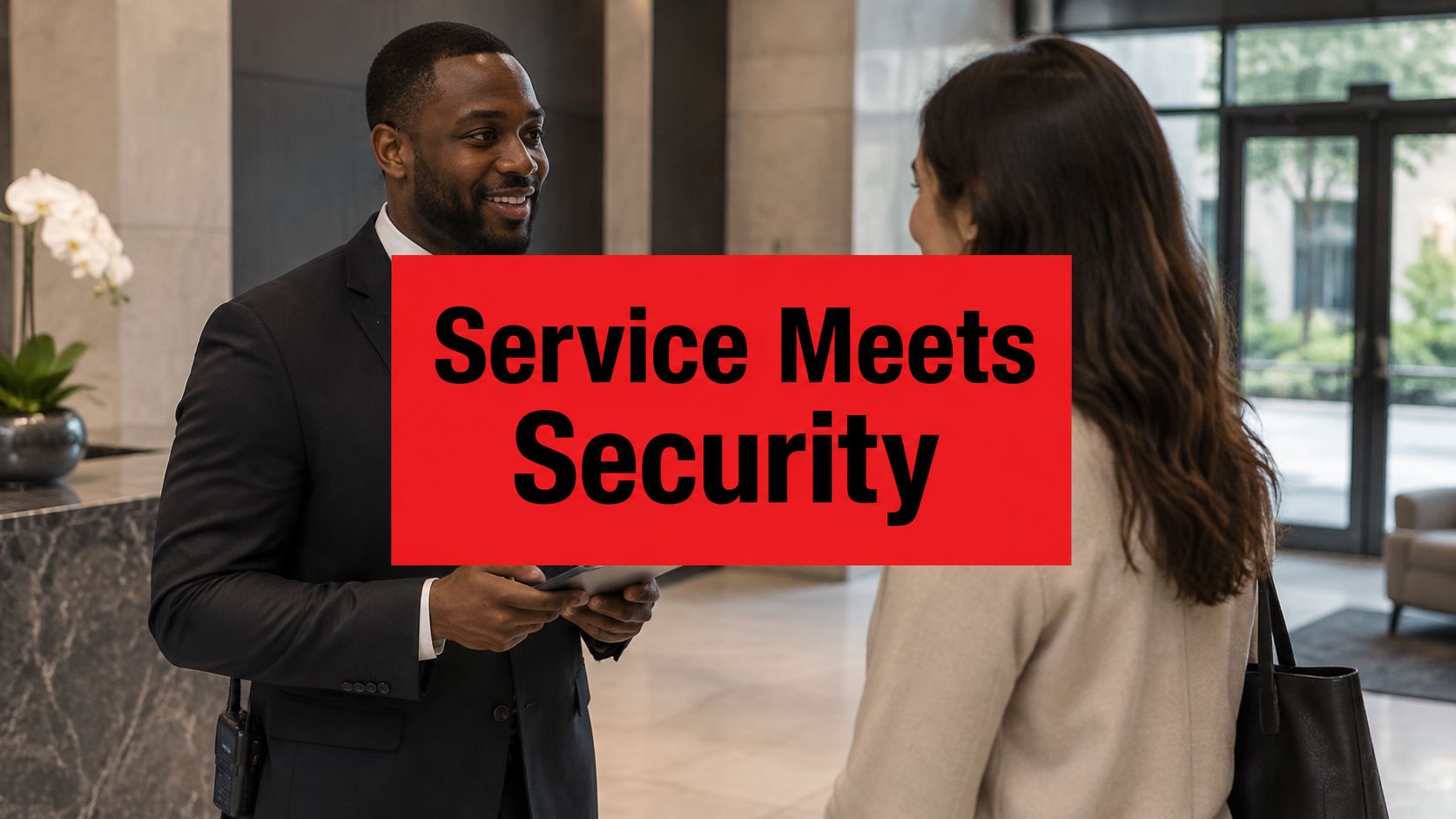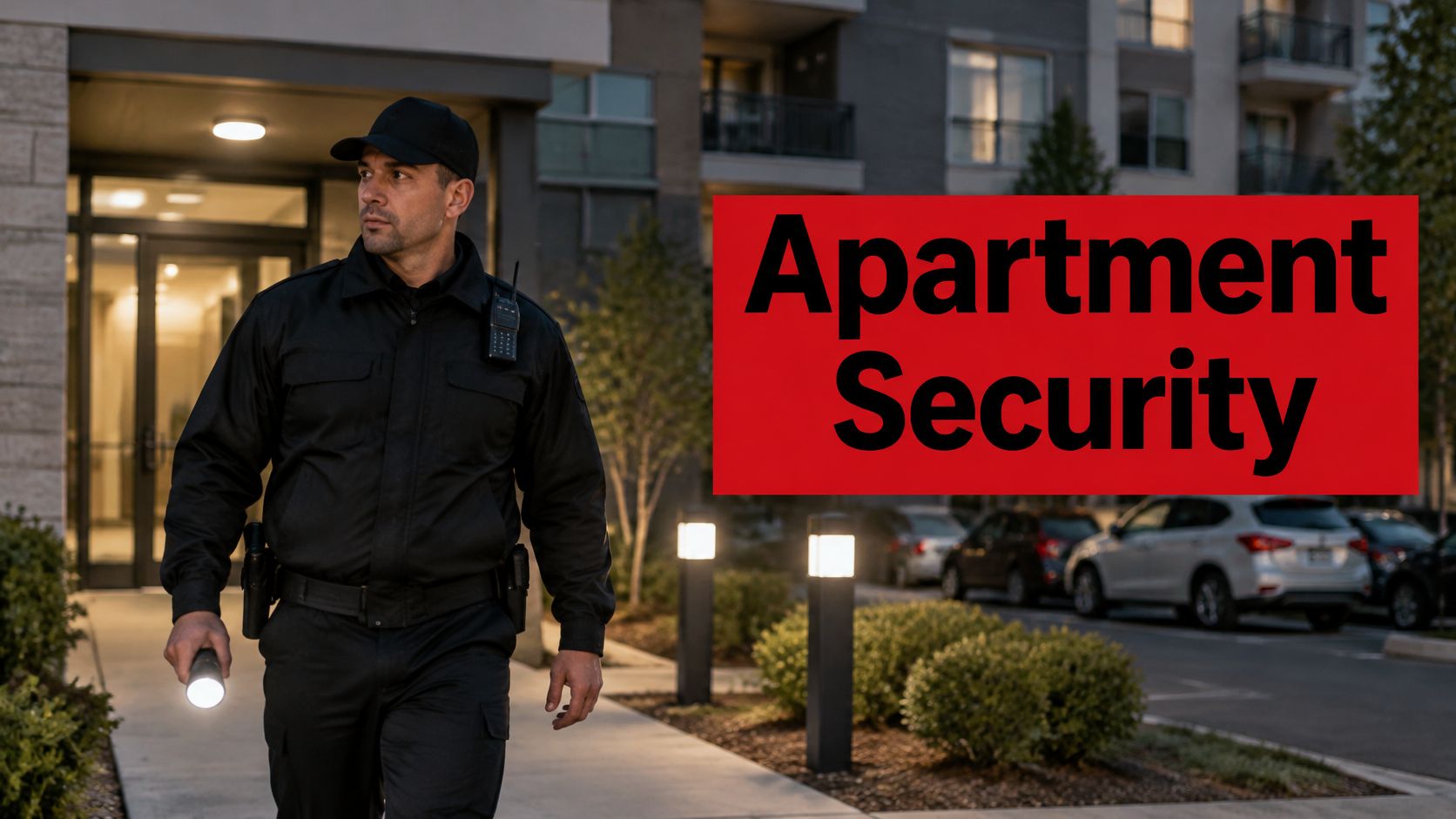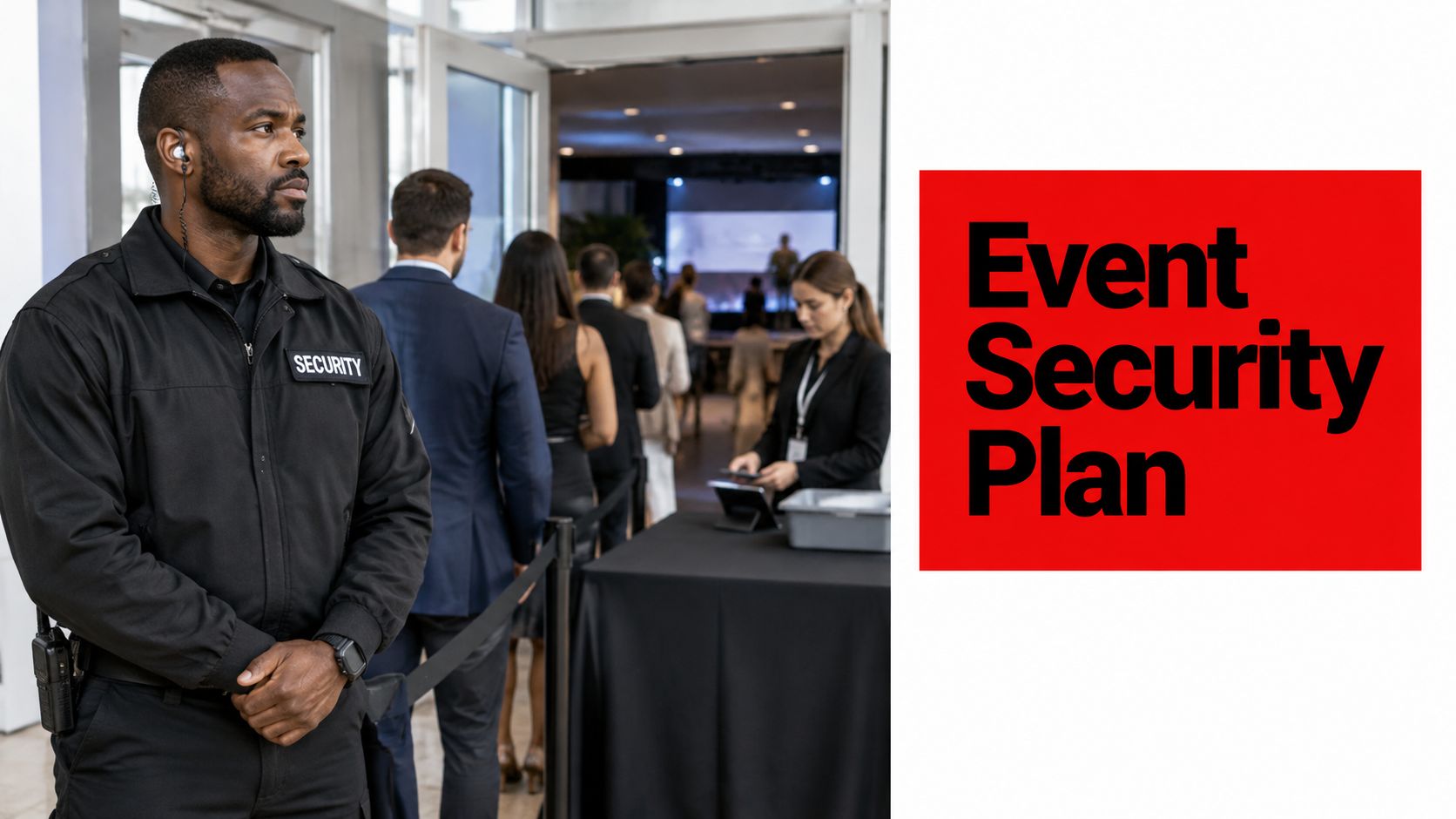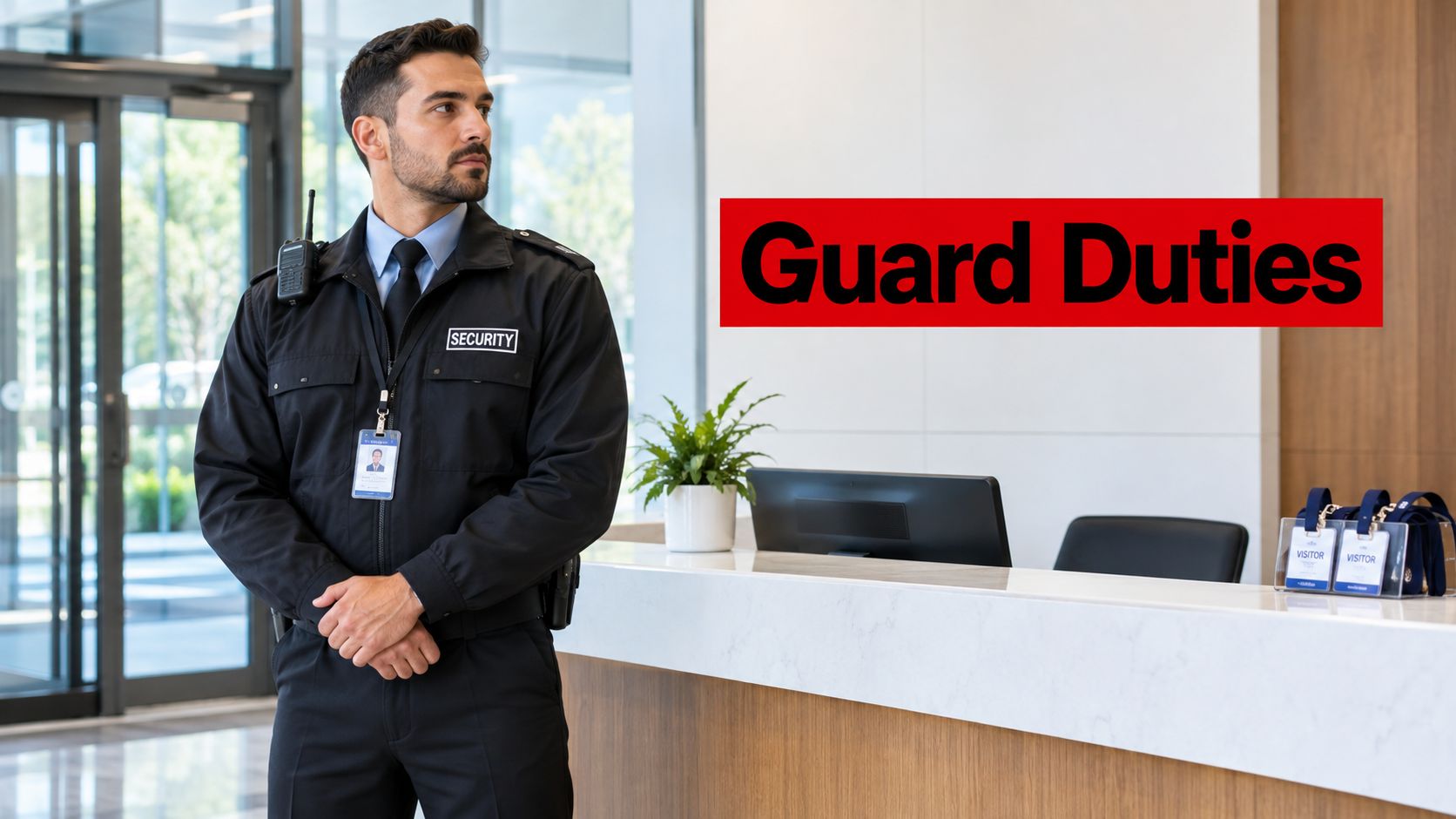
A tenant in a Class A high-rise calls the front desk about a visitor who doesn't match the sign-in sheet. The officer answers late, sounds unsure, and lets the moment drag. From that point on, the tenant isn't judging only the guard at the desk, they're judging the whole property, the management team, and whether anyone on-site can be trusted to handle a real problem.
That is why security customer service matters more than most property teams admit. In security, service isn't a soft extra, it's part of the control environment. A fast, clear response can calm a tenant, protect a lobby, and reduce the kind of confusion that turns a simple issue into a complaint or a liability conversation.
Why Your Security Team's Service Quality Matters More Than You Think
A front desk call about a visitor, a loading dock issue, or a resident complaint can either reassure people or make the whole property look disorganized. Property managers who treat security as a coverage expense miss the part that tenants and visitors notice first, the interaction. The officer at the desk, the mobile patrol driver, and the concierge all shape how people judge safety, professionalism, and control.
The service standard is not vague. In one security-industry dataset, 90% of security customers expect a response within 15 minutes, and a 5-minute response makes customers 3 times more likely to remain loyal to the provider (Zipdo security customer experience statistics). That is a direct signal for site teams. If your officers acknowledge slowly, tenants read that as weak control, even if the underlying issue is minor.
Practical rule: if the first response is slow, every later explanation has to work harder.
Service quality shows up in renewal decisions
A tenant does not split “security” from “operations” when a problem lands at the desk. They remember whether the team answered quickly, spoke clearly, and closed the loop. That memory affects renewal talks, resident satisfaction, and the building's reputation, especially in residential communities, retail centers, and Class A office properties where service is part of the lease value.
Property teams also need to look at resolution speed, not just first contact. Industry data shows the average time to resolve a service ticket is 4 hours and 90% of customers are satisfied with that speed, while 55% of consumers will stop doing business with a company if wait times are too long (WorldMetrics customer experience in the security industry statistics). That should push managers to treat response time as an operational control, not an internal metric that only lives in a report.
A California site run by Overton drove the point home in practical terms. When officers gave fast acknowledgment, kept notes tight, and routed issues without confusion, the complaints dropped because people felt heard before the problem escalated.
Security service also shapes risk exposure
A sloppy response does more than frustrate people. It creates gaps in documentation, inconsistent handoffs, and missed follow-up. That is how a visitor dispute, a delivery exception, or a badge issue turns into a larger access-control problem.
For property managers, the right question is simple. Are your officers polite, or do they turn a live issue into a controlled process with clear handoffs and traceable follow-up? When they do, tenants feel heard and the property looks managed. When they do not, even a small event can feel like a breakdown.
What Security Customer Service Actually Means
The old definition is too small. Greet visitors, answer questions, stay professional. That's the surface layer, and it matters, but it's not the whole job. Real security customer service starts when a person at the desk needs access, information, or help, and the officer has to deliver it without exposing the property to risk.
The service interaction has to protect information
The highest-risk moment is disclosure. An officer can't treat every request like a routine hospitality exchange. Before a sensitive action or answer, the team needs identity verification, least-privilege access, and out-of-band approval for higher-risk requests so the same voice or chat channel isn't used to both request and complete the action (Freshworks secure customer service guidance).
That matters because frontline service staff often have high access and limited tooling. Help Scout points out that customer service teams can face high turnover, limited tools, and high levels of access to customer data, which makes them a target for manipulation, and it recommends training, removing unnecessary access, and building security into workflows (Help Scout on customer service security). For a building, that translates into one rule. The officer should only see what they need to solve the issue, not everything the system can reveal.
Treat access control like service, not bureaucracy
Access control is part of the customer experience. A good officer verifies identity quickly, explains why a step is needed, and keeps the interaction moving. A bad officer turns every exception into a debate. The difference is operational, not just stylistic.
The best help desk doesn't expose the whole network to speed up one ticket, and your security desk shouldn't expose resident or tenant information just to look helpful. The goal is controlled assistance. Fast, clear, and limited to what the situation requires.
Good service in security is repeatable. If the answer depends on which officer is working, the process isn't strong enough.

Balancing Security Presence With Customer Experience
Visible security can build trust or create friction. The outcome depends on the property and the posture you choose. A welcoming concierge in a residential tower tells tenants the building is watched and cared for. A rigid, intimidating presence in the same lobby tells them the space is tense.
That tension is real across property types. In retail centers, shoppers respond to the feel of the environment. In healthcare facilities, patients already arrive under stress, so overbearing security can make the whole visit feel worse. In mixed-use properties, the right balance often means strong deterrence at the perimeter and a lighter, hospitality-minded touch at the front door.
The DHS customer-experience report describes a structural tension between security, freedom, and customer experience, and it notes practical limits like constrained budgets, expensive technology, and the training burden that comes with new screening methods (DHS FY2024 Q1 Customer Experience report). That same tension shows up at property level. You can't ask officers to be both highly visible and invisible, both strict and warm, unless you define the posture clearly.
Use the right level of visibility
Start with the property's actual risk and traffic pattern. A luxury high-rise needs a different front-of-house posture than a distribution yard or a retail plaza. One needs reassurance, one needs deterrence, and the third may need both at different times of day.
The wrong move is copying another site's model because it looked polished. A stronger approach is to decide where visible security adds confidence and where it starts to signal inconvenience. That's where post orders, officer training, and management oversight have to work together.
Measure the experience, not just the presence
Too many teams count heads and hours, then assume service is handled. It isn't. If tenants complain about tone, if visitors hesitate at the desk, or if property staff keep stepping in to smooth over interactions, the program is off balance.
For a practical reference point, browse the Waymap survey analysis on customer satisfaction patterns. The useful lesson isn't a slogan. It's that experience data needs to be translated into site behavior, not just collected and filed away.

Best Practices for Building a Service-Oriented Security Program
A service-oriented program doesn't happen by accident. It comes from training, written standards, communication rules, and the right technology working together. If one piece is weak, officers improvise, and improvisation is where inconsistency creeps in.
Train for the moments that actually happen
Start with de-escalation, visitor verification, package handling, access exceptions, and complaint response. Officers should practice what they'll see at the front desk or gate, not just generic “professionalism.” Scenario-based drills help them learn how to keep the interaction moving while staying inside policy.
The training itself should be documented, not assumed. If an officer can't explain the reason for a verification step in plain language, they're not ready for a live lobby interaction. For a structured example of how this should be built, review Overton Security's officer training programs.
Write post orders that tell officers how to serve
Generic post orders create generic service. Strong post orders define what officers say, what they log, who they contact, and when they escalate. They should also spell out how to handle routine friction points, like a resident leaving a package with the desk, a contractor arriving early, or a tenant reporting noise after hours.
If the post order doesn't cover the common issue, the officer will invent the process under pressure.
Use communication to reduce confusion
Property managers don't need every detail of every incident, but they do need timely, consistent updates. Define who gets notified, what gets reported immediately, and what gets summarized later in writing. That's how you avoid the half-true version of events that causes avoidable conflict at the next management meeting.
Let technology support the service model
Digital DARs, GPS-enabled guard tour systems, photo uploads, and 24/7 SOC oversight make the work visible. They don't replace judgment, they support it. When officers know their rounds, incident notes, and response times are documented in real time, accountability improves and finger-pointing drops.

Measuring Security Customer Service With Real KPIs
If the front desk is friendly but complaints keep repeating, service is still failing. Incident counts only show activity. They do not show whether the security provider answered quickly, explained things clearly, documented the issue correctly, or reduced friction for the property team. Property managers need a scorecard that measures service quality as a risk-control function, not just a headcount of problems.
Use metrics that show the full service picture
Track response, resolution, communication, and documentation quality. Those are the indicators that show whether the security team is supporting the property or filling a post. A provider that only hands over incident totals is reporting volume, not performance. For a useful framework, use Overton Security's performance indicators as a model for what operational accountability should look like.
| KPI | Benchmark Range | Why It Matters |
|---|---|---|
| Response acknowledgment time | Minutes, not hours | Tenants judge the first response as the primary service indicator |
| Service ticket resolution time | About 4 hours is a common benchmark in security-industry data (WorldMetrics) | Shows whether the provider closes issues quickly enough to limit disruption |
| First-contact resolution | High enough that most issues don't bounce between people | Fewer handoffs mean fewer errors and less tenant frustration |
| Proactive communication frequency | Regular, predictable updates | Reduces uncertainty for managers and residents |
| Documentation quality | Clear, time-stamped, specific | Protects the property if there's a dispute later |
Track the data where the work happens
Use digital reports, GPS-enabled patrol data, and structured feedback from tenants or staff. If an officer says a round was completed, the system should show it. If a complaint was closed, the report should show who handled it, when it was acknowledged, and what action was taken.
That is the difference between a provider that claims good service and one that can prove it. Service quality also has to match what residents feel, so if you want a broader benchmark on satisfaction patterns, you can browse the Waymap survey analysis.
Review the metrics every month. Compare them with complaints, renewals, and escalation patterns. Push back when the numbers are missing, vague, or padded with boilerplate. A security vendor that cannot show its response times, closure rates, and report quality is asking you to manage blind.
Real-World Examples Across Property Types
A residential high-rise, a retail center, and a construction site all need different service behaviors. The common thread is control, but the way that control is delivered changes completely by environment. That's where property managers either get a polished operation or a confused one.
Residential high-rise
In a luxury tower, concierge officers handle visitor verification, package intake, and resident complaints at the same desk. The service standard has to feel warm without becoming casual. Officers need to greet people professionally, verify access consistently, and know when a tenant issue should be logged, escalated, or referred to management.
The strongest towers are the ones where residents stop worrying about whether the front desk will “get it right.” That only happens when the desk team uses the same language, the same verification steps, and the same reporting rhythm every shift. In California markets like Los Angeles and San Francisco, that consistency is part of what tenants notice first.
Retail center
At a retail property, mobile patrol officers are doing a different job. They deter loitering, watch for after-hours issues, and handle shoplifting responses without turning the common areas into a police scene. Shoppers want to feel safe, but they don't want the center to feel tense.
The right posture is visible, calm, and predictable. Officers should coordinate with tenants and center management so escalations don't spill into public confrontation. In San Diego retail environments, that balance matters because the customer experience is part of the property's value, not separate from it.
Construction site
Construction security is all about logistics and risk control. Officers protect equipment and materials, but they also manage access for subcontractors, deliveries, and after-hours work. If the guard doesn't know who should be on-site, the site loses time and the superintendent loses confidence.
That's why service here means clear check-in procedures, fast communication with the field team, and no confusion about exceptions. A good officer makes the gate run smoothly without letting the site become porous. For project teams, that's the difference between protection and bottleneck.
How to Evaluate Security Vendors on Customer Service Performance
Vendor selection should be harder than “Can you staff the post?” If a company can't show how it handles service, transparency, and accountability, it's not ready for a customer-facing property. Price matters, but it should never be the only filter.
Ask the questions that expose the model
Start with manager-to-client ratio, officer training, reporting tools, KPI tracking, and retention. If the account manager is overloaded, service will drift. If the officer training is generic, the lobby experience will be generic too.
Also ask how the provider handles sensitive requests and identity verification. The reason is simple. Support and service functions can be targeted when they're treated as soft targets, and the same logic applies to lobby-facing security. For a broader example of how attackers exploit access points, review how intruders target villas.
Watch for the red flags
- High turnover: If officers rotate constantly, the property spends all its time retraining people.
- Generic post orders: If every site gets the same binder, your site-specific risks are probably being ignored.
- No digital reporting: If you can't see what happened in real time, accountability is weak.
- Overloaded account managers: If no one has time to visit the site, service problems linger.
- No service KPIs: If the provider only talks about coverage hours, they're not managing customer experience.
If you're comparing firms, use Overton Security's outsourcing partner guide as a checkpoint against your own selection process. That kind of evaluation helps separate a staffing vendor from a real service partner.
The cleanest contract language is the one that makes service measurable. If it can't be measured, it can't be enforced.
Your Action Plan for Better Security Customer Service
Start with your current provider and inspect the service layer. Review response times, documentation quality, escalation handling, and whether the team communicates before problems turn into complaints. If the answers are vague, the service model is weak.
Then look at the post orders. They should read like operating instructions for real people in real situations, not a generic liability document. If the language doesn't define verification, escalation, and customer interaction standards, revise it.
Next, test the communication chain. Property managers should know exactly who gets notified, how quickly, and in what format. If the process depends on one reliable person remembering to call, that isn't a process.
Finally, evaluate the technology. You need reporting, transparency, and accountability that support the service model, not just extra software. If your provider can't show what happened, when it happened, and who handled it, you're paying for presence without control.
If the gaps are fixable, renegotiate the contract with service-level expectations. If the provider can't meet basic transparency or staffing standards, switch. Security customer service is not a courtesy, it's a measurable part of property protection.
If you want a security program that treats service as part of risk control, Overton Security builds site-specific staffing, reporting, and oversight around that standard. Visit Overton Security to discuss a service-oriented security plan for your property, your tenants, and your operating goals.