A tenant calls about another suspected theft, a shopper wants help finding a missing child, and your officer is already responding to an argument in the parking garage. As the property manager, you need more than a uniform at the entrance. You need clear priorities, dependable communication, and officers who know when to assist, when to keep their distance, and when to call police.
For California shopping centers, the difficult question isn't whether security should be visible. It's whether mall security officers have the training, authority, and support to make sound decisions when an ordinary interaction becomes a safety concern.
What Mall Security Officers Actually Do
A shoplifting spike can push a property manager toward a narrow solution: put guards near the affected stores. That may help with visibility, but it leaves unanswered questions about parking areas, service corridors, customer assistance, and emergencies elsewhere on the property.
Shopping centers combine retail units with food courts, restaurants, entertainment venues, parking structures, and shared gathering spaces. Officers need a property-wide assignment that balances tenant concerns with the safety of everyone using those spaces.
Start with the property's operating needs
Define the role around the people and locations officers support:
- Customers need accessible help. Officers should provide directions, assist with safety concerns, and communicate calmly with people who are confused or distressed.
- Tenants need a dependable contact. Store personnel should know how to request assistance and what information security needs to respond.
- Management needs actionable observations. An unsecured service door or recurring parking dispute deserves a documented response, not just a passing mention.
- Emergency responders need coordination. Officers can identify the incident location, guide responders through the property, and help keep access routes clear.
These duties shouldn't compete without a priority system. A request for directions can wait when someone needs urgent medical assistance; a routine patrol can change when an entrance becomes congested.
Separate public confidence from incident counts
In a 2023 NRF survey of 5,031 U.S. consumers, 53% said retail crimes such as shoplifting and looting had increased in their communities since the pandemic began, rising to 57% among suburban consumers, according to the NRF consumer-perception survey. Those findings measure perceptions, not mall-specific crime rates.
Ask tenants and shoppers where they feel uncomfortable, then compare those concerns with actual reports. An officer who is approachable and attentive can address a customer's immediate concern without treating every uncomfortable interaction as a criminal incident.
The assignment is to maintain a safe, orderly property, not merely to watch merchandise.
The Core Functions That Define the Role
Patrol assignments should follow the property's layout and operating risks, not an arbitrary route drawn around the building. Crime Prevention Through Environmental Design, or CPTED, provides a useful way to connect officer duties with physical conditions.
A study of 389 store and shopping-mall managers in Istanbul identified six prevention dimensions: natural surveillance, target hardening, territoriality, access control, formal organized surveillance, and image or maintenance. These are planning categories, not proof that a particular staffing arrangement will work at every California mall.
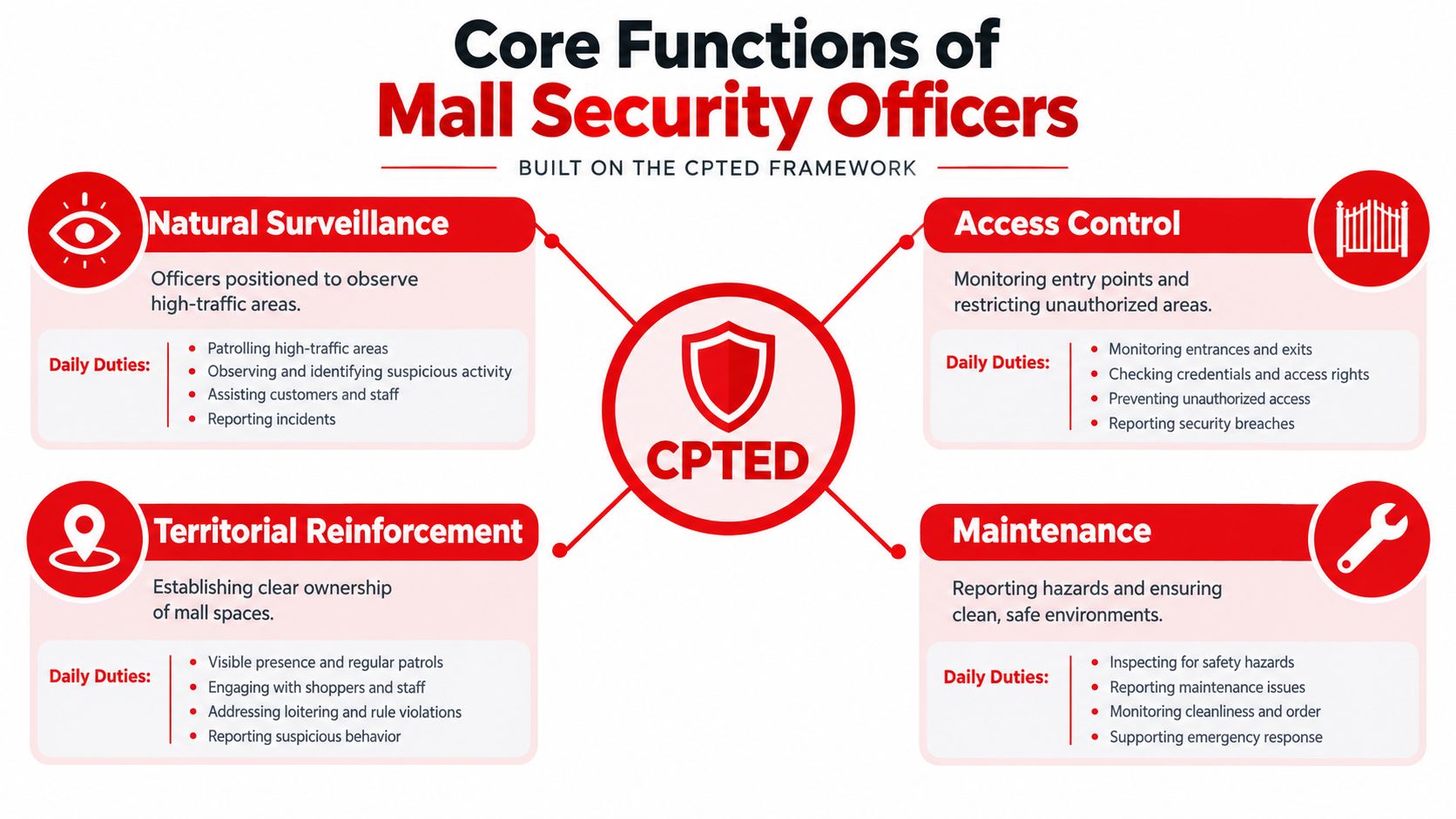
Translate the framework into shift duties
| Prevention dimension | Practical officer assignment |
|---|---|
| Natural surveillance | Observe entrances, corridors, and gathering areas while remaining available to customers. |
| Target hardening | Check relevant doors and barriers, and help verify camera or alarm concerns. |
| Territoriality | Maintain a recognizable presence and explain boundaries between public and restricted spaces. |
| Access control | Follow authorization procedures at loading docks and service entrances. |
| Formal organized surveillance | Coordinate patrol observations with dispatch, camera operators, and supervisors. |
| Image and maintenance | Report failed lighting, obstructed views, damaged doors, and other conditions requiring correction. |
An officer at a loading dock, for example, needs delivery procedures and a reliable tenant contact. Standing beside the door does not establish whether a visitor is authorized.
Match the post to the task
A fixed post makes sense where uninterrupted observation or access screening is necessary. It becomes less useful when management expects that same officer to cover distant parking areas and respond throughout the property.
Deployment rule: Don't assign simultaneous duties that require an officer to be in different places.
Combine fixed posts, foot patrols, and mobile patrols where the layout justifies them. Require patrol findings to identify the location, observed condition, action taken, and person responsible for follow-up. The value is in finding and resolving problems, not merely completing a route.
Training and Certification Requirements
A California guard registration is a compliance starting point. It doesn't tell a property manager whether an officer understands the shopping center's evacuation routes, tenant boundaries, or response procedures.
Evaluate state-required training and site-specific readiness separately. Both matter, but they answer different questions.
Verify the California requirements
California's BSIS security guard training requirements require 3 hours of Power to Arrest training, 5 hours of Appropriate Use of Force training, and a 100% examination score before registration; officers must then complete 32 hours of security-officer-skills training within six months, including at least 16 hours within the first 30 days, plus 8 hours of continuing training annually, with at least 2 hours devoted to appropriate-use-of-force topics.
Ask the provider to show how it tracks completion dates and identifies officers approaching a deadline. Annual continuing training shouldn't be confused with registration renewal or treated as an optional refresher.
Use these procurement checkpoints:
- Registration status: Obtain the officer's registration details and verify current status through BSIS.
- Training records: Review completion documentation rather than accepting a general statement that everyone is trained.
- Assignment readiness: Confirm that incoming and relief officers receive property-specific instruction before taking responsibility for the post.
- Supervisor ownership: Identify who monitors compliance and prevents an unprepared officer from being assigned.
Test judgment, not just attendance
Site orientation should include realistic decisions. Ask an officer what they would do if a store employee demanded a pursuit into the garage, or if a customer dispute appeared to involve a medical or mental-health crisis.
Look for an answer that identifies immediate safety concerns, requests appropriate support, and stays within the assignment. Confidence without an explanation of limits isn't reassuring.
A provider's description of unarmed security guard training can help you frame questions about preparation, but request the records and site-training process behind it. Course completion establishes a requirement; scenario practice shows how an officer applies it.
Technology That Strengthens Mall Security
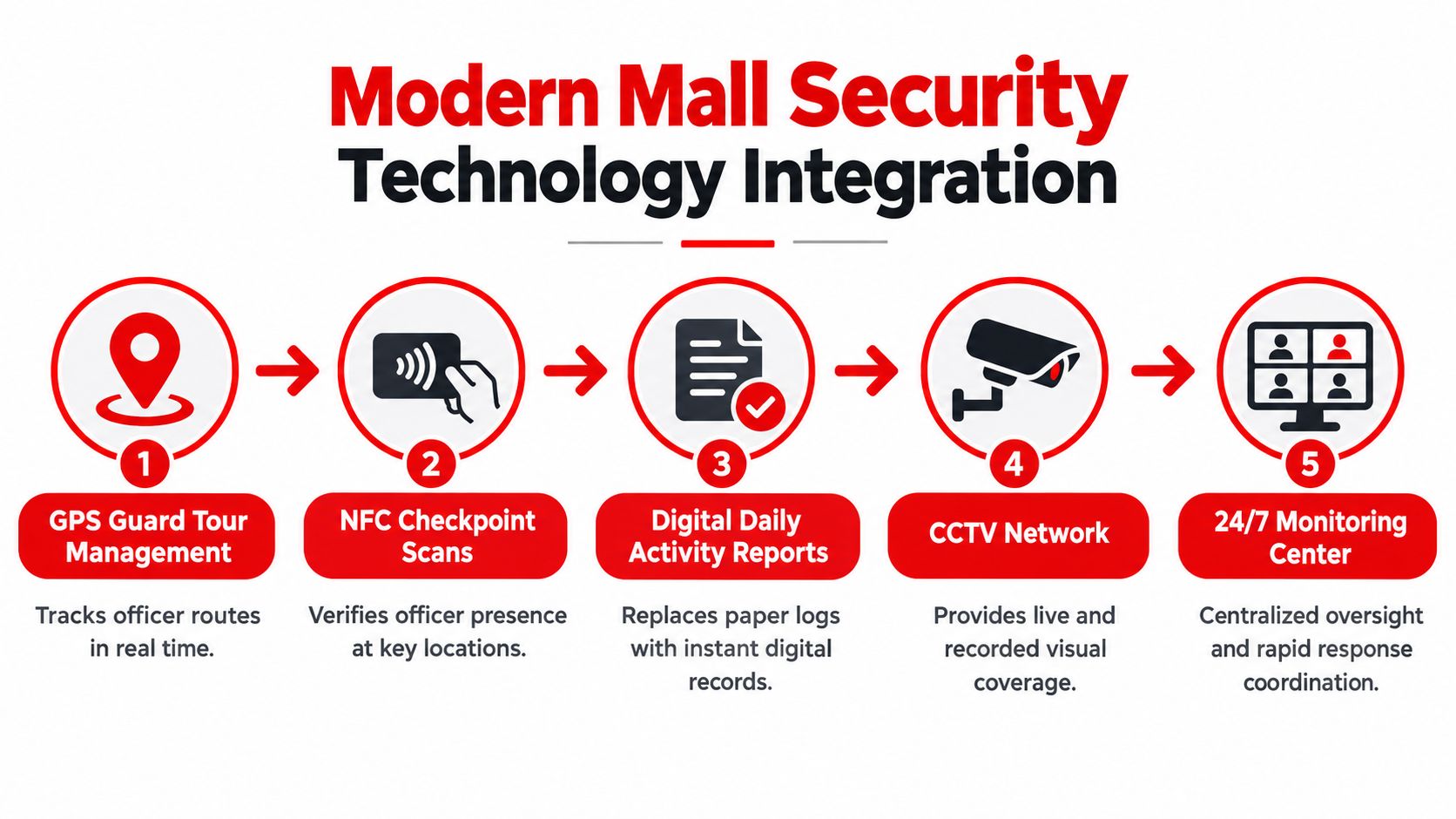
A checkpoint scan tells you that someone scanned a checkpoint. It doesn't tell you whether they checked the nearby door, noticed damaged lighting, or responded appropriately to a customer.
Useful technology connects officer presence, observed conditions, and follow-up. Treat a dashboard as an operational tool, not a substitute for supervision.
Know what each record establishes
- GPS-enabled guard tour management: Location records help supervisors review routes and investigate coverage gaps. They don't establish the quality of an inspection.
- NFC checkpoint scans: Near-field communication tags record visits to designated checkpoints. Pair the scan with a relevant inspection prompt.
- Digital daily activity reports: DARs should separate routine activity from exceptions requiring management attention.
- CCTV: Live and recorded views can help officers verify events and locate relevant footage. Cameras still need usable views and a response process.
For a comparison of equipment categories, Amax Fire & Security Ltd.'s retail security system options offers a resource to review alongside your property's requirements. Don't assume that a system designed for an individual store addresses every common-area need.
Require a response behind the alert
A 24/7 security operations center, or SOC, can support monitoring, dispatch, officer-welfare checks, and escalation. Ask who receives each alert, what happens if the onsite officer doesn't acknowledge it, and how the unresolved issue reaches a supervisor.
Review retail security camera systems in terms of coverage, monitoring responsibilities, and footage retrieval, rather than camera count alone. Before accepting an installation, walk through a sample incident from detection to report completion.
A recorded exception without an assigned follow-up is still an unresolved problem.
Technology should make gaps easier to identify. It shouldn't encourage managers to mistake a completed scan for a completed safety task.
Incident Response Protocols and Escalation
The hardest decisions happen before police arrive. An officer may have incomplete information, a crowd gathering nearby, and a tenant insisting on immediate action.
Recent retail-worker survey findings reported that 27% of U.S. retail employees felt unsafe at work, 54% had observed customer aggression or harassment, and 11% had personally experienced physical violence during the prior year, as summarized by Safety+Health's retail-worker safety report. Those figures support careful preparation, not a more confrontational posture.
Write decision thresholds before incidents happen
Post orders should specify who takes command, when backup is requested, and which conditions require emergency services. Use standardized radio terminology and accurate locations so responders aren't trying to interpret vague descriptions.
| Situation | Recommended response boundary |
|---|---|
| Suspected shoplifting or an alarm | Establish what was observed, coordinate with the tenant, and follow approved procedures. An allegation alone shouldn't trigger physical intervention. |
| Disorderly conduct or an argument | Offer calm assistance and maintain distance when safe. Request support if behavior escalates. |
| Fight, assault, weapon report, or credible threat | Request emergency assistance promptly, communicate known facts, and help others avoid the affected area when safe. |
| Medical emergency | Request EMS, direct responders, and provide assistance within training. |
| Missing child or vulnerable person | Activate the property's search and notification procedure, gather identifying information, and apply police-escalation criteria. |
| Suspicious activity | Describe observable behavior and circumstances, not assumptions about identity or intent. |
Don't require an officer to complete a report before making an urgent emergency call. Safety comes first.
Make the handoff useful
Record the event location, sequence, statements, observed injuries, actions taken, and available witnesses. Preserve relevant footage and document who accessed, copied, or transferred evidence.
For administrative follow-through, Facility Management Insights provides a resource to help optimize your reporting workflow. Adapt reporting procedures to the property's command structure and privacy requirements.
Response priority: De-escalation is appropriate when it's safe. It isn't a reason to delay emergency assistance for an immediate threat.
Officers should never be left to improvise pursuit, detention, or force decisions under pressure from a tenant.
Addressing Organized Retail Crime Without Overreach
Similar theft reports across neighboring tenants deserve review. They don't automatically establish organized retail crime, and officers shouldn't convert a suspected pattern into a definitive accusation.
California's statewide organized-retail-crime operation reported 331 investigations, 629 arrests, and recovery of 113,245 stolen items worth nearly $6.5 million from January through May 2025, as reported in the NRF retail theft and violence release. Those are enforcement results, not appropriate performance targets for private mall security.
Document the pattern without deciding the case
Officers can help investigators by recording information that otherwise remains scattered across stores:
- Recurring descriptions: Note clothing, distinguishing observations, and the source of each description. Separate firsthand observations from tenant reports.
- Possible coordinated behavior: Document apparent distraction tactics or simultaneous activity without claiming to know the participants' intent.
- Vehicles and exit routes: Record details that can be observed safely, without pursuing someone to obtain them.
- Supporting material: Identify relevant video segments, witnesses, and tenant reports for authorized review.
A report should make uncertainty visible. If an officer didn't see merchandise taken, the report shouldn't imply otherwise.
Coordinate across tenant boundaries
Use standardized incident categories and a shared escalation matrix so stores aren't reporting similar events in incompatible ways. Schedule case reviews with appropriate tenant representatives, management, and law enforcement, while restricting access to sensitive information.
Incomplete reporting makes comparison difficult. Encourage tenants to document incidents consistently, including those that don't result in a police response, subject to their procedures and applicable requirements.
The distinction between opportunistic theft and a coordinated pattern belongs in evidence review, not in an officer's unsupported label. Broader retail loss-prevention strategies should connect store procedures with common-area observations.
Assess the officer's contribution by the reliability of the record and the quality of coordination. A dramatic confrontation can distract from the information investigators need.
Common Misconceptions About Mall Security
Adding officers may be appropriate when duties exceed available coverage. But more headcount won't correct unclear assignments, weak supervision, or an unusable reporting process.
Before buying additional hours, identify the failure you're trying to fix. A recurring unsecured door may need an access-control repair rather than another person walking past it.
More guards don't create more authority
California's BSIS security guard fact sheet explains that the Power to Arrest curriculum addresses citizen's-arrest responsibilities and ethics, relationships between private security and public police, and limitations on guard arrest powers. Mall security officers aren't police officers, and training doesn't grant general police authority.
A provider that promises routine arrests without discussing legal limits, officer safety, or supervisory review is offering the wrong assurance.
Shrink isn't a guard-performance score
A 2022 retail survey estimated approximately $112 billion in total inventory shrink, attributing about 36% to shoplifting and organized theft, 29% to employee theft, and 27% to process, accounting, or inventory-tracking errors, as summarized by Retail Dive's examination of retail shrink. That breakdown doesn't support assigning every inventory discrepancy to external theft.
Use measures tied to the actual security assignment:
- Response documentation: Can management reconstruct the event and understand the officer's decisions?
- Repeat-location findings: Are recurring property conditions being addressed?
- Tenant feedback: Do employees know how to get help, and does security follow through?
- Nonviolent resolutions: Are officers resolving appropriate situations without unnecessary escalation?
Visible presence matters, but it isn't a guarantee. Neither an arrest nor recovered merchandise proves that an officer made a safe, lawful decision. Procurement should reward disciplined service, not activity that merely looks decisive.
Choosing the Right Security Partner
Ask a prospective provider to walk through an actual assignment, not just a presentation. Give them your layout, operating hours, tenant concerns, and emergency-access constraints, then ask how they would organize coverage.
For shopping centers in Los Angeles, San Jose, Sacramento, or elsewhere in California, the useful answer should reflect the property. A parking-heavy plaza and an enclosed mall shouldn't receive interchangeable post orders.
Ask for evidence behind the proposal
- Training verification: Who maintains records, and how are relief officers cleared for assignment?
- Officer stability: Request retention information and ask how pay, benefits, recognition, and career development support continuity.
- Management access: Ask about the manager-to-client ratio, site visits, and the person accountable when service falls short.
- Technology integration: Request a demonstration of patrol records, incident reports, and escalation handling.
- Post-order customization: Establish who writes, approves, trains, and updates the instructions.
Experienced officers still need support. Ask how supervisors handle difficult incidents, welfare concerns, and lessons from report reviews rather than treating replacement as the default answer.
Put expectations into the agreement
Define reporting frequency, review meetings, escalation responsibilities, and performance benchmarks. Include a process for changing coverage when tenant occupancy, access conditions, or incident patterns change.
Procright's resource on how to evaluate vendors objectively can help structure a comparison beyond providers' own descriptions. Request sample deliverables and explanations of how exceptions are resolved.
Choose documented accountability over sweeping promises. A low manager-to-client ratio is useful only if management remains accessible, reviews the work, and corrects problems.
Overton Security offers California shopping-center officer programs with customized post orders, GPS-enabled patrol accountability, detailed digital reporting, and SOC support. Visit Overton Security to discuss your property's coverage gaps, training-verification needs, and incident-escalation procedures before selecting an officer program.