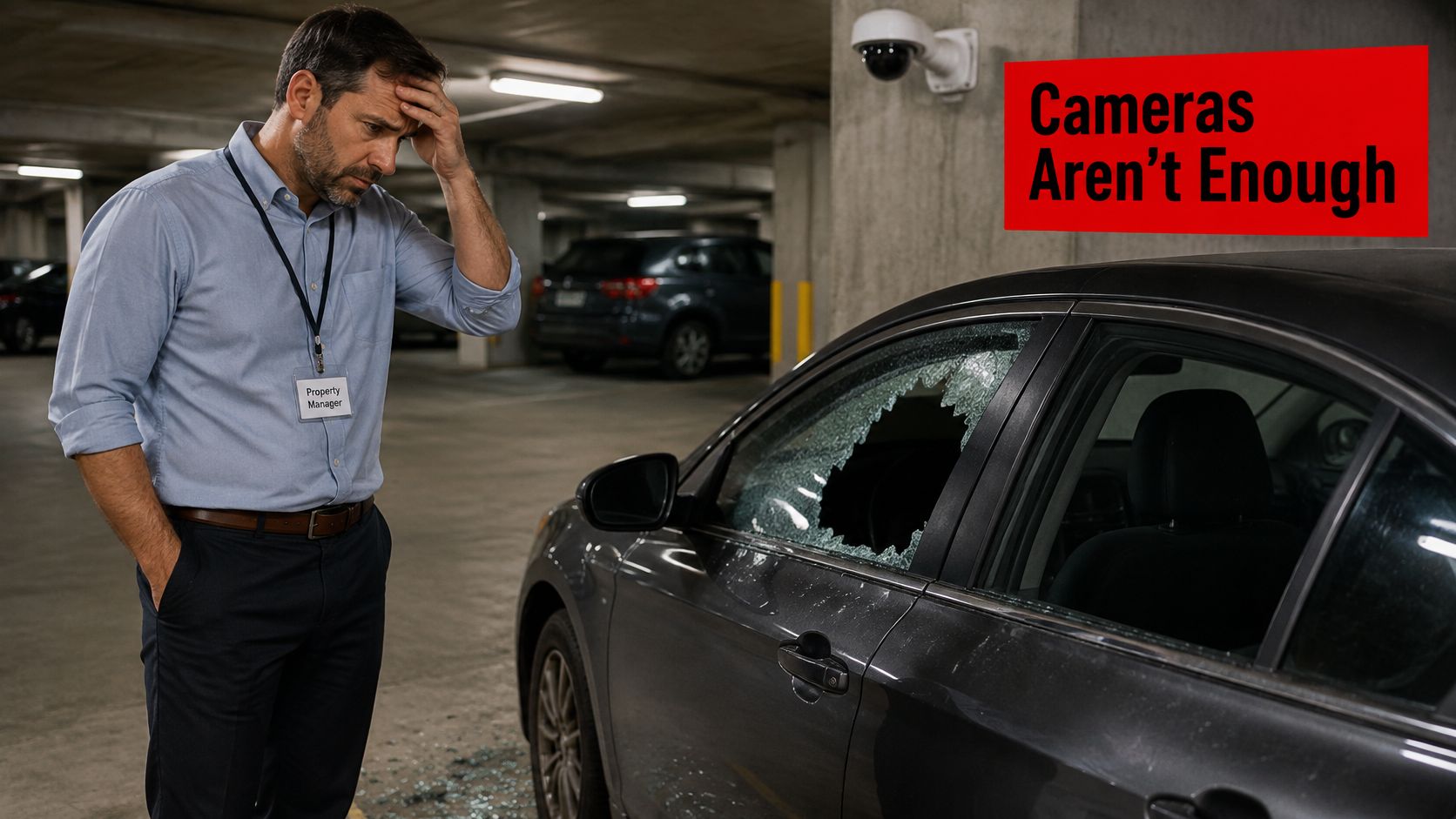
A resident emails a photo of a shattered car window just as your leasing team opens the office. The garage camera recorded the incident, but nobody saw it happening. As you review the footage, the practical question becomes clear: would your current security arrangement have noticed the problem and responded?
Choosing a security guard for an apartment complex starts with that question, not only deciding where a uniformed officer should stand. Effective coverage connects the places residents use, the problems your team encounters, and the actions someone is responsible for taking.
Why Apartment Complexes Need Security Guards
An apartment community is both someone's home and a shared operating environment. Residents need convenient access, delivery drivers need directions, visitors arrive throughout the day, and maintenance teams move between buildings. A security plan has to accommodate those activities without treating everyday community life as suspicious.
Consider the garage incident above as a hypothetical example. Reviewing footage might help establish what happened, but it doesn't answer whether an entrance was left open, whether someone noticed damaged glass, or how the resident received assistance.
Residential security needs context
Historical Bureau of Justice Statistics burglary findings show that rental households experienced higher burglary rates than owner-occupied households during 2003–2007, while an estimated 3.7 million burglaries occurred annually across all household types. These are historical national findings, not a current crime rate for your apartment community.
Use that distinction when discussing security with ownership. National evidence provides context, but your property's incident history, layout, access conditions, and resident concerns should determine deployment.
A useful assessment asks:
- Where can people enter? Include pedestrian gates, garage ramps, service doors, and connections between buildings.
- Where does responsibility become unclear? Look at delivery access, after-hours complaints, and doors that maintenance hasn't repaired.
- What happens after someone reports a problem? Identify who receives the call, who responds, and who follows up.
Active coverage closes an operational gap
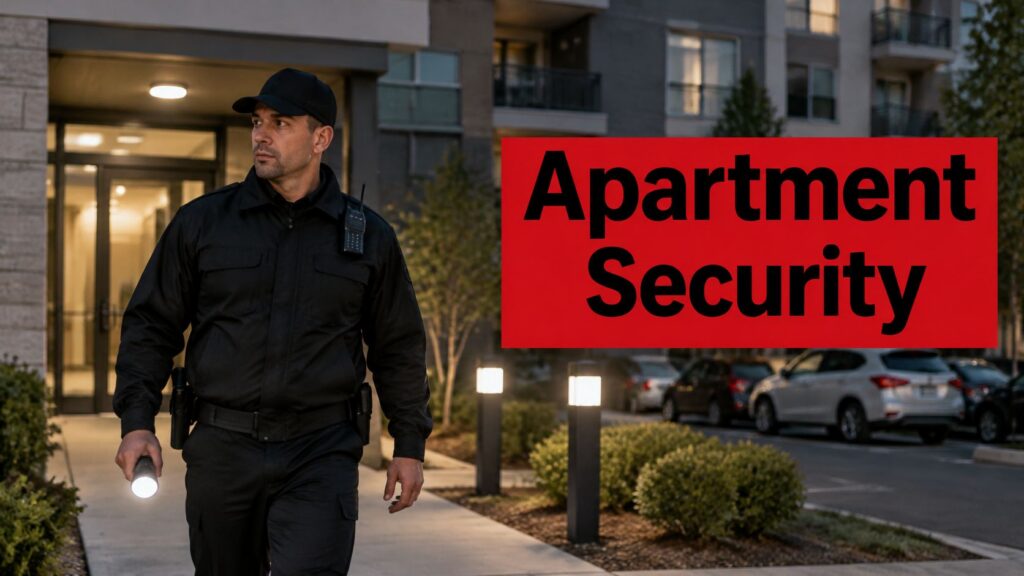
A guard adds a person who can interpret conditions and take an authorized next step. That might mean questioning an access exception, assisting a resident, notifying maintenance, or requesting emergency help.
Practical rule: Don't evaluate coverage only by whether an officer is visible. Ask what the officer can observe, reach, and address from that position.
The objective isn't to make a residential community feel restrictive. It's to give residents a dependable response while keeping ordinary movement welcoming and manageable.
What an Apartment Security Guard Actually Does
An apartment security officer's shift should begin with a handoff, not guesswork. The officer needs to know about unresolved incidents, malfunctioning equipment, authorized contractors, and any temporary changes to normal operations.
Post orders turn those details into written responsibilities. They explain what the officer checks, what decisions the officer can make, and when management or emergency services must become involved.
Translate the role into daily assignments
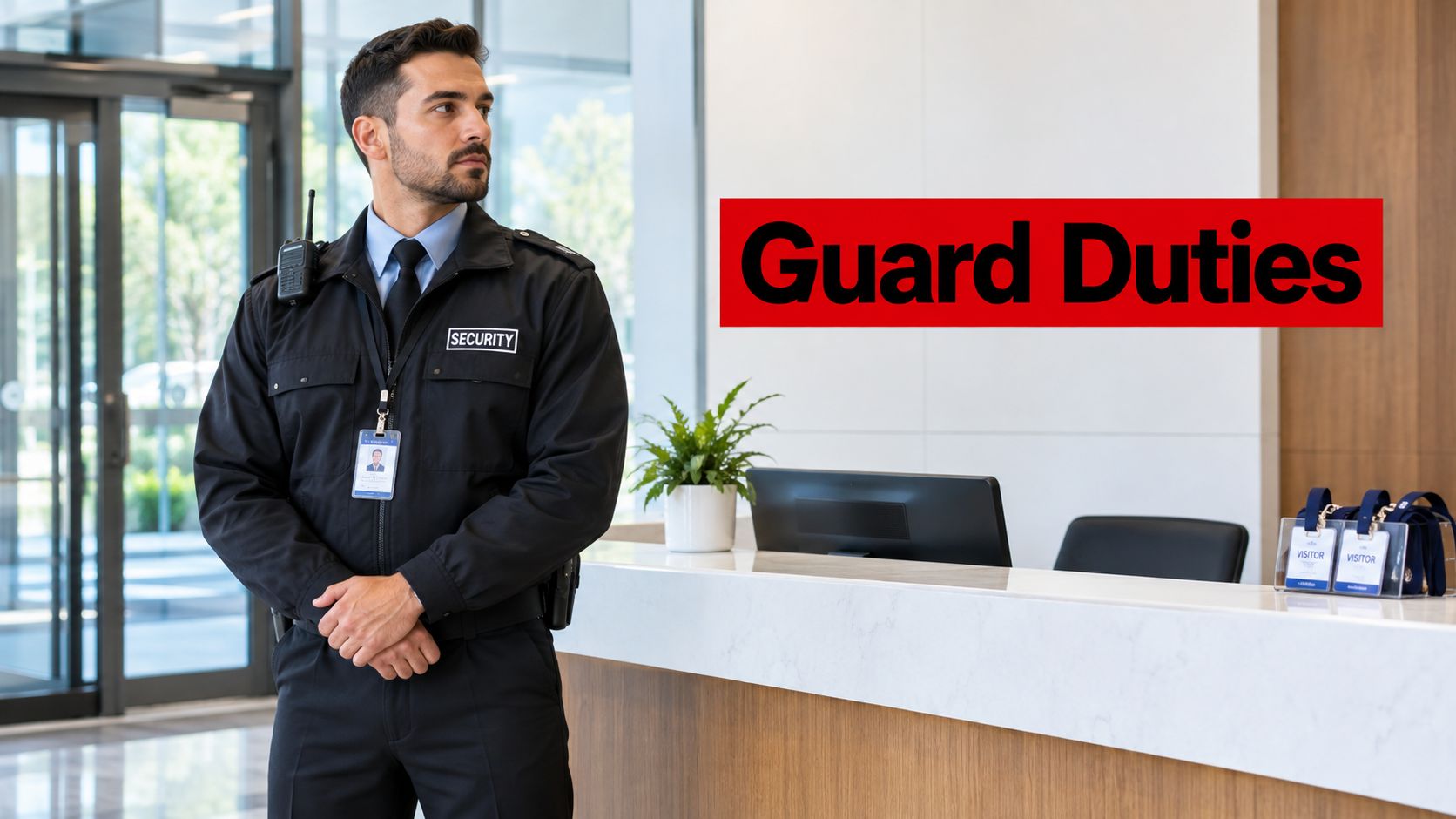
- Manage authorized access. Follow the property's visitor-verification procedure, address credential exceptions, and avoid granting entry merely because someone sounds familiar.
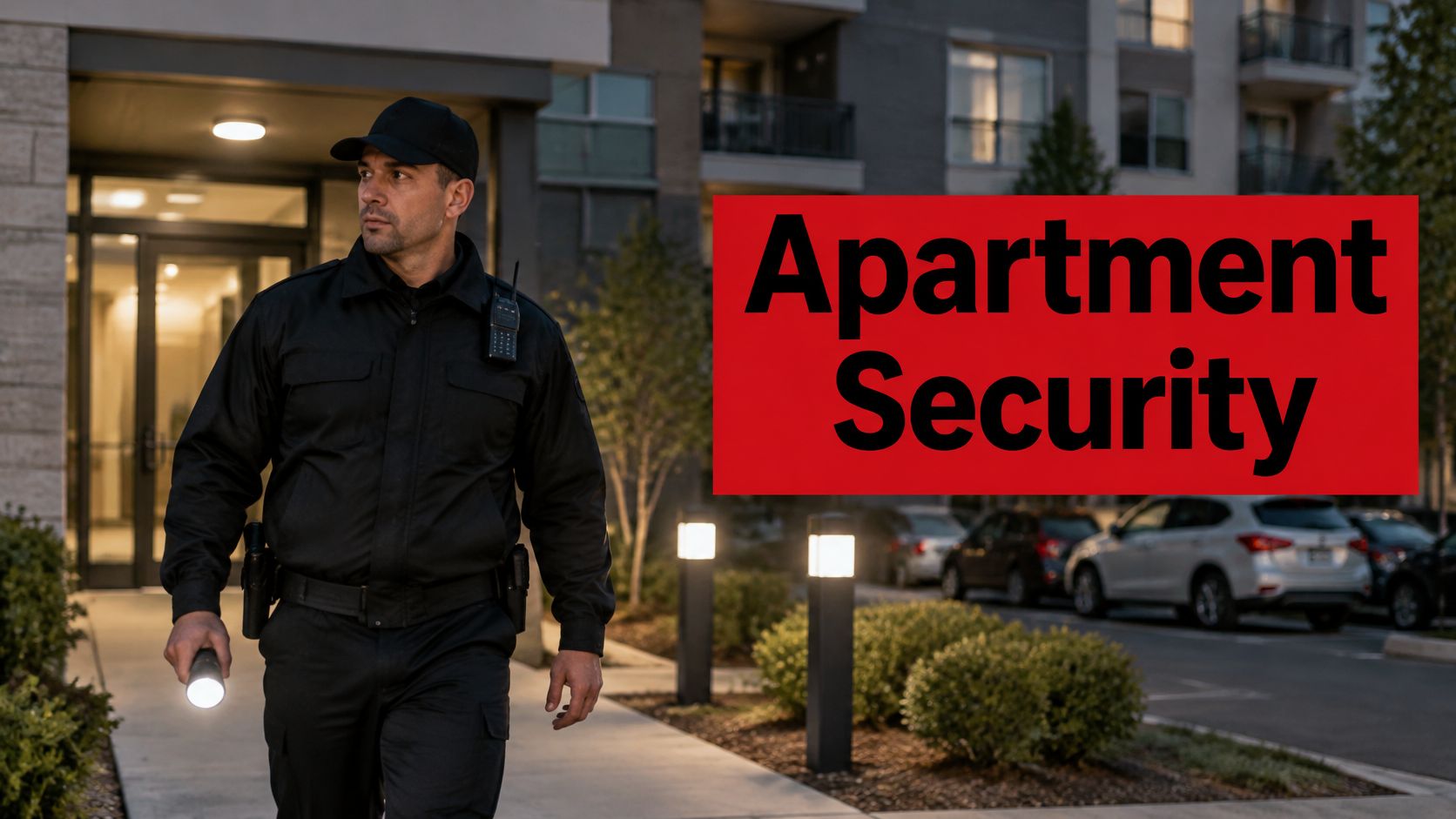
- Observe conditions during patrol. Look for tampering, unauthorized entry, blocked routes, and behavior that warrants further attention under established rules.
- Respond within training and authority. Assess the situation, communicate calmly, request assistance, and avoid unnecessary confrontation.
- Document what happened. Separate direct observations from statements made by residents or witnesses.
- Complete the handoff. Identify unresolved issues so the next officer or management team knows what still needs attention.
For example, an unfamiliar person waiting near a stairwell isn't automatically trespassing. An officer should establish context, apply the property's access rules consistently, and document relevant behavior rather than assumptions about appearance.
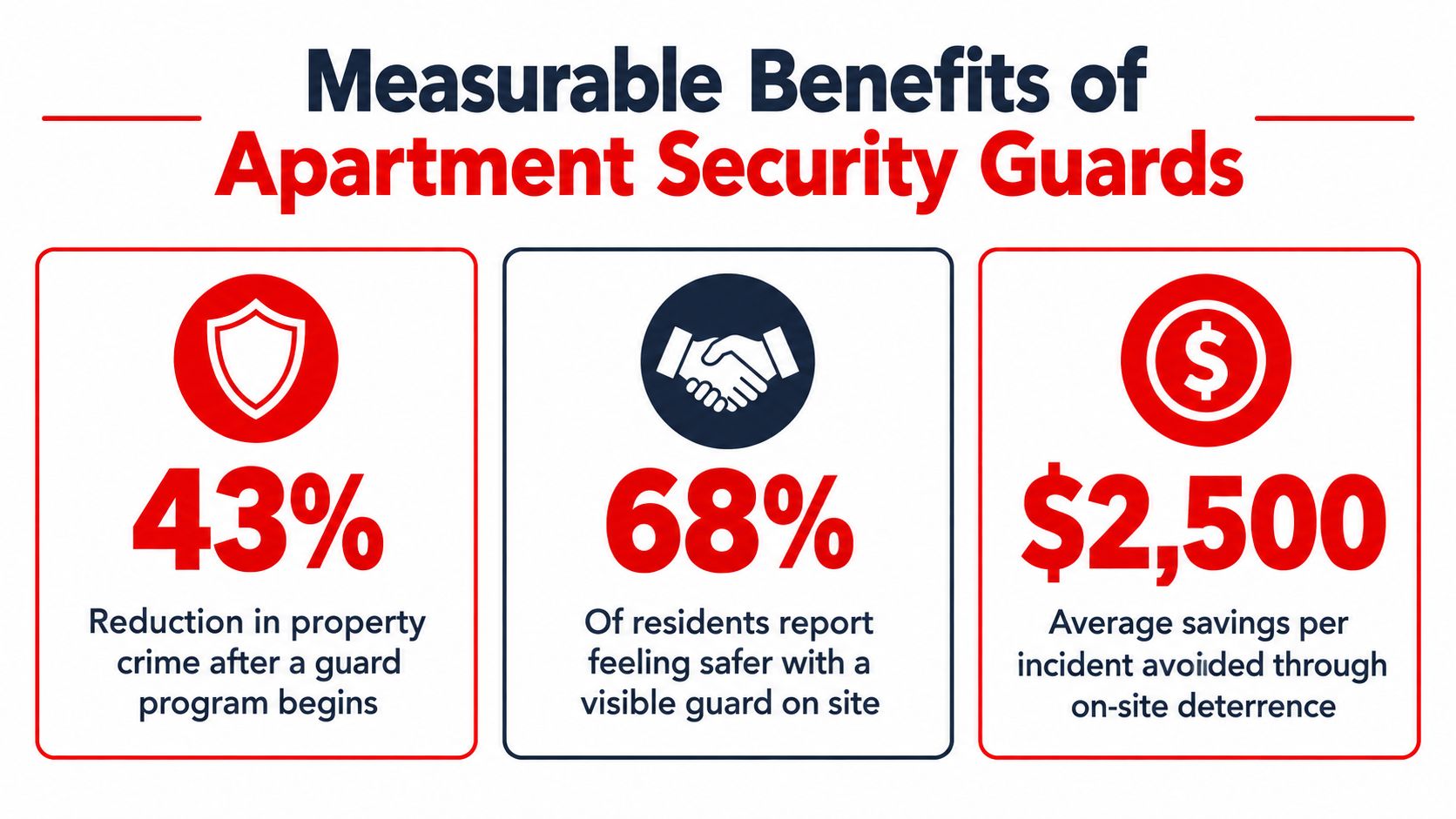
The supplied benefits graphic should not be used as evidence of a guaranteed outcome. Its percentage and savings claims aren't substantiated by the research cited here.
Budget for the assignment, not just the uniform
The Bureau of Labor Statistics occupational wage estimates reported 1,202,940 security guards nationally in May 2023, with a mean annual wage of $40,440 and a median annual wage of $37,070. Those historical employee-wage figures are budgeting context, not apartment-security contract prices.
Ask prospective providers to explain how supervision, relief coverage, training, reporting, and the scope of duties appear in their proposals. A lower quoted rate doesn't tell you whether the officer has the support needed to perform the assignment.
Also clarify service boundaries. Security officers shouldn't become the default answer for unrelated administrative work if those tasks prevent them from completing their protective responsibilities.
Key Benefits for Residents and Property Managers
The strongest argument for apartment security guards isn't that a uniform guarantees safety. It's that an appropriately deployed person can increase the likelihood that concerning activity is noticed and addressed.
In a virtual-reality burglary experiment involving 181 incarcerated burglars and 172 non-burglars, a guardian's presence deterred both groups, and participants perceived a greater likelihood of being caught. The experiment supports a deterrence mechanism, not a promised reduction at an individual apartment property.
Separate supported benefits from promises
A critical review of guardianship research describes effective guardianship through availability, observation, and an appropriate capacity to intervene. It also discusses residential-building research in which recorded offenses were lowest where guardianship was highest.
For a property manager, the operational implication is straightforward: an officer needs a workable assignment, not merely a designated chair.
| Potential benefit | What management should examine |
|---|---|
| More useful intervention | Whether officers recognize problems and take appropriate action |
| Better incident information | Whether reports establish a clear sequence of events |
| Resident assistance | Whether residents receive respectful, understandable guidance |
| Stronger management decisions | Whether documented patterns lead to practical changes |
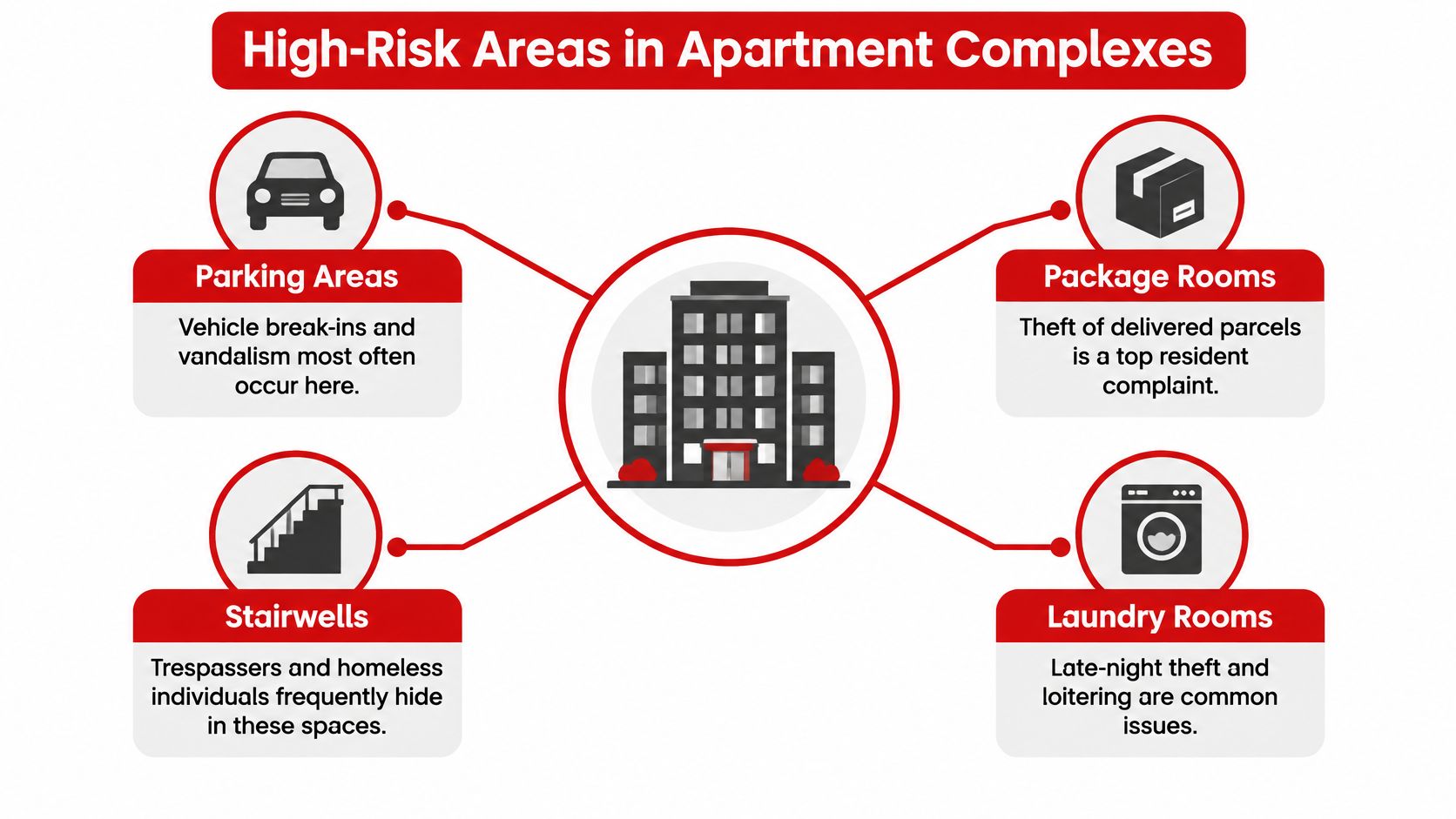
The following diagram identifies places worth assessing. Treat its location labels as planning prompts, not evidence that every property has the same incident pattern or that someone's housing status indicates misconduct.
Evaluate value without inventing a return
A trained officer can offer a calm point of contact during a disagreement, help a resident explain a concern, or communicate conditions to responders. Those are meaningful service functions even when they don't produce a simple financial calculation.
Avoid promising lower insurance premiums, reduced legal liability, or improved resident retention without property-specific evidence. Good documentation can support later review, but it doesn't automatically establish legal protection or insurance eligibility.
A sensible business case connects spending to defined service outcomes. Ask whether management receives actionable information, residents understand how to obtain help, and recurring problems receive a documented response.
Covering High-Risk Areas Parking Packages and Shared Spaces
A lobby assignment can leave a garage effectively unattended. Before calling any location a hotspot, examine actual reports, resident complaints, access failures, and observations from property staff.
Parking deserves particular attention. In a 2025 Parks Associates survey of 62 multifamily-property professionals, 68% reported vehicle break-ins multiple times per year, 18% reported incidents several times per month, and nearly one-quarter reported no parking-security measures. This small professional survey is a useful planning signal, not a national incident rate.
Assign tasks by location
- Garages and surface lots. Specify walking routes, pedestrian-door checks, vehicle-gate observations, and procedures for reporting damage. Set patrol frequency around documented vulnerabilities rather than choosing an arbitrary interval.
- Package rooms. Verify that doors close and latch, follow authorized delivery procedures, and record access failures without inspecting residents' parcels. Use this package-theft prevention guidance when reviewing the delivery process.
- Stairwells and laundry rooms. Check access conditions, lighting, and signs of tampering. Address observed conduct under community rules, not assumptions about who belongs.
- Shared amenities. Clarify opening, closing, guest-access, and complaint-handling duties so enforcement doesn't depend on an individual officer's preference.
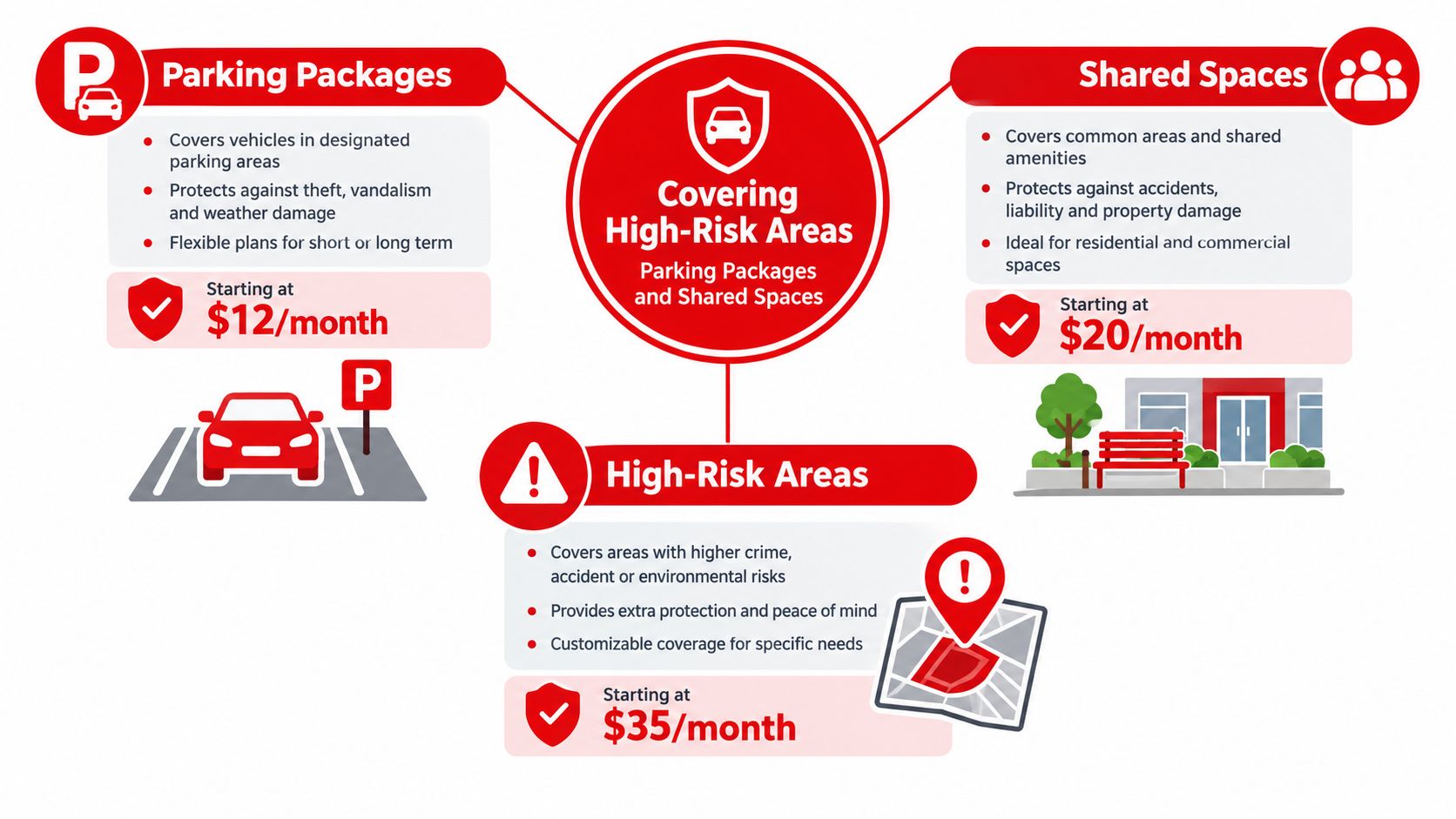
The graphic below isn't a security-service quote or an insurance recommendation. Any package or pricing information shown should not replace a property-specific assessment.
Connect observations to repairs
HUD housing guidance on common-area conditions specifies continuously illuminated exit access and vandal-resistant lighting in the covered settings, including permanent fixtures in common laundry facilities. Confirm which requirements apply to your property rather than assuming every HUD provision governs every apartment building.
An officer's report should identify the exact failed fixture or defective latch, who received notification, and whether a temporary precaution was needed. Management should close the loop after repair.
For condominium or HOA teams reviewing broader shared-space responsibilities, Royal LePage Brookside Realty's guide provides an additional resource on condo management services. Keep the security assignment aligned with the actual management agreement and local requirements.
Choosing the Right Security Coverage Model
Choose coverage by asking what must happen between an incident starting and someone taking action. A property that needs continuous visitor assistance has a different requirement from one that needs periodic checks of closed amenities and perimeter gates.
Property size matters, but it isn't the only deciding factor. Consider walking distances, simultaneous responsibilities, incident timing, access complexity, resident expectations, and the consequences of leaving a post.
Apartment Security Coverage Models
| Model | Best For | Key Strength | Consideration |
|---|---|---|---|
| Onsite guards | Properties needing sustained access management and resident-facing assistance | Immediate human availability during assigned hours | A fixed post can limit coverage elsewhere |
| Vehicle patrols | Communities needing periodic inspections across grounds or buildings | Mobile visibility and documented checks | Officers aren't continuously present between visits |
| Remote monitoring | Properties with suitable cameras and a defined response arrangement | Observation without an officer at every monitored location | Camera views and communications limit what operators can assess |
| Hybrid coverage | Properties with different needs by location or operating period | Combines selected services around specific tasks | Requires clear responsibility for alerts and response |
A smaller community may be a candidate for shared mobile patrols if its needs are periodic. A larger community may need dedicated personnel, but adding an officer without separating incompatible duties can leave the original gaps unresolved.
A coverage proposal should explain what happens when the officer is already handling another call.
Test the proposal against an ordinary shift
Ask the provider to walk through a realistic scenario: a delivery needs verification while a resident reports a garage disturbance. Who remains at the entrance? Who investigates? Who communicates with management?
This comparison of onsite security officers and security patrol services can help frame questions about continuous presence versus scheduled visits.
Don't use staffing to compensate indefinitely for defective hardware. For an example of a specialist resource outside California, Breaking Glass Co.’s page on East Texas security door replacements illustrates a separate repair consideration to discuss with an appropriately located contractor.
Whether you manage apartments in Los Angeles, San Jose, or Sacramento, request a proposal that states its assumptions. Those assumptions should include coverage hours, patrol scope, backup arrangements, reporting access, and exclusions so you can compare services fairly.
Balancing Human Guards with Smart Technology
A camera can show someone entering a room. It can't independently explain whether that person is an authorized guest, a resident seeking assistance, or a contractor following an outdated instruction.
Human judgment has limitations too. Officers need reliable information, supervision, and boundaries on what they record and how they act.
A building-performance report discussing Parks Associates research cites a 2025 study based on 8,000 U.S. internet households, finding that approximately half of apartment residents were concerned about community safety and interested in smart safety amenities. Interest in technology shouldn't be interpreted as permission for unrestricted surveillance.
Give each tool a defined purpose
Cameras can support observation and incident review. Electronic credentials can support controlled entry, while GPS-enabled patrol verification and checkpoint scans can help supervisors review assigned activity.
A Guard Tour Management System should supplement supervision, not replace it. A scanned checkpoint confirms a recorded action at a location; management still needs to assess whether the officer made useful observations.
For credential planning, this explanation of apartment-building access control systems offers a starting point for discussions about resident, visitor, and service access.
Establish privacy and fairness rules
Write procedures that address:
- Relevant recording. Capture facts needed to explain the incident, not unrelated details about residents' lives.
- Controlled access. Identify who may view reports and footage, and how requests are approved.
- Retention and sharing. Establish a legally reviewed schedule and procedures for preserving material connected to an incident.
- Consistent enforcement. Base decisions on observed conduct and applicable rules rather than appearance, disability, background, or perceived housing status.
VerticalRent's overview of rental property camera regulations is a resource for identifying questions to take to qualified local counsel. Don't substitute a general overview for advice about your jurisdiction or camera placement.
Resident trust matters: Explain how to report a concern, what response to expect, and whom to contact if an interaction feels inappropriate.
A documented hybrid program should make responsibility clearer. More devices and more recorded data aren't useful measures of success by themselves.
How to Build an Effective Guard Program
Start with a site walk involving management, maintenance, and the proposed security supervisor. Each person sees different problems, and the assignment should reflect those perspectives before coverage begins.
OSHA's workplace-violence guidance recommends assessing workplace threats and developing a site-specific prevention program, with potential controls including surveillance, lighting, alarms, identification badges, electronic keys, and guards. Apply that workplace guidance thoughtfully to leasing operations and employee duties rather than treating it as a complete residential-security standard.
Establish responsibilities before deployment
- Map the assignment. Identify entrances, patrol areas, equipment locations, and places requiring special authorization.
- Write usable post orders. Include visitor procedures, access exceptions, communication methods, emergency contacts, and limits on officer authority.
- Define escalation thresholds. State which conditions require immediate emergency contact, supervisor review, maintenance notification, or management follow-up.
- Practice realistic situations. Review a missing credential, an unresponsive resident, an alarm, and a conflict over an amenity rule.
- Confirm support arrangements. Ask how absences, breaks, urgent backup needs, and supervisor questions will be handled.
Avoid vague directions such as maintaining a safe environment. The officer needs instructions that remain usable during an interruption, an equipment failure, or a stressful interaction.
Review performance without rewarding empty activity
The Department of Justice's rental-property problem-solving guidance emphasizes owners' and managers' responsibility for recurring problems and recommends establishing an acceptable level of activity, then acting when problems exceed it. Use that approach to distinguish isolated events from conditions requiring a change.
Review checkpoint completion alongside report quality, response times, repeat incidents, resident complaints, and unresolved work orders. Increased reporting may reflect better observation rather than worsening conditions, so examine the underlying events before drawing conclusions.
A useful supervisor review asks whether the officer followed instructions, whether the instructions were sufficient, and whether management completed its own follow-up. Accountability shouldn't stop with the person writing the report.
Finally, give residents a simple service description. Explain what security handles, how to request assistance, and when they should contact emergency services directly. Clear expectations prevent confusion and help your team evaluate the service fairly.
The Bottom Line on Apartment Security Guards
An apartment security program should answer a practical question: who is responsible for noticing a problem, taking an appropriate action, and making sure the issue reaches the right person?
A lobby presence alone doesn't answer that question. Neither does a collection of cameras without a response procedure or a patrol schedule that ignores the property's documented concerns.
Look beyond police-call totals
The Bureau of Justice Statistics national property-crime summary reported that about 3 in 10 property-crime victimizations were reported to police in 2024, while burglary or trespassing accounted for 41% of property-crime victimizations. Those national figures support maintaining internal records rather than treating police reports as a complete account of property conditions.
Your management record should distinguish confirmed incidents, resident statements, observed deficiencies, and unresolved questions. That distinction helps avoid overstating problems while preserving information that could reveal a recurring pattern.
Choose a partner you can supervise
Before signing an agreement, ask for examples of the operational documents you'll receive:
- A sample post order. Check whether duties are specific enough for an unfamiliar relief officer to follow.
- A sample incident report. Look for clear observations, actions taken, notifications, and outstanding needs.
- A supervisor-review process. Confirm who checks performance and how concerns reach decision-makers.
- An officer-support plan. Ask about training, continuity, relief staffing, and how field personnel obtain help.
You're not purchasing certainty that nothing will happen. You're establishing a dependable process for managing conditions, assisting residents, and responding when something does happen.
Start with your property's most persistent operational gap. Bring the relevant reports, access issues, resident concerns, and maintenance history to a site assessment. A useful proposal should show how the recommended coverage addresses that gap and how you'll know whether the assignment is being carried out.
Overton Security offers onsite officers, vehicle patrols, and remote monitoring supported by GPS-enabled patrol verification, detailed digital reports, and round-the-clock Security Operations Center oversight. Visit Overton Security to discuss your apartment community's parking, package, and shared-space needs and request a site-specific coverage assessment.