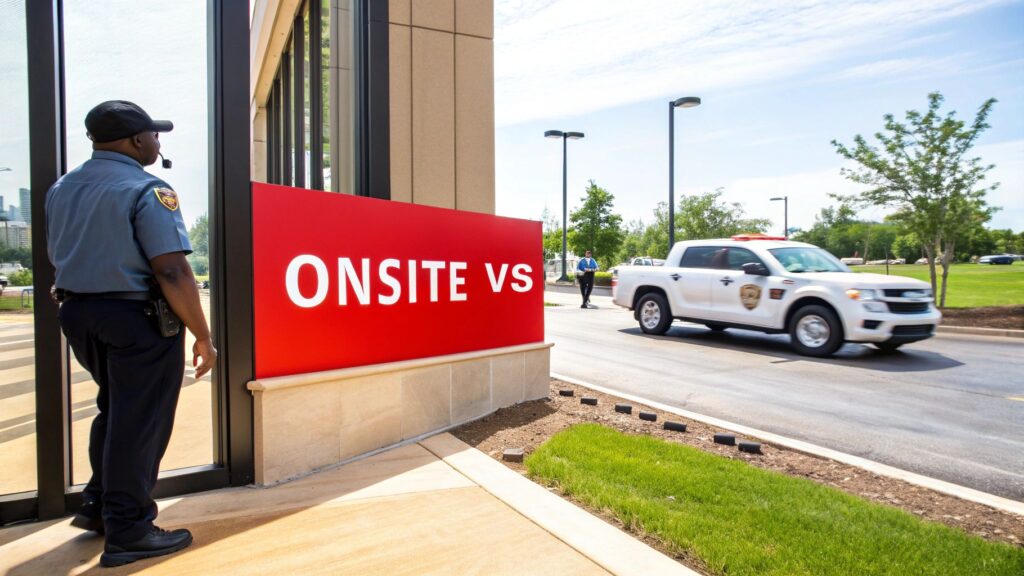
Choosing the right security for your property is a critical decision for any property manager, HOA board, or business owner. The choice often comes down to one core difference: an onsite security officer provides a constant, dedicated presence at a single location, while a security patrol service offers a visible, mobile deterrent that covers a wider area.
Your decision hinges on whether you need immediate, around-the-clock oversight or a more cost-effective, broad-coverage approach to deter potential threats.
Choosing Your Ideal Security Solution
Figuring out whether to go with a dedicated onsite officer or a mobile patrol service can seem complex, but it's really about getting honest about your property’s specific weak spots and daily needs. With over 26 years of experience as a security partner, we've guided countless clients in Los Angeles, San Jose, and across California through this very decision.
An onsite security officer essentially becomes a part of your team. They are the perfect fit for:
- High-traffic locations that demand consistent access control, like a busy corporate lobby or a large residential community gate.
- Properties holding high-value assets that simply can't be left unwatched.
- Environments where an immediate response to any incident isn't just a benefit—it's non-negotiable.
On the other hand, security patrol services offer a dynamic and budget-friendly alternative. This model is incredibly effective for:
- Covering large areas like industrial parks, construction sites, or sprawling apartment complexes.
- Deterring opportunistic crimes like vandalism, loitering, and trespassing through visible, unpredictable visits.
- Properties that need security checks after hours, including facility lock-ups and alarm response.
To make it even clearer which solution is the right one for your goals, let’s put their key features side-by-side.
Onsite Officer vs Patrol Service At a Glance
The table below offers a quick snapshot of how these two security models stack up against each other, highlighting their fundamental differences in presence, cost, and function.
| Attribute | Onsite Security Officer | Security Patrol Service |
|---|---|---|
| Presence | Constant and dedicated at one location. | Intermittent and mobile across multiple locations. |
| Response Time | Immediate, as the officer is already on site. | Varies based on the patrol vehicle's location. |
| Cost Structure | Higher cost; billed hourly for a dedicated professional. | Lower cost; resources are shared among clients. |
| Primary Role | Site-specific duties, access control, and immediate response. | Visual deterrence, property checks, and alarm response. |
| Best For | High-risk, high-traffic, or single-location properties. | Large areas, multi-site portfolios, and budget-conscious needs. |
Ultimately, this comparison shows that one isn't inherently "better" than the other. The best choice is the one that directly addresses your property's unique risks and operational demands.
The Role of Onsite Security Officers
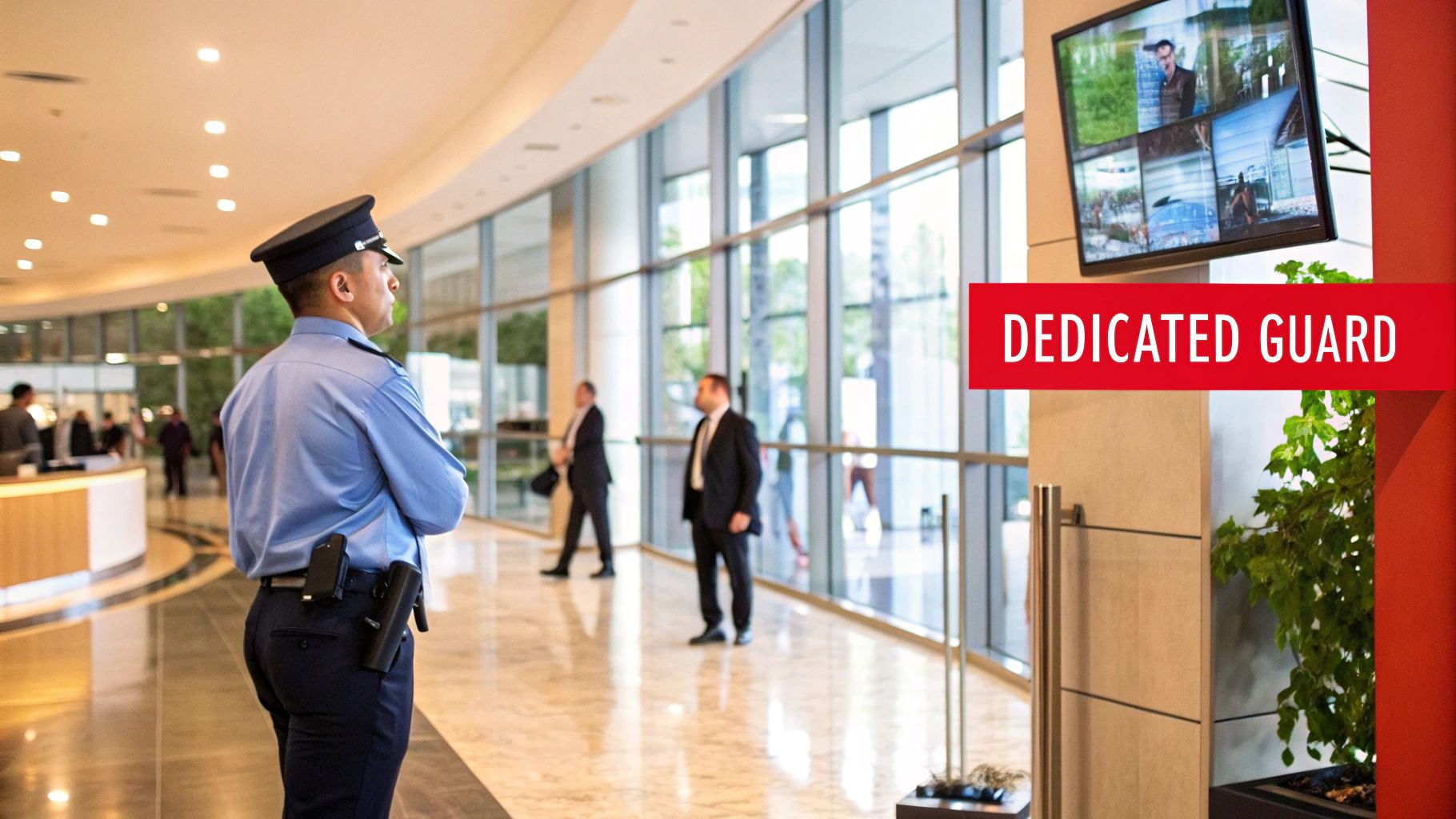
Onsite security officers represent the gold standard for dedicated protection. They provide a constant, visible presence at your property, becoming a fully integrated part of your daily operations. More than just a guard at a post, this professional is a powerful deterrent to potential threats simply by being there.
Their role goes far beyond observation. An onsite officer is an active manager of your property’s safety, handling crucial tasks that maintain order and security around the clock. They are your first line of defense for both people and assets.
A Dedicated Presence and Immediate Response
The true value of an onsite officer is their unwavering presence. Unlike a mobile patrol that visits periodically, a stationed officer is always there, ready to respond in an instant. This eliminates the delay between an incident occurring and security arriving on the scene.
This constant presence allows them to manage access points with precision, monitor security systems like CCTV in real-time, and react immediately to any emergency. Onsite officers typically work in full-time shifts to ensure you have continuous coverage, seven days a week. While this dedicated model is a larger investment, its value is in that immediate action. For businesses weighing this, our guide on unarmed security guard services offers deeper insights into their capabilities.
An onsite officer’s greatest strength is their ability to shift from a proactive deterrent to a reactive first responder in seconds. They don’t just report problems; they are there to manage them as they unfold.
Multifaceted Responsibilities Beyond Security
A professional onsite officer does much more than stand guard. They become a versatile asset, handling a variety of responsibilities tailored to your specific needs. In a corporate lobby, for instance, they provide a welcoming yet secure first point of contact. In a luxury residential community, they might take on concierge-like duties, adding value to the resident experience while keeping everyone safe.
Their daily duties often include:
- Access Control: Carefully managing the flow of employees, visitors, and vendors to prevent unauthorized entry.
- Real-Time Monitoring: Actively watching surveillance feeds to spot and address suspicious activity before it escalates.
- Emergency Response: Serving as the initial responder for medical issues, fire alarms, or security breaches, providing critical support until emergency services arrive.
- Customer Service: Acting as a helpful and reassuring presence for tenants, employees, and guests.
This multifaceted role is what truly separates an onsite officer from a patrol service. The investment delivers a tangible return through constant vigilance and a secure environment. Industry analysis shows that while this approach can have a cost premium of 20-40% over mobile patrols, the comprehensive coverage it provides is unmatched for high-risk or high-traffic locations.
How Security Patrol Services Operate
Security patrol services bring a dynamic and highly efficient style of protection to the table. Unlike a stationary officer, a mobile patrol unit works on a shared-resource model. This means a single uniformed officer in a clearly marked vehicle covers multiple clients within a specific geographic area, providing a powerful, visible security presence without the cost of a dedicated, full-time guard.
The real strength of this model is its strategic unpredictability. Patrol officers conduct their checks at randomized times, making it nearly impossible for would-be criminals to learn their patterns. That element of surprise is a powerful deterrent against opportunistic crimes like vandalism, trespassing, and theft.
The Strategic Advantage of Mobile Coverage
Mobile patrols are perfect for casting a wide security net, especially for properties where a constant, fixed presence isn't necessary or financially practical. Think of a sprawling industrial park after hours or a large construction site filled with valuable equipment. A single onsite officer would be stretched thin trying to cover the entire perimeter.
A vehicle patrol, however, can efficiently sweep the property multiple times throughout the shift, ensuring everything stays secure. Their primary duties are targeted and incredibly effective.
This infographic breaks down the primary functions of a patrol officer's shift, showing how their time is split to maximize protection for your property.
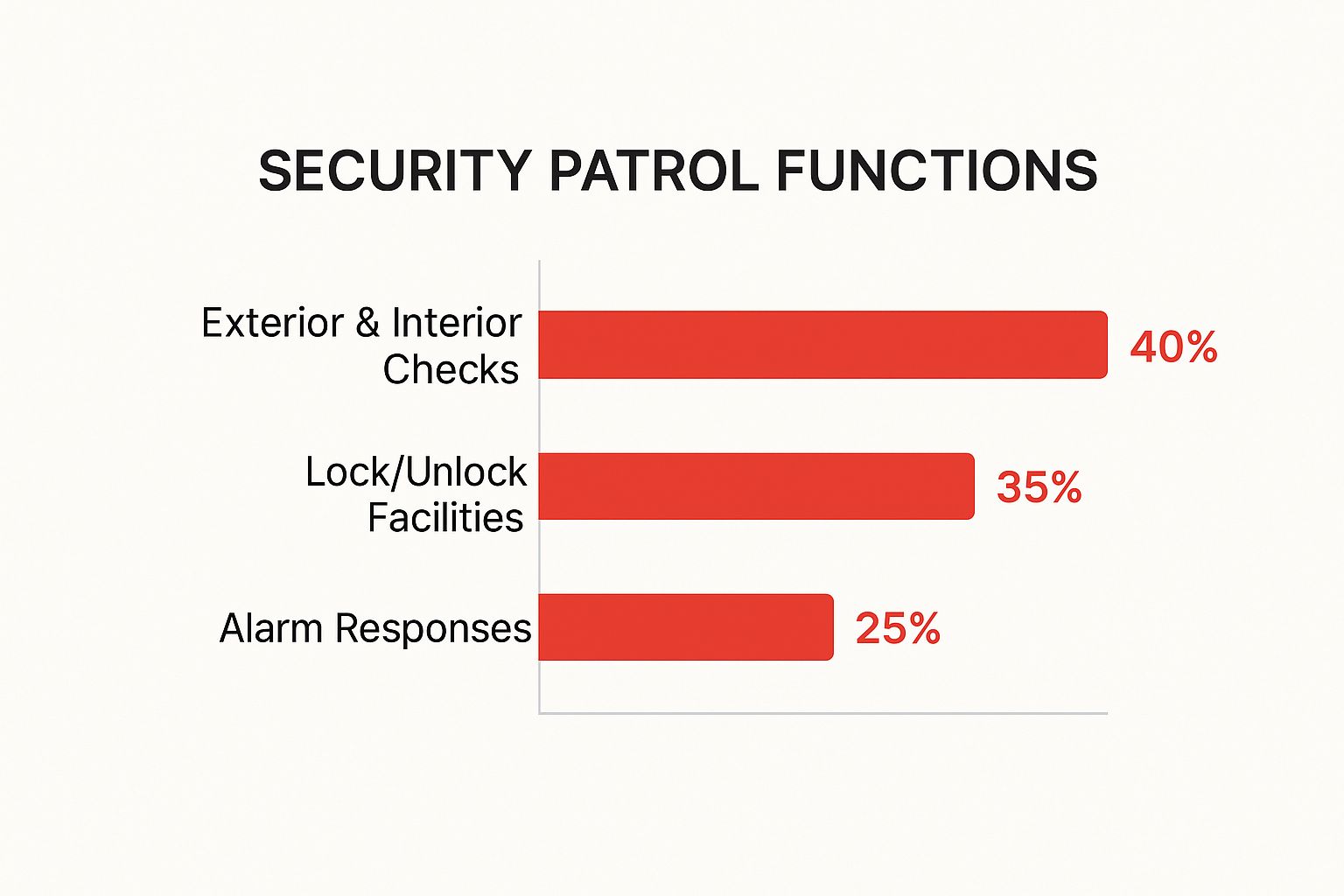
As you can see, a significant portion of a patrol officer's time—nearly 75%—is spent on proactive checks and securing facilities, which is key to preventing incidents before they happen.
A Blend of Human Expertise and Technology
Modern security patrols are so much more than just a quick drive-by. At Overton Security, we pair the expertise of our trained officers with smart technology to ensure complete accountability. Our officers use GPS-enabled systems to log their arrival, scan specific checkpoints around your property, and file detailed digital reports in real-time.
This gives you a verifiable, minute-by-minute record of every patrol and any observations made during their rounds. For property managers juggling multiple sites in places like Los Angeles or San Jose, this provides priceless peace of mind. Old-fashioned paper logs simply can't compete with that level of transparency.
If you want to dive deeper into how these operations run, you can explore our detailed overview of mobile patrol security solutions.
Security patrols are most effective when they create a consistent yet unpredictable presence. Their visibility deters crime, while their randomized schedule disrupts criminal planning, offering a cost-effective way to protect large or multiple properties.
Ultimately, these services are built for proactive deterrence. They handle essential tasks like:
- Locking and Unlocking Facilities: Ensuring your property is secured at the close of business and ready to open on time.
- Responding to Alarms: Acting as your first line of defense to investigate alarm triggers, verify the situation, and coordinate with law enforcement if a real threat is present.
- Deterring Nuisance Activity: Discouraging loitering, unauthorized parking, and other minor issues that can escalate if ignored.
Digging Deeper: Onsite vs. Patrol Security
To get to the heart of the matter, you have to look at onsite security officers and mobile patrol services side-by-side, analyzing the factors that truly impact your property and your bottom line. This isn't just a surface-level glance; it's about giving you a solid framework to decide which security model truly fits your situation.
Each service provides a completely different approach to protection. The right choice is never universal—it always comes down to your property’s unique risks, daily operations, and budget.
Response Time and Immediate Action
The most significant difference between the two is response time. An onsite security officer is already there, providing an immediate, real-time reaction to anything that happens. When an alarm goes off or a tenant reports an issue, there is zero delay. A trained professional is already on the scene, taking action. For high-risk environments where every second is critical, this is non-negotiable.
On the other hand, a security patrol service operates with a variable response time. When an alarm is triggered at your location, the patrol officer might be handling an issue for another client. While our patrols are strategically routed for maximum efficiency and backed by our 24/7 SOC for quick dispatch, travel time is an unavoidable factor.
Cost Structure and Budget Allocation
The financial models for these services are worlds apart. An onsite officer is a dedicated resource—you are paying for their undivided attention and constant presence. This naturally comes with a higher hourly rate and should be seen as an investment in total, uninterrupted security coverage.
A mobile patrol runs on a shared-cost model. Since a single officer and vehicle serve multiple clients within a geographic zone, the expense is spread out. This makes it a far more budget-friendly choice for businesses that need a professional security presence without committing to the full cost of a dedicated guard.
For many, the decision boils down to this: Are you paying for a dedicated resource to manage known, ongoing risks (onsite), or are you investing in a shared deterrent to prevent opportunistic, unknown threats (patrol)?
Scope of Duties and Site Integration
An onsite officer becomes an integral part of your property’s daily rhythm. Their responsibilities are tailored specifically to your site and can include complex jobs like managing visitor access control systems, monitoring sophisticated CCTV networks, and enforcing specific property rules. Over time, they build invaluable, deep knowledge of your site’s layout, its people, and its normal patterns of activity.
A patrol officer’s duties are typically broader and more checklist-oriented. Their primary focus is providing a high-visibility deterrent, performing physical checks of doors and windows, securing common areas, and responding to alarms. They are incredibly effective at these tasks, but they don’t achieve the same level of deep, site-specific integration.
To help visualize the differences, let's break down the core features side-by-side. This table offers a clear, at-a-glance comparison of what each service model brings to the table, helping you align their strengths with your specific security needs.
Detailed Feature Comparison Onsite vs Patrol
| Decision Factor | Onsite Security Officer | Security Patrol Service |
|---|---|---|
| Primary Role | Comprehensive site management and immediate incident response. | High-visibility deterrence and scheduled/random property checks. |
| Response Time | Immediate. Officer is already on the property. | Variable. Depends on officer's location and travel time. |
| Cost | Higher hourly rate due to dedicated, full-time presence. | Lower, shared cost model serving multiple clients. |
| Deterrence Type | Constant and predictable. A continuous, visible presence. | Intermittent and unpredictable. Random patrols discourage opportunists. |
| Scope of Duties | Highly specific and integrated (access control, concierge, rule enforcement). | Broader and checklist-driven (lock-ups, perimeter checks, alarm response). |
| Site Knowledge | Develops deep, intimate knowledge of the property, people, and routines. | General knowledge of multiple sites within a patrol route. |
| Best For | High-risk properties, large campuses, sites with constant activity, or where immediate response is critical. | Low-to-moderate risk properties, vacant sites, HOAs, commercial lots after hours. |
As you can see, the choice isn't about which one is "better" in a general sense, but which one is the right tool for the job based on your property's specific profile and security goals.
The Impact of Visual Deterrence
Both services act as a powerful visual deterrent, but they achieve it in different ways. An onsite officer establishes a constant, predictable deterrent. Their uninterrupted presence sends a clear message that the property is under active, professional watch at all times.
A security patrol, in contrast, creates an intermittent, unpredictable deterrent. The random timing of their visits makes it nearly impossible for a would-be criminal to know when the property is being monitored. This visible yet unpredictable presence is exceptionally effective at discouraging crimes of opportunity. The security industry has grown at an average rate of 6.6% annually, driven in part by the demand for these effective, mixed security models. Studies show onsite security can reduce incidents by 35%, while mobile patrols improve deterrence by up to 25% precisely because of their unpredictable nature. You can find more insights about security industry market research to see how these trends are shaping the landscape.
Which Security Model Fits Your Property Best?
Knowing the difference between an onsite officer and a mobile patrol on paper is one thing. Figuring out which one actually makes sense for your property is where the real decision lies. The right choice hinges entirely on your property’s unique risks, the flow of people each day, and your security goals.
When you start looking at real-world applications, a clear winner for your specific needs will often emerge. Let's walk through a few common scenarios to help you visualize where each model truly excels.
Ideal Scenarios for Onsite Security Officers
A dedicated, onsite officer is the best choice when your property requires constant oversight and the ability to respond in seconds. This approach delivers its greatest value in high-traffic or high-risk environments where even a small incident needs immediate, hands-on attention.
Think about these common situations:
- High-Traffic Corporate Headquarters: A stationed officer is invaluable for managing the daily check-in of hundreds of employees and visitors, screening deliveries, and projecting a professional, reassuring presence right from the lobby.
- Hospitals and Healthcare Facilities: In these sensitive environments, officers do more than just secure the building. They provide a calm presence, manage access to restricted wings, de-escalate emotionally charged situations, and ensure the safety of patients and staff 24/7.
- Gated Residential Communities: Here, an onsite officer often provides a concierge-level service. They’re not just a guard; they greet residents by name, manage guest entry, and become a trusted, familiar face that builds a true sense of community.
Where Security Patrol Services Shine
Mobile security patrols are the perfect fit for properties that cover a lot of ground, are empty after hours, or simply need a visible deterrent without the expense of a full-time guard. Their strength is in creating an unpredictable presence that disrupts criminal activity across a large area.
Security patrols are incredibly effective for:
- Construction Sites: Once the crew leaves for the day, these sites are prime targets for theft of expensive materials and equipment. Random patrols are a powerful, cost-effective way to deter after-hours crime.
- Large Warehouse Districts: A single patrol vehicle can efficiently sweep through multiple properties and vast parking lots, checking for unlocked gates, signs of forced entry, or suspicious vehicles.
- Vacant Properties: For owners, regular, documented checks from a patrol service are key to preventing vandalism, trespassing, and squatting, protecting the asset from damage.
- HOAs and Apartment Complexes: When communities need to address issues like loitering, enforce parking rules, or handle nuisance activity across a sprawling property, mobile patrols are the go-to solution.
For many properties, the most effective strategy isn’t an either/or choice. A hybrid model creates a layered, comprehensive security plan that maximizes protection while managing costs.
For instance, a business might post an onsite officer during peak hours to manage the daily rush of employees and visitors. After closing, a mobile patrol can take over, performing lock-up duties and conducting random checks overnight. This approach gives you the best of both worlds—a dedicated presence when you need it most and a cost-effective deterrent during your most vulnerable off-hours.
The Overton Security Partnership
Choosing a security provider isn't just about hiring a uniform; it's about finding a true partner you can trust with the safety of your property, your tenants, and your assets. At Overton Security, we’ve spent the last 26 years building that trust by focusing on quality over quantity. Our approach is intentionally different from large national firms where clients can feel like just another number.
We ensure our clients in Los Angeles, San Jose, and across California get the dedicated attention they deserve. How? We maintain a deliberately low manager-to-client ratio. This simple but powerful commitment means you always have a hands-on leader who knows your property and is genuinely invested in your success.
Blending Human Expertise with Smart Technology
Our philosophy is that technology should empower our officers, not replace them. We combine the real-world expertise of our team with smart, practical tools to deliver a level of transparency and accountability that’s second to none.
This means our security patrol services are far more than just a simple drive-by. Our officers are equipped with:
- GPS-Enabled Patrols: Every one of our vehicles is tracked, guaranteeing verifiable and consistent coverage of your property. You know exactly where we are and when.
- Real-Time Digital Reporting: Officers file detailed digital reports right from the field, complete with photos and time-stamped notes. You get a clear and immediate picture of what’s happening on your property.
This blend of skilled people and effective technology is watched over by our 24/7 Security Operations Center (SOC). It's an extra layer of support and oversight that guarantees reliability around the clock.
With Overton, you aren’t just hiring a guard. You're gaining a dedicated security partner committed to delivering professional, consistent, and accountable solutions designed for your specific needs.
Ultimately, our greatest strength comes from our commitment to our officers. We invest heavily in their training and work hard to retain them, which directly translates to more consistent, professional, and reliable service for you. That’s the Overton difference.
Common Questions About Security Services
When you're trying to figure out the difference between an onsite security officer and a mobile patrol, a few key questions always come up. Getting clear answers helps you make a confident decision that fits your property's needs and budget.
Can I Combine Onsite Officers and Patrol Services?
Absolutely. In fact, a hybrid or layered approach is often the most effective and cost-efficient strategy.
A commercial property manager might have an onsite officer during peak business hours to handle access control and interact with tenants. After hours, a mobile patrol can take over, performing lock-up duties and providing that visible deterrent overnight. This way, you get the best of both worlds and maximize your security investment.
How Is Technology Used in Security Patrol Services?
Modern security patrols are a world away from a simple drive-by. Today, technology is at the core of accountability and transparency. At Overton Security, we blend our officers' expertise with smart tools to deliver a service you can count on.
Our patrols are backed by:
- GPS Tracking, which gives you a verifiable, digital record of our vehicle's route and presence on your property.
- Digital Reporting Systems that let our officers file incident reports instantly from the field, complete with photos and time-stamped notes.
- A 24/7 Security Operations Center (SOC) that provides real-time oversight and support for our officers, guaranteeing a swift, coordinated response when it's needed.
Which Service Is Better for Vandalism and Loitering?
The best tool depends on the job. If you're dealing with a persistent issue in a specific trouble spot—like a loading dock that attracts unwanted visitors—a dedicated onsite officer is an unmatched deterrent. Their constant presence disrupts nuisance activity before it can start.
However, for a larger area like a residential community or business park, the random and highly visible presence of a mobile patrol can be incredibly effective. It breaks up criminal patterns across the entire property, making it difficult for troublemakers to predict when security will show up. To get a better handle on what's possible, you can explore our detailed guide on what security guards can and can't do in California to understand their legal scope and authority.
Partnering with an experienced provider is the first step toward a safer property. Overton Security has spent over 26 years creating customized security plans for businesses and communities across California. Contact us today to discuss your unique security needs.