
As a property manager or business owner in California, you understand the need for a safe and secure environment. But have you ever wondered about the specific legal authority of the security guards on your site? Their role isn't what you see in the movies; it’s carefully defined by three key actions: observe, deter, and report.
Think of a professional security officer as your first line of defense, not a private police force. This distinction is crucial for a successful security program. A guard’s value comes from preventing incidents through their presence and communication—not by direct, forceful intervention. Understanding these boundaries ensures your property is protected effectively and legally.
Defining the Role of a California Security Guard
If you're a property manager, HOA board member, or business owner, getting this right is the cornerstone of any successful security program. It’s easy to misunderstand their authority and picture them as officers with badges and cuffs. The reality is, their true value comes from preventing problems before they ever start.
A professional security officer is fundamentally a trained observer. Their mission is to maintain a safe environment for your property, employees, and tenants. A visible, professional presence is a powerful deterrent against vandalism, theft, and trespassing. When an incident does occur, their role shifts to that of a reliable witness and a direct line to emergency services.
Core Responsibilities and Boundaries
A guard's duties are spelled out within clear legal boundaries, ensuring they protect people and property without overstepping their authority. Their main job is to be a vigilant set of eyes and ears—monitoring the premises, checking access points, and identifying anything out of the ordinary.
If they observe an issue, their protocol is clear: report it to law enforcement immediately. This ensures a fast, coordinated response. How these duties are laid out is often detailed in security guard post orders, which serve as their customized playbook on-site.
They are empowered to perform several key actions:
- Deterring Threats: A uniformed presence is often enough to make potential wrongdoers think twice.
- De-escalating Conflicts: Trained officers can frequently resolve disputes with calm, professional communication before they become physical.
- Responding to Emergencies: They can provide first aid and secure a scene until official responders arrive, which can be a critical buffer in an emergency.
- Safeguarding Property: This includes managing access, checking locks, and reporting any security breaches they find.
This focused approach makes them a crucial extension of your management team, centered on prevention and professional response. To give you a quick reference, here's a simple breakdown of what California security guards can and can't do.
Quick Overview of Security Guard Powers in California
| Permitted Actions (What They CAN Do) | Prohibited Actions (What They CAN'T Do) |
|---|---|
| Observe and report suspicious activity. | Act as a law enforcement officer or impersonate one. |
| Make a citizen's arrest for a crime committed in their presence. | Carry firearms without the proper permit and BSIS certification. |
| Use reasonable force to defend themselves or others from harm. | Use excessive force or any force not justified by the situation. |
| Detain a suspect for a reasonable time until police arrive. | Conduct searches of a person's property without their consent. |
| Enforce property rules (e.g., parking, access control). | Issue traffic citations or pull over vehicles on public roads. |
| Patrol designated areas to deter crime. | Make arrests for misdemeanors not committed in their direct presence. |
This table is a helpful starting point. The specifics of a guard's authority can be nuanced, but these are the foundational rules that every security professional in California operates under.
What California Security Guards Can Legally Do
To get the most out of your security investment, it's helpful to understand what a professional security officer is legally empowered to do on your property. They are much more than a passive presence; a well-trained guard actively shapes a secure environment using a clearly defined set of legal authorities. These actions form the foundation of a solid security plan for any California property.
The core of their role is to observe and report. A guard is your dedicated set of eyes and ears. At Overton Security, we enhance this with smart technology. Our officers use a GPS-enabled system to log patrols and create detailed digital reports, giving you real-time, useful intelligence about what's happening on your property.
Proactive Deterrence and Access Control
Effective security is about stopping problems before they start, and deterrence is an active strategy. It's more than a uniform standing in one spot. It involves visible patrols, professional interactions with tenants and visitors, and clear communication. This consistent presence is often enough to discourage trespassing, vandalism, and other common issues.
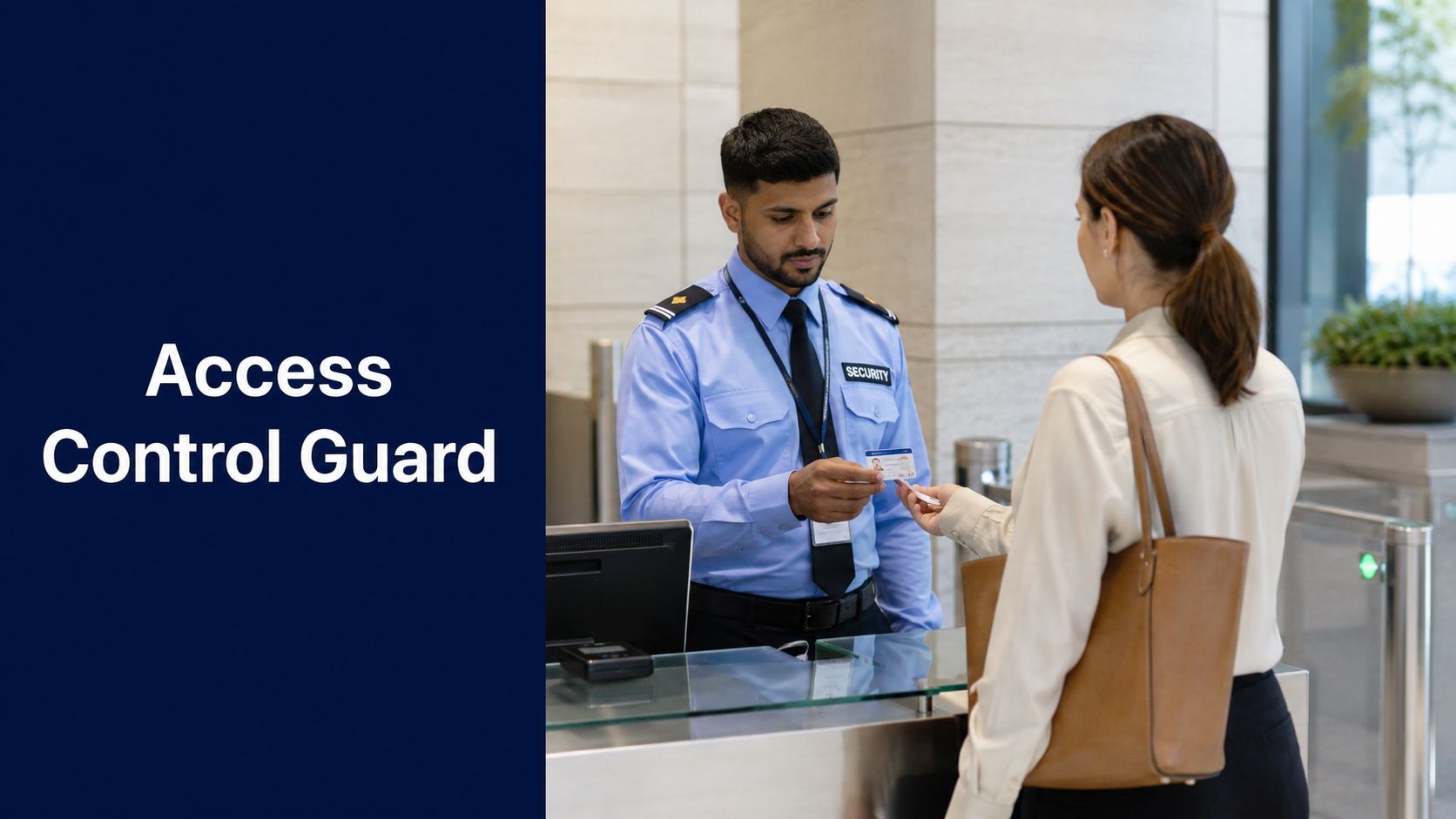
Another critical authority is managing access control. This is a hands-on role that includes:
- Checking IDs for visitors or employees at entry points.
- Maintaining a detailed log of who comes and goes.
- Ensuring only authorized individuals can access sensitive areas.
- Enforcing your specific property rules, like parking regulations or business hours.
These tasks are fundamental for maintaining order and protecting your assets, whether you manage a bustling commercial tower in Los Angeles or a quiet residential community. A guard can also perform limited searches, but only with clear and voluntary consent. Think of a retail store with a posted bag-check policy at the entrance—by entering, a customer implies their consent to that policy.
A professional officer’s authority comes directly from the property owner. In essence, they act as your designated agent, enforcing the rules you've established for your property, all within the boundaries of California law.
Authority in Critical Situations
During an emergency, a security guard's role becomes even more crucial. They are trained to take the lead, guiding people during an evacuation, providing initial first aid in a medical crisis, and securing the scene until police or paramedics can take over.
Perhaps the most significant power a guard holds is the ability to make a citizen’s arrest, as outlined in California Penal Code § 837. This law allows them to detain someone who commits or attempts to commit a crime in their presence.
For any property manager, this is an indispensable tool. If an officer observes a shoplifter or a vandal damaging your building, they can legally detain that person. The key here is that the detention must only be for a reasonable amount of time and for the sole purpose of handing the individual over to law enforcement. When used correctly by a trained professional, this authority means immediate action can be taken to protect your property while awaiting a police response.
Legal Lines California Security Guards Cannot Cross
Understanding what a security guard can do is only half the picture. To truly protect your property and avoid serious liability, it is equally important to know what they can't do.
Professional security officers have the authority to protect your assets, but there are firm legal lines they are strictly forbidden from crossing in California. Adhering to these rules isn't just good practice; it's the hallmark of a professional security partner you can trust.
The single most important rule is that a security guard cannot impersonate a law enforcement officer. This is a critical distinction enforced by the Bureau of Security & Investigative Services (BSIS), and it covers everything from uniform design and vehicle markings to the language they use. Their role is clear: they are private security agents, not public peace officers.
Restrictions on Force and Searches
The use of force is another area that's very tightly controlled. A security officer is only allowed to use force that is reasonable and necessary for self-defense or to protect others. Anything more is considered excessive and can lead to severe legal consequences for both the officer and the security company. This is why de-escalation is always the first and most important tool in their toolbox.
Likewise, a guard's power to search people or their property is extremely limited and nothing like what is permitted for police.
- No Warrantless Searches: Unlike police officers, guards cannot conduct searches without clear and voluntary consent.
- Implied Consent: In some places, like a retail store with a clearly posted bag-check policy at the entrance, consent might be implied by a person choosing to enter.
- No Coercion: A guard can never force or intimidate someone into agreeing to a search.
This infographic breaks down some of the key operational lines that can't be crossed.
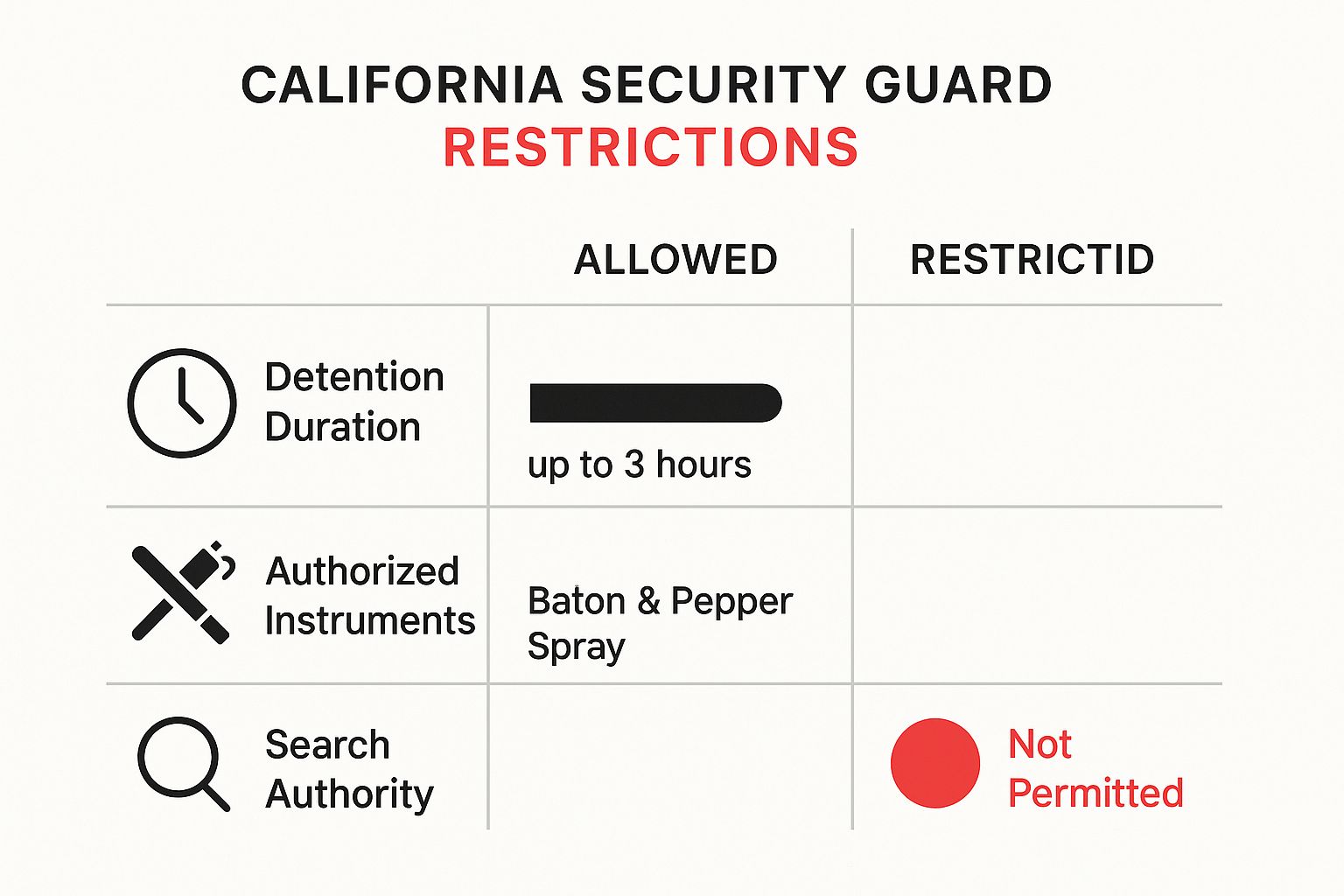
As you can see, while guards have specific authorities, those powers are very carefully defined to prevent any overreach. To make the distinction crystal clear, it helps to see a side-by-side comparison of the legal authority granted to private security versus sworn police officers.
Comparing Security Officer and Police Officer Authority
| Action | Security Officer Authority | Police Officer Authority |
|---|---|---|
| Make an Arrest | Can perform a "citizen's arrest" for a public offense committed in their presence. | Can arrest based on probable cause for a felony or for a misdemeanor committed in their presence. |
| Use of Force | Limited to what is "reasonable and necessary" for self-defense or defense of others. | Can use force that is "objectively reasonable" under the circumstances to make an arrest or overcome resistance. |
| Conduct Searches | Requires explicit consent; cannot search without permission unless it's part of a lawful citizen's arrest. | Can conduct searches with a warrant, probable cause, or under specific exceptions (e.g., search incident to arrest). |
| Detain Individuals | Can detain a person for a reasonable amount of time until law enforcement arrives. | Can detain individuals for investigation based on reasonable suspicion ("Terry stop"). |
| Issue Citations | Can only enforce private property rules (e.g., parking tickets on a private lot). Cannot issue traffic citations on public roads. | Can issue citations for traffic violations and criminal infractions on public and private property. |
| Carry Firearms | Only with a specific BSIS Firearms Permit after extensive, specialized training. | Authorized to carry firearms as part of their standard duty equipment and training. |
This table highlights the fundamental difference: security officers act as private citizens with limited, specific authority, whereas police officers are agents of the state with broad enforcement powers.
Prohibited Enforcement Actions
Beyond physical interactions, guards are also barred from taking on duties reserved for sworn law enforcement. For instance, a security guard cannot make traffic stops or issue citations on public roads. They can absolutely enforce parking rules on private property you own or manage, but their authority stops at the property line.
Finally, carrying any kind of weapon—whether it's a firearm, a baton, or pepper spray—is strictly prohibited without the proper, specific certification from BSIS. Each tool requires its own license, proving the officer has completed the required training to use it safely and legally. At Overton Security, our 26 years of experience are built on a foundation of strict compliance, ensuring your security program is not only effective but legally sound.
Weapon Regulations for California Security Guards
When it comes to weapons, the rules for security guards in California are incredibly strict, and for good reason. The Bureau of Security & Investigative Services (BSIS) enforces a complex set of regulations to ensure any officer carrying a weapon is highly trained, thoroughly vetted, and legally authorized to do so. This protects your property, your people, and your liability.
The most fundamental split is between unarmed and armed security. An unarmed officer is a powerful visual deterrent, trained to handle most situations through sharp observation and de-escalation. But some high-risk environments need an elevated level of protection. That’s where a professionally trained armed officer becomes a critical asset.
Stringent Requirements for Armed Officers
Becoming an armed guard in California is an intensive process. An officer must earn a specific BSIS Firearms Permit, which goes far beyond basic security training.
This advanced certification process includes:
- Extensive Firearms Training: This covers firearm safety, proper handling, marksmanship, and, most importantly, critical decision-making under pressure.
- Comprehensive Background Checks: Both the FBI and the Department of Justice conduct deep-dive criminal history checks.
- Psychological Evaluation: A licensed psychologist must assess the candidate's mental and emotional fitness to carry a firearm in a professional capacity.
These layers of screening ensure that only the most responsible and stable individuals are permitted to be armed. The same tough standards apply to less-lethal tools as well. An officer needs a separate BSIS certification to carry a baton or pepper spray, each requiring its own specialized training course.
Critical Rules for Proprietary Security
A significant recent change in California law impacts businesses that use their own in-house security teams. Under Assembly Bill (AB) 2515, which took effect in 2023, proprietary security officers are now prohibited from carrying any type of weapon. That means no firearms, batons, or pepper spray.
This legislation brought much stricter rules to previously less-regulated proprietary guards, requiring them to register with BSIS and complete specific training.
This distinction is vital for property managers and business owners. While a contract security partner like Overton can provide licensed and certified armed officers, an in-house team is legally restricted to unarmed roles.
This legal framework highlights the importance of partnering with a professional security firm. With over 26 years of experience, Overton Security ensures every officer—armed or unarmed—is fully compliant with all BSIS regulations. We handle all the licensing, training, and certification, giving you peace of mind that your security program is not just effective, but 100% legally sound.
The Importance of BSIS Licensing and Training
Why is hiring a licensed and properly trained security team an absolute must? Here in California, the Bureau of Security and Investigative Services (BSIS) sets the non-negotiable standards for the industry. Think of them as the essential safeguard for property managers, business owners, and the general public.
Grasping what these standards mean is the key to seeing the difference between a basic guard and a true professional security officer.
Before any guard sets foot on your property, they must earn a BSIS "Guard Card." This isn't just a piece of paper. The process involves in-depth background checks by both the FBI and the Department of Justice, a critical step to screen out individuals with troubling criminal histories.
The Foundation of Professionalism
Initial training is also mandatory, covering the essentials like the Power to Arrest and the legal lines a guard cannot cross. But for a security firm that is serious about its commitment to clients, these BSIS requirements are the bare minimum, not the ultimate goal.
This is where a company's dedication to quality truly shines.
At Overton Security, we see that BSIS foundation as something to build on with continuous, advanced training. Our officers don't just stop at licensing; they receive ongoing education in skills that matter in the real world, such as:
- Advanced De-escalation Techniques: To calmly resolve conflicts and avoid physical confrontations whenever possible.
- Exceptional Customer Service: To serve as professional, helpful ambassadors for your property.
- Site-Specific Protocols: Custom training that addresses the unique risks and procedures of your specific location.
For security guards, effectively preparing for unpredictable situations and legal challenges can be greatly enhanced through practical methods like scenario-based training techniques.
A well-trained officer is more than just a uniform—they are a professional risk mitigator. They solve problems, protect assets, and enhance your property's reputation, transforming security from a cost into a tangible asset.
This commitment to going above and beyond is critical. Even with strict laws in place, the BSIS received a staggering 2,822 consumer complaints in 2021—almost double the number from 2016.
Investing in a partner who puts comprehensive security guard training first is the smartest way to ensure your security program is professional, effective, and fully compliant with the law.
Choosing a Compliant and Professional Security Partner
Knowing the law is one thing; putting that knowledge to work when you hire a security firm is another. Choosing the right security partner is about more than just filling a spot—it’s about finding a company that actively shields you from liability by making compliance and professionalism part of their DNA.
A top-tier provider isn't just another vendor. They're a true partner in ensuring your security measures are effective and perfectly aligned with California law. The difference almost always comes down to their company culture and day-to-day operations.
Vetting a Potential Security Vendor
When you're evaluating a potential security company, it's important to cut through the sales pitch and find out how they really operate. A truly professional firm will welcome your questions and have confident, transparent answers ready.
Here are a few essential questions to ask any security firm you're considering:
- BSIS License Verification: "How do you track the license status for every officer, including their Guard Card and any firearms permits? Can you provide proof of current, valid licensing for the officers who would be assigned to my property?"
- Ongoing Training Programs: "What training do your officers receive after they've met the basic BSIS requirements? I'm interested in de-escalation techniques, customer service skills, and how you prepare them for emergencies at a site like mine."
- Incident Reporting Protocols: "Could you walk me through your incident reporting process? May I see a sample report?" A professional partner will use detailed, digital reports that are clear, delivered promptly, and solid enough to be used as documentation if liability ever becomes an issue.
These questions quickly separate the companies just trying to meet the bare minimum from those who are committed to a higher standard of service.
The Overton Security Difference
With 26 years of experience protecting clients across California, Overton Security was built on a simple principle: quality over quantity. We know that real security comes from professional, well-supported officers who are held accountable by strong internal systems. Our deliberately low manager-to-client ratio means your property gets the direct, hands-on attention it deserves from our leadership team.
We combine seasoned human expertise with smart, practical technology to give you complete peace of mind. Our officers utilize GPS-enabled patrol systems, giving you real-time verification that their rounds are being completed. Their detailed digital reports offer a transparent, minute-by-minute look at everything happening on your property. This dedication to service and accountability is how we build lasting trust and ensure your security program is always an asset, never a liability.
Common Questions Answered
When you're managing security on your property, the details matter. Let's clear up some of the most common questions property managers and business owners have about the real-world authority of security guards in California.
Can a Security Guard Legally Handcuff Someone?
Yes, but only in a very specific situation. A guard can only use handcuffs when making a citizen's arrest—meaning they are detaining someone who committed a crime in their presence until the police arrive.
The key here is that any force used, including restraints, must be reasonable and necessary for the situation. This is a fine line, which is why professional security firms invest heavily in training guards on the proper and legal use of restraints to keep everyone safe and minimize liability.
What Happens If a Guard Uses Excessive Force?
This is a major liability risk. If a guard uses excessive force on your property, the legal consequences don't just stop with them. Both the individual officer and the security company that employs them can face serious repercussions, from civil lawsuits to criminal charges.
That risk extends to you as the property owner. It’s exactly why you can't afford to partner with just any security company. At Overton Security, we train our team extensively on de-escalation tactics and strict use-of-force policies. Every action is designed to be legal, appropriate, and—most importantly—to minimize your risk.
The actions of a security officer on your site are a direct reflection of the company you hire. Choosing a partner with a proven commitment to compliance and training is the single best way to protect your assets and reputation.
Are Security Guards Required to Identify Themselves?
Absolutely. Every licensed security guard in California is required to carry their state-issued "Guard Card" from the Bureau of Security and Investigative Services (BSIS) while on duty.
They must present that card to any member of the public or a law enforcement officer upon request. It’s a matter of transparency and confirms they are legally authorized to be performing security duties.
Can a Security Guard Ask for My ID?
On private property, yes. A security guard acts as an agent of the property owner and is there to enforce the site's rules. If the rules of your private residential community or office building require people to show ID to verify they belong there, the guard has the authority to ask for it.
They cannot compel you to hand it over. However, if you refuse to follow the established rules, they have the authority to ask you to leave the property.
Navigating the complexities of California security regulations requires a partner with proven experience and a deep commitment to compliance. Overton Security provides professional, highly trained officers who understand these legal boundaries inside and out, protecting your property while minimizing your liability. Learn more about our customized security solutions at the Overton Security website.