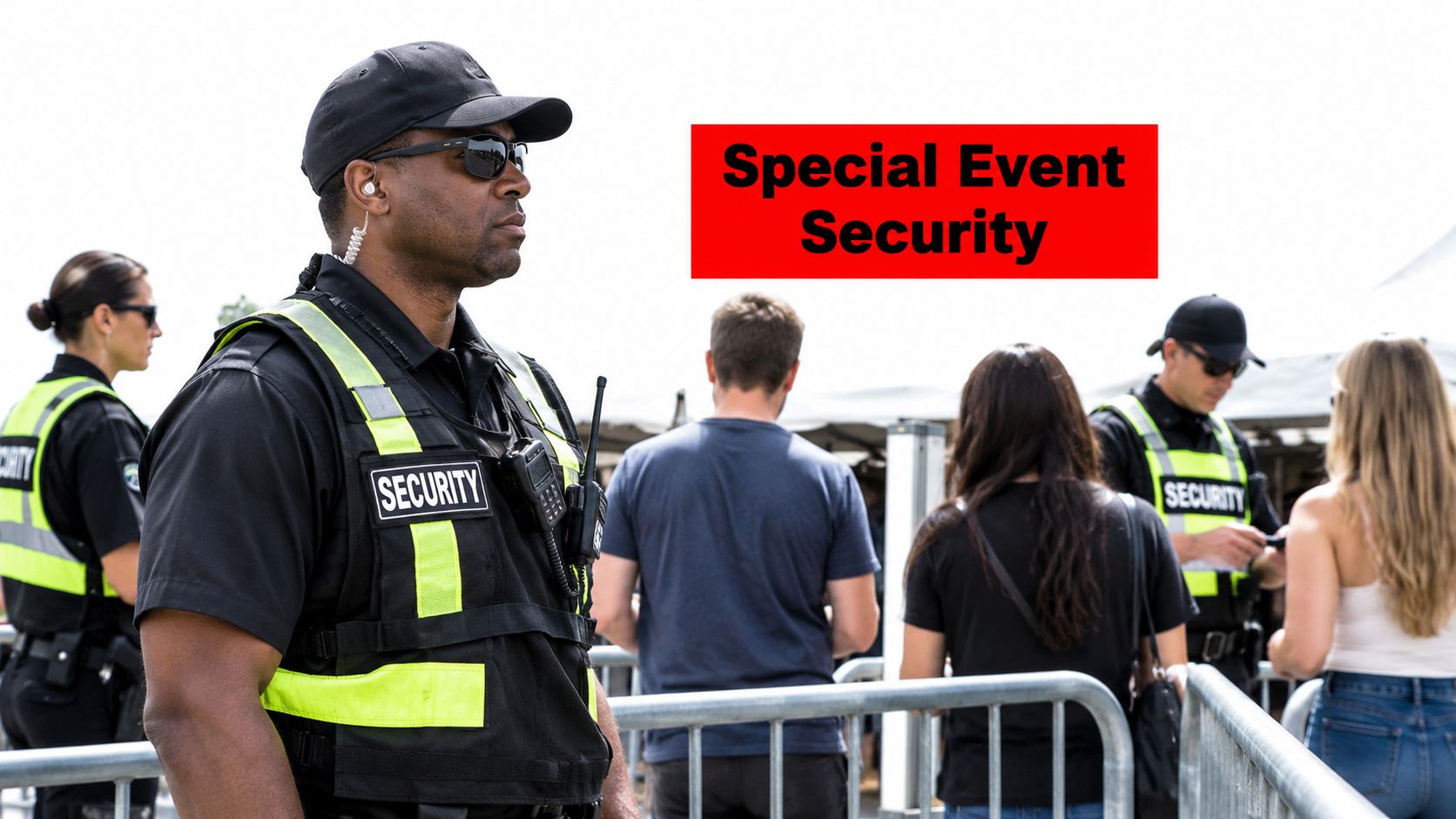

Doors open at 7 p.m. The queue already reaches the corner, one entrance is moving slowly, and your two roaming officers are tied up stabilizing a side barricade. Meanwhile, nobody is watching the rear service corridor, a propped emergency exit is attracting curious guests, and the alcohol cutoff has created a dispute at the bar.
You hired security guards for events, but the plan still failed. The problem wasn't necessarily the number of officers. It was the shape of the coverage. Event security works when staffing follows crowd movement, access points, restricted areas, and escalation routes, not when a planner divides attendance by a convenient ratio and hopes the result holds.
Why Event Security Plans Often Break Before the Doors Open
Event security plans usually fail during preparation, not during the incident itself. A roster can look complete on paper while leaving the busiest entrance, the rear perimeter, or the performer exit effectively unstaffed.
A common planning error is treating every officer as interchangeable. A rover can't screen credentials while also watching a stage-front surge. A gate officer can't leave a checkpoint to investigate a service-door alarm without creating a new gap. Once the event starts, those gaps become queue pressure, unauthorized access, delayed response, or confused radio traffic.
Headcount isn't coverage
Start by walking the venue at the same times the event will operate. Trace guest arrival routes, staff entrances, loading areas, parking paths, vendor access, emergency exits, bars, restrooms, backstage corridors, and the routes performers or VIPs will use. Mark every location where people must slow down, change direction, show credentials, or gather in unusual density.
The UN crowd-management guidance for major sporting events emphasizes multilayered perimeter security and coordinated entry and exit management. That principle applies to concerts, festivals, corporate launches, community events, and private functions. Crowd safety depends on movement geometry as much as visible guard presence.
Practical rule: If you can't explain what each post controls, you haven't finished the staffing plan.
Stress-test the plan against arrival surges, intermissions, alcohol service, weather changes, late performers, and simultaneous guest departure. Decide in advance which posts are fixed, which officers can redeploy, who has authority to move them, and what triggers a call to local police or emergency services.
The right question isn't “How many guards can we afford?” It's “Where will friction form, and who is responsible for managing it?”
Defining the Scope and Risk Profile of Your Event
Before requesting a quote, write a short operational profile. Vendors need more than an attendance estimate. They need to know how people will enter, where they'll gather, what they'll carry, and which moments could change the crowd's behavior.
Record these basics:
- Indoor or outdoor setting
- Seated, standing, roaming, or mixed attendance
- Ticketed, invited, or open public access
- Daytime or after-dark operation
- Alcohol service and cutoff procedures
- Expected peak attendance, not just registrations
- Audience profile, such as corporate, family, concert, sporting, or political
- Venue history, including prior incidents or recurring trouble spots
Then score the major risk drivers. A 400-person nonprofit gala with no alcohol presents a different operating problem from a 1,200-person product launch with an open bar and a featured keynote, even if both use a formal venue. The audience's behavior, access requirements, timing, and layout matter as much as the guest count.
Event Risk Scoring Worksheet
| Factor | Low (1) | Medium (2) | High (3) |
|---|---|---|---|
| Venue access | Single controlled entrance | Multiple managed entrances | Open perimeter or many access points |
| Crowd movement | Seated and predictable | Mixed movement | Standing, dense, or surge-prone |
| Alcohol | None | Limited service | Open service or cutoff pressure |
| VIP or talent | No special access | Designated VIP area | High-profile talent or sensitive guest |
| Cash and valuables | Minimal handling | Controlled transactions | Visible cash, equipment, or high-value assets |
| Site history | No known incidents | Minor recurring issues | Prior serious incidents or conflict |
| Surroundings | Isolated, controlled site | Nearby public activity | Streets, transit, or public interfaces |
| Event emotion | Routine gathering | Competitive or important moments | Political, contentious, or high-intensity program |
Add the scores, then discuss the result with the security provider and venue team. The worksheet isn't a substitute for judgment. It's a way to prevent one overlooked factor from disappearing inside a vague event brief.
For California outdoor events in San Francisco, organizers need a security plan when expected attendance exceeds 500 people, according to the San Francisco event security planning guidance. That guidance also states that security firms must hold a California Department of Consumer Affairs Private Patrol Operator license, while individual guards need a DCA-issued Guard Card.
For a broader discussion of event-specific hazards, review Overton's event risk guidance. Your final risk profile should drive the staffing model, post assignments, officer qualifications, and escalation procedures.
Calculating How Many Guards You Actually Need
The familiar one guard per 100 attendees rule is a starting point, not a finished staffing plan. Independent event-security guidance commonly places low-risk events around one officer per 75 to 100 attendees, medium-risk events around one per 50 to 75, and high-risk events around one per 25 to 50. These planning ranges appear in industry event-security staffing guidance, but the same guidance warns that attendance alone misses the operational load created by entrances, alcohol, venue layout, and arrival surges.
Use the ratio to establish baseline mobile coverage. Then build the actual roster from fixed posts.
Count fixed posts before adding rovers
List every position that must remain occupied:
- Entry screening: Ticket, credential, bag, or prohibited-item checks
- VIP and backstage access: Credential verification and restricted-area protection
- Service and loading areas: Vendor, performer, equipment, and delivery control
- Alcohol pressure points: Bars, cutoff locations, and high-density queues
- Parking and shuttles: Vehicle movement, pedestrian crossing, and late departures
- Medical liaison: A designated contact for medical teams and emergency access
- Command post: Radio coordination, incident logging, and redeployment
- Fire watch or required posts: Any position required by the venue, authority, or code
Each fixed post represents an officer who can't patrol another area. Add rovers only after those obligations are clear. Rovers should cover the spaces between posts, respond to calls, monitor changing density, and support a checkpoint before its queue becomes unmanageable.
Build a coverage map
Draw the venue and mark fixed posts, patrol loops, blind spots, choke points, emergency routes, relief locations, and supervisor positions. Then test the map against the busiest operating periods, not the quietest part of the schedule.
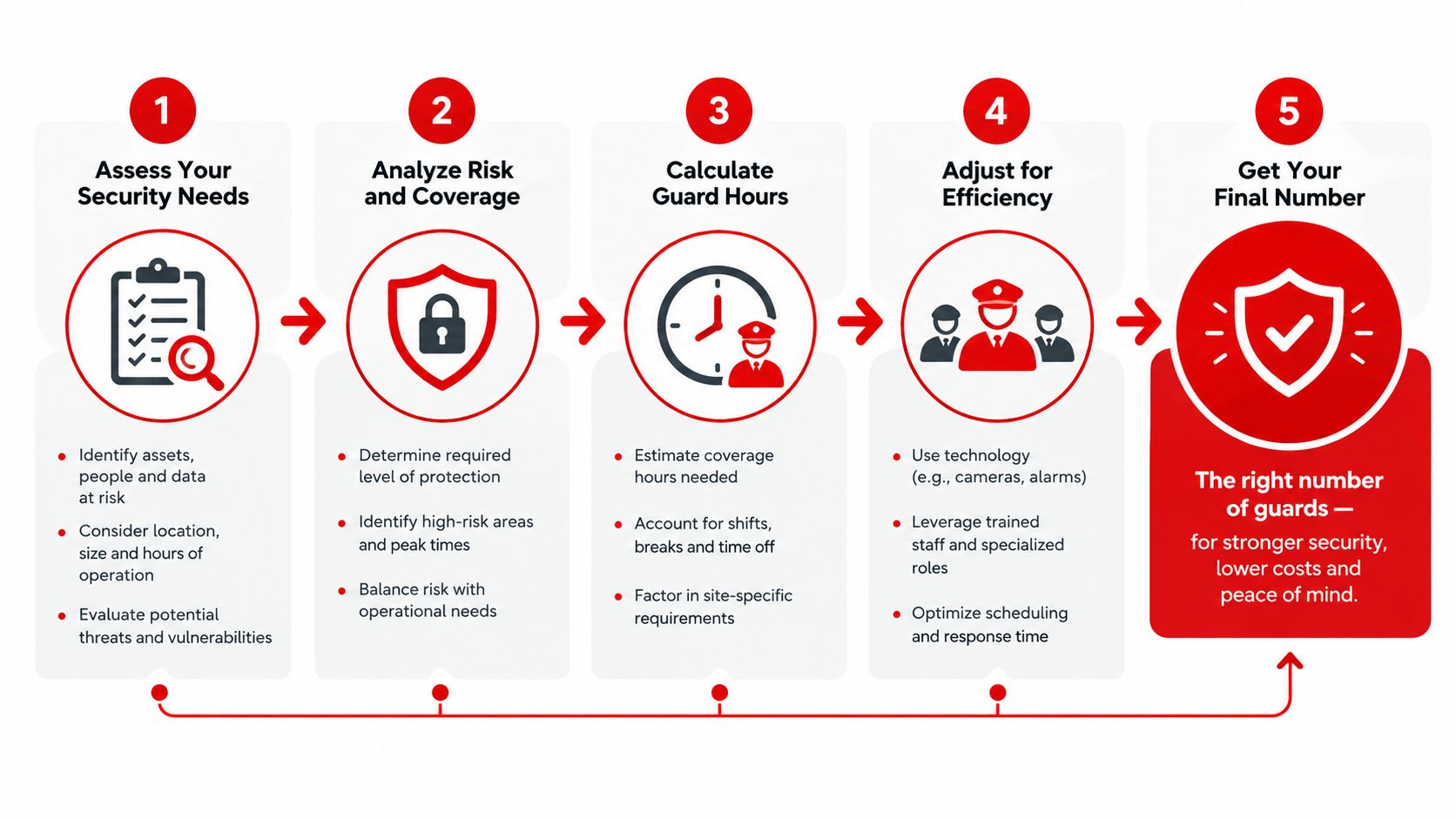
The practical sequence is straightforward:
- Estimate peak occupancy and arrival concentration.
- Classify the event's risk tier.
- Apply a baseline ratio.
- Add fixed posts.
- Add rovers and a supervisor layer.
- Recheck coverage during ingress, program breaks, and egress.
A reliable staffing number should explain why each officer is present. If the answer is only “the ratio produced that number,” the plan is incomplete.
Assigning the Right Roles to the Right Posts
Don't give every officer the same broad instruction. Separate the operation into three lanes, then define how those lanes interact.
Crowd control officers manage movement. Place them at choke points, stage fronts, bar queues, stairways, narrow corridors, and areas where guests may stop suddenly. Their job is to preserve sightlines, prevent dangerous compression, identify rising tension, and keep people moving without turning routine congestion into confrontation.
Access control officers protect the boundary between authorized and unauthorized movement. They verify tickets or credentials, conduct defined screening, monitor staff entrances, and control backstage, service, and restricted areas. They need a clear refusal process, including who receives a denied guest, how the interaction is documented, and when a supervisor takes over.
Emergency response personnel remain available for rapid redeployment. They should know evacuation routes, rally points, medical access routes, lost-child procedures, radio priorities, and the escalation chain. Posting every available officer at a gate may look efficient, but it leaves no capacity for a sudden medical call, fight, missing child, or perimeter breach.
Choose the priority lane
The right emphasis depends on the venue:
| Operating condition | First priority | Supporting coverage |
|---|---|---|
| Multiple entrances or open access | Access control | Queue management and rovers |
| Dense interior or stage-front crowd | Crowd flow | Emergency response and access control |
| VIP, talent, or restricted production areas | Credential control | Roving response |
| Complex outdoor footprint | Perimeter and movement | Fixed posts and mobile patrol |
| Active incident or medical event | Emergency response | Supervisory redeployment |
If staffing drops unexpectedly, don't spread everyone thinner. Protect the critical lane, notify event command, document the gap, and redeploy according to a preapproved priority order.
For a clearer breakdown of officer responsibilities, use Overton's event security job description. Precise post orders reduce duplicate effort and make accountability possible when conditions change.
Choosing Armed, Unarmed, or Tech-Enabled Coverage
Armed versus unarmed coverage shouldn't be a checkbox on a vendor form. It should follow a documented risk decision based on the event's threat profile, assets, audience, and legal requirements.
Start with the factors that can change the response model:
- Cash handling or valuable equipment on site
- VIP, performer, executive, or public-official exposure
- Prior incidents involving the venue or promoter
- Alcohol service and expected behavioral volatility
- Political sensitivity or contentious programming
- Crowd size, density, and perimeter complexity
- Local licensing, insurance, and venue requirements
For lower-risk corporate receptions, family festivals, and controlled private events, unarmed security officers supported by mobile patrols are often the practical fit. The emphasis should be visibility, guest assistance, access management, observation, and early intervention.
A medium-risk event may call for unarmed officers with de-escalation training and body cameras, particularly where alcohol, higher attendance, or emotionally charged audiences create more interaction. Armed coverage belongs only where verified threats, high-value assets, or regulatory requirements justify that level of force. The provider must be properly licensed and operate under a documented use-of-force policy.
Technology extends coverage, but doesn't replace judgment
Tech-enabled operations add a third layer. Live video monitoring can help identify density changes. Digital credentialing can reduce uncertainty at restricted doors. Panic-button applications can help staff request support without broadcasting sensitive details over an open channel. Emerging AI systems are being developed for real-time crowd-density estimation and proactive event control, as discussed in recent event-security market coverage.
Technology is useful when it connects to a human response. A camera that detects a queue surge but doesn't trigger a redeployment is just another screen. Ask whether the provider can combine officers with live monitoring, digital incident reports, GPS-enabled patrol verification, and a clear escalation process.
For a focused comparison of coverage models, see Overton's armed versus unarmed security guide. Decide first what the event needs to control, then select the least-forceful model that reliably manages that risk.
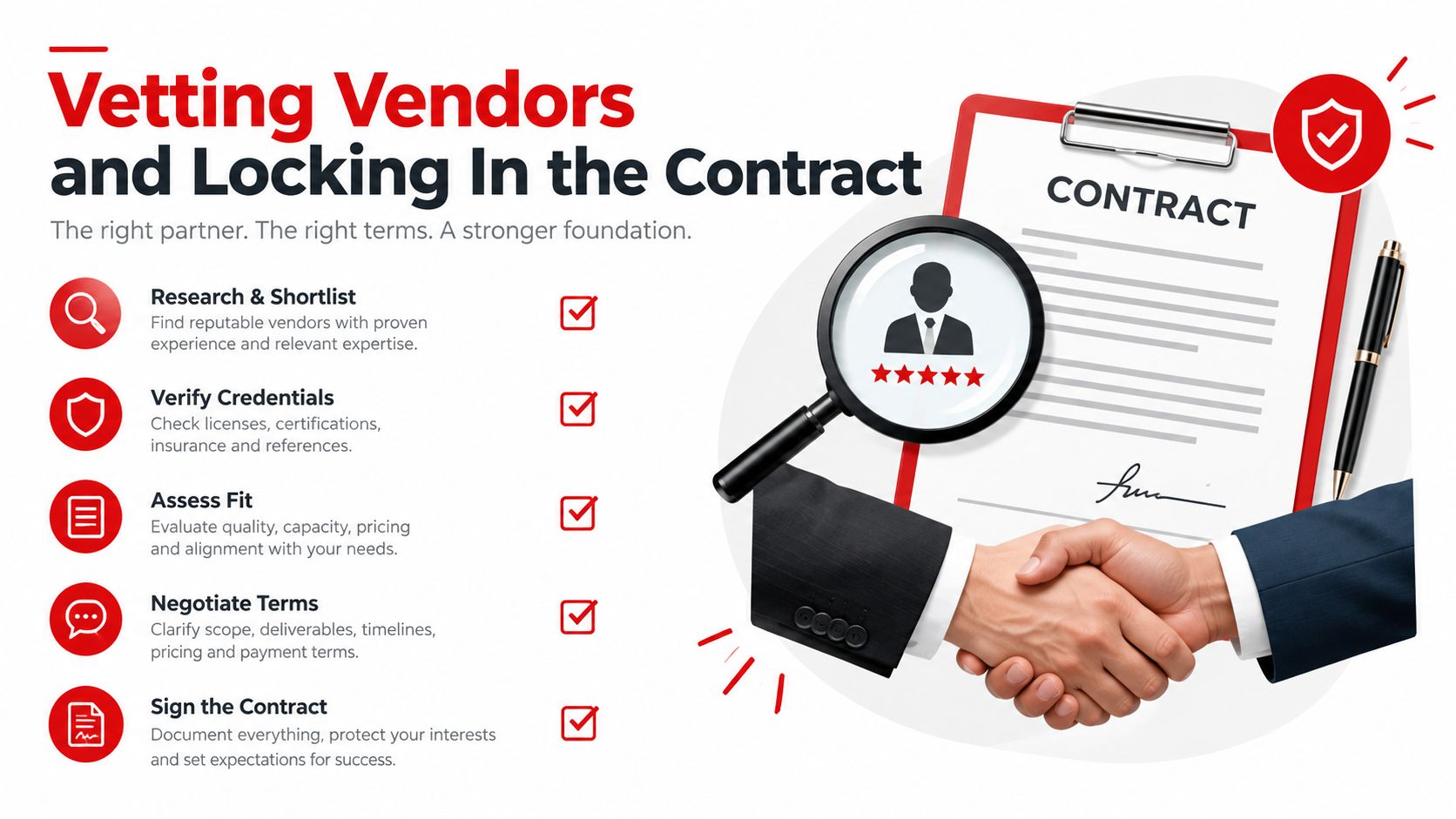
Vetting Vendors and Locking In the Contract
A polished proposal doesn't prove that coverage will hold on event day. The vendor call should test licensing, supervision, staffing reliability, documentation, and the company's ability to replace a missing officer without leaving a critical post exposed.
Ask for specific evidence, not broad assurances.
Run the vendor call as an operations audit
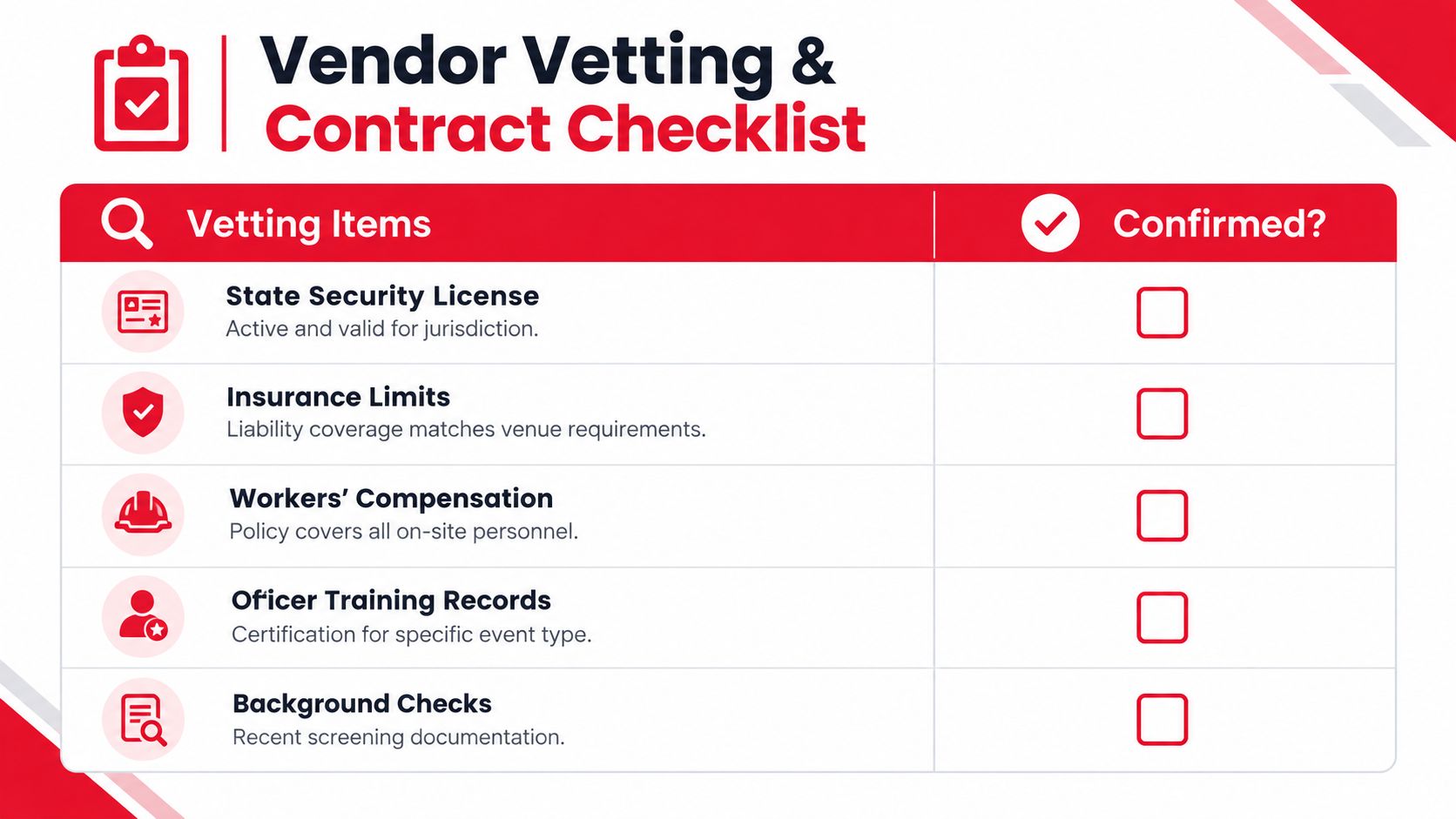
Confirm the following before signing:
- State licensing: Verify the company and assigned personnel can legally perform the work in the event jurisdiction.
- Insurance limits: Match liability coverage to the venue's requirements and contract language.
- Workers' compensation: Confirm that every on-site officer is covered.
- Training records: Request certifications relevant to the event, including crowd control, access procedures, first aid, or de-escalation where applicable.
- Background checks: Require current screening documentation for assigned personnel.
- Post orders: Review a sample document showing how the vendor turns a site plan into officer instructions.
- Supervision: Ask how many supervisors will be present and how they monitor posts.
- Staffing reliability: Discuss retention, turnover, no-shows, and the substitution process.
- References: Call two comparable event references from the past 90 days, as recommended in the planning criteria for this guide. Older references may not reflect current staffing or management practices.
A supervisor-to-guard ratio above one supervisor per 10 guards weakens accountability, so include the supervision expectation in writing rather than leaving it to a verbal promise.
Put the operating terms in black and white
Your agreement should identify the scope of work, hourly or flat-fee billing, minimum and maximum headcount, cancellation windows, overtime treatment, post changes, uniforms, equipment, reporting, and the escalation chain. Name the person who can make a staffing decision before doors open, not just the salesperson who prepared the quote.
Include indemnification language, proof-of-license attachments, a background-check requirement, and a written process for replacing an absent officer. The contract should also state what happens if the event's attendance, layout, operating hours, or risk profile changes.
In Victoria, Australia, personnel performing crowd-control duties must hold the proper crowd-controller license under the Private Security Act 2004. The Geelong event-planning licensing guidance also states that applicants must complete a Certificate II in Security Operations and a First Aid course before becoming licensed and registered crowd controllers. Requirements vary by jurisdiction, so verify local rules before hiring.
Running the Day-of Coordination and Wrapping Up
The pre-shift briefing should be short enough to hold attention and detailed enough to prevent improvisation. Give every officer the site map, post assignment, radio channel, supervisor contact, relief plan, and event schedule. Walk through the points where conditions are most likely to change, including arrival, doors, program breaks, alcohol cutoff, performer movement, and final egress.
Brief the team around decisions
Cover these items in plain language:
- Radio assignments: Identify the primary channel, emergency channel, call signs, and radio discipline.
- Escalation chain: State who handles routine refusals, who approves redeployment, and who contacts police or emergency services.
- Medical response: Explain how officers preserve access for responders and guide them to the incident.
- Lost-child protocol: Establish the receiving point, communication method, reunification authority, and documentation process.
- Evacuation: Show exits, rally points, blocked routes, and the person responsible for coordinating with venue management.
- Post map: Mark fixed positions, patrol loops, blind spots, relief breaks, and command locations.
Keep a dedicated security liaison with event command. That person should receive updates from supervisors, understand the program schedule, and have authority to coordinate with venue staff, production, medical personnel, and law enforcement.
Manage friction while it's still small
Don't wait for an incident report to reveal that a queue has become unsafe. Use scheduled check-ins and live observation to redeploy officers toward emerging pressure points, such as a bar line that has stopped moving, a stage-front surge, an overloaded entry lane, or an exposed service corridor.
Define the threshold for outside help before the event. Call local police or emergency services for situations involving serious violence, weapons, immediate threats to life, uncontrolled crowd movement, or circumstances beyond the authority and training of the security team. Handle routine access refusals, guest assistance, minor disputes, and observation tasks through the event's internal chain when doing so is safe and appropriate.
Debrief before the details disappear
Capture the same-night record while officers still remember the sequence:
- Guard attendance and post coverage
- No-shows, substitutions, and late arrivals
- Response times and redeployments
- Access refusals and restricted-area issues
- Medical, lost-child, ejection, or police contacts
- Queue, density, alcohol, and perimeter friction
- Radio or equipment failures
- Recommended changes for the next event
Use the report for vendor review, venue planning, and insurance documentation. Don't let it sit in an inbox. Schedule a 30-minute debrief within 48 hours with the event planner, venue representative, security supervisor, and any relevant production or medical lead. Turn each gap into a specific change to the site map, post order, staffing model, briefing, or contract.
Overton Security provides event and temporary security with tailored onsite officers, mobile patrol support, digital reporting, GPS-enabled accountability, and 24/7 SOC oversight. If you're planning an event in Los Angeles, San Francisco, San Diego, Sacramento, San Jose, Oakland, Long Beach, or Fresno, visit Overton Security to discuss a coverage plan built around your venue, crowd flow, and operational risks.