You're probably staring at a venue contract, a promoter's run-of-show, and a staffing deadline that's already too close for comfort. If the event security language is thin, you don't just risk weak coverage at the door. You risk bad screening, broken crowd flow, and a paper trail that won't help you when the insurer asks what your plan was.
A solid event security job description fixes that fast. It gives your security provider, your venue team, and your insurance carrier the same operational picture, so the people showing up on event night know whether they're handling guest list verification, magnetometer screening, VIP movement, or emergency evacuation support. For a planning resource that helps teams streamline venue operations and events, the right job language is a practical starting point, not an HR nicety.
If you're hiring in California, the bar is higher than “friendly guard at the entrance.” You need credentials, risk-based staffing, and post orders that match the actual event. A generic template won't protect you if the venue is packed, the alcohol is flowing, or an unlicensed officer shows up and creates a compliance problem you didn't budget for.
Why a Strong Event Security Job Description Matters
The mistake I see most often is simple. An event planner treats security like a line item, then realizes the venue wants a written staffing plan next week and the draft barely says “monitor entrance.” That is not a plan, and it will not hold up when people start asking how the doors, the crowd, and the emergency exits are supposed to work together.
A proper event security job description drives the entire operation. It sets the staffing ratio, the training scope, the post orders, and the liability posture before the first officer is assigned. It also makes it easier to match the work to the risks tied to the event, which is exactly why venue teams should review common event risks before locking in headcount.
Event security is not static guarding
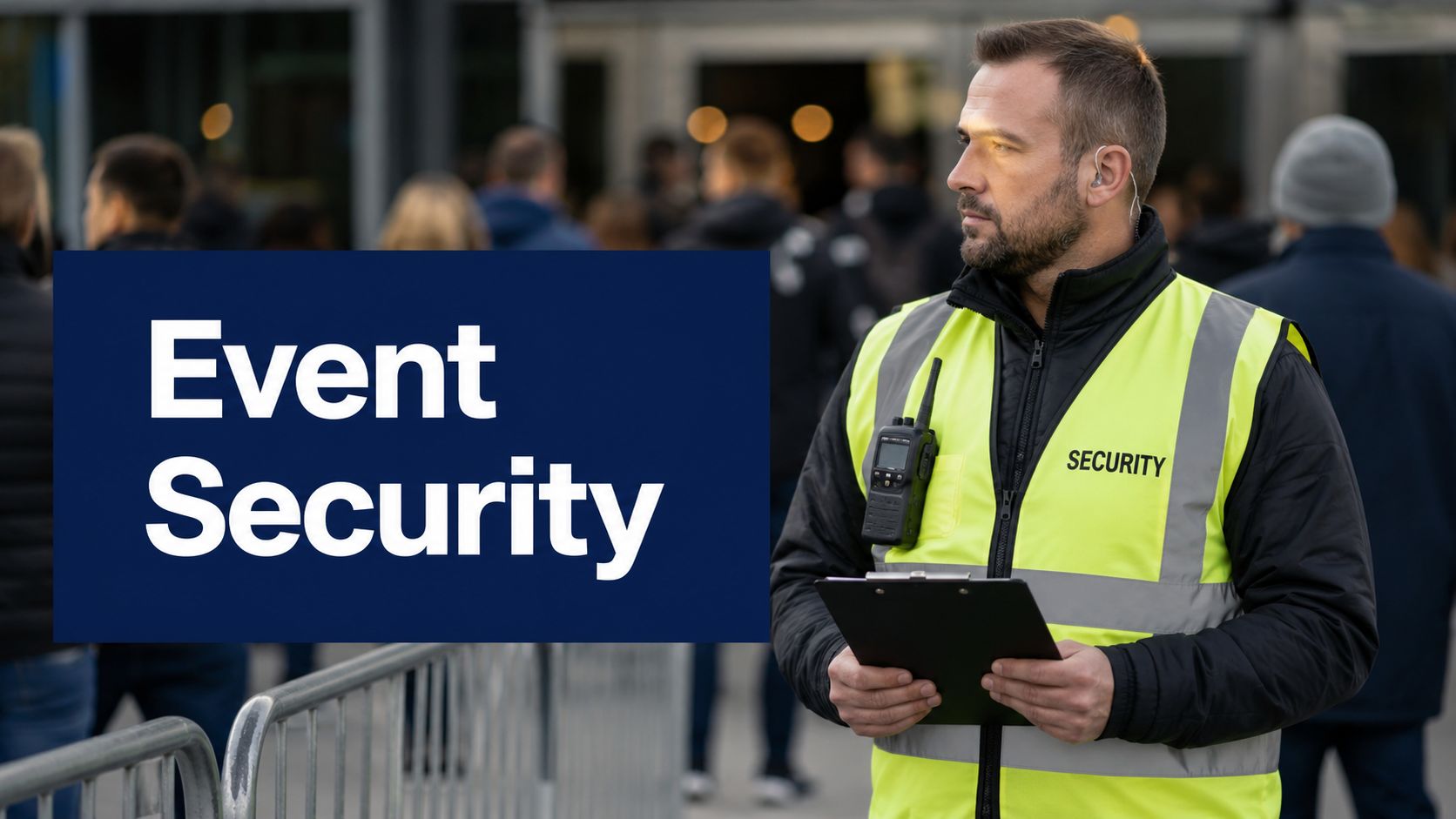
Event work centers on high-volume access control and crowd management, not just standing near a door. A 2024 venue posting listed bag checks, screening with walkthrough magnetometers, patrolling event areas, responding immediately to emergencies or disturbances, and assisting with crowd control inside and outside the facility as core duties (The Vets RI). That is a different job from residential patrol or a quiet lobby post.
Practical rule: if your description does not mention screening, crowd flow, and emergency response, you have written a guard ad, not an event security posting.
For hiring in California, the bar is higher than “friendly guard at the entrance.” The posting should make BSIS credentials plain, and it should spell out armed coverage only if the assignment calls for it. Ambiguity invites bad hires, weak vendor comparisons, and compliance problems that show up after the event has already started.
A clean description also helps you defend staffing decisions to the venue, the insurer, and anyone reviewing the file after an incident. It keeps the work aligned with the actual assignment, and it gives teams a practical starting point they can use to streamline venue operations and events.
Defining the Event Security Officer Role
An event security officer is a customer-facing, crowd-aware professional who controls access, watches the room, documents incidents, and helps the venue move people safely through a defined footprint. That footprint can be tight and formal, like a ballroom or conference center, or messy and fast-moving, like a concert lawn, street closure, or festival perimeter.
The role expands when the event adds alcohol service, VIP movement, large outdoor queues, or high guest density. It narrows when the venue has controlled access points, seated guests, and a clear path from arrival to exit. Either way, the officer isn't there to “stand guard.” They're there to manage contact points where risk shows up first.
A clean role summary you can paste into a posting
Event Security Officer is responsible for screening guests, maintaining access control, monitoring crowd behavior, documenting incidents, and supporting emergency procedures within the assigned event area. The officer works closely with venue staff, supervisors, and event leadership to keep entry points orderly, discourage prohibited behavior, and respond quickly to disturbances, medical issues, or evacuations.
That summary works because it defines the job by function, not by vague presence. It also leaves room for the overlap event security often has with concierge-style guest service, loss prevention thinking, and liaison work with police, fire, or EMS when an incident requires escalation.
For California planners, that distinction matters. A polished lobby greeter is not the same thing as a trained event officer who can screen bags, read crowd tension, and document a removal accurately. If the job requires the officer to interact with guests under pressure, the posting needs to say that plainly instead of hiding behind soft wording that doesn't tell applicants what they'll face.
Core Duties You Should Put in Every Posting
Good event postings read like an operating plan. Weak ones read like a placeholder. If you want people who can work the door, move a crowd, and write a usable report, spell out duties by function, not by a scattered list of guard verbs.
Before, during, and after the event
Start with the entry point, because that is where most problems begin. Core duties should include bag checks, screening with walkthrough magnetometers where used, guest verification, and enforcement of venue rules at arrival. A strong posting should also call out patrolling event areas, because security in motion catches problems that a single fixed post misses (5 Star Staff).
Then move to the room itself. The officer should manage queueing, keep access routes open, help with barrier lines, and watch for unruly behavior before it turns into a larger incident. Crowd control inside and outside the facility belongs in the role, not as an afterthought (The Vets RI).
Keep the description honest about the physical and social pressure of the post. If the officer will work the front gate, the stage edge, or the parking flow, say so.
Finally, include the post-event responsibility. The job should require incident documentation, shift notes, and a clean handoff to supervisors. If an issue happens at 8 p.m. and the report is sloppy at midnight, your insurance file and your internal review both suffer. I would also add a short line for emergency support, because event security descriptions should reflect the expectation to respond immediately to disturbances, medical issues, or evacuation needs, not just watch from a distance.
Required and Preferred Qualifications for Event Security
A strong qualifications block does two things at once. It filters out people who aren't legally ready to work, and it tells insurance reviewers you hired for competence, not convenience. In California, that means you need to be direct.
Put the must-haves in plain language
For unarmed event posts, I recommend listing a high school diploma or GED, a current BSIS Guard Card for California assignments, the ability to stand for long periods, and availability for nights, weekends, and holidays. Those are baseline expectations for a real event operation, not nice-to-haves. In major markets, event work happens outside standard business hours, so if your posting doesn't mention schedule flexibility, you'll attract the wrong applicants.
If the assignment is armed, say so without ambiguity. For California armed posts, the description should require the proper California firearm permit and the exposed firearm permit where applicable, along with the BSIS training and eligibility requirements that govern armed security work. Don't leave that to chance, because the wrong applicant won't self-disqualify if your ad is vague.
Add preferred credentials that actually help on site
Preferred qualifications should be practical, not decorative. I'd prioritize de-escalation training, CPR and first aid certification, prior venue or crowd experience, and a customer service background. Those skills matter because event officers spend a lot of time dealing with people who are frustrated, intoxicated, confused, or in a hurry.
The UK model is worth noting because it shows how major markets standardize competence. Event security work there generally requires an SIA licence, usually earned through a door-supervisor training program and exam (Surely Security). That isn't California law, but the principle is useful. Credentials should prove the officer can handle a crowd-facing environment, not just carry a badge.
Hiring standard: list the regulatory credential first, then list the performance skills, screening, de-escalation, emergency response, and documentation.
Staffing Ratios and Physical Demands by Event Risk Level
A staffing ratio is a planning tool, not a rough guess. Set it from attendance, site layout, alcohol service, entrance count, and how fast a small problem can turn into a crowd problem. More guests, more access points, and more movement around performers or VIP areas mean more officers on the ground.

Use risk tiers, not vibes
For low-risk corporate or private events, a practical starting point is 1 officer per 75 to 100 attendees. For medium-risk concerts or festivals, plan closer to 1 per 50 to 75. For high-risk events, including those with alcohol, political activity, or large outdoor crowds, staffing often tightens to 1 per 25 to 50 (The Vets RI). Those ratios are there for a reason, and they belong in the job description before anyone starts assigning shifts.
Stretching a thin crew across a difficult site is how event security failures start. More entrances, VIP movement, performer escorts, awkward floor plans, and local crime conditions all push staffing higher. If guests are being funneled through one choke point and only two officers are posted there, the post is already underbuilt.
The job description should also spell out the physical load. Officers need to stand for long periods, work in heat or cold at outdoor venues, and stay controlled when guests are intoxicated or argumentative. If barriers, stanchions, radios, or other gear have to be moved, say so plainly so no one arrives unprepared. Event planners who want a tighter read on concert risk can use this concert security planning guide as a reference point for how staffing pressure changes around live shows.
California event security descriptions also need to account for licensing and permit requirements at the staffing stage, not after the contract is signed. If the assignment calls for armed coverage, the post should require the proper California firearm permit and the exposed firearm permit where applicable, along with the BSIS credentials that apply to the post. That requirement protects the venue, the insurer, and the client, and it keeps unqualified applicants from slipping through a vague ad.
High-risk sites need more than headcount. They need officers who can keep moving, observe continuously, and report clearly without burning out halfway through the shift.
Sample Job Postings for Different Event Types
A reusable posting template saves time and keeps your team from rewriting the same basics for every event. The trick is to keep the structure consistent while changing the operational emphasis. A concert should read differently from a corporate gala, and both should read differently from a private estate event.
Concert posting
Event Security Officer, Concert Venue
Responsible for magnetometer screening, bag checks, barricade or mosh-pit management, and communication with tour security or venue leadership. Must maintain open access routes, assist with crowd flow, and respond quickly to disturbances or emergency instructions. Experience with large crowds and fast-moving entry lines is preferred.
Corporate posting
Event Security Officer, Corporate Event
Responsible for guest list verification, badge or invite checking, discreet lobby presence, VIP escort support, and maintaining a professional guest experience. Must monitor entrances, keep unauthorized visitors out, and document incidents accurately. Hospitality-minded service and clear communication matter here as much as security presence.
Private posting
Event Security Officer, Private Function
Responsible for guest list control, parking flow, access management, and discreet enforcement of venue rules at weddings, galas, and estate events. Must be comfortable working in a low-profile, service-oriented setting while still addressing unwanted behavior quickly. Professional judgment and calm guest interaction are essential.
If you want a broader hiring standard for short-term assignments, event security for hire should be framed around event type, guest profile, and venue footprint rather than one generic officer profile. One template doesn't fit every assignment, and your posting language should make that obvious.
Interview Questions That Reveal Real-World Competence
A good interview for event security sounds less like HR and more like a field check. You're trying to find out whether the candidate can think under pressure, follow a procedure, and write a report that makes sense after the shift is over.
Ask scenario questions, not personality questions
Start with crowd management. Ask how they'd handle an intoxicated guest who refuses to leave, or what they'd do if a guest kept pushing back at the barricade line. A strong answer names the escalation path, keeps the tone calm, and shows awareness of both guest safety and venue authority.
Move to emergency response. If a fire alarm activates mid-event, the candidate should talk about following the evacuation chain, clearing routes, and communicating with supervisors without creating confusion. If they jump straight to panic language or “I'd just wait for instructions,” that's not a reliable answer.
Then test documentation discipline. Ask how they'd write up a minor incident that could escalate later. Good candidates talk about facts, times, witnesses, and observed behavior, not opinion or blame.
What you want to hear
- Clear process: They describe steps in the order they'd happen.
- Calm language: They don't exaggerate or become dramatic about conflict.
- Report thinking: They understand that a clean note can matter later.
- Boundaries: They know when to escalate to a supervisor, EMS, or law enforcement.
If your team wants to sanity-check the wording of those questions, a tool like LegesGPT's legal AI chatbot can help with draft review and compliance wording before the interview sheet goes out. I'd still keep a human reviewer in the loop, because event security hiring needs local judgment, not just text cleanup.
Pre-Event Training Checklist for Officers
Training should not start at the door. If an officer is learning the venue map, radio channels, and code words five minutes before guests arrive, the assignment was underprepared from the start. The cleanest event teams treat training like a short run-up, not a last-minute scramble.
Pre-event, day-of, and post-event steps
Before the event, officers should review the post orders, walk the venue, and identify choke points at entry and exit routes. They should know where screening happens, where the command point sits, and which areas are restricted.
On event day, the briefing should cover VIP movement, prohibited items, code words, and the escalation chain. If the officer doesn't know who to call, when to call, and what phrasing to use, the whole team loses time in a real incident.
After the event, supervisors should review incident reports, collect equipment, and run a short debrief. That's where you catch weak handoffs, missing notes, and recurring crowd issues before the next assignment.
Best practice: officers should arrive having already read the run-of-show document. Handing it over at the last minute is how mistakes get buried in the first hour.
This is also where your culture shows. Teams that support officers with clear directions, proper staffing, and real accountability usually get better field performance than the “show up and figure it out” model.
Pay and Salary Guidance for Event Security Officers
Pay should follow the assignment, not a fantasy benchmark copied from another market. A short corporate reception, a high-risk festival, and an armed post do not belong in the same pay bucket. If you want serious applicants, the wage structure has to match the pressure of the job.
Build the rate around risk and timing
Unarmed event officers usually sit at the baseline for temporary security work, while armed posts deserve a premium because the licensing, responsibility, and exposure are different. Short events can be priced as event-day flat fees, but anything that runs long or spills past midnight needs a clear overtime plan. That's where many budgets get distorted.
California adds more variables. Prevailing wage, meal and rest break rules, and scheduling fair workweek ordinances can all affect how event security gets paid and contracted. That's one reason many venues choose a licensed security provider instead of treating officers like casual labor.
The practical move is to ask for vendor proposals that separate role, schedule, and compliance cost. If the quote doesn't show whether it covers unarmed or armed coverage, overtime exposure, or the exact staffing pattern, it's too vague to approve. You'll spend the difference later in revisions, complaints, or coverage gaps.
Compliance and Insurance Considerations
Security contracts fail when the paperwork is an afterthought. The officer can do the job right and the venue can still get burned if the COI, the license status, or the indemnity language isn't tight.
What to request before the event
Ask for a Certificate of Insurance that includes general liability, workers' compensation, and the correct additional insured endorsement. If the provider can't produce that cleanly, stop there. No officer should be on site if the insurance file is vague.
The venue may also require a written security plan, especially when the event has significant crowd risk. That plan should align with BSIS licensing status, training records, and post orders so the carrier can see that the staffing was deliberate. If you're hiring off-duty officers, make sure the authorization is written, not assumed.
Common contract gaps are easy to spot once you know where they hide. Unlicensed personnel, no indemnification clause, or a staffing promise that ignores the actual event footprint can turn a manageable assignment into a claims dispute. If force is used inappropriately, the venue wants protection in writing, not a verbal assurance from a staffing rep.
For California property and event managers, Overton Security's Event & Temporary Security service fits naturally as one option, because the work can be aligned with site plans, reporting, and short-term assignment needs without pretending every event is the same.
Quick Reference Checklist for Hiring Event Security
A clean hiring standard should fit on one screen or one page. If you can't summarize the role, the qualifications, the ratio, and the paperwork, you're not ready to hire.
Print this before you approve the vendor
- Role summary: Customer-facing officer for access control, screening, crowd management, and incident documentation.
- Core duties: Entry screening, crowd flow, emergency support, and shift reporting.
- California credentials: BSIS Guard Card for unarmed work, armed permits where required, and the right training for the assignment.
- Staffing ratio: Match officer count to event risk, not guesswork.
- Posting templates: Use separate language for concert, corporate, and private functions.
- Interview questions: Test scenarios, de-escalation, emergencies, and reporting.
- Training steps: Review post orders, walk the site, brief the day-of chain of command.
- Insurance documents: COI, workers' comp, general liability, and additional insured status.
If you only do one thing, do this, write the job posting as if you'll need to defend it later. That mindset forces better staffing and fewer surprises.
Event Security Job Description Frequently Asked Questions
How do I verify a BSIS Guard Card?
Ask the provider for the officer's card number and expiration date, then confirm the credentials match the assignment on the roster. If the documentation is missing or inconsistent, don't put the person on site until it's corrected.
When is an armed permit required?
It's required when the post is armed, and the job posting should say that upfront. If the assignment involves armed security in California, the permit language and training requirements need to be part of the qualifications block, not buried in an email thread.
What if I need event security on short notice?
Use a provider that can staff from an existing bench, not a team that has to scramble for bodies. Short notice is where written post orders, insurance files, and license checks matter most, because there's less time to fix mistakes.
What if an officer gets injured on site?
Document the incident immediately, notify the provider, and make sure workers' compensation procedures are triggered through the proper channel. Don't improvise the response. Injury handling should already be covered in the contract and the insurance file.
If you want help pressure-testing a staffing plan, a legal or operations review tool like LegesGPT's legal AI chatbot can help organize the questions before you send the contract out. It's still on you to verify the provider, the licenses, and the coverage.
If you need an event security partner that writes clear post orders, staffs to the actual risk, and stays accountable from briefing through final report, talk to Overton Security. Our team can help you build a California-ready event plan and match the right officers to the venue, the schedule, and the compliance requirements. Visit Overton Security to start the conversation.