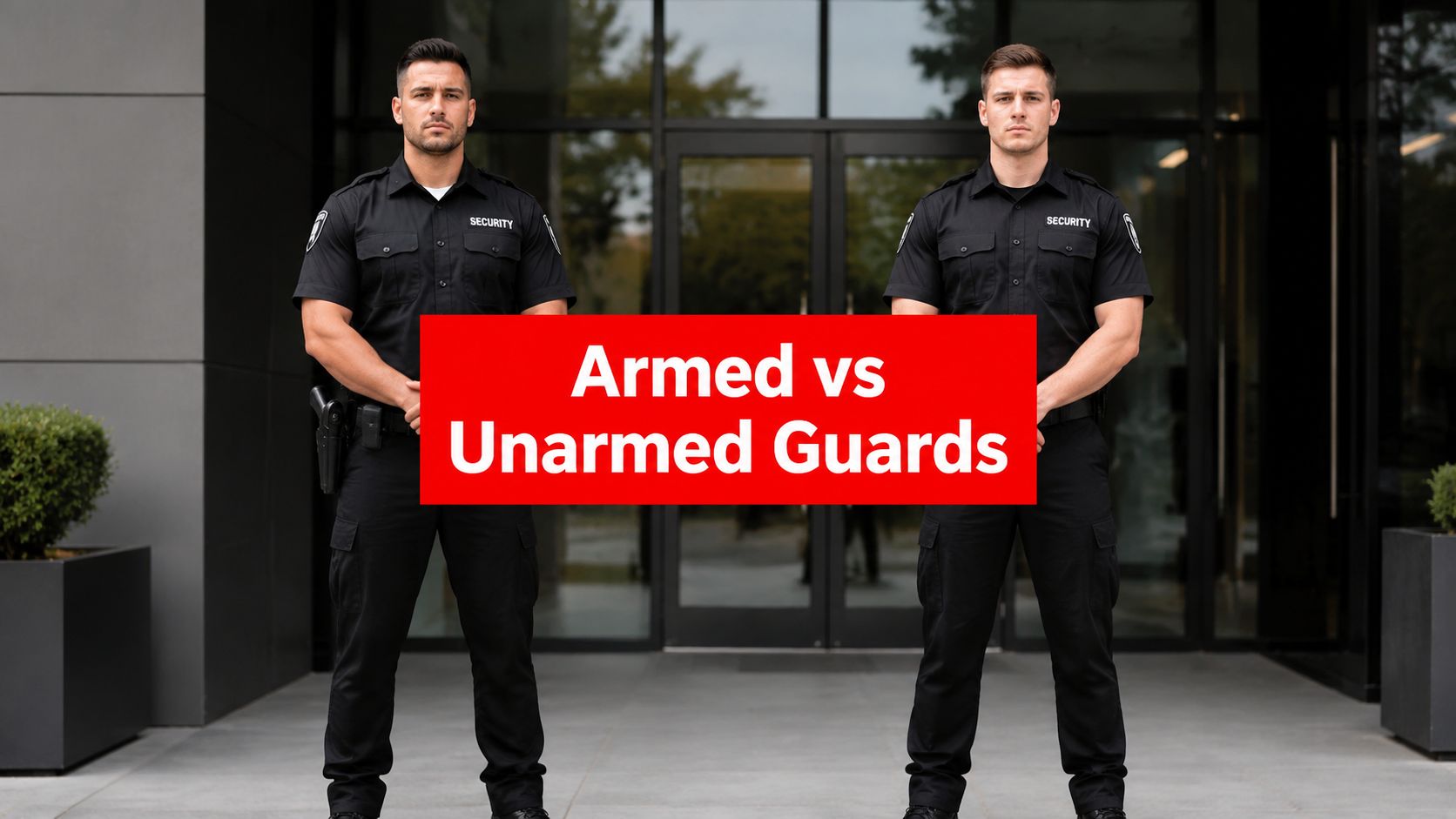

Unarmed guards in Nashville usually anchor around $19 to $24 per hour, and armed guards around $25 to $35 per hour. If a quote lands far outside those bands, or sits inside them without explaining staffing, training, and coverage, you're not comparing real value yet.
A lot of Nashville buyers start with the same Monday morning headache. A gate was left open, the overnight officer was unfamiliar with the site, and the report doesn't match what the property manager saw on camera. The hourly rate looked fine on paper, but the service didn't hold up under pressure.
The Nashville Security Decision Most Buyers Get Wrong

A lot of Nashville buyers make the same mistake. They shop for guard coverage as if the hourly rate settles everything, then they wonder why the site still feels loose a month later. According to a 2020 Tennessee security industry outlook, unarmed billing rates at $19 to $24 per hour and armed rates at $25 to $35 per hour sit alongside a market where guard turnover can run 100% to 200% annually in the state, with Nashville higher than rural areas, and where it can take 14 to 21 days to fill a post plus $800 to $1,200 in training cost per new guard, including the required 48 hours of training. Those figures are old, but the buyer lesson still holds, the lowest quote often hides the highest operational risk.
The core question is not whether a vendor can send a body to the site. It is whether that vendor can keep the same quality of coverage next month, after the first call-off, the first supervisor miss, and the first officer who has never seen your property before. If the answer depends on revolving staffing, loose oversight, or thin post orders, the price tag is a distraction.
Practical rule: Buy continuity, not just coverage. If a company cannot explain how it prevents call-off chaos, it is selling a labor slot, not a security program.
That is the decision path most buyers ignore. They compare hourly rates, then skip the harder questions about retention, supervision, training, and whether the vendor has the internal staffing structure to hold a post without constant churn. For a closer look at how guard services are typically divided, Overton Security's guard service overview is useful because it separates the service types instead of lumping them together.
A Monday-morning failure at a retail center, multifamily site, or construction yard usually comes down to execution. Did the officer know the site, follow the route, document the issue, and escalate it correctly? If not, the hourly savings never mattered. PEO Metrics' analysis makes the staffing side of that problem plain, especially for buyers trying to judge whether a vendor can hold onto people long enough to deliver consistent coverage.
Core Services a Nashville Security Company Should Offer
A Class A lobby, a retail center, and a construction yard all need different service layers, so start by matching the site to the job. A good Nashville security company should show you a mix of services, not just a body count. Static guards cover access control, customer-facing deterrence, and onsite response. Patrols cover wider footprints, and remote monitoring fills the blind spots after hours.
On-site guards fit properties where someone needs to control entrances, watch a lobby, or manage a gatehouse. That is the right setup for office towers, apartment communities, retail centers, and sites with steady public traffic. Armed and unarmed are different tools, and the correct choice depends on the site's risk profile, not ego or optics.
Vehicle patrols make more sense when the property is too spread out for one post to cover. Parking lots, loading zones, construction sites, and multi-building portfolios often need that kind of coverage. If a vendor offers patrols, ask whether the route is shared or dedicated, because those are different service models with different levels of consistency.
Remote monitoring matters when the site has after-hours blind spots or needs alarm triage before someone drives out. Kastle's Nashville page makes the continuous-monitoring model clear, and buyers should expect that kind of escalation speed if they care about response, not just uniform presence. Kastle Nashville
For buyers comparing labor models, PEO Metrics' analysis is a useful outside read on how staffing decisions affect management load. For a more service-specific breakdown, this security guard services overview is a practical reference point.
Bottom line: the right mix is usually layered, guards for access, patrols for breadth, and monitoring for after-hours control.
If you are vetting providers for a Class A lobby, a retail center, or a construction project, start with the service shape first. Then judge whether the vendor is solving your problem, or just quoting a uniform.
Why Turnover Is the Hidden Metric Behind Nashville Security
Turnover changes the quality of service long before it shows up on an invoice. A Nashville vendor can sell you coverage on paper and still leave you with a revolving door of officers who never stay long enough to learn your site. That is why buyers should treat retention as a buying signal, not an HR footnote.
What Churn Does to a Property
High churn shows up in small failures first. Post orders get read differently from shift to shift. Handoffs lose detail. Incident reports get thinner, which makes it harder for property managers to spot patterns, compare officer judgment, or defend a decision after a dispute.
The cost is site memory. An officer who knows gate codes, tenant routines, delivery windows, and the usual trouble spots reacts faster and with less supervision. If the company keeps replacing people, your property becomes the training ground.
That is also where retention strategy separates serious vendors from paper vendors. Some firms keep people by paying better, offering steady schedules, and giving supervisors enough time to coach instead of just cover holes. Others run lean, burn people out, and pass the churn cost to the client through inconsistency. If you want a useful comparison, review how Security Industry Authority buyers tend to pressure vendors on retention, then apply that same discipline in Nashville.
A vendor should answer turnover questions directly, and the answers should be about the actual site profile you care about:
- Average tenure on similar accounts. Short average tenure usually means your post will see new faces often.
- How often the same officers return to the same property. Repeated rotation matters because familiarity improves response and reduces mistakes.
- Whether supervisors work with the same team long enough to coach performance. Weak supervision usually shows up as weak continuity on the post.
- How the company handles replacements for absent officers. If the answer is vague, expect gaps and inconsistent coverage.
A low rate still gets expensive when it comes with retraining, missed details, and weak continuity. Buyers should favor vendors that keep good people on site, because stable staffing usually means faster responses, cleaner reports, and fewer surprises for property management.
If you are comparing vendors for armed posts, ask for proof that the company follows armed security guard requirements instead of treating armed coverage as a sales add-on. Turnover matters even more when the post carries higher risk, because a new officer who does not know the site is slower to make the right call.
Tennessee Licensing, Training, and the Compliance Signals That Matter
A Nashville buyer who skips licensing checks is asking for a bad contract. Tennessee security work is regulated, and a serious vendor should produce its paperwork without hesitation. If the records take time, keep changing, or arrive with gaps, treat that as a warning about how the company runs its posts.
Start with the basics. Ask for the current Tennessee license, proof of insurance, training records, and the incident escalation process. Tennessee requires guard training before an officer is placed on duty, and buyers should verify that the company can show proof of those records, not just promise that training happens. That is a practical screening step, especially for vendors that also have to keep up with changing post assignments and call-off coverage.
Compliance risk is not abstract. A NewsChannel 5 report said Solaren Risk Management was fined $118,000 and had its license suspended for 30 days after guards were accused of posing as police. The same report said a later public notice, filed by the Tennessee Department of Commerce and Insurance in July 2024, charged the company with 62 violations of state law. Buyers should read that as a licensing and supervision problem, not a one-off headline.
A simple outside filter helps. The Security Industry Authority buyers resource is a useful reminder to press vendors on documentation, supervision, and accountability before signing anything.
If you want one hard rule, use this one. A company that cannot produce its license, cannot show training records, or gets defensive about insurance is not ready for your site. If you need a sharper read on officer qualification standards, review armed security guard requirements before you compare vendors.
How to Read a Nashville Security Quote Without Getting Burned
Two proposals can carry the same hourly rate and still end up very different in practice. One quote may include supervision, reporting, and staffing that holds up. The other may bury cost in call-off coverage, thin coverage assumptions, or billable extras that show up after you sign.
Read the quote as a full operating cost, not a sticker price. A useful way to pressure-test the number is to ask how the bill rate was built, because labor, supervision, scheduling, and admin overhead all sit underneath it. How security guard services get to a bill rate If the vendor cannot explain that structure in plain English, the quote is too thin for a property manager to trust.
| Nashville Security Quote Comparison Variables | What to Ask | Why It Matters |
|---|---|---|
| Billing rate | What is included in the hourly number? | The lowest rate can hide supervision or reporting gaps. |
| Contract terms | Are there minimums, holiday premiums, or auto-renewals? | These clauses can incrementally increase the true cost. |
| Add-on fees | What triggers extra charges for reports, calls, or special coverage? | Small line items add up fast once the site gets busy. |
| Billing assumptions | Is the proposal based on fixed coverage or variable demand? | Weak assumptions make the final invoice drift away from the bid. |
A simple comparison matrix helps. Put every quote on the same page, then mark whether the company is clear about what the rate covers, what it leaves out, and what will be charged later. If a vendor stays vague on those three points, the proposal is not ready for a serious buyer.
The cleanest bids usually show where the money goes after the guard clocks in. That is the part most buyers skip, and it is where contract surprises tend to hide.
If you are comparing a mall, an office property, or a residential portfolio, ask for a plain breakdown of the labor line, management overhead, and any extra charges tied to the site. That is the fastest way to see whether the quote is disciplined or padded.
The RFP and Post Orders That Actually Filter Vendors
A vague RFP gets vague answers. If you want serious bids, ask questions that force specificity about staffing, reporting, and escalation. The companies that answer cleanly are usually the ones that can execute cleanly.
Start your RFP with a direct ask for operational proof:
- Account management. How often will the account manager visit the site?
- Officer continuity. What is the average tenure of officers on similar accounts?
- GPS verification. Do officers use checkpoint scanning or another tracked patrol method?
- SOC workflow. Who monitors issues, and how fast are alarms or incidents escalated?
- Digital reporting. When are DARs delivered, and can photos be attached?
- Comparable references. Give me Nashville properties with a similar footprint or risk profile.
That list matters because it separates marketing from operations. A company that dodges those questions usually struggles with the details that keep a property secure day to day.
Post orders should be equally concrete. They should include the site map, marked checkpoints, access control procedures, incident escalation tiers, reporting cadence, and the handoff log format. If the post order doesn't tell an officer what to do at 11:30 p.m. when something changes, it's too vague to trust.
If you need a reference point for how guard-shack-based operations are framed in practice, the guard shack buyer's guide is a helpful side read. It's not about Nashville specifically, but it's useful if your site includes gates, entrances, or controlled access points.
A solid provider should also be able to describe its own mechanics. Overton's model uses a 24/7 National Security Operations Center, GPS-enabled checkpoint reporting, customized post orders, and both shared and dedicated patrol options, which is the kind of operational detail buyers should expect from any vendor they seriously consider. That's the standard, not a premium extra.
Red Flags That Disqualify a Nashville Security Vendor
Some vendors should be out of the running before price ever enters the conversation. If a company won't produce a current Tennessee license, can't show insurance, or gives fuzzy answers about training, that's enough reason to walk away.
Watch the operational tells too. Late shift changes, missing DARs, unfamiliar officers showing up repeatedly, and slow escalation all point to weak control. A vendor that pressures you on contract length before proving consistency is trying to lock in revenue before earning trust.
A clean disqualifier list looks like this:
- No proof of license. If the document isn't current and easy to verify, stop.
- No insurance certificates. General liability and workers' compensation should not be hard to obtain.
- No supervisor cadence. If they can't say how often managers visit, accountability is weak.
- No patrol records. GPS-verified checkpoints and time-stamped reports should be normal.
- No local references. Nashville buyers deserve local proof, not generic claims.
If the first answer is vague, the rest usually gets worse.
The goal isn't to become suspicious of every vendor. It's to protect yourself from the ones that depend on confusion, turnover, and loose oversight. A serious Nashville provider should welcome scrutiny because the work is built on proof.
Your Nashville Security Vendor Decision Checklist
Use this sequence before you sign anything. Start with the threat profile, then match the service mix to the property, verify Tennessee licensing and insurance, and compare the total cost of ownership, not just the headline rate. After that, check the post orders against the site map, review how reporting works, and make sure the contract gives you a clean exit if the vendor misses the mark.
Do not treat every item the same. Score the first four checks at twice the weight of the rest, because license status, insurance, site fit, and pricing structure tell you whether the vendor belongs in the final round at all. Then score the remaining items as pass, weak pass, or fail. That gives you a cleaner comparison than a flat yes-or-no list.
- Define core need. State the risk in plain terms, trespass, theft, gate control, lobby coverage, overnight patrol, or a mix of all of them.
- Verify TN license. Confirm the license is current and matches the company name you are contracting with.
- Check insurance. Ask for certificates for general liability and workers' compensation, and make sure the limits fit the site.
- Review training protocols. Look for onboarding, supervisor review, incident response, and clear expectations for guards on duty.
- Assess technology. Decide whether you need GPS-backed patrols, electronic reporting, camera monitoring, access control, or only basic site coverage.
- Request client references. Ask for local properties with a similar footprint, not vague praise from unrelated markets.
- Compare contract terms. Read term length, termination rights, replacement timelines, and rate-change language before you sign.
- Evaluate reporting. Reports should show what happened, when it happened, and who handled it. Weak notes create weak accountability.
- Confirm emergency procedures. The vendor should explain escalation steps, supervisor response, and coordination with property management or law enforcement.
- Finalize agreement. Only close after the scope, post orders, pricing, and performance review schedule all match the site.
If you want a sharper filter for guard-heavy properties, the guard shack buyer's guide helps you compare booth staffing, access control, and operator responsibilities before you commit.
Do that work once, and you avoid the vendors that look fine in a sales meeting but fail under pressure. Start with one property, prove the model, and only then roll the vendor across the rest of the portfolio.