
A property manager notices it before anyone else does. The front desk calls to ask who the new overnight officer is. A tenant says the usual guard knew exactly how to handle package access after hours, but the replacement had to call a supervisor. A construction superintendent arrives early and finds a different patrol officer at the gate, one who doesn't yet know the delivery schedule, the lock sequence, or which subcontractors should be on site.
That moment is what security guard turnover rates look like in real life.
For California property managers, HOA boards, facilities directors, and multi-site operators, turnover isn't just an HR number sitting in a vendor report. It shows up as uneven coverage, slower response, repeat training, more supervision, and more questions from tenants or residents. If you're responsible for a commercial property in Los Angeles, a residential community in San Jose, or a construction site in San Diego, staffing continuity affects your daily operation.
Why Security Guard Turnover Matters for Your Property
A familiar officer doesn't just stand post. That officer learns your building.
They know which vendor always arrives early, which stairwell door sticks in wet weather, which resident needs a little extra patience at the lobby desk, and which loading dock issue tends to trigger after-hours calls. When that officer leaves, that knowledge leaves too.
The risk doesn't start with a vacancy
Many readers hear "turnover" and think of empty shifts. That matters, but the first problem often appears before a post is ever left open. It starts when a property gets a rotating cast of officers who are technically present but still learning the site.
For a retail center, that may mean slower recognition of recurring loitering patterns. For an HOA, it may mean inconsistent guest access procedures. For a construction site, it may mean a new officer misses a routine equipment storage check because it wasn't yet part of muscle memory.
Practical rule: If residents, tenants, or staff keep asking, "Who is on this account now?" you're not looking at a simple staffing issue. You're looking at a continuity issue.
Why managers should treat turnover as a property-risk signal
High turnover often shows up in three places that matter to clients:
- Service consistency: New officers need time to learn post orders, resident expectations, and escalation paths.
- Incident handling: An officer who doesn't know the site may respond correctly in principle but more slowly in practice.
- Liability exposure: When procedures are handled inconsistently, documentation and follow-through can become uneven.
That's why smart managers ask about staffing stability the same way they ask about patrol frequency, reporting quality, or after-hours supervision. A guard company's turnover pattern can tell you whether your account is likely to feel settled or constantly reset.
Stability depends on how people are supported
Pay matters, but so do schedules, supervision, and fatigue. If officers are constantly shuffled, called in at the last minute, or stretched too thin, the account will feel it. For teams trying to think more clearly about burnout and day-to-day performance, this piece on practical employee energy management offers a useful way to frame the human side of staffing stability.
For property managers, the practical question is simple. Are you buying hours on a schedule, or are you building dependable site coverage with people who stay long enough to become effective?
What Security Guard Turnover Rates Mean and How They Are Measured
Turnover gets talked about loosely, which is where confusion starts. The simplest way to think about it is this: if you kept changing players during a season, the team might still take the field, but execution would get shaky because people wouldn't know the full playbook.
Security accounts work the same way.
The basic definition
A turnover rate measures how many employees leave during a set period compared with the average number of employees on the team during that same period.
In the security industry, researchers described the standard approach clearly. Annual turnover is calculated as total annual separations divided by average employment in the period, as noted in the UC Berkeley Labor Center's national workforce report on the U.S. security guard workforce.
What counts as a separation
Property managers should slow down and ask follow-up questions.
A separation usually means an employee left the employer, whether voluntarily or involuntarily. In plain terms:
- Voluntary separation: The officer resigns, takes another job, or leaves because the schedule no longer works.
- Involuntary separation: The company ends employment for performance, attendance, conduct, or another reason.
A transfer can be trickier. If a company moves an officer from one property to another but the officer still works for the same firm, that may affect your account stability without necessarily counting as company-wide turnover. That's why an account can feel unstable even when a provider quotes a lower overall company rate.
A simple worked example
Suppose your account typically uses about 50 officers across all shifts over a year. During that year, 25 officers leave the company.
The turnover rate would be:
25 separations ÷ 50 average officers = 0.50
That equals 50% annual turnover.
Now change the example. Suppose only 10 officers leave the company, but 20 officers are rotated off your account and replaced by other existing employees. Company turnover may look moderate, while account turnover still feels disruptive to your building.
Ask vendors for both the company view and the account view. A stable property needs both.
Common measurement mistakes
Managers often get mixed answers because firms measure different things. Watch for these issues:
Company-wide averages hiding site problems
A provider may report one overall number while a difficult site experiences much more churn.Short-term posts distorting the picture
Temporary event work, fire watch, or emergency assignments can make a company look more volatile than a long-term standing account really is.Monthly churn being presented like an annual rate
If someone reports a monthly staffing change number, ask whether it has been annualized or not.Open shifts being confused with turnover
Vacancy and turnover are related, but they're not the same thing. One measures departures. The other measures whether coverage is filled.
If you want a plain-English refresher on formulas and basic definitions, this guide to employee turnover rate calculation is a helpful companion for non-HR readers.
Industry Benchmarks for Security Guard Turnover Across the US and Major Metros
The national picture is useful because it tells you whether your provider is operating in a generally stable industry or in one with constant workforce churn. In security, the benchmark is sobering.
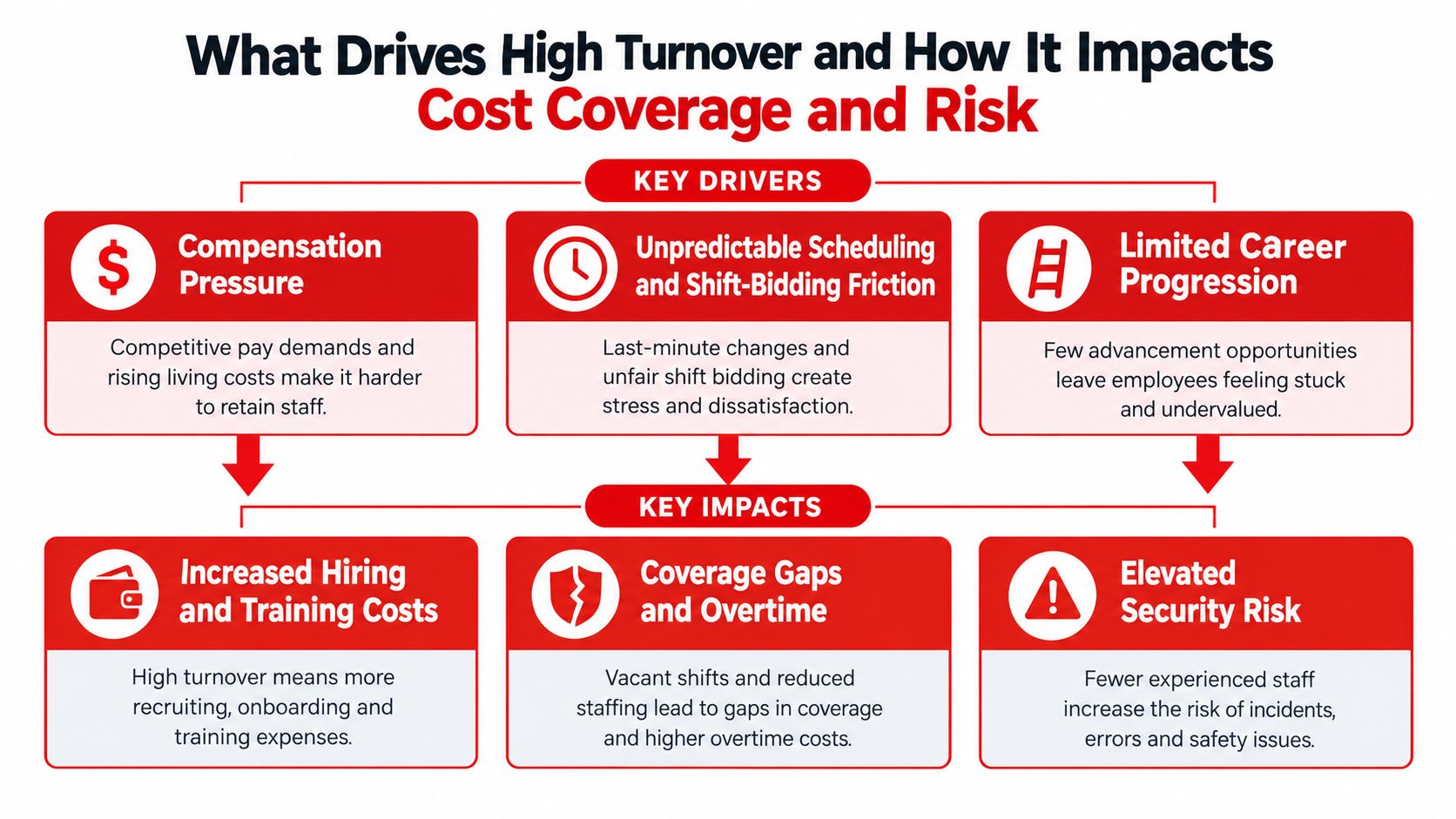
According to a UC Berkeley Labor Center report, annual turnover in the U.S. security services industry reached 88.6% in 2024, compared with 66.0% in the private sector overall, and the same report notes the industry's turnover peaked at 99.3% in 2022 when measured as total annual separations divided by average employment. Berkeley's researchers also found the industry had run above the broader private-sector benchmark across 2014 to 2024 by about 16 percentage points on average in that period, showing a long-running structural challenge rather than a temporary fluctuation in one year alone. This appears in the Labor Center's report on demographic and job characteristics in the U.S. security guard workforce.
What the national benchmark means for a local property
Those numbers don't mean every account is unstable. They do mean property managers shouldn't treat frequent guard changes as rare or surprising in this industry.
A vendor can deliver stable service, but it won't happen by accident. In a labor environment with this much churn, staffing continuity has to be built intentionally through scheduling discipline, supervision, training, and officer support.
Metro markets show why geography matters
The problem isn't limited to one city, and the local labor market can shape what your account experiences.
A Berkeley study of Baltimore's security services sector found annual turnover was 76% in 2014, rose to 90% in 2019, and climbed to 95% in 2024. Over that same period, the broader private sector in the Baltimore metro moved differently, falling from 68% in 2019 to 63% in 2024, which shows security can become more unstable even while the wider labor market becomes less so. Those figures appear in Berkeley's report on Baltimore's security guard workforce.
New York City shows a similar pattern, though at a different level. Berkeley reported 77.0% turnover in New York City's security services sector in 2024, up from 69.3% in 2019, while the city's overall private-sector turnover declined from 65.0% to 58.1% in the same period. That report also notes that security guards make up about three-quarters of employment in the Investigation and Security Services sector in the city, which helps explain why the sector's staffing pattern matters operationally. The findings come from Berkeley's analysis of NYC's security guard workforce.
A market can look calmer overall while security staffing remains difficult. That's why broad labor headlines rarely tell the whole story for guard coverage.
How California managers should read these benchmarks
If you manage properties in Los Angeles, San Francisco, Oakland, Sacramento, Long Beach, or Fresno, don't assume a polished proposal means the staffing environment is easy. Dense metro areas, long commute patterns, contract-driven scheduling, and competition for entry-level labor can all affect your account.
The practical takeaway is to use benchmarks as context, not as an excuse. High industry turnover tells you what pressure a provider is operating under. It doesn't tell you whether that provider has built a system to protect your property from the effects of that pressure.
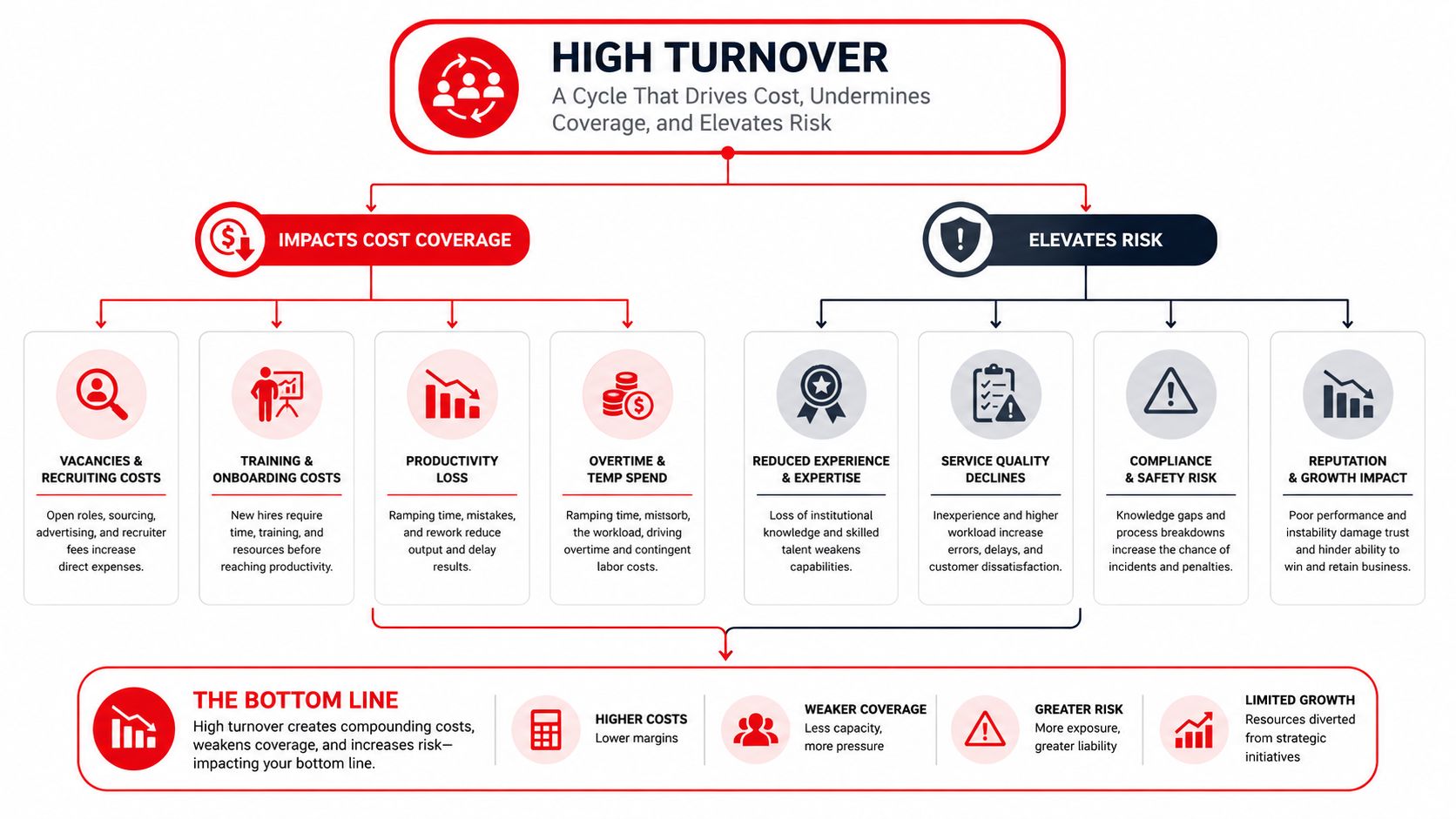
What Drives High Turnover and How It Impacts Cost Coverage and Risk
A rotating security team usually isn't caused by one single problem. More often, several smaller operational choices stack together until officers start leaving or transferring off difficult accounts.
The common drivers behind churn
Some causes are straightforward. Others are easy for clients to miss because they happen behind the scenes.
- Compensation pressure: If a post feels demanding but pay doesn't match the effort, officers may keep looking.
- Unpredictable schedules: Frequent last-minute changes, split days off, or unclear shift assignments wear people down.
- Limited career visibility: When officers can't see a path to lead officer, field supervisor, dispatch, or account management, the job can feel temporary.
- Weak onboarding: A site that hands someone a uniform and a clipboard but not clear post orders creates frustration on day one.
- Site-level culture: Officers stay longer where supervisors answer calls, respect the schedule, and solve problems quickly.
One industry discussion that focuses on security staffing argues that scheduling and shift-bidding issues are major retention levers and notes that some guard operations experience turnover in the 200-300% range. Set against Berkeley's finding that national industry turnover still reached 88.6% in 2024, the larger point is that churn isn't driven by pay alone, and that local conditions can overwhelm generic retention advice. That perspective appears in Teambridge's piece on security guard retention, shift bidding, and scheduling.
How turnover reaches your property
Clients usually feel the effects in three layers.
First comes cost pressure. A provider with constant backfilling spends time recruiting, orienting, and supervising replacements. Even if those costs don't show up as a line item, they often reappear as service inconsistency.
Second comes coverage strain. Open shifts lead to call-offs, reassignment, overtime requests, or supervisors temporarily covering posts. On a retail property, that may reduce visible patrol presence. On a residential account, it may leave the front desk too reliant on one person for too long.
Third comes risk exposure. Newer officers may not yet recognize site-specific warning signs. A construction guard may not know which trailer should be sealed each night. A concierge officer in a high-rise may not yet know the normal pattern for contractors, movers, and delivery access.
Why clients should ask about root causes, not just rates
A turnover number matters, but the cause matters more. If a provider struggles because a few temporary assignments ended, that's different from a provider losing officers because schedules are erratic and managers can't stabilize accounts.
For a deeper look at the staffing side of this issue, especially the relationship between wages and officer stability, Overton's article on why security guard pay is so important is a useful reference point.
The best question isn't "Is your turnover high?" It's "What makes officers stay on difficult accounts, and how do you know it's working?"
How to Calculate and Monitor Turnover on Your Accounts
Property managers don't need to wait for an annual review to find out whether a security account is stable. You can track the signs yourself with a simple dashboard and a regular review rhythm.
Start with the account, not just the vendor
Ask your security provider for a roster by site and shift. Then track movement in a way that reflects your real operation.
Use these categories:
- Account turnover: Officers assigned to your property who leave the employer.
- Account rotation: Officers removed from your account and replaced, even if they stay employed elsewhere in the company.
- Vacancy or fill performance: Whether scheduled shifts are covered as planned.
Those three measures tell different stories. Together, they show whether your property feels steady.
A practical dashboard for monthly reviews
A monthly check is often enough to spot trends early without turning this into a burdensome admin task. If you're running a large portfolio, review by site and then compare across the portfolio.
| KPI | How to Calculate | Healthy Signal |
|---|---|---|
| Turnover rate | Separations on the account during the period divided by average number of officers assigned to the account during the same period | The roster changes infrequently and departures don't cluster on one shift |
| New-hire retention | Track whether newly assigned officers are still on the account after their initial period | New officers stay long enough to learn the property and settle into the post |
| Fill rate | Compare scheduled shifts with shifts fully covered as planned | Few last-minute substitutions and minimal uncovered time |
| Overtime hours | Review hours worked beyond normal schedules on the account | Overtime stays occasional rather than becoming the default staffing plan |
| Incident report completeness | Audit whether reports are submitted fully, on time, and with site-specific detail | Documentation stays consistent even when staffing changes |
If you want a broader framework for what to track across guard operations, this overview of security performance indicators can help you build a cleaner scorecard.
How to verify what you're being told
Roster reports are useful, but they shouldn't be the only source. Compare staffing claims against operating evidence such as:
- GPS tour records: Patrols should show time-stamped movement, not just promised rounds.
- Digital DARs: Daily Activity Reports should reflect real observations, not generic repeated notes.
- Supervisor notes: Field checks should confirm whether officers know post orders and site expectations.
- Client-facing logs: Front desk, resident, or tenant feedback can reveal instability before a formal metric does.
When to escalate with your provider
You don't need a perfect account. You need a managed one.
Escalate when you see patterns like repeated officer changes on the same shift, overtime becoming routine, incident reports losing detail, or recurring confusion about basic site procedures. Those usually point to a staffing system issue rather than a one-off absence.
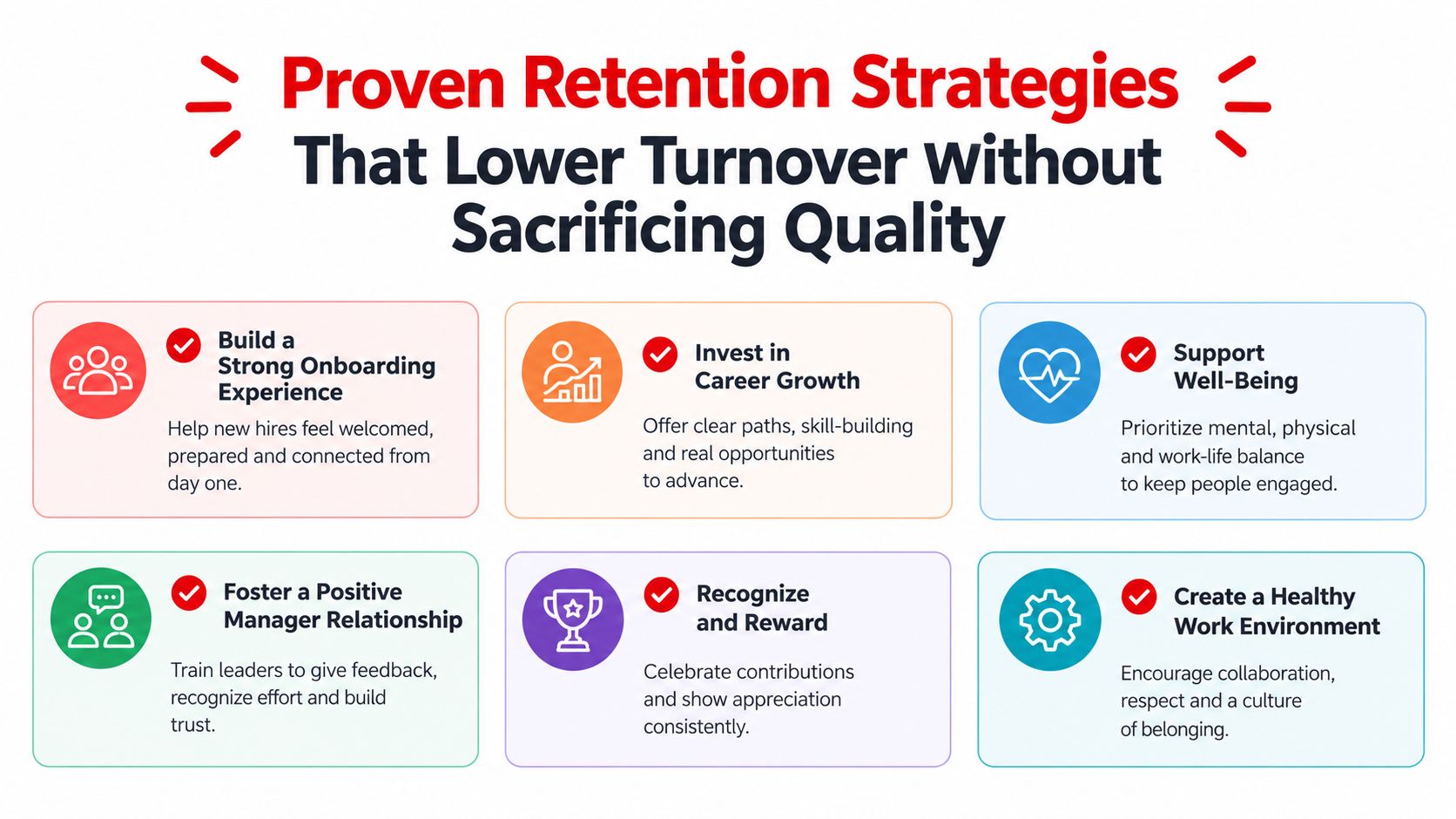
Proven Retention Strategies That Lower Turnover Without Sacrificing Quality
Stable staffing doesn't come from one policy. It comes from a system.
That's the part many buyers miss. A provider can offer slightly better pay and still struggle if schedules are chaotic, onboarding is weak, or supervisors are spread too thin. The strongest retention results usually come from several practices working together.
Retention starts with job design
A well-run account gives officers a reason to stay because the work feels manageable and predictable.
That includes fair scheduling, clear post assignments, realistic expectations on patrol frequency, and supervisors who respond when something goes wrong. In many operations, reducing friction matters almost as much as increasing pay.
For operations leaders who want a broader management perspective, this article on employee retention for COOs is useful because it treats retention as an operating system issue, not just a hiring issue.
What to look for in a provider's retention model
Some signals are visible in the proposal. Others only come out when you ask direct questions.
- Predictable scheduling: Ask how the company handles call-offs, shift swaps, and schedule changes. A provider that plans coverage carefully is less likely to burn people out. If scheduling is central to your account, review how security guard scheduling is managed before signing a long-term contract.
- Site-specific onboarding: Officers should receive post orders, access instructions, emergency procedures, and reporting expectations for your property.
- Ongoing training: The goal isn't just licensing. It's building site familiarity, judgment, and communication skills over time.
- Supportive technology: Tools should help officers do the job, not bury them in paperwork. GPS-enabled patrol verification, digital reports, and active operations-center oversight can reduce confusion and improve accountability.
- Career pathways: Officers are more likely to stay when there is a visible next step and a manager who talks with them about it.
- Hands-on leadership: Smaller manager caseloads often lead to faster problem solving, more site visits, and better retention on demanding accounts.
Good retention is engineered. It shows up in schedules, post orders, supervision, and tools long before it shows up in a recruiting ad.
One example of a retention-oriented operating model
One option in California is Overton Security Services, which describes a staffing model built around low manager-to-client ratios, customized post orders, GPS-enabled guard tour management, digital DARs, and 24/7 SOC oversight. In practical terms, that kind of setup aims to make officers more supported in the field and give clients clearer visibility into whether account stability is being maintained.
For buyers, the point isn't to look for polished language. It's to confirm that a provider's retention practices are visible in daily operations and not limited to general promises about culture.
Putting It Into Practice With a Sample Action Plan and Overton Example
If a property feels unstable today, the fix doesn't need to be complicated. It needs to be disciplined.
A simple 30 60 90 day approach
First 30 days: Audit your current account. Review roster changes, check whether the same officers are staying on the key shifts, and compare patrol records with incident documentation. Ask the provider which posts have been hardest to retain and why.
Next 60 days: Tighten the operating basics. Clarify post orders, clean up scheduling friction, identify where supervisors need to visit more often, and make sure new officers receive site-specific orientation before they work alone. If one shift is driving most of the disruption, solve that shift first.
By 90 days: Review the pattern. Are fewer new faces cycling through? Are reports more consistent? Do tenants, residents, or site staff seem more comfortable with the officers on post? Stability should feel visible before it ever shows up in a summary report.
What this looks like in practice
For many California clients, especially in residential, retail, and construction settings, the best staffing plan combines human continuity with transparent oversight. That means officers who know the site, managers who stay close to the account, and digital systems that confirm patrols and document activity clearly.
Overton has operated for 26 years across California and works from that quality-over-quantity approach. Its model emphasizes hands-on leadership, investment in officers, GTMS-based patrol visibility, and SOC support so clients in markets like Los Angeles, San Francisco, San Diego, Sacramento, and San Jose can see whether continuity is holding at the property level.
The broader lesson is reassuring. High industry churn is real, but it doesn't mean your property has to accept unstable coverage as normal. With the right questions and the right operating discipline, staffing stability can be managed.
If you're reviewing a guard program and want a clearer picture of how staffing stability affects coverage, reporting, and day-to-day property risk, Overton can help. Overton Security provides California properties with hands-on guard management, transparent patrol documentation, and retention-minded staffing practices designed to support consistent service across residential, commercial, retail, and construction environments.