A lot of scheduling problems don't show up on the schedule.
They show up when a resident calls because the lobby desk was uncovered during a handoff. They show up when a retail manager learns the assigned officer arrived late because the route from home to site was unrealistic for that start time. They show up when a construction superintendent asks why a patrol report is missing and nobody can give a clear answer. On paper, the post was covered. In practice, the security program was already drifting.
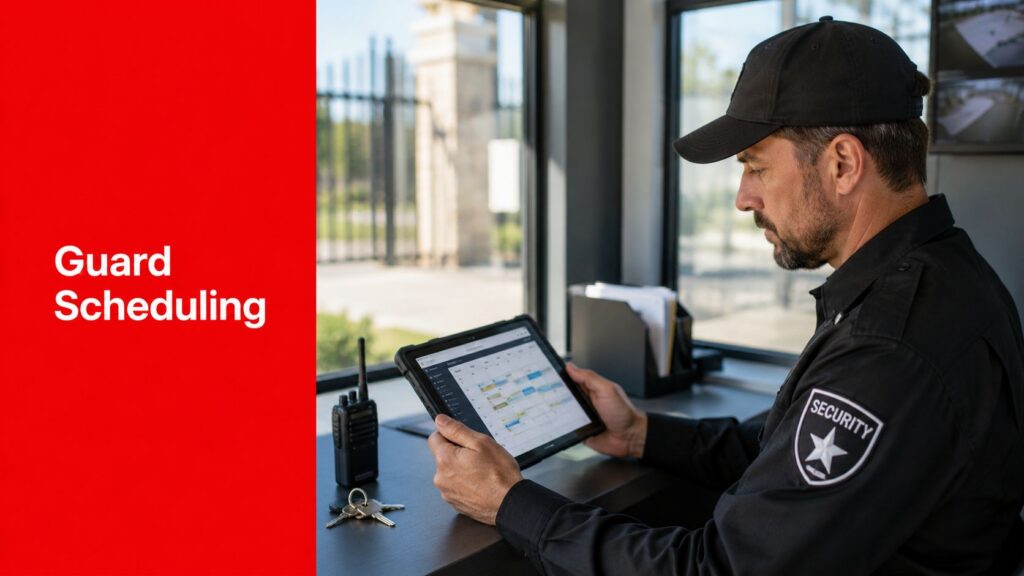
That's why security guard scheduling can't be treated like a weekly admin task. For property managers, facilities directors, HOA boards, and multi-site operators, the schedule is the operating backbone of the entire protection plan. If the schedule is loose, the service will be loose. If the schedule is disciplined, documented, and built around real conditions on the ground, everything else gets stronger too.
Why Your Security Schedule Is More Than Just a Roster
A common failure point is simple. Someone fills shifts fast, but nobody checks whether the person assigned to a post is the right fit for that site, that hour, and that type of activity. The result is familiar across commercial property security in Los Angeles, residential communities in San Diego, and retail environments in San Jose. Coverage exists, but performance slips.
That distinction matters because the schedule controls more than attendance. It affects response readiness, patrol consistency, overtime exposure, reporting quality, client confidence, and the officer's ability to carry out the post orders.
What goes wrong when scheduling is treated as clerical work
A roster tells you who is supposed to be there.
A real schedule tells you whether the officer can arrive on time, understands the assignment, has the right certifications, can complete the required patrol pattern, and has enough continuity to notice what has changed at the property since the last shift.
A security schedule should answer two questions before the shift starts. Who is covering the post, and are they set up to succeed there?
That's especially important in contract security. Nearly 74% of all security guards work for contract security companies, not directly for the properties they protect, which means most scheduling is handled by third-party providers covering multiple client sites and often running complex round-the-clock deployment models through a central operations function, as noted by Building Security industry statistics.
For clients, that industry structure creates a practical reality. Your provider may be balancing apartment communities, office towers, construction gates, vehicle patrol routes, and temporary coverage requests at the same time. Good scheduling in that environment doesn't happen by accident.
The schedule also protects the site plan
If the coverage pattern doesn't line up with the actual duties on site, the officer starts the shift already behind. A front desk post with visitor management needs different support than a fire watch assignment, a mobile patrol route, or after-hours warehouse security. That's why the schedule has to be built around the site's written expectations, not just around open boxes on a calendar.
Well-written security post orders help define that connection. They clarify what the officer must do, when those tasks must happen, and which periods of the day require the most attention.
In practice, the strongest schedules do three things at once:
- Match staffing to risk: Busy arrival windows, vendor access periods, school dismissal traffic, or overnight perimeter checks all need different coverage intensity.
- Support consistency: The same officers on the same sites tend to spot patterns faster, document better, and communicate more clearly with property staff.
- Limit avoidable disruption: Last-minute moves, excessive overtime, and frequent reassignment usually create more problems than they solve.
A strong schedule isn't just an internal operations tool. It shapes the daily experience of tenants, employees, residents, and visitors.
Building Your Security Coverage Model
Before anyone assigns a single shift, the property needs a coverage model. That means deciding what the site needs protected, when risk changes, and what kind of officer presence fits the environment. Without that groundwork, security guard scheduling turns into guesswork.

Start with the property, not the staffing template
A quiet gated community in San Diego doesn't need the same schedule logic as a high-traffic shopping center in San Jose. A Class A office building in San Francisco may need strong lobby coverage during business hours and lighter after-hours patrol. A construction site in Sacramento may need the opposite, with stronger overnight protection when tools, materials, and equipment are most exposed.
The right first step is a site-by-site review of:
- Access points: Vehicle gates, loading docks, lobby entrances, rooftop access, stairwells, and service corridors
- High-risk zones: Vacant units, cash handling areas, package rooms, electrical rooms, tool storage, and blind spots
- Activity peaks: Shift changes, tenant arrival periods, delivery windows, school release times, and weekend traffic
- Site-specific obligations: Patrol timing, visitor handling, escort duties, incident documentation, and emergency response procedures
A formal security risk assessment usually makes these decisions much clearer because it separates real exposure from assumptions.
Choose a shift pattern that fits the site
There's no universal “best” shift structure. Some sites work better with shorter shifts because the post demands steady alertness and frequent interaction. Other sites benefit from fewer handoffs because continuity matters more than turnover frequency.
Here's the trade-off most managers run into:
| Shift pattern | What it helps | What to watch |
|---|---|---|
| 8-hour shifts | More consistent energy, easier relief planning, cleaner overlap for busy periods | More handoffs, more chances for communication gaps |
| 12-hour shifts | Fewer handoffs, simpler weekend coverage, stronger continuity on stable posts | Fatigue risk rises if post activity is demanding or commute times are long |
| Split coverage | Good for properties with sharp peaks and quieter off-hours | Can be harder to staff consistently if the split feels inconvenient to officers |
Field rule: Don't choose the shift pattern that looks neat on paper. Choose the one the site can actually support without creating fatigue, missed patrols, or handoff confusion.
Coverage should reflect client priorities
In a retail setting, visible deterrence during customer-heavy windows may matter most. In a residential high-rise, resident service and access control may lead the plan. At a construction project, perimeter integrity and after-hours patrol discipline often matter more than daytime presence.
That's why customization matters in such a large market. The U.S. security services industry is a $50.4 billion market in 2026, and in a sector of that size, scheduling becomes a real point of differentiation for firms that deliver reliable, accountable service rather than generic coverage, according to IBISWorld's U.S. security services industry profile.
The practical takeaway is straightforward. Good coverage models are built around risk, activity, and officer function. Weak ones are built around convenience.
From Plan to Published Schedule
Once the coverage model is clear, the work shifts from planning to execution. At this stage, many firms either gain control or lose it. The strongest process is structured, repeatable, and visible to supervisors, dispatch, and field officers.

The workflow that holds up in real operations
A validated approach uses five phases: mapping sites, assessing guards, building the schedule, resolving conflicts, and publishing. When this workflow is supported by scheduling software, it can reduce administrative time to under 30 minutes per week, and operators commonly track fill rate, call-off recovery time, and unplanned overtime to keep improving, as outlined in this guide to creating a security guard schedule.
That sequence matters because each phase solves a different operational problem.
Map the posts
List every location, start time, relief expectation, patrol frequency, and service requirement. If a post requires a perimeter check at a set interval, lobby coverage without interruption, or vehicle patrol verification, that must be built into the schedule from the start.
Assess the guard pool
Not every officer is interchangeable. Skills, licenses, site familiarity, reliability, communication ability, and availability all matter. A polished concierge-style officer may fit a corporate lobby better than a rugged overnight patrol route. A construction gate may need someone who handles vendors, deliveries, and access logs cleanly.
Build the weekly draft
Stable posts should use recurring templates where that makes sense. That reduces avoidable rework and makes it easier to spot unusual changes that need human review.
Conflict checks should happen before publication
The following process is what separates disciplined operators from schedule fillers. Before anything is released, managers should review:
- Overtime exposure: Whether the added assignment pushes the officer into unnecessary overtime
- Certification fit: Whether the post requires a specific qualification or experience level
- Rest window issues: Whether the officer can realistically recover between shifts
- Travel practicality: Whether the route to the site makes the report time achievable
That last point is often overlooked. Dispatch quality matters here too. Teams that rely on centralized communications can learn a lot from broader operations fields, including guides on choosing call center management software that emphasize queue visibility, escalation workflows, and real-time coordination.
Publish for confirmation, not just notification
A schedule isn't final because it was sent out. It's final when the assigned officer confirms it, supervisors can see exceptions, and operations has a clear path for immediate correction if someone doesn't acknowledge the shift.
Operational reminder: A published schedule without confirmation is just an assumption.
This is also where role clarity matters. The assigned duties need to match the expectations of the post, the handoff process, and the officer's actual responsibilities on site. A clear security guard job description helps align staffing decisions with what the shift requires in practice.
Technology should support that visibility, not replace judgment. GPS-enabled patrol systems, digital DARs, checkpoint verification, and real-time operations oversight are strongest when they help managers catch problems early, not after a client calls.
Scheduling Beyond Basic Coverage
The hardest scheduling lesson in security is that filled posts can still produce weak service. A body on site isn't the same thing as an alert, prepared officer who can observe, report, de-escalate, and follow procedure with consistency.

Readiness matters more than simple availability
Most schedule boards answer one question: who is free?
Better security operations ask a tougher one: who is ready for this assignment?
That difference matters because guards working forward rotations and travel times over 30 minutes experience 15–20% higher rates of fatigue-induced errors, a hidden readiness gap many scheduling guides miss, according to this analysis of security guard scheduling and fatigue risk.
For clients, that's not a technical detail. It shows up in missed observations, slower reporting, poor judgment at access points, and weaker patrol discipline.
What readiness-based scheduling looks like
A readiness-based approach doesn't treat every open shift the same. It weighs the demands of the post against the actual circumstances of the person being assigned.
That means looking at factors such as:
- Commute burden: Early starts become harder when the trip to site is long and traffic is unpredictable.
- Rotation pattern: Moving someone from morning to night and then back again may fill holes, but it can also erode attention.
- Post intensity: A reception desk with constant tenant interaction creates a different kind of fatigue than a low-traffic patrol route.
- Site familiarity: Officers perform better when they know the property, the contact chain, and the normal rhythm of the location.
The schedule should protect officer judgment, not just officer hours.
Retention is a scheduling issue
Poor scheduling often drives the very turnover companies later describe as a hiring problem. Officers who live in constant schedule uncertainty tend to disengage. They stop feeling ownership over the site. They become less likely to build strong relationships with property staff. Eventually, they leave.
Clients feel that churn quickly. New faces mean more retraining, weaker continuity, and more room for preventable mistakes. By contrast, predictable scheduling supports professionalism. Officers arrive with better context, stronger habits, and more confidence in how the site runs.
That's one reason mature programs don't chase maximum flexibility at all times. They protect enough consistency for officers to stay effective. In residential communities, that helps with resident trust. In office towers, it improves front-of-house presence. In construction, it reduces the chance that unusual site activity gets missed because the assigned officer doesn't know what “normal” looks like.
Security guard scheduling works best when it is designed around human performance, not just labor coverage.
Contingency Planning and Proactive Scheduling
Every property manager knows the worst version of the call-off. The shift starts soon. The assigned officer can't make it. The supervisor is texting multiple people, dispatch is trying to reshuffle nearby posts, and the client is left wondering whether the site will be covered at all.
That scramble isn't inevitable. It usually signals that contingency planning was too thin from the start.

Build a standby system before you need it
Reliable operations keep relief options ready in advance. One widely used scheduling rule is to set an alert threshold at 35 hours before assigning more shifts, and to maintain a regional standby list of 3 to 5 guards who live close to multiple sites and can respond quickly when a no-show occurs, as described in these security company scheduling rules.
That kind of standby planning works because it respects geography, availability, and timing. It also keeps managers from solving every problem with the same blunt tool, which is overtime.
A strong standby pool usually includes a mix of officers:
- Local flex officers: People who can reach several sites without a long drive
- Part-time availability: Useful for shorter fill-ins or peak periods
- Experienced floaters: Officers who already know multiple client locations
- Reliable full-time backups: Team members willing to take targeted extra assignments without destabilizing their main schedule
Proactive scheduling is better than reactive coverage
The next step is more strategic. Predictive standby scheduling uses historical patterns and local demand signals to pre-assign flexible standby shifts, and this approach can reduce call-off recovery time by 40% and cut unplanned overtime by 25%, according to this overview of predictive standby scheduling for security operations.
That idea isn't unique to security. Other labor-heavy industries deal with the same conflict between service continuity and last-minute staffing volatility. Restaurant operators, for example, often rely on practical strategies for restaurant labor management that translate well to any environment where customer experience suffers when coverage falls apart.
Reactive scheduling asks, “Who can we find?” Proactive scheduling asks, “What is most likely to go wrong, and who is already positioned to solve it?”
Real-time oversight closes the loop
Standby planning only works if someone is actively managing exceptions as they happen. A central operations function gives schedulers and supervisors a live picture of who has checked in, which posts are confirmed, where patrol units are located, and which open issue needs escalation first.
That real-time layer changes the tone of the whole operation. Instead of hoping the shift starts cleanly, management can verify coverage, reroute support, and communicate clearly before a small staffing problem becomes a client problem.
For multi-site portfolios, that's often the difference between a manageable disruption and a visible service failure.
Measuring Success and What to Expect
A schedule should be judged by results, not by how polished the calendar looks. Property teams need a practical way to evaluate whether the staffing plan fits the site and whether the security provider is managing it well.
A useful starting point is to compare coverage structure by property type.
Sample Security Schedule Templates by Property Type
| Property Type | Primary Coverage Need | Common Shift Pattern | Example Post Focus |
|---|---|---|---|
| Retail center | Visible deterrence during peak customer hours and strong closing coverage | Split day and evening coverage with added presence during peak traffic | Parking lot patrols, storefront visibility, loading area checks, incident reporting |
| Construction site | After-hours site protection and access control for vendors and deliveries | Day gate coverage plus stronger overnight patrol or fixed post coverage | Gate logs, perimeter checks, equipment yard patrols, trespass deterrence |
| Class A office building | Professional lobby presence and controlled access with after-hours patrol support | Business-hour desk coverage with evening patrol continuity | Visitor management, badge control, lobby watch, common-area rounds |
The metrics clients should ask about
The most useful KPIs are the ones that show whether the schedule is stable, responsive, and realistic.
- Fill rate: This measures how many scheduled shifts were covered as intended.
- Call-off recovery time: This shows how quickly operations can move from a gap to a confirmed replacement.
- Unplanned overtime: This reveals whether the provider is leaning too heavily on overtime to hold service together.
- Scheduling admin hours: This helps show whether the process is organized or constantly being rebuilt by hand.
Those metrics matter because they expose the difference between a provider that runs a disciplined operation and one that survives week to week through improvisation.
What good scheduling should feel like on site
Clients usually notice the impact before they ever ask for a metric report.
The officer arrives prepared. Handoffs are clean. Patrols happen when they should. Reports are submitted with usable detail. Property staff know who is on duty and how to reach support. When something changes, the response is calm and coordinated.
That's the standard to expect from modern security guard scheduling. Not just filled shifts, but dependable coverage built on planning, officer readiness, accountable systems, and contingency depth.
If your current schedule creates too many surprises, it may be time for a closer review of the operating model behind it. Overton Security helps California properties build coverage plans that are practical, accountable, and suited to the actual conditions on site.