A property manager usually discovers bad post orders at the worst possible moment. An officer calls after hours about a door alarm, a trespasser in the garage, or a vendor who wants emergency access. The next morning, the incident report makes the true problem obvious. The officer wasn't sure which door was high priority, who had authority to approve entry, or who needed to be notified first.
That's what generic post orders do. They create hesitation when the site needs clarity.
If you're learning how to write security post orders for the first time, it helps to stop thinking of them as paperwork. Good post orders are the operating instructions for the property's security program. They tell an officer how to act, what to record, when to escalate, and what “done correctly” looks like on a live shift.
After working with residential communities, office properties, retail centers, and construction sites across California, one pattern shows up again and again. The sites with the fewest avoidable mistakes usually have post orders that are current, site-specific, and easy to use under pressure. The sites with the most confusion usually have a binder full of recycled language that doesn't match the building anymore.
Why Your Old Post Orders Are a Liability
A property usually gives you a warning before bad post orders turn into a claim. The warning is small. An officer signs in a contractor who should have been sent to engineering. A patrol report skips a checkpoint that no longer exists in the tour route. A weekend officer releases a package based on an old tenant instruction, and the property ends up explaining the mistake to an angry resident or tenant.
That is how liability starts. The document still exists, but it no longer matches the site, the technology, or the people using it.
Generic language creates real exposure
New property managers often inherit post orders that read more like a position description than site instructions. They list broad security guard duties, but they do not tell an officer what to do when a real decision has to be made at 2:00 a.m.
A line like “patrol property and report unusual activity” is too loose to protect anyone. It does not define the patrol route, required checkpoints, reportable conditions, escalation order, or who can authorize access after hours. If an incident reaches an insurance carrier, attorney, or client review, vague wording makes it hard to show that the property gave clear direction and that the officer followed it.
Old binder-style post orders often look complete until an unfamiliar officer has to use them alone on a live shift.
The standard should be practical. A relief officer who has never worked the site before should be able to pick up the post orders, follow the route, handle routine issues, document exceptions, and know when to call for help without guessing.
Stale instructions create avoidable liability
The risk is not limited to major emergencies. I see more problems come from ordinary site changes that never made it into the orders. A tenant vacates and the access list stays the same. A loading dock procedure changes after repeated theft complaints, but the overnight officer still follows the old process. A guard tour system adds new checkpoints in the garage, yet the written patrol sequence still points officers to the prior route.
Now the property has two sets of instructions. One lives in the software. One sits in the binder. If they conflict, the officer is put in a bad position and the property manager owns the gap.
That is what people mean when they say post orders need to stay current. In practice, the document should change whenever the site changes. Access control updates, new vendors, revised after-hours contacts, camera blind spots, package procedures, and lessons from recent incidents all belong in the orders. The strongest programs treat post orders as an active operating record tied to daily operations, tour checkpoints, and incident reporting, not a file that gets reviewed only after something goes wrong.
For California property managers, this matters even more because sites change fast and expectations after an incident are high. If the written instructions do not match the actual building conditions or current procedures, that gap can become part of the liability story.
The Core Components of Effective Post Orders
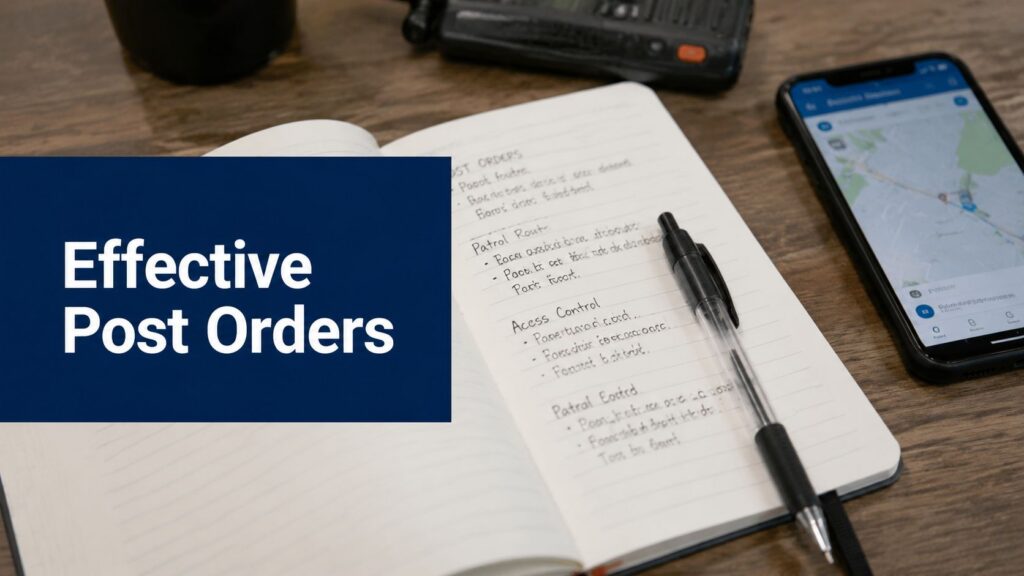
The easiest way to write strong post orders is to build them like a field manual. Every section should answer one of four practical questions. Where am I? What do I do? What do I do if something goes wrong? What exactly do I document?
This visual captures the framework well:

Start with site identity and command structure
Every post order should open with the basics that an officer needs before making any decision.
Include:
- Property identification: Full site name, address, building entrances, loading areas, garage access points, and any secondary structures.
- Post purpose: State whether the assignment focuses on access control, customer service, patrol, fire watch, loss prevention, construction security, or a blend.
- Chain of command: List property contacts, after-hours emergency contacts, maintenance contacts, and the reporting path inside the security program.
- Shift-specific expectations: Spell out what changes by time of day, day of week, holiday period, or after-hours mode.
This sounds simple, but missing command details create unnecessary delay. If the officer has to guess whether to call engineering, property management, law enforcement, or a supervisor first, the document hasn't done its job.
Write duties so a new officer can execute them
The strongest post orders define the post in operational terms, not abstract terms.
Instead of “monitor access,” write the actual process. Instead of “perform patrols,” identify the route, sequence, timing expectation, checkpoints, and areas of special concern. If the property uses front desk coverage, concierge service, or patrol-based coverage, the order should describe each duty separately.
A good practical reference for duty design is this guide to security guard duties, especially if you're trying to distinguish customer-facing tasks from enforcement and reporting tasks.
Cover the five operational blocks every site needs
Most properties need these categories, even if the details vary:
- Access control procedures: Key and fob handling, visitor entry, vendor authorization, delivery protocols, resident or tenant verification, and restricted-area rules.
- Patrol and inspection duties: Patrol routes, checkpoint locations, stairwells, rooftops, fire exits, mechanical spaces, parking structures, and exterior perimeter checks.
- Emergency response instructions: Fire alarms, medical incidents, criminal activity, elevator entrapment, utility issues, and evacuation support.
- Reporting standards: Daily activity reports, incident reports, photo documentation rules, and escalation triggers.
- Equipment protocols: Radios, phones, access devices, keys, master keys, and any site-issued technology.
Practical rule: If an officer can read a duty line in two different ways, rewrite it until only one meaning remains.
Make the reporting standard unambiguous
One of the clearest benchmarks in public guidance is how incident details should be recorded. Government sample orders emphasize using the 24-hour time system, writing in clear factual language, avoiding slang and unnecessary abbreviations, and including the who, what, when, where, why, and how for incidents, as shown in the District of Columbia sample post orders.
That level of detail isn't just about neat paperwork. It reduces ambiguity when several people review the same event later, including supervisors, property management, tenants, and legal counsel.
Here's a simple comparison:
| Weak instruction | Strong instruction |
|---|---|
| Check the garage often | Patrol garage levels in assigned sequence, inspect stairwells, fire exits, and gate arms, and document any unsecured doors or unauthorized vehicles |
| Call if needed | Notify the listed contact immediately for forced entry, fire alarm activation, medical emergency, or key-control discrepancy |
| Write a report | Complete log entries before end of shift and include who, what, when, where, why, and how in any incident report |
Customizing Orders for Your Property Type
A post order that works at a high-rise HOA won't work at a construction site. The structure can stay similar, but the details have to follow the property's daily reality.
That's where many first drafts go wrong. They borrow language from another account and only change the address. The result looks polished, but it doesn't match the site.

Residential communities
In a residential setting, the officer is often balancing safety, privacy, and service. The post order needs to reflect that balance clearly.
For a gated HOA or apartment community, useful instructions usually include resident verification procedures, guest and vendor entry rules, amenity access controls, package handling limits, noise complaint response, parking enforcement boundaries, and escalation rules for disputes. If the property has pools, clubhouses, parcel rooms, or garage storage areas, each one should have a specific operating instruction.
A common mistake is writing a residential post order like a commercial lobby manual. Residents don't want a guard improvising policy at the front gate. They want consistent treatment, especially after hours.
Commercial properties
An office property in Los Angeles, San Francisco, or San Jose typically needs more layered access control and more precise after-hours procedures.
One building may need concierge-style lobby coverage during business hours and perimeter patrol after hours. Another may have loading dock management, elevator access issues, rooftop restrictions, and after-hours contractor coordination. The post order should identify approved tenant contacts, the process for vendor sign-in, rules for opening suites, and what the officer must do when an employee requests access without credentials.
Commercial sites also benefit from clearer loitering and trespass procedures. A vague line such as “monitor exterior activity” doesn't tell the officer how to distinguish a tenant waiting for a ride from someone testing doors or lingering near a secured access point.
Construction sites
Construction post orders need less generic language and more control language.
Material theft prevention, equipment yard checks, contractor entry, perimeter integrity, gate lock procedures, lighting checks, and temporary camera or trailer protection should all be addressed directly. If the project has high-value tools, copper, appliances, fuel, or staged finish materials, those areas should be named. If the site has multiple phases, each phase should be described separately so the patrol route stays current as the project evolves.
On construction sites, the best post orders are usually the ones that treat the property as changing ground, not a fixed building.
A useful way to think about customization is this:
- Residential sites need consistency in resident-facing decisions
- Commercial sites need clarity around access and escalation
- Construction sites need control over movement, materials, and perimeter changes
If you're a portfolio manager, don't force one master template across all properties. Keep a common format, but customize the instructions at the site level.
Integrating Post Orders with Modern Security Technology
A printed binder still has value, but it can't verify performance by itself. Modern post orders work better when the written instruction is tied to a digital action.
That changes the role of the document. It stops being a passive reference and becomes part of a monitored system.

Turn instructions into verifiable tasks
A line in the post order that says “check west stairwells, garage fire exits, and mechanical room during each patrol” becomes much stronger when those checkpoints are tied to a guard tour platform.
Expert guidance on post orders notes that the most technically effective versions convert field activity into verifiable controls by using a property map, mandatory checkpoint sequencing, and proof-of-performance tools such as NFC or QR scans so supervisors can confirm critical zones were checked, as described in Overton's post orders guidance.
That's the practical advantage of digitization. It creates a time-stamped record connected to the duty itself.
Use technology to reduce ambiguity
When post orders are loaded into a mobile platform, officers don't have to rely on memory alone. They can review site instructions on shift, follow checkpoint sequences, submit digital logs, attach photos, and escalate incidents while the details are still fresh.
For properties trying to connect physical coverage with systems oversight, it also helps to think about post orders alongside broader integration of security systems. The more your patrol instructions align with cameras, access control events, and incident reporting workflows, the easier it becomes to spot gaps.
What this looks like in practice
A modern workflow usually includes some version of the following:
- Mapped patrol routes: Officers follow the actual route the property expects, not a personal shortcut.
- Checkpoint confirmation: Critical areas such as fire exits, parking garages, gates, and utility spaces are tied to scans or documented checks.
- Digital daily reports: Shift activity is logged in real time instead of reconstructed at the end of the night.
- Escalation history: Management can see what happened, when it happened, and who was notified.
Overton Security uses this kind of model with GPS-enabled patrols, NFC checkpoints, digital reporting, and SOC oversight. That's one example of how a security provider can connect written post orders to field accountability without relying on paper alone.
A post order is strongest when the officer can read it, act on it, and prove the task was completed in the same system.
Legal and Compliance Considerations in California
In California, post orders do more than guide the shift. They also show whether the property took its security responsibilities seriously.
When an incident happens, one of the first questions is whether the response should have been anticipated and addressed in advance. That's where site-specific written procedures matter. If a known risk existed at a loading dock, pool gate, stairwell, parking garage, or vacant suite, a current set of post orders helps demonstrate that the property had a defined process for prevention, observation, reporting, and escalation.
Liability usually grows from avoidable ambiguity
Vague instructions create room for inconsistent action. Inconsistent action is where many negligence arguments begin.
For example, if the property expects officers to verify vendors after hours, control master keys, patrol a known trouble area, or notify management immediately after certain events, those expectations should appear in writing. If they don't, the officer is left to improvise, and the property manager is left explaining why a known procedure was never formally documented.
A simple rule works well here:
- If the issue is foreseeable, document the response
- If the response matters, define the reporting path
- If the task affects life safety, make it unmistakable
California-specific issues to watch
California property managers should also review post orders for alignment with state-specific rules and operating realities. That includes staying within the lawful scope of security officer duties, making sure officers aren't being directed into roles they shouldn't perform, and confirming that daily operations don't conflict with labor requirements for breaks, meal periods, and handoff coverage.
If you need a practical overview of role boundaries, this guide on what security guards can and can't do in California is a useful starting point.
Post orders should also be internally consistent with the rest of the property's policies. If your leasing office, engineering team, HOA board, or construction superintendent has one set of expectations and the security binder has another, the conflict itself becomes a risk.
Write for the incident review, not just the shift
Most post orders are judged twice. First by the officer on duty, then by everyone reading them after an incident.
That second audience matters. The document should show that the property identified key risks, assigned responsibilities clearly, and created a reasonable escalation process. That's what due diligence looks like in practice.
Auditing and Maintaining Your Post Orders
A property manager usually learns the state of their post orders at the worst possible time. An officer calls with a gate issue, a tenant complaint turns into a claim, or a serious incident triggers a file review. Then someone opens the binder and finds an old supervisor name, a dead phone number, and patrol instructions that no longer match the site.
That gap creates liability fast.
Post orders should work as living documents. They need a clear owner, a review schedule, and a record of what changed. On properties using guard tour systems or digital reporting platforms, that matters even more. If the software says one thing and the written orders say another, officers improvise, supervisors give verbal corrections, and your documentation gets harder to defend later.

Set a review rhythm and assign ownership
A review schedule only works if one person is responsible for it. On smaller properties, that may be the property manager. On larger sites, it may be the security account manager or site supervisor, with final approval from management.
Review post orders at set intervals and after any event that changes operations. For many California properties, a practical baseline is:
- Residential communities: at least annually, and sooner after resident policy or access changes
- Commercial office buildings: at least twice a year
- Construction sites and retail centers: quarterly, because conditions, routes, and public traffic change quickly
- Any property after a significant incident: immediately, while the lessons are still clear
The point is simple. If the property changed, the post orders should change with it.
Audit the document against the real site
Desk review is not enough. Walk the property with the current post orders in hand and compare the instructions to actual operations.
Check the following:
- Contacts and authority levels: Confirm phone numbers, after-hours contacts, tenant representatives, and approval authority.
- Access procedures: Verify key control, credential handling, vendor entry, delivery rules, and lockup procedures.
- Patrol logic: Make sure the route still reflects active risk areas, closed amenities, vacant units, construction zones, and life-safety equipment.
- Technology instructions: Confirm QR checkpoints, guard tour expectations, access control steps, camera references, and reporting workflows match the systems officers use.
- Reporting triggers: Review which incidents require immediate notification, photo documentation, supervisor response, or client follow-up.
- Training records: Confirm officers assigned to the post received the current version and acknowledged any revisions.
Use one practical test. Hand the post orders to a relief officer who has never worked the property. If that officer still needs major verbal patchwork to get through the shift, the document is not ready.
Keep a clean revision record
A revised post order without a revision trail creates its own problem. If an incident leads to a client complaint, workers' compensation claim, or lawsuit, you may need to show what instructions were in effect on a specific date, who approved them, and how the update was communicated.
Property teams already do this in other parts of operations. Security documents need the same discipline. The logic behind understanding contract audit trails applies here too. Save prior versions, note the reason for each revision, record approvals, and document officer acknowledgment. In California, that paper trail can help show that management gave clear direction instead of relying on inconsistent verbal practice.
Update immediately when conditions change
Do not wait for the next scheduled review if any of these happen:
- A serious incident exposed a gap: revise the response steps, notification chain, or scene security instructions
- A building area changed use: update patrol routes, access limits, and after-hours procedures
- A tenant, resident, or HOA policy changed: revise visitor management, package handling, parking enforcement, or amenity rules
- A staffing model changed: adjust meal break coverage, handoff instructions, and supervisor escalation
- New technology was added or removed: update guard tour checkpoints, access readers, camera references, and digital reporting steps
This is a common failure point on California accounts. The property adds a new access control process or changes after-hours coverage, but the post orders stay untouched for months. Then an officer follows the old instruction because it is the only written direction available.
Treat maintenance as risk control, not paperwork
Good post orders age well because someone keeps them tied to real conditions. Bad post orders drift. They become historical files instead of operating instructions, and that is when mistakes, inconsistent enforcement, and avoidable liability show up.
If your current post orders feel generic, outdated, or hard to use on a live shift, it may be time for a professional review. Overton Security works with California property teams to develop site-specific post orders that align with real operations, officer training, and accountable reporting.