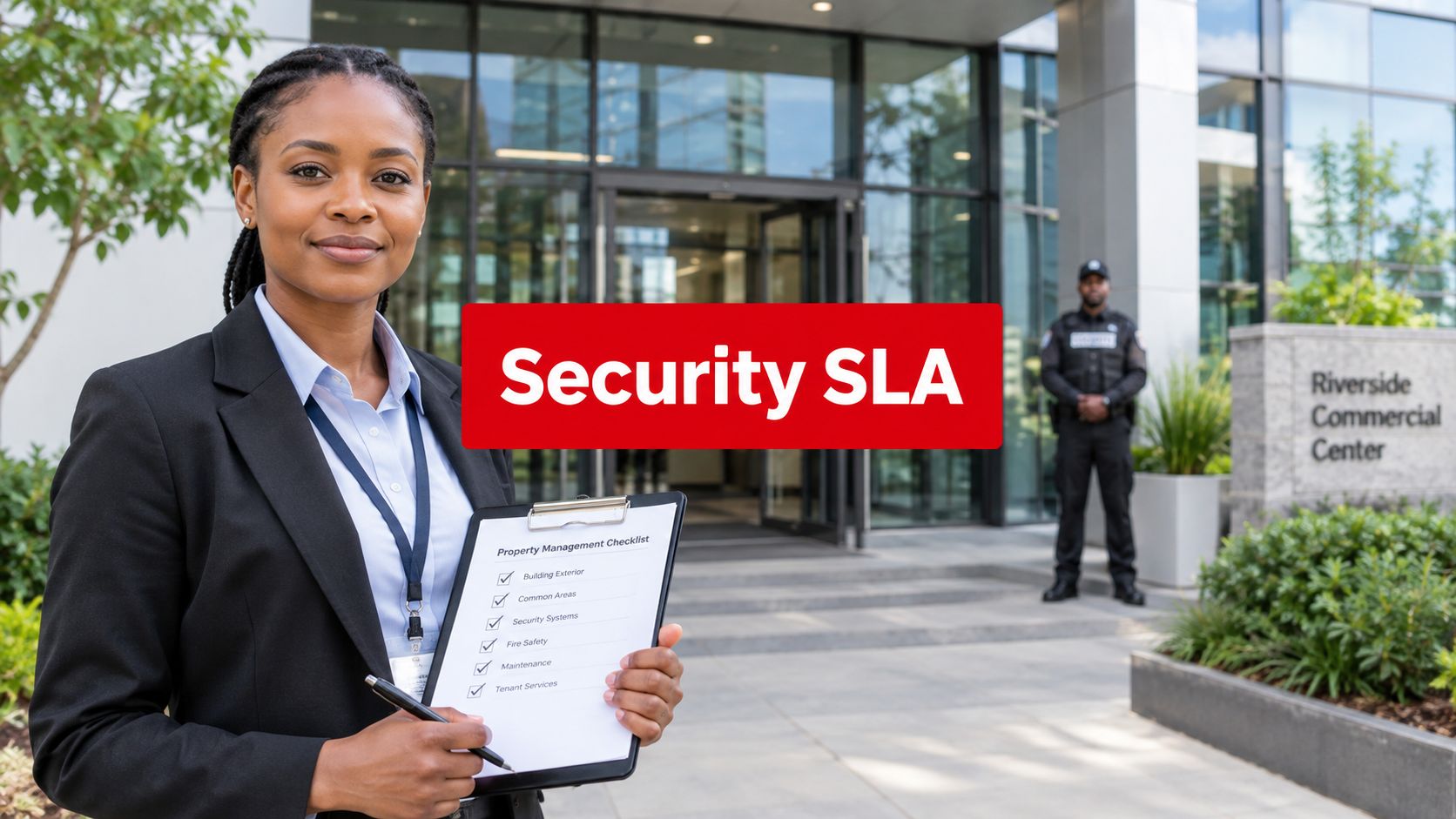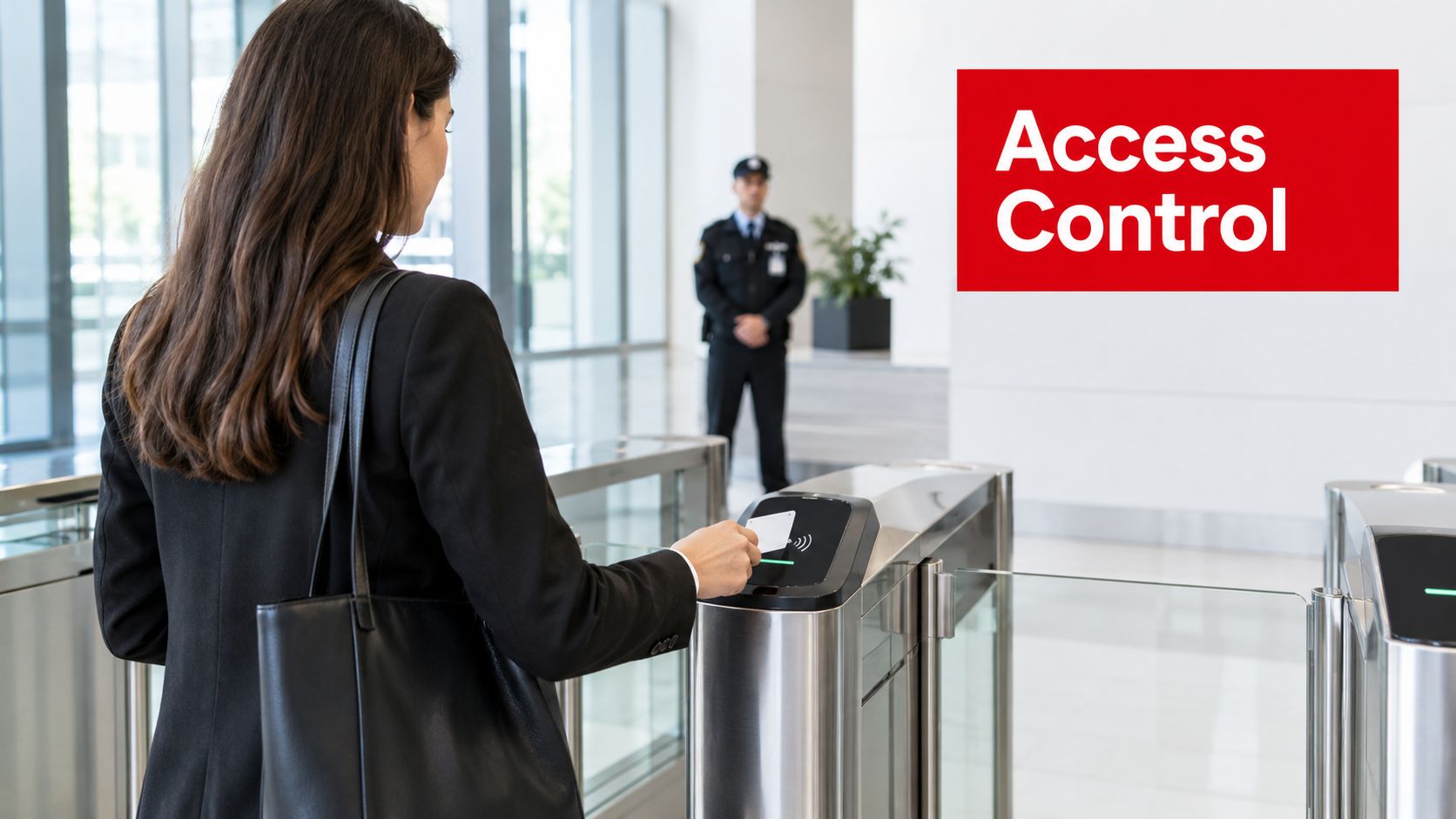

A property manager usually knows something is wrong before anyone says it out loud. The call comes in after hours, a guard missed a post detail, a tenant is frustrated, and the security company sounds unprepared for the property they're supposed to protect. At that point, the problem usually isn't just staffing, it's the security account manager.
Good account management is the difference between a provider that drops off bodies and one that runs a security program. The role sits at the center of service quality, officer performance, reporting, and escalation. In a well-run account, the account manager understands the site, the people, the routine, and the weak points, so the response is calm, specific, and useful.
That matters in the market too. In the U.S. labor market, security account managers were estimated at about 135,887 positions in 2023, with a national median salary of $102,336 and a median hourly wage of $49; the lowest earners were around $60,840 annually and the highest around $169,021. Employers posted 99,691 related job ads, and in a larger sample of 102,942 ads, salary was listed in 35% of them, which shows how visible and management-heavy the role has become in major U.S. markets. Franklin University's salary profile for security account managers supports that picture.
Why Your Security Provider's Account Manager Matters
The fastest way to spot a weak provider is simple, call them during a real problem. If the person who answers does not know the site's access points, tenant schedule, loading dock pattern, or recurring trouble spots, your account is being managed at a distance. That gap shows up first in small things, then in response time, then in trust.
A strong security account manager is the person tying together field officers, the SOC, and your property team so everyone is working from the same playbook. That role matters most in properties where the daily rhythm changes, residential move-ins, retail deliveries, construction traffic, or after-hours contractor access all create different risks.
Practical rule: if the account manager cannot explain your property's top three operational risks without opening a notebook, the account is too shallow.
The job market reflects that operational reality. Job postings tie the role closely to facility management, which appeared as the top specialized skill in 29% of 102,942 analyzed postings, and the largest employment concentration was Local Government, Excluding Education and Hospitals, at 7.7% of jobs in 2023. The most frequently advertised role was facilities manager, with 11,771 unique postings between September 2022 and August 2023. Franklin University's role analysis for security account managers makes one point clear, the role belongs inside operations, not at the edge of it.
For property managers, the practical takeaway is direct. You want a partner who can reduce repeat issues, support tenant expectations, and make the contract feel active instead of anonymous. If your current provider only shows up when you complain, that is reactive administration, not account management.
What a Security Account Manager Handles
The role gets oversimplified all the time. Many people assume the account manager just handles schedules, approves overtime, or relays complaints. In practice, the position sits much closer to operations leadership, and the best job descriptions make that scope plain.
The role bridges people, process, and client expectations
A solid security account manager handles client relationship management, operational oversight, strategic planning, team leadership, performance monitoring, budget management, risk assessment, compliance, and business development. One published job description lays out that exact mix of responsibilities, which is why the role is materially broader than “the person who watches the guards.” Good Guard Security's security account manager job description reflects the shape of the job.
That bridge function matters because field staff can't always see the full business impact of a problem, and property teams don't always see what's happening at the post level. The account manager translates both sides. They take a staffing issue, a recurring incident, or a site control gap and turn it into a decision, an action plan, and a follow-up.
What the role looks like in practice
A posted security account manager description says the manager must develop post orders and emergency procedures, meet all contract specifications in the client service agreement and scope-of-work document, ensure posts are staffed with qualified personnel, and be available 24/7 for calls, notifications, assistance, and emergency response. Jooble's security account manager description shows how operational the role really is.
That means the account manager shapes the rules that control the site, checks whether staffing matches the plan, and steps in when something falls outside it. On a residential property, that may mean lobby access procedures and visitor flow. On a retail center, it may mean loitering control and opening and closing routines. On a construction site, it may mean gate control, subcontractor verification, and night coverage.
The key distinction is simple. A guard watches the post. The security account manager makes sure the post works.
Daily Responsibilities and Operational Duties
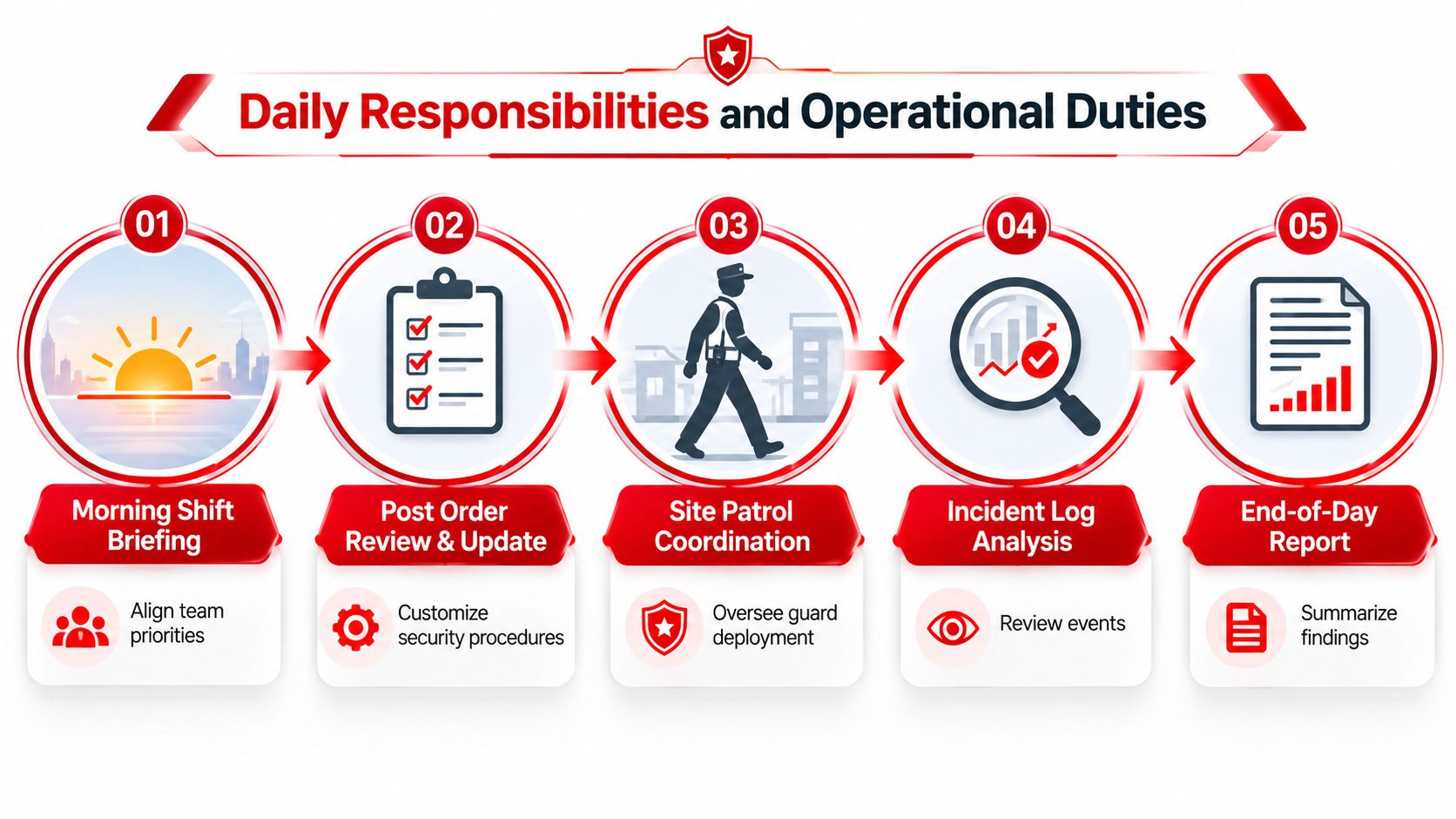
A strong account manager earns trust through repetition and follow-through. The daily work usually mixes structure, execution checks, and early correction before small misses turn into client frustration. When those basics slip, the relationship starts to weaken fast.
The work starts with the post, not the report
The most important daily habit is keeping post orders and emergency procedures aligned with the site. If those documents are generic, stale, or buried in an inbox, officers end up improvising, and inconsistency follows. A useful reference for clearer post orders is Overton Security's guide to writing security post orders.
At the site level, the manager should also conduct regular inspections, review Daily Activity Reports, and confirm the officer on duty is following the contract, not just showing up. For a residential community, that may mean checking badge compliance and visitor log discipline. For a retail property, it could mean verifying patrol timing during high-traffic periods. For a construction site, it often means making sure access controls reduce theft opportunities instead of only documenting them.
The weekly rhythm should be visible
The weekly cadence matters just as much. The account manager should coordinate with the SOC on incident escalations, follow up on service gaps, and keep staffing coverage from drifting into guesswork. If a vacancy keeps reappearing, a capable manager treats it as an operational risk rather than an annoying scheduling issue.
If the same correction shows up in report after report, the account manager should fix the process instead of merely apologizing for the outcome.
The monthly output should be client-facing and useful
At the monthly level, the manager should deliver a performance picture the property team can use. That usually means summaries of incidents, coverage trends, compliance issues, and any site changes that affect the security plan. A manager who cannot explain what happened this month, what changed, and what still needs attention is not managing the account, they are archiving it.
The strongest providers treat these tasks as a living cycle. They brief, inspect, correct, and report. That keeps the relationship operational instead of ceremonial.
Essential Skills and Certifications for the Role
Not every capable account manager comes from the same background, but the best ones share a few traits. They understand field operations, they can speak to clients without jargon, and they can make technical details usable for a property team that cares more about outcomes than acronyms.
Technical fluency matters more than many buyers expect
Job postings for the role emphasize SOC operations, incident response, vulnerability management, identity and security tooling, and compliance frameworks, along with the ability to turn technical issues into business recommendations. That combination matters because the account manager is often the first person who has to explain whether a problem is an isolated event, a recurring exposure, or a contract issue. Indeed's security account manager posting frames the job in that practical way.
For property managers, that means the person managing your account should be able to talk about more than coverage. They should understand escalation logic, reporting quality, and how field observations become management decisions. If they can't connect those dots, you'll feel it in slower responses and weaker follow-through.
Facility knowledge is a real differentiator
One of the more important signals in the labor data is that facility management appears as a top specialized skill. That makes sense, because the job is often embedded in properties where operations, access, tenant experience, and safety all overlap. A strong account manager sees the site as a working system, not a patrol route.
Here's the practical comparison:
- Average manager: knows who is on shift and sends reminders.
- Effective manager: understands the site layout, the escalation path, the contract obligations, and the operational risks tied to daily use.
- Strong manager: can explain why a recurring issue is happening and what change will reduce it.
Certifications help, but they're not the whole story
Certifications can be useful as proof of discipline and baseline knowledge, especially when paired with real field experience. But a certificate alone doesn't tell you whether someone can lead officers, handle a difficult tenant conversation, or improve reporting quality. The better question is whether the candidate has managed real sites, handled incidents cleanly, and kept communication steady when something went sideways.
That's the difference property teams should look for. The title matters, but the operating skill matters more.
KPIs and Performance Metrics That Matter
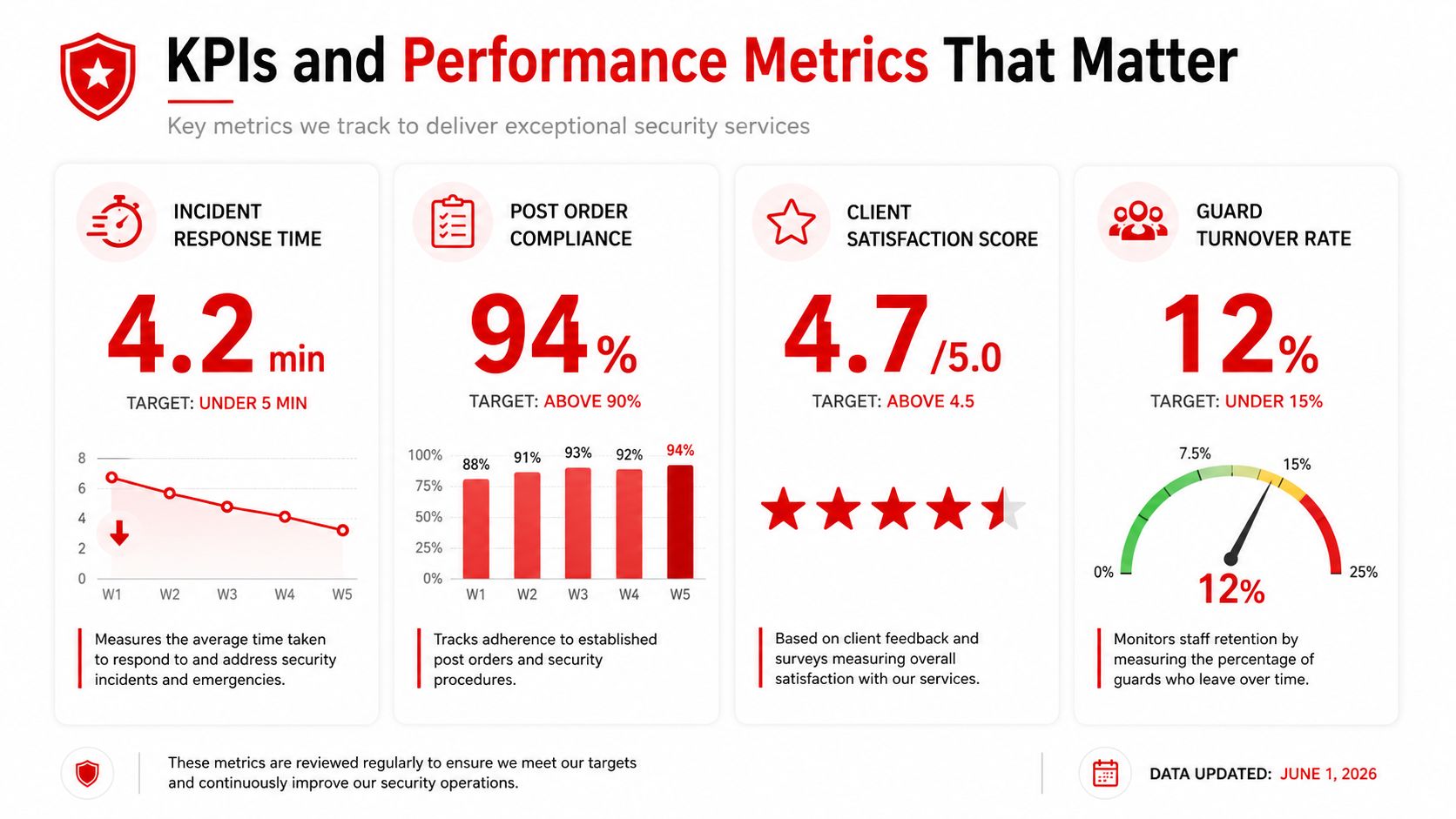
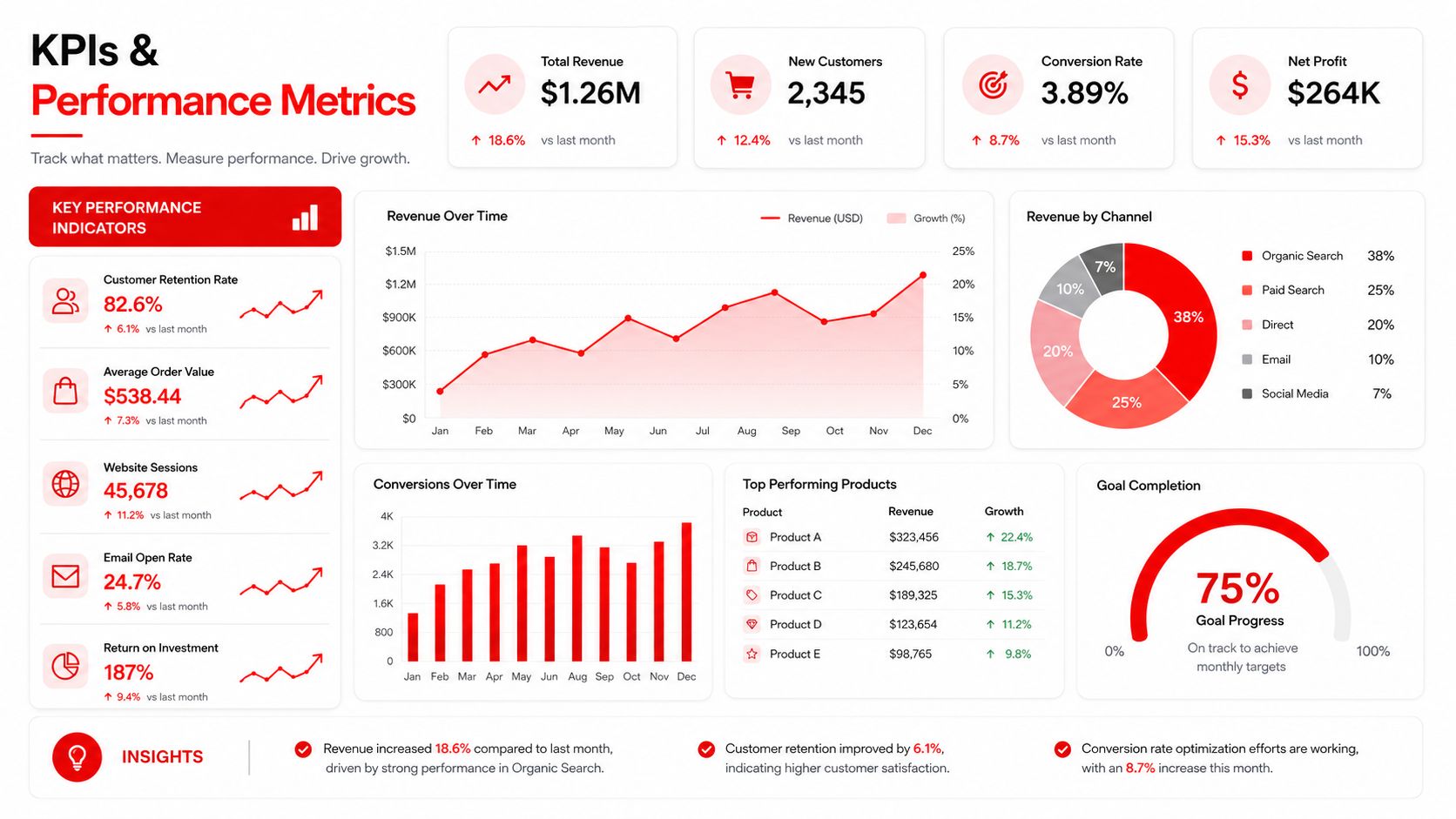
A property can look covered on paper and still be underperforming in practice. The difference shows up in the numbers. If a provider cannot show what it tracks and how those numbers change over time, the account manager is working off instinct, not evidence. That is a poor foundation for any site, especially one with multiple locations or recurring service issues.
A useful scorecard is simple and repeatable
The core KPIs should be straightforward: incident response time, officer attendance and punctuality, post compliance, client satisfaction, incident closure time, site audit results, and report accuracy. Those metrics let a property manager separate real performance from polished language. If the reports look good but the same problems keep returning, the scorecard should show that pattern.
A security program also needs to prove that procedures are being followed. That is why a provider's quality system matters. Overton Security's service quality assurance page is one example of where a property team can look for process discipline instead of relying on verbal reassurance alone.
The right metrics connect operations to business outcomes
The goal goes beyond creating a spreadsheet for its own sake. It is identifying whether the account manager is improving the site. Faster incident response means less time waiting on support. Better post compliance means officers are more likely to act the same way from shift to shift. Clearer reports make it easier for property management to make staffing, vendor, or tenant decisions.
A good monthly review should answer questions like these:
- Did incidents get closed out cleanly, with follow-up documented?
- Did officers show up when they were supposed to and perform the post correctly?
- Did the account manager catch issues before they became tenant complaints?
- Did report accuracy hold up when different officers covered the same post?
What mediocre reporting looks like
Mediocre reporting is busy, but it lacks judgment. It lists incidents without explaining patterns. It mentions patrols without showing whether the site is improving. It also tends to hide problems in generic language, which makes it hard for a property manager to challenge anything.
A strong security account manager does the opposite. They make the numbers easier to interpret, connect them to site risks, and give you a real basis for accountability. That is the standard worth demanding.
How Overton Security Approaches Account Management
Some providers talk about service, then overload one manager until the account becomes a backlog. That model usually fails slowly. A better model keeps the manager close enough to the property to spot issues early, while giving them the tools to act on what they see.
Hands-on leadership changes the quality of the account
Overton Security's operating approach is built around a low manager-to-client ratio, which gives each account more direct attention and more frequent site visibility. That matters because the manager can't solve operational issues from a distance. They need time on the property, time with the officers, and time with the client team.
The company also uses its 24/7 SOC and GPS-enabled Guard Tour Management System to give account managers real-time visibility into officer activity. That means the manager can see whether patrols are happening, whether reports are getting filed, and whether the site is drifting from the plan before the client has to raise the flag.
Consistency is a service feature, not a luxury
A security account manager is only as effective as the team they support. Overton's emphasis on officer retention helps preserve familiarity at the site, which reduces the churn that often weakens service quality. Clients notice when officers know the property, understand the routine, and don't need to relearn the basics every week.
Customized post orders also matter here. Different properties need different rules, and a generic instruction set usually creates gaps. A site with tenant deliveries, after-hours access, and public-facing entrances needs different controls than a gated community or a construction yard. The account manager's job is to keep those instructions current and tied to actual conditions.
One practical model for property managers is to watch how quickly a provider adapts after a site change. If the response is slow, the account structure is too loose. If the response is coordinated, documented, and reflected in the field, the account is being managed well.
Questions Property Managers Should Ask Before Hiring
Vendor selection gets easier when the questions are specific. A lot of providers sound strong in a sales meeting, then get vague when you ask how the account runs. The best questions force clarity on staffing, transparency, escalation, and measurement.
Ask about coverage, visibility, and accountability
Start with the basics. How many accounts does the assigned security account manager oversee, and how often do they visit the property? What technology gives you real-time visibility into officer activity? How are reports delivered, and how quickly can the client team review them?
You should also ask how the company updates post orders. Are they customized during onboarding, reviewed after incidents, and revised when the site changes? A provider that treats those documents as living operational tools will usually be stronger in the field than one that treats them as paperwork.
Ask how the provider measures performance
The next layer is measurement. What KPIs are reported monthly? How does the provider track attendance, compliance, incident closure, and report quality? If the answer stays broad, the account manager may be too focused on service language and not enough on management discipline.
A useful hiring reference is Overton Security's guide to choosing the right private security company for your property.
Ask about escalation before you need it
Emergencies expose structure fast. Who gets called first? Who has authority to change staffing, reroute patrols, or contact the SOC? What happens after hours when the site has an urgent issue and the property manager is unavailable?
Tailor the questions to the property type:
- Residential communities: Ask how the manager handles resident complaints, access issues, and recurring visitor problems.
- Commercial properties: Ask how reporting supports tenant relations and after-hours coverage.
- Construction sites: Ask how the team responds to theft risks, gate control issues, and contractor accountability.
A good provider answers these questions clearly before the contract starts. A weak one asks you to “see how things go.”
If the answers feel vague, the account structure is probably weak. If the answers are specific, measurable, and easy to verify, you're looking at a provider that understands what real account management requires.
Building a Security Partnership That Delivers Results
A security account manager should feel like part of your operating team, not a vendor contact you chase when something breaks. The strongest accounts combine low client loads, real-time transparency, customized post orders, measurable KPIs, and steady officer staffing. Those are the traits that keep a security program useful instead of decorative.
Overton Security has spent 26 years refining that model across California, working with residential communities, retail centers, construction sites, and commercial properties in major metro areas including Los Angeles, San Francisco, San Diego, and Sacramento. For property managers, the benchmark is simple. Your account manager should know the site, support the officers, and give you clear evidence that the program is working.
If your current security relationship feels reactive, it's time to look at the account structure behind it. Overton Security provides account management built around site knowledge, reporting discipline, and steady operational follow-through, so property teams aren't left guessing about coverage or performance. Visit Overton Security to talk about a more accountable security program for your property.