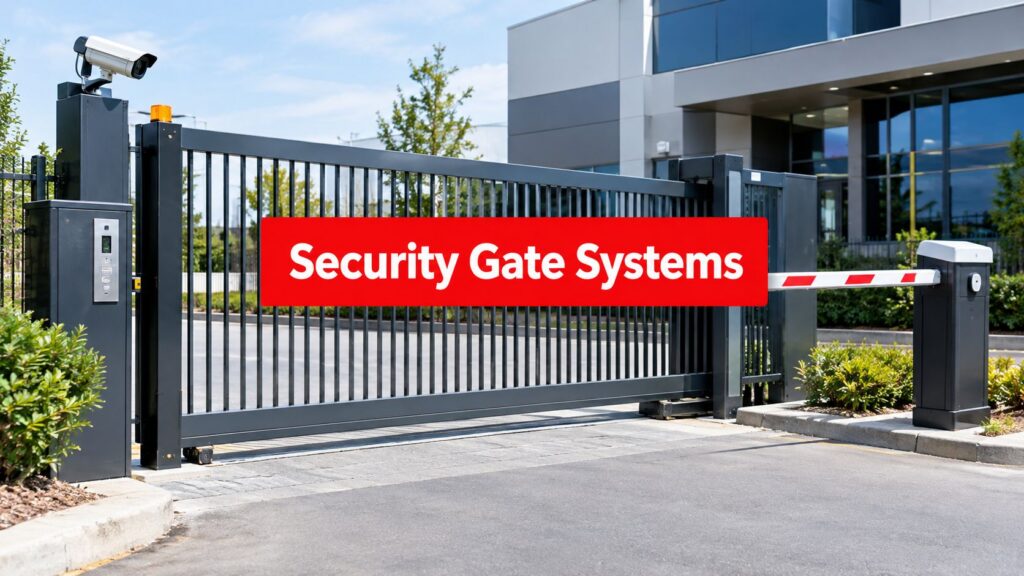
A motorized gate is closed, the keypad is active, and the property manager assumes the perimeter is secure. Then a tenant props the service gate open with a rock, a delivery driver follows a resident through the vehicle entrance, or an old access code still works weeks after a resident moves out. The hardware functions exactly as designed, yet unauthorized people still enter.
That gap between the gate operator and the credentialing stack is where many security gate systems fail. The right purchase decision isn't just about swing versus slide, motor strength, or a polished mobile app. It's about whether the property can verify access, detect misuse, document events, and produce a timely response.
Why Gates Alone Rarely Solve the Security Problem
A property manager at a 240-unit community can spend heavily on a motorized entry gate and still face repeated break-ins. The gate may close correctly during normal operation, but a tenant can prop open a separate service entrance, a visitor can follow an authorized vehicle through, and a shared PIN can circulate beyond the people who were meant to use it.
The gate hasn't necessarily malfunctioned. The security process has.
A gate access control system is a physical barrier that permits entry to authorized people or vehicles, for both pedestrian and vehicle access. The physical security fundamentals explained by Overton Security are useful here because the barrier is only one part of a broader protective plan. The property still needs rules for identity, exceptions, observation, and escalation.
Where the perimeter breaks down
Common failure points include:
- Propped-open gates: A rock, trash bin, or delivery delay defeats a functioning operator.
- Tailgating: An unauthorized vehicle enters behind a resident before the gate closes.
- Shared PINs: A credential that identifies no individual can't support meaningful accountability.
- Convenience-mode remote opens: Staff may leave a gate open longer than necessary to avoid repeated access requests.
- Unverified vendor entry: A contractor receives access without a confirmed work order, identity check, or time restriction.
- Stale credentials: Former tenants, former employees, or old vendors retain access because nobody closes the lifecycle loop.
The purchasing question should therefore be broader than, “Will the gate open and close?” Ask, “Can we prove who requested access, what the gate did, what the camera saw, and who responded when the event looked wrong?”
Practical rule: Treat the gate as a perimeter device, not a complete security outcome.
A standalone gate can become an expensive traffic signal. A unified system connects the credential, controller, camera, monitoring workflow, and response plan. That's the difference between controlling vehicle movement and controlling access risk.
Main Types of Security Gate Systems
The correct gate type follows the site, not the catalog. Start with the driveway geometry, available setback, pavement condition, traffic pattern, pedestrian exposure, and required level of vehicle resistance.
Six practical categories
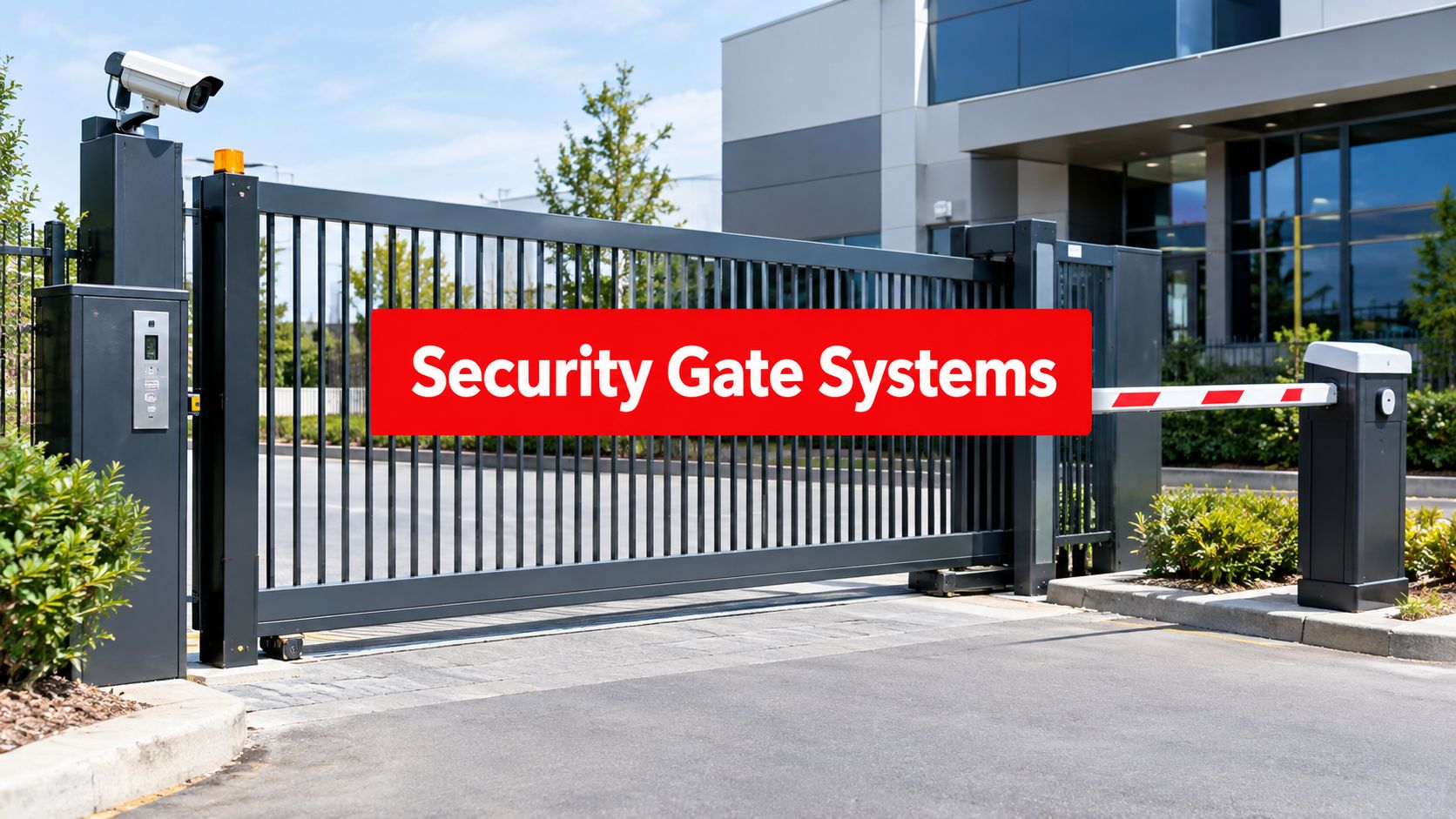
Swing gates open inward or outward from hinges, much like a large driveway door. They suit many single-family properties and smaller residential entrances, but they need clear swing space and can be vulnerable to wind, hinge movement, or force applied against the leaf.
Slide gates move laterally along the opening. They're a common commercial choice where the site has enough side clearance and relatively flat travel, especially for wider driveways. Ground tracks need regular cleaning, alignment, and inspection.
Cantilever slide gates remove the ground track by suspending the gate over a foundation beam. That makes them useful where snow, debris, uneven pavement, or drainage would make a track troublesome. The trade-off is a larger structural footprint and more demanding foundation work.
Barrier arms raise vertically and prioritize throughput. They work well at parking garages, office lots, and retail entrances where the objective is to regulate vehicles rather than create a solid perimeter. They offer less physical resistance than a full gate.
Bollards are fixed or removable vertical posts that protect lanes, sidewalks, storefronts, and restricted approaches. They're appropriate where vehicle impact is the principal concern, not where every vehicle needs routine passage.
Crash-rated gates are engineered for hostile vehicle mitigation. Ratings such as K4, K12, and M50 communicate increasing resistance levels in property terms, from stopping lower-energy vehicle attacks to addressing severe impact scenarios. Require the manufacturer's tested assembly, installation conditions, and certification, not just a rating printed on a proposal.
| Gate Type | Mechanism | Best-Fit Property | Security Level | Key Limitation |
|---|---|---|---|---|
| Swing gate | Hinged leaf opens | Residential driveways and low-volume entries | Moderate | Needs swing clearance and stable hinges |
| Slide gate | Gate rolls beside opening | Commercial and industrial driveways | Moderate to high | Track, rollers, and side clearance need attention |
| Cantilever slide | Suspended gate rolls without ground track | Snow, debris, or uneven pavement sites | High | Larger foundation and counterweight requirements |
| Barrier arm | Arm lifts vertically | Parking lots and garages | Access control focused | Limited vehicle impact resistance |
| Bollards | Fixed or removable posts | Storefronts, sidewalks, protected lanes | High physical protection | Doesn't manage routine vehicle identity alone |
| Crash-rated gate | Reinforced barrier resists impact | Critical infrastructure and high-risk sites | Very high | Cost, engineering, and site constraints |
During the site survey, verify the driveway slope, drainage, turning radius, side room, sightlines, pedestrian routes, emergency access, and expected traffic rhythm. A gate that works on a drawing can become unreliable when delivery vehicles queue across a sidewalk or when a leaf opens into a blind corner.
Core Components Inside a Working Gate System
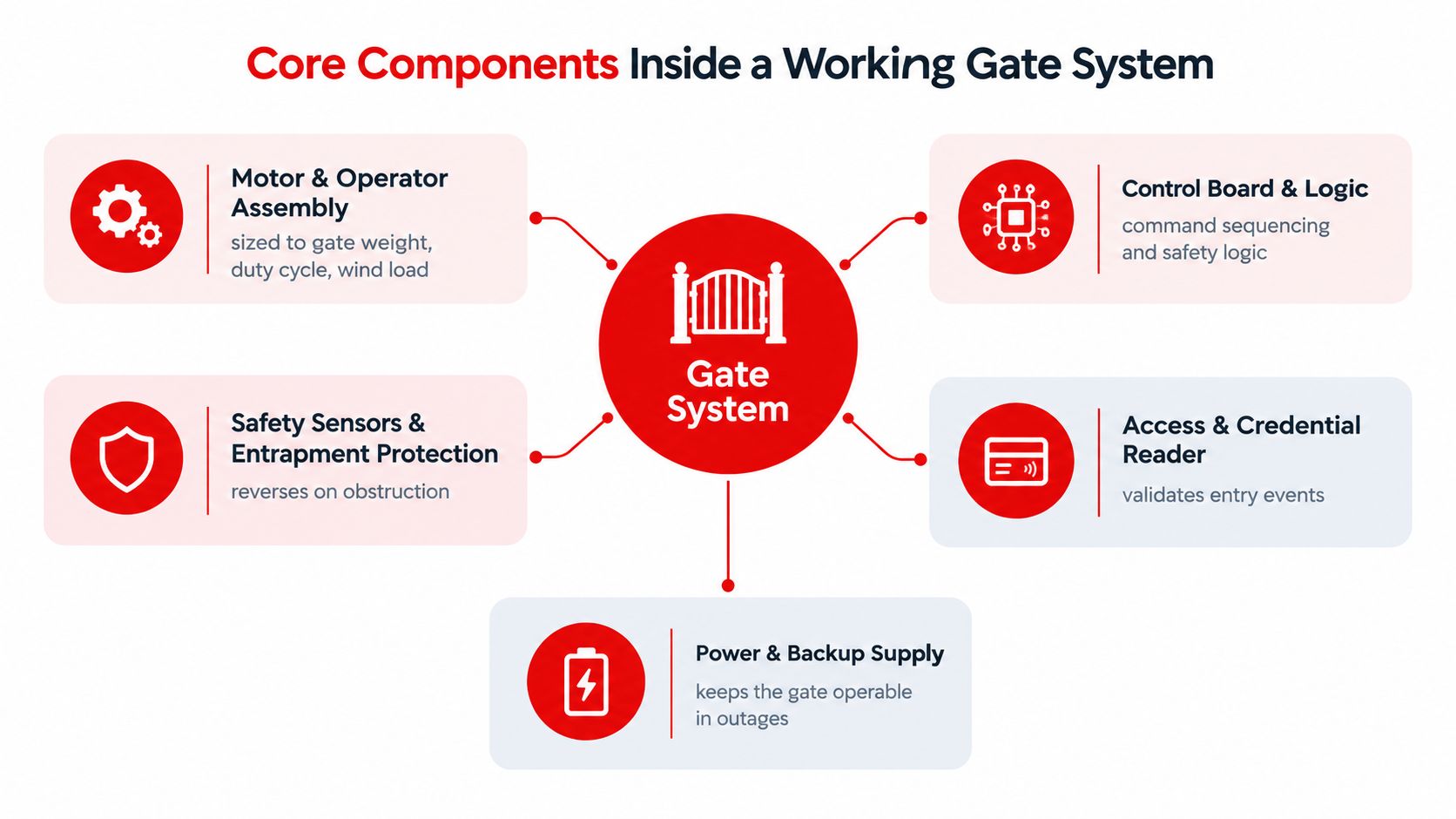
A reliable gate isn't a single product. It's a group of subsystems that must communicate and remain safe when one element fails.
Five subsystems to verify
The motor and operator assembly must match the gate's weight, length, duty cycle, and wind load. Chain drives can suit demanding sliding applications, while gear-driven assemblies may fit other operator designs. Ask the installer to show the sizing calculation rather than accepting a generic horsepower recommendation.
The controller board manages relay logic, timing, limit settings, safety logic, and connections to readers, intercoms, cameras, and remote management software. A controller may operate perfectly while still lacking useful event reporting. Confirm which commands and faults are logged, retained, and exportable.
The sensors provide the system's awareness. Vehicle loops detect presence, photo eyes provide non-contact beam protection, free-exit sensors support egress, and safety edges detect contact along a moving gate member. Sensor placement must cover the entire travel path, not merely the center of the opening.
The access and credential reader decides whether a person or vehicle may request entry. Keypads, proximity readers, mobile credentials, Bluetooth, intercoms, license plate recognition, and biometric devices all connect differently. The electronic access control system overview from Overton Security provides useful context for treating that reader as part of a wider access architecture.
The power and backup supply keeps the system predictable during outages, voltage problems, or communications interruptions. Decide in advance how the gate behaves when power, network connectivity, or the controller itself is unavailable.
Safety is a design requirement
Technical guidance identifies ANSI/CAN/UL 325 for gate operator safety and ASTM F2200 for the design, construction, and installation of automated vehicular gates, as summarized in DASMA's technical guidance. UL 325 requires at least two independent entrapment-protection means in each direction of travel for slide and swing gates, and external protective sensors must be monitored at least once per gate cycle, according to this UL 325 FAQ.
In plain language, one protection method may be an inherent reverse function that detects abnormal resistance. The second commonly uses photo eyes, safety edges, or another independent device. Type B1 photo eyes detect beam interruption without contact, while Type B2 edges respond when a moving member contacts an obstruction.
Also inspect dimensional hazards. ASTM F2200-based safety guidance identifies gaps greater than 2-1/4 inches (57 mm) as requiring protection, and ground clearances above 4 inches but below 16 inches as requiring entrapment protection. These checks belong in commissioning records, not just in the installer's memory.
Access Control Options and Credential Risks
A credential method answers one question, “What is presented at the gate?” It doesn't automatically answer, “Who is using it, whether the use is authorized now, or whether someone followed an authorized user through?”
Compare the credential by its weakness
A PIN keypad verifies something the user knows. It's affordable and familiar, but fixed codes are easy to share and can be replayed by anyone who learns them. Use individual codes where possible, impose schedules, and avoid one code for an entire property.
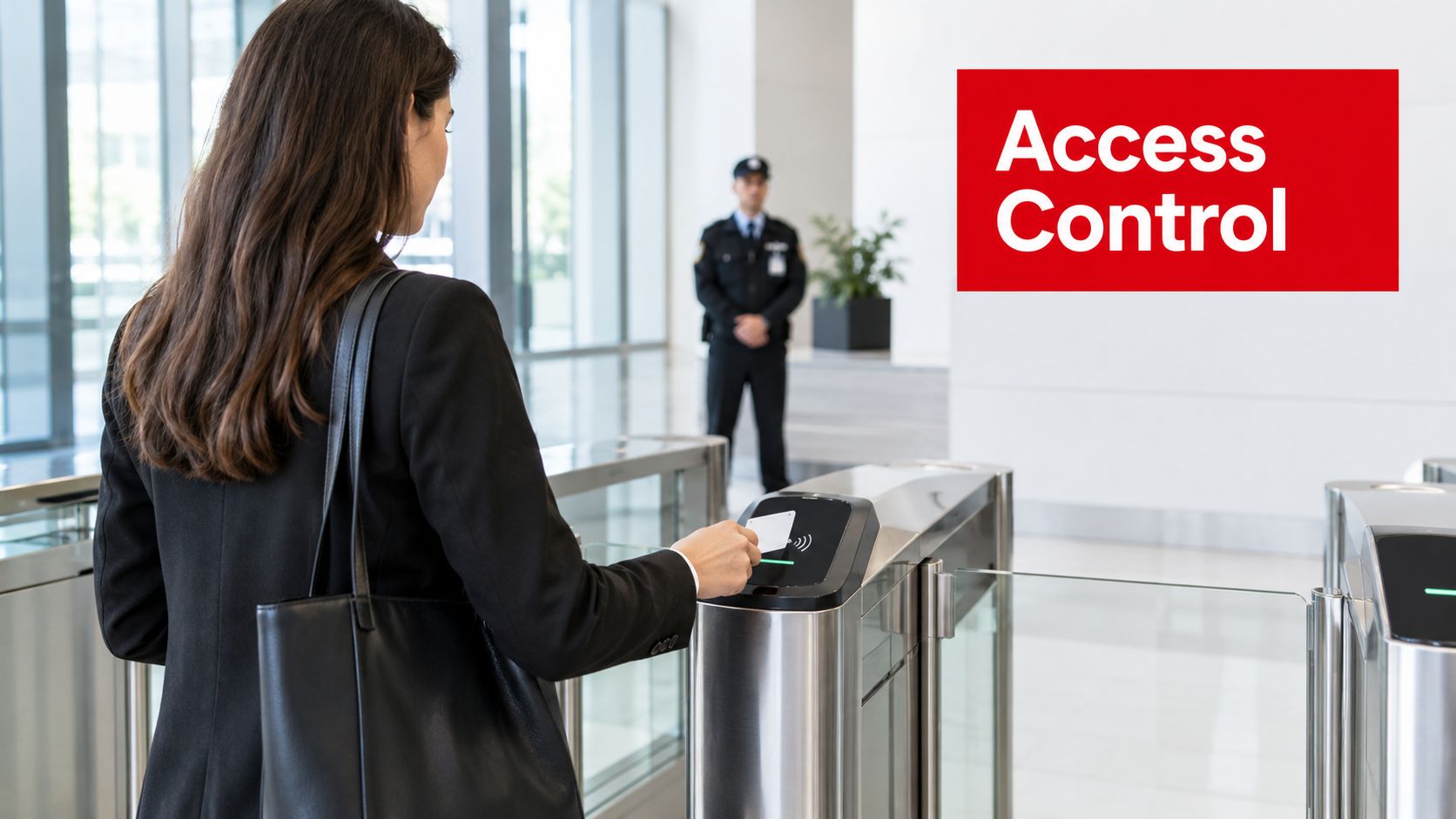
A proximity card or RFID fob verifies something the user has. It creates a better audit trail than a shared PIN, but lost, borrowed, or cloned credentials remain a concern. Disable them immediately when employment, tenancy, or vendor authorization ends.
Mobile credentials and Bluetooth readers can support individual identity and temporary visitor permissions. They still depend on phone security, account administration, connectivity, and carefully controlled remote-open privileges. Bluetooth range-extension attacks and poorly configured hands-free access deserve testing before deployment.
License plate recognition ties an access decision to a vehicle rather than a person. It can reduce friction at busy entrances, but covered plates, temporary plates, poor lighting, occlusion, and misreads require a secondary verification path.
Biometrics verify something the user is. They can strengthen identity assurance at sensitive sites, but managers must address privacy, enrollment, accessibility, exception handling, and failure during environmental or operational changes.
| Credential Method | Tailgating | Credential Sharing | Replay/Spoof | Remote-Open Abuse |
|---|---|---|---|---|
| PIN keypad | High exposure | Easy to share | Fixed-code replay risk | High if codes are reused |
| RFID card or fob | Doesn't stop a following vehicle | Borrowing and cloning risk | Depends on credential design | Moderate |
| Mobile credential | Requires lane and camera controls | Account or phone sharing remains possible | Depends on app and reader security | High if remote opening is unrestricted |
| Bluetooth reader | Doesn't independently stop tailgating | Device sharing is possible | Range-extension risk | Moderate to high |
| LPR | Can identify the vehicle, not every occupant | Vehicle lending creates ambiguity | Misreads and plate manipulation | High if remote overrides lack approval |
| Biometric | Doesn't stop an unverified follower | Harder to share directly | Spoofing resistance varies by design | Moderate with strong admin controls |
Administration matters more than the reader
Require a documented credential lifecycle. Ask who enrolls users, who approves exceptions, how quickly access is revoked, how vendors receive temporary permissions, and whether audit logs show the credential, time, lane, command, and result.
For higher-risk properties, use two-factor controls for administrative changes and remote opens. Tailgating still requires camera coverage and a response process because no reader can verify everyone inside a vehicle queue.
Matching Gate Systems to Property Type
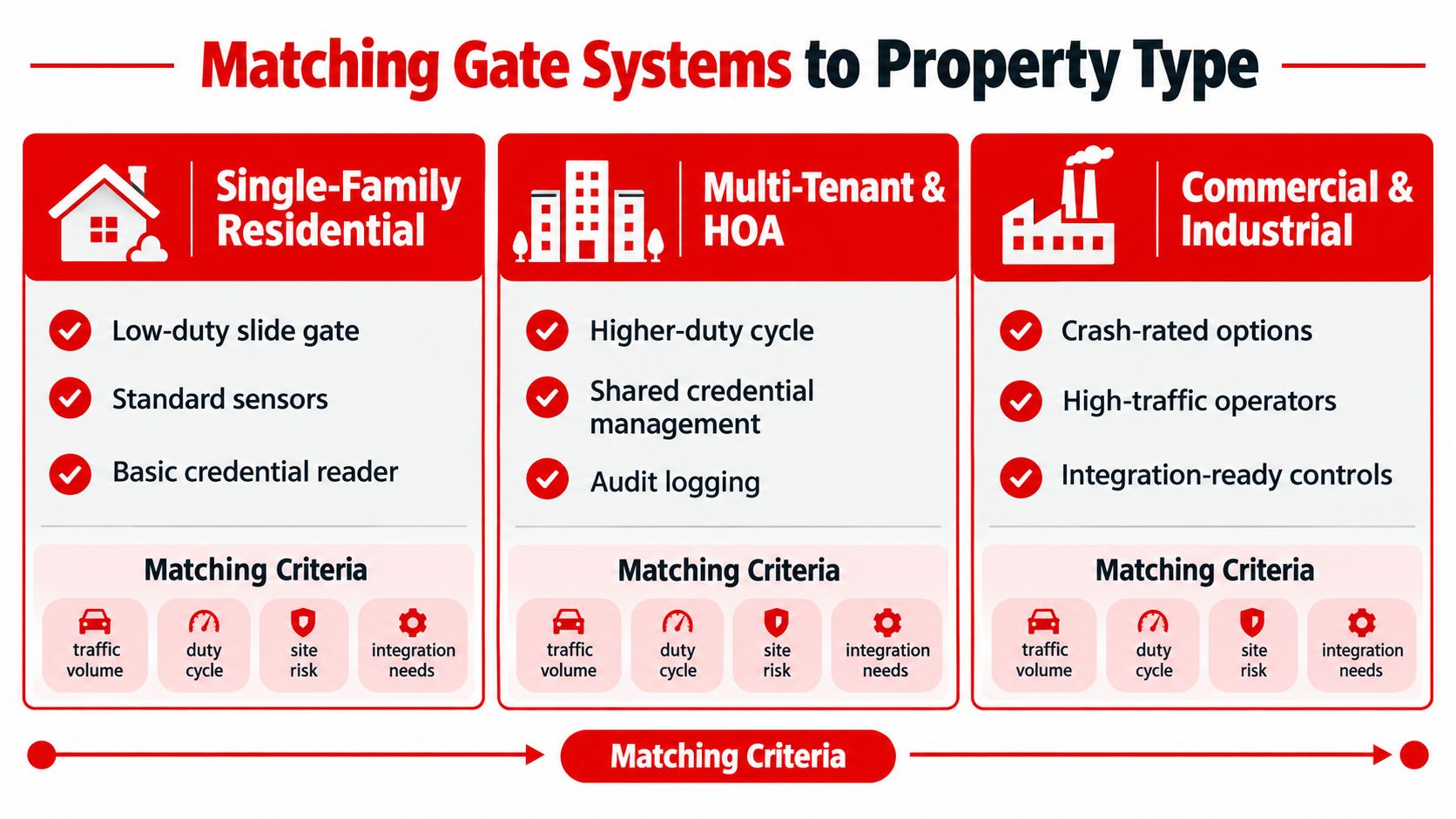
A property manager should begin with the dominant constraint, then select the gate and credential stack around it.
Use the site context as the decision filter
For a single-family residential property, choose a low-duty slide or swing gate when traffic is light and the layout supports it. Keep the credential system simple, but don't omit individual user accountability or entrapment protection.
A multi-tenant community needs visitor management more than a motor. Residents need controlled ways to authorize guests, while management needs audit logs, expired-credential cleanup, delivery handling, and a clear policy for service entrances. A higher-duty operator may be appropriate where several households share one lane.
An HOA community must balance appearance with enforceability. A decorative swing gate may satisfy design expectations but create clearance, wind, or maintenance problems. A site walk should test whether the desired aesthetic leaves room for safe pedestrian circulation and reliable sensors.
Class A offices often benefit from a card and LPR combination. The card identifies the employee, while LPR supports vehicle recognition and investigation. Administrative controls should prevent a receptionist or tenant from leaving a lane open indefinitely for convenience.
At a retail center, throughput and sightlines usually dominate. Barrier arms may be more practical than solid gates where shoppers need fluid movement, but cameras, intercoms, and patrol response must address misuse and after-hours access.
An active construction site has changing users, valuable materials, and temporary routes. Use strong temporary barriers, tightly managed vendor permissions, and inspection routines that confirm every gate closes fully. Healthcare facilities add emergency-vehicle access and life-safety coordination, so the access plan must be tested with facility operations rather than improvised during an incident.
During the site walk, record:
- Traffic pattern: Who arrives, at what times, and through which lane?
- Duty cycle: How often will the operator move during the busiest period?
- Sightline: Can a camera and officer see the complete approach?
- Pedestrian path: Can people avoid vehicle pinch points?
- Integration need: Does the gate need LPR, intercom, visitor management, or SOC review?
Integrating Gates With Cameras and SOC Monitoring
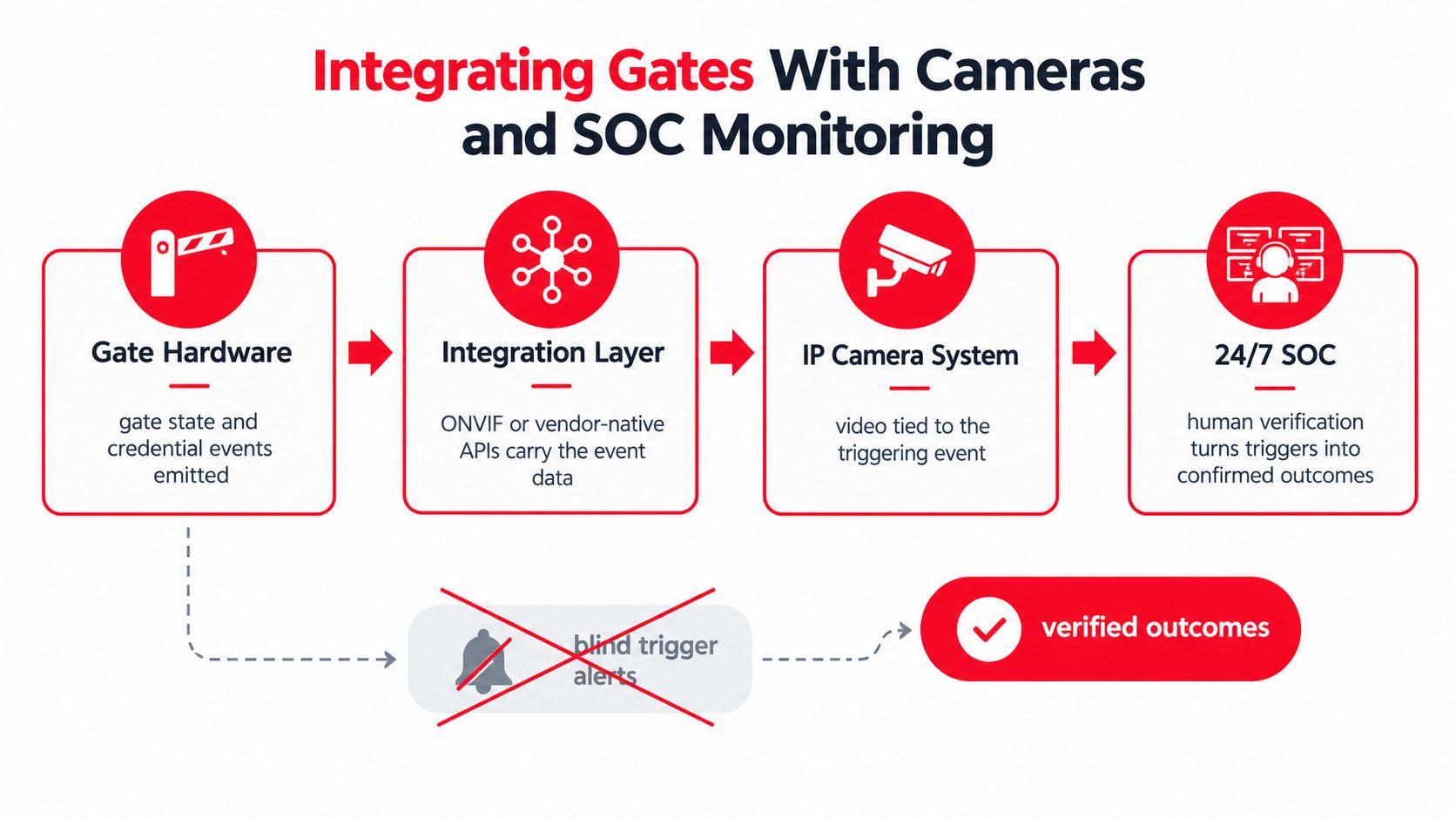
An access event becomes useful only when the property can verify what happened. The gate controller should emit gate state, credential events, operator faults, and forced-open conditions to an integration layer that can connect with the video management system.
Build an event chain, not a pile of devices
ONVIF or vendor-native APIs can carry event data between systems, but compatibility must be tested at the installed versions. A proposal that says “integrates with cameras” isn't enough. Require a live demonstration showing a valid credential, a denied credential, a forced-open alarm, an operator fault, and a communications failure.
The camera should provide relevant pre-roll and post-event footage, while the access log identifies the credential and command. A monitoring analyst can then compare the person, vehicle, plate, direction of travel, and gate state before deciding whether the event is routine or suspicious.
Useful response actions include:
- Talk-down: Address a person at the gate through an intercom or speaker.
- Plate cross-check: Compare the observed vehicle with approved or denied lists.
- Remote verification: Confirm that an after-hours opening has a valid work order or resident authorization.
- Officer dispatch: Send a mobile patrol to inspect a forced entry, propped gate, or repeated alarm.
- Escalation: Preserve logs and video, notify management, and contact law enforcement when policy and circumstances require it.
A 24/7 SOC should also receive tamper, camera obstruction, recording loss, and offline-device alerts. Otherwise, the system may report that the gate opened while failing to record the person who used it.
The 24/7 security operations center model used by Overton Security illustrates the operational principle. Human review turns a blind trigger into a documented decision, with an accountable path from detection to verification and response.
Installation, Maintenance, and Cost Over Time
Treat the project as a lifecycle decision, not a hardware purchase. Installation begins with civil work, drainage, foundations, electrical service, conduit, communications, operator selection, and commissioning. Poor alignment or inadequate foundation work can create recurring friction that no software update will fix.
Commissioning should include UL 325 force testing, photo-eye alignment, safety-edge testing, limit verification, manual release inspection, backup-power testing, and a documented baseline. Keep the baseline with the property's maintenance records so later technicians can distinguish a new fault from an original condition.
Track the failures that create downtime
Schedule service around the installed equipment and site conditions. Inspect chains, gears, rollers, hinges, tracks, capacitors, loop detectors, batteries, wiring, corrosion, drainage, and structural movement. Re-test entrapment devices after repairs, impact events, or changes to the gate path.
The Lighthouse Energy Services guide on automatic gate maintenance is a useful maintenance reference because it reinforces the practical point that lubrication, alignment, inspection, and preventive service protect both uptime and safety.
| Gate Class | Typical Install Cost (USD) | Annual Maintenance | Expected Service Life | Best Fit Property |
|---|---|---|---|---|
| Basic manual gate | $1,000 to $3,000 | Low, site dependent | Site dependent | Low-traffic residential or storage |
| Automated sliding or ornamental gate | Can exceed $10,000 | Scheduled operator and safety service | Site dependent | Residential, commercial, and mixed-use entrances |
| High-end biometric or LPR system | Can exceed $15,000 | Hardware, software, and integration service | Site dependent | Higher-risk or integration-heavy properties |
The published security gate cost overview shows why proposals vary widely. Compare civil work, electrical work, software licensing, credentials, cameras, communications, emergency service, replacement parts, and training instead of comparing the equipment line alone.
A simpler mechanical gate can outperform a smart system on total ownership value at a low-traffic site with unreliable power, harsh weather, or limited maintenance capacity. Solar, cellular, and IoT features can reduce wiring or improve remote management, but they also introduce batteries, connectivity, firmware, and account dependencies. Choose advanced features only when the operating plan can support them.
For ownership, document the business case qualitatively through incident records, response performance, insurance discussions, resident experience, and property operations. The defensible ROI is a system that reduces uncertainty and provides evidence, not an unsupported promise of savings.
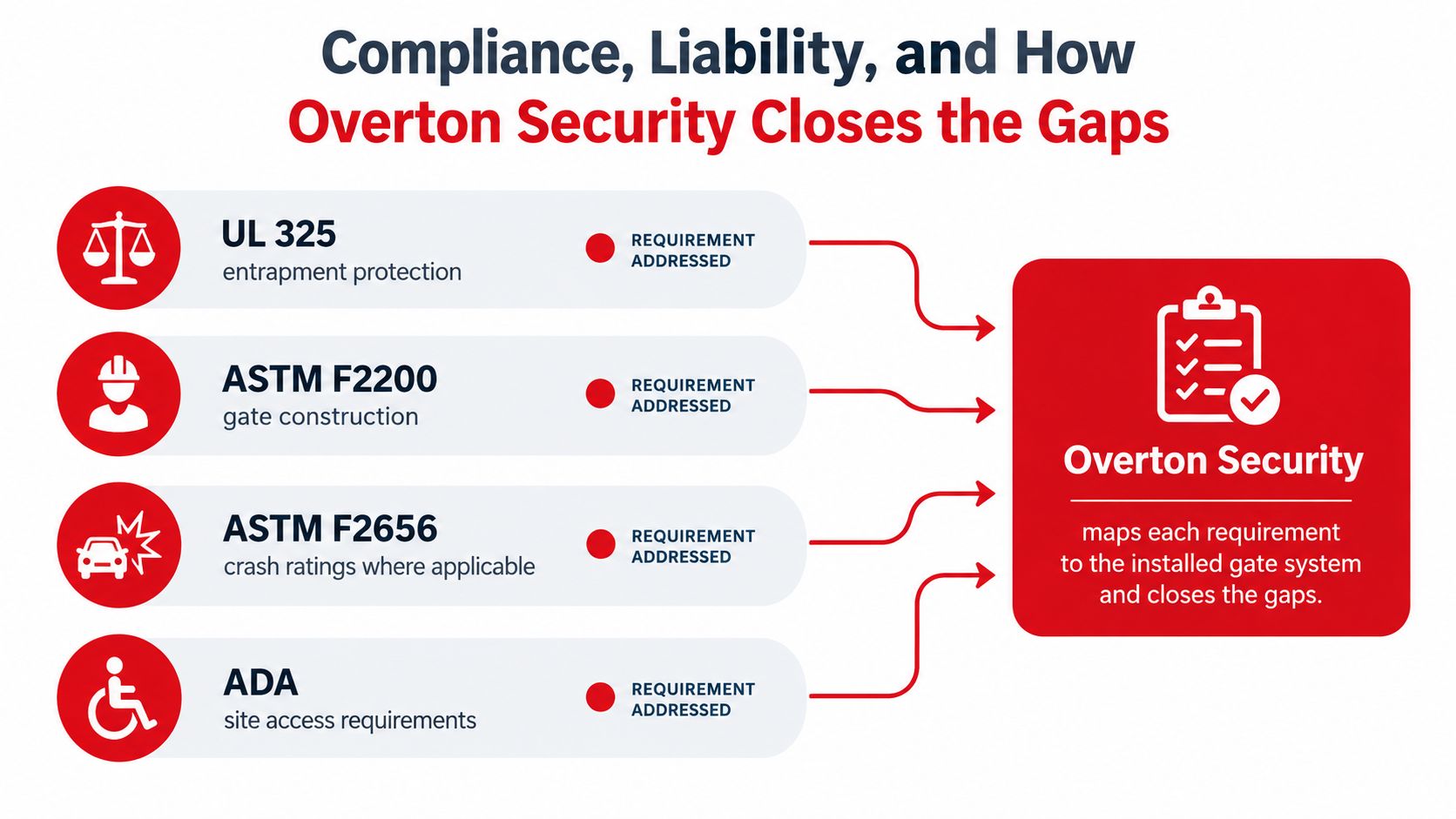
Compliance, Liability, and How Overton Security Closes the Gaps
Compliance establishes the minimum defensible foundation. UL 325 addresses operator safety and entrapment protection, ASTM F2200 addresses automated vehicular gate construction, and ASTM F2656 applies when crash-rated performance is required. ADA considerations affect pedestrian routes, controls, clearances, and accessible use, while work zones around moving equipment require disciplined safety practices.
Keep records for installation, force testing, sensor checks, repairs, signage, user training, emergency release procedures, and operator changes. A property owner who can't show what was tested, when it was tested, and who corrected a defect may face a more difficult liability conversation after an incident.
Hardware cannot close every operational gap
No operator can independently prevent a resident from holding a gate open for a stranger. No LPR camera can guarantee that the authorized vehicle's occupants are authorized. No mobile app can make an unsafe remote-open policy acceptable.
That's where a trained operational layer matters. Overton Security can combine onsite armed or unarmed security officers, vehicle patrol services, remote monitoring, and SOC oversight. Its officers use GPS-enabled patrol tracking, digital Daily Activity Reports, photos, and time-stamped incident documentation, while customized post orders define how staff should handle forced entries, suspicious vehicles, propped gates, and access exceptions.
Compliance buys time. Trained response buys outcomes.
A property manager should require officers to validate LPR alerts against camera footage, challenge or document suspicious activity, inspect damaged gates, and escalate according to written procedures. A low manager-to-client ratio and hands-on leadership also make it easier to adjust post orders when the site's incident pattern changes.
Overton Security brings 26 years of experience serving residential communities, retail centers, construction sites, offices, industrial properties, healthcare facilities, and government agencies across California. Its model emphasizes quality over quantity, professional officer retention, and real-time accountability rather than just placing a person at a post.
If your property is purchasing or integrating security gate systems in the next 60 days, ask Overton Security to review the gate, credential workflow, camera coverage, monitoring path, and response plan together. Visit Overton Security to discuss onsite officers, vehicle patrols, remote monitoring, and SOC-backed incident response for your California property.