At dusk, an active jobsite can look quiet while presenting several immediate risks. Pedestrians may be walking beside the property, a delivery gate may still be open, and tools or materials may be visible inside the perimeter. A properly planned construction site safety fence gives the public a clear boundary, helps crews control movement, and makes it harder for an uninvited visitor to drift into an active hazard area.
The fence is important, but it isn't the entire security plan. Its performance depends on the panels, posts, feet, gates, locks, screens, lighting, inspections, and after-hours response working together. This guide explains how to select and place temporary fencing, understand local and hazard-specific requirements, identify common failure points, and connect the perimeter to patrols and monitoring.
Why Every Active Jobsite Needs a Safety Fence
A superintendent may discover the gap when a pedestrian pauses beside an open excavation. The person has not entered, yet the site has already lost control of the boundary. Without a visible, stable perimeter, people may not know where public space ends, workers must redirect them by hand, and a near miss can raise questions about responsibility as well as safety.
A construction site safety fence provides the first layer of separation, but it works as part of a larger security system. Panels, posts, gates, locks, warning signs, lighting, inspections, and after-hours monitoring must support one another. A fence that stands securely during the day can still fail if a delivery gate remains open, wind shifts unsecured panels, or nobody responds to an alarm after the crew leaves.
New York City requires temporary construction fencing to protect the public around new-building sites, demolition areas, open excavations, and extensive alterations. If work stops or a site is abandoned, the city requires a chain-link fence after hazardous equipment and materials have been removed or secured. The New York City Department of Buildings construction fence requirements outline these conditions.
The boundary does several jobs at once
A continuous perimeter:
- Separates people from hazards: It helps keep pedestrians away from demolition, excavation, unfinished structures, equipment, and stored materials.
- Signals active work: Warning signs and a defined edge show that ordinary public access ends at the fence.
- Supports access control: Gates can distinguish worker access, deliveries, and emergency routes.
- Reduces casual intrusion: A stable barrier discourages entry driven by curiosity or convenience.
- Improves accountability: A controlled entry point makes it easier to track who should be inside and when.
The market reflects ongoing demand for fencing around excavation and construction work. Future Market Insights estimates the excavation safety fencing market at USD 1,240.6 million in 2026, reaching USD 2,139.3 million by 2036, with a 5.6% compound annual growth rate. Its excavation safety fencing market estimate provides the cited figures.
For a superintendent, success is not having panels in place on mobilization day. The system should limit uncontrolled entry, remain stable as the site changes, and produce inspection records. Managers coordinating fencing with trailers, storage, and site offices can also consult this practical ANTS Trailers construction guide.
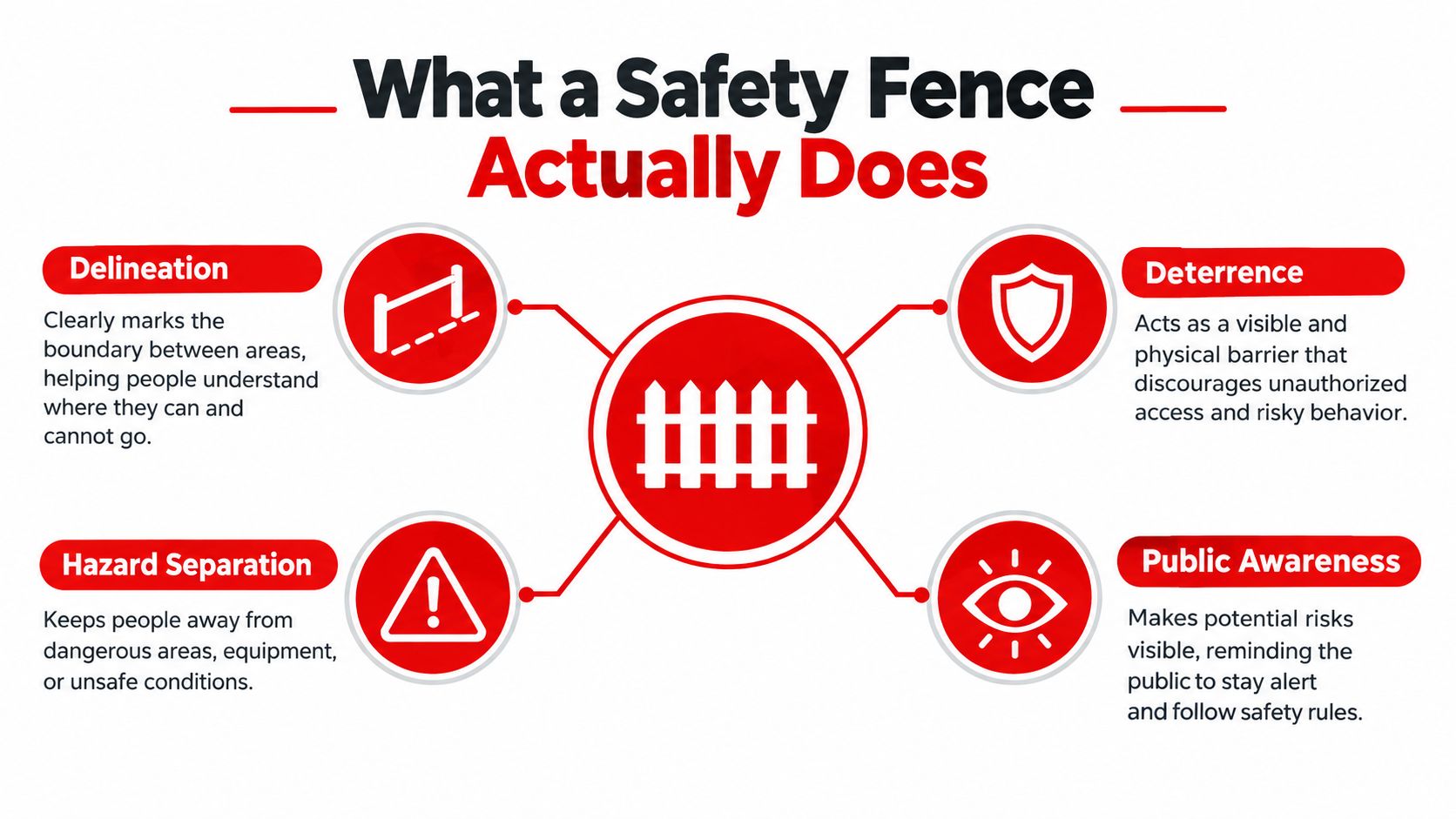
What a Construction Site Safety Fence Actually Does
A delivery arrives after the crew leaves. The gate is left ajar, a wind gust shifts a panel, and a passerby finds an easy route into the work area. These failures show why a construction site safety fence is one layer of an integrated security system, not a standalone product.
The fence establishes a visible boundary where workers, visitors, vehicles, and the public must change their behavior. Its first job is delineation: showing where public movement ends and controlled work begins. That distinction matters on tight urban parcels, residential renovations, and projects beside active sidewalks, where natural separation may be limited.
It also provides deterrence. Panels, warning signs, and a visible gate make casual entry less convenient. A determined intruder may still get through, so deterrence must work with locks, lighting, patrols, and after-hours monitoring.
A perimeter barrier supports hazard separation by keeping pedestrians away from excavations, demolition zones, equipment routes, and unstable materials. It does not replace interior guardrails, fall protection, excavation protection, or covers designed for specific hazards. Those controls address conditions inside the site or at a particular edge.
The fourth function is public awareness. Signs identify authorized access and warn people about hazards. A continuous, upright fence reinforces those messages more clearly than isolated cones or a damaged panel.
Gates, wind, and monitoring determine whether the system holds
A strong panel can fail when its feet are poorly placed. A secure gate becomes an opening when workers prop it open for convenience. Privacy screening can also increase wind pressure across the entire fence run, especially when ballast, anchors, or connections are inadequate.
Review the assembly as one working system:
- Panels and mesh create the visible and physical boundary.
- Frames and posts transfer movement and wind forces along the line.
- Feet, ballast, and anchors keep sections positioned.
- Gates and locks control practical access, including deliveries and emergency routes.
- Signs and lighting make the boundary understandable and visible.
- Inspections and response address loose connections, gaps, and damage before they become entry points.
After-hours checks matter because an unattended fence can conceal a problem until the next shift. The FenceScape guide to fencing provides broader background on selecting and arranging temporary systems. The practical rule is simple: the fence performs only as well as its weakest connection, gate, or monitoring step.
Types and Materials for Construction Site Safety Fencing
A demolition crew works beside a busy sidewalk. The fence must separate pedestrians from the work, withstand weather, control deliveries, and remain visible to people monitoring the site after hours. A light crowd-control barrier may suit a short pedestrian channel, while that demolition project may require a rigid, continuous enclosure with debris control.
The fence is one layer of the security system, not the whole system. Gates, connections, supports, visibility, and monitoring determine whether the selected material performs as intended.
Compare the common options
| Fence Type | Best Use Case | Strengths | Limitations |
|---|---|---|---|
| Chain-link panels | General construction perimeters, urban projects, excavation areas | Durable, familiar, visible, reusable, and easy to reconfigure | Offers limited privacy and can become unstable if feet or connections are inadequate |
| Welded wire panels | Residential sites, controlled work zones, and projects needing rigid sections | Rigid appearance, clear visibility, and orderly panel alignment | Open mesh may be easier to climb than a purpose-designed anti-climb system, and small gaps need attention |
| Mesh or debris netting | Sites where falling debris, dust, or material containment is a concern | Adds screening and can help contain light debris | Attachment must remain taut, and added surface area increases wind exposure |
| Solid hoarding | High-privacy sites, dense public areas, and projects needing visual separation | Limits public visibility and presents a strong continuous face | Opaque surfaces increase wind loads and can reduce sightlines for guards and cameras |
| Plastic snow or crowd-control fencing | Temporary pedestrian guidance and low-risk boundary marking | Lightweight, quick to move, and useful for short-duration control | Not a substitute for a secure perimeter around valuable materials, excavations, or active hazards |
Match height and width to the site
ASTM F3342-19 describes temporary construction fence enclosures as 6 ft or 8 ft high barriers used to delineate and form a physical barrier on construction sites. The ASTM F3342-19 temporary fence applications guide provides a useful reference, while local requirements and the actual hazard determine the final selection.
A 6-foot fence is a common starting point for many temporary construction perimeters. An 8-foot fence may provide more separation or privacy where the project and local rules support it. Height alone does not make a fence safer. Taller sections catch more wind and place greater demands on frames, supports, feet, anchors, and connections.
Panel width affects installation and stability. ASTM F3342-19 includes panel widths up to 14 ft, or 4.27 m, allowing a wide panel to cover ground quickly. Longer spans can move more if the system lacks adequate support, so compare panel stiffness and connection methods rather than judging only by coverage.
Selection rule: Choose the lightest system that still provides the required hazard separation, rigidity, access control, and weather performance.
Chain link often preserves sightlines for guards and cameras. Solid hoarding can suit a public-facing project that needs privacy, but its wind exposure and reduced visibility require deliberate review. Gates also need compatible hardware and a clear operating plan. A fence that looks strong on paper can fail if workers prop the gate open or if screening loosens during bad weather.
The reliable choice matches the site's exposure and remains intact through each construction phase. Treat the panels, gates, supports, and monitoring routine as connected parts of one working security system.
Regulatory and OSHA Considerations You Should Know
A superintendent may ask for the OSHA construction fence height while planning mobilization. OSHA does not set one universal fence specification for every jobsite. Temporary fencing usually supports safety and access control, while enforceable requirements come from local building codes, municipal ordinances, project specifications, and duties tied to specific hazards.
New York City shows how local rules can control the design. Its construction code requires temporary fencing to protect the public and identifies new buildings, demolition areas, open excavations, and extensive alterations as situations requiring enclosure. See the New York City Department of Buildings construction fence requirements. Other jurisdictions may use different terms or thresholds, so verify the applicable rules before installation.
Match the fence to its duty
OSHA requirements address hazards rather than prescribing one perimeter product. Depending on the site, fencing may function as:
- A public-safety barrier beside a sidewalk.
- An excavation barricade that keeps people and equipment away from an open cut.
- A fall-hazard boundary within a broader protection plan.
- A controlled-access enclosure around tools, materials, and equipment.
- A site security perimeter that limits unauthorized entry after hours.
These roles can overlap, but they do not replace one another. A perimeter fence cannot substitute for a compliant fall-protection system. Likewise, a barricade around one excavation does not secure the rest of the property. Gates, warning signs, pedestrian routing, and after-hours monitoring must support the fence, or the system has an obvious weak point.
Local rules can differ sharply. In Ontario, a public-facing fence of at least 1.8 meters is required for certain dangerous work, as described in this Ontario construction fence guidance. U.S. Army Corps of Engineers projects may impose more detailed specifications. For areas of active public use, including locations near family housing or schools, temporary project fencing must extend from grade to at least 4 ft above grade, use mesh no larger than 2 in, remain rigid and taut, and withstand 200 lbs of force from any direction with less than 4 in of deflection, according to the U.S. Army Corps of Engineers EM 385-1-1 safety manual.
Before mobilization, confirm local code, project specifications, traffic-control requirements, emergency egress, signage, and the inspection process. The Overton construction site safety rules and regulations PDF can support internal planning, but it does not replace direction from the authority having jurisdiction or the project's safety professional.
How to Choose and Place Fencing for Maximum Protection
A fence protects the site only when its layout supports the way people, vehicles, weather, and security equipment use the property. Walk the perimeter during daylight and after dark before placing the first panel. Mark sidewalks, slopes, corners, loading zones, utility access, neighboring properties, fire routes, camera views, and the shortcuts workers or visitors may take.
Build the layout around actual traffic
Map the complete boundary, then identify every required opening. Separate pedestrian and vehicle access where the site permits. Place gates away from blind corners, excavation edges, and turning areas where vehicles could strike the fence. A gate is the controlled doorway into the security system, so its position and daily operation deserve as much planning as the panels.
Use this field sequence:
- Map the perimeter. Measure the fence run and mark direction changes, uneven ground, and sections exposed to public traffic.
- Study the terrain. A panel that sits firmly on level ground may rock or leave a gap on a slope.
- Assess wind exposure. Open lots, rooftops, waterfront areas, and corridors between buildings can place greater pressure on panels.
- Choose gate locations. Make authorized entry obvious and keep emergency routes clear.
- Review sightlines. Coordinate the fence with lights, cameras, and guard posts so screens or stored materials do not create blind spots.
- Confirm local requirements. Resolve questions about height, mesh, signage, sidewalks, and egress before delivery.
Treat wind as a design condition
Taller and wider panels receive greater lateral wind pressure. Solid privacy or debris screens can create a sail effect, much like a broad sheet catching air. Adding one should trigger a review of ballast, bracing, post spacing, footing type, and tie-down hardware. Technical guidance indicates that properly configured temporary works systems can be designed for winds around 90 mph, or about 145 km/h, or more, depending on the system and conditions. (Temporary works hoardings guidance)
Check corners first because movement often concentrates there. After strong weather, walk the line, test panels for rocking, confirm that feet remain fully seated, and inspect ties and screens for looseness or detachment. On sloped ground, choose an installation method that preserves continuity at grade instead of leaving large triangular gaps beneath panels.
After-hours monitoring should cover the same access points the fence controls. Confirm that cameras or patrol routes can view gates, corners, and vulnerable transitions, and record inspections so a small shift is corrected before it becomes an open route.
The gate must remain secured when unattended. If workers can lift it, slide around it, or leave it propped open, the perimeter has an access problem regardless of the strength of the rest of the line.
Common Vulnerabilities and How Fences Fail
A fence can look intact while still offering an easy route onto the site. Weaknesses usually develop where the perimeter changes: gates, corners, uneven ground, delivery openings, and panels moved as work areas shift. One loose section can function like a missing link in a chain.
Gates deserve daily attention because they are designed to open. A gate propped open for a delivery may remain unsecured after the crew leaves. A worn latch can appear closed but release under pressure. Check that each gate closes fully, latches correctly, and cannot be lifted or pushed aside. Assign responsibility for locking it at the end of every shift.
Ground-level gaps create another route, especially on slopes or beside uneven pavement. Inspect for erosion, undermining, displaced feet, and materials that could help someone climb. Corners and transitions also receive more movement than a straight run, so they deserve closer examination after deliveries, grading, or relocation of panels.
A fence needs a practical failure check
Use a short walk-through rather than relying on a visual glance:
- Walk every line: Find gaps, leaning panels, missing clips, and shifted feet.
- Test each gate: Operate the latch and lock, then verify full closure.
- Check the base: Look for erosion, unstable ground, and climbing aids.
- Review visibility: Identify screens, stored materials, or poor lighting that hide movement.
- Inspect after weather: Recheck corners, long runs, screens, and entrances after strong wind or rain.
Screens and banners can turn a fence into a wind-loaded surface. If ballast, bracing, or tie-downs remain unchanged, a panel that stood securely in calm weather may lean or topple when conditions change. Privacy screening can also block camera views and give intruders cover. Any change to screening should prompt a review of the fence's support and visibility.
The access-control gap matters after the workforce leaves. A 2025 security report monitored 2,639 confirmed break-ins at active commercial construction sites, with more than 40% occurring on weekends. (TrueLook state of construction site security report) That finding supports disciplined weekend procedures: locked gates, clear alarm escalation, adequate lighting, remote observation, and verified patrols.
A perimeter is secure only when someone owns its condition after the last worker leaves.
Pair the inspection routine with a focused tool theft prevention resource so small defects are corrected before they invite theft, vandalism, or a public-safety incident.
Integrating Fencing Into a Complete Site Security Program
Fencing works best as the visible edge of a layered program. During the day, stationed unarmed guards or security officers can manage access, confirm deliveries, and challenge unauthorized entry. After hours, vehicle patrols can check gates, corners, material yards, and vulnerable approaches instead of treating the fence as a set-and-forget installation.
Technology adds accountability to those activities. GPS-enabled patrol verification can show that an officer reached assigned checkpoints, while detailed digital reports can record gate conditions, damaged panels, photographs, and corrective actions. A 24/7 Security Operations Center can support live monitoring, dispatching, wellness checks, and incident escalation when an alert or camera view requires attention.
Assign clear responsibility
A site-specific plan should identify:
- Who checks the fence at the start and end of each shift.
- Who controls keys, access codes, and delivery permissions.
- Which gates must remain locked after hours.
- How officers respond to an open gate, damaged panel, or suspected intrusion.
- Where lighting and cameras cover the perimeter.
- How managers receive time-stamped reports and escalation notices.
Overton Security provides construction site security with stationed officers, vehicle patrols, remote monitoring, GPS-enabled guard tours, digital daily activity reports, and customized post orders. Its California coverage includes markets such as Los Angeles, San Diego, San Francisco, Sacramento, San Jose, Oakland, Long Beach, and Fresno. The company also emphasizes officer support and retention, a low manager-to-client ratio, and hands-on leadership rather than a high-turnover coverage model. (Overton construction site security services)
Lighting should support the fence rather than create glare that obscures cameras. Cameras should cover gates and likely approach routes, while patrols verify physical conditions that a fixed view may miss. For installation planning and perimeter construction details, this guide to professional fence installation provides additional practical context.
The strongest result is a site where the fence defines the boundary, the gate controls it, officers verify it, technology documents it, and managers respond to problems quickly. Review the perimeter as part of the entire security plan, then adjust the system as the project changes.
Overton Security can assess your construction perimeter and combine security officers, mobile patrols, GPS-verified tours, digital reporting, and 24/7 SOC oversight around your site's actual risks. Visit Overton Security to request a site-specific security review for your project in California.