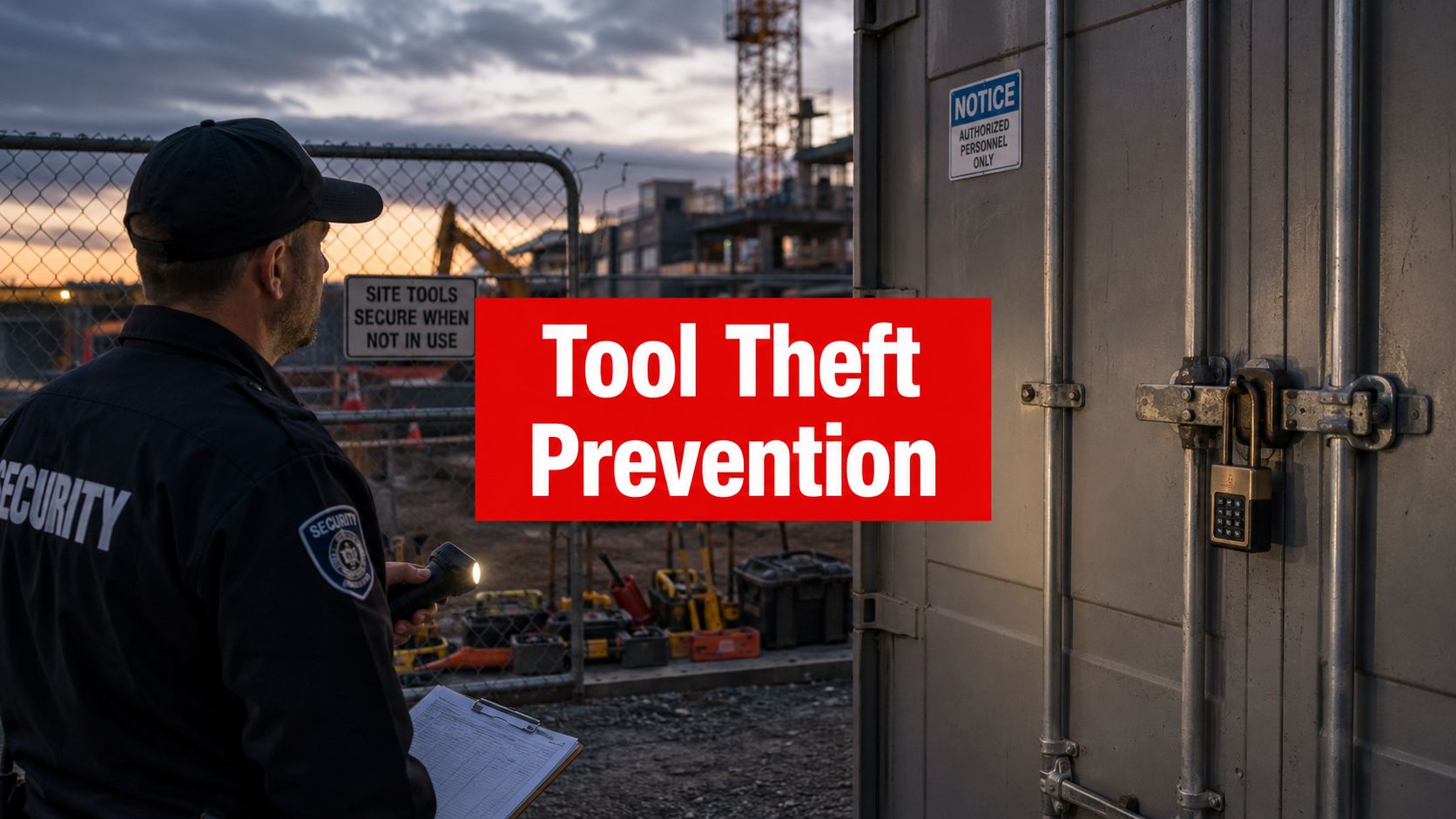
Monday morning is when the weak spots show up. A project manager gets to a closed jobsite and finds a storage container pried open, a facilities director reviews weekend footage and gets little more than shadows, or a foreman calls from a retail center because a locked cage was no match for a determined thief. By then, the damage is already spread across replacement costs, schedule slips, angry subcontractors, and a round of calls nobody wanted to make.
Tool theft prevention works best when it's treated as an operating program, not a shelf full of gadgets. The sites that hold up under pressure usually have a clear asset picture, a layered perimeter, disciplined handoff habits, and a response plan that starts before the loss becomes a report. That's where a single security partner can do more than watch a fence line, it can help carry the whole stack, from patrols and monitoring to reports and escalation.

The Call You Do Not Want to Take on Monday Morning
The first call usually isn't about a missing wrench. It's about a high-value piece of equipment, a forced container, or a pattern of losses that finally got expensive enough to notice. On a live site, that means the superintendent is now juggling police, insurance, schedule impact, and subcontractors who want to know who had the last key.
Tool theft prevention starts long before that call. The reason is simple, once a tool is gone, recovery odds are poor, and replacement is only part of the cost. Industry guidance says construction and equipment theft in the U.S. is widely placed at $300 million to $1 billion a year, with more than 11,000 incidents reported annually and only about 20 to 21% of stolen equipment recovered, while recovery for single-item theft can fall below 7% (Milwaukee Tool theft protection guidance).
What a bad night really creates
A thief doesn't just take metal and batteries. The site loses time, the crew loses momentum, and the manager loses flexibility. If a generator, scissor lift, or welding machine disappears, the next day's work often bends around that loss whether anyone planned for it or not.
Practical rule: treat theft prevention as part of site operations, not as a cleanup task after the fact.
That mindset also changes who owns the problem. The field team needs a plan, the office needs documentation, and the security partner needs enough visibility to act before a theft becomes a headline. In markets like Los Angeles, San Jose, and other busy commercial corridors, that usually means combining vehicle patrols, stationed officers, and remote monitoring rather than asking one layer to do everything.
Reading Your Site Before You Spend a Dollar
A site can look secure from the street and still be easy to rob. The useful starting point is a deliberate walk-through, not a purchase order. Map where tools are staged, where equipment parks overnight, how crews enter and leave, and which areas go dark after hours.
Start with the asset picture
Build the inventory first. Every valuable item should be tied to a person or a location, and the inventory should separate what's expensive, what's portable, and what's painful to replace. A plate compactor does not need the same controls as a box of drill bits, and a trailer full of specialty gear should never be managed like loose consumables.
That's why a simple risk profile helps. Walk the perimeter, note blind spots, check fence gaps, look at lighting, and pay attention to neighboring uses like alleys, vacant lots, public parking, or shared access roads. Then compare that picture with incident history and the hours when the site is empty.
A good parallel is a structured risk management roadmap for clinics. Different industry, same discipline, identify assets, locate weak points, and decide which controls matter most before the incident forces the decision.
Prioritize by loss impact, not by habit
Some tools deserve heavier protection because they're both mobile and easy to resell. The strongest examples are generators, plate compactors, welding machines, scissor lifts, light towers, trailers, and other specialist equipment worth tracking individually, which is consistent with MapTrack's construction guidance and its focus on check-in and check-out accountability. For property managers, that same logic applies to maintenance carts, access tools, and any equipment that moves between garages, rooftops, and storage rooms.
A practical scoring approach is straightforward:
- High mobility: items that can be lifted, rolled, or loaded quickly deserve stronger controls.
- High replacement pain: items that stop work or trigger rental costs should be cataloged first.
- Low visibility: anything stored in a back lot, dark corner, or shared yard needs layered protection.
- Weak accountability: if no one can say who had it last, the program needs a log, not a guess.
For a deeper construction-focused framework, Overton Security's construction site theft prevention resource fits well with a site walk and helps turn that assessment into a workable plan.

Physical and Technical Controls That Stack
A theft prevention program works best as a layered operation, not a shopping list of gadgets. A fence slows entry, lighting exposes movement, cameras document what happened, and locked storage buys time. Add asset registers, geofences, and tracking tags, and the site depends less on luck and more on a system that can be measured for avoided loss and faster recovery.
What each layer covers
The weak point in many programs is putting too much faith in one control. Cameras without access control still leave you with clean video of the theft. A strong lock without visibility still lets a thief work in the dark. GPS can tell you where something went, but not who handled it or when it crossed the line.
A layered stack works better:
- Fencing and perimeter control: slows opportunistic entry and narrows the access points.
- Lighting and visibility: removes cover and makes after-hours movement easier to spot.
- Locked storage and containers: protect portable tools when the crew is gone.
- Immobilization methods: fuel shutoffs, battery disconnects, hydraulic locks, or kill switches help protect self-propelled equipment.
- Forensic marking and asset registers: make recovery, insurance claims, and police reporting stronger.
- GPS or BLE tags with geofences: trigger movement alerts on high-value assets.
For teams that want tighter inventory control, RFID inventory tracking adds a practical way to record what leaves the cage, what comes back, and what is still unaccounted for at closeout.
That mix matters because prevention and recovery are not the same thing. Guidance in the field repeatedly notes that fewer than 25% of stolen heavy equipment is recovered, while recovery for smaller tools and portable equipment drops below 10% (MapTrack prevention guidance). In plain terms, you protect the item before it leaves the site, or you are relying on a weak recovery path.
Camera selection should fit the rest of the program, not sit apart from it. A useful starting point is OctoStream's best cameras for construction sites. Image quality matters, but so does whether the camera feeds into a response workflow that includes lighting, access control, and someone ready to act.
What good looks like in the field
A skid steer parked in the center of the site overnight, bucket lowered, cab locked, and surrounded by a lit perimeter is harder to remove undetected than one left near the gate. The same idea applies to yard equipment and trailers. Place them where patrols can see them and where a quick theft is harder to stage.
A camera system earns its keep when it supports human action.
That is also where a single security partner can make a real difference. A property team should not have to assemble cameras from one vendor, patrols from another, and monitoring from a third. A coordinated program keeps the alerts, reports, and field response in one operating picture, which is how Overton Security typically structures its mobile video guard approach for clients who need eyes on the site and action when something moves.
Workforce Practices That Keep the Program Honest
Hardware fails when habits are loose. The most disciplined sites make people accountable for what they touch, where they leave it, and how it gets locked up at the end of the shift. That starts with a simple rule, every tool is assigned to a person or a location at all times.
Day shift discipline matters more than most teams admit
Check-in and check-out logs don't have to be complicated. They just have to exist, stay current, and be used by supervisors who actually care whether the record matches the truck, the cage, and the job trailer. When a foreman walks the site at the start of the day, they should know what came back, what didn't, and what was left out overnight.
Overnight vehicle storage is a common weak point. If portable tools live in trucks or vans after hours, the policy needs to be explicit, the lockup needs to be consistent, and the exceptions need approval. The most effective crews don't argue with the rule, they build the closeout routine into the end of every shift.
Make the first walk-through count
The first site check of the day should answer a few simple questions:
- What's missing: compare the cage, container, and vehicle contents against the log.
- What's been moved: look for tampered locks, shifted materials, or open access points.
- What's left exposed: verify that high-value items are not sitting in sight or near exits.
- What changed overnight: flag any new damage, broken lighting, or signs of forced entry.
This is also where digital reporting helps. GPS-enabled guard tour systems and detailed daily activity reports turn supervision into a documented routine instead of a memory test. If a subcontractor ignores the policy, the record is there. If a supervisor misses a checkpoint, that's visible too.
Patrols, Monitoring, and the Detection-to-Action Loop
A patrol without monitoring is usually just a drive-by. Monitoring without a field response is usually just a notification. Sites that hold the line on tool theft tie both together so one suspicious event moves through a single chain of action instead of breaking into disconnected alerts.

How the loop works
A practical loop starts with detection, then moves to verification, alerting, response, resolution, and analysis. A motion alert at a gate, a geofence breach on a generator, or a missed checkpoint on a patrol should all follow the same workflow. Field officers, the monitoring team, and the account lead should all be working from the same facts.
Randomized patrols usually deter better than a fixed route because offenders cannot time the gap as easily. Scheduled patrols still matter, especially on sites that need routine checks on access points, lighting, and lock integrity. On residential, retail, and office properties, stationed officers or concierge security can add a visible layer that patrols alone cannot match.
The practical reference point for this mix is Wisenet Security Ltd.’s security patrols for South Wales, which reflects the field reality that patrols work best when they are paired with clear reporting and a visible deterrent. Our mobile video guard solution fills the gap when a site needs remote eyes, documented response, and tighter coverage without adding another disconnected vendor.
A 2 a.m. fence-line alert matters only if someone verifies it quickly and has authority to act.
A 24/7 security operations center changes that equation. It can watch cameras, track patrol activity, check officer welfare, and escalate the right alarm instead of treating every signal the same. If a tag on a generator crosses a geofence or a perimeter camera catches movement after hours, the response should be immediate, not pushed to morning.
Policy, Response, and the 72-Hour Reset
The worst mistake after a theft is drifting back to business as usual. A site that was just hit has already taught the offender where the weak points are, and the next incident often gets easier if the visible controls don't change.
Document the response before the loss happens
A tool-security policy should spell out who calls whom, what gets reported, what evidence gets collected, and who has authority to tighten controls. When theft is confirmed, the first move is a police report with serial numbers, photos, and GPS data if the item is tracked. The same packet should go to insurance, because the quality of the record affects both recovery and claims handling.
The response plan should also identify the communication chain:
- Site lead or property manager confirms the loss and preserves evidence.
- Security partner reviews footage, patrol logs, and movement alerts.
- Owner, client, or executive lead gets a concise incident summary and next steps.
- Operations team resets access, storage, and patrol coverage.
Reset fast, not later
DeterTech's guidance is blunt, the site becomes especially vulnerable once offenders have learned its layout and weak points, and overt security measures should be changed within 72 hours after an incident (DeterTech equipment theft prevention). That doesn't mean a full rebuild. It means moving equipment, changing patrol patterns, improving lighting, tightening storage, and adjusting access control while the threat is still fresh.
The practical issue is leadership continuity. A low manager-to-client ratio matters here because the person handling the account needs to know the site, not just read a ticket. Hands-on leadership cuts the delay between incident and reset, which is where a lot of recurring theft problems start.
Measuring the Program and Rolling It Out in 30 Days
If the program can't be measured, it'll drift. The useful metrics are simple and operational, not decorative. Track incident counts, recovery rate, time-to-alert, time-to-response, current serial and photo coverage, and patrol tour completion.
Keep the scorecard honest
Those measures tell you whether the site is getting harder to hit and faster to defend. A good result isn't just fewer thefts, it's faster detection, better documentation, and a cleaner handoff between the field team and the office. If the asset register is stale or patrol tours are incomplete, the whole program is weaker than it looks.
A practical 30-day rollout usually works in four steps:
- Week 1, assess and catalog: complete the walk-through, asset register, and risk ranking.
- Week 2, harden the site: install or improve lighting, storage, cameras, fencing, and tracking.
- Week 3, train the team: review policy, logs, alert escalation, and end-of-shift routines.
- Week 4, go live: activate patrols, monitoring, and incident documentation, then review the first round of reports.
That rhythm is manageable for property teams, construction superintendents, and facilities directors because it doesn't ask them to build a security department from scratch. It asks them to adopt a system, with a partner that can handle the patrol layer, the digital reporting, the monitoring, and the response workflow in one place.
For multi-site portfolios in Los Angeles, San Francisco, San Diego, Sacramento, San Jose, Oakland, Long Beach, or Fresno, that kind of structure keeps the program consistent without creating extra admin.
If you're ready to turn tool theft prevention into a working program instead of a stack of disconnected products, Overton Security can help build the site plan, patrol structure, and monitoring workflow around your actual risk. Visit Overton Security to talk through a customized approach for your property, yard, or jobsite.