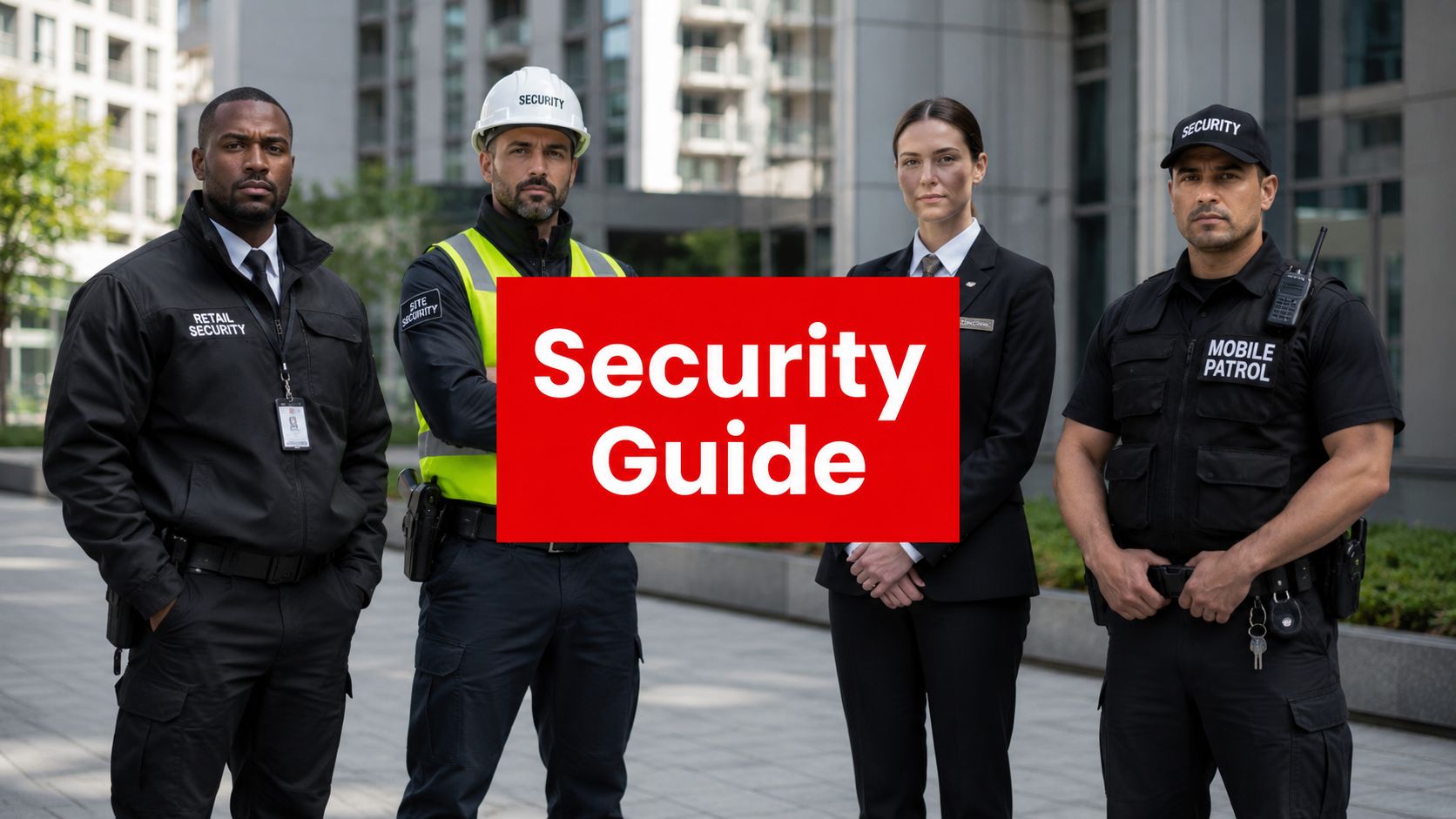
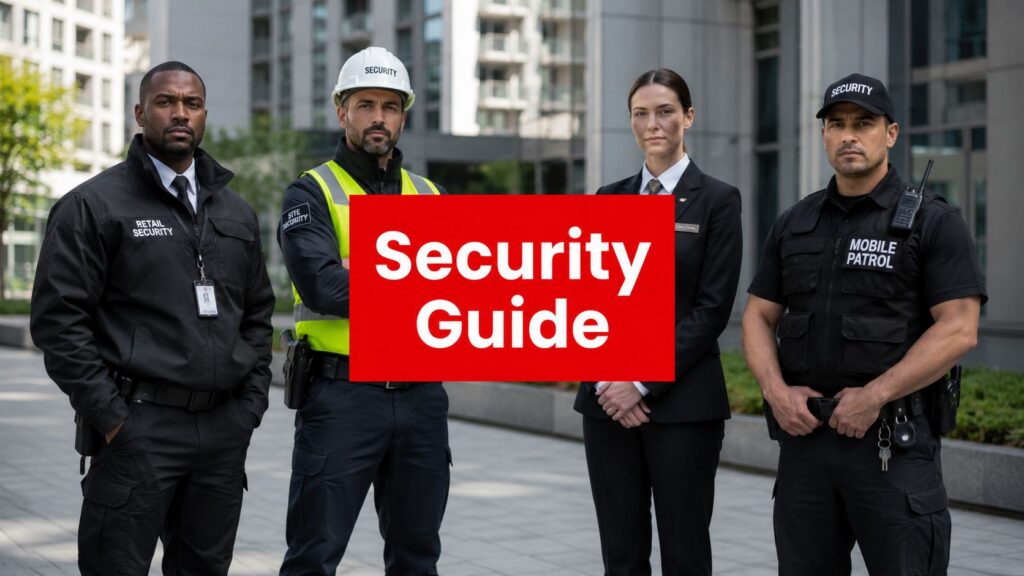
Are you choosing a security officer for the title alone, or for the actual risk sitting on your property after hours? That's where many teams get tripped up. A lobby desk, a construction gate, a retail floor, and a fire watch post can all need “security,” but the right officer type, the right post orders, and the right level of oversight are very different decisions.
The phrase types of security officers sounds simple until you have to match a role to a real site. A condo tower in San Francisco doesn't need the same posture as a warehouse in San Jose, and a Los Angeles retail center doesn't need the same coverage as a healthcare lobby or a mixed-use HOA. In practice, the job is about aligning deterrence, access control, response, customer service, and documentation with what the property faces.
That's why the most useful way to think about security officer categories is by function, not just uniform. Some officers are stationed at one site all day. Others move between locations, verify cameras from a SOC, manage visitor flow, or step in during a fire alarm outage or special event. Each role solves a different problem, and each one works best when it's paired with clear post orders, trained people, and consistent accountability.
For property managers and business owners, the question is simpler than the industry jargon. Who should be in place, what should they be doing, and how do you know the service is working? The list below breaks down the 10 primary types of security officers and connects each one to the kinds of sites where it tends to perform best.
1. Onsite Security Guard Armed & Unarmed
An onsite security guard is the most familiar face in the field, and for good reason. The U.S. Bureau of Labor Statistics shows that security guards are the largest single protective-service occupation, with 1,057,100 jobs in May 2021, about 90% in the private sector, and a public-sector share of only 9.6%. That labor mix makes it clear that most guard work is contract-based or proprietary, not government protective work, and it sits at the center of the broader security-officer field. BLS protective-service employment data
What they do on a property
These officers stay at one site and serve as the visible front line for access control, patrols, visitor screening, and incident response. A class A office building in downtown Los Angeles might use armed guards at the lobby, while a hospital in San Diego might rely on unarmed guards for entry screening and patient safety. Residential high-rises, retail centers, and office towers all benefit when the guard knows the layout, the tenant mix, and the site's daily rhythm.
Practical rule: a guard's value comes from post orders, not just presence. If the officer doesn't know where to check, what to challenge, and when to escalate, the uniform becomes decoration.
A strong onsite program usually includes the basics that clients can see and verify. That means clear written instructions, customer-service skills, conflict de-escalation, emergency procedures, and reporting that documents what happened in real time. It also means choosing a provider that can keep staffing stable, because turnover can leave the site exposed to inconsistent coverage and weak follow-through.
If the site is a luxury condo, a professional appearance matters as much as the patrol route. If it's a retail center, the officer has to balance deterrence with a calm customer experience. If it's a construction site, the same role may need to shift into access control, equipment protection, and after-hours response.
2. Mobile Patrol Officer
A mobile patrol officer is the right fit when a property needs visibility without a person standing in one place all day. The U.S. labor data for the investigation and security services sector shows 735,430 workers at a mean hourly wage of $18.64, which helps explain why standardized patrol models are so common in property protection. Shared patrols and vehicle-based coverage make sense when cost control and repeatable procedures matter. BLS occupational employment data
Where vehicle patrol works best
Patrol officers move between sites or around a large property in marked or unmarked vehicles. They check gates, lighting, doors, loading areas, and perimeter conditions, then document the stop with time-stamped reports. That makes them a smart choice for multi-unit retail centers in Los Angeles, industrial yards in San Jose, residential communities in San Diego, and municipal parking facilities in Sacramento.
For managers comparing coverage models, the practical advantage is flexibility. A mobile patrol can be scheduled, randomized, or layered with onsite staff, which gives you deterrence without paying for a permanent post that the site doesn't need. If you want a deeper look at how that service is structured, Overton's vehicle patrol security page is a useful starting point.
A patrol officer should never feel like a random drive-by. The route needs checkpoints, inspection priorities, and a reporting standard that lets the client see what was checked and what was found. GPS tracking helps confirm that the stop happened, while digital reports help managers spot coverage gaps and recurring trouble areas.
Randomness helps only if it's controlled. Predictable patrol timing teaches trespassers when to return, but sloppy randomization can leave managers guessing instead of informed.
Construction phases, holiday periods, and weather shifts can all change the right patrol frequency. That's why the best patrol programs are flexible. They adjust to risk instead of locking a property into a rigid schedule that no longer fits conditions on the ground.
3. Concierge Security Officer
Concierge security is a good example of why types of security officers can't be reduced to uniforms alone. The Canadian occupational taxonomy and the U.S. ONET both make the point that security work includes a wide range of roles, from customer-facing protection to more specialized functions. ONET's sample titles include Hotel Security Officer, Customer Service Security Officer, Safety and Security Officer, and Security Agent, which is a good reminder that the work often blends service and control. O*NET Security Guards summary
Why hospitality skill matters here
A concierge security officer protects the site while shaping the tenant experience. In a luxury residential tower, that might mean managing lobby access, greeting guests, handling package deliveries, and staying composed when a resident has a concern. In a Class A office lobby, the same officer may be responsible for visitor check-in, badge issuance, and a polished first impression for executives and clients.
The officer has to be friendly without becoming loose with policy. That balance is the job. A high-end building doesn't want a militarized feel, but it also can't afford a weak access-control culture that lets strangers drift through the property.
A few habits separate a good concierge post from a weak one.
- Professional presentation: clean uniforms, good grooming, and calm communication that matches the property brand.
- Clear decision rules: the officer should know when to accommodate a guest and when to enforce a restriction.
- Tenant support: routine requests, package handling, and directions should be handled without sending every small issue up the chain.
- Documented incidents: upscale properties often draw more scrutiny, so incident notes need to be precise and discreet.
Concierge security works especially well in mixed-use communities, corporate headquarters, and medical office buildings where the officer becomes part of the building's identity. If the role is done well, residents and tenants feel both welcomed and protected. If it's done poorly, the property feels either unwelcoming or unsecure, and neither outcome helps management.
4. Fire Watch Security Officer
What happens when a property's fire protection system goes offline, even for a short period? Fire watch is the assignment that fills that gap. The Canadian classification for security work includes roles that patrol for theft, vandalism, and fire, and that fits the basic idea here, but fire watch is narrower and more urgent. It centers on life safety, clear documentation, and compliance while normal protection is temporarily unavailable.
The temporary role that carries real responsibility
Fire watch officers are deployed when sprinklers, alarms, or detection systems are down for maintenance, retrofit, or construction. They patrol at set intervals, watch for smoke, electrical hazards, blocked exits, or unsafe work practices, and record each round carefully. That is why this role is often used in high-rise office buildings, hospitals, shopping centers, warehouses, and apartment communities during system downtime.
The assignment may be temporary, but the accountability is not. Fire marshals, building managers, contractors, and insurers may all want proof that the patrols happened on time and that the documentation is complete. GPS-enabled verification and a disciplined reporting process help when the property needs a clear record of what was checked and when.
If a fire system is offline, the officer's log becomes part of the property's protection record. Gaps in documentation can create problems long after the maintenance crew leaves.
Fire watch also needs property-specific awareness. A warehouse has different ignition risks than a healthcare facility, and a retail center has different occupancy and evacuation concerns than an apartment complex. Officers need to spot blocked egress, overheated equipment, smoking violations, and maintenance activity that raises risk. When downtime exposes assets to theft as well as fire, property teams can also review cargo theft tips for fleets to tighten controls around vulnerable deliveries and stored goods.
This is not a role to improvise. The site should confirm requirements with the fire marshal, define patrol intervals, post clear signage, and keep operations, maintenance, and security in the same communication loop until the system is back online. For properties that want stronger tracking during these periods, Overton Security's retail loss prevention strategies show how documented observation and response can support broader site protection when conditions change.
5. Loss Prevention Specialist
Loss prevention specialists are a strong fit for retail and commercial settings where theft, fraud, and shrinkage cut directly into margins. In stores with high foot traffic or fast-moving inventory, visible deterrence still matters, but it works best when it is paired with observation, documentation, and fast communication. That is why many property teams still rely on trained personnel who can watch behavior, intervene appropriately, and keep a clean record of what happened. Grand View Research manned security services market report
Retail security with an investigative edge
A loss prevention specialist watches patterns, not just people. In a shopping center, that may mean plainclothes observation near entrances, returns counters, or high-theft merchandise. In a big-box store, it might mean monitoring employee theft, receipt fraud, or repeat offenders while keeping the sales floor comfortable for legitimate customers.
For a deeper look at store-level tactics, see our guide to retail loss prevention strategies.
Loss prevention work also includes investigation, evidence handling, and coordination with management or law enforcement when needed. That broader scope is reflected in the Canadian occupational classification for security work, which recognizes related roles such as store detective and theft prevention officer under the same umbrella. Statistics Canada occupational classification for security work
A good loss prevention program depends on a few practical habits.
- Observation first: officers should identify patterns before confronting anyone.
- Documentation discipline: footage, timestamps, descriptions, and witness notes matter.
- Customer service balance: the goal is to protect inventory without turning the store into a hostile environment.
- Legal coordination: any stop, question, or detention policy should be set with counsel and management. To address internal theft risks, consider ways to cut offboarding costs with Beyond Surplus.
The role is especially useful in downtown retail, shopping centers, and specialty stores where theft patterns change by daypart and customer traffic. A solid officer knows when to stay visible at the entrance, when to work discreetly, and when to hand the matter over. In practice, that judgment often separates a reactive store from one that stays in control.
6. Construction Site Security Officer
Construction sites carry risks that finished properties do not. Material deliveries, heavy equipment, open access points, changing schedules, and long stretches of inactivity create openings for theft and vandalism, and a standard guard post does not always match that environment. On these jobs, a construction site security officer has to track people, vehicles, tools, and timing with the same care. The role fits the kind of work described in the construction risk management guide, because security only works when it matches the way the site operates.
Why construction needs a site-specific model
A construction site security officer needs to understand staging areas, laydown yards, equipment caches, and the daily rhythm of subcontractors arriving and leaving. That makes the role useful on commercial builds in Los Angeles, multi-unit projects in San Francisco, infrastructure work in San Diego, industrial expansions in Sacramento, and mixed-use developments in Long Beach.
The officer should do more than stay near the gate. Practical coverage includes verifying access, checking vulnerable areas after hours, coordinating with the superintendent, and recording suspicious activity as it happens. The officer also has to tell the difference between a legitimate delivery delay and someone trying to move material without authorization.
Construction security breaks down when the officer is cut off from the site team. The superintendent, GC, and security provider need the same picture of what is happening on the ground.
A few habits separate useful coverage from a token presence.
- Access control: every entry point should have a clear rule.
- Asset awareness: high-value tools, copper, fuel, and equipment need close attention.
- After-hours coverage: theft often rises when the site is quiet.
- Site hazard training: officers should know how to move safely around active work zones.
Overton's construction risk management guide fits well alongside field security planning because it keeps the focus on real site conditions. The main point is simple. If the officer does not understand the build, the build is harder to protect.
7. Event Security Officer
Event security has to work fast without feeling heavy-handed. The job exists for a short window, but the pressure is real because one bad entry line, one unmanaged crowd surge, or one missed VIP issue can affect the whole event. The right officer keeps order while preserving the tone the host is trying to create.
Short-term protection with a customer-facing edge
Event security officers are common at corporate galas, conferences, trade shows, private fundraisers, holiday parties, and venue activations. They manage entry screening, watch high-traffic zones, respond to disturbances, and coordinate with event staff or venue management. In practice, that can mean badge checks at a conference in San Jose, VIP protection at a Los Angeles gala, or floor coverage at a San Diego trade show.
The role depends on planning. Officers need the attendee count, the VIP list, the emergency exits, the medical response plan, and the communication channels before the first guest arrives. Without that groundwork, security gets reactive fast.
A strong event team usually does three things well. First, it controls the entry points and the exits. Second, it places officers where crowd movement is naturally concentrated. Third, it keeps communication open between the venue, the host, and the security lead.
The best event officers are visible without looking confrontational. Guests should feel guided, not blocked.
This role also benefits from post-event review. If there was a bottleneck, a near-miss, or a guest complaint, the next event should account for it. Event security is one of the clearest examples of how service and protection have to work together in the same moment.
8. Remote Monitoring Operator
Remote monitoring operators extend protection beyond the person standing onsite. That matters because a property doesn't stop being vulnerable when the lobby empties. It just becomes harder to watch without the right technology and the right people behind it. Overton's Security Operations Center overview is a useful example of how SOC-based oversight supports field coverage.
Centralized eyes on multiple properties
From a Security Operations Center, operators monitor camera feeds, alarms, sensors, and access control events across multiple sites. They verify activity in real time, coordinate with onsite officers, and escalate emergencies when needed. This model works well for multi-property retail portfolios, office buildings, residential communities, industrial yards, and healthcare campuses.
The point isn't to replace onsite security. It's to make the onsite team more effective. A remote operator can catch a gate left open, confirm whether a motion alert is a real intrusion, or dispatch help to an officer who needs support. That makes SOC oversight especially valuable when a client wants 24/7 visibility without staffing every point of vulnerability in person.
Poor camera placement ruins the whole setup. So does bad lighting, weak video quality, or a monitoring protocol that alerts operators to too many low-value events. The technology has to be designed around the site, not added as an afterthought.
Good remote monitoring depends on discipline. If the operator doesn't know which events require a call-out, the screen becomes noise instead of protection.
This role is especially effective when paired with onsite patrols and digital reporting. The operator can see what the officer checked, when a route was completed, and whether an incident needs follow-up. For managers with multiple locations, that kind of central visibility is often the difference between guessing and managing.
9. Access Control and Credential Management Officer
A lobby, gate, or badge reader can be the difference between a controlled site and a constant stream of avoidable risk. Access control officers keep that first layer of protection working by deciding who enters, who waits, and who needs to be verified before moving deeper into the property.
The role behind every controlled entry point
These officers manage entry and exit, verify credentials, issue visitor passes, and maintain logs. In practice, that makes them a strong fit for corporate headquarters in Los Angeles, medical office buildings in San Francisco, government facilities in Sacramento, research sites in San Jose, and luxury residential buildings in Long Beach.
The work depends on judgment as much as process. A good access control officer is courteous enough to keep the front desk moving, but firm enough to stop an unverified visitor before they reach a restricted area. They also need to recognize social engineering attempts, where someone uses confidence, urgency, or title-dropping to get past normal checks.
A solid access program usually has a few moving parts:
- Clear access rules: everyone should know who belongs where.
- Visitor accountability: badges and logs should make entry traceable.
- Technology support: badge systems and electronic records reduce manual errors.
- Consistent enforcement: exceptions weaken the whole system.
This role matters most in places with heavy visitor traffic, frequent turnover, or strict confidentiality requirements. Medical buildings and corporate campuses often need fast processing without losing control, while residential properties need a front-desk experience that feels welcoming and still protects residents. The officer becomes the point where security and day-to-day flow have to work together.
10. Specialized Response Officer
Some sites need more than routine coverage. They need people who can make fast decisions under pressure and support the first minutes of a serious incident until police, fire, or medical responders take over. That's where specialized response officers stand apart from general guarding.
Trained for higher-pressure situations
These officers may handle workplace violence concerns, active threat response, bomb-threat procedures, medical emergencies, natural disaster coordination, or hazmat-related situations depending on the assignment. Healthcare facilities, financial offices, government buildings, retail centers, and corporate campuses all face scenarios where an increased response role is useful.
The University of Phoenix draws a clean distinction between a security officer and a security guard, describing the officer as generally a higher-level position with more authority and the guard as typically entry-level. That hierarchy matters here because specialized response work usually calls for more training, stronger judgment, and clearer authority at the scene. University of Phoenix security officer vs. security guard guide
The value of this role is preparation. If the site has a history of volatile incidents or a higher consequence if something goes wrong, the officer should be trained for those exact conditions. That includes incident command protocols, emergency drills, first aid, CPR, and coordination with local responders.
Specialization only works when it's supported by training and supervision. A title alone doesn't make an officer ready for a critical event.
This is also where leadership and retention matter. Low wages and poor training put security guards and the public at risk, according to a 2026 Berkeley news release reporting on study findings, and that warning applies across the field, not just in one category. Berkeley news release on low wages and poor training
Comparison of 10 Security Officer Types
| Service | Implementation complexity | Resource requirements | Expected outcomes | Ideal use cases | Key advantages |
|---|---|---|---|---|---|
| Onsite Security Guard (Armed & Unarmed) | Medium–High: site-specific post orders, vetting and training; armed needs licensing | Full-time officers, supervision, scheduling, reporting tools, SOC integration | Continuous visible deterrence, immediate incident response, property familiarity | Office buildings, residential high-rises, hospitals, retail centers | Consistent presence, rapid response, tenant relations, documented patrols |
| Mobile Patrol Officer (Vehicle-Based Security) | Medium: route planning, scheduling and unpredictability planning | Vehicles (marked/unmarked), GPS/DAR tech, rotating officers, dispatch support | Periodic deterrence across sites, rapid on-call response, flexible coverage | Multi-property portfolios, warehouses, construction sites, parking facilities | Cost-effective multi-site coverage, unpredictable patrols, scalable frequency |
| Concierge Security Officer (Hospitality-Focused) | High: dual security and hospitality training, higher hiring standards | Professionally trained officers, customer-service tools, access control integration | Discreet security with enhanced tenant experience and brand alignment | Luxury residential, Class A offices, corporate campuses, private medical facilities | Improves image, discreet incident handling, higher tenant satisfaction |
| Fire Watch Security Officer | High: regulated patrol intervals, certification, coordination with fire authority | Specially trained officers, 24/7 coverage during system downtime, documentation/GPS | Life-safety compliance, early hazard detection, regulatory proof for inspections | Buildings during fire-system maintenance, hospitals, data centers, construction sites | Ensures code compliance, reduces liability, provides time-stamped documentation |
| Loss Prevention Specialist (Retail & Commercial) | Medium–High: investigative protocols, legal coordination, covert operations | Specialized training, CCTV/EAS integration, plainclothes/uniform options, law-enforcement liaison | Reduced shrinkage, evidence collection, deterrence of shoplifting and employee theft | Retail stores, shopping centers, big-box, specialty/high-value retail | Direct loss reduction, intelligence on repeat offenders, tech-enabled investigations |
| Construction Site Security Officer | Medium: adaptable patrols, frequent coordination with GC and site changes | Off-hours patrols, site-specific safety training, communication with superintendent | Reduced equipment/material theft, controlled access, improved site safety | Active construction projects, staging yards, infrastructure and industrial sites | Protects project assets, lowers insurance risk, tailored to construction workflows |
| Event Security Officer (Temporary & Specialized) | Medium: event-specific planning, rapid familiarization, crowd-control procedures | Temporary/short-term officers, crowd-control gear, coordination with planners/law enforcement | Managed crowds, safe attendee experience, focused short-term incident response | Corporate events, conferences, galas, trade shows, private functions | Flexible short-term coverage, preserves attendee experience, scalable staffing |
| Remote Monitoring Operator (SOC-Based Security) | High: SOC setup, system integration, operator protocols and redundancy | Cameras/sensors, servers/software, trained operators, reliable broadband | 24/7 surveillance, rapid alarm verification, centralized incident coordination | Multi-property portfolios, retail chains, healthcare campuses, industrial sites | Cost-effective continuous oversight, evidence capture, reduces false alarms |
| Access Control & Credential Management Officer | Medium: policy development, tech integration, consistent enforcement | Badge/visitor systems, access-control software, trained front-desk officers | Reduced unauthorized access, audit trails, controlled entry flows | Corporate HQs, medical/research facilities, government sites, luxury residences | Prevents unauthorized entry, compliance documentation, improved visitor experience |
| Specialized Response Officer (Rapid Response & Emergency Management) | High: advanced certifications, incident command protocols, interagency coordination | Highly trained personnel, specialized equipment, ongoing certification upkeep | Immediate competent emergency response, effective incident containment, reduced escalation | Healthcare, financial services, government buildings, large corporate campuses | Strong crisis management, rapid mitigation, coordination with responders, lowers liability |
Partner with Experience to Build Your Security Solution
Understanding the different types of security officers is the first step. The next step is matching the role to the site, the risk, and the service level your tenants, customers, or residents expect. A retail center may need a mix of loss prevention and mobile patrols. A construction site may need access control, patrol coverage, and a stronger after-hours posture. A residential tower may need concierge security with clear escalation paths and consistent reporting.
For over 26 years, Overton Security has built programs around that kind of practical fit. Our approach combines human oversight with smart technology, including GPS-enabled tours, digital reporting, and 24/7 SOC support, so property managers can see what's happening and respond with confidence. We also keep a low manager-to-client ratio, which helps us stay hands-on with site visits, post-order updates, and day-to-day accountability.
That matters because officer type is only part of the equation. Training, retention, supervision, and documentation are what turn a good concept into reliable protection. Overton's service model is built around those details, especially for residential communities, retail centers, construction projects, office buildings, healthcare facilities, and multi-site portfolios across California.
If you're comparing onsite guards, vehicle patrols, concierge officers, fire watch, or SOC-based monitoring, the smartest next move is to review your property's risks with a team that works in the field every day. You'll get a clearer picture of where one officer type is enough, where a mixed model makes sense, and where better oversight will do more for you than adding another uniform.
If you're ready to build a security plan around the actual conditions at your property, visit Overton Security and start with a complimentary security assessment. Our team can help you compare officer types, coverage models, and reporting tools so your program fits the site instead of forcing the site to fit the program.