For retail business owners and property managers in communities from Los Angeles to San Jose, is inventory shrinkage a growing concern? This isn't just a line item; it's a direct threat to profitability. As risks like organized retail crime (ORC) become more sophisticated, security measures must evolve. A proactive, multi-layered security plan is essential for protecting assets, ensuring staff safety, and maintaining a welcoming environment for your customers.
This guide moves beyond generic advice to provide a comprehensive roundup of modern retail loss prevention strategies. We will detail a powerful blend of technology, on-site personnel, and intelligent operational tactics that work in concert to secure your business. You will learn how to implement these strategies effectively, whether you manage a single storefront or a sprawling retail portfolio.
From the visible deterrence of Electronic Article Surveillance (EAS) to the subtle insights of advanced video analytics, each strategy plays a crucial role. By the end of this article, you will have a clear, actionable framework for building a robust defense that not only mitigates loss but also enhances the overall customer experience. Let’s dive into the solutions that protect your profits.
1. Strategy 1: Implementing Electronic Article Surveillance (EAS)
Electronic Article Surveillance (EAS) stands as a foundational and highly effective technology among retail loss prevention strategies. This system acts as a powerful and visible deterrent against casual shoplifting by using security tags or labels attached to merchandise. When a tagged item passes through detection antennas at store exits without being deactivated, an alarm is triggered, immediately alerting staff.
The core of an EAS system consists of three parts: security tags or labels, deactivators at the point-of-sale (POS), and detection pedestals at the exits. This creates an automated first line of defense that is both reliable and difficult to bypass without specific tools. Its primary benefit is not just catching theft in progress but actively discouraging it from happening in the first place.
When and Why to Use This Approach
EAS is particularly crucial for retailers with high-value, easily concealed items. Stores selling apparel, electronics, cosmetics, or liquor see significant returns on investment. The visible presence of EAS pedestals and tags sends a clear, calm message that the store is actively monitored, effectively reducing opportunistic theft.
Key Insight: A well-implemented EAS system does more than just sound an alarm; it fundamentally changes shopper behavior, creating a store environment where theft is perceived as high-risk and low-reward.
Actionable Implementation Tips
- Prioritize Staff Training: Your team is central to the system's success. Provide comprehensive training on proper tag application, ensuring tags are placed consistently and are difficult to remove without damaging the product. Equally important is scripting a calm, customer-focused response for when an alarm sounds to avoid alienating legitimate shoppers.
- Vary Your Tag Technology: A one-size-fits-all approach is ineffective. Use a mix of hard tags, adhesive labels, and specialty tags like spider wraps for boxed goods. For example, fashion retailers often use aesthetically pleasing hard tags that integrate with the garment, while electronics stores use robust spider wraps for high-value items.
- Conduct Regular System Audits: Schedule weekly or bi-weekly tests of your EAS system. Walk a tagged item through the pedestals to check sensitivity and ensure there are no dead zones. This proactive maintenance minimizes false alarms and ensures the system is always performing optimally.
The following data provides a quick reference on the potential impact and investment required for an effective EAS system.
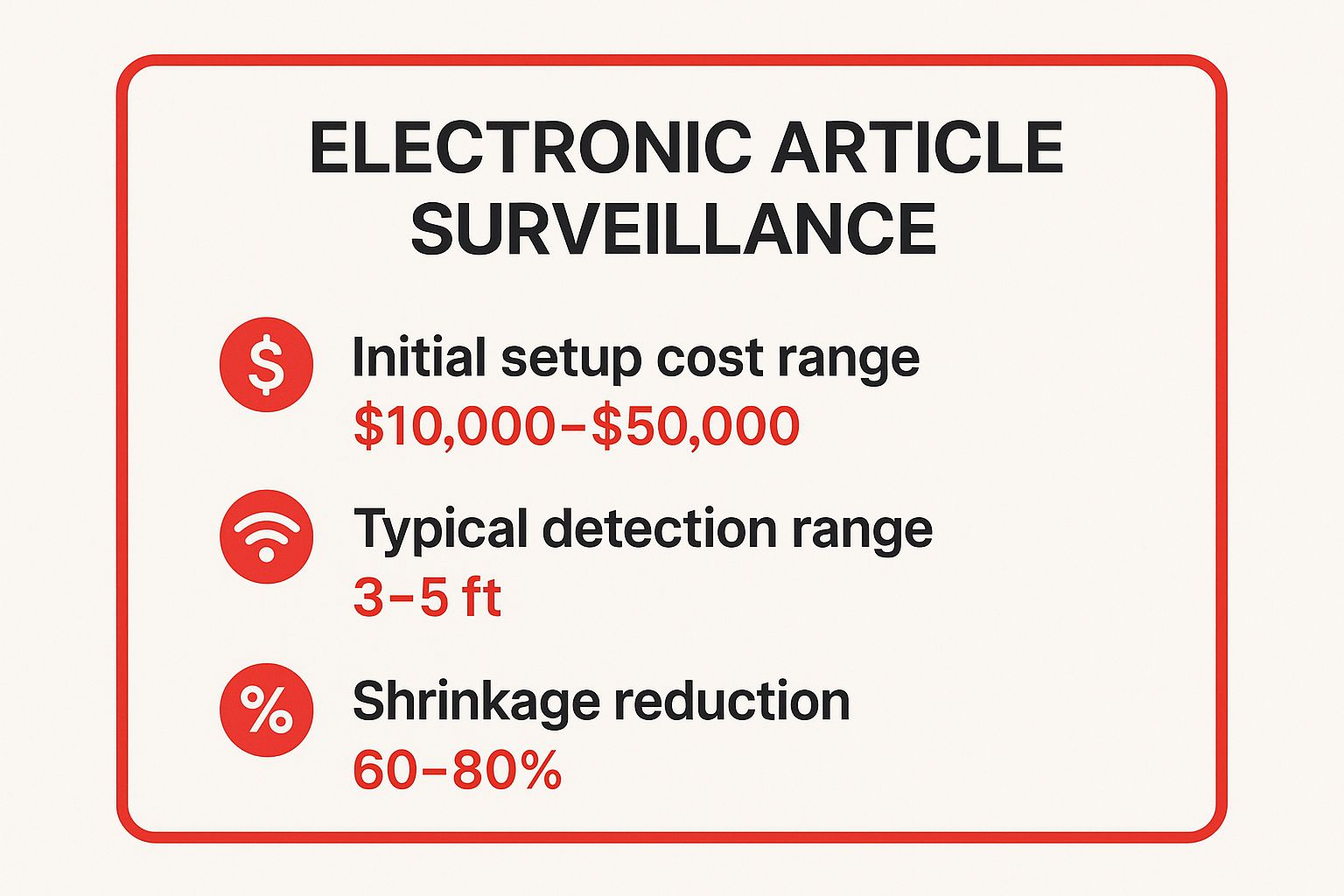
As the data shows, while there is an initial setup cost, the significant potential for shrinkage reduction makes EAS a worthwhile investment for many retailers looking to protect their bottom line.
2. Video Surveillance and Analytics
Modern video surveillance has evolved far beyond simple recording. Today's systems blend high-definition cameras with smart analytics, transforming them into proactive tools for retail loss prevention. These solutions monitor store activities, can automatically detect suspicious behaviors, and provide invaluable evidence for investigations. By identifying specific actions like merchandise concealment or extended loitering in high-risk zones, these systems can alert security personnel, enabling timely intervention.
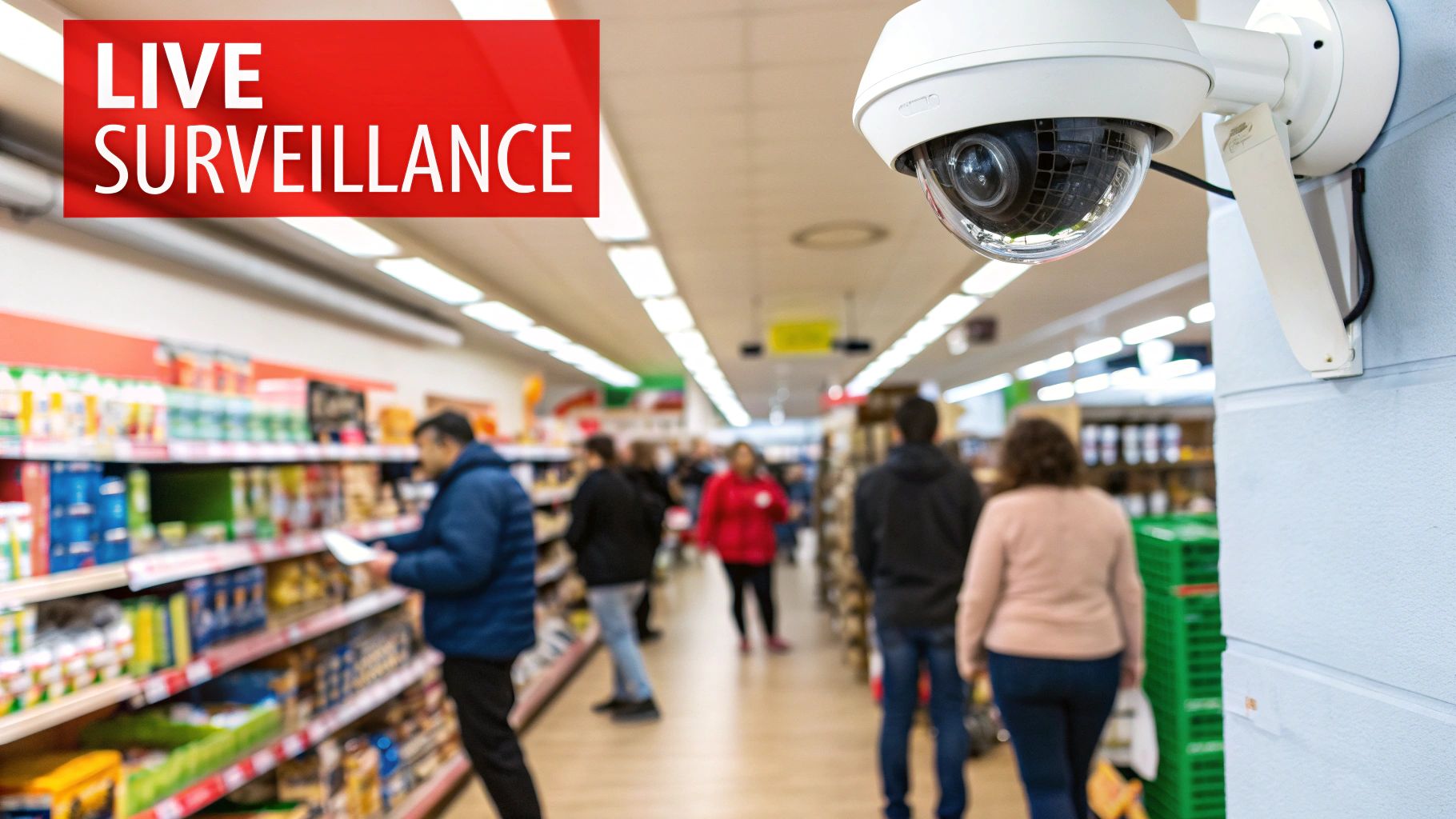
This blend of human expertise with smart technology provides a comprehensive security overview. For instance, some large retailers have used AI-powered systems to reduce shrinkage by up to 30% in pilot stores. These examples highlight how video analytics serve as a powerful force multiplier, helping loss prevention teams monitor vast areas with greater efficiency and accuracy than human eyes alone.
When and Why to Use This Approach
This strategy is indispensable for any retail environment, but it's especially critical for large-format stores, retailers with extensive blind spots, or those experiencing high rates of organized retail crime (ORC). The ability to automatically flag suspicious events allows staff to focus their attention where it's most needed. It provides concrete, time-stamped evidence that is crucial for internal investigations and police reports, moving beyond prevention to enable accountability.
Key Insight: Advanced video analytics shift surveillance from a passive, after-the-fact tool to a live, intelligent system that actively identifies and alerts you to potential theft as it happens, creating a safer and more secure environment.
Actionable Implementation Tips
- Strategize Camera Placement: Focus camera placement on high-risk, high-value areas. This includes entrances and exits, cash wraps, stockroom doors, and aisles with easily concealed items. Use a mix of overt dome cameras as a deterrent and discreet cameras to capture activity in sensitive zones without altering the customer experience.
- Ensure Optimal Conditions: High-quality footage is non-negotiable. Ensure all camera zones have adequate, consistent lighting to avoid shadows and glare that can obscure details. Regularly clean lenses and check camera angles to guarantee your coverage is not obstructed by new displays or signage.
- Establish Clear Protocols and Training: Your team must know how to leverage the technology. Train staff on how to interpret alerts from the analytics system and establish clear, calm response procedures. It is also vital to educate your team on local privacy laws and ensure appropriate signage is posted to inform customers about video monitoring.
- Regularly Audit and Update: A "set it and forget it" approach can create vulnerabilities. Conduct quarterly reviews of your camera coverage to identify any new blind spots created by store layout changes. Review analytics performance to fine-tune alerts, reducing false positives and ensuring the system remains effective.
3. Loss Prevention Officers and Security Personnel
While technology provides automated defenses, the human element remains one of the most dynamic and effective retail loss prevention strategies. Trained loss prevention officers (LPOs) and uniformed security personnel provide active, on-the-ground protection. They work to identify and deter theft, investigate suspicious activity, and can safely manage incidents, acting as a visible and responsive security presence.
These professionals are more than just guards; they are specialists who blend keen observation with de-escalation skills and an understanding of relevant laws. This combination allows them to protect assets without disrupting the positive shopping atmosphere essential for retail success. The presence of a dedicated security staff, whether uniformed or plainclothes, can deliver a substantial return on investment through loss reduction.
When and Why to Use This Approach
This strategy is vital for retailers facing high rates of organized retail crime (ORC) or significant internal theft. It is also crucial for large-format stores or high-traffic shopping centers where passive measures are insufficient. A mix of uniformed security officers at entrances and plainclothes officers on the sales floor creates a comprehensive security posture, deterring both opportunistic shoplifters and more coordinated criminal efforts.
Key Insight: Loss prevention officers do more than just stop theft; they provide invaluable intelligence on shrink patterns, internal issues, and organized crime activity, enabling a more proactive and strategic security approach.
Actionable Implementation Tips
- Establish Clear Operational Protocols: Your team's effectiveness hinges on clear directives. Develop and document strict protocols for every stage of an incident, from initial observation and approach to contacting law enforcement. This ensures all actions are safe, legal, and consistent with company policy.
- Balance Uniformed and Plainclothes Staff: Use a strategic mix of personnel. Uniformed guards create a powerful visual deterrent at entrances and high-risk areas. Meanwhile, plainclothes LPOs can blend in with shoppers to effectively monitor behavior and identify internal theft without making legitimate customers feel watched.
- Invest in Continuous, Advanced Training: Initial hiring is just the beginning. Provide ongoing education on de-escalation techniques, local laws, evidence preservation, and internal investigation tactics. The success of a professional team hinges on their training and preparedness.
4. Inventory Management and Cycle Counting
Beyond visible deterrents, one of the most powerful retail loss prevention strategies happens behind the scenes through meticulous inventory management. This approach involves systematic processes like regular cycle counting and maintaining a perpetual inventory system to quickly spot discrepancies between recorded stock and physical stock. When managed correctly, it creates an ecosystem of accountability that makes it difficult for theft—either internal or external—to go unnoticed.
The foundation of this strategy is data accuracy. By knowing exactly what you should have on hand at all times, you can immediately investigate missing items and identify patterns of loss. This pinpoints specific vulnerabilities in your supply chain or on the sales floor. Modern systems often leverage RFID technology to achieve high accuracy, turning inventory management from a reactive chore into a proactive security measure.
When and Why to Use This Approach
Robust inventory management is non-negotiable for any retailer, but it is especially critical for businesses with large and diverse stock, high product turnover, or multiple locations. It is the primary method for identifying internal theft, which often manifests as a slow, consistent inventory bleed. It also helps uncover process errors, like receiving mistakes or unscanned items, that contribute to shrinkage.
Key Insight: Accurate inventory management turns your stock file into a powerful security tool. It provides the hard data needed to move beyond guessing about losses and start strategically addressing their root causes, from employee theft to supply chain issues.
Actionable Implementation Tips
- Implement ABC Analysis: Not all inventory is created equal. Categorize your products into "A" (high-value, low-quantity), "B" (moderate value and quantity), and "C" (low-value, high-quantity) groups. Focus your cycle counting efforts more frequently on "A" items, as their loss has the greatest financial impact.
- Leverage Mobile Technology: Equip your team with mobile scanners and devices for efficient and accurate counting. This reduces manual data entry errors and allows counts to be conducted on the sales floor with minimal disruption. For instance, many large retailers have used RFID implementation to significantly improve inventory accuracy.
- Analyze Variance Reports Diligently: The real value comes from analyzing the discrepancies found during counts. Regularly review variance reports to identify patterns. Is a specific product always missing? Are losses higher during a particular shift? This analysis provides the clues needed to take targeted corrective action. You can learn more about how this contributes to reducing overall shrinkage on overtonsecurity.com.
5. Store Layout and Design Optimization
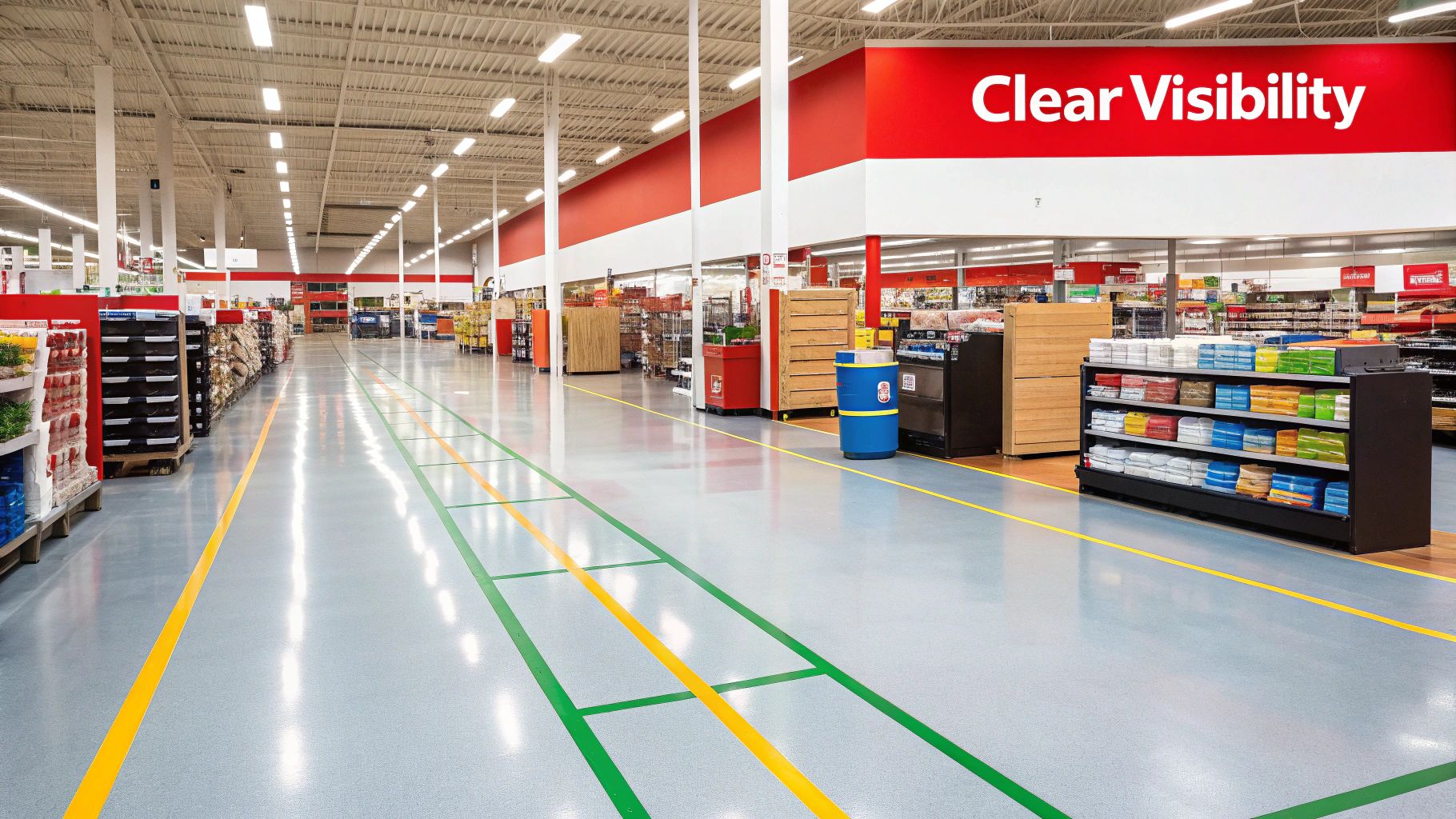
One of the most proactive and integrated retail loss prevention strategies is optimizing your store’s physical layout and design. This approach, often called Crime Prevention Through Environmental Design (CPTED), involves creating a space that naturally discourages theft by enhancing visibility. It strategically shapes the environment to influence behavior, making illicit activities feel riskier and more difficult for potential offenders.
A well-designed store layout does more than just prevent loss; it enhances the customer shopping experience. By eliminating blind spots and improving sight lines, you create a setting that feels both open and secure. This balance is key, as the goal is to deter theft without making honest customers feel watched or uncomfortable. Its effectiveness lies in its subtlety, embedding security directly into the store’s architecture.
When and Why to Use This Approach
Optimizing store design is a universal strategy beneficial for every type of retailer, from small boutiques to large big-box stores. It is particularly critical during a new store build-out, a major renovation, or when a specific area is identified as a high-theft zone. For example, some retailers have successfully redesigned stores to remove blind spots where high-value electronics were frequently stolen by using lower shelving and wider aisles.
Key Insight: A strategic store layout acts as a silent security partner. It uses principles of natural surveillance and territoriality to make staff presence more impactful and theft attempts more conspicuous, effectively discouraging crime before it happens.
Actionable Implementation Tips
- Create Clear Sight Lines: Ensure that cash registers and staff workstations have an unobstructed view of high-traffic areas, entrances, and valuable merchandise. Avoid tall displays that create "canyons" where thieves can hide. The open, minimalist layouts of Apple Stores are a prime example of this principle.
- Strategic Merchandise Placement: Position high-value, easily concealed items near the checkout counter, in locked cases, or within direct view of a staff-heavy area. This forces potential thieves to operate under direct scrutiny, significantly increasing the perceived risk.
- Optimize Lighting and Visibility: Ensure all corners, aisles, and stockrooms are brightly and evenly lit. Dark or poorly lit areas are natural invitations for theft. Use mirrors strategically to eliminate blind spots, especially in long aisles or hidden corners.
- Manage Fitting Room Access: Position fitting rooms so that a dedicated employee can monitor who enters and exits, and how many items they take in. This single point of control is a major deterrent for one of the most common shoplifting methods in apparel retail.
6. Point-of-Sale (POS) Monitoring and Controls
While external theft often gets the most attention, a significant portion of retail shrinkage originates from internal sources at the checkout counter. Implementing robust Point-of-Sale (POS) monitoring and controls is one of the most effective retail loss prevention strategies for addressing this internal risk. This approach involves leveraging technology and strict procedures to prevent employee theft, fraudulent transactions, and procedural errors that lead to loss.
Advanced POS systems can serve as a digital supervisor, flagging unusual activities like excessive voids, unauthorized discounts, or suspicious cash-out patterns. By integrating POS data with video surveillance and exception-based reporting, retailers gain a powerful tool to identify and verify fraudulent behavior. This strategy shifts loss prevention from a reactive process to a proactive one.
When and Why to Use This Approach
This strategy is essential for any retail environment, but its value multiplies in high-volume settings or stores with complex discount structures. Businesses like grocery stores, fast-food restaurants, and big-box retailers rely on POS controls to manage thousands of daily transactions. The core goal is to create a system of accountability that minimizes opportunities for internal theft while protecting honest employees.
Key Insight: A well-designed POS control system creates an environment of transparency and accountability. It protects honest employees from false accusations while making it significantly more difficult for dishonest individuals to manipulate the system without detection.
Actionable Implementation Tips
- Establish Clear Alert Thresholds: Configure your POS system to automatically flag suspicious activities. Set reasonable limits for actions like voids, "no sale" drawer opens, and manual price overrides. For instance, a cashier processing more than three voids in a single shift should trigger an alert for a manager to review.
- Conduct Regular Exception Report Audits: Don't let the data sit idle. Schedule weekly meetings with store managers to review exception reports. Look for patterns, such as a single employee consistently appearing for high-value returns without a customer present or excessive discount usage.
- Integrate Video with Transaction Data: The most powerful POS monitoring links transaction data directly to video footage. When a suspicious event is flagged (e.g., a large cash refund), you can instantly pull up the corresponding video to verify the transaction's legitimacy. This provides undeniable evidence for investigations.
- Mandate Comprehensive Staff Training: Ensure every employee understands proper POS procedures, including cash handling, returns, and discount application. Document these procedures in a clear, accessible manual and require sign-off. Proper training is your first line of defense, minimizing both accidental errors and intentional fraud.
7. Customer Service and Staff Training
Among the most effective retail loss prevention strategies is one that focuses on people: exceptional customer service and comprehensive staff training. This approach transforms every employee into a proactive loss prevention asset. It creates a store environment where potential thieves feel seen and engaged, not through confrontation, but through attentive service that makes concealment significantly more difficult.
This human-centric strategy is built on the principle that a welcoming, helpful atmosphere is also a secure one. When employees are trained to actively greet and assist every person who enters, they naturally disrupt the anonymity that shoplifters rely on. This dual-purpose engagement simultaneously enhances the experience for legitimate customers while discouraging illicit activities.
When and Why to Use This Approach
This strategy is universally applicable and foundational for any retail environment. It is especially critical for retailers who want to maintain an open, high-touch shopping experience without creating a fortress-like atmosphere. For example, high-end retailers have famously leveraged a customer-centric service model to reduce shrinkage, demonstrating that positive engagement is a powerful security tool.
Key Insight: Proactive customer service is a form of positive deterrence. It makes shoppers feel valued and thieves feel observed, reducing theft opportunities without compromising the store's welcoming ambiance.
Actionable Implementation Tips
- Implement the 10-5 Rule: Train all staff to follow a simple but powerful engagement standard: acknowledge any customer within 10 feet with eye contact and a smile, and verbally greet any customer who comes within 5 feet. This simple, consistent action eliminates the "invisibility" that shoplifters seek.
- Train for Behavioral Awareness: Educate employees to recognize non-confrontational behavioral indicators of potential theft, such as avoiding staff or watching employees more than merchandise. This is not about profiling but about understanding shopper behavior to offer timely assistance, which often doubles as a deterrent.
- Establish Clear Escalation Procedures: Ensure every employee knows exactly what to do and who to contact if they observe suspicious activity. Create a clear, non-confrontational protocol that may involve alerting a manager or in-house security via a code word. This empowers staff to act safely and effectively.
- Conduct Regular Role-Playing: Run frequent training exercises that simulate various scenarios, from handling a customer with a large, empty bag to managing a group attempting to distract staff. These practical drills build confidence and ensure the team's response is calm, consistent, and aligned with company policy.
8. Access Control and Perimeter Security
Effective retail loss prevention strategies extend beyond the sales floor to encompass the entire physical environment. Access control and perimeter security systems create a structured, defensible space by managing who can enter specific areas and when. This approach is critical for protecting back-of-house areas like stockrooms, loading docks, and offices, which are often prime targets for both internal and external theft.
The system's core function is to enforce security policies automatically. Modern solutions utilize a combination of technologies, including electronic keycards, biometric scanners, and smart locks, all integrated with the store’s alarm and surveillance systems. This creates a secure, layered environment where access is granted based on verifiable credentials, not just a traditional metal key, significantly reducing unauthorized entry and creating a clear audit trail.
When and Why to Use This Approach
This strategy is indispensable for any retailer with a significant back-of-house operation, high-value inventory storage, or sensitive administrative areas. Big-box stores, luxury boutiques, and electronics retailers see immediate benefits by securing non-public zones. The goal is to make sensitive areas impenetrable to unauthorized individuals, whether they are opportunistic outsiders or dishonest employees.
Key Insight: Access control shifts security from a reactive to a proactive model. Instead of just monitoring for theft, you are actively preventing the opportunity for it to occur in your most vulnerable areas.
Actionable Implementation Tips
- Implement Role-Based Access Levels: Not every employee needs access to every area. Create distinct permission levels based on job function. For instance, a cashier may only have access to the main floor and breakroom, while a stockroom manager has access to inventory and receiving areas. This principle of least privilege is fundamental to a strong system.
- Integrate with HR and Conduct Regular Audits: Link your access control system to your HR database. This ensures that when an employee is terminated, their access credentials are automatically and instantly revoked, eliminating a common security gap. Schedule quarterly audits to review who has access to what, ensuring permissions are still appropriate.
- Establish Time-Based Restrictions: Enhance security by restricting access to certain areas outside of normal operating or shift hours. For example, the loading dock doors should only be accessible during scheduled delivery windows. This prevents unauthorized after-hours entry, a common time for large-scale internal theft to occur.
These systems provide a powerful layer of protection, crucial for a comprehensive retail loss prevention plan.
Retail Loss Prevention Strategies Comparison
| Item | Implementation Complexity | Resource Requirements | Expected Outcomes | Ideal Use Cases | Key Advantages |
|---|---|---|---|---|---|
| Electronic Article Surveillance (EAS) | Moderate (requires tags, antennas, integration) | Medium hardware & maintenance costs | Significant shrinkage reduction | High-volume retail stores | Automated deterrent, cost-effective |
| Video Surveillance and Analytics | High (advanced AI, camera setup) | High initial cost, ongoing monitoring | Shrinkage reduction, evidence capture | Large stores needing real-time monitoring | Concrete evidence, multi-area coverage |
| Loss Prevention Officers and Security Personnel | High (staff recruitment, training) | High labor costs | Immediate response, shrinkage reduction | Stores needing human judgment & active deterrence | Human judgment, customer service |
| Inventory Management and Cycle Counting | Moderate (system setup & staff training) | Medium system & labor investment | Improved accuracy, early loss detection | Stores focused on inventory accuracy | Data-driven decisions, discrepancy detection |
| Store Layout and Design Optimization | Moderate to High (renovation possible) | Potentially high upfront renovation | Theft reduction, enhanced surveillance | Stores undergoing redesign or remodeling | Natural deterrent, improved customer flow |
| Point-of-Sale (POS) Monitoring and Controls | Moderate (software + policy enforcement) | Medium IT investment, management | Detects internal theft, reduces fraud | Retail with risk of employee theft | Real-time alerts, detailed audits |
| Customer Service and Staff Training | Low to Moderate (training programs) | Low ongoing training investment | Reduced theft, improved customer experience | Stores leveraging existing staff resources | Cost-effective, natural surveillance |
| Access Control and Perimeter Security | High (advanced access technology) | High initial cost and maintenance | Prevents unauthorized access, reduces internal theft | Stores with restricted areas and after-hours security | Audit trails, strong perimeter security |
Your Trusted Partner in Comprehensive Retail Security
Navigating the landscape of retail loss prevention can feel like an overwhelming task. As we've explored, protecting your assets is not about implementing a single solution but about weaving together a tapestry of interconnected strategies. From EAS and AI-powered video analytics to the foundational importance of meticulous inventory management and strategic store design, each element plays a critical role. A truly effective loss prevention program is both proactive and holistic.
However, theory alone doesn't stop theft. The real challenge lies in the consistent, professional execution of these strategies. It requires a deep understanding of how each component, from a well-placed camera to a well-trained employee, contributes to the larger security ecosystem. At Overton Security, we focus on quality over quantity, blending experienced officers with smart technology to deliver consistent, reliable service.
Bridging the Gap Between Strategy and Execution
The most powerful retail loss prevention strategies are those that are actively managed and adapted. This is where a strategic partnership becomes a core component of your operational success. Consider these critical action points as you move forward:
- Conduct a Comprehensive Risk Assessment: Before investing in new systems, take a step back. Analyze your current shrinkage data, walk your store from a potential thief's perspective, and identify your most significant vulnerabilities. Where are your blind spots?
- Prioritize Integration: Ensure your chosen strategies work in harmony. Your POS monitoring system should complement your video surveillance, and your security officers should be trained on how to respond to alerts from your EAS gates.
- Focus on People and Process: Technology is a powerful tool, but your team is your greatest asset. We believe in supporting and retaining professional officers, which is why our low manager-to-client ratio ensures hands-on leadership and real-time accountability.
The Enduring Value of Proactive Security
Ultimately, mastering these concepts is about more than just reducing shrinkage numbers; it's about creating a secure, stable, and welcoming environment. When employees feel safe and customers feel comfortable, your business can thrive. A well-executed loss prevention plan deters potential offenders and builds a reputation for operational excellence. It protects your profits, your property, and your people. This proactive stance transforms security from a reactive cost center into a strategic investment that delivers a powerful return.
Implementing and managing these comprehensive retail loss prevention strategies requires expertise and unwavering consistency. For over 26 years, Overton Security has served as a trusted partner for retailers across California, blending experienced security professionals with smart technology to create customized, effective security programs. To learn how our hands-on approach can protect your assets and enhance your operations, visit Overton Security for a complimentary security consultation today.