A Los Angeles property manager usually doesn’t call security because of one dramatic incident. The call comes after weeks of small failures. People start lingering near entrances. Vendors prop open side doors. Tenants complain about strangers in the garage. Staff spend too much time dealing with access issues, noise complaints, and after-hours activity that keeps repeating.
Those problems rarely look urgent on paper. They still cost time, create friction, and weaken confidence in the property.
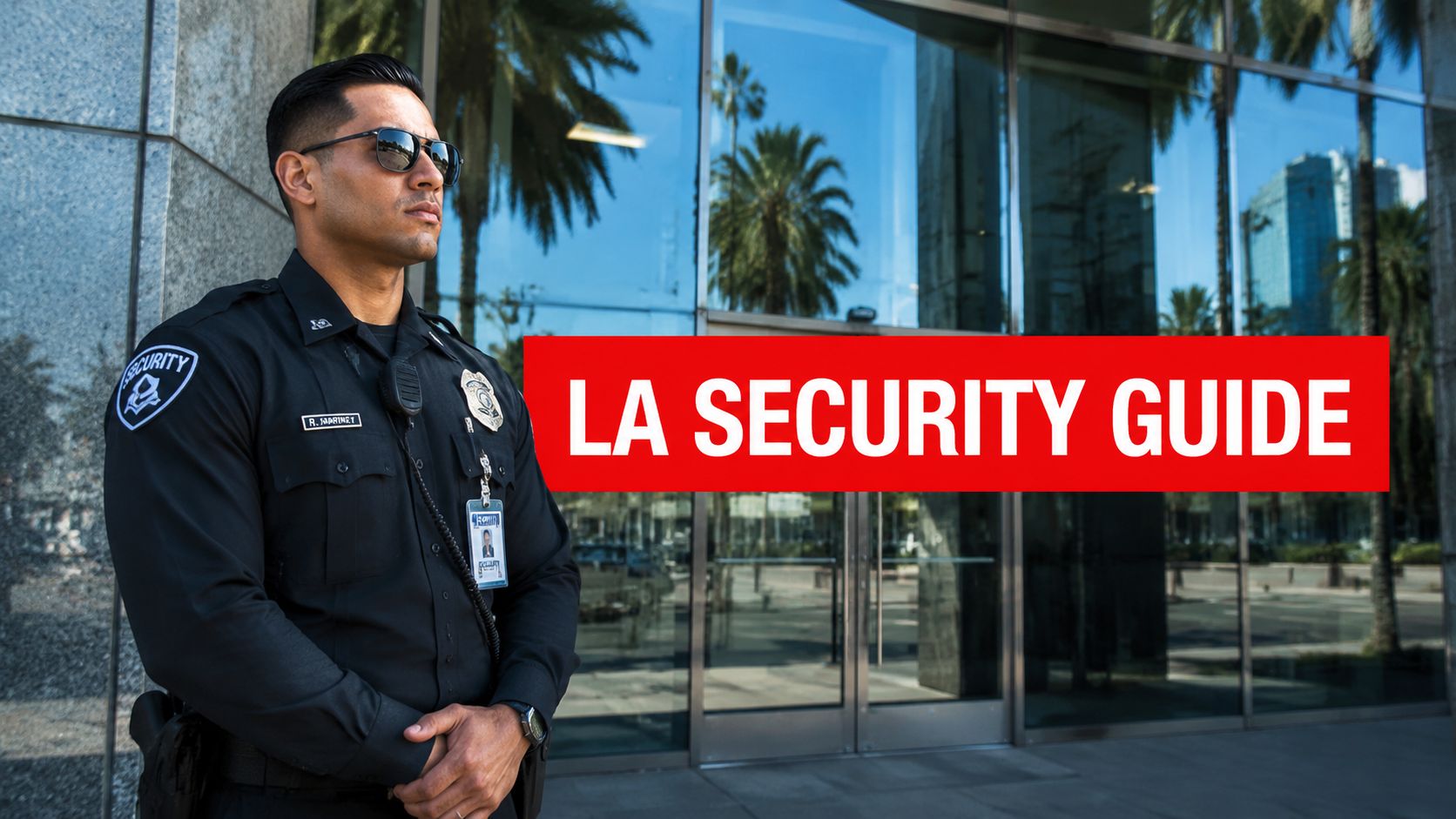
That’s where professional unarmed security guards los angeles services make sense. In most commercial, residential, retail, and mixed-use settings, the need isn’t force. It’s steady control of the environment. You need a trained officer who can manage access, document issues, deter low-level misconduct, and communicate clearly with management before a minor problem turns into a bigger one.
Securing Your Los Angeles Property Beyond the Basics
A common LA scenario looks like this. An apartment manager has cameras, gates, and decent lighting, but residents still report people hanging around the lobby entrance. A retail center has no major crime problem, yet storefront staff keep asking for help with trespassing, parking disputes, and suspicious behavior near closing time. A construction superintendent keeps finding unsecured gates and missing tools, but no one can say exactly when the issue started.
In each case, the site isn’t asking for a dramatic response. It’s asking for accountable daily control.
Los Angeles relies heavily on private security for exactly that reason. The Los Angeles-Long Beach-Anaheim metro area employs approximately 77,910 security guards, representing about two-fifths of California's entire security workforce, according to the UC Berkeley Labor Center report on California security guard workforce data. That concentration tells you something practical. Security is not a niche function in this market. It’s part of normal property operations across office buildings, HOAs, shopping centers, healthcare sites, and industrial facilities.
Why basics alone stop short
Cameras help after the fact. Gates help when people use them. Signage helps when someone is willing to comply.
A professional unarmed officer closes the gap between policy and real-world behavior. The officer becomes the person who notices the side door left ajar, addresses loitering before tenants escalate complaints, logs recurring issues, and creates visible order at the points where properties tend to drift out of control.
For homeowners comparing tools for a smaller residential setting, resources on trail cameras for home security can be useful. On managed properties, though, cameras alone usually don’t solve operational problems. Someone still has to intervene, document, and communicate.
A good security program doesn’t just react to incidents. It reduces the number of issues that ever reach management’s desk.
Defining the Modern Unarmed Security Officer
The outdated version of an unarmed guard is a person in a chair who watches the clock and calls only when something has already gone wrong. That model still exists, and it usually fails for the same reason. Presence without training, reporting, or supervision doesn’t create much value.
A modern unarmed officer should be treated as an operational asset. The role is built around prevention, observation, communication, and controlled response.
What the job actually includes
On a well-run site, unarmed guards typically handle a mix of duties such as:
- Visible deterrence: Standing post in high-traffic areas, conducting foot patrols, and creating enough presence that opportunistic misconduct becomes less attractive.
- Access control: Managing visitor entry, checking credentials, monitoring deliveries, and making sure after-hours access follows site rules.
- Observation and reporting: Recording maintenance issues, suspicious behavior, policy violations, and incident details so management gets usable information.
- Customer-facing support: Assisting residents, tenants, employees, guests, and contractors without losing control of the security function.
- De-escalation: Addressing conflicts early, using clear verbal direction, and avoiding unnecessary escalation.
That mix matters because most properties don’t need a confrontational posture. They need someone who can maintain order consistently and professionally.
The difference between coverage and performance
Two guards can stand at the same front desk and deliver very different results. One just occupies the post. The other notices patterns, documents recurring problems, and follows post orders with discipline.
The second officer gives property management something useful:
- Better visibility into recurring issues
- Cleaner incident documentation
- More consistent rule enforcement
- Faster communication when conditions change
Practical rule: If a security vendor can’t show you how officers document activity, verify patrols, and escalate problems, you’re not buying a security program. You’re buying staffing.
Why unarmed works on most properties
Most Los Angeles properties need someone who can be firm without being inflammatory. That includes apartment communities, office lobbies, mixed-use developments, parking structures, loading docks, and retail centers.
In those environments, the strongest value of an unarmed officer usually comes from:
| Function | Why it matters to management |
|---|---|
| Presence | Reduces casual misconduct and reinforces site rules |
| Reporting | Creates records for lease enforcement, risk review, and follow-up |
| Access control | Limits unauthorized entry and after-hours drift |
| De-escalation | Protects staff, tenants, and guests from unnecessary conflict |
| Consistency | Turns security from an ad hoc response into a daily operating system |
An effective officer isn’t there to create drama. The officer is there to keep normal problems from becoming expensive ones.
Navigating California's Security Guard Licensing and Training
A vendor promises coverage for your building by tomorrow morning. Before you approve the post, one question matters more than the rate. Are the officers licensed, trained, and documented for California compliance?
This is not clerical detail. It is a liability control issue. If an officer mishandles a tenant confrontation, exceeds detention authority, or shows up without the right credentials, the problem lands on the property, not just the security company.
California regulates security officers through the Bureau of Security and Investigative Services, or BSIS. Property managers do not need to memorize every rule, but they should know the baseline well enough to verify that a contractor is running a real program and not just filling shifts.
The basic training path
For unarmed officers, California requires an 8-hour Power to Arrest and Appropriate Use of Force training course before assignment, plus additional training to complete the full BSIS requirement. The state standard sets the floor, not the standard of performance.
That first course matters because it covers the points that create claims. Legal authority. Observation and reporting. The limits of detention. Use of force boundaries. An officer who understands those limits is less likely to turn a minor site issue into an injury claim, tenant complaint, or lawsuit.
A good vendor builds on the state minimum with post-specific instruction. That usually includes access procedures, emergency contacts, incident reporting standards, camera coverage, trespass protocols, and escalation rules for your property. The difference shows up fast. Officers make cleaner decisions when expectations are clear before the first shift.
What to verify before a guard ever starts
Ask direct questions and ask for proof.
Use this checklist during vendor review:
Guard Card status
Confirm that each assigned officer holds a current BSIS Guard Card.Required training records
Ask how the company tracks pre-assignment training, follow-up hours, and annual requirements.Background screening
Verify Live Scan completion and confirm the provider maintains current personnel files.Site-specific training
Ask who writes post orders, how officers are trained on them, and how updates are documented when site conditions change.Supervision and audit trail
Ask how the company verifies patrols, reviews reports, and documents exceptions. Compliance without oversight breaks down quickly.
For a clearer summary of the state rules, review these California security guard licensing requirements.
Why compliance pays off operationally
Licensed officers reduce risk. Trained officers reduce friction. Well-supervised officers give management a record of what happened, who responded, and whether policy was followed.
That has business value in Los Angeles. It supports lease enforcement, helps defend against claims, improves consistency across shifts, and gives property managers something measurable instead of guesswork. If a vendor cannot produce training records, credential verification, and site onboarding steps, the low hourly rate is usually hiding future cost.
Ask for documentation, not assurances.
The right security partner does more than place a uniform on post. The company gives you a documented, accountable operation that protects the property without creating a second problem.
Typical Guard Duties and Common Deployment Models

A property manager usually feels the difference between average coverage and a disciplined security operation within the first week. The desk is staffed on time. Visitor logs are usable. Patrol activity is documented. Tenants know who to call. Small issues get addressed before they become leasing, safety, or liability problems.
That is the job.
Professional unarmed security guard services for Los Angeles properties are built around control, documentation, and consistent response. The officer is there to deter misconduct, enforce site rules, protect access points, and give management a clear record of what happened on the property and how it was handled.
Three common Los Angeles deployments
High-rise lobby and concierge post
In a Downtown or Century City tower, the officer often serves as the first point of control for the building. Duties usually include visitor check-in, vendor sign-in, key and package control, CCTV monitoring, after-hours access approval, and incident reporting. The trade-off is clear. These sites need an officer who can hold policy without creating friction for tenants, guests, and building staff.
Construction site access control
At a jobsite in the Valley, South Bay, or on the Westside, the assignment shifts from hospitality to perimeter discipline. Officers manage gate access, verify deliveries, log contractors, patrol fencing and staging areas, and watch for after-hours trespass, theft, or unsafe conditions. Construction posts also require frequent updates because entrances, materials, and hazards change fast.
Retail or mixed-use patrol
In shopping centers, parking facilities, and mixed-use properties, the officer’s value comes from visibility and early intervention. Typical duties include foot patrols, parking lot checks, escort presence for closing staff, loitering deterrence, nuisance response, and clear incident documentation for management. A good officer keeps order without escalating routine contacts into avoidable disputes.
Duty sets matter more than post titles
“Lobby guard” and “patrol guard” are labels. Post performance depends on the actual assignment design.
On one property, a static post may be the right answer because access control is the main exposure. On another, a mobile patrol model works better because the risk is spread across garages, loading areas, side entrances, and tenant corridors. Some sites need both. A front desk presence handles arrivals and policy enforcement while a rover checks vulnerable areas, confirms doors are secure, and responds to tenant calls.
That deployment choice has cost implications, but it also affects liability. If the officer is tied to one desk, management should not assume the rest of the property is being actively monitored. If the post is patrol-based, the patrol route, frequency, and reporting method should be defined in writing.
The legal boundaries matter
California law sets clear limits on what unarmed officers can do, and those limits matter operationally. Under California B&P Code Section 7582.26, unarmed guards must wear distinct uniforms and a BSIS-issued badge. That visual distinction helps establish authority on private property while making clear that the officer is not law enforcement.
Their authority is narrower than many tenants assume. Officers can observe, report, direct movement on private property, document violations, and act within the scope allowed for private persons and site policy. Detention mistakes, use-of-force mistakes, and overstepping role boundaries create expensive problems quickly. That is why post orders, supervision, and report quality are business issues, not just field issues.
A uniformed officer should reduce uncertainty, not create it.
What good daily execution looks like
Across these deployment models, strong officers tend to do five things consistently:
- Patrol with intent: They cover priority areas on schedule, check vulnerable points, and avoid predictable dead zones.
- Control access cleanly: They verify identity, apply visitor procedures, and document exceptions instead of waving people through.
- Write reports that help management: Times, names, actions taken, witness details, and follow-up needs are recorded clearly enough to support operations or claims handling.
- Stay within scope: They enforce property rules and call law enforcement when the situation requires it.
- Surface patterns early: Repeated loitering, broken lighting, propped doors, vendor issues, and tenant complaints are reported before they turn into loss events.
For property managers, that is the business case. A quality unarmed officer is not a placeholder at the post. The officer is part of the site’s operating system, reducing preventable incidents, supporting documentation, and giving ownership a more defensible position when something goes wrong.
Comparing Unarmed and Armed Security Services

The unarmed versus armed decision should be based on risk, not instinct. Some managers assume armed guards automatically mean stronger protection. In practice, that depends on the environment, the threat profile, and how the property operates day to day.
For most office, residential, retail, and mixed-use sites, unarmed security is the better fit because the work is centered on deterrence, access control, reporting, and de-escalation. Armed coverage usually belongs in a narrower category of high-risk environments.
Unarmed vs armed security guards a comparison for property managers
| Factor | Unarmed Security | Armed Security |
|---|---|---|
| Primary role | Visible deterrence, access control, patrols, reporting, de-escalation | Protection in elevated-risk settings with a credible need for armed response |
| Typical property fit | Apartments, HOAs, office buildings, retail centers, mixed-use sites, parking facilities | High-risk sites, high-value assets, elevated threat posts |
| Atmosphere | More approachable for tenants, visitors, and staff | More force-oriented presence |
| Liability profile | Lower force-related risk in routine public interactions | Higher scrutiny around use of force, supervision, and insurance |
| Budget impact | Usually lower bill rate | Usually higher bill rate |
| Best use case | Low-to-moderate risk environments | Specific threat conditions that justify it |
What actually drives the decision
This choice usually comes down to four questions:
- What type of incidents happen here most often
- Does the site need de-escalation or armed response
- How much public interaction does the officer have
- What level of liability is ownership willing to carry
If your recurring problems are trespassing, loitering, garage access, rule enforcement, nuisance behavior, vendor control, or after-hours entry, unarmed coverage is usually the right answer.
If the site faces a documented heightened threat, handles unusually sensitive assets, or operates in conditions where armed response is justified, then armed staffing may be appropriate.
Why most properties should start with unarmed
Many managers don’t need a more intense security posture. They need better execution. A professional unarmed team with strong post orders, active supervision, and reporting discipline often solves the actual problem more effectively than a heavier posture that doesn’t match the site.
For managers comparing service options, this overview of unarmed security guard services gives a practical starting point.
Choosing armed security when the site doesn’t warrant it can increase tension without improving day-to-day control.
The right security model should fit the property’s risk profile and operating style. It shouldn’t overcorrect.
Understanding the Cost of Unarmed Security in Los Angeles
Security pricing gets misunderstood because managers often compare quotes as if they’re buying labor by the hour. They’re not. They’re buying a package that includes staffing, compliance, supervision, insurance, and operational oversight.
That’s why the cheapest proposal can become the most expensive one if service fails, incidents go undocumented, or the assigned guard isn’t properly supported.
What the market rate usually reflects
While average unarmed guard salaries in Los Angeles are around $21/hour, the bill rate for property managers is typically $25-$40/hour. That spread is explained in Salary.com’s Los Angeles unarmed security guard salary benchmark, which also notes that the difference covers core overhead such as BSIS training, liability insurance, supervision, and technology.
That distinction matters. The hourly bill rate is not just payroll with markup. It supports the structure behind the officer.
What you’re actually paying for
A professional bill rate usually includes several layers:
- Compliance costs: Licensing, onboarding, required training, and recordkeeping
- Insurance: Coverage that protects both the provider and the client relationship
- Field supervision: Site visits, corrective coaching, post inspections, and escalation support
- Technology: Patrol verification, digital reporting, communication systems, and client visibility
- Retention support: Better employment conditions that help keep officers on the account longer
A low quote often means one of those categories is thinner than it should be.
Why low bids create avoidable problems
If a provider underprices the service, the strain usually shows up somewhere visible:
| Low-bid shortcut | What the client often experiences |
|---|---|
| Weak supervision | Inconsistent performance and unresolved issues |
| Thin staffing bench | Call-offs, late relief, and post vacancies |
| Minimal training support | Officers who don’t understand the site or legal boundaries |
| Poor reporting tools | Limited visibility into what happened on the property |
| High turnover | Constant retraining and lack of continuity |
That doesn’t mean every higher quote is better. It means the quote should match the level of accountability you expect.
A good proposal should explain how the vendor handles reporting, field oversight, scheduling backup, and property-specific training. If those answers are vague, the price probably isn’t the whole story.
The Overton Difference From Presence to Performance

A tenant calls about a person sleeping in the stairwell. Your onsite team says security handled it. The next morning, ownership wants to know when the officer found it, whether the area was checked earlier, and if the incident was documented properly.
That is where weak security programs break down. The officer may have been present, but the client still has no clean record of what happened.
What accountable service looks like
A professional unarmed security program should function like an accountable operating service, not a placeholder at a desk. The job is not only to deter problems. It is to document activity, surface issues early, and give property management a record they can use when a tenant complains, an incident escalates, or a liability question comes up.
In practice, that usually includes:
- GPS-verified patrol activity
- Time-stamped Daily Activity Reports
- Photo-supported incident reports
- 24/7 operations oversight
- Scheduled manager follow-up and site reviews
Those tools change the conversation. A property manager does not have to guess whether the rear gate, loading dock, or garage stairwell was checked. The work can be reviewed, verified, and corrected if standards slip.
Why retention and supervision show up in client results
The officer on post matters. The support behind that officer matters just as much.
Stable assignments usually produce better results because the same officer learns normal traffic patterns, recurring tenant issues, contractor behavior, and the small warning signs that often show up before a bigger problem. High turnover strips that value out of the account. New officers need time to learn the property, and during that gap, details get missed.
Supervision has the same effect. If field managers are stretched too thin, small service problems sit too long. If they have workable account loads, they can inspect posts, coach officers, review reports, and step in before a client has to chase answers.
Security accountability should be visible. If patrols and incidents cannot be verified, the property is being managed with limited information.
One example of this model
Overton Security uses GPS patrol verification, digital DARs, 24/7 SOC oversight, and a low manager-to-client ratio. For a property manager, the business value is practical. Better visibility reduces disputes about whether work was completed, faster escalation helps contain issues earlier, and cleaner reporting supports tenant communication, internal review, and claim defense.
Technology does not replace the officer. It makes the officer's work measurable and gives the client a stronger record of site activity.
What matters most to a manager
Property managers usually want clear answers to four operating questions:
- Was the post covered correctly
- Were patrols completed and documented
- Did management hear about issues in time to act
- Can the vendor correct service problems without repeated follow-up
If a security company can answer those questions with records, supervision, and consistent execution, unarmed security stops being a line item you hope is working. It becomes a managed asset that protects the property, supports operations, and lowers avoidable risk.
Your Hiring Checklist for a Los Angeles Security Partner

A hiring process goes off track when the only serious question is hourly rate. Price matters, but it doesn’t tell you much about reliability, supervision, or legal compliance.
A better approach is to interview the vendor the same way you’d evaluate any other risk-sensitive contractor.
Questions every property manager should ask
Use these questions in proposals, calls, and final interviews:
Licensing verification
Can you confirm that every officer assigned to this property will hold a valid BSIS Guard Card and current required training?Reporting sample
Can you show a real Daily Activity Report and incident report format, including how photos and timestamps are handled?Patrol accountability
How do you verify patrol completion and document checkpoint activity?Supervision model
How often do field supervisors visit the site, and what happens if service quality drops?Backup staffing
What is your plan for call-offs, late relief, and emergency coverage?Post-specific training
How do officers learn this property’s access rules, emergency contacts, tenant expectations, and problem areas?Account management
How many clients does the account manager handle, and how often will they review the site with us?Insurance and scope
What coverages do you carry, and how do you define the officer’s responsibilities versus management’s responsibilities?
What strong answers sound like
Good vendors answer directly. They provide documents. They explain their escalation process clearly. They can tell you who supervises the account, how reports are delivered, and what happens when an officer doesn’t meet expectations.
Weak vendors stay vague. They rely on general assurances. They focus on speed to start, but not on how service will be managed after day one.
For managers who want a clearer sense of what officers are typically expected to handle onsite, this overview of a security guard job description is a helpful reference point.
A final screening test
Before you sign, ask the provider to walk you through a likely scenario on your property. Use a real example, such as a trespasser in a parking garage, a resident lockout, an after-hours vendor arrival, or repeated loitering near a storefront.
Listen for whether the answer includes:
- Observation
- Communication
- Documentation
- Escalation
- Legal limits
If the response sounds improvised, the field performance probably will be too.
Frequently Asked Questions About Unarmed Security
Are unarmed guards effective for apartment buildings and office properties
Yes, if the post is set up around the property’s actual exposure.
For most apartment communities and office buildings in Los Angeles, the job is controlling access, keeping common areas orderly, documenting incidents, and giving tenants or staff a reliable point of contact. That work does not require force. It requires consistency, judgment, and clear site procedures. A professional unarmed officer can reduce day-to-day friction, deter nuisance behavior, and give management a better record of what is happening onsite.
That last point matters. Good security is not just visible presence. It is documented performance that helps reduce disputes, support enforcement of property rules, and show that management took reasonable steps to address recurring problems.
Can unarmed guards handle difficult people without escalating the situation
Yes. In many cases, that is where trained unarmed officers provide the most value.
The better officers use positioning, verbal direction, calm repetition of site policy, and timely calls to supervisors, management, or law enforcement when a situation goes outside their authority. They do not try to dominate every interaction. They stabilize it, protect bystanders, and create a clean record of what was said, what was observed, and what happened next.
That approach lowers risk for the property. It also helps avoid the kind of unnecessary confrontation that can turn a manageable issue into a complaint, claim, or video problem.
What’s the best setup for a construction site
Construction sites usually need tighter control than standard commercial properties because materials, tools, and access points change constantly. The right setup often includes perimeter checks, gate logs, patrol verification, lighting checks, and real-time reporting to the site contact.
Some sites need a dedicated officer at the gate during active hours. Others are better served by after-hours patrols with documented checkpoints and photo-backed incident reports. The right answer depends on how exposed the tools and materials are, how many entry points exist, whether subcontractors come and go irregularly, and how long the site sits unattended.
For a property manager or general contractor, the business case is straightforward. A guard program should not just place someone onsite. It should create accountability, show proof of patrol activity, and give management usable records when theft, trespassing, or vandalism becomes an insurance or contract issue.
Should I choose standing guards or vehicle patrol
Choose based on where the risk concentrates.
A standing post makes sense when problems repeatedly happen at one fixed point, such as a lobby, gate, loading dock, retail entrance, or parking garage access lane. Continuous presence helps with access decisions, visitor management, and immediate response.
Vehicle patrol is often the better fit when coverage is spread across a large site, multiple buildings, or several properties. It can also work well for after-hours checks, provided the vendor verifies stops, timestamps activity, and sends reports that are detailed enough for management to act on. Without that reporting discipline, patrol can look inexpensive on paper and weak in practice.
How quickly should I expect value from a new security program
Basic gains should show up early.
Management should see cleaner reporting, better control over entrances and common areas, and fewer unanswered questions about what happened during a shift. The larger return usually comes later, once officers and supervisors know the property well enough to identify patterns, flag repeat offenders, and recommend changes to post orders or site operations.
That is where a quality vendor starts to function as an operational asset. The value is not only in presence. The value is in better information, faster follow-up, and fewer preventable problems slipping through the cracks.
What’s the biggest mistake property managers make when hiring security
Treating the service like a commodity purchase.
Low hourly rates often hide the actual costs: weak supervision, thin training, poor shift coverage, inconsistent reports, and limited accountability when something goes wrong. On paper, two vendors can look similar. In operation, one may give you verified patrol activity, responsive supervision, and usable documentation, while the other gives you little more than a body on site.
A better buying approach is to focus on accountability. Ask how the company verifies patrols, how quickly incident reports are delivered, who reviews officer performance, and how service corrections are handled. That is what changes the conversation from simple coverage to usable security.
If you're evaluating unarmed security guards los angeles for a commercial property, residential community, retail center, or construction site, Overton Security is one provider to review for service options, operating practices, and site-specific support. The right partner should help reduce daily friction, improve accountability, and give you clear visibility into what is happening on your property.