
As a property manager, HOA board member, or facilities director, you've likely seen the difference between a security program that works and one that creates constant headaches. More often than not, the root cause of high officer turnover, inconsistent patrols, and resident complaints can be traced back to one crucial factor: compensation.
So, why is security guard pay so important? Because it's not just a line item on a budget—it's the foundation of your property's safety and your tenants' peace of mind. Choosing a security partner who invests in their people is the most direct way to ensure you receive reliable, professional, and effective service.
How Compensation Shapes Your Security Outcome
When you hire a security provider, you're not just buying hours of coverage; you're investing in the professionals tasked with protecting your community and assets. The level of that investment directly dictates the caliber, motivation, and stability of the officers who show up to your site.
Think of it like the foundation of a building. A weak foundation poured with cheap materials will inevitably cause cracks to appear throughout the structure. It’s the same with security. Low wages create a weak foundation, leading to "cracks" like missed patrols, sloppy incident reports, and a general lack of engagement from the officers on site.
This flowchart breaks down the direct line from competitive pay to reliable officers and, ultimately, to a safer property.
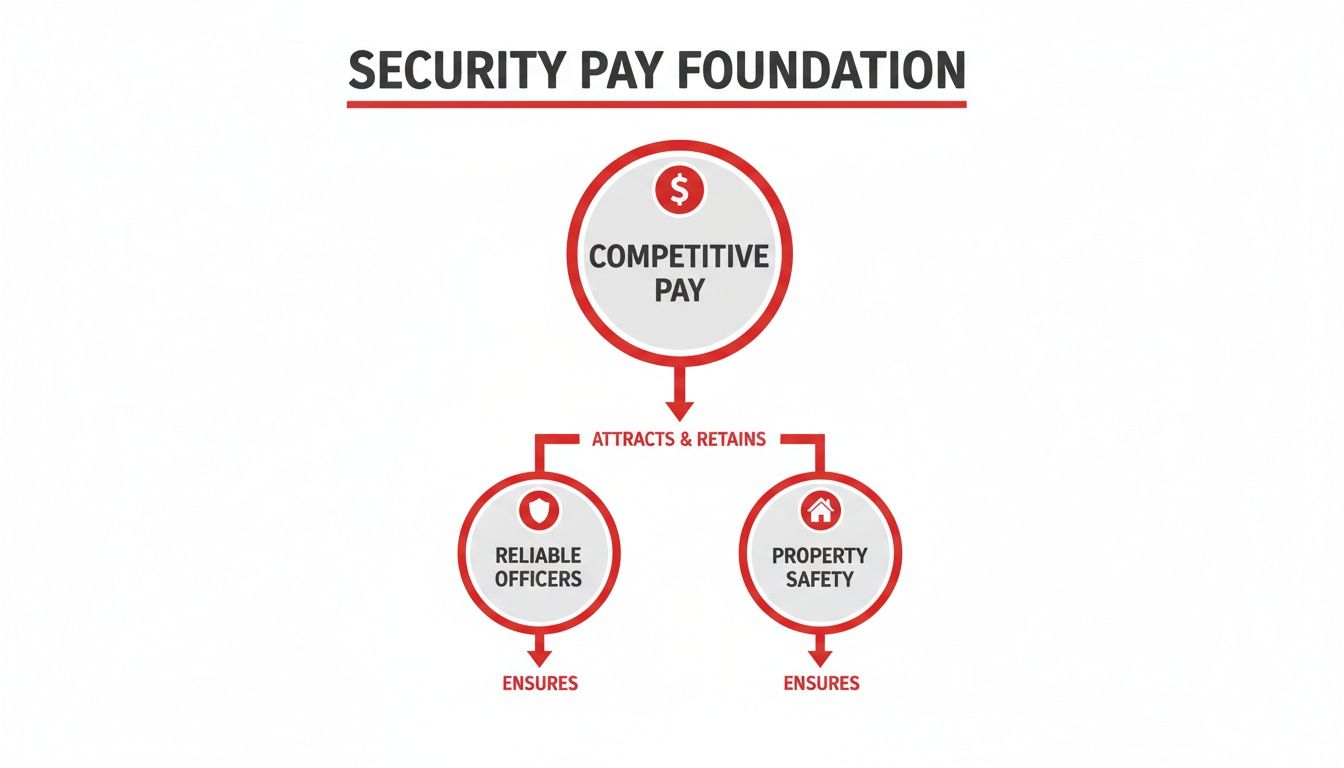
These elements are all connected. They create a positive cycle that strengthens your entire risk management strategy, rather than undermining it from the start.
The table below breaks down the real-world difference between a low-cost approach and a quality-focused one. It’s not just about dollars and cents; it’s about tangible outcomes for your property.
The Real-World Impact of Security Guard Compensation
| Key Factor | The Impact of Low Pay (Industry Standard) | The Impact of Competitive Pay (The Quality Approach) |
|---|---|---|
| Officer Turnover | Extremely high. A constant revolving door of new, inexperienced faces. | Significantly lower. Officers build site familiarity and stay long-term. |
| Recruitment Pool | Attracts candidates looking for any job, regardless of fit or dedication. | Attracts career-minded professionals, including former law enforcement. |
| Performance | Inconsistent, disengaged, and often reactive. "Just doing the minimum." | Proactive, engaged, and motivated. Officers take ownership of the site. |
| Client Headaches | Frequent complaints, missed patrols, and constant need to retrain. | Fewer complaints, reliable patrols, and a stable, knowledgeable team. |
| Overall Risk | Higher. Gaps in coverage and inexperienced staff create vulnerabilities. | Lower. A stable, professional team reduces incidents and liabilities. |
The contrast is stark. One path leads to constant problems and vulnerabilities, while the other builds a resilient and reliable security program.
The Industry-Wide Challenge of Low Pay
The U.S. security industry is a massive economic engine, generating roughly $46 billion in revenue in 2022 and employing over 1.1 million professionals as of 2023. Yet, it’s plagued by a persistent problem: an astonishingly high turnover rate that can soar up to 40% annually.
This isn't a coincidence; high turnover is directly tied to compensation. When pay is too low, experienced and capable officers will inevitably leave for better opportunities, forcing security companies into a constant cycle of recruiting and training. You can read more about security industry trends and how they impact service quality.
This "burn and churn" model, especially common among low-bid providers, means your property is often staffed by a revolving door of trainees.
A fairly compensated officer sees their role as a career dedicated to protecting your site. An underpaid one often sees it as just a temporary job, and their performance reflects that difference.
Choosing a security partner that prioritizes competitive pay is the first step toward building a program that is stable, proactive, and truly effective. At Overton Security, our 26 years of experience have taught us one simple truth: investing in our officers is the most direct and effective way to invest in our clients' safety.
Uncovering the Hidden Costs of High Officer Turnover
For property managers, high turnover is more than a staffing headache—it's a significant financial drain that quietly compromises safety and your bottom line. This "revolving door" of security officers, driven by low pay, creates a cascade of expenses and risks that go far beyond what you see on an invoice.
This constant churn is a direct consequence of compensation. The security industry struggles with a staggering 40% annual turnover rate, which is roughly double the national average for all jobs. Why? Because the pay frequently can't compete with similar roles, not just in law enforcement but even in fields like manufacturing. As a company with 26 years of experience serving clients across California, Overton Security views competitive pay as a non-negotiable tool for building the stability our clients demand. You can explore the numbers yourself with the occupational employment statistics on the BLS website.
The Loss of Institutional Knowledge
Picture a residential community in Los Angeles. A dedicated, long-term officer doesn’t just wear a uniform; they know residents by name, recognize their cars, and understand the property’s unique weak spots. They know which side gate is always being propped open or which corner of the parking garage has a burnt-out light.
When that officer leaves for a better-paying job, all that invaluable, site-specific knowledge walks right out the door with them. The new officer, no matter how competent, is starting from scratch. This creates dangerous gaps in your security during the transition—gaps that could lead to theft, vandalism, or worse.
This hidden "brain drain" is a major contributor to rising operational costs. If you're looking for broader methods for reducing operational costs, addressing staff instability is a powerful place to start.
The True Financial Impact of Instability
Beyond losing valuable knowledge, constant turnover introduces very real costs and risks that property managers are ultimately forced to absorb.
- Inconsistent Enforcement: New officers haven't yet mastered your community's specific rules. This leads to spotty enforcement of parking, amenity use, or access control policies, which erodes resident trust.
- Increased Liability: An inexperienced officer is more likely to mishandle an incident, document it incorrectly, or completely miss critical warning signs. Every mistake increases your property’s exposure to potential lawsuits and insurance claims.
- Reputational Damage: A constant stream of new faces in security uniforms makes a property feel unstable and unsafe. For high-end residential buildings or Class A commercial properties, this perception can directly impact tenant retention and property values.
Constant turnover isn't just inefficient; it's a silent risk multiplier. Every time a new officer starts, your property re-enters a period of heightened vulnerability until that person is fully integrated.
In the end, the cheap upfront bid from a security provider that underpays its people is almost always a mirage. The real price is paid down the line through more incidents, unhappy tenants, and the endless headache of managing an unreliable security program. This is precisely why security guard pay is so important—it acts as a direct shield, insulating your property from these costly and preventable risks.
Attracting a Higher Caliber of Security Professional
What kind of person do you want protecting your property, your tenants, and your reputation? The answer is directly tied to the compensation being offered. When a security firm offers competitive pay and benefits, it attracts a fundamentally different type of professional—one who sees their role as a career, not just a temporary job.

This is a critical distinction for any property manager, especially those overseeing Class A office buildings, construction sites, or luxury residential communities. These environments demand more than just a warm body in a uniform. You need an individual with a specific, refined skillset.
Defining the Professional Security Officer
A top-tier security officer is a career-minded individual. They often come from backgrounds that have sharpened their discipline, communication, and decision-making abilities. You won't find them at the lowest market rate because they bring a proven track record of responsibility and professionalism.
This talent pool frequently includes:
- Veterans and Former Law Enforcement: These individuals bring invaluable, real-world experience in de-escalation, structured reporting, and maintaining a command presence under pressure.
- High-Level Customer Service Professionals: Officers from hospitality or corporate backgrounds have exceptional communication skills, which are essential for concierge-style roles and managing tenant relations.
- Career Security Specialists: These are dedicated professionals who have invested years in the industry, earning specialized certifications and a deep understanding of risk management.
Make no mistake, these candidates are in high demand across multiple sectors. The security industry faces the same recruitment challenges as other fields—the best people are drawn to the best opportunities.
Investing in higher pay isn't about overspending. It's about gaining access to a pool of candidates who possess the judgment, reliability, and communication skills needed to protect a high-value asset.
The Connection Between Pay and a Proactive Mindset
A well-compensated officer is naturally more invested in their role and the property they protect. This personal investment translates directly into a proactive mindset. Instead of just passively observing, they actively look for potential issues, engage professionally with residents, and provide detailed, useful reports.
This is where the real value comes in. A higher-caliber officer brings critical thinking to the table, solving small problems before they can escalate into major incidents. They become a trusted part of your operations, not another problem you have to manage.
At Overton Security, we believe this starts with giving our team the best support possible, including robust training. You can learn more about our commitment by exploring our security officer training programs. This dedication ensures the professionals protecting your site are prepared for any scenario.
Connecting Fair Pay with Proactive On-Site Performance
An officer's motivation on the job is directly tied to how they are valued, and that sense of value starts with their paycheck. There’s a night-and-day difference in on-site performance between a fairly compensated officer and one who feels like just another line item on a budget.
It’s the difference between someone “watching the clock” and a true professional who is actively “watching your back.”
For property managers and facilities directors, that distinction is everything. An underpaid, disengaged officer is more likely to stay glued to their post, doing the bare minimum. A well-paid, respected officer takes real ownership of your site’s safety, which you’ll see in their proactive patrols and genuine commitment to stopping incidents before they happen.
From Passive Observation to Proactive Engagement
When an officer sees their job as a career, their entire mindset shifts. This change is immediately obvious in the quality of their work and their willingness to go beyond basic post orders.
- Detailed Incident Reports: A motivated officer provides clear, detailed reports—complete with photos and context—that give you actionable information. A checked-out officer might scribble vague, one-line notes that are useless for spotting trends or fixing problems.
- Proactive Patrols: A career-minded professional doesn’t just walk the route; they analyze it. They’re actively looking for vulnerabilities, like a broken fence link or a malfunctioning access gate, and reporting them immediately.
- Professional Engagement: A valued team member interacts respectfully with tenants and visitors, becoming a positive ambassador for your property. Their presence makes the environment feel safer and more welcoming.
An officer who is properly compensated and supported sees your property’s safety as their personal responsibility. This sense of ownership is the most powerful deterrent you can have, and it cannot be achieved with minimum-wage compensation.
Technology Is Only as Good as the Person Using It
Modern security runs on tools like GPS-enabled guard tour systems and real-time reporting apps. These systems are fantastic for providing the accountability that facilities directors and property managers demand. But at the end of the day, technology is just a tool.
Its effectiveness depends entirely on the motivation and diligence of the professional using it.
A disengaged officer might just scan checkpoints without paying any real attention, simply going through the motions to satisfy the system. In stark contrast, a motivated officer uses that same technology to meticulously document their findings, creating a transparent and reliable record of their proactive efforts.
At Overton Security, we blend our hands-on leadership and robust accountability systems with officers who are truly invested in their roles. This combination ensures technology delivers on its promise, giving you the peace of mind that comes from verified, high-quality performance.
Reducing Your Liability with a Well-Compensated Team
For any property manager or corporate decision-maker, choosing a security partner is a fundamental part of your risk management strategy. Investing in a quality security service isn't just another operational expense; it’s one of the most powerful tools you have for limiting your liability.
The logic is straightforward. An experienced, stable, and professionally paid officer is far less likely to make a costly mistake that ends in a lawsuit. These are the professionals who follow post orders to the letter, know how to de-escalate tense situations, and document every incident with precision.
That kind of proactive, professional conduct directly shrinks your exposure to negligence claims.
The High Cost of a Single Mistake
The financial fallout from just one security failure can be catastrophic. The tragic condominium collapse in Surfside, Florida, serves as a sobering example. The security provider reportedly paid a $517 million settlement because an on-duty officer failed to activate the building's alert system.
This single incident reveals a critical truth: the cost of one mistake can completely dwarf any perceived savings from a low-bid security contract.
A well-compensated team is your first and best line of defense against these kinds of devastating events. These officers have more to lose, receive better training, and possess the critical thinking skills to act decisively and correctly when the pressure is on. They are much less likely to create situations that lead to lawsuits over things like:
- Failure to Act: Missing a critical event unfold or not following emergency procedures correctly.
- Improper Conduct: Using excessive force or behaving unprofessionally with tenants, visitors, or customers.
- Negligent Documentation: Writing incomplete or inaccurate reports that leave you exposed in a legal dispute.
You can dive deeper into the complexities of this topic in our detailed guide on security guard liability. Understanding these risks is the first step toward building a more resilient safety program for your property.
Proactive Safety as a Liability Shield
Think about how a thorough workplace safety inspection checklist is vital for preventing physical accidents. A well-paid and motivated security team functions in the same way—as a proactive human shield. They don't just react to problems; they actively work to prevent them, which truly reduces your liability as an organization.
Investing in a professional, well-compensated security team protects more than just your physical assets. It safeguards your brand's reputation, your tenants' trust, and your financial stability from significant legal and financial exposure.
In our 26-year history at Overton Security, we've seen it time and again: the slightly higher upfront cost for a quality-focused service provides an immense return on investment by minimizing the risk of incidents and lawsuits.
Questions to Ask Any Security Provider About Their Pay Practices
When you're vetting potential security partners, the bill rate they quote is only one piece of the puzzle. To understand whether a company is built on quality, you have to dig deeper into how they invest in their people.
Asking the right questions is about doing your due diligence to protect your property. A quality partner will welcome these questions as a chance to demonstrate their commitment to their team.
Your Vetting Checklist
Use this list to guide the conversation with a potential security vendor and get the clarity you need.
-
What is your starting wage for an officer assigned to this specific property? This question cuts through vague promises and gets you a hard number. It tells you exactly how they value an officer at your site.
-
What benefits do you provide your officers? Look for essentials like health insurance, paid time off (PTO), and retirement savings plans. Benefits are a huge factor in retaining good officers.
-
What is your average officer turnover rate over the last 12 months? A high number, often 20% or more, is a major red flag. It points to underlying problems with pay or management that will eventually impact your service.
-
How do you determine pay rates for different sites or roles? This shows if they have a thoughtful compensation strategy or if they’re just paying the absolute minimum they can get away with.
Asking these questions helps you see the whole picture, not just the price tag. You can learn more about all the components that go into a final invoice in our guide explaining how security guard services get to a bill rate for their services.
A provider’s investment in their people is a direct investment in your safety.
Your Questions About Security Guard Compensation, Answered
Even when the benefits of fair pay are clear, property managers and HOA board members understandably have practical questions. Here are answers to some of the most common ones we hear.
Does a Higher Bill Rate Always Mean Better Pay for the Guard?
Not necessarily, and this is a critical point. A high bill rate can easily hide bloated corporate overhead or excessive profit margins, with very little of that extra money ever making it into the officer's pocket. The key is transparency.
A quality-focused security partner will be open about how they invest in their people to deliver a better service for you. That’s why you must ask vendors directly: what’s your pay structure? What benefits do you offer? How do you support your officers on the ground?
What Are the Real Risks of Choosing the Cheapest Security Service?
Going with the lowest bidder almost always creates significant hidden costs down the line. Those initial savings evaporate quickly when you start paying for constant officer turnover, dismal on-site performance, and a spike in liability.
You often end up paying far more in the long run to fix security gaps, deal with failed incident responses, and field nonstop resident complaints. A quality service is a more predictable and cost-effective strategy.
Choosing the lowest bid often means you are inheriting all the problems that come with an underpaid, unmotivated workforce. Investing in quality from the start is the smarter risk management decision.
How Is Officer Accountability Maintained Beyond Just Pay?
Competitive pay is the foundation, but true accountability is built on a solid system of support, supervision, and technology. A dependable security program must combine fair compensation with other critical elements.
These include:
- A low manager-to-client ratio that guarantees hands-on supervision.
- 24/7 operations center support for real-time oversight and backup.
- GPS-enabled technology that gives you transparent, time-stamped digital reports.
This blend of valuing people and verifying performance is what ensures you get the consistent, high-quality service you're paying for.
At Overton Security, our 26 years of experience have proven that investing in our officers is the single most effective way to protect our clients. We focus on building stable, professional, and accountable teams you can trust.
Ready to see the difference a quality-focused security partner can make? Contact Overton Security today for a personalized security assessment.